
Environmental Quality Management
Environmental Quality Management
Małgorzata Szlachta, Ph.D. Eng.
Małgorzata Szlachta, Ph.D. Eng.
Environmental Chemistry (Water) -
Environmental Chemistry (Water) -
laboratory
laboratory

What is Environmental
Chemistry?
Environmental chemistry is the study of the
sources, reactions, transport, effects, and fates
of chemical species in water, soil, and air
environments.
Reference: S. M. Manahan, Environmental
Chemistry.

What is water?
“
Water
(wo’tar,wot’ar) n. 1.
A clear colorless, nearly
odorless and tasteless liquid, H
2
O, essential for most
plant and animal life and the most widely used of all
solvents. Melting point 0°C, boiling point 100°C,
specific gravity (4°C) 1.000, weight per gallon (15°C)
8.337 pounds. 2. Any of various forms of water such
as rain. 3. Any body of water such as a sea, lake,
river, or stream.”
Reference: W. Morris, The American Heritage Dictionary of the
English Language.

“
Water
is the dilute aqueous
solution/suspension of inorganic and organic
compounds that constitutes various types of
aquatic systems.”
Reference: V. Snoeyink and D. Jenkins, Water
Chemistry.
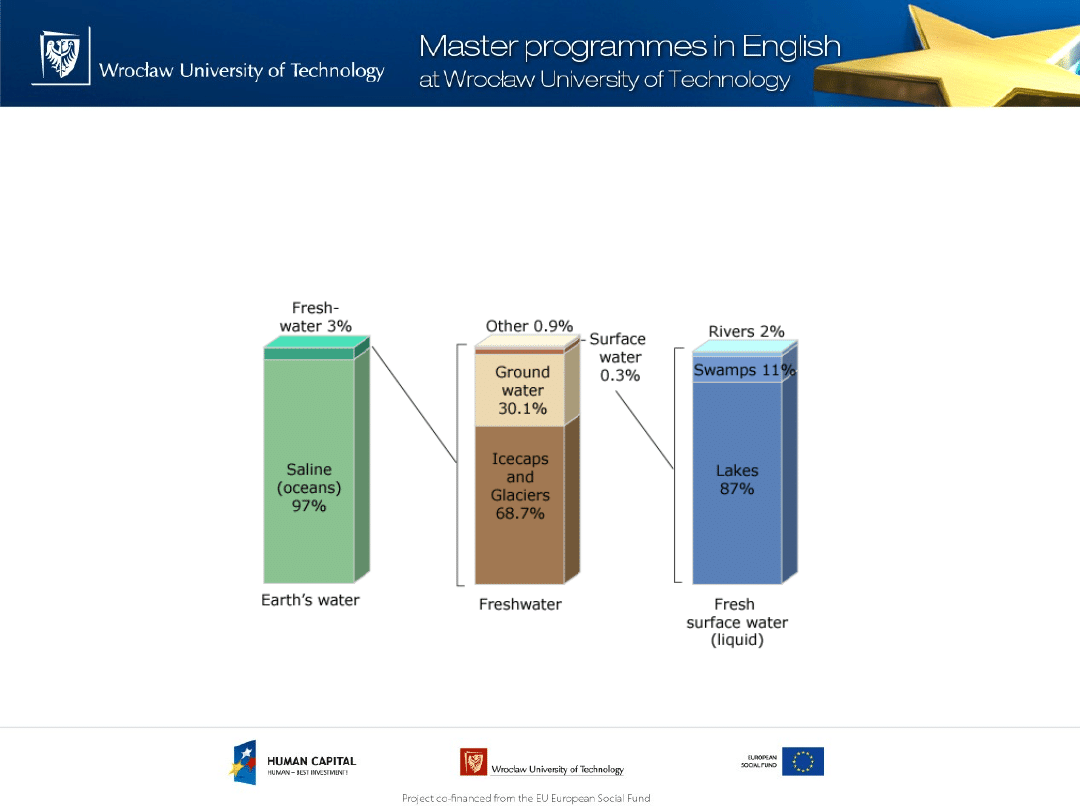
Distribution of Earth’s
Water
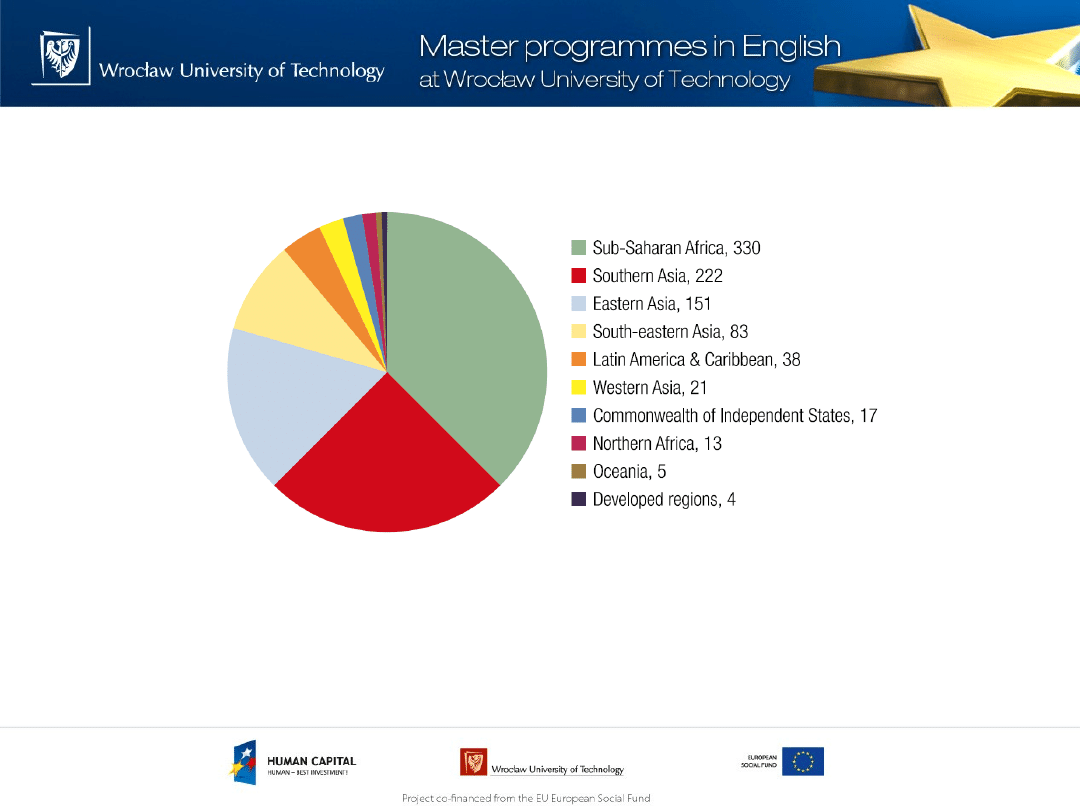
The regional distribution of the
884 million people
not using
improved drinking water sources in 2008, population (million)
Reference: WHO/UNICEF, Monitoring Programme for Water Supply and
Sanitation.
Report: Progress on Sanitation and Drinking Water, 2010 Update.
Safe drinking water

Revision

There are two basic ways to express the mass
concentration of dissolved species (solutes) in
solution:
1.
w/v basis
(weight/volume) - a concentration
in
units of mass of solute in a unit volume of
solution,
2.
w/w basis
(weight/weight) - weight of solute
in a given weight of solution.
Mass concentration

• mg/L = mass of substance (mg)
volume of solution (liter)
• ppm(parts per million) = mass of substance (mg)
mass of solution
(kg)
If the density of the solution is known:
• density of solution, ρ = mass of solution (kg)
volume of solution (liter)
• Concentration in ppm (mg/kg) = concentration in
(mg/L)
x 1/ρ (L/kg)

Equivalents and normal
concentration
The expression of solute concentration as
equivalents/liter, that is,
normal concentration
,
is based on a definition that is related to the type
of reaction in which the solution constituents are
involved.
Equivalent weight (EW)
definition, widely used
in water chemistry based on the charge of ion or
the number of hydrogen/ hydroxyl ions transferred
in an acid-base reaction.

The
equivalent weight
is defined as:
and the number of equivalents per liter -
normality
,
is defined as:
Definitions of equivalents and normality are used for
determining the number of eq/L of charge units and the
number of eq/L of species that participate in precipitation-
dissolution reactions.
molecular weight(MW)
Equivalent weight(EW)
ioncharge
=
massof substanceperliter
Normality
EW
=

Example
Find the normality of the following solutions:
1. 120 mg CO
32-
/L, given that CO
32_
participates in the precipitation
reaction:
Ca
2+
+ CO
32-
→ CaCO
3
2. 155 mg Ca
3
(PO
4
)
2
/L, given that Ca
3
(PO
4
)
2
participates in the
dissolution reaction:
Ca
3
(PO
4
)
2
→ 3Ca
2+
+ 2PO
43-

Solution
1. The molecular weight (MW) of CO
32-
is 60 g/mole.
gramMW 60g/ mole
GramEW
30g/ eq 30mg/ meq
ioncharge 2eq/ mole
120mg/ L
Normality
4meq/ L
30mg/ meq
=
=
=
=
=
=

2. The MW of Ca
3
(PO
4
)
2
is 310 g/mole.
According to reaction Ca
3
(PO
4
)
2
forms six positive and six negative
charges, therefore:
310g/ mole
GramEW
51.6g/ eq 51.6mg/ meq
6eq/ mole
155mg/ L
Normality
3meq/ L
51.6mg/ meq
=
=
=
=
=

The
equivalent weight
of a substance in acid-base
reactions is defined as:
"the weight of a substance that will either replace
one H
+
(hydrogen ion/proton) in an acid, provide one
H
+
for reaction, or react with one H
+
to form an
acid."
where „n” is the number of hydrogen or hydroxyl
ions that react.
molecular weight(MW)
Equivalent weight(EW)
n
=

Example
Find the normality (meq/L) of the following
solutions:
1. 40 mg HCl/L, with respect to the reaction:
HCl + NaOH → NaCl + H
2
O
2.
59 mg H
3
PO
4
/L, with respect to the reaction:
H
3
PO
4
→ 2H
+
+ HPO
42-
3.
45 mg CO
32-
/L, with respect to the reaction:
CO
32-
+ 2H
+
→ H
2
CO
3

Solution
1. One H
+
reacts per HCl, therefore:
gramMW 36.5g/ mole
GramEW
36.5g/ eq 36.5mg/ meq
n
1eq/ mole
40mg/ L
Normality
1.1meq/ L
36.5mg/ meq
=
=
=
=
=
=

2. Two H
+
react per H
3
PO
4
, therefore:
gramMW 98g/ mole
GramEW
49g/ eq 49mg/ meq
n
2eq/ mole
59mg/ L
Normality
1.2meq/ L
49mg/ meq
=
=
=
=
=
=

3.
Two H
+
react with each CO
32-
, therefore:
gramMW 60g/ mole
GramEW
30g/ eq 30mg/ meq
n
2eq/ mole
45mg/ L
Normality
1.5meq/ L
30mg/ meq
=
=
=
=
=
=

Concentration (meq/L) → Concentration
(mg/L)
C (meq/L) x EW (mg/meq) → C (mg/L)
massof substance
Equivalents
EW
=

Example
What is equivalent for 2 g of Ca
2+
?
Solution
2
2
2
MWof Ca
40g/ mole
40g/ mole
EW
20g/ eq
2eg/ mole
2gCa
EW
0.1eqCa
20g/ eq
+
+
+
=
=
=
=
=

Example
What is the EW of sodium sulfate Na
2
SO
4
?
Solution
Na
2
SO
4
→ 2Na
+
+ SO
42-
2
4
MWof Na SO
142.1g/ mole
142.1g/ mole
EW
71.1g/ eq
2eg/ mole
=
=
=

Example
What is concentration of 80 g/m
3
of aluminium ion Al
3+
in
meq/L and in eq/L?
Solution
3
3
3
Al
C
80g/ m 80mg/ L
MWof Al
30g/ mole
30g/ mole
EW
10g/ eq 10mg/ meq
3eg/ mole
C(mg/ L)
80mg/ L
8meq/ L 0.008eq/ L
EW(mg/ meq) 10mg/ meq
+
+
=
=
=
=
=
=
=
=
=

Water quality
parameters

Colour
Colour
in water is caused by:
• dissolved minerals,
• dyes,
• humic acids which cause a brown-yellow to
brown-black colour,
• coloured wastes, including dyes or pulp and
paper plants,
• the presence of iron, manganese and
plankton.

• Water colour caused by dissolved or colloidal
substances that remain in the filtrate after filtration
through
a 0.45 μm filter membrane is defined as
true colour
.
• Apparent colour
is the term applied to coloured
compounds in solution together with coloured
suspended matter.
Colour is measured spectrophotometrically at a
wavelength
between 450 and 460 nm using glass cells with
path
lengths of 10, 30 or 50 mm, with platinum-cobalt
solution
as standards.

Equipment
•Spectrophotometer
•Glass cells with a light path length equals 5 cm
•0.45 μm filter membrane without organic binder
Method
1.Turn on the instrument and let it warm up
according to manufacturer’s instructions.
2.Filter water sample using 0.45 μm filter
membrane to remove particular matter.
Colour
determination

3. Rinse the blank measuring cell with distilled
water, refill it and place cell at first position in
the spectrophotometer.
4. Rinse the second measuring cell with filtered
water sample, refill it and place cell at second
position in the spectrophotometer.
5. Choose the proper calibration curve, press
AUTOZERO and START.
6. Read colour directly from the instrument, the
result in mgPt/L will be displayed.
(2120 C. Spectrophotometric – Single-Wavelength Method,
Standards methods for the examination of water and
wastewater, 21 Edition, 2005)

UV absorbance at 254 nm
Some organic compounds present in natural waters,
such as humic substances and various aromatic
compounds, strongly absorb ultraviolet. Therefore
UV absorption
is a useful surrogate measure of
selected
organic constituents
.
Strong correlations may exist between UV absorption
and both colour and organic carbon content. UV-
absorbing organic matter in a water sample absorb
UV light in proportion to their concentration.

UV254 determination
UV absorption is measured at 253.7 nm but often
rounded off to 254 nm. Samples are filtered through
0.45 µm filter membrane to remove suspended and
colloidal particles.
Equipment
•Spectrophotometer
•Quartz cells with a light path length equals 5 cm
•0.45 μm filter membrane without organic binder

Method
1.Turn on the instrument and let it warm up
according to manufacturer’s instructions.
2.Filter water sample using 0.45 μm filter
membrane to remove the colloidal matter.
3.Rinse the blank measuring cell with distilled
water, refill it and place cell at first position in
the spectrophotometer.

4.
Rinse the second measuring cell with filtered
water sample, refill it and place cell at second
position in the spectrophotometer.
5.
Set wavelength to 254 nm, press AUTOZERO and
START.
6.
Read absorbance directly from the instrument.

Calculations
where:
Abs - absorbance measured
d - quartz cell path length, cm
1
Abs 100
UV245, m
d
-
�
=

Turbidity
Turbidity
in water is a measure of the
cloudiness
and is
caused by:
• suspended and colloidal matter such as clay, silt,
finely divided organic,
• inorganic matter,
• plankton,
• other microscopic organisms.

Turbidity can be correlated with
suspended solids
,
but only for waters from the same source. In such
cases, a simple turbidity measurement may replace
the complex time-consuming suspended solids test.
The instrument used for turbidity measuring is called
nephelometer
or
turbidimeter
. Turbidity also may
be determined by a visual comparison test with
standard turbidity suspensions.
Turbidity is measured in
Nephelometric Turbidity
Units (NTU)
.

Equipment
• Turbidimeter
• Sample cell
Method
1.
Turn on the instrument and let it warm up
according to manufacturer’s instructions.
2.
Gently agitate the water sample.
Turbidity
determination

3. Wait until air bubbles disappear and pour
the sample into the cell.
4. Dry the cell and place it in the turbidimeter,
then close the cover and wait for a while.
5. Read turbidity directly from the instrument,
the result in NTU will be displayed.
(2130 B. Nephelometric method, Standards methods for the
examination of water and wastewater, 21 Edition, 2005)

Solids
The solids content of water is one of the most
significant quality parameter. The amount, size and
type of solids depend on the specific water.
Untreated sewage wastewater may have organic
particulate matter, including food scraps of size
range in millimetres, while a purified drinking water
may have particles in the size range
10
-6
mm.
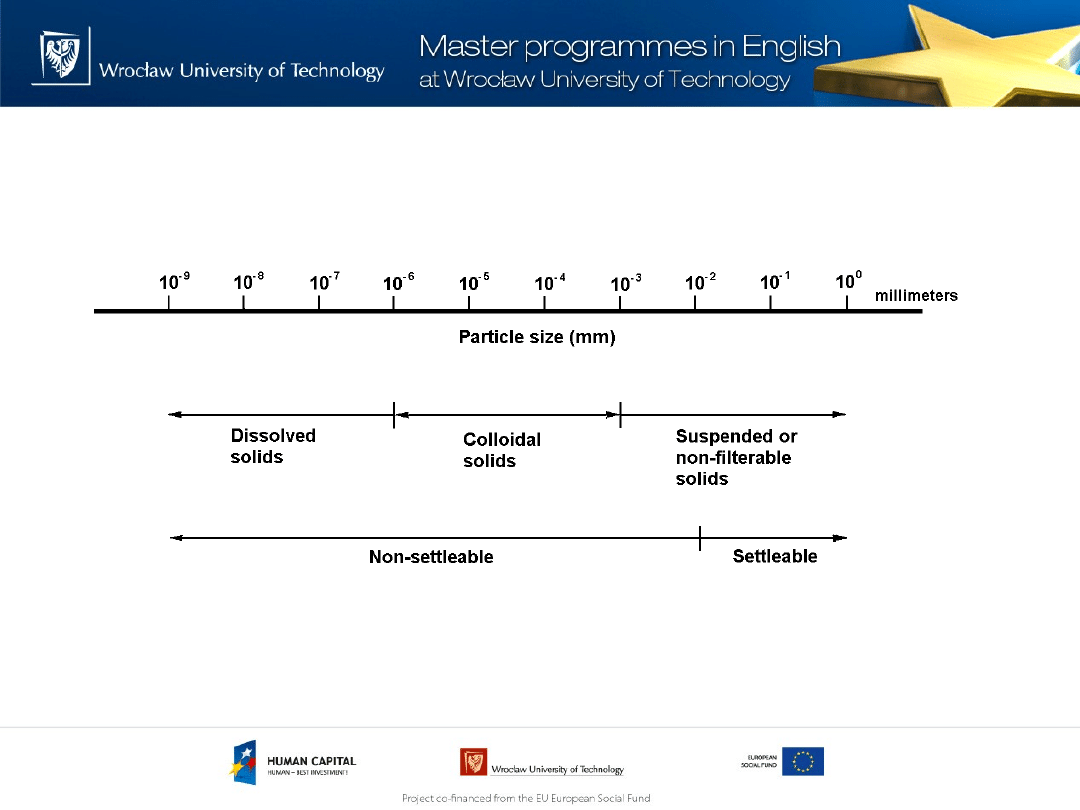
Solids size:
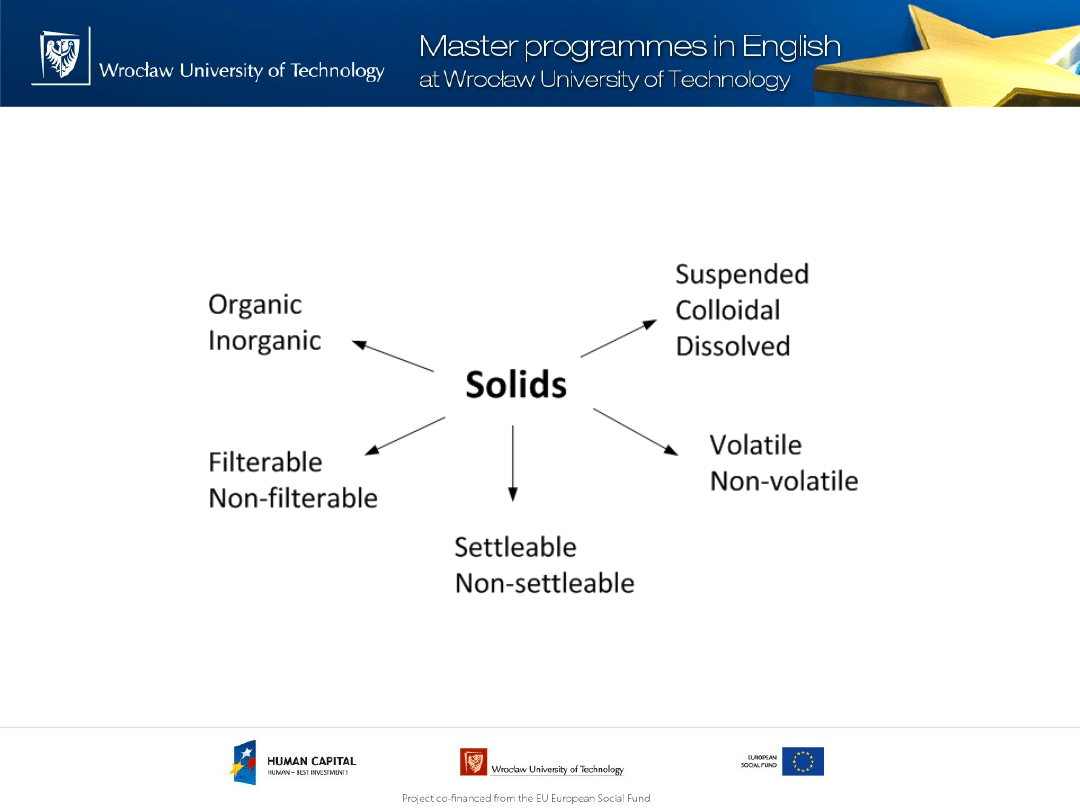
Solids general classification:

Solids classification:
• Total solids, TS = SS + TDS
• Suspended solids, SS
• Total dissolved solids, TDS = TS - SS
• Total volatile solids, TVS
• Volatile suspended solids, VSS

Total solids
defined as residue left in the vessel/dish after
sample evaporation and drying in an oven at a defined
temperature.
Total solids = sum of
total suspended solids
(the portion
of total solids retained on a filter paper) and
total
dissolved solids
(the portion that passes through a filter
paper).
Volatile fraction
is the weight loss on ignitron of dried
residue of total, suspended or dissolved solids.

Solids determination
Equipment
• Graduated cylinder, 100 ml
• Evaporating dish, 100 mL
• Standard filter paper
• Funnel
• Analytical balance
• Steam bath
• Drying oven

Total solids (TS)
Method
1.Weigh empty evaporating dish; recorded mass
mark as “a”.
2.Using the graduated cylinder measure 50 mL of
well-mixed water sample and pour into the
preweighed dish.
3.Evaporate the sample to dryness on a steam
bath.

4. Next place the evaporating dish in the drying oven
and dry sample for 1 hour at 105˚C.
5. Cool the dish in desiccator to balance the
temperature.
6. Using the analytical balance weigh the
evaporating dish with dried deposit; recorded
mass mark as “b”.
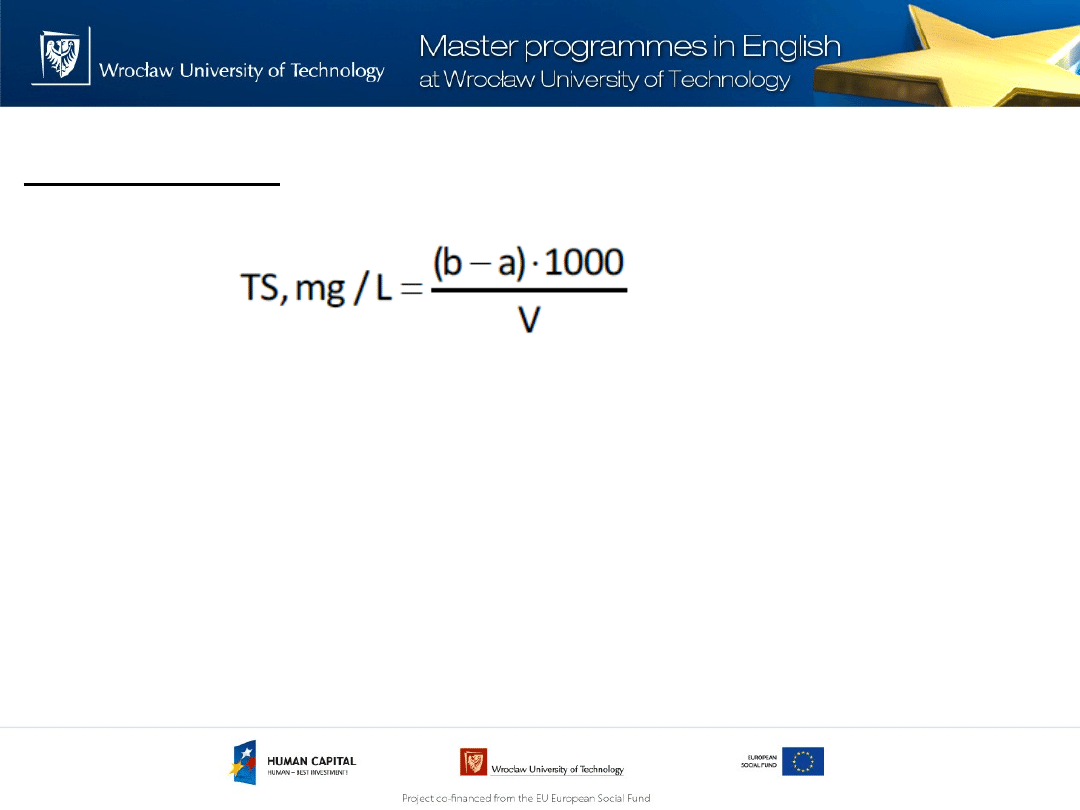
Calculations
where:
a – mass of empty evaporating dish, mg
b – mass of evaporating dish with dried deposit,
mg
V – volume of sample, mL

Total dissolved solids
(TDS)
Method
1.Weigh empty evaporating dish; recorded
mass mark as “a”.
2.A well-mixed water sample filter through a
standard filter paper.
3.Using the graduated cylinder measure 50 mL
of filtrate and pour into the preweighed dish.
4.Evaporate the sample to dryness on a steam
bath.

5. Next place the evaporating dish in the drying
oven and dry sample for 1 hour at 105˚C.
6. Cool the dish in desiccator to balance the
temperature.
7. Using the analytical balance weigh the
evaporating dish with dried deposit;
recorded mass mark as “b”.
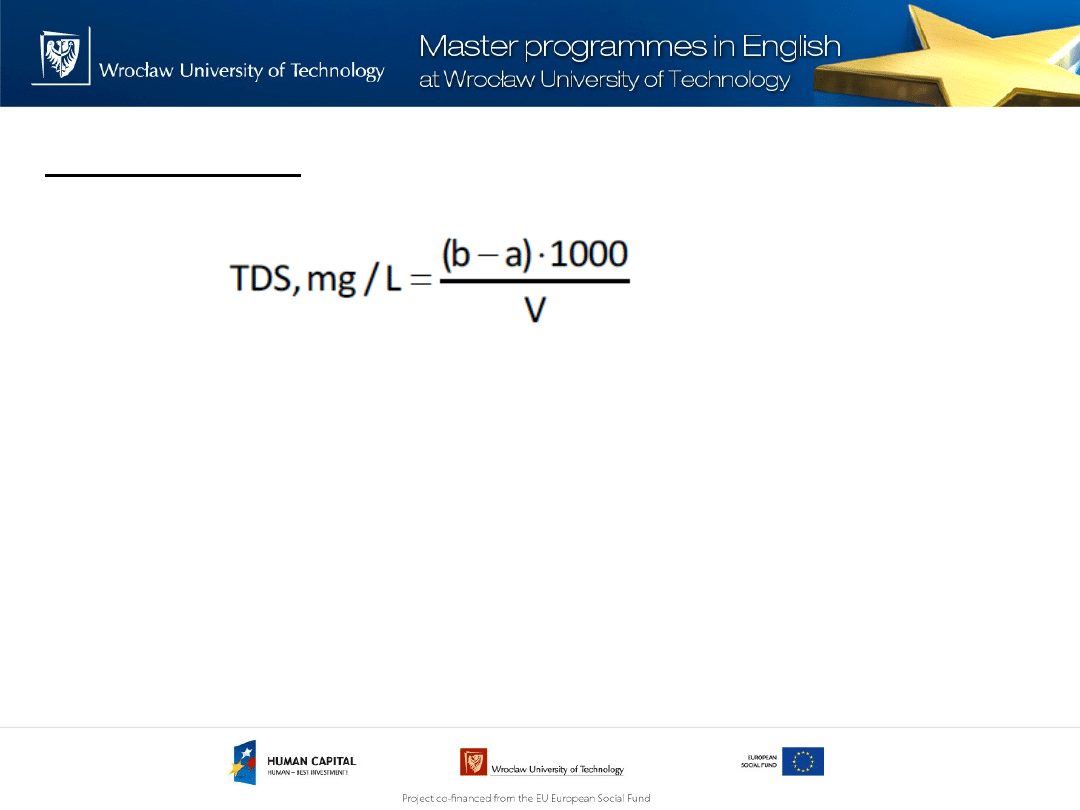
Calculations
where:
a – mass of empty evaporating dish, mg
b – mass of evaporating dish with dried
deposit, mg
V – volume of sample, mL
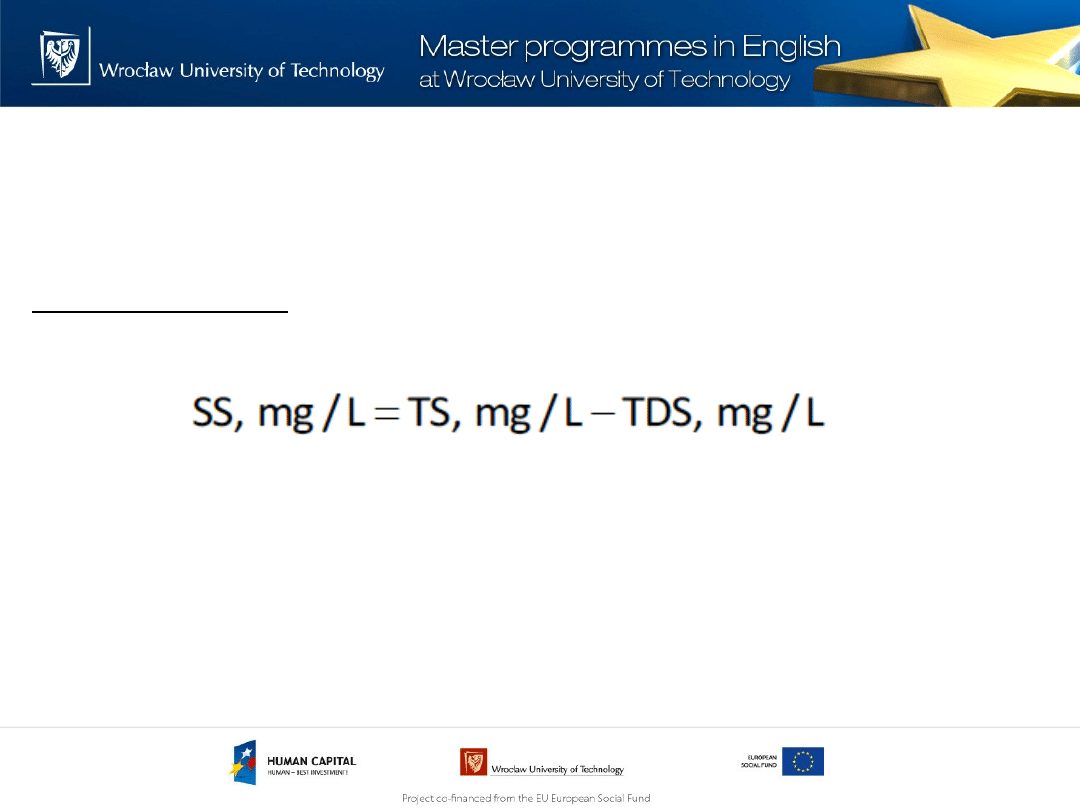
Suspended solids (SS)
Calculations

Alkalinit
y
Alkalinity
is a measure of water capacity to
neutralize acids (sometimes referred as the acid
neutralization capacity).
Similarity, acidity is a measure of the base
neutralizing capacity.
Alkalinity in most natural waters is predominantly
due to
bicarbonate (HCO
3-
), carbonate (CO
32-
),
and
hydroxide (OH
-
)
and may vary depending on
the pH.

The amount of acid required to react with OH
-
, CO
32-
and
HCO
3-
is defined as total alkalinity.
Total alkalinity (eq/L) = [OH
-
] + 2[CO
32-
] + [HCO
3-
] –
[H
+
]
where concentrations on right side are molarities (known as
molar concentration in mole/L).
Alkalinity is measured by titrating with sulphuric acid
(H
2
SO
4
)
or hydrochloric acid (HCl).
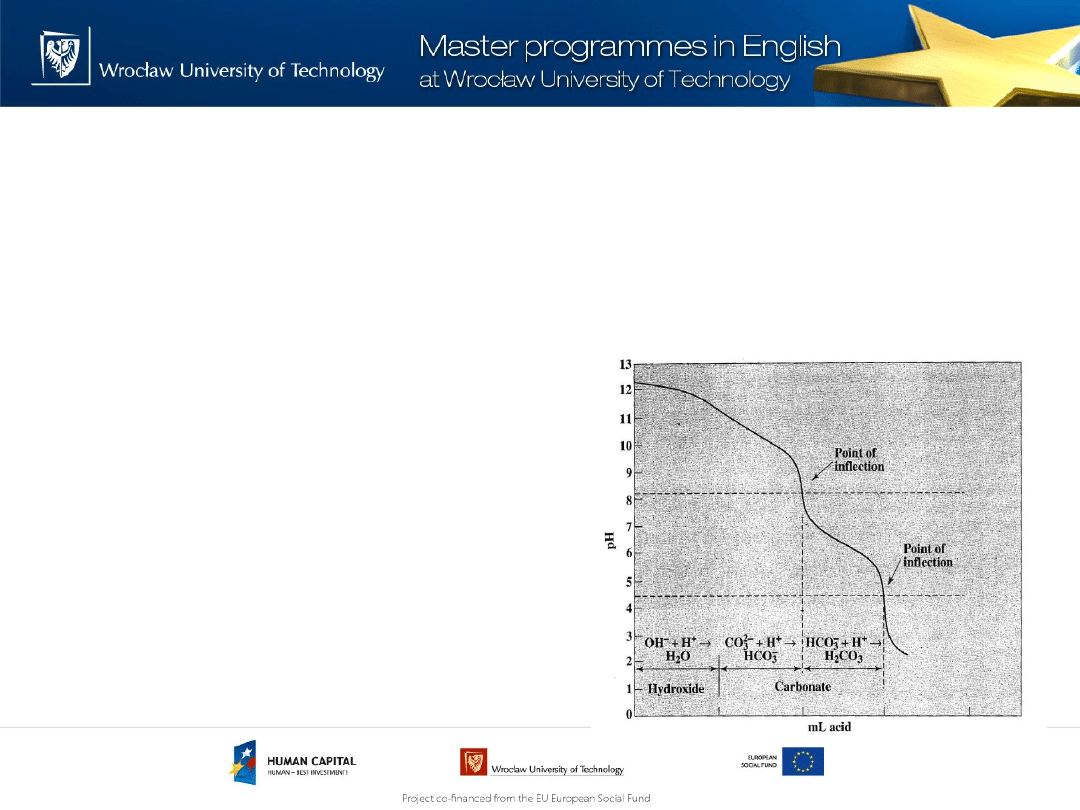
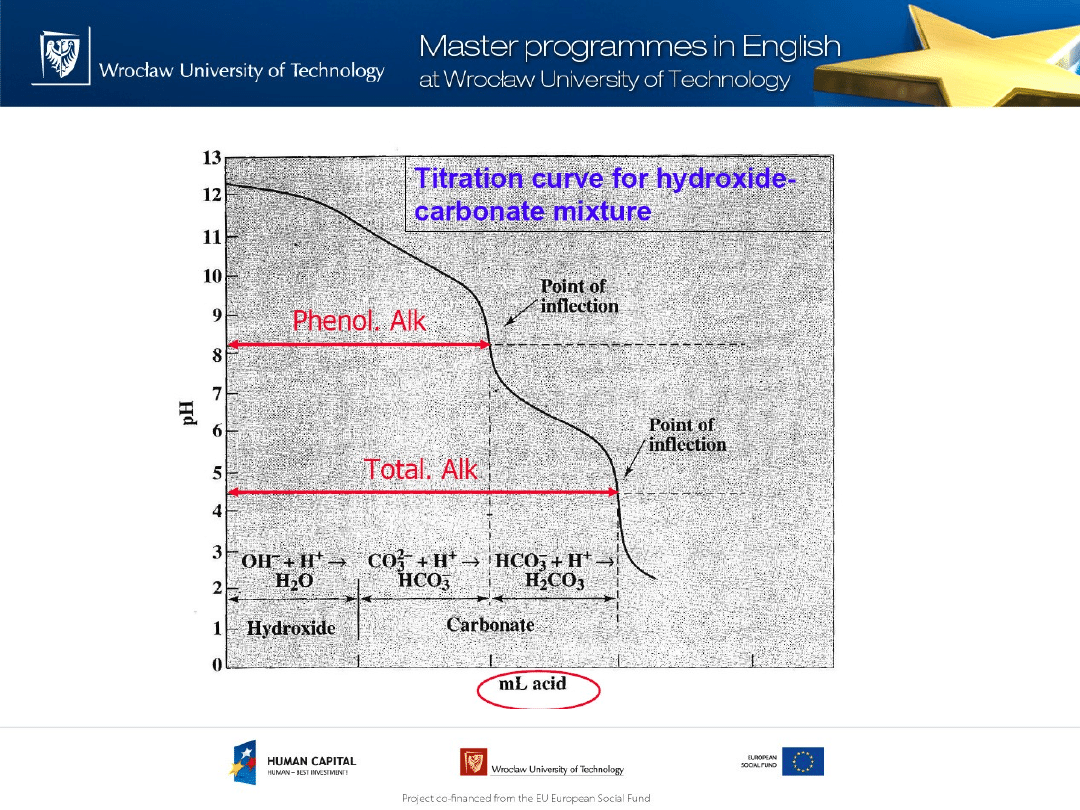
• For
pH > 11
, the added H
+
reacts with OH
-
.
• For
8.3 < pH < 11
, H
+
reacts with CO
32-
, producing
HCO
3-
.
• For
4.5 < pH <8.3
, H
+
reacts with HCO
3-
, producing
H
2
CO
3
.
• Inflection point at
pH 8.3
corresponds to equivalence
point for conversion of CO
32-
to HCO
3-
.
• Inflection point at
pH 4.5
corresponds to equivalence
point for conversion of HCO
3-
to H
2
CO
3
.

For water samples with pH > 8.3 the titration is
made in two steps.
•The first step is to pH of 8.3.
This endpoint corresponds to the equivalence
point for
conversion of CO
32-
to HCO
3-
:
CO
32-
+ H
+
→HCO
3-
Phenolphthalein alkalinity
= [OH
-
] + [CO
32-
]

• The second step is to pH of 4.5.
This endpoint corresponds to the equivalence point for
conversion of HCO
3-
to H
2
CO
3
:
HCO
3-
+ H
+
→H
2
CO
3
Total alkalinity
(known as methyl orange alkalinity)
= [OH
-
] + 2[CO
32-
] + [HCO
3-
] – [H
+
]
For water samples with pH < 8.3 the titration is made
in one step and it is to pH of 4.5, so it’s total
alkalinity.

In water chemistry the alkalinity (HCO
3-
, CO
32-
and OH
-
) can
be express following the calcium carbonate system where
the concentration of a substance is given as
mg/L as
calcium carbonate (CaCO
3
).
CaCO
3
→ Ca
2+
+ CO
32-
Each mole of CaCO
3
yields 1 mole, or 2 equivalents of Ca
2+
,
therefore with respect to Ca
2+
:
3
100g/ mole
EWof CaCO
50g/ eq 50mg/ meq
2eq/ mole
=
=
=

Example
What is the total alkalinity (TA) in mg/L as CaCO
3
if a solution has a total alkalinity of 0.002 eq/L?
Solution
TA = 0.002 eq/L
EW
CaCO3
= 50 g/eq = 50 000 mg/eq
TA = 0.002 eq/L · 50 000 mg/eq = 100 mg/L as
CaCO
3

The procedure is for water samples with pH >
4.6.
Equipment and reagents
• Conical flask, 250-300 ml
• Graduated cylinder, 100 ml
• Burette with HCl 0.1 molar solution
• Methyl orange, 0.1 % water solution
• pH-meter with electrode
Alkalinity determination

Method
1.Using the graduated cylinder measure 100 mL of
water sample and pour into the flask.
2.Add a few drops of methyl orange and gently mix.
3.Titrate at room temperature with HCl 0.1 molar
solution. The end of titration can be seen by a
colour change from yellow to orange.
4.Record the amount of HCl taken for titration as
”a”.

Calculations
where:
a - amount of HCl 0.1 molar solution taken for
titration, mL
0.1 - conversion factor related with 0.1 molar HCl
50 - the gram equivalent weight of CaCO
3
1000 - conversion factor, mL to L
V - volume of examined water, mL
3
a 0.1 1000
Alkalinity,mgCaCO / L
50
V
� �
=
�

Hardness
of water sample is defined as a
measure of capacity of water to precipitate soap.
The two main divalent ions responsible for soap
precipitation are
calcium
and
magnesium
.
Total hardness
is defined as the sum of calcium
and magnesium concentrations expressed as
calcium carbonate in milligrams per liter
(mg/L as CaCO
3
).
Hardness
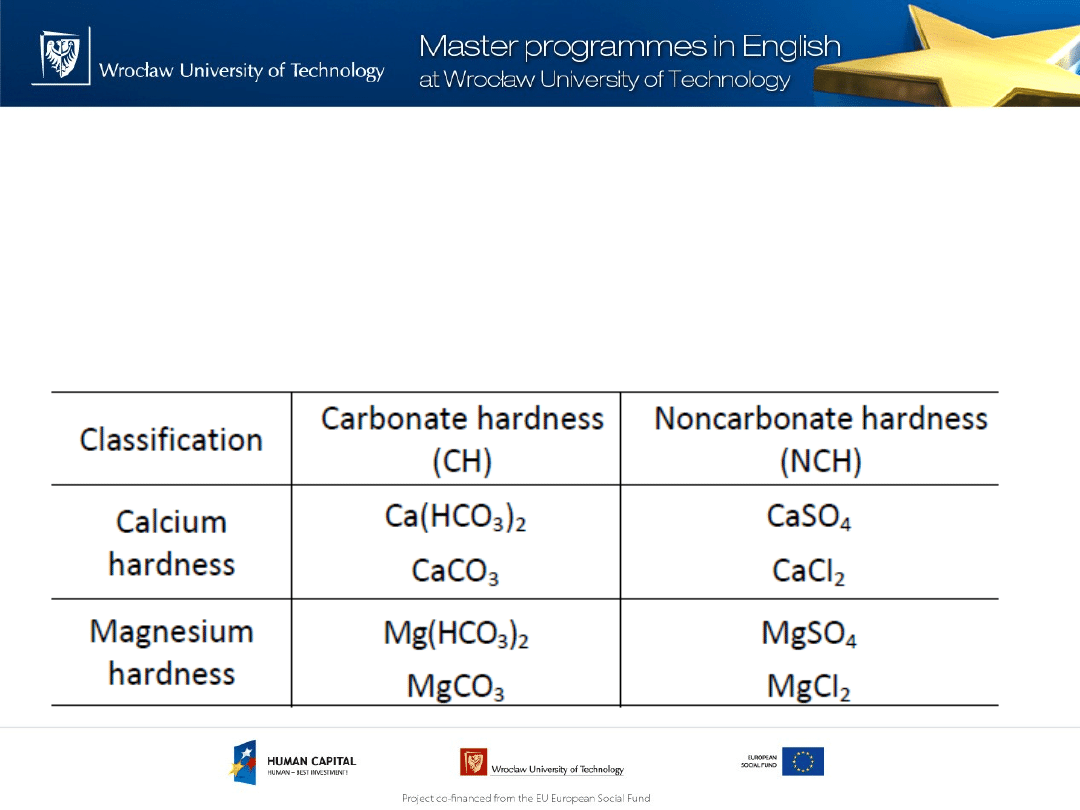
When hardness is greater than the sum of carbonate
and bicarbonate alkalinity, that amount of hardness
equivalent to the total alkalinity is called
carbonate
hardness
while the amount of hardness in excess of
this is called
non-carbonate hardness
.
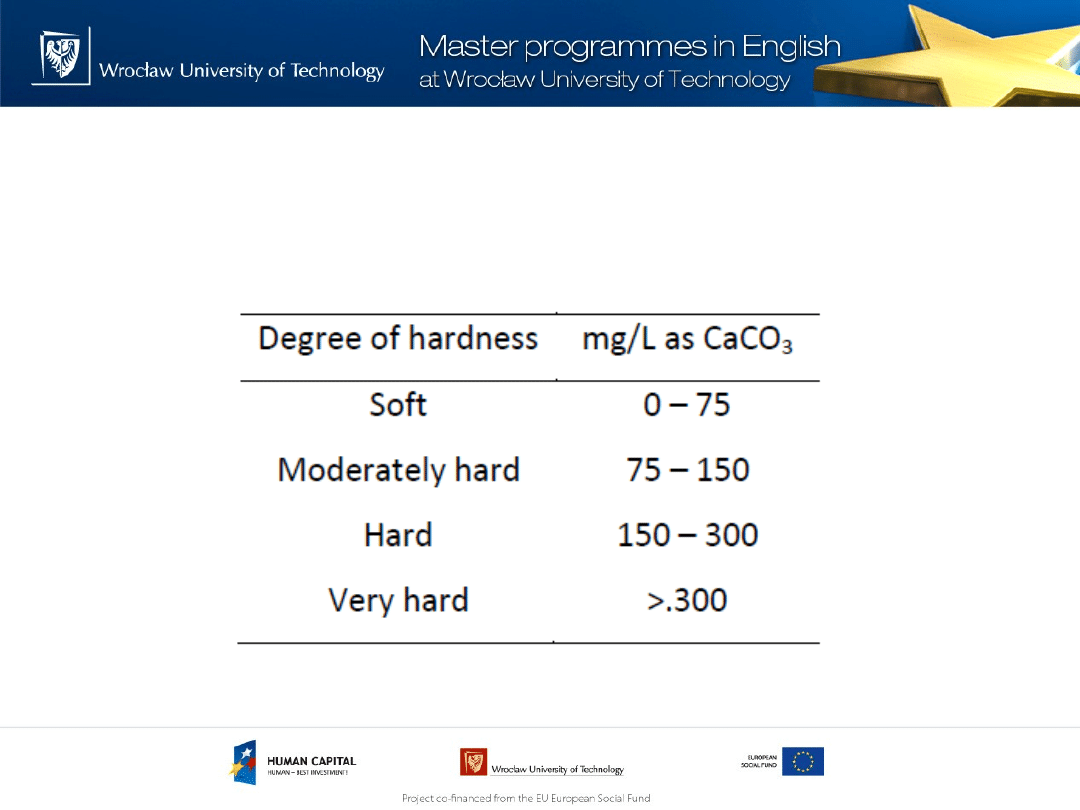
The hardness of water samples may range from zero
to hundreds of milligrams per liter.

Hardness calculations
where M
2+
is divalent metallic ion (e.g. Ca
2+
, Mg
2+
)
2
3
3
2
2
3
3
M (mg/ L)
Hardness,mg/ LasCaCO
EWof CaCO (mg/ meq)
EWof M (mg/ meq)
Hardness,mg/ LasCaCO M (meq/ L) EWof CaCO (mg/ meq)
+
+
+
=
�
=
�
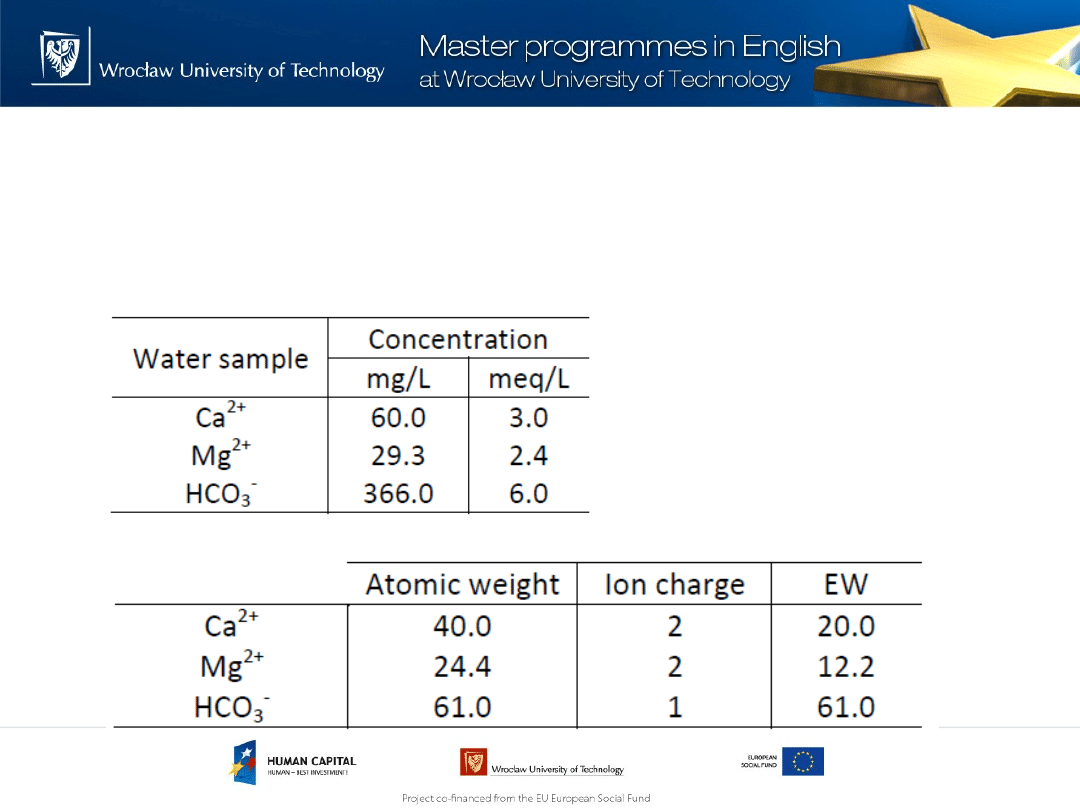
Example
Determine the hardness in mg/L as CaCO
3
of the water sample
contains calcium, magnesium and biocarbonate ions in
concentrations
given in the table.
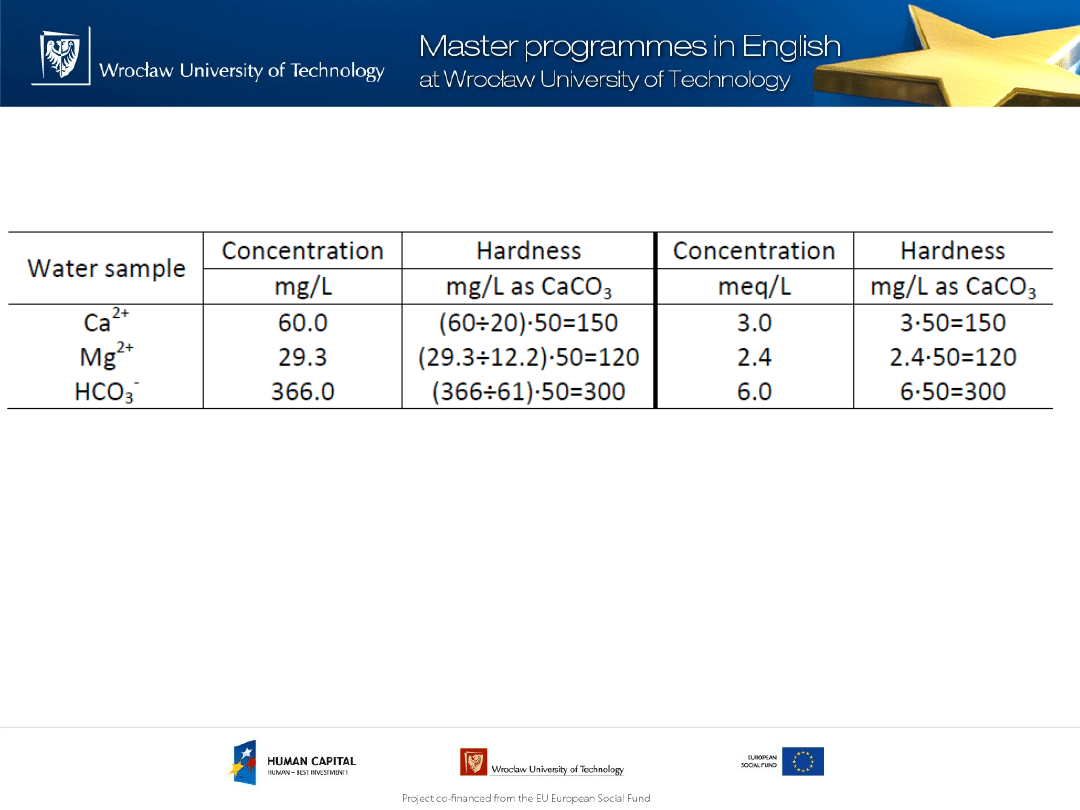
Solution
Total hardness (TH) = Ca
2+
+ Mg
2+
= 270 mg/L as
CaCO
3
Carbonate hardness (CH) = HCO
3
-
= 300 mg/L as
CaCO
3

The titration method is used in order to detremine the
hardness
as sum of Ca
2+
and Mg
2+
ions.
Equipment and reagents
• Conical flask, 250-300 mL
• Graduated cylinder, 100 ml
• Burette with EDTA-Na, 0.01 molar solution
• HCl, 0.1 molar and 1+1 solution
• NaOH, 2.5 molar solution
• Ammonia, 25% solution
• Reagent ET and murexide
Hardness determination

Method
Ca
+2
1.
Using the graduated cylinder measure 100 mL of water
sample and pour into the flask.
2.
Add the same mL of HCl, 0.1 molar solution as used for
total alkalinity determination.
3.
Add a pinch of murexide and gently mix.
4.
Add 2 mL of NaOH and mix the sample.
5.
Titrate at room temperature with EDTA-Na solution. The
end of titration can be seen by a colour change from
pink to violet.
6.
Record the amount of EDTA-Na taken for titration as ”a”.

Mg
+2
1.After calcium determination, add to the same
sample 7 mL of HCl, 1+1 solution and mix until the
colour disappears.
2.Add 7 mL of ammonia solution, a pinch o ET
reagent and gently mix.
3.Titrate at room temperature with EDTA-Na solution.
The end of titration can be seen by a colour
change from violet to blue.
4.Record the amount of EDTA-Na taken for titration
as ”b”.

Calculations
2
2
2
2
2
2
3
a 0.1 1000 20
Ca ,mgCa / L
2.8 V
b 0.1 1000 12
Mg ,mgMg / L
2.8 V
Totalhardness,mg/ LasCaCO
Ca
Mg
+
+
+
+
+
+
� �
�
=
�
� �
�
=
�
=
+
�

where:
0.1 – conversion factor, 1 mL of EDTA-Na equals
0.1 hardness
number
1000 – conversion factor, mL to L
V – volume of water sample, mL
20 – gram equivalent weight of Ca
+2
12 – gram equivalent weight of Mg
+2

pH
pH
is defined as the negative log (base 10) of
the hydrogen ion concentration and is unitless:
pH = -log[H
+
]
Taking the negative log of K
W
= [H
+
] [OH
-
]:
-logK
w
= -log[H
+
]-log[OH
-
]
pK
w
= pH + pOH

where:
pH=-log[H
+
]
pOH = -log [OH
-
]
Since K
w
= 10
-14
at 25
o
C, it follows that
pK
w
= 14 at 25
o
C,
which means that:
pH + pOH = 14

The definition of
neutrality
is:
pH = 7 = pOH
Acidity:
[H
+
] > [OH
-
]
[H
+
] > 10
7
mole/L
pH < 7
Basicity:
[H
+
] < [OH
-
]
[H
+
] < 10
7
mole/L
pH > 7
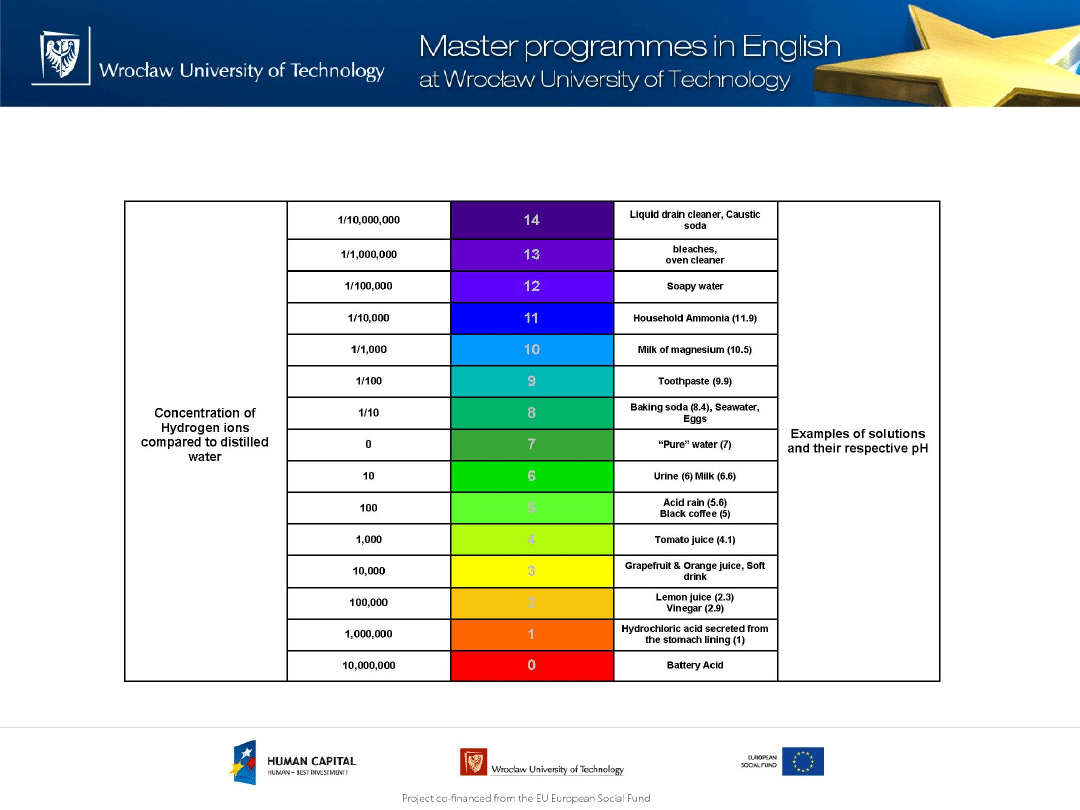
pH scale:

pH determination
Measure the pH at room temperature with
properly calibrated pH-meter.
Equipment
•pH-meter with electrode
•Glass beaker, 25 mL

Method
1.Remove electrode from storage solution,
rinse with distilled water and dry.
2.Pour the water sample into a small beaker.
3.Place the pH electrode in the beaker.
4.Let the electrode to stabilize.
5.The result of pH value will be displayed.

Example
What is the pH and alklinity of groundwater sample with quality
parameters listed in the table. The water temperature is 15 °C.
Constituent
Concentration
mg/L
Ca
2+
190
Mg
2+
84
Na
+
75
Fe
2+
0.1
HCO
3
-
260
SO
4
2-
64
CO
3
2-
30
NO
3
-
35

Solution
Consider the dissociation of HCO
3-
ion: [HCO
3-
] ↔ [H
+
] + [CO
32-
]
At 15°C K
2
= 3.72·10
-11
mole/L
3
3
3
2
3
2
4
3
MWof HCO
61g/ mole
260
HCO
4.26 10 mole/ L
1000 61
MWof CO
60g/ mole
30
CO
5 10 mole/ L
1000 60
-
-
-
-
-
-
=
�
�=
=
�
�
�
�
=
�
�=
= �
�
�
�

Reorganized the equilibrium equation:
pH = - log [H
+
] = - log 3.17·10
-10
= 9.5
3
2
2
3
HCO
H
K
CO
-
+
-
�
�
�
�
� �
� �
�
�
�
�
= �
3
11
10
4
4.26 10 mole/ L
H
3.72 10 mole/ L
3.17 10
5 10 mole/ L
-
+
-
-
-
�
� �=
�
�
=
�
� �
�
2
3
3
Alkalinity HCO
CO
260 60 320mg/ L
-
-
=
+
=
+ =

Example
Given the following water quality analysis, determine the
unknown values:
Constituent
Concentratio
n
Ca
2+
40 mg/L
Mg
2+
?
Na
+
?
K
+
39.1 mg/L
HCO
3
-
?
SO
4
2-
96 mg/L
Cl
-
35.5 mg/L
Alkalinity
3 meq/L
Non-
carbonate
hardness
1 meq/L

Solution
• Use alkalinity to determine [HCO
3-
]
MW of HCO
3-
= 61 g/mole
[HCO
3-
] = 183 mg/L
3
61g/ mole
EWof HCO
61g/ eq 61mg/ meq
1eg/ mole
-
=
=
=
3
HCO
Alkalinity 3meq/ L
61mg/ meq
-
�
�
�
�
=
=

• Use hardness to determine [Mg
2+
]
{
}
2
2
Total hardness Carbonate hardness noncarbonate hardness
Ca
Mg
3meq/ L
1meq/ L
+
+
=
+
+
=
+
2
2
2
2
Ca
Mg
4meq/ L
EW
EW
Mg
40
4meq/ L
20
EW
Mg
24.4mg/ L
+
+
+
+
� � �
�
� � �
�
+
=
�
�
�
�
+
=
�
�=
�
�

•
Use the anion-cation balance to determine [Na
+
]
Cation
s
Concentr
a-
tion
Equivale
nt mass
Concentr
a-
tion
Anion
s
Concentr
a-
tion
Equivale
nt mass
Concentr
a-
tion
mg/L
mg/meq
meq/L
mg/L
mg/meq
meq/L
Ca
2+
40
20
2
HCO
3
-
183
61
3
Mg
2+
24.4
12.2
2
SO
4
2-
96
48
2
K
+
39.1
39.1
1
Cl
-
35.5
35.5
1
Na
+
x
23
x/23
Total
5+x/23
6
Anions
Cations
x
6 5
23
Na
x 33mg/ L
+
=
= +
� �= =
� �
�
�

Conductivity
Conductivity
is a parameter used to measure the
ionic concentration and activity of a solution, and is
usually express in
µS/cm
.
Conductivity is an important parameter that is often
used for monitoring water quality. For instance
conductivity measurements are used for applications
such as determining the total dissolved solids (
TDS
,
mg/L) or
salinity
of sea water. It’s also used for
assessment the degree of mineralization of distilled
and deionized water.
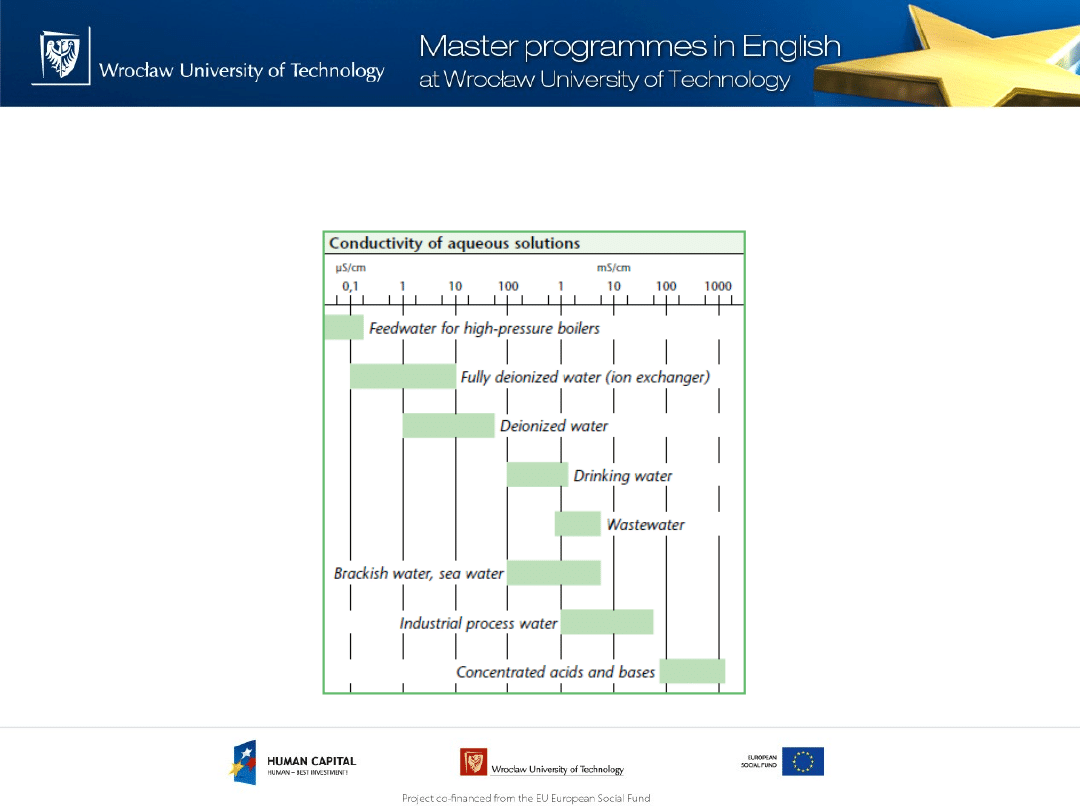
Conductivity of aqueous solutions:

Conductivity determination
Measure the conductivity at room temperature
with properly calibrated conductivity-meter.
Equipment
•Laboratory conductivity meter with the special
conductivity cell
•Glass beaker, 25 mL

Method
1.Rinse the conductivity cell with distilled water
and dry.
2.Pour the sample into a small beaker.
3.Place the cell in the beaker.
4.Operate the conductivity-meter according to
manufacturer’s instructions.
5.Record the result in µS/cm.

Ammonia/nitrite/nitrate
Nitrogen forms - nitrate, nitrite, ammonia, are
of great interest in water chemistry because
they are components of the nitrogen cycle.
Ammonia
is present naturally in water bodies
and wastewaters. Its concentration is
considerably lower in waters - µg/L, than in
wastewaters - mg/L.

Nitrate
is an essential nutrient for many
photosynthetic autotrophs and in some cases has
been identified as the growth-limiting nutrient. It
occurs in trace quantities in surface water but
may attain high levels in some groundwater.
In fresh domestic wastewater nitrate is found in
small amounts but in the effluent of nitrifying
biological treatment plants nitrate may be
present in concentrations of up to 30 mg/ L.

Nitrite
is an intermediate oxidation state of
nitrogen, both in the oxidation of ammonia to
nitrate and in the reduction of nitrate.
Such oxidation and reduction may occur in
wastewater treatment plants, water
distribution systems and natural waters. Nitrite
can enter a water supply system through its
use as a corrosion inhibitor in industrial process
water.

Ammonia (NH
4
+
)
determination
Equipment and reagents
• Standards, mg NH
4+
/100 mL
• Nessler tube, 100 mL
• Seignette salt
• Nessler reagent (K
2
HgI
4
)

Method
1.Pour 100 mL of well-mixed water sample
into the Nessler tube.
2.Add 1 mL of Seignette salt and 1 mL of
Nessler reagent.
3.Mix content of the Nessler tube by turning
it upside down and wait 10 minutes. Yellow
colour occurs and its intensity is
proportional to ammonia concentration.

4.
Compare the sample with standards by looking
vertically downward through the Nessler tube
toward a white surface placed at such angle
that light is reflected upward through the
column of liquid.
5.
Record the result in mg/L NH
4+
.

Nitrite (NO
2
-
) determination
Equipment and reagents
• Conical flask, 250-300 mL
• Spectrophotometer
• Glass cells with a light path length equals 5 cm
• Sulfanilamide acid
• α- naphtylamine solution

Method
1.
Pour 100 mL of water sample into the flask.
2.
Add 1 mL of sulfanilamide acid, mix and wait 5
minutes.
3.
Add 1 mL of α-naphtylamine solution.
4.
Mix gently the sample and wait 10 minutes. Red-
violet colour occurs and its intensity is
proportional to the nitrite concentration.
5.
Turn on the spectrophotometer and let it warm
up according to manufacturer’s instructions.

6. Rinse the blank measuring cell with blank
sample, refill it and place cell at first position
in the spectrophotometer.
7. Rinse the second measuring cell with water
sample, refill it and place cell at second
position in the spectrophotometer.
8. Set the proper calibration curve (a wavelength
520 nm), press AUTOZERO and START.
9. Read nitrite concentration in mg/L directly
from the instrument.

Nitrate (NO
3
-
)
determination
Equipment and reagent
• Nessler tube, 100 mL
• Evaporating dish, 100 mL
• Glass rod
• Pipet
• Steam bath
• Standards, mg NO
3-
/100 mL
• Phenolodisulfonic acid
• NaOH solution

Method
1.Pipet 10 mL of water sample into the
evaporating dish and using the steam bath
evaporate it to dryness.
2.Remove the dish from the steam bath, dry it
and cool it down.
3.Add 1 mL of phenolodisulfonic acid and
using the glass rod, distribute the acid on
the dish walls (the acid makes the deposit
dissolved).

4. Add a few mL of distillated water and pour
the dish contents into Nessler tube.
5. Pipet 5÷7 mL of NaOH solution to the tube
and fill it up to 100 mL with distillated
water. Yellow colour occurs and its intensity
is proportional to the nitrate concentration.
6. Mix the sample by turning it upside down.

7. Compare the sample with standards by looking
vertically downward through the Nessler tube
toward a white surface placed at such angle
that light is reflected upward through the
column of liquid.
8. The results express as mg/L NO
3-
taking into
account that 10 mL of water sample was used
for nitrate determination.

Chlorides
Chloride ions (Cl
-
)
are one of the major inorganic
anions in aquatic environment. The salty taste of
water is due to presence of chloride ions and
dependents on the chemical composition of water.
Waters containing 250 mgCl
-
/L may have a detectable
salty taste if the predominant cation is sodium. The
typical salty taste may be absent in waters containing
as much as 1000 mg Cl
-
/L when the predominant
cations are calcium and magnesium.

Chlorides determination
This method can be used to determine the Cl
-
ions
concentration of water from many sources such as
seawater, stream water or river water. The pH of
the water sample should be between 6.5 and 10.
Equipment and reagents
•Conical flask, 250-300 ml
•Graduated cylinder, 100 ml
•Burette with AgNO
3
solution
•Potassium chromate (K
2
CrO
4
) indicator

Method
1.
Using the graduated cylinder measure 100 mL of
water sample and pour into the flask.
2.
Add 1 mL of K
2
CrO
4
and gently mix.
3.
Titrate the sample with AgNO
3
solution. The end of
titration can be seen by a colour change from faint
lemon-yellow to brick-red.
4.
Record the amount of AgNO
3
taken for titration as
”a”.

Calculations
where:
a – amount of AgNO
3
solution taken for titration, mL
V – volume of water sample, mL
1000 – the conversion factor, mL to L
0.3 – factor related with the amount of AgNO
3
solution, which is necessary for Ag
2
CrO
4
formation
in 100 cm
3
of distillated water
(a 0.3) 1000
Chlorides, mgCl / L
V
-
-
�
=

Determination of organic content
of water
The determination of the organic content of water can
be
done by:
• Specific tests
are suitable for measurement the
concentrations of specific compounds.
Details of specific tests are in
Standard Methods (2005).
• Non-specific
tests to measure the overall
concentration of the organic content.

Tests for the overall concentrations include:
• BOD
(a biochemical test that uses microorganisms)
• COD
(a chemical test)
• TOC
(an instrumental test)

BOD - biochemical oxygen
demand
The
BOD
5
is the amount of dissolved oxygen used
up from the water sample by microorganisms as
they break down organic material at 20˚C over a 5-
day period. It measures the
readily biodegradable
organic carbon
.
The BOD
5
is arbitrarily set at 5 days and this may
not be long enough to determine the
BOD ultimate
(BOD
u
)
, which is again arbitrarily set at
20 days
.
BOD
u
≈ 2 x BOD
5

Clean waters have BOD
5
values of less than 1
mg/L.
Rivers are considered polluted if the BOD
5
is
greater than 5 mg/L.
The BOD
5
of municipal wastewaters ranges
from about 150 to 1000 mg/L, while for
industrial wastewaters (food industries) the value
may be several thousands.

COD - chemical oxygen
demand
The
COD
test measures the total organic carbon, with
the exception of some aromatics such as benzene
which are not oxidized in the reaction. The test
determines the amount of
oxygen needed to
chemically oxidize the organics
in water/
wastewater sample.
A strong chemical oxidizing agent is used to oxidize
the organics rather than using microorganisms as in
the BOD test. The oxidizing agent is potassium
dichromate in an acid solution.

COD is attractive as a test since it takes about 2
hours by comparison with 5 days for the BOD. A
disadvantage is that it tells nothing about the
rates of biodegradation.
In typical municipal wastewaters:
BOD ultimate (≈ BOD
20
) is ≈ equal (92%) to
COD
BOD
5
≈ 0.6 COD

Example
If bacterial cells are represented by the chemical
formula
C
5
H
7
O
2
N, determine the potential carbonaceous BOD.
Solution
As the cells require O
2
to stabilize them to end
products, first stoichiometrically balance the
equation:
C
5
H
7
O
2
N + 5O
2
→ 5CO
2
+ 2H
2
O + NH
3
stable end products as a result of oxidation

Therefore each mole of bacterial cells requires 5
moles of O
2
for oxidation:
BOD
u
= 0.92 COD = 0.92 · 1.42 = 1.31
If the bacterial cell concentration was, e.g. 1000
mg/L, then the potential BOD
u
= 1310 mg/L.
2
5 7 2
5moleof O
5 32
COD
1.42
1moleof C H O N 113
�
=
=
=

Dissolved oxygen
determination (DO)
Equipment and reagents
• Conical flask, 250-300 ml
• Graduated cylinder, 100 ml
• BOD bottles, 125 mL
• Burette with Na
2
S
2
O
3
solution
• Solutions of MnSO
4
, KJ, and H
2
SO
4
• Starch indicator

Method
1.Fill the bottle with the sample without
entraining the air.
2.Add 1 mL of MnSO
4
and 2 mL of KJ; a
precipitate will form.
3.Cap the bottle that insertion of the stopper
leaves no air bubbles in the bottle and mix it
by inverting several times.
4.Place the bottle in the dark place and allow
the precipitate to settle.

5. Add 1 mL of H
2
SO
4
.
6. Next cap the bottle and gently shake until
the reagent and precipitate have dissolved
(depending on the oxygen content of the
sample a clear yellow to brown colour will
appear).
7. Using the graduated cylinder measure 100
mL of sample and pour into the flask without
entraining the air.

8.
Titrate at room temperature with Na
2
S
2
O
3
solution
until the faint yellow colour will be seen.
9.
Then add 5 mL of starch indicator and continue the
titration until the blue colour disappears.
10.
Record the amount of Na
2
S
2
O
3
taken for titration as
”a”.

Calculations
where:
x – amount of Na
2
S
2
O
3
taken for titration (before
and
after starch addition), mL
1000 – conversion factor, mL to L
0.2 – conversion factors
V – volume of sample, mL
2
0.2 a 1000
DO, mgO / L
V
��
=

Literature
•
S. E. Manahan, Fundamentals of Environmental
Chemistry. Second Edition, Lewis Publishers, 2001.
•
V. L. Snoeyink, D. Jenkins, Water Chemistry. John
Wiley & Sons, 1980.
•
S. D. Faust, O. M. Aly, Chemistry of water
treatment. Lewis Publishers, 1998.
•
Standards Methods for the Examination of
Water and Wastewater. American Public Health
Association, American Water Works Association,
American Public Health Association, 21 Edition,
2005.
Document Outline
- Slide 1
- Slide 2
- Slide 3
- Slide 4
- Slide 5
- Slide 6
- Slide 7
- Slide 8
- Slide 9
- Slide 10
- Slide 11
- Slide 12
- Slide 13
- Slide 14
- Slide 15
- Slide 16
- Slide 17
- Slide 18
- Slide 19
- Slide 20
- Slide 21
- Slide 22
- Slide 23
- Slide 24
- Slide 25
- Slide 26
- Slide 27
- Slide 28
- Slide 29
- Slide 30
- Slide 31
- Slide 32
- Slide 33
- Slide 34
- Slide 35
- Slide 36
- Slide 37
- Slide 38
- Slide 39
- Slide 40
- Slide 41
- Slide 42
- Slide 43
- Slide 44
- Slide 45
- Slide 46
- Slide 47
- Slide 48
- Slide 49
- Slide 50
- Slide 51
- Slide 52
- Slide 53
- Slide 54
- Slide 55
- Slide 56
- Slide 57
- Slide 58
- Slide 59
- Slide 60
- Slide 61
- Slide 62
- Slide 63
- Slide 64
- Slide 65
- Slide 66
- Slide 67
- Slide 68
- Slide 69
- Slide 70
- Slide 71
- Slide 72
- Slide 73
- Slide 74
- Slide 75
- Slide 76
- Slide 77
- Slide 78
- Slide 79
- Slide 80
- Slide 81
- Slide 82
- Slide 83
- Slide 84
- Slide 85
- Slide 86
- Slide 87
- Slide 88
- Slide 89
- Slide 90
- Slide 91
- Slide 92
- Slide 93
- Slide 94
- Slide 95
- Slide 96
- Slide 97
- Slide 98
- Slide 99
- Slide 100
- Slide 101
- Slide 102
- Slide 103
- Slide 104
- Slide 105
- Slide 106
- Slide 107
- Slide 108
- Slide 109
- Slide 110
- Slide 111
- Slide 112
- Slide 113
- Slide 114
- Slide 115
- Slide 116
- Slide 117
- Slide 118
- Slide 119
- Slide 120
Wyszukiwarka
Podobne podstrony:
BASICS OF ENVIRONMENTAL CHEMISTRY lab no2
9g environmental chemistry
Chemistry for Environmental Engineering and Science
Chemistry for Environmental Engineering and Science
Lean Manufacturingnd The Enviroment (2003)
Fundamentals of Polymer Chemist Nieznany
EnviroDeck Contracts
kids flashcards environment 2
ABC Of Occupational and Environmental Medicine
environmentalmodals
To what extend?n?ucation help protect the environment
SAVE ENVIRONTMENT
Environmental?tivism
Huang et al 2009 Journal of Polymer Science Part A Polymer Chemistry
Chemistry HL paper 2 TZ2mk
Knowledge?out Gases Chemistry, organic
15 Weather and enviroment
Nutritional & Environmental Pathology, Nutritional & Environmental Pathology
więcej podobnych podstron