A PRELIMINARY
ANALYSIS OF THE
BOTANY, ZOOLOGY,
AND MINERALOGY
of the
By Arthur O. Tucker, PhD, and Rexford H. Talbert
Unless otherwise noted, images courtesy of Beinecke collections:
Cipher manuscript (Voynich manuscript). General Collection, Beinecke
Rare Book and Manuscript Library, Yale University
VOYNICH
MANUSCRIPT
Introduction
In 1912, Wilfrid M. Voynich, a Polish-born
book collector living in London, discovered a
curious manuscript in Italy. This manuscript,
written in an obscure language or, perhaps,
code, is now housed at the Beinecke Rare
Book and Manuscript Library at Yale Univer-
sity,
1
which acquired it in 1969. Since 1912,
this manuscript has elicited enormous interest,
resulting in books and Internet sites with no
sound resolution on the manuscript’s origin.
Even the US National Security Agency has
taken an interest in its cryptic contents, and
doctoral theses have been written on attempts
to decipher the language of the Voynich
Manuscript (hereinafter abbreviated Ms.).
With such voluminous published informa-
tion, its history can be easily found elsewhere
and need not be repeated here ad nauseum.
1-5
However, what appears to be a reasonably reli-
able introduction for the novice is provided at
Wikipedia.
6
Information is continually updated on the
website of René Zandbergen,
7
a long-term
researcher of the Voynich Ms., and, along
with Gabriel Landini, PhD, one of the devel-
opers of the European Voynich Alphabet
(EVA) used to transcribe the strange alphabet
or syllabary in the Voynich Ms. As Zandber-
gen relates, past researchers primarily have
proposed — because the Voynich Ms. was
discovered in Italy — that this is a European
manuscript, but some also have proposed Asian
and North American origins. As such, almost
every language, from Welsh to Chinese, has
been suspected of being hidden in the text.
Of course, aliens also have been implicated
in the most bizarre theories. These theories
with no solid evidence have clouded the whole
field of study, and many scholars consider
research into the Voynich Ms. to be academic
suicide. Recently, however, Marcelo Monte-
murro, PhD, and Damián Zanette, PhD,
researchers at the University of Manchester
and Centro Atómico Bariloche e Instituto
Balseiro, have used information theory to
prove that the Voynich Ms. is compatible with
a real language sequence.
8
The Voynich Ms. is numbered with Arabic
numerals in an ink and penmanship different
from the work’s text portions. The pages are
in pairs (“folios”), ordered with the number
on the facing page on the right as recto, the
reverse unnumbered on the left as verso (thus
folios 1r, 1v, 2r, 2v, etc. to 116v). Fourteen
folios are missing (12, 59, 60, 61, 62, 63, 64,
74, 91, 92, 97, 98, 109, and 110). By conven-
tion of Voynich researchers, the manuscript
includes the following:
70 •
I
S S U E
100 • 2013 •
www.herbalgram.org
• “Herbal pages” or a “botanical section” (pages with a
single type of plant);
• “Pharma pages” or a “pharmaceutical section” (pages
with multiple plants and apothecary jars, sometimes
termed “maiolica”);
• “Astrological pages” (circular volvelles with nymphs,
folios 70v2-73v);
• “Astronomical pages” (other circular designs, folios
67rl-70r2, etc.);
• “Balneological pages” or “biological section”
(nymphs, baths, plumbing, folios 75r-84v);
• “Magic Circle page” (folio 57v);
• “Fertilization/Seed page” (folio 86v); and a
• “Michiton Olababas page” (folio 116v).
Our Introduction to the Voynich Manuscript,
Backgrounds, and Pattern of Investigation
While we had known of the existence of the Voynich Ms.,
we, like so many others, probably dismissed it as a fantastic,
elaborate hoax. Scattered, intersecting evidence may trace it
back to ca. 1576-1612 to the court of Rudolf II (1552-1612)
in Austria.
1-7
Any origin prior to this time is strictly conjec-
ture, but such spurious claims have channelized scholars’
thinking and have not been particularly fruitful. We had to
face the facts that (so far) there was no clear, solid chain of
evidence of its existence prior to ca. 1576-1612.
Thus, with our varied backgrounds and viewpoints
as a botanist and as an information technologist with a
background in botany and chemistry, the authors of this
HerbalGram article decided to look at the world’s plants
without prejudice as to origin in order to identify the plants
in the Voynich Ms. With the geographical origins of the
plants in hand, we can then explore the history of each
region prior to the appearance of the Voynich Ms. The
authors of this article employ abductive reasoning, which
consists of listing of all observations and then forming the
best hypothesis. Abductive reasoning (rather than deductive
reasoning normally practiced by scientists in applying the
scientific method) is routinely used by physicians for patient
diagnosis and by forensic scientists and jurors to determine
if a crime has or has not been committed. In abductive
reasoning, it is necessary to record all facts, even those that
may seem irrelevant at the time. This is well illustrated by
physicians who have misdiagnosed patients who were not
fully forthcoming with all their symptoms because they
interpreted some as trivial, unrelated, or unnecessary to
share with the physician.
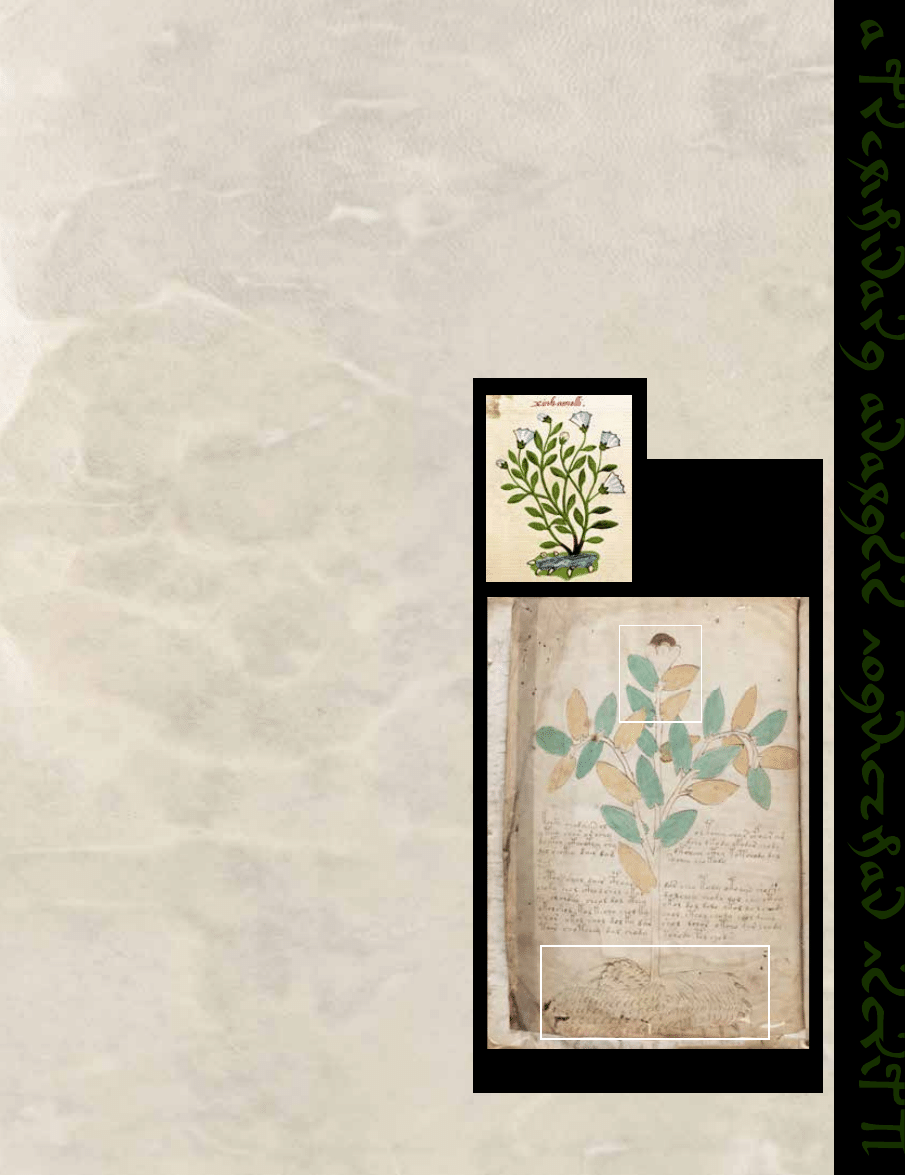
We were both immediately struck by the similarity of
xiuhamolli/xiuhhamolli (soap plant) illustrated on folio 9r in
the 1552 Codex Cruz-Badianus
9-12
of Mexico (sometimes
known as the “Aztec Herbal”) to the plant in the illustration
on folio 1v of the Voynich Ms. Both depictions have a large,
broad, gray-to-whitish basal woody caudices with ridged
bark and a portrayal of broken coarse roots that resemble
toenails. The plant in the Codex Cruz-Badianus is in both
bud and flower with leaves that have a cuneate (wedge-
shaped) base, while the plant in the Voynich Ms. has only
one bud with leaves that have a cordate (heart-shaped) base.
The illustration in the Codex Cruz-Badianus is accepted by
numerous commentators
9-12
as Ipomoea murucoides Roem.
& Schult. (Convolvulaceae); the illustration in the Voynich
Ms. is most certainly the closely related species I. arbore-
scens (Humb. & Bonpl. ex Willd.) G. Don. However, the
portrayals of both of these Mesoamerican species are so
similar that they could have been drawn by the same artist
or school of artists.
This possible indication of a New World origin set us
down a path that diverges from most previous Voynich
researchers. If our identifications of the plants, animals, and
minerals are correct as originating in Mexico and nearby
areas, then our abductive reasoning should be focused
upon Nueva España (New Spain) from 1521 (the date of
the Conquest) to ca. 1576 (the earliest possible date that
the Voynich Ms. may have appeared in Europe with any
documentation). If the Voynich Ms. is, as one reviewer of
this article indicated, “an invention by somebody in, let’s
say Hungary, who invented
it based on images of early
printed books,” then this
forger had to have intimate
Top image courtesy of Biblioteca Nacional de Antropologie e
Historia, Mexico City, Mexico.
The illustration of Ipomoea
murucoides from the Codex
Cruz-Badianus (fol. 9r) is in
an identical style as that of I.
arborescens in the Voynich Ms.
(fol. 1v). Note the similar bud
(A) and the woody caudex with
rootlets (B).
www.herbalgram.org
•
2013
•
I
S S U E
100
•
71
B
A
72
•
I
S S U E
100
•
2013
•
www.herbalgram.org
knowledge of the plants, animals, and minerals of Mexico
and surrounding regions, in addition to its history, art, etc.
Some of this knowledge, such as the distinction of Viola
bicolor (Violaceae; which is not illustrated in earlier books
to our knowledge) vs. V. tricolor, was clarified only in the
20th century. A forgery is certainly possible, but apply-
ing the principle of Occam’s Razor (which says that the
hypothesis with the fewest assumptions should be selected),
attention should be focused upon Nueva España between
1521 and ca. 1576, not Eurasia, Africa, South America, or
Australia (or alien planets).
Names
Names as keys to decipher lost languages
The most fruitful, logical approach to initially decipher
ancient languages has been the identification of proper
names. Thomas Young (1773-1829) and Jean-François
Champollion (1790-1832) first decrypted Egyptian hiero-
glyphics with the names of pharaohs that were found
in cartouches, coupled with a study of Coptic (the later
Egyptian language that used primarily Greek script).
The initial attempts by many researchers to deci-
pher Sumerian, Babylonian, and Assyrian cuneiform
were the names of kings, in conjunction with links to
ancient Persian. Michael Ventris (1922-1956) and John
Chadwick (1920-1998) initially deciphered Minoan
Linear B as Mycenaean Greek by identifying cities
on Crete and finding links of these names to ancient
Greek. Heinrich Berlin (1915-1988) initially deciphered
Mayan logograms by connecting “emblem glyphs” with
cities and ruling dynasties or territories, which allowed
the breakthroughs of Yuri Knorosov (1922-1999),
coupled with a study of Mayan dialects. Michael Coe
(b. 1929) and others later found the names of gods in
logograms repeated in the Popol Vuh, the Mayan holy
book.
13
Plant, Animal, and Mineral Names in the Voynich
Manuscript
None of the primary folios with plant illustrations
(the so-called “herbal pages”) have a name that can
be teased out (yet). However, of the approximately
179 plants or plant parts or minerals illustrated in
the “Pharma pages,” about 152 are accompanied by
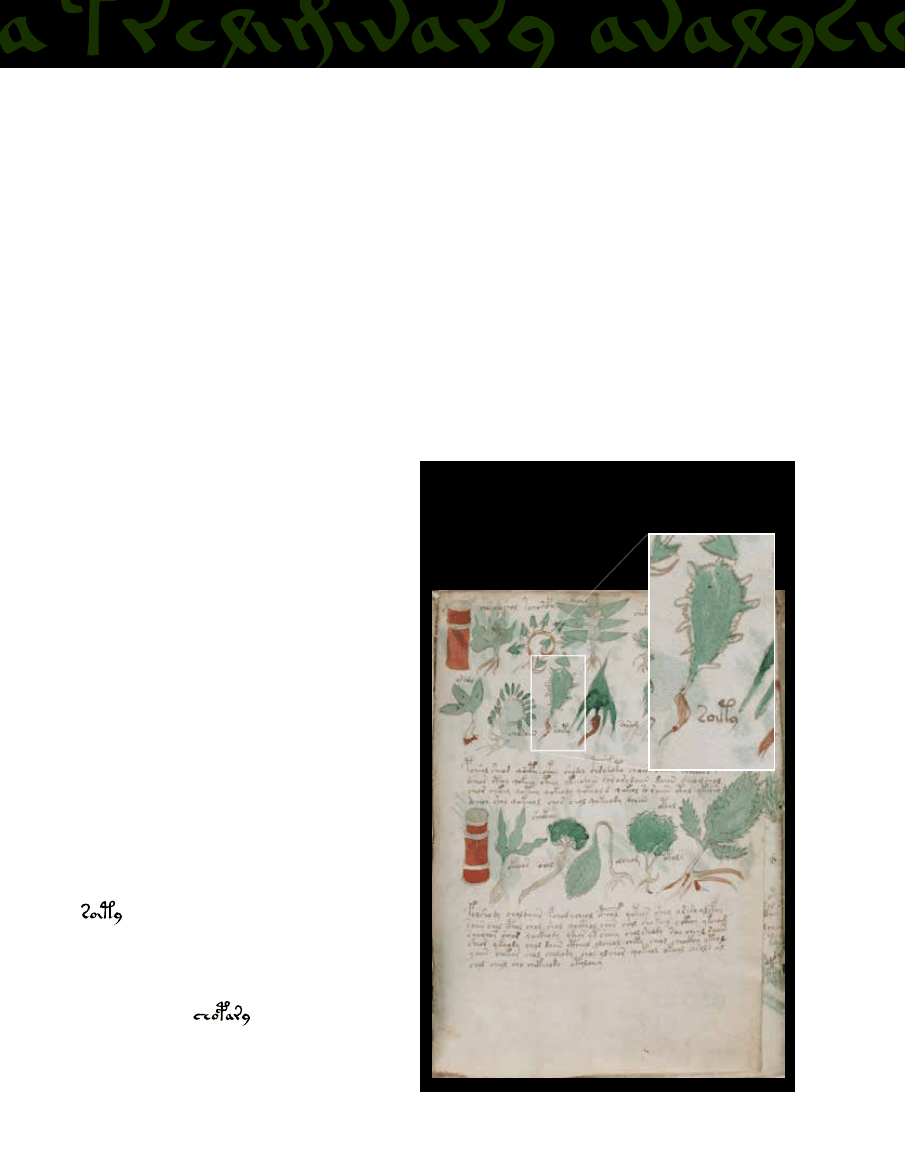
names. We were initially drawn to plant No. 8 of the
16 plants on folio 100r; this is obviously a cactus pad
or fruit, i.e., Opuntia spp., quite possibly Opuntia ficus-
indica (L.) Mill. (Cactaceae) or a related species. Thus,
is quite easily transliterated as nashtli, a variant
of nochtli, the Nahuatl (Aztec) name for the fruit of the
prickly pear cactus or the cactus itself. Then we looked
at plant No. 4 on folio 100r, which appears to be a
pressed specimen of a young Yucca spp. or Agave spp.,
quite possibly Agave atrovirens Karw. ex Salm-Dyck
(Agavaceae). Here
transliterates to maguoey,
or maguey. These initial keys of proper names allowed
us to uncover further names, and details are listed in
the Appendix of this article.
Not many of the names beyond nochtli and a few
others have correspondences in the nine manuscripts,
14
which include portrayals and discussions of 16th century
Mesoamerican plants, particularly Codex Cruz-Badianus
of 1552,
9-12
Hernández of ca. 1570-1577,
15
and Sahagún’s
Florentine Codex of ca. 1545-1590.
16
It should be remem-
bered that Hernández and his associates took surveys from
all over Mexico, and these works and their Nahuatl names
are not monolilthic, i.e., representing only one ethnic
group.
12
Thus, it is useful to distinguish the four classes of
Nahuatl plant names as outlined by Clayton, Guerrini, and
de Ávila in the Codex Cruz-Badianus:
12
1. primary ‘folk-generic’ names
that cannot at pres-
ent be analysed [sic] but which are likely to have been
known widely and to be present as cognates in the
modern Nahua languages…
2. compound ‘folk-generic’ names
…
3. ‘folk-specific’ names
, composed of a generic term
plus a qualifying epithet (which may be compounded
into the name), a class less likely to be widespread…
4. descriptive phrases
, which may have been coined by
Martin de la Cruz himself (see below) and which are
This illustration (fol. 100r) is obviously a cactus pad or fruit, i.e.,
Opuntia sp., quite possibly Opuntia ficus-indica or a related species.
Thus, the name accompanying the illustration is quite easily trans-
literated as nashtli, a variant of nochtli,
the Nahuatl (Aztec) name for the fruit
of the prickly pear cactus or the cactus
itself.
least likely to have been shared widely and to have
been preserved in contemporary languages….
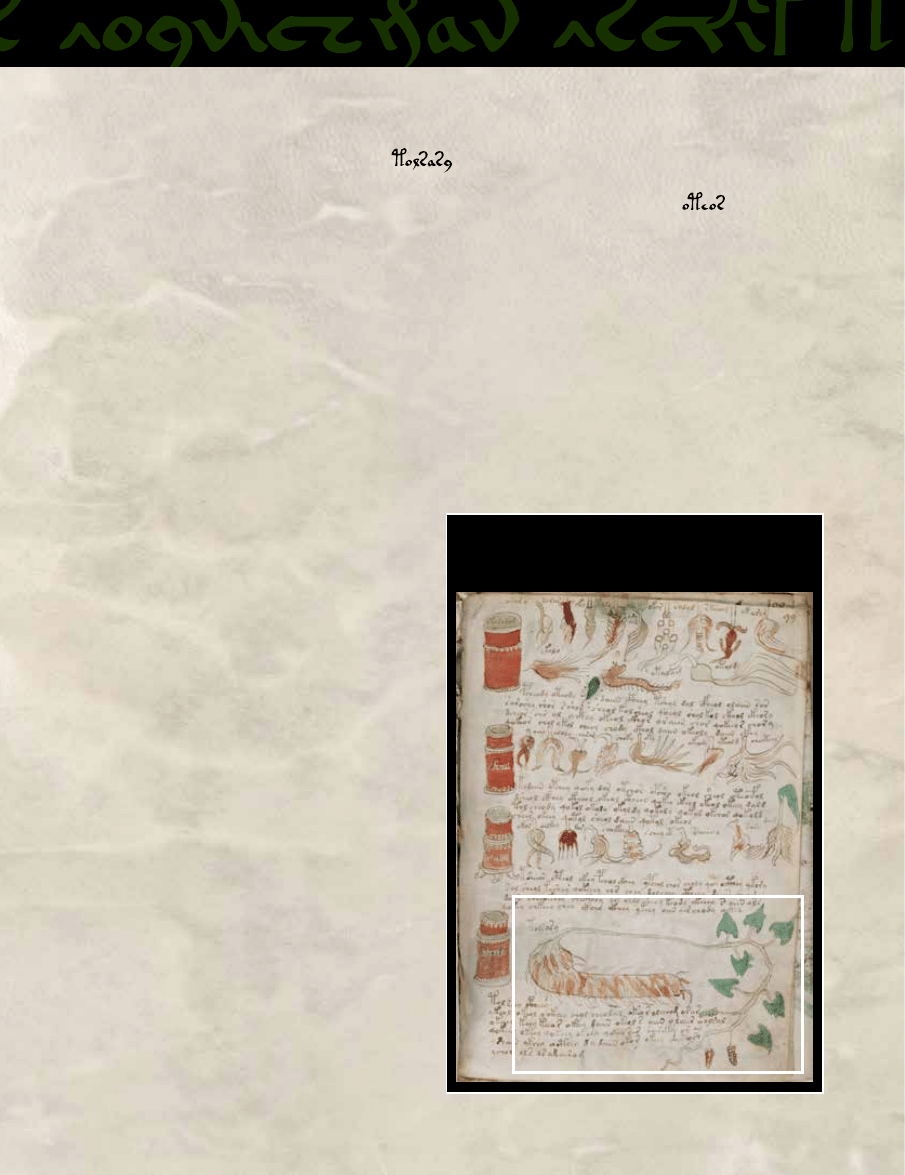
Thus the Nahuatl nochtli and the Spanish loan-word
maguey fit the primary ‘folk-generic’ names of Number 1
above, but the use of the Nahuatl tlacanoni (
)
— “bat” or “paddle” — for Dioscorea remotiflora Kunth
(Dioscoreaceae) in No. 28 on folio 99r, fits the descriptive
phrase of Number 4.
Further attempts at identifying the plants and their
Nahuatl names, when given, are presented in the Appen-
dix. Many of the identifications still need refinement. Also,
because we have been trained as botanists and horticultur-
ists, not linguists, our feeble attempts at a syllabary/alphabet
for the language in the Voynich Ms. must be interpreted
merely as a key for future researchers, not a fait accompli.
Much, much work remains to be done, and hypotheses will
be advanced for years.
Minerals and Pigments in the Voynich Manuscript
In 2009, McCrone Associates, a consulting research
laboratory hired by Yale University, filed a report on the
pigments in the Voynich Ms. with analyses done by chemist
Alfred Vendl, PhD. They found the following:
17
• Black ink = iron gall ink with potassium lead
oxide, potassium hydrogen phosphate, syngen-
ite, calcium sulfate, calcium carbonate, mercury
compound (traces), titanium compound, tin
compound (particle), bone black, gum binder
• Green pigment = copper-organic complex,
atacamite (possible to probable), calcium sulfate,
calcium carbonate, tin and iron compounds,
azurite and cuprite (traces), gum binder
• Blue pigment = azurite, cuprite (minor)
• Red-brown pigment = red ochre, lead oxide,
potassium compounds, iron sulfide, palmierite
• White pigment = proteinaceous, carbohydrate-
starch (traces).
This analysis was more thorough than the analy-
sis done on 16th century maps from Mexico, which
did not identify the chemical nature of the particles.
18
These pigments found by McCrone Associates in the
Voynich Ms. differ from those of European manu-
scripts.
19,20
In particular, atacamite is primarily from
the New World (it was named after the Atacama Desert
in Chile), and the presence of this New World mineral
in a European manuscript from prior to ca. 1576 would
be extremely suspicious.
However, these analyses remind us that the artist for
the Voynich Ms. had a very limited palette and thus one
blue pigment was used for all the hues, tints, and shades
of blue, i.e., colors from blue-to-purple, dark-to-light.
Likewise, one red pigment was used for colors from red-
to-coral, dark-to-light, etc.
Folio 102r includes a cubic (isometric) blue mineral
(No. 4) resembling a blue bouillon cube. This might
be boleite (KPb
26
Ag
9
Cu
24
Cl
62
(OH)
48
); the morphol-
ogy of the primitive drawing certainly matches very
closely. The only sources for large crystals of this qual-
ity and quantity are three closely related mines in Baja
California, Mexico, principally the mine at Santa Rosale (El
Boleo).
21,22
These crystals, 2-8 mm on the side, typically
occur embedded in atacamite. Copper compounds have
been used historically to treat pulmonary and skin diseases
and parasitic infections (e.g., shistosomiasis and bilharzia).
23
The presence of five drop-like circles on the surface of this
blue cube alludes to the Aztec logogram for water, atl,
9-12,16
and the name accompanying this,
, we transliterate
as atlaan, or atlan, “in or under the water.” Some miner-
als, e.g., tin (amochitl) and lead (temetstli), in the Florentine
Codex
16
also are illustrated with the atl logogram in allu-
sion to the color of mist and foam. The translation of the
accompanying text might tell us whether this blue cube and
its name are referring to a mineral, a watery color, water
itself, a technique of preparation, or even a calendar date.
Artistic Style: Emphasis of Plant Parts and
So-Called “Grafted” Plants
The senior author of this article taught Horticultural
Plant Materials at Delaware State University (DSU) for 36
years. Students had to learn the scientific name, the common
name, a field characteristic, and uses of major horticultural
plants ranging from significant conifers to houseplants
(within one semester!). The class involved frequent field
trips to collect living specimens. The students would inevi-
This illustration (fol. 99r) is most probably Dioscorea remotiflora,
which is native from northern to southern Mexico. The large root
is paddle- or bat-like, and the name attached to this illustration is
tlacanoni, Nahuatl (Aztec) for paddle or bat.
www.herbalgram.org
•
2013
•
I
S S U E
100
•
73
tably gravitate to a type of plant illustration that is depicted
in the Voynich Ms. For example, when they encountered
bird’s nest spruce (Picea abies (L.) H. Karst. ‘Nidiformis,’
Pinaceae) in every class that was taught, one student would
inevitably remark that the tips of the hooked needles of this
conifer resembled Velcro®. The students would then start
calling the bird’s nest spruce the “Velcro plant” and illus-
trate it in their notebooks with a circular bird’s nest outline
and needles that were far out of proportion with the rest
of the plant (a 0.5 inch needle was portrayed as a colossal
one foot grafted onto three-foot plant). That is to say, the
students omitted insignificant parts and enlarged impor-
tant portions accordingly, often seemingly grafting them
together. From a diversity of hundreds of students from
various ages and ethnic backgrounds at DSU, this proved
to be a common human pattern for notation and memori-
zation, at least among university students in 20
th
century
North America.
Thus, on folio 33v of the Voynich Ms., the illustration
matches Psacalium peltigerum (B. L. Rob. & Seaton) Rydb.
(Asteraceae) in botanical characters except for the size of the
flowers. This may allude to the importance of the flowers,
either for identification or use.
Also, following the same avenue of thought, in the case
of the so-called “grafted” plants, e.g., Manihot rubricaulis
I. M. Johnst. (Euphorbiaceae) on folio 93v, the artist may
have merely left out the unimportant parts to condense
the drawing to the limits of the paper size. This type
of illustration also occurs in Hernández,
15
e.g., tecpatli
(unknown, perhaps a Smallanthus spp., Asteraceae), teptepe-
hoila capitzxochitl (unknown, probably an Ipomoea sp.,
Convolvulaceae) and tlalmatzalin hocxotzincensi (Brazoria
arenaria Lundell, Lamiaceae), and uses the same sort of
artistic device to compress a large plant into a small illustra-
tion. However, in Hernández, the cut portion is skillfully
hidden from view, facing the back of the page. For chimalatl
peruina (Helianthus annuus L., Asteraceae) in Hernandez,
the top and bottom are shown side-by-side rather than
attached.
Plants, Language, and Other Evidence of a Post-
Conquest Central American Origin
The plants, animals, and minerals identified so far are
primarily distributed from Texas, west to California, and
south to Nicaragua, indicating a botanic garden somewhere
in central Mexico.
Sources of Calligraphy in the Voynich Ms.
In 1821, Sequoyah (George Gist) created the Chero-
kee syllabary by modifying letters from Latin, Greek, and
Cyrillic that he had encountered. Following this example,
what was the inspiration for the calligraphy in the Voynich
Ms.? Focusing upon the four most unique symbols (
) in the Voynich Ms. and perusing documents from
Nueva España 1521-ca. 1576, only one document reveals
some calligraphy that might have served as inspiration for
the Voynich Ms.: the Codex Osuna.
24
In the Codex Osuna,
there consistently is a broken version of “tl” in the Nahuatl
that matches the same symbol “ ” in the Voynich Ms.,
and on folio 12v of the Codex Osuna, there is an identical
version of “ ” on the lower left. Throughout the Codex
Osuna (e.g., folio 37v), the “s” in the Nahuatl is often writ-
ten as a large, conspicuous, backward version of that from
the Voynich Ms. “ ”. On folios 13v and 14r of the Codex
Osuna, the florid Spanish signatures have several inspira-
tions for the “ ” in the Voynich Ms. On folio 39r of the
Codex Osuna, the “z” is written in a very similar manner to
the “ ” in the Voynich Ms.
The Codex Osuna
24
was written between 1563-1566 in
Mexico City and actually consists of seven books; it is not
a codex in the strict definition. According to the Biblioteca
Nacional, Madrid (Control No. biam00000085605), where
it is listed as Pintura del gobernador, alcades y regidones de
México, the Codex Osuna was:
A 16th century pictographic manuscript, written in
Mexico. It contains the declarations of the accused and
the eye witnesses made in New Spain by Jerónimo de
Valderrama, by order of Philip II between 1563-1566, to
investigate the charges presented against the Viceroy, Luis
de Velasco, and the other Spanish authorities that partici-
pated in the government of said Viceroy. These people
and their testimonies are represented by pictographs,
followed by an explanation in the Nahuatl and Castilian
languages, as the scribes translated the declarations of the
Indians by means of interpreters or Nahuatlatos.
The Codex Osuna was donated in 1883 to the Biblio-
teca Nacional by the estate of Don Mariano Téllez-Girón
y Beaufort-Spontin (1814-1882), 12th Duke of Osuna and
15th Duke of the Infantado.
The use of “tl” and “chi” endings places this dialect of
Nahuatl in central or northern Mexico.
25,26
The use of
Classic Nahuatl, Mixtec, and Spanish loan-words for some
plant names (see Appendix) also indicates an origin in
central Mexico.
Other Indications of a 16th Century Mexican Origin
A number of other features of the Voynich Ms. also
point to a Mesoamerican origin. For example, a “bird
glyph” (folio 1r) as a paragraph marker is not known by the
authors of this paper to exist in European manuscripts but
as common in Post-Conquest Mexican manuscripts, e.g.,
the Codex Osuna
24
and the Codex Mendoza
27
(among
many others).
A volcano is pictured on the top left side of folio 86v,
within the crease. Mexico has roughly 43 active or extinct
volcanoes, most centered near Mexico City. The most
famous in recent centuries has been Popocatepetl in More-
los, southeast of Mexico City, a World Heritage Site of 16th
century monasteries.
Animals in the Voynich Ms.
The fish illustrated on folio 70r are most definitely the
alligator gar [Atractosteus spatula (Lacepède, 1803)]. This
fish is very distinctive because of its pointed snout, length/
width ratio, prominent interlocking scales (ganoid scales),
and the “primitive” shape and distribution of the rear fins.
The alligator gar is found only in North America.
28
The
Nahuatl name accompanying this illustration, otolal, trans-
literated to atlacaaca, means someone who is a fishing folk
(atlaca, “fishing folk” + aca, “someone”). Curiously, there
74
•
I
S S U E
100
•
2013
•
www.herbalgram.org
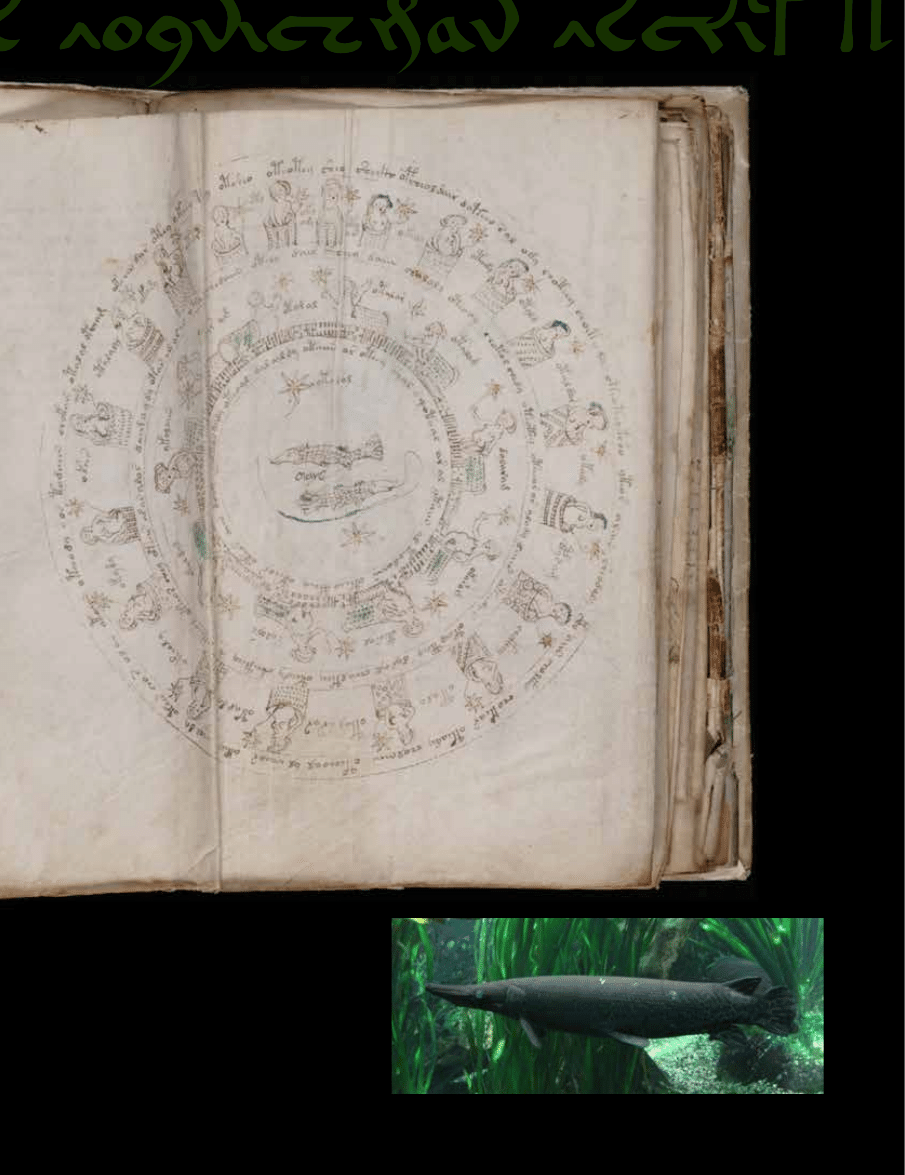
The fish illustrated on fol. 70r are most definitely
the alligator gar (Atractosteus spatula). This fish
is very distinctive with its pointed snout, length/
width ratio, prominent interlocking scales (ganoid
scales), and the “primitive” shape and distribution
of the rear fins. The alligator gar is found only in
North America. The Nahuatl (Aztec) name accom-
panying this illustration, atlacaaca means someone
who is a fishing folk (atlaca, fishing folk + aca,
someone). Curiously, there is an addition of what
seems to be “Mars” (French, March?) in a darker,
different ink and handwriting at this illustration.
www.herbalgram.org
• 2013 •
I
S S U E
100 • 75

76
•
I
S S U E
100
•
2013
•
www.herbalgram.org
is an addition with this illustration of what seems to be
“Mars” (French for March, perhaps?) in darker ink and
different handwriting.
The dark-red bull illustrated on folio 71v is the Retinta
breed of cattle (Bos taurus taurus Linnaeus, 1758), while
the pale red is an Andalusian Red. Both of these types
of cattle are notable for their upward curved antlers. The
Spanish introduced Andalusian, Corriente, and Retinta
cattle to North America as early as 1493 with Ponce de
León in Florida. Cortés introduced cattle to Mexico some
30 years later. These breeds were chosen for their ability
to survive the long sea voyage and later to endure graz-
ing on just minimal “scrub lands.” Descendants of these
cattle in North America, albeit with later interbreeding
with dairy cattle, are Texas Longhorn cattle and Florida
Cracker/Scrub/Pineywoods cattle.
29
Curiously, on the
illustration in the Voynich Ms., there is an addition in a
darker, different ink and handwriting that seems to read
“Ma.”
The crustaceans illustrated on folio 71v match the
morphology of the Mexican crayfish, Cambarellus monte-
zumae (Saussure, 1857). Acocil (from the Nahuatl cuitzilli)
are found in a broad section across Mexico.
28
The cat illustrated on folio 72r is the ocelot [Leopardus
pardalis (Linnaeus, 1758)]. The stripes across the face,
the rounded ears, and the gray spotting (illustrated with
the blue pigment) are all characteristic of this cat. This
species ranges from Texas to Argentina.
28
Oddly, “angst”
is written in a darker ink and different handwriting.
The sheep on folios 70v and 71r are bighorn sheep
(Ovis canadensis Shaw, 1804). The hooves (two-cleft and
hollow to clasp rocks) indicate that this might be the
desert bighorn sheep (O. canadensis mexicana Merriam,
1901), which are found in deserts in southwestern North
America and across Mexico.
28
What seems to be the
word “abime” (French for chasm or abyss) is attached to
this illustration in a different handwriting and a darker
ink.
A black Gulf Coast jaguarundi [Puma yagouaroundi
cacomitli (Berlandier, 1859)] is portrayed on folio 73 (with
what appears to be “noūba,” French for spree, written over
the original writing with a darker, different ink). This
cat, which has brown and black phases, is very distinctive
in profile with a flatter face than most cats; the overall
aspect of the face almost resembles a monkey. The tail is
also notable, very long and particularly bushy at the base.
Additional tiny animals apparently are used as decora-
tive elements and are difficult to identify: (1) a chame-
leon-like lizard (quite possibly inspired by the Texas
horned lizard, Phrynosoma cornutum [Harlan 1825])
nibbling a leaf on folio 25v, (2) two caecilians [wormlike
amphibians, probably inspired by Dermophis mexicanus
(Duméril & Bibron, 1841)] in the roots of the plant on
folio 49r, and (3) five animals at the bottom of folio 79v.
Other Evidence of Mexican Origin: The Influence of
the Catholic Church
Besides Spanish loan-words, other indications of the
European influence on Post-Conquest Mexico are the
so-called “maiorica” or pharmaceutical containers in
the “Pharma pages.” The sharp edges, filgree, lack of
painted decoration, and general design allude to inspira-
tion by metal objects, not ceramic or glass. The immedi-
ate suggestions for inspiration were the ciboria and oil
stocks of 16th century Spanish Catholic church ceremo-
nies. The former consists of a capped chalice, often on
a highly ornamented stand, which stores the Eucharist.
The latter consists of a cylindrical case comprising three
compartments that screw into each other and hold the
holy oils. Using these holy objects as designs for pharma-
ceutical containers would have been a mockery of the reli-
gion forced upon the conquered natives and thus another
reason for writing in code. A ciborium also appears on
folio 67r of the Codex Aubin.
30
Future Avenues for Research
The Aztec elite were highly educated and hygienic.
Cortéz reported libraries, called amoxcalli (Nahuatl for
book house), complete with librarians and scribes. The
Spanish conquistadors, along with the office of the Holy
Inquisition burnt them all because of their “superstitious
idolatry” (translated words of Juan de Zumarraga, first
Archbishop of Mexico).
14
Axiomatically, the Spanish priests established schools
for children of the Aztec elite, teaching them European
writing methods, painting, and Latin. Probably one of
the most famous products of these schools, the Codex
Cruz-Badianus, was completed by two students educated
The plants, animals, and
minerals identified so far are
primarily distributed from
Texas, west to California, and
south to Nicaragua, indicating
a botanic garden somewhere in
central Mexico.

at the College of Santa Cruz in Tlatelolco. It was written in
Nahuatl by Martin de la Cruz — a native convert and prac-
ticing physician at the College of Santa Cruz — and trans-
lated into Latin by Juan Badiano, another native convert
and student of the College. Two versions of this manuscript
exist, the original Codex Cruz-Badianus, formerly in the
Vatican, returned in 1990 by Pope Paul II to Mexico (now
at the Biblioteca Nacional de Antropologie e Historia in
Mexico City [F1219 B135 1940]), and a later copy at the
Royal Library of Windsor Castle (RCIN970335).
9-12
The Aztecs also were the first to establish comprehen-
sive botanic gardens, which later inspired those in Europe.
Gardens were in Tenochtitlan, Chapultepec, Ixtapalapa, el
Peñon, and Texcoco, as well as more distant ones such as
Huaztepec (Morelos). Some of these botanic gardens, such
as Huaztepec, included water features for ritualistic bath-
ing. Coupled with this was the use of the temezcalli, or
sweatbaths.
31,32
Besides outright destruction of the libraries by Spanish
invaders, much of this accumulated indigenous knowl-
edge also was destroyed by diseases, both imported and
endemic. According to epidemiologist Rodolfo Acuña-Soto
and colleagues,
33
the population collapse in 16th century
Mexico — a period of one of the highest death rates in
history — shows that not only were European diseases
devastating, but an indigenous hemorrhagic fever also may
have played a large role in the high mortality rate. On top
of the smallpox epidemic of 1519-1520, when an estimated
5-8 million natives perished in Mexico, the epidemics of
1545 and 1576 were due primarily to cocoliztli (“pest” in
Nahuatl). These latter epidemics occurred during moist
years following devastating droughts, providing food for
a surge of rodents, which eventually killed an additional
estimated 7-17 million people in the highlands of Mexico,
roughly 90% of the population.
33
This pattern is similar
to the sudden, severe epidemics of other zoonoses (diseases
of animal origin that can be transmitted to humans).
34
Thus, the author(s) and artist(s) (tlacuilo, the native painter-
scribes) of the Voynich Ms. may have perished in one of
these epidemics, along with the speakers of their particular
dialect.
Questions in the following paragraphs are particularly
pertinent to fully establish this as the work of a 16th century
ticitl (Nahuatl for doctor or seer).
35,36
Interpretation of the flora and languages of Mexico is
a difficult task even today. Mexico is extremely diverse
in both floristics and ethnic groups, with approximately
20,000 plants and at least 30 extant dialects of Nahuatl.
12
We are confident that our attempts at a preliminary sylla-
bary for the Voynich Ms. can be refined. What are the
linguistic affinities of this dialect to extant dialects of
Nahuatl? Is this dialect truly extinct?
A six- to eight-pointed star, especially in the latter folios
of the Voynich Ms. (103r-116r, where it often is dotted
with red in the center), is used as a paragraph marker. Is
this reminiscent of the eight-pointed Mexica Sun Stone or
Calendar Stone? On the top center of folio 82r, the eight-
pointed star is quite strikingly similar to this stone. This
stone was unearthed in 1790 at El Zócalo, Mexico City, and
is now at the capital’s National Museum of Anthropology.
One interpretation of the face in the center of this stone is
Tonatiuh, the Aztec deity of the sun. Another interpretation
of the face is Tlatechutli, the Mexica sun or earth monster.
An identical eight-pointed star also appears on folio 60 of
the Codex Aubin.
30
What is the influence of the sibyls in the murals at the
Casa del Deán (Puebla) on the portrayal of the women in
the Voynich Ms.? The Casa del Deán originally belonged
to Don Tomás de la Plaza Goes, who was dean of Puebla
from 1553 to 1589 and second in command to the bishop.
The murals were executed by native artists, tlacuilo, whose
names are unknown. Undoubtedly, much was destroyed
through the centuries, and only two restored rooms remain.
In La Sala de las Sibilias, or Room of the Sibyls, female
prophets from Greek mythology narrate the passion of
Christ. The women in the murals at the Casa del Deán have
short hair and European features, and the friezes include
nude angels and satyrs.
How was the parchment, which may date to animals
killed in the first half of the 15th century, used over a full
century later for this manuscript?
37
How did putative medi-
eval German script on folio 166v (the so-called “Michiton
Olababas page”) get integrated into this manuscript? Was
this a case of European parchment being repurposed?
Copal resins (most commonly used for incense) were
often used as binders in Mesoamerican pigments.
18,38
McCrone Associates supposedly documented the IR spec-
trum of the resin.
17
Is this a copal resin from a Meso-Ameri-
can species, such as Protium copal (Schltdl. & Cham.) Engl.,
Hymenaea courbaril L. (Fabaceae), or Bursera bipinnata
(Moç. & Sessé ex DC.) Engl. (Burseraceae)?
What was the chain of evidence from post-Conquest
Mexico to the court of Rudolph II? The circuitous route
of the Codex Mendoza is perhaps illustrative of the fact
that materials did not always flow directly from New Spain
(present-day Mexico) to Spain, and European materials
were quite often used for writing (rather than the native
amate paper, amatl in Nahuatl). The Codex Mendoza was
created in Mexico City on European paper about 20 years
(ca. 1541) after the Spanish conquest of Mexico for Charles
V, Holy Roman Emperor and King of Spain. It was sent by
ship to Spain, but the fleet was attacked by French corsairs
(privateers), and the Codex, along with the other booty,
was taken to France. From there it came into possession of
André Thévet, cosmographer to Henry II of France. Thévet
wrote his name in five places in the Codex, twice with the
date of 1553. It was later sold to Richard Hakluyt around
1587 for 20 francs (Hakluyt was in France from 1583-1588
as secretary to Sir Edward Stafford, English Member of
Parliament, courtier and diplomat to France during the
time of Queen Elizabeth I). Sometime near 1616 it was
passed to Samuel Purchas, then to his son, and then to John
Selden. The Codex Mendoza has been held at the Bodle-
ian Library at Oxford University since 1659, five years after
Selden’s death.
27
Another question is the involvement of John Dee (1527-
1608/1609), if any. Dee — a Welsh mathematician, astrono-
mer, astrologer, occultist, navigator, imperialist, and consul-
tant to Queen Elizabeth I — purchased an Aztec obsidian
“shew-stone” (mirror) in Europe between 1527-1530 (this
www.herbalgram.org
•
2013
•
I
S S U E
100
•
77
object was subsequently owned by Horace Walpole). Dee
was in Paris in the 1550s, and a letter dated 1675 quoted
Arthur Dee, son of John Dee, saying that he had seen his
father spending much time over a book “all in hierolyph-
icks.” Dee also is suspected of being the sales agent to
Rudolf II, ca. 1584-1588.
2-5
Conclusion
We note that the style of the drawings in the Voynich
Ms. is similar to 16th century codices from Mexico (e.g.,
Codex Cruz-Badianus). With this prompt, we have identi-
fied a total of 37 of the 303 plants illustrated in the Voynich
Ms. (roughly 12.5% of the total), the six principal animals,
and the single illustrated mineral. The primary geographi-
cal distribution of these materials, identified so far, is from
Texas, west to California, south to Nicaragua, pointing to a
botanic garden in central Mexico, quite possibly Huaztepec
(Morelos). A search of surviving codices and manuscripts
from Nueva España in the 16th century, reveals the callig-
raphy of the Voynich Ms. to be similar to the Codex Osuna
(1563-1566, Mexico City). Loan-words for the plant and
animal names have been identified from Classical Nahuatl,
Spanish, Taino, and Mixtec. The main text, however, seems
to be in an extinct dialect of Nahuatl from central Mexico,
possibly Morelos or Puebla.
Appendix: Plants Identified to Date
Beyond the approximately 172 plants, plant parts, and
minerals in the “pharma section,” the “herbal section”
includes about 131 plants. In the following, we have indi-
cated only identifications that immediately “jumped out”
to us with seemingly sound identifications. We have many
more putative identifications, but these still are question-
able, so they have been reserved for later publication. Unless
financing could be procured for a large-scale project with
leading scholars in botany, linguistics, and anthropology,
decades of research remain. After all, we indicate only 37
plant identifications in the following pages (and boleite
mineral) from a total of roughly 303 taxa (a meager 12.5%
approximation of the total). And the text, bathing prac-
tices, astrology/astronomy, chain of evidence, etc., also need
explanation.
Throughout this HerbalGram article, nomenclature and
plant distributions follow the United States Department
of Agriculture’s GRIN taxonomic database,
39
and/or The
Plant List produced by the Missouri Botanical Garden and
Royal Botanic Garden, Kew,
40
and/or the Integrated Taxo-
nomic System (ITIS),
28
unless otherwise indicated. The
plants are listed below, alphabetically by family.
Apiaceae (Carrot Family)
Probably the most phantasmagoric illustration in the
Voynich Manuscript is the Eryngium species portrayed on
folio 16v. The inflorescence is colored blue, the leaves red,
and the rhizome ochre, but the features verge on a stylized
appearance rather than the botanical accuracy of the Viola
bicolor of folio 9v, immediately suggesting that more than
one tlacuilo (painter, artist) was involved. This lack of tech-
nical attention makes identification beyond genus difficult,
if not impossible. However, a guess might be E. heterophyl-
lum Engelm.
41
This species, native to Mexico, Arizona,
New Mexico, Louisiana, and Texas, has similar blue inflo-
rescences, blue involucral bracts (whorl of leaves subtending
the inflorescence), and stout roots, and it also develops rosy
coloring on the stems and basal leaves. However, E. hetero-
phyllum has pinnately compound leaves (leaflets arranged
on each side of a common petiole), not peltate (umbrella-
shaped) leaves. This lack of specificity on the shape of the
leaves also plagues identifications in the Codex Cruz-Badia-
nus.
12
Today, E. heterophyllum, Wright’s eryngo or Mexican
eryngo, is used to treat gallstones in Mexico and has been
found in in vivo experiments to have a hypocholesteremic
effect.
42
Apocynaceae (Dogbane Family)
Plant No. 14 on folio 100r appears to be the fruit of an
asclepiad, possibly the Mexican species Gonolobus chloran-
thus Schltdl. The name
transliterates to acamaaya,
a variant of acamaya, “crab” or “crayfish,” and the fruit of
G. chloranthus does have a resemblance to knobby, ridged
crab claws. The tlallayoptli in Hernández,
13
with a similar
illustration of the fruit (but with smooth ribs), is nominally
accepted as the related species G. erianthus Decne., or Cala-
baza silvestre. The roots of G. niger (Cav.) Schult. are used
today in Mexico to treat gonorrhea.
43
Araceae (Arum Family)
Plant No. 7 on folio 100r appears to be the leaf of an
aroid, most likely the Mexican species Philodendron goeldii
G. M. Barroso. The name
transliterates as maca-
nol, which refers to the wooden sword, macana (a Taino
word, called macuahuitl by some authorities for the Aztec
version), studded with slices of razor-sharp obsidian.
Plant No. 2 on folio 100r also appears to be a vine of
an aroid, ripped from a tree, most probably Philodendron
mexicanum Engl. The name
transliterates as
namaepi, which may incorporate a loan-word from Mixtec
referring to soap, nama, which is a plant that produces
soap.
44
Author Deni Bown writes of the Araceae in general:
“Most of the species of Araceae which are used internally for
bronchial problems contain saponins, soap-like glycosides
which increase the permeability of membranes to assist
in the absorption of minerals but also irritate the mucous
membranes and make it more effective to cough up phlegm
and other unwanted substances in the lungs and bronchial
passages.”
45
Asparagaceae (the Asparagus Family, alternatively
Agavaceae, the Agave Family)
Plant No. 4 on folio 100r appears to be a pressed speci-
men of a young Yucca species or Agave species. Here
transliterates to maguoey, or maguey, a name that
entered Spanish from the Taino in the middle of the 16th
century,
46
rather than the Nahuatl metl. Thus, this may
quite possibly be Agave atrovirens Karw. ex Salm-Dyck,
which was a source for the beverages pulque, mescal, and
tequila in 16th century Nueva España.
47,48
Mayaguil was
the female goddess associated with the maguey plant as
outlined in the Codex Rios of 1547-1566:
49
78
•
I
S S U E
100
•
2013
•
www.herbalgram.org
www.herbalgram.org
•
2013
•
I
S S U E
100
•
79
Rios 15 (20v) Eighth Trecena: Mayaguil (Mayahuel)
They feign that Mayaguil was a woman with four
hundred breasts, and that the gods, on account of her
fruitfulness, changed her into the Maguei (Maguey
plant), which is the vine of that country, from which
they make wine. She presided over these thirteen signs:
but whoever chanced to be born on the first sign of the
Herb (Grass), it proved unlucky to him; for they say that
it was applied to the Tlamatzatzguex, who were a race of
demons dwelling amongst them, who according to their
account wandered through the air, from whom the minis-
ters of their temples took their denomination. When this
sign arrived, parents enjoined their children not to leave
the house, lest any misfortune or unlucky accident should
befall them. They believed that those who were born in
Two Canes (Reed), which is the second sign, would be
long lived, for they say that sign was applied to Heaven.
They manufacture so many things from this plant called
the Maguei, and it is so very useful in that country, that
the Devil took occasion to induce them to believe that it
was a god, and to worship and offer sacrifices to it.
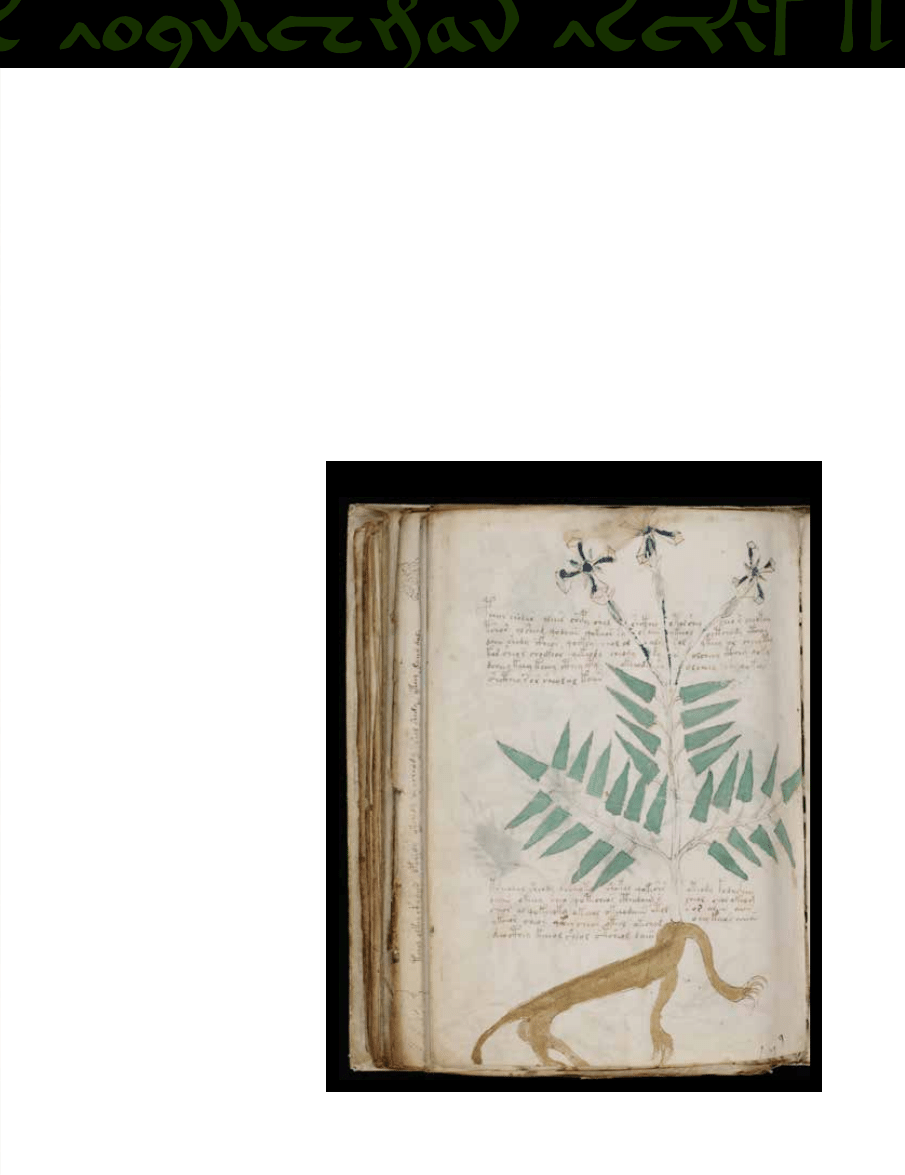
Asteraceae (Daisy Family)
In 1944, the Rev. Hugh O’Neill
at Catholic University wrote that
the plant illustrated on folio 93r
is sunflower, Helianthus annuus
L. He wrote that six botanists
agreed with him,
50
but, in spite of
this, non-botanists disagreed. This
is most certainly the sunflower,
called chimalatl peruiana in
Hernández.
15
The difficulty of
portraying an exceedingly tall
annual is conveyed in Hernán-
dez by having cut stems side-by-
side, but in the Voynich Ms. the
features are deeply compressed,
possibly confusing non-botanists,
but perhaps more difficult is the
admission that the Voynich Ms.
may be post-1492 or possibly from
the New World!
The plant illustrated on folio
13r is probably a Petasites sp. The
closest match might be P. frigi-
dus (L.) Fr. var. palmatus (Aiton)
Cronquist, the western sweet-
coltsfoot. This is native to North
America, from Canada to Cali-
fornia. Petasites spp. are used in
salves or poultices as antiasthmat-
ics, antispasmodics, and expecto-
rants.
51
The plant illustrated on folio
33v is likely Psacalium peltigerum
(B. L. Rob. & Seaton) Rydb.,
possibly var. latilobum Pippen.
52,53
This is a fairly good match to this
New World asterid genus as to
its lobed peltate (umbrella-shaped) leaves, inflorescence,
and fleshy subterranean tubers, except that the flowers are
shown in larger size than reality, perhaps to emphasize the
identification or use. Psacalium peltigerum is known from
the Mexican states of Jalisco, Guadalajara, and Guerrero,
but the variety P. latilobum is restricted to Guerrero. Psaca-
lium peltatum (Kunth) Cass. is used for genito-urinary tract/
reproduction treatment and for rheumatism in Mexico.
54
Boraginaceae (Borage Family, Alternatively
Hydrophyllaceae, the Waterleaf Family)
The plant illustrated folio 56r is almost certainly Phacelia
campanularia A. Gray, the California bluebell. The blue
flowers, dentate (toothed) leaves, scorpioid cyme (inflores-
cence coiled at the apex), and overlapping leaf-like basal
scales are all good matches. This species is native to Cali-
fornia.
Brassicaceae (Mustard Family)
The plant illustrated on folio 90v is most probably
Caulanthus heterophyllus (Nutt.) Payson, San Diego wild
The plant illustrated on fol. 90v is most probably Caulanthus heterophyllus (Nutt.) Payson,
San Diego wild cabbage or San Diego jewelflower.
cabbage or San Diego jewelflower. The flowers of C. hetero-
phyllus are four-petaled, white with a purple streak down the
center, with four protruding, dark purple anthers. Leaves
vary from dentate (toothed) to lobed. It is native to Califor-
nia and Baja California.
Cactaceae (Cactus Family)
Plant No. 8 on folio 100r is obviously a cactus pad or
fruit, i.e., Opuntia spp., quite possibly Opuntia ficus-indica
(L.) Mill. or a related species (e.g., O. megacantha Salm-
Dyck or O. streptacantha Lem.).
47
Thus,
quite easily
is transliterated as nashtli, a variant of nochtli, the Nahuatl
name for the fruit of the prickly pear cactus or the cactus
itself (the pads are called nopalli). Opuntia ficus-indica is
widely cultivated but apparently native to central Mexico.
Nopalea cochenillifera (L.) Salm-Dyck also is cultivated
widely for the insect that is the source for cochineal.
55
Caryophyllaceae (Carnation Family)
The plant illustrated on folio 24r is probably a Silene
sp., possibly S. menziesii Hook., Menzie’s catchfly. This
grows natively from Alaska to California and New Mexico.
The flowers are a good match, even showing the infection
with the fungus Microbotryum violaceum (Pers.) G. Deml
& Oberw., anther smut fungus, which turns the anthers
purple. However, the leaves are shown as hastate (arrow-
head-shaped), and S. menziesii has attenuate (gradually
narrowing to the base) leaf bases. Is this another case of
disparity of the leaves between reality and portrayal, or is
there another Silene species that is closer to the illustration?
Convolvulaceae (Morning Glory Family)
As mentioned previously, the plant illustrated on folio
1v is Ipomoea arborescens (Humb. & Bonpl. ex Willd.) G.
Don, found from northern to southern Mexico. It is over-
whelmingly similar to the xiuhamolli/xiuhhamolli (soap
plant) in the Codex Cruz-Badianus
9-12
of Mexico from
1552. Both trees have a large, broad, gray-to-whitish basal
woody caudex (base) with ridged bark, portrayed here with
broken coarse roots that resemble toenails. The plant in
the Codex Cruz-Badianus is in both bud and flower with
leaves that have a cuneate (wedge-shaped) base, while the
plant in the Voynich Ms., has only one bud with leaves that
have a cordate (heart-shaped) base. The illustration in the
Codex Cruz-Badianus is nominally accepted as I. murucoi-
des Roem. & Schult. by leading commentators.
9-12
The plant illustrated on folio 32v is probably I. pubescens
Lam., silky morning-glory. This vine is native to Arizona as
well as New Mexico to Argentina. The blue flowers, deeply
lobed leaves, and tuberous roots are all characteristic of silky
morning-glory.
Species of Ipomoea are known for their resin glycosides
and use in treating several conditions, such as diabetes,
hypertension, dysentery, constipation, fatigue, arthritis,
rheumatism, hydrocephaly, meningitis, kidney ailments,
and inflammation.
56-58
In addition, the arborescent
Ipomoea species, I. murucoides and I. arborescens, are used in
hair and skin care, especially the ashes, which are used to
prepare soap.
55,58
While the bases of both of the arborescent
species are portrayed somewhat accurately, Clayton, Guer-
rini, and de Ávila
12
state that, “The blue patch with small,
white ovate glyphs at the base of the plant is the symbol for
flowing water.” This may be related to the story relayed by
Standley for I. arborescens: “In Morelos there is a popu-
lar belief that the tree causes imbecility and other cerebral
affections [sic], and for this it is necessary only to drink the
water running at the foot of the trees.”
55
Dioscoreaceae (Yam Family)
The vine illustrated as No. 28 on folio 99r is likely
Dioscorea remotiflora Kunth, native from northern to south-
ern Mexico. The large root is paddle- or bat-like, and the
name attached to this illustration is
, tlacanoni,
Nahuatl for paddle or bat.
The vine illustrated on folio 17v may very well be Dioscorea
composita Hemsl., barbasco, native from northern to southern
Mexico. The root quite often is segmented as shown in the
Voynich Ms. and is a major source of diosgenin, a hormone
precursor.
The vine illustrated on folio 96v is almost certainly
Dioscorea mexicana Scheidw., Mexican yam. This also is
native from northern to southern Mexico. This is another
source of diosgenin.
Euphorbiaceae (Spurge Family)
The plant illustrated on folio 6v is very likely a Cnidoscolus
sp., either C. chayamansa McVaugh or C. aconitifolius (Mill.)
I. M. Johnst. Both are called chaya and are widely cultivated
from Mexico to Nicaragua. The characteristic leaves and
spiny fruit are both good fits, but because of the variability
in both species (especially cultivated selections), it is difficult
to tell for sure from the crude illustration that is portrayed.
59
The plant illustrated on folio 5v is most probably Jatropha
cathartica Terán & Berland., jicamilla. The palmately dentate
(toothed) leaves, red flowers, and tuberous roots are all good
fits for the species. Its native habitats are from Texas to north-
ern Mexico. As the scientific name implies, this is cathartic
and poisonous.
The plant illustrated on folio 93v is most likely Manihot
rubricaulis I. M. Johnst. from northern Mexico. This close
relative to the cassava, M. esculenta Crantz, has thinner,
more deeply lobed leaves. Manihot rubricaulis is illustrated in
Hernández
15
as chichimecapatli or yamanquipatlis (gentle or
weak medicine).
Fabaceae (Bean Family)
Plant No. 11 on folio 88r is almost certainly Lupinus
montanus Humb., Bonpl., & Kunth of Mexico and Central
America. This lupine is noted to contain alkaloids.
60
The
name attached to this is
,
aguocacha, which we trans-
late as watery calluses. The compound peltate leaves and soft,
callus-like, nitrogen-fixing root nodules (knobs) on one side
of the roots are typical of this species.
Grossulariaceae (Gooseberry Family)
The plant illustrated on folio 23r is probably Ribes malva-
ceum Sm., chaparral currant. This woody, stoloniferous shrub
has purple-magenta flowers and palmately (arranged like a
hand) lobed leaves and is endemic to California south to Baja
Norte, Mexico.
55
80
•
I
S S U E
100
•
2013
•
www.herbalgram.org
www.herbalgram.org
•
2013
•
I
S S U E
100
•
81
Lamiaceae (Mint Family)
The plant illustrated on folio 45v is very possibly Hyptis
albida Kunth, hierba del burro. The gray leaves, blue flow-
ers, and stout root all match the characteristics of the
species. This shrub is native to Sonora and Chihuahua to
San Luis Potosí, Guanajuato, and Guerrero. Standley
55
relates that “the leaves are sometimes used for flavoring
food. In Sinaloa they are employed as a remedy for ear-ache,
and in Guerrero a decoction of the plant is used in fomenta-
tions to relieve rheumatic pains.”
The plant illustrated on folio 32r is most likely Ocimum
campechianum Mill. (O. micranthum Willd.). This suffru-
tescent (low-shrubby) annual basil grows indigenously from
Florida to Argentina; in Mexico it is found from Sinaloa
to Tamaulipas, Yucatán, and Colima.
55
The inflorescence
and leaves are both good matches. Standley
55
relates, “In El
Salvador bunches of the leaves of this plant are put in the
ears as a remedy for earache.”
Plant No. 5 on folio
100r has three flowers
that match Salazaria mexi-
cana Torr., or bladdersage.
This species also seems to
match the description of
tenamaznanapoloa (carry-
ing triplets?) of Hernán-
dez
15
(alias tenamazton
or tlalamatl). This shrub,
native from Utah to
Mexico (Baja California,
Chihuahua, and Coahuila),
exhibits inflated bladder-
like calyces that vary in
color, depending upon maturity, from green to white to
magenta, with a dark blue-and-white corolla emerging from
it.
55
We have transliterated the name accompanying these
three flowers,
as noe, moe-choll-chi.
The name choll-chi we translate as skull-owl (Spanish cholla
plus Nahuatl root chi), and, indeed, the flowers do bear an
uncanny resemblance to the white skull and black beak of
the great horned owl (Bubo virginianus Gmelin 1788).
The plant on folio 45r most likely is Salvia cacaliifolia
Benth., endemic to Mexico (Chiapas), Guatemala, and
Honduras. The blue flowers in a tripartite inflorescence
(branching in threes) with distantly dentate (toothed)
deltoid-hastate (triangular-arrowhead-shaped) leaves are
quite characteristic of this species.
61
Marantaceae (Prayer Plant Family)
The plant illustrated on folio 42v is a crude representa-
tion of a Calathea spp., probably allied to C. loeseneri J.
This illustration from the
Voynich Ms. (fol. 23v) is
quite definitely Passiflora
subgenus Decaloba. The
flower (A) with promi-
nent petals and reduced
sepals and the paired
petiolar glands in the
upper third of the leaf (B)
fit quite well. The dentate
(toothed) leaves that are
deeply cordate (heart-
shaped) only seem to
match the variability of P.
morifolia Mast. in Mart.,
although the artist has
made the leaves slightly
more orbicular (round)
than they normally occur
in mature foliage (young
plants, i.e., root suck-
ers, sometimes exhibit
orbicular, entire leaves in
cultivation).
A
B
B
F. Macbr., which yields a blue dye. The crudeness of the
illustration, coupled with inadequate surveys of the genus
Calathea in Mexico, impede an easy identification at this
time.
Menyanthaceae (Buckbean Family)
The obviously aquatic plant illustrated on folio 2v is
undoubtedly Nymphoides aquatica (J. F. Gmel.) Kuntze,
the so-called banana plant or banana lily. This is native to
North America, from New Jersey to Texas.
Moraceae (Mulberry Family)
The plant illustrated on folio 36v is probably a Dorstenia
sp., likely the variable D. contrajerva L., tusilla. The inflo-
rescence is quite distinct and is genus-appropriate. Leaves
for this species vary “in spirals, rosulate (in the form of a
rosette) or spaced; lamina broadly ovate (egg-shaped) to
cordiform (heart-shaped) to subhastate (tending towards
arrowhead-shaped), pinnately (arranged on opposite sides
of a petiole) to subpalmately (tending to be arranged as a
hand) or subpedately (tending to be two-cleft), variously
lobed to parted with three-to-eight lobes at each side or
subentire (tending to have a smooth edge).”
62
Passifloraceae (Passionflower Family)
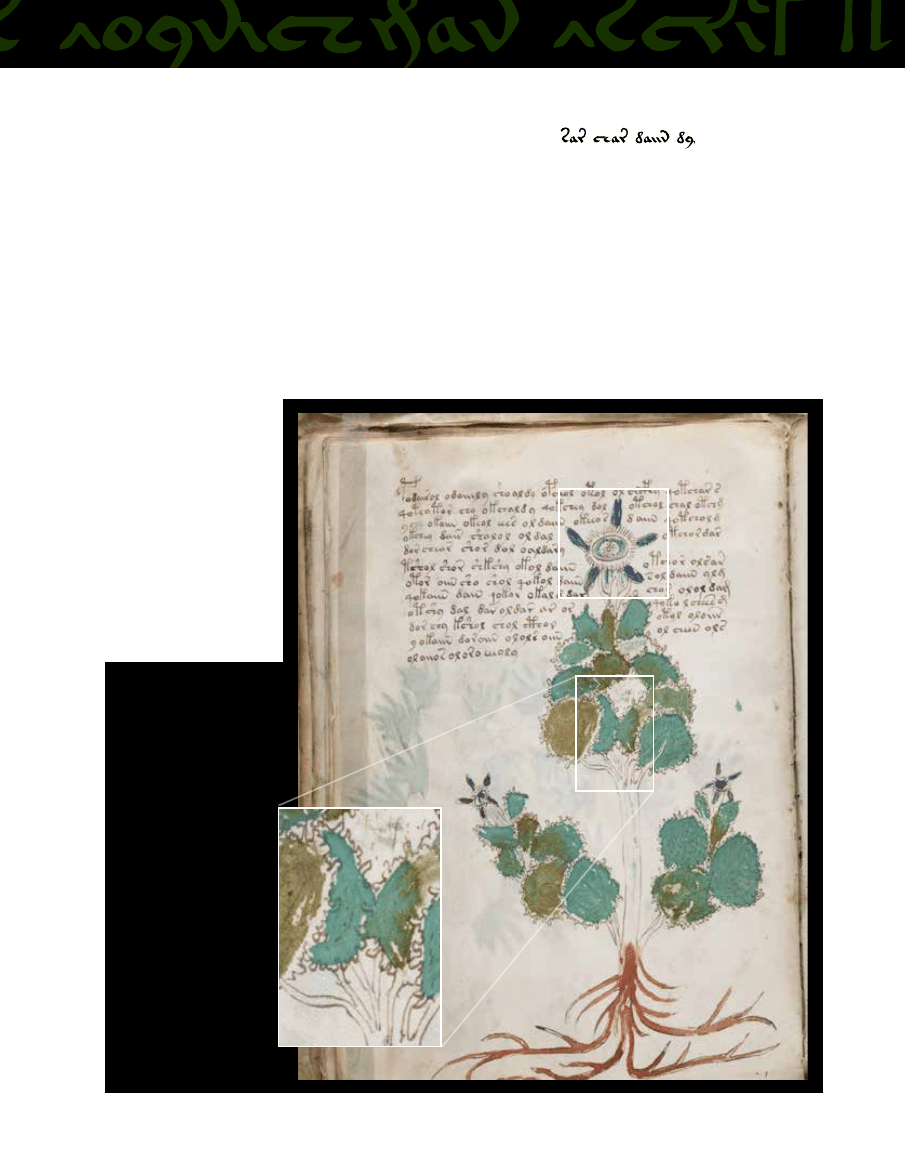
The plant illustrated on folio 23v is definitely a Passi-
flora sp. of the subgenus Decaloba. This is primarily a New
World genus (some species occur in Asia and Australia)
and cannot be confused with any other genus. The paired
petiolar glands in the upper third of the leaf, blue tints in
the flower, and dentate (toothed) leaves that are deeply
cordate (heart-shaped) seem to match only the variability
of P. morifolia Mast. in Mart.,
63
although the artist has
made the leaves slightly more orbicular (round) than they
normally occur in mature foliage (young plants such as
root suckers sometimes exhibit orbicular, entire leaves in
cultivation).
Penthoraceae (Ditch-Stonecrop Family)
The plant illustrated on folio 30v is easily identifiable as
Penthorum sedoides L., the ditch stonecrop, a New World
species that grows indigenously from Canada to Texas.
The cymose inflorescence (convex flower cluster), dentate
leaves, and stolons (trailing shoots) are characteristic of the
species. The artist, though, apparently has illustrated this
in very early bud (or glossed over the details of the flowers)
because the prominent pistils emerge later, and are very
obvious in fruit, often turning rosy.
Polemoniaceae (Phlox Family)
The plant illustrated on folio 4v is quite definitely a
Cobaea sp., a New World genus. The best match is C.
biaurita Standl., which is closely related to the cultivated
C. scandens Cav., the cup and saucer vine. This vine is
native to Chiapas, Mexico, and possesses acute (taper-
ing to the apex, sides straight or nearly so) to acuminate
(tapering to the apex, sides more-or-less pinched) leaflets
and flowers that emerge cream-colored but later mature
to purple.
64,65
Ranunculaceae (Buttercup Family)
The plant illustrated on folio 95r is quite definitely an
Actaea sp., probably the white-fruited Actaea rubra (Aiton)
Willd. f. neglecta (Gillman) B. L. Rob. Actaea rubra is native
to Eurasia, and in North America from Canada to New
Mexico.
66
As the common name baneberry indicates, this
species is poisonous.
Urticaceae (Nettle Family)
As first postulated by the Rev. Hugh O’Neill, the plant
on folio 25r is clearly a member of the Urticaceae, or nettle
family.
50
The best match, because of the dentate, lanceolate
(lance-shaped) leaves and reddish inflorescences, seems to
be Urtica chamaedryoides Pursh, commonly known as heart-
leaf nettle. This is native in North America from Canada to
Mexico (Sonora). Urtica and the closely related genus Urera
also occur in the Codex Cruz-Badianus
9-12
and Hernández.
15
Valerianaceae (Valerian Family)
The plant illustrated on folio 65r is probably Valeriana albo-
nervata B. L. Rob. The palmately or cleft-lobed leaves, inflo-
rescence, and napiform (turnip-shaped) to fusiform (spindle-
shaped), often forked taproots, are a good match. This is
native to the Sierra Madre of Mexico.
67
Violaceae (Violet Family)
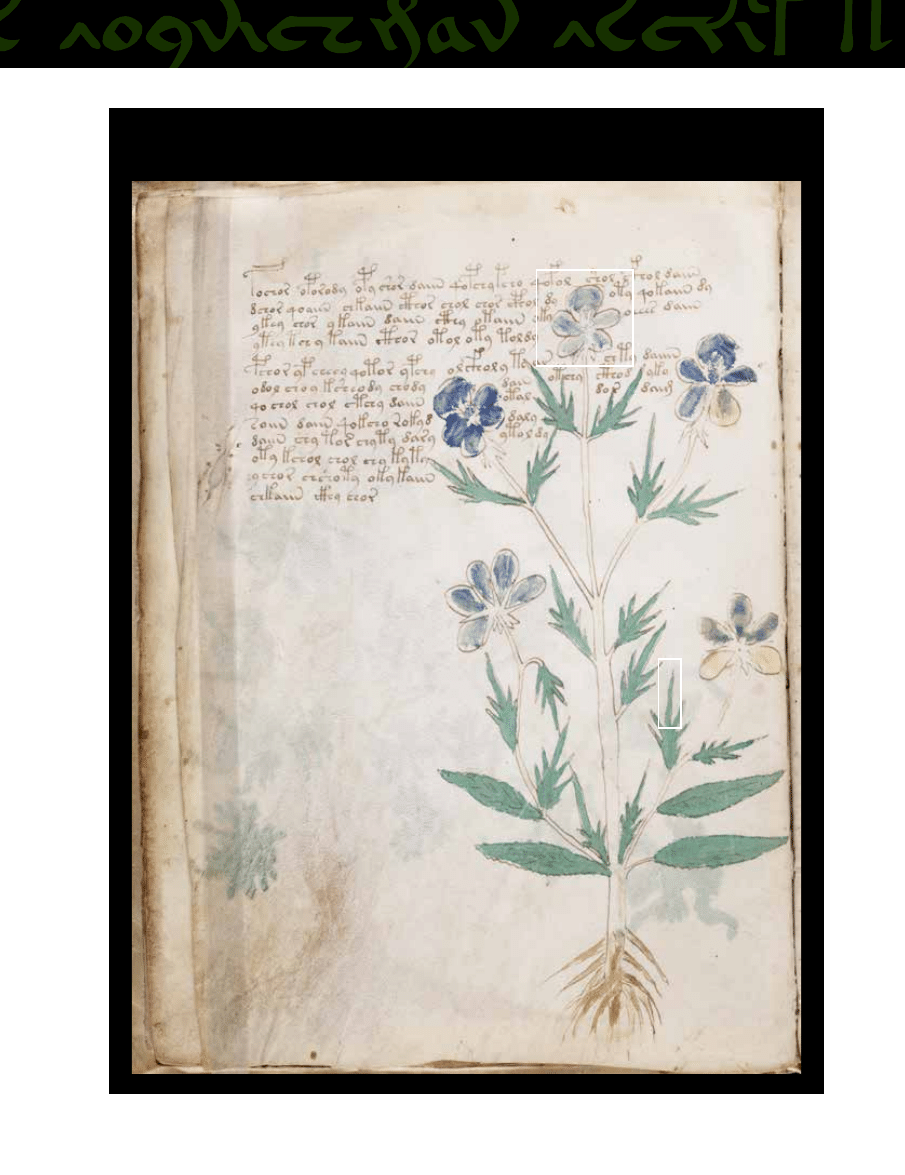
The plant illustrated on folio 9v has been identified previ-
ously as Viola tricolor of Eurasia,
68
but we claim that it is not
this species. If the illustration in the Voynich Ms. is correct
(and the illustration is actually quite decent), the terminal
stipular lobes are linear (narrow and flat with parallel sides),
as characteristic of the North American native V. bicolor
Pursh (V. rafinesquei Greene), not spatulate (spatula-shaped)
as in V. tricolor. Also, the flowers of V. bicolor are uniformly
cream to blue, while the flowers of V. tricolor usually have
two purple upper petals, three cream-to-yellow lower petals.
Viola bicolor, American field pansy, is native to the present-
day United States from New Jersey to Texas, west to Arizona,
although Russell mysteriously says “originally derived from
Mexico” even though its center of diversity seems to be east-
ern Texas.
69,70
Arthur O. Tucker, PhD,
is emeritus professor and co-director
of the Claude E. Phillips Herbarium at Delaware State Univer-
sity in Dover, an upper-medium-sized herbarium and the only
functional herbarium at an historically Black college or univer-
sity, graced with a few type specimens of Mexican plants collected
by Ynes Mexia, Edward Palmer, et al.
71
He has had a special
interest in identifying plants from period illustrations utilizing
flora and herbarium specimens, e.g., the “Blue Bird Fresco” at
Knossos.
72
Because of his expertise, he was hired by CPHST/PPQ/
APHIS/USDA (Center for Plant Health Science Technology/
Plant Protection & Quarantine) to identify botanicals imported
to the United States and to construct a Lucid key.
73
The latter
research was particularly challenging because these botanicals
encompass parts of everything “botanical” — from fungi (though
not truly botanical), to mosses and lichens, to gymnosperms and
angiosperms that had been greatly modified (bleached and/or
dyed, scented, and sometimes reconstructed into new botani-
82
•
I
S S U E
100
•
2013
•
www.herbalgram.org
www.herbalgram.org
•
2013
•
I
S S U E
100
•
83
This illustration from the Voynich Ms. (fol. 9v) is most definitely Viola bicolor of North America by the terminal stipular lobes (A),
which are linear (narrow and flat with parallel sides), not spatulate (spaula-shaped) as in V. tricolor of Europe. Also, the flowers (B)
are uniformly a pale blue, as in V. bicolor, not tricolored as in V. tricolor.
B
A

cals) — collected in India, China, Southeast Asia, Australia,
Brazil, etc. Dr. Tucker also has published widely on the system-
atics and chemistry of herbs in both scientific and popular
journals and is the co-author of The Encyclopedia of Herbs
(Timber Press, 2009), which attempts to summarize the latest
scientific information on herbs of flavor and fragrance for the
average reader.
74
Rexford H. Talbert
, a retired Senior Information Technol-
ogy Research Scientist from the United States Department of
Defense and the National Aeronautics and Space Administra-
tion, is an autodidact, writer, and lecturer in botany, plant
taxonomy, and plant chemistry with a keen interest in ethnic
plants.
Acknowledgements
The authors gratefully appreciate the discussion and
proofing by Arthur O. Tucker, IV; Sharon S. Tucker, PhD;
and Susan Yost, PhD.
References
1. Beinecke Rare Book and Manuscript Library, Yale University.
Voynich Manuscript. Available at: http://beinecke.library.yale.
edu/digitallibrary/voynich.html. Accessed December 29,
2012.
2. Brumbaugh RS. The Most Mysterious Manuscript. Carbon-
dale, IL: Southern Illinois Press; 1978.
3. D’Imperio ME. The Voynich Manuscript: An Elegant Enigma.
Fort George G. Meade, MD: National Security Agency/
Central Security Service; 1978. Available at: www.dtic.mil/
cgi-bin/GetTRDoc?AD=ADA070618 and http://www.nsa.
gov/about/_files/cryptologic_heritage/publications/misc/
voynich_manuscript.pdf. Accessed December 29, 2012.
4. Kennedy G, Churchill R. The Voynich Manuscript. Rochester,
VT: Inner Traditions; 2006.
5. Kircher F, Becker D. Le Manuscrit Voynich Décodé. Agnières,
France: SARL JMG editions; 2012.
6. Wikipedia.
Voynich Manuscript. Available at: http://
en.wikipedia.org/wiki/Voynich_manuscript. Accessed
December 29, 2012.
7. Zandbergen R. The Voynich Manuscript. Available at: www.
voynich.nu/index.html. Accessed December 29, 2012.
8. Montemurro MA, Zanette DH. Keywords and co-occur-
rence patterns in the Voynich Manuscript: An informa-
tion-theoretic analysis. PLoS ONE 2013;8(6):e66344.
Doi:10.371/hournal.pone.0066344.
9. Gates W. An Aztec Herbal. Mineola, NY: Dover Publications;
2000 (originally published in Baltimore, MD: Maya Society;
1939).
10. Emmart EW. The Badianus Manuscript. Baltimore, MD:
Johns Hopkins Press; 1940.
11. Cruz M de la, Badiano J. Libellus de Medicinalibus Indorum
Herbis. México: Fondo de Cultiura Económica; 1991.
12. Clayton M, Guerrini L, de Ávila A. Flora: The Aztec Herbal.
London: Royal Collections Enterprises; 2009.
13. Cottrell L. Reading the Past: The Story of Deciphering Ancient
Languages. London: J. M. Dent & Sons; 1972.
14. Williams DE. A review of sources for the study of Náhuatl
plant classification. Adv Econ Bot. 1990;8:249-270.
15. Hernández F et al. Rerum Medicarum Novae Hispaniae
Thesaurus, seu, Plantarum animalium, Mineralium Mexi-
canorum Historia. Rome: Vitale Mascardi; 1651. Available
at: http://archive.org/details/rerummedicarumno00hern.
Accessed December 29, 2012.
16. Sahagún B de. Florentine Codex. General History of the Things
of New Spain. Book 11 – Earthly Things. Transl. Dibble C E
and Anderson A J A. Salt Lake City, UT: University of Utah
Press; 1963.
17. McCrone Associates, Inc. Materials Analysis of the Voynich
Manuscript, McCrone Associates Project MA47613. Westmont,
IL: McCrone Associates; 2009. Available at: http://beinecke.
library.yale.edu/digitallibrary/manuscript/voynich_analysis.
pdf. Accessed December 30, 2012.
18. Haude ME. Identification of the colorants on maps from the
Early Colonial Period of New Spain (Mexico). J Amer Inst
Conserv. 1998;37:240-270.
19. Burgio L, Ciomartin DA, Clark RJH. Pigment identifica-
tion on medieval manuscripts, paintings and other artefacts
by Raman microscopy: applications to the study of three
German manuscripts. J Mol Struc. 1997;405:1-11.
20. Special Collections Conservation Unit, Preservation Depart-
ment. Medieval Manuscripts: Some Ink & Pigment Recipes.
New Haven, CT: Yale University Library; 2012. Available
at: http://travelingscriptorium.files.wordpress.com/2012/03/
scopa-recipes-booklet_web.pdf. Accessed August 16, 2013.
21. Mallard E, Cumenge E. Sur une nouvelle espèce minérale, la
Boléite. Bull Soc Fr Minér Crystallogr. 1891;14:283-293.
22. Cooper MA, Hawthorne FC. Boleite: Resolution of
the formula KPb26Ag9Cu24Cl62(OH)48. Can Miner.
2000;38:801-808.
23. Copper Development Association. Uses of Copper
Compounds. CDA Technical Note TN11. Hemel Hemp-
stead, England: Copper Development Association; 1972.
Available at: www.copperinfo.co.uk/copper-compounds/
downloads/tn11-uses-of-copper-compounds.pdf. Accessed
December 29, 2012.
24. Valerrama J de. Pintura del gobernador, alcaldes y regidores de
México, Osuna Codex. 1600. Available at: www.theeuropean-
library.org/exhibition-reading-europe/detail.html?id=108151.
Accessed January 4, 2013.
25. Canger U. Nahuatl dialectology: A survey and some sugges-
tions. Intern J Amer Linguist. 1988;54:28-72.
26. Lacadena A. Regional scribal traditions: Methodological
implications for the decipherment of Nahuatl writing. PARI
J. 2008;8:1-22.
27. Berdan FF, Anawalt PR. The Essential Codex Mendoza.
Berkeley, CA: Univ. California;1997.
28. Integrated Taxonomic Information System on-line database.
Available at: www.itis.gov/. Accessed January 16, 2013.
29. McTavish EJ, Decker JE, Schnabel RD, Taylor JF, Hillis
DM. New World cattle show ancestry from multiple
independent domestication events. Proc Natl Acad Sci.
2013;110(15):E1398-1406.
30. Codex Aubin/Códice Aubin 1576/Códice de 1576/Historia
de la nación mexicana/Histoire mexicaine. Available at: www.
britishmuseum.org/research/search_the_collection_database/
search_object_details.aspx?objectid=3008812&partid=1&s
earchText=Aubin+Codex¤tPage=1. Accessed January
28, 2013.
31. Nuttall Z. The gardens of ancient Mexico. Ann Rep
Smithsonian Inst. 1925;1923:453-464.
32. Granziera P. Huaxtepec: The sacred garden of an Aztec
emperor. Landscape Res. 2005;30:81-107.
33. Acuna-Soto R, Stahle DW, Cleaveland MK, Therell MD.
Megadrought and megadeath in 16th century Mexico. Emerg
Infect Dis. 2002;8:360-362.
34. Quammen D. Spillover. New York: W. W. Norton & Co.;
2012.
35. Alcarón HR de. Treatise on the Heathen Superstitions That
Today Live Among the Indians Native to This New Spain,
1629. Transl. & ed. Andrews J R, Hassig R. Norman: Univ.
Oklahoma Press; 1987.
84
•
I
S S U E
100
•
2013
•
www.herbalgram.org

www.herbalgram.org
•
2013
•
I
S S U E
100
•
85
36. Varey S, ed. The Mexican Treasury: The Writings of
Dr.Francisco Hernández. Stanford, CA: Stanford Univ Press;
2000.
37. Sherwood E. Analysis of Radiocarbon Dating Statistics in
Reference to the Voynich Manuscript. 2010. Available at: www.
edithsherwood.com/radiocarbon_dating_statistics/radiocar-
bon_dating_statistics.pdf. Accessed December 30, 2012.
38. Case R, Tucker AO, Maciarello MJ, Wheeler KA. Chemistry
and ethnobotany of commercial incense copals, copal blanco,
copal oro, and copal negro of North America. Econ Bot.
2003;57:189-202.
39. USDA, Agriculture Research Service, National Genetic
Resources Program. Germplasm Resources Information
Network (GRIN). Beltsville, MD: National Germplasm
Resources Laboratory. Available at: www.ars-grin.gov/cgi-bin/
npgs/html/taxgenform.pl. Accessed December 31, 2012.
40. Kew et al. The Plant List. Available at: www.theplantlist.org/.
Accessed December 31, 2012.
41. Mathias ME, Constance L. A synopsis of North American
species of Eryngium. Amer Midl Nat. 1941;24:361-387.
42. Navarrete A, Nino D, Reyes B, Sixtos C, Aguirre E, Estrada
E. On the hypocholesteremic effect of Eryngium heterophyl-
lum. Fitoterapia. 1990;61:183-184.
43. Stuart AG. Plants Used in Mexican Traditional Medicine.
Available at: www.herbalsafety.utep.edu/presentations/
pptpresentations/Plants%20Used%20in%20Mexican%20
Traditional%20Medicine-July%2004.pdf. Accessed Decem-
ber 31, 2012.
44. Arana E, Swadesh M. Los Elementos del Mixteco Antiguo.
México: Inst Nac Indigenista e INAH; 1965.
45. Bown D. Aroids, Plants of the Arum Family. Portland, OR:
Timber Press; 1988.
46. Harper D. Online Etymology Dictionary. Available: www.
etymonline.com/index.php?search=maguey. Accessed Decem-
ber 31, 2012.
47. Dressler RL. The Pre-Columbian cultivated plants of
Mexico. Bot Mus Leafl Havard Univ. 1953;16:115-172.
48. Hough W. The pulque of Mexico. Proc US Natl Mus.
1908:33:577-592.
49. Foundation for the Advancement of Mesoamerican Studies,
Inc. (FAMSI), Los Angeles County Museum of Art. Ancient
Books: Borgia Group Codex. A Colonial Era Decipherment of
Codex Rios, (Borgia Group). Available at: www.famsi.org/
research/pohl/jpcodices/rios/index.html. Accessed December
31, 2012.
50. O’Neill H. Botanical observations on the Voynich MS.
Speculum. 1944;19:126.
51. Bayer RJ., Bogle AL, Cherniawsky DM. Petasites. Flora of
North America. 20:541-543, 635-637. Available at: www.
efloras.org/florataxon.aspx?flora_id=1&taxon_id=124686.
Accessed December 31, 2012.
52. Pippin RW. Mexican “Cacalioid” genera allied to Senecio
(Compositae). Contrib Natl Herb. 1968;34:365-447.
53. Robinson H, Brettell RD. Studies in the Senecioneae
(Asteraceae). III. The genus Psacalium. Phytologia.
1973;27:254-264.
54. Manzanero-Medina GI, Flores-Martínez A, Sandoval-
Zapotitla E, Bye-Boettler R. Etnobotánica de siete raíces
medicinales en el Mercado de Sonora de la Ciudad de
México. Polibotánica. 2009;27:191-228.
55. Standley PC. Trees and shrubs of Mexico. Contrib. US Herb.
1920-1926;23:1-1721.
56. Pereda-Miranda R, Rosas-Ramírez D, Castañeda-Gómez J.
Resin glycosides from the morning glory family. Fort Chem
Org Naturst. 2010;92:77-153.
57. Meira M, Silva EP da, David JM, David JP. Review of the
genus Ipomoea: traditional uses, chemistry and biological
activities. Rev Bras Farmacogn. 2012;22:682-713.
58. Batres LDP de, Alfaro CAB, Ghaemghami J. Mesoamerica
aesthetics: Horticultural plants in hair and skin care. Chron
Hort. 2012;50(2):12-15.
59. Ross-Ibarra J, Molina-Cruz A. The ethnobotany of chaya
(Cnidoscolus aconitifolius ssp. aconitifolius Breckon): A nutri-
tious Maya vegetable. Econ Bot. 2002;56:350-365.
60. Dunn DB, Harmon WE. The Lupinus montanus complex
of Mexico and Central America. Ann Missouri Bot Gard.
1977;64:340-365.
61. Standley PC, and Williams LO. Labiatae, Mint family. In:
Standley P C, Williams L O (eds.). Flora of Guatemala. Part
IX, No. 3. Fieldiana. 1973;24:237-317.
62. Berg CC. Moreae, Artocarpeae, and Dorstenia (Moraceae). Fl
Neotropica. 2001:83:1-346.
63. Killip EP. The American species of Passifloraceae. Fieldiana
1938;19:1-613.
64. Standley PC. A revision of the genus Cobaea. Contr US Natl
Herb. 1914;17:448-458.
65. Prather A. Systematics of Cobaea (Polemoniaceae). Syst Bot
Monogr. 1999;57:1-81.
66. Compton JA, Culham A, Jury SL. Reclassification of Actaea
to include Cimicifuga and Souliea (Ranunculaceae): Phylog-
eny inferred from morphology, nrDNA ITS, and cpDNA
trnL-F sequence variation. Taxon. 1998;47:593-634.
67. Meyer FC. Valeriana in North America and the West Indies
(Valerianaceae). Ann Missouri Bot Gard. 1951;38:377-503.
68. Han P. Discussion of the plant illustrated in folio f9v of the
Voynich manuscript. Available at: www.as.up.krakow.pl/jvs/
library/2-7-2011-05-25/pansyvm.pdf. Accessed January 1,
2013.
69. Shinners LH. Viola rafinesquii: Nomenclature and native
status. Rhodora. 1961;63:327-335.
70. Russell N H. Violets (Viola) of Central and Eastern United
states: an introductory survey. Sida. 1965;2:1-113.
71. Claude E. Phillips Herbarium, Delaware State University.
Available at: http://herbarium.desu.edu/. Accessed December
29, 2012.
72. Tucker AO. Identification of the rose, sage, iris, and lily
in the ‘‘Blue Bird Fresco’’ from Knossos, Crete (ca. 1450
B.C.E.). Econ Bot. 2004;58:733-736.
73. Tucker AO, Redford AJ, Scher J, Trice MD. Dried Botani-
cal ID. Delaware State University, Identification Technology
Program, CPHST, PPQ, APHIS, USDA; Fort Collins, CO.
Available at: http://idtools.org/id/dried_botanical. Accessed
December 29, 2012.
74. Tucker AO, DeBaggio T. The Encyclopedia of Herbs. Port-
land, OR: Timber Press; 2009.
Wyszukiwarka
Podobne podstrony:
Extensive Analysis of Government Spending and?lancing the
Analysis of Nazism, World War II, and the Holocaust
Babi Yar Message and Writing Analysis of the Poem
Analysis of Religion and the?fects on State Sovereignty
Crime and Punishment Analysis of the Character Raskol
A systematic review and meta analysis of the effect of an ankle foot orthosis on gait biomechanics a
The Red Scare Extensive Analysis of its?uses and?fects
Death of a Salesman Breakdown and Analysis of the Play
Analysis of Roosevelt's New?al and the Great?pression
Intraindividual stability in the organization and patterning of behavior Incorporating psychological
Crime and Punishment Analysis of the Character Raskolnikov
Death of a Salesman and The Price Analysis of Ideals
A Content Analysis of Magazine?vertisements from the United States and the Arab World
Pride and Prejudice Analysis of the Theme of the Novel
Comparative Analyses of the Bacterial Microbiota of the Human Nostril and Oropharynx
Sexual behavior and the non construction of sexual identity Implications for the analysis of men who
Intraindividual stability in the organization and patterning of behavior Incorporating psychological
Tsitsika i in (2009) Internet use and misuse a multivariate regresion analysis of the predictice fa
With Microscope and Tweezers An Analysis of the Internet Virus of November 1988
więcej podobnych podstron