67.
(a) The first contribution to the overall deviation is at the first refraction: δθ
1
= θ
i
− θ
r
. The next
contribution to the overall deviation is the reflection. Noting that the angle between the ray right
before reflection and the axis normal to the back surface of the sphere is equal to θ
r
, and recalling
the law of reflection, we conclude that the angle by which the ray turns (comparing the direction
of propagation before and after the reflection) is δθ
2
= 180
◦
− 2θ
r
. The final contribution is the
refraction suffered by the ray upon leaving the sphere: δθ
3
= θ
i
− θ
r
again. Therefore,
θ
dev
= δθ
1
+ δθ
2
+ δθ
3
= 180
◦
+ 2θ
i
− 4θ
r
.
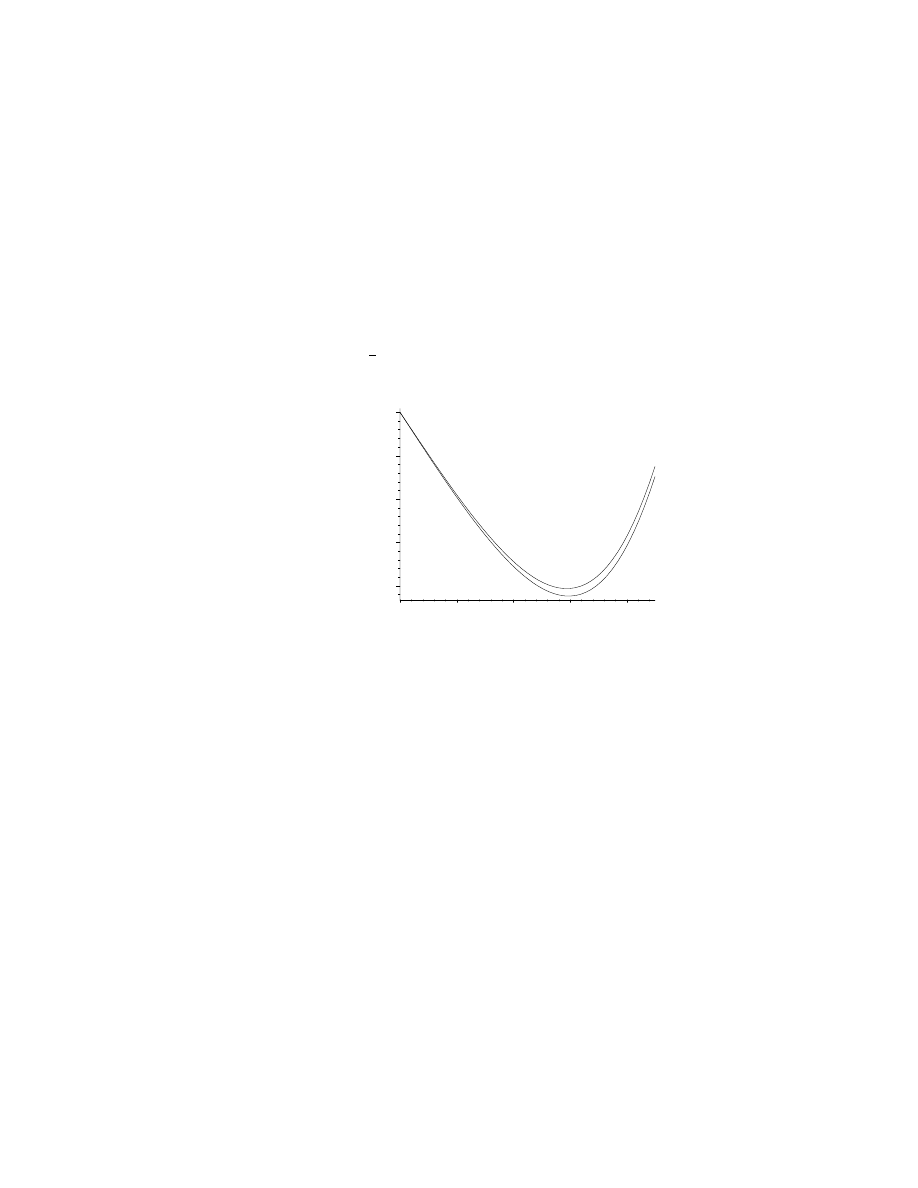
(b) We substitute θ
r
= sin
−1
(
1
n
sin θ
i
) into the expression derived in part (a), using the two given values
for n. The higher curve is for the blue light.
140
150
160
170
180
deviation_degrees
0
20
40
60
80
incident_angle_degrees
(c) We can expand the graph and try to estimate the minimum, or search for it with a more sophisticated
numerical procedure. We find that the θ
dev
minimum for red light is 137.63
◦
, and this occurs at
θ
i
= 59.52
◦
.
(d) For blue light, we find that the θ
dev
minimum is 139.35
◦
, and this occurs at θ
i
= 59.52
◦
.
(e) The difference in θ
dev
in the previous two parts is 1.72
◦
.
Document Outline
- Main Menu
- Chapter 1 Measurement
- Chapter 2 Motion Along a Straight Line
- Chapter 3 Vectors
- Chapter 4 Motion in Two and Three Dimensions
- Chapter 5 Force and Motion I
- Chapter 6 Force and Motion II
- Chapter 7 Kinetic Energy and Work
- Chapter 8 Potential Energy and Conservation of Energy
- Chapter 9 Systems of Particles
- Chapter 10 Collisions
- Chapter 11 Rotation
- Chapter 12 Rolling, Torque, and Angular Momentum
- Chapter 13 Equilibrium and Elasticity
- Chapter 14 Gravitation
- Chapter 15 Fluids
- Chapter 16 Oscillations
- Chapter 17 Waves—I
- Chapter 18 Waves—II
- Chapter 19 Temperature, Heat, and the First Law of Thermodynamics
- Chapter 20 The Kinetic Theory of Gases
- Chapter 21 Entropy and the Second Law of Thermodynamics
- Chapter 22 Electric Charge
- Chapter 23 Electric Fields
- Chapter 24 Gauss’ Law
- Chapter 25 Electric Potential
- Chapter 26 Capacitance
- Chapter 27 Current and Resistance
- Chapter 28 Circuits
- Chapter 29 Magnetic Fields
- Chapter 30 Magnetic Fields Due to Currents
- Chapter 31 Induction and Inductance
- Chapter 32 Magnetism of Matter: Maxwell’s Equation
- Chapter 33 Electromagnetic Oscillations and Alternating Current
- Chapter 34 Electromagnetic Waves
- 34.1 - 34.10
- 34.1
- 34.2
- 34.3
- 34.4
- 34.5
- 34.6
- 34.7
- 34.8
- 34.9
- 34.10
- 34.11 - 34.20
- 34.11
- 34.12
- 34.13
- 34.14
- 34.15
- 34.16
- 34.17
- 34.18
- 34.19
- 34.20
- 34.21 - 34.30
- 34.21
- 34.22
- 34.23
- 34.24
- 34.25
- 34.26
- 34.27
- 34.28
- 34.29
- 34.30
- 34.31 - 34.40
- 34.31
- 34.32
- 34.33
- 34.34
- 34.35
- 34.36
- 34.37
- 34.38
- 34.39
- 34.40
- 34.41 - 34.50
- 34.41
- 34.42
- 34.43
- 34.44
- 34.45
- 34.46
- 34.47
- 34.48
- 34.49
- 34.50
- 34.51 - 34.60
- 34.51
- 34.52
- 34.53
- 34.54
- 34.55
- 34.56
- 34.57
- 34.58
- 34.59
- 34.60
- 34.61 - 34.70
- 34.61
- 34.62
- 34.63
- 34.64
- 34.65
- 34.66
- 34.67
- 34.68
- 34.69
- 34.70
- 34.71 - 34.80
- 34.71
- 34.72
- 34.73
- 34.74
- 34.75
- 34.76
- 34.77
- 34.78
- 34.79
- 34.80
- 34.81 - 34.90
- 34.81
- 34.82
- 34.83
- 34.84
- 34.85
- 34.86
- 34.87
- 34.88
- 34.89
- 34.90
- 34.91 - 34.101
- 34.91
- 34.92
- 34.93
- 34.94
- 34.95
- 34.96
- 34.97
- 34.98
- 34.99
- 34.100
- 34.101
- 34.1 - 34.10
- Chapter 35 Images
- Chapter 36 Interference
- Chapter 37 Diffraction
- Chapter 38 Special Theory of Relativity
- Chapter 39 Photons and Matter Waves
- Chapter 40 More About Matter Waves
- Chapter 41 All About Atoms
- Chapter 42 Conduction of Electricity in Solids
- Chapter 43 Nuclear Physics
- Chapter 44 Energy from the Nucleus
- Chapter 45 Quarks, Leptons, and the Big Bang
Wyszukiwarka
Podobne podstrony:
p34 099
mat bud 067 (Kopiowanie) (Kopiowanie)
p34 066
p34 089
p34 036
067 (2)
P16 067
p34 050
p34 076
P21 067
p34 037
05 2005 066 067
p34 096
p10 067
p34 042
p34 044
067
więcej podobnych podstron