
Acta Agrophysica, 2006, 7(2), 439-445
DIATOM MONITORING OF INLAND DUNE LAKE SEDIMENTS
IN PUSZCZA NOTECKA LAKES (NORTH WIELKOPOLSKA)
*
Beata Messyasz, Maciej G bka
Department of Hydrobiology, Adam Mickiewicz University
ul. Umultowska 89, 61-614 Pozna , Poland
e-mail: messyasz@amu.edu.pl
A b s t r a c t.
Analysis of diatom assemblages was carried out in the surface sediment in both the
midlake and the littoral zone of 8 dystrophic lakes from the Puszcza Notecka area. The species composi-
tion and density of diatoms were estimated. Moreover, physicochemical analysis in all samples was con-
ducted. The sediment of each lake was characterised by a low pH, small amounts of calcium and organic
matter. Among the 145 taxa identified, the most characteristic species of cosmopolitic diatoms were:
Cymbella minuta, Cyclotella radiosa, Navicula radiosa, Gomphonema acuminatum. Furthermore, taxa
like Achnanthes spp., Eunotia spp., Anomoeoneis spp., Frustularia rhomboides were used as indicators of
acidity. More eutrophic conditions in the littoral zone as compared to the midlake part were evident.
K e y w o r d s: diatoms, sediment, taxon ecology, humic lakes, chemistry of sediment
INTRODUCTION
Inland dune lakes, which were created in depressions among dunes, belong to
an uncommon type of water ecosystems in the area of Poland [2]. The greatest
complex of inland dunes is present in the Notecka Primeval Forest (Puszcza
Notecka) in the North of Wielkopolska. Most lakes in this territory were created
as a consequence of cutting the wide area of woodlands devastated by insect
Lymantria monacha in the years 1922-1924 [7,14]. An increase in the level of
water in spaces lacking in trees, which stabilised the level of water, resulted in
a rise of the ground water level and produced in this way many small lakes. At the
beginning, they were recognised as ephemeral water ecosystems. At present,
many of them have Sphagnum floating mats and on the basis of their physico-
*
The paper was presented and published in the frame of activity of the Centre of Excellence
AGROPHYSICS – Contract No.: QLAM-2001-00428 sponsored by EU within the 5FP.

B. MESSYASZ, M. G BKA
440
chemical water parameters dystrophic nature was stated [3]. Polish references
lack the limnological characteristics of these kind of ecosystems.
Phytobenthos analysis provides valuable information about changes which
have taken place in the lakes in preceding years. Diatoms are very useful tools in
the reconstruction of both past and present ecological conditions. Using particular
taxa and community ecology, it is possible to reconstruct environmental condi-
tions in lakes, including pH and trophic conditions. The aim of the present study
was to estimate the abiotic conditions in lakes and to characterise potential pH
and trophy reflected in the structure of diatom assemblages.
RESEARCH AREA AND METHODS
The research was carried out in 8 lakes in the region of Wielkopolska (Pusz-
cza Notecka). The lakes are situated in the area of the Gorzowska Valley, between
the Warta and the Note rivers [6]. These small water ecosystems are located
among sand dunes, which are poor in nutrients, and surrounded by a large pine
forest. This is the most dense forest complex in that region. They are lakes which
were created a relatively short time ago (80 years ago).
Most of the lakes are small (area of 0.6-8.5 ha; max depth of 3.8 m) with high
incidence of moss bog in their catchment areas (Tab. 1). The humic content re-
flected by water colour varies between the lakes. Two lakes were -mesohumic,
three -mesohumic and three polyhumic. Dissolved organic carbon contents
ranged from 4 to 30 mg C l
–1
[4].
Table 1. Some characteristics of the lakes studied
Lake
Type of humic lake
Area (ha)
Max. depth (m)
wi te
Moczydło
Perskie
Zgniłe
Pokraczyn
Pustelnik I
Pustelnik II
Wilcze Błoto
-mezo-
-mezo-
poli-
poli-
-mezo-
-mezo -
mezo-
poli-
6.5
2.7
8.5
1.4
1.5
1.5
2.1
0.6
2.5
1.5
2
1.2
3
2
3.8
2.1
Field investigations were carried out in the summer seasons of 2002 and 2003.
In order to estimate whether diatom horizontal differentiation existed in the investi-
gated lakes, transects perpendicular to the bank were realised. The material for the
diatom studies was collected from the surface sediments in the deepest part of each
lake (midlake station). In addition, the sampling stations corresponded to water
plant communities and contained hydrophyte and helophyte assemblages occurring

DIATOM MONITORING OF INLAND DUNE LAKES' SEDIMENTS
441
in each lake. For each investigated sample of sediment three sub-samples were put
together. Sixteen parameters of sediment were analysed in each sample.
The samples for diatom analyses were treated with 10% HCl to remove cal-
cium carbonate. Then they were washed several times with distilled water and
boiled in 30% H
2
O
2
in a water bath at a temperature of 82°C to remove organic
matter. Constant slides were mounted in Naphrax. At least 500 diatom valves were
counted from each slide and next the relative abundance of each taxon was calcu-
lated. The counting results formed the basis for diatom structure presenting a hori-
zontal distribution of different ecological diatom groups including pH and trophy.
RESULTS AND DISCUSSION
The lakes sediment was strongly hydrated (80-90%), relatively rich in organic
matter, and generally had a detritus gyttia texture. The pH of sediment in the lakes
between 2002-2003 was within the range of 6.1 and 6.7. Due to calcium concen-
tration in the sediment, two groups of lakes were identified: with dry mass con-
centration lower than 50 g Ca kg
–1
(Pokraczyn, Pustelnik I, Pustelnik II and Wil-
cze Błoto lakes) and with dry mass concentration higher than 100 g Ca kg
–1
(Per-
skie, Moczydło, Zgniłe and wi te lakes). Lake Pokraczyn was conspicuous due
to higher magnesium concentration when compared to calcium in the sediment
from other investigated lakes. These parameters indicated a strongly dystrophic
character of Lake Pokraczyn. Comparatively high concentrations of total phos-
phate (from 1 g PO
4
kg
–1
dry mass in Lake Pokraczyn to 9 g PO
4
kg
–1
dry mass in
Lake Zgniłe) and differentiated total iron concentration (the highest at 220 g kg
–1
of dry mass in the case of Lake Zgniłe) were typical of the lakes. The interesting
thing is that these chemical sediment parameters did not at all times reflect the
division of the lakes according to the water properties. Despite higher contents of
calcium in the sediment of some lakes (Pustelnik I, Pustelnik II, Perskie) the
sediment did not have a dystrophic character and acid pH and very small electro-
lytic conductivity amounting to 50 S cm
–1
. Probably in these three lakes as
a result of calcium precipitation from inflow waters from the catchments area the
calcium deposit in sediment was gathered. At the beginning, the lakes were rich in
calcium. Then, they underwent distrophication and gradually ran short of the con-
centration of calcium. This is a result of the creation of transition moor formation
between the lakes and the catchments area which functions as a frontier [3,4].
The total number of taxa identified in all the samples studied was 145. In almost
all of the lakes examined, except Lake Perskie (69) and Lake Wilcze Błoto (64),
a similar distribution of about 80 taxa was observed. Although pinnate forms were the
most frequent, centric forms were often more conspicuous ecologically, e.g. Aulaco-
seira/Melosira sp., Cyclotella comensis, Cyclotella pseudosteligera [1,9]. Periphytic

B. MESSYASZ, M. G BKA
442
diatoms, especially taxa representing the genera Gomphonema, Navicula, Nitzschia
and Cocconeis, dominated in the sediment taken from macrophyte stations in the
littoral zone. However, planktonic forms occurred mainly in the sediment from the
deepest part of each lake and were represented mainly by taxa belonging to the genera
Aulacoseira, Cyclotella, Fragillaria and Stephanodiscus.
Based on the ecological characteristics [11] and presented there, among others,
pH preferences of particular diatoms, 12 acidophilous taxa, 39 indifferent, 68 alka-
liphilous, and 27 with a wide scale of tolerance were recorded. Among diatoms
Achnanthes ventralis, Anomoeoneis styriaca, Cymbella gracilis, Eunotia bilunaris
v. linearis, Eunotia bilunaris v. mucophila, Eunotia paludosa, Eunotia praerupta,
Frustularia rhomboids, Gomphonema parvulum, Navicula subtilissima, Pinularia
nobilis were the taxa that prefer small range of pH in waters [5,7,8]. In all the lakes
high numbers of chrysophyte cysts which are characteristic for humic waters were
noted. Their presence proved the dystrophic character of water in all the lakes [10].
A similar comparison related to the diatom structure of trophic spectrum pref-
erence was made. The found taxa mainly prefered eutrophic waters (55), but also
oligo-mesotraphentic taxa (13) and meso-eutraphentic taxa (35) were observed.
Furthermore, 42 diatom taxa had wide trophic preference and can abundantly
occur in lakes of different trophy. Other very abundant taxa included Cyclotella
meneghiniana
, Eunotia bilunaris, Nitzschia sigmoidea, Cocconeis placentula,
Cymbella lanceolata, Navicula lanceolata, Fragilaria ulna which are known as
indicative of eutrophic character of the water [5,9,10]. Eutrophic taxa of diatoms
were in more cases observed at greater numbers in the littoral zone, similarly to
the results obtained by Bubak and Bogaczewicz-Adamczak [1].
Differentiation was also observed at the level of dominating taxa (Tab. 2).
Table 2. Dominant diatom taxa in the surface sediment samples (relative abundance %)
Lake
Dominant taxon (%)
Subdominant taxon (%)
wi te
Fragilaria spp. complex (49)
Tabellaria fenestrata (10)
Moczydło
Navicula lanceolata (37)
Fragilaria spp. complex (22)
Perskie
Cyclotella comensis (33)
Navicula lanceolata (12)
Zgniłe
Fragilaria spp. complex (54)
Cymbella minuta (11)
Pokraczyn
Cyclotella pseudosteligera (31)
Fragilaria spp. complex (29)
Pustelnik I
Fragilaria spp. complex (45)
Pinularia borealis (27)
Pustelnik II
Fragilaria spp. complex (52)
Eunotia bilunaris v. mucophila (12)
Wilcze Błota
Fragilaria spp. complex (36)
Pinularia mesolepta (10)
The group of dominants characteristic of acid waters with a low nutrient con-
tent included: Eunotia bilunaris var. mucophila, Cyclotella comensis, C. pseudos-
teligera, Pinularia mesolepta. They were more or less frequent and abundant.
Fragillaria spp. complex dominated in most of the lakes lakes, irrespective of the
macrophyte station, with the highest dominance level (54%) in Zgniłe Lake. The
DIATOM MONITORING OF INLAND DUNE LAKES' SEDIMENTS
443
species of Fragilaria complex formed more than half of the total diatom cell num-
bers (Tab. 2). Fragilaria construens, F. exigua, F. brevistriata and others can be
abundant in nutrient–poor waters but also in alkaline and eutrophic waters [5,9,10].
Dominant Tabellaria fenestrata is an indifferent species which was characteristic of
oligotrophic and mesotrophic waters with a pH close to 7 and found favourable
conditions for its development in wi te Lake. The other species were not frequent
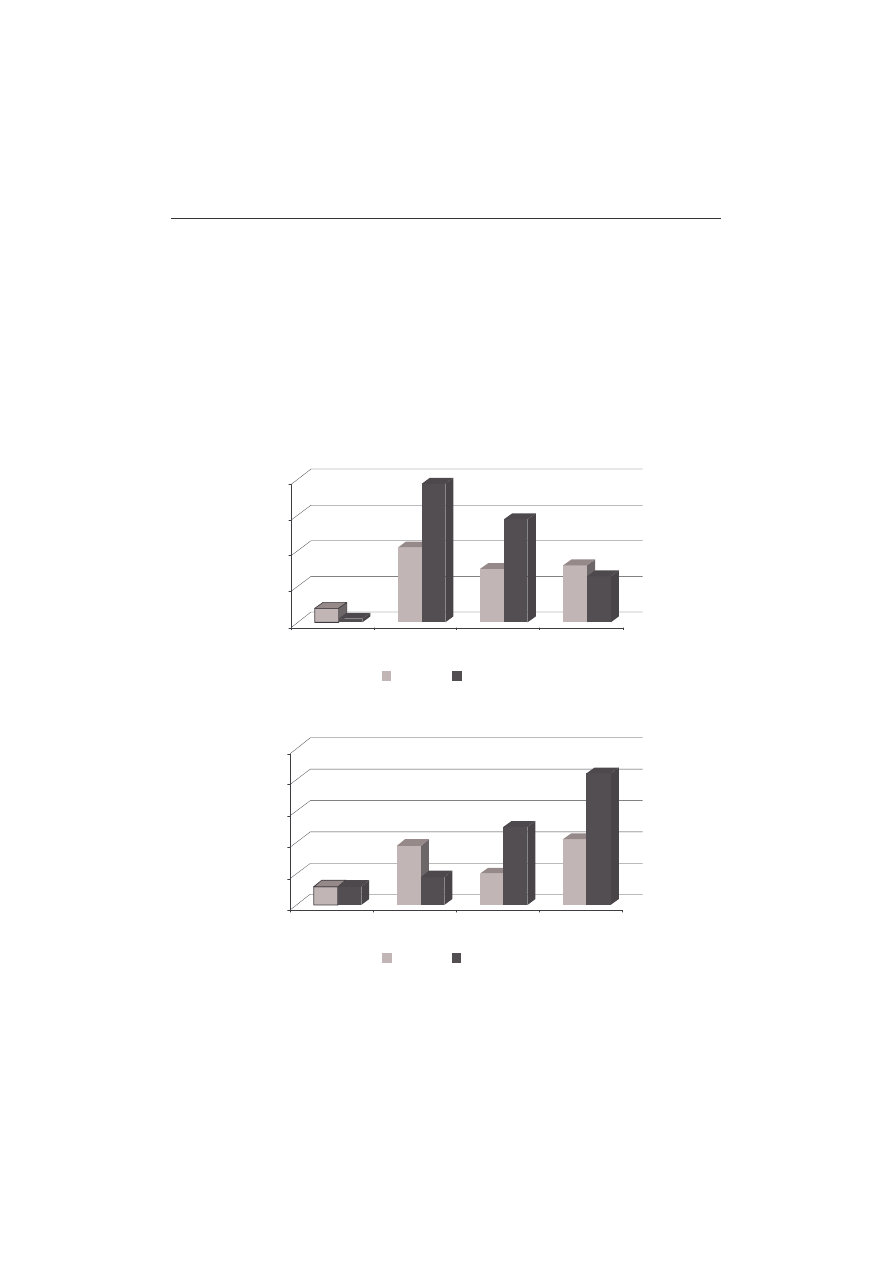
and had low density. The characteristic special variation of the pH and trophy spec-
trum structure in the spatial transect in Lake wi te is clearly shown in Figures
1 and 2. Charetum intermediae station (charophytes meadow) was characterised by
higher number of taxa, density and particpation of both periphytic (e.g. Cocconeis
placentula, Gomponema spp.) and eutrophic forms compared to the midlake station.
Fig. 1. Numbers of diatom taxa with different pH preferences in spatial transect in Lake wi te
(acidoph. – acidophilous; alkaliph. – alkaliphilous; w.prefer. – wide preferences)
Fig. 2. Number of diatom taxa representing different trophic groups in spatial transect in Lake
wi te (oligo-mezo – oligo-mesotraphentic; mezzo-eutro – meso-eutraphentic; eutro- eutraphentic;
w.prefer. – wide preferences)
0
10
20
30
40
acidoph.
indifferent
alkaliph.
w.prefer.
midlake
Charetum
N
um
be
r
0
10
20
30
40
50
oligo-mezo mezo-eutro
eutro
w.prefer.
midlake
Charetum
N
um
be
r

B. MESSYASZ, M. G BKA
444
The diatoms of midlake sediment indicated more acid and oligotrophic waters
in comparison with those of the macrophyte station in the littoral zone. Differences
between peaks were the same in most of the lakes. The taxonomical composition
and the quantitative relations of diatoms in our study were similar to those charac-
teristic for humic lakes from the north part of Poland [1]. The nutrient supply of
investigated lakes is not high enough for developing dense diatom communities.
The trophic status of the sediment of the lake can reach more eutrophic level during
the growing season in the littoral during low water periods, which was observed in
most of the investigated lakes.
CONCLUSIONS
From the analysis of changes in the qualitative composition of diatoms in
8 dystrophic lakes, the following results were obtained:
1. 145 taxa of diatoms were recorded.
2. A constant increase in the numbers in the direction of littoral took place in
most of the lakes.
3. In most of the lakes the alkaliphilous and indifferent forms in the littoral sta-
tions increased up to an average of 28 and 39 of the total number of taxa, respectively.
4. In each lake different dominant taxa were noted.
5. More eutrophic conditions were found in the littoral zone as compared to
the midlake part of the lakes.
REFERENCES
1.
Bubak I., Bogaczewicz-Adamczak B.: Recent benthic diatom assemblages from the Tuchola
Pinewoods (Bory Tucholskie) lakes as a basis for palaeoecological reconstruction. Acta
Botanica Warmiae et Masuriae, 3, 155-165, 2003.
2.
Choi ski A.: Physical limnology profile of Poland (in Polish). Wyd. Nauk. UAM, Pozna ,
298, 1995.
3.
G bka M.: Plant vegetation of humic lasek on the background their habitat requirements (in
Polish). PhD manuscript. Zakład Hydrobiologii UAM, Pozna , 199, 2005.
4.
G bka M., Owsianny P. M., Sobczy ski T.: Acidic lakes in the Wielkopolska region – phys-
ico-chemical properties of water, bottom sediments and the aquatic micro- and macrovegeta-
tion. Limnological Review, 4, 81-88, 2004.
5.
Hall R.I., Smol J.P.: Diatoms as indicators of lake eutrophication. [In:] E.F. Stoermer & J.P
Smol (eds.): The Diatoms: Applications For The Environmental And Earth Sciences. Cam-
bridge University Press. Cambridge, 128-168, 1999.
6.
Kondracki J.: Regional Geography of Poland (in Polish). Wyd. Nauk. PWN, Warszawa, 440, 1998.
7.
Kopytowski Cz.: Ephemeral lakes in the Warta – Note dune area (in Polish). Bad. Geogr. nad
Polsk północno-zachodni , 6-7, 125-135, 1931.
8.
Kwadrans J., Eloranta P.: Sediment diatoms as indicators of acidified lake recovery. [In:]
Algae and Biological state of Water. Acta Botanica Warmiae et Masuriae, 3, 123-133, 2003.

DIATOM MONITORING OF INLAND DUNE LAKES' SEDIMENTS
445
9.
Lange-Bertalot H., Metzeltin D.: Indicators of Oligotrophy. 800 taxa representative of three
ecologically distinct lake types. [In:] H. Lange-Bertalot (ed.): Iconographia Diatomologica.
Ecology-Diversity-Taxonomy. Koeltz Scientific Books Koenigstein, 2, 1-390, 1996.
10.
Mannion A.M.: Diatoms: Algal indicators of environmental change, II. Applications, Depart-
ment of Geography University of Reading. London, 34, 1986.
11.
Van Dam H., Martens A., Sinkeldam J.: A coded checklist and ecological indicator values of
freshwater diatoms from the Netherlands. Netherl. J. Aquat. Ecol., 28, 117-133, 1994.
12.
urawski M.: Attempt to allocate zones of first underground water level in the Wielkopolska
Lowland (in Polish). PTPN, Wydz. Mat.-Przyr., Prace Kom. Geogr.-Geol., VI, 2, Pozna , 1968.
MONITORING OKRZEMEK OSADÓW DENNYCH RÓDWYDMOWYCH
JEZIOR PUSZCZY NOTECKIEJ (PÓŁNOCNA WIELKOPOLSKA)
Beata Messyasz, Maciej G bka
Zakład Hydrobiologii
Uniwersytet im. Adama Mickiewicza
ul. Umultowska 89, 61-614 Pozna
e-mail: messyasz@amu.edu.pl
S t r e s z c z e n i e. Badania zbiorowisk okrzemek powierzchniowej warstwy osadów dennych pro-
wadzono w 8 płytkich (gł b. maks. do 4 m), dystroficznych jeziorach na obszarze Puszczy Noteckiej.
W ka dym zbiorniku w transektach przecinaj cych obszar ródjezierza pobrano próby powierzchniowych
osadów dennych. W próbach okre lono skład ilo ciowy i jako ciowy okrzemek, jak i równie wykonano
analizy fizyczno-chemiczne osadów. Osady charakteryzowały si silnie kwa nym odczynem, niewielk
zawarto ci wapnia oraz zasobno ci w materi organiczn . Analiza okrzemkowa osadów w badanych
jeziorach wykazała wyra n dominacj taksonów o charakterze kosmopolitycznym (np. Cymbella
minuta, Cyclotella radiosa, Navicula radiosa, Gomphonema acuminatum). Równocze nie w jeziorach
spotykane były gatunki wska nikowe, zwłaszcza w odniesieniu do odczynu wody (np. Achnanthes spp.,
Eunotia spp., Anomoeoneis spp., Frustularia rhomboides).
S ł o w a k l u c z o w e: okrzemki, osady denne, ekologia gatunku, jeziora humusowe, chemia osadów
Wyszukiwarka
Podobne podstrony:
ActaAgr 133 2006 7 2 363
ActaAgr 133 2006 7 2 343
ActaAgr 133 2006 7 2 503
ActaAgr 133 2006 7 2 289
ActaAgr 132 2006 7 1 81
ActaAgr 139 2006 8 1 69
Materia, ActaAgr 135 2006 7 4 909
puchar swiata 2006 www prezentacje org
Gospodarka płynami kwiecień 2006
Znaki taktyczne i szkice obrona, natarcie,marsz maj 2006
więcej podobnych podstron