
Mathematics
Higher level
Specimen paper 1, paper 2 and paper 3
For first examinations in 2006
p
IB DIPLOMA PROGRAMME
PROGRAMME DU DIPLÔME DU BI
PROGRAMA DEL DIPLOMA DEL BI

CONTENTS
Mathematics higher level paper 1 specimen paper
Mathematics higher level paper 1 specimen markscheme
Mathematics higher level paper 2 specimen paper
Mathematics higher level
paper 2 specimen markscheme
Mathematics higher level paper 3 specimen paper
Mathematics higher level paper 3 specimen markscheme

j
IB DIPLOMA PROGRAMME
PROGRAMME DU DIPLÔME DU BI
PROGRAMA DEL DIPLOMA DEL BI
22xx-72xx
19 pages
SPEC/5/MATHL/HP1/ENG/TZ0/XX
MATHEMATICS
HIGHER LEVEL
PAPER 1
SPECIMEN
2 hours
INSTRUCTIONS TO CANDIDATES
! Write your session number in the boxes above.
! Do not open this examination paper until instructed to do so.
! Answer all the questions in the spaces provided.
! Unless otherwise stated in the question, all numerical answers must be given exactly or to three
significant figures.
0 0
Candidate session number

SPEC/5/MATHL/HP1/ENG/TZ0/XX
22xx-72xx
− 2 −
Full marks are not necessarily awarded for a correct answer with no working. Answers must be
supported by working and/or explanations. In particular, solutions found from a graphic display
calculator should be supported by suitable working, e.g. if graphs are used to find a solution, you
should sketch these as part of your answer. Where an answer is incorrect, some marks may be
given for a correct method, provided this is shown by written working. All students should
therefore be advised to show their working. Working may be continued below the lines, if
necessary.
1.
The polynomial
3
2
( )
3
f x
x
x
ax b
=
+
+
+ leaves the same remainder when divided by
(
2)
x
−
as
when divided by
(
1)
x
+
. Find the value of
a .
.....................................................................................................................................................
.....................................................................................................................................................
.....................................................................................................................................................
.....................................................................................................................................................
.....................................................................................................................................................
.....................................................................................................................................................
.....................................................................................................................................................
.....................................................................................................................................................
.....................................................................................................................................................
.....................................................................................................................................................
.....................................................................................................................................................
.....................................................................................................................................................

SPEC/5/MATHL/HP1/ENG/TZ0/XX
22xx-72xx
Turn over
− 3 −
2.
The displacement
s metres of a moving body B from a fixed point O at time t seconds is given by
2
50 10
1000
s
t
t
=
−
+
.
(a) Find the velocity of B in
1
ms
−
.
(b) Find its maximum displacement from O.
.....................................................................................................................................................
.....................................................................................................................................................
.....................................................................................................................................................
.....................................................................................................................................................
.....................................................................................................................................................
.....................................................................................................................................................
.....................................................................................................................................................
.....................................................................................................................................................
.....................................................................................................................................................
.....................................................................................................................................................
.....................................................................................................................................................
.....................................................................................................................................................
SPEC/5/MATHL/HP1/ENG/TZ0/XX
22xx-72xx
− 4 −
3.
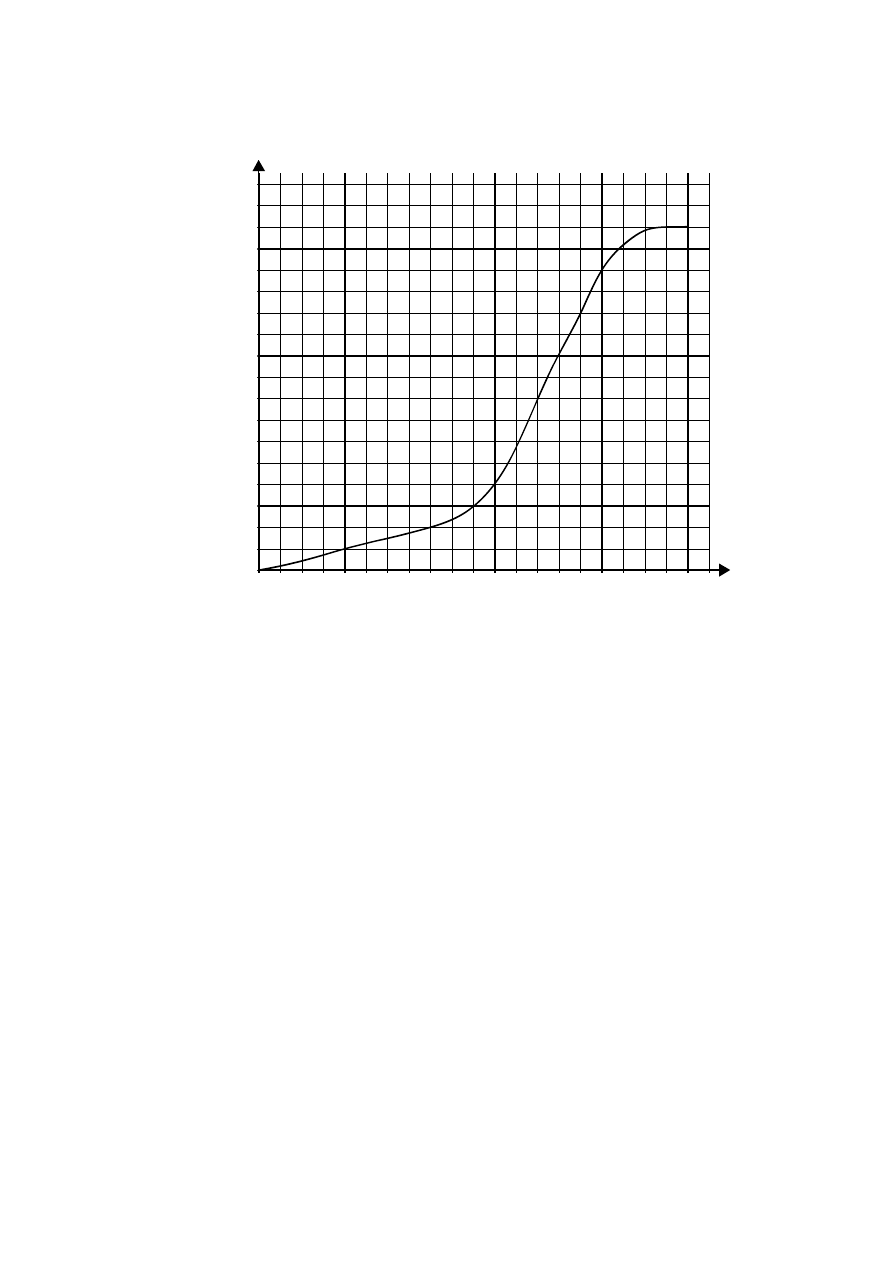
A test marked out of 100 is written by 800 students. The cumulative frequency graph for the
marks is given below.
(a) Write down the number of students who scored 40 marks or less on the test.
(b) The middle 50 % of test results lie between marks
a and b, where a
< b .
Find
a and b.
.....................................................................................................................................................
.....................................................................................................................................................
.....................................................................................................................................................
.....................................................................................................................................................
.....................................................................................................................................................
.....................................................................................................................................................
.....................................................................................................................................................
.....................................................................................................................................................
.....................................................................................................................................................
.....................................................................................................................................................
.....................................................................................................................................................
.....................................................................................................................................................
10
20
30
40
50
60
70
80
90
100
100
200
300
400
500
600
700
800
Number
of
candidates
Mark

SPEC/5/MATHL/HP1/ENG/TZ0/XX
22xx-72xx
Turn over
− 5 −
4.
The angle
θ satisfies the equation
2
2 tan
5sec
10 0
θ
θ
−
−
=
, where
θ
is in the second quadrant.
Find the exact value of
sec
θ .
.....................................................................................................................................................
.....................................................................................................................................................
.....................................................................................................................................................
.....................................................................................................................................................
.....................................................................................................................................................
.....................................................................................................................................................
.....................................................................................................................................................
.....................................................................................................................................................
.....................................................................................................................................................
.....................................................................................................................................................
.....................................................................................................................................................
.....................................................................................................................................................

SPEC/5/MATHL/HP1/ENG/TZ0/XX
22xx-72xx
− 6 −
5.
A discrete random variable
X
has its probability distribution given by
P(
)
(
1),
X
x
k x
=
=
+
where
is 0, 1, 2, 3, 4
x
.
(a) Show that
1
15
k
=
.
(b) Find
E( )
X
.
.....................................................................................................................................................
.....................................................................................................................................................
.....................................................................................................................................................
.....................................................................................................................................................
.....................................................................................................................................................
.....................................................................................................................................................
.....................................................................................................................................................
.....................................................................................................................................................
.....................................................................................................................................................
.....................................................................................................................................................
.....................................................................................................................................................
.....................................................................................................................................................

SPEC/5/MATHL/HP1/ENG/TZ0/XX
22xx-72xx
Turn over
− 7 −
6. The
function
f ′
is given by
( ) 2sin 5
2
f x
x
π
⎛
⎞
′
=
−
⎜
⎟
⎝
⎠
.
(a) Write
down
( )
f x
′′
.
(b) Given
that
1
2
f
π
⎛ ⎞ =
⎜ ⎟
⎝ ⎠
, find
( )
f x
.
.....................................................................................................................................................
.....................................................................................................................................................
.....................................................................................................................................................
.....................................................................................................................................................
.....................................................................................................................................................
.....................................................................................................................................................
.....................................................................................................................................................
.....................................................................................................................................................
.....................................................................................................................................................
.....................................................................................................................................................
.....................................................................................................................................................
.....................................................................................................................................................

SPEC/5/MATHL/HP1/ENG/TZ0/XX
22xx-72xx
− 8 −
7.
A sum of
$ 5 000
is invested at a compound interest rate of 6.3 % per annum.
(a) Write down an expression for the value of the investment after
n full years.
(b) What will be the value of the investment at the end of five years?
(c) The value of the investment will exceed
$10 000
after
n full years.
(i) Write an inequality to represent this information.
(ii) Calculate the minimum value of
n.
.....................................................................................................................................................
.....................................................................................................................................................
.....................................................................................................................................................
.....................................................................................................................................................
.....................................................................................................................................................
.....................................................................................................................................................
.....................................................................................................................................................
.....................................................................................................................................................
.....................................................................................................................................................
.....................................................................................................................................................
.....................................................................................................................................................
.....................................................................................................................................................

SPEC/5/MATHL/HP1/ENG/TZ0/XX
22xx-72xx
Turn over
− 9 −
8.
The speeds of cars at a certain point on a straight road are normally distributed with mean
µ and standard deviation
σ
. 15 % of the cars travelled at speeds greater than 90
1
km h
−
and
12 % of them at speeds less than 40
1
km h
−
. Find
µ and
σ
.
.....................................................................................................................................................
.....................................................................................................................................................
.....................................................................................................................................................
.....................................................................................................................................................
.....................................................................................................................................................
.....................................................................................................................................................
.....................................................................................................................................................
.....................................................................................................................................................
.....................................................................................................................................................
.....................................................................................................................................................
.....................................................................................................................................................
.....................................................................................................................................................

SPEC/5/MATHL/HP1/ENG/TZ0/XX
22xx-72xx
− 10 −
9.
The functions
f and g are defined by :
e , :
2
x
f x
g x
x
+
!
!
.
(a) Calculate
1
1
(3)
(3)
f
g
−
−
×
.
(b)
Show
that
1
(
) (3) ln 3 2
f g
−
=
−
"
.
.....................................................................................................................................................
.....................................................................................................................................................
.....................................................................................................................................................
.....................................................................................................................................................
.....................................................................................................................................................
.....................................................................................................................................................
.....................................................................................................................................................
.....................................................................................................................................................
.....................................................................................................................................................
.....................................................................................................................................................
.....................................................................................................................................................
.....................................................................................................................................................

SPEC/5/MATHL/HP1/ENG/TZ0/XX
22xx-72xx
Turn over
− 11 −
10. Given that
2
(
i)
z
b
= +
, where
b
is real and positive, find the exact value of
b
when
arg
60
z
=
"
.
.....................................................................................................................................................
.....................................................................................................................................................
.....................................................................................................................................................
.....................................................................................................................................................
.....................................................................................................................................................
.....................................................................................................................................................
.....................................................................................................................................................
.....................................................................................................................................................
.....................................................................................................................................................
.....................................................................................................................................................
.....................................................................................................................................................
.....................................................................................................................................................

SPEC/5/MATHL/HP1/ENG/TZ0/XX
22xx-72xx
− 12 −
11. Find the gradient of the normal to the curve
2
2
3
2
2
x y
xy
+
= at the point
(1, 2)
−
.
.....................................................................................................................................................
.....................................................................................................................................................
.....................................................................................................................................................
.....................................................................................................................................................
.....................................................................................................................................................
.....................................................................................................................................................
.....................................................................................................................................................
.....................................................................................................................................................
.....................................................................................................................................................
.....................................................................................................................................................
.....................................................................................................................................................
.....................................................................................................................................................

SPEC/5/MATHL/HP1/ENG/TZ0/XX
22xx-72xx
Turn over
− 13 −
12. A triangle has its vertices at
A( 1, 3, 2)
−
,
B(3, 6, 1)
and
C( 4, 4, 3)
−
.
(a) Show
that
AB AC
10
→
→
= −
i
.
(b) Show that, to three significant figures,
cos BA C
0.591
= −
#
.
.....................................................................................................................................................
.....................................................................................................................................................
.....................................................................................................................................................
.....................................................................................................................................................
.....................................................................................................................................................
.....................................................................................................................................................
.....................................................................................................................................................
.....................................................................................................................................................
.....................................................................................................................................................
.....................................................................................................................................................
.....................................................................................................................................................
.....................................................................................................................................................

SPEC/5/MATHL/HP1/ENG/TZ0/XX
22xx-72xx
− 14 −
13. (
a) Write down the inverse of the matrix
1
3
1
2
2
1
1
5
3
−
⎛
⎞
⎜
⎟
=
−
⎜
⎟
⎜
⎟
−
⎝
⎠
A
(b) Hence, find the point of intersection of the three planes.
3
1
2 2 2
5
3
3
x
y
z
x
y
z
x
y
z
−
+
=
+
− =
−
+
=
(c) A fourth plane with equation
x y z d
+ + =
passes through the point of intersection.
Find the value of
d
.
.....................................................................................................................................................
.....................................................................................................................................................
.....................................................................................................................................................
.....................................................................................................................................................
.....................................................................................................................................................
.....................................................................................................................................................
.....................................................................................................................................................
.....................................................................................................................................................
.....................................................................................................................................................
.....................................................................................................................................................
.....................................................................................................................................................
.....................................................................................................................................................

SPEC/5/MATHL/HP1/ENG/TZ0/XX
22xx-72xx
Turn over
− 15 −
14. Use the substitution
2
u x
= +
to find
3
2
d
(
2)
x
x
x
+
∫
.
.....................................................................................................................................................
.....................................................................................................................................................
.....................................................................................................................................................
.....................................................................................................................................................
.....................................................................................................................................................
.....................................................................................................................................................
.....................................................................................................................................................
.....................................................................................................................................................
.....................................................................................................................................................
.....................................................................................................................................................
.....................................................................................................................................................
.....................................................................................................................................................

SPEC/5/MATHL/HP1/ENG/TZ0/XX
22xx-72xx
− 16 −
15.
There are 30 students in a class, of which 18 are girls and 12 are boys. Four students are
selected at random to form a committee. Calculate the probability that the committee contains
(a) two girls and two boys;
(b) students all of the same gender.
.....................................................................................................................................................
.....................................................................................................................................................
.....................................................................................................................................................
.....................................................................................................................................................
.....................................................................................................................................................
.....................................................................................................................................................
.....................................................................................................................................................
.....................................................................................................................................................
.....................................................................................................................................................
.....................................................................................................................................................
.....................................................................................................................................................
.....................................................................................................................................................
16.
The line L is given by the parametric equations
1
,
2 3 ,
2
x
y
z
λ
λ
= −
= −
=
. Find the
coordinates of the point on L which is nearest to the origin.
.....................................................................................................................................................
.....................................................................................................................................................
.....................................................................................................................................................
.....................................................................................................................................................
.....................................................................................................................................................
.....................................................................................................................................................
.....................................................................................................................................................
.....................................................................................................................................................
.....................................................................................................................................................
.....................................................................................................................................................
.....................................................................................................................................................
.....................................................................................................................................................

SPEC/5/MATHL/HP1/ENG/TZ0/XX
22xx-72xx
Turn over
− 17 −
17.
The random variable X has a Poisson distribution with mean 4. Calculate
(a)
P (3
5)
X
≤
≤
;
(b)
P(
3)
X
≥
;
(c)
P (3
5|
3)
X
X
≤
≤
≥
.
.....................................................................................................................................................
.....................................................................................................................................................
.....................................................................................................................................................
.....................................................................................................................................................
.....................................................................................................................................................
.....................................................................................................................................................
.....................................................................................................................................................
.....................................................................................................................................................
.....................................................................................................................................................
.....................................................................................................................................................
.....................................................................................................................................................
.....................................................................................................................................................

SPEC/5/MATHL/HP1/ENG/TZ0/XX
22xx-72xx
− 18 −
18.
Let
( )
,
and
( )
,
4
x
x
f x
x
g x
x
x
x
+ 4
− 2
=
≠ −1
=
≠
+1
− 4
. Find the set of values of x such that
( )
( )
f x
g x
≤
.
.....................................................................................................................................................
.....................................................................................................................................................
.....................................................................................................................................................
.....................................................................................................................................................
.....................................................................................................................................................
.....................................................................................................................................................
.....................................................................................................................................................
.....................................................................................................................................................
.....................................................................................................................................................
.....................................................................................................................................................
.....................................................................................................................................................
.....................................................................................................................................................
19.
Solve the differential equation
2
d
1
d
y
x
y
x
−
=
, given that
0
y
=
when
2
x
=
. Give your answer
in the form
( )
y
f x
=
.
.....................................................................................................................................................
.....................................................................................................................................................
.....................................................................................................................................................
.....................................................................................................................................................
.....................................................................................................................................................
.....................................................................................................................................................
.....................................................................................................................................................
.....................................................................................................................................................
.....................................................................................................................................................
.....................................................................................................................................................
.....................................................................................................................................................
.....................................................................................................................................................

SPEC/5/MATHL/HP1/ENG/TZ0/XX
22xx-72xx
Turn over
− 19 −
20.
The square matrix
X
is such that
3
0
=
X
. Show that the inverse of the matrix
-
(I X)
is
2
+
+
I X
X .
.....................................................................................................................................................
.....................................................................................................................................................
.....................................................................................................................................................
.....................................................................................................................................................
.....................................................................................................................................................
.....................................................................................................................................................
.....................................................................................................................................................
.....................................................................................................................................................
.....................................................................................................................................................
.....................................................................................................................................................
.....................................................................................................................................................
.....................................................................................................................................................


c
IB DIPLOMA PROGRAMME
PROGRAMME DU DIPLÔME DU BI
PROGRAMA DEL DIPLOMA DEL BI
SPEC/5/MATHL/HP1/ENG/TZ0/XX/M
11 pages
MARKSCHEME
SPECIMEN
PAPER
MATHEMATICS
Higher
Level
Paper
1

- 2 -
SPEC/5/MATHL/HP1/ENG/TZ0/XX/M
Markscheme Instructions
A. Abbreviations
M
Marks awarded for attempting to use a correct Method: the working must be seen.
(M) Marks awarded for Method: this may be implied by correct subsequent working.
A
Marks awarded for an Answer or for Accuracy, usually dependent on preceding M marks: the
working must be seen.
(A) Marks awarded for an Answer or for Accuracy: this may be implied by correct subsequent working.
R
Marks awarded for clear Reasoning
N
Marks awarded for correct answers, if no working (or no relevant working) shown: in general, these
will not be all the marks for the question. Examiners should only award these N marks for correct
answers where there is no working (or if there is working which earns no other marks).
B. Using the markscheme
Follow through (ft) marks: Only award ft marks when a candidate uses an incorrect answer in a subsequent
part. Any exceptions to this will be noted on the markscheme. Follow through marks are now the exception
rather than the rule within a question or part question. Follow through marks may only be awarded to work
that is seen. Do not award N (ft) marks. If the question becomes much simpler then use discretion to award
fewer marks.
If a candidate mis-reads data from the question apply follow-through.
Discretionary (d) marks: There will be rare occasions where the markscheme does not cover the work seen.
In such cases, (d) should used to indicate where an examiner has used discretion. It must be accompanied by
a brief note to explain the decision made.
It is important to understand the difference between “implied” marks, as indicated by the brackets, and
marks which can only be awarded for work seen - no brackets. The implied marks can only be awarded if
correct work is seen or implied in subsequent working. Normally this would be in the next line.
Where M1 A1 are awarded on the same line, this usually means M1 for an attempt to use an appropriate
formula, A1 for correct substitution.
As A marks are normally dependent on the preceding M mark being awarded, it is not possible to award M0
A1.
As N marks are only awarded when there is no working, it is not possible to award a mixture of N and other
marks.
Accept all correct alternative methods, even if not specified in the markscheme Where alternative methods
for complete questions are included, they are indicated by METHOD 1, METHOD 2, etc. Other
alternative (part) solutions, are indicated by EITHER….OR. Where possible, alignment will also be used to
assist examiners to identify where these alternatives start and finish.

- 3 -
SPEC/5/MATHL/HP1/ENG/TZ0/XX/M
Unless the question specifies otherwise, accept equivalent forms. On the markscheme, these equivalent
numerical or algebraic forms will generally be written in brackets after the required answer The markscheme
indicate the required answer, by allocating full marks at that point. Once the correct answer is seen, ignore
further working, unless it contradicts the answer.
Brackets will also be used for what could be described as the well-expressed answer, but which candidates may
not write in examinations. Examiners need to be aware that the marks for answers should be awarded for the form
preceding the brackets eg in differentiating ( ) 2sin (5
3)
f x
x
=
− , the markscheme says
(
)
( )
2cos(5
3) 5
f x
x
′
=
−
(
)
10cos(5
3)
x
=
−
A1
This means that the A1 is awarded for seeing
(
)
2cos(5
3) 5
x
−
, although we would normally write the
answer as 10cos(5
3)
x
− .
As this is an international examination, all alternative forms of notation should be accepted.
Where the markscheme specifies M2, A3, etc, for an answer do NOT split the marks unless otherwise
instructed.
Do not award full marks for a correct answer, all working must be checked.
Candidates should be penalized once IN THE PAPER for an accuracy error (AP). There are two types of
accuracy error:
• Rounding errors: only applies to final answers not to intermediate steps.
• Level of accuracy: when this is not specified in the question the general rule is unless otherwise
stated in the question all numerical answers must be given exactly or to three significant figures.
- 2 -
SPEC/5/MATHL/HP1/ENG/TZ0/XX/M
1. Attempting
to
find
(2) 8 12 2
f
a b
= +
+
+
(M1)
2
20
a b
=
+ +
A1
Attempting
to
find
( 1)
1 3
f
a b
− = − + − + .
(M1)
2 a b
= − +
A1
Equating
2
20 2
a
a
+
= −
A1
6
a
= − .
A1 N2
2.
(a)
2
50
10
1000
s
t
t
=
−
+
d
d
s
v
t
=
(M1)
50 20t
=
−
A1 N2
(b) Displacement is max when
0
v
= ,
M1
ie
when
5
2
t
= .
A1
Substituting
2
5
5
5
,
50
10
1000
2
2
2
t
s
⎛ ⎞
=
=
× − ×
+
⎜ ⎟
⎝ ⎠
(M1)
1062.5 m
s
=
A1 N2
3.
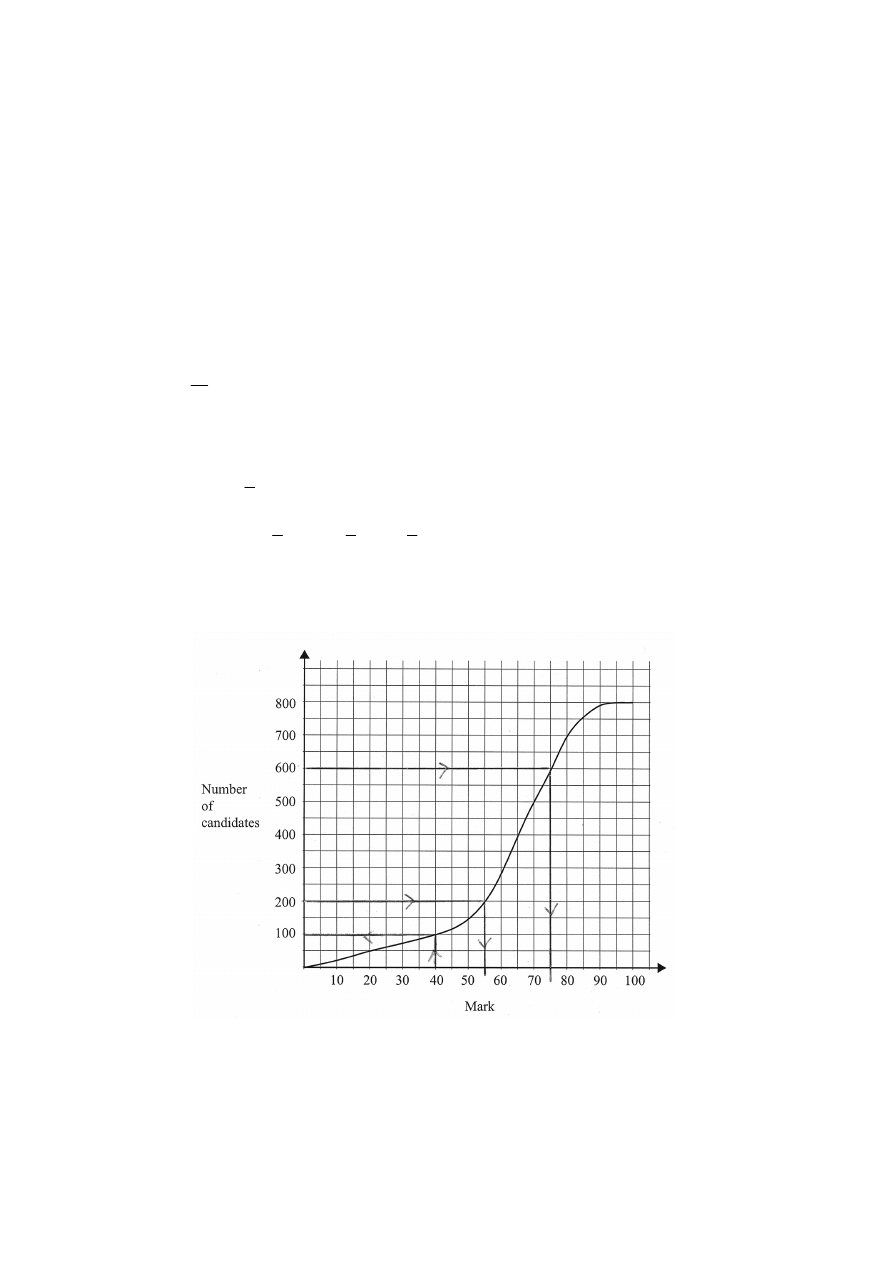
(a)
Lines
on
graph
(M1)
100 students score 40 marks or fewer.
A1 N2
(b) Identifying
200
and 600
A1
Lines
on
graph.
(M1)
55,
75
a
b
=
=
.
A1 A1
N1N1

- 3 -
SPEC/5/MATHL/HP1/ENG/TZ0/XX/M
4.
2
2 tan
5sec
10 0
θ
θ
−
−
=
Using
2
2
1 tan
sec
θ
θ
+
=
,
(
)
2
2 sec
1
5sec
10 0
θ
θ
⇒
− −
−
=
(M1)
2
2sec
5sec
12 0
θ
θ
−
−
=
A1
Solving the equation eg
(
)(
)
2sec
3 sec
4
0
θ
θ
+
−
=
(M1)
3
sec
or sec
4
2
θ
θ
= −
=
A1
θ
in second quadrant
⇒
sec
θ
is negative
(R1)
3
sec
2
θ
⇒
= −
A1 N3
5. (a) Using
P(
) 1
X
x
=
=
∑
(M1)
1
2
3
4
5 15
1
k
k
k
k
k
k
∴ × + × + × + × + × =
=
M1A1
1
15
k
=
AG N0
(b)
Using
E( )
P(
)
X
x
X
x
=
=
∑
(M1)
1
2
3
4
5
0
1
2
3
4
15
15
15
15
15
= ×
+ ×
+ ×
+ ×
+ ×
A1
8
2
2 , 2.67
3
3
⎛
⎞
= ⎜
⎟
⎝
⎠
A1 N2
6.
(a) Using the chain rule
π
( )
2cos 5
5
2
f x
x
⎛
⎞
⎛
⎞
′′
=
−
⎜
⎟
⎜
⎟
⎝
⎠
⎝
⎠
(M1)
π
10cos 5
2
x
⎛
⎞
=
−
⎜
⎟
⎝
⎠
A1
N2
(b)
( )
( )d
f x
f x x
′
=
∫
2
π
cos 5
5
2
x
c
⎛
⎞
= −
−
+
⎜
⎟
⎝
⎠
A1
Substituting to find c,
π
2
π
π
cos 5
1
2
5
2
2
f
c
⎛
⎞
⎛ ⎞
⎛ ⎞
= −
−
+ =
⎜
⎟
⎜ ⎟
⎜ ⎟
⎝ ⎠
⎝ ⎠
⎝
⎠
M1
2
2
7
1
cos 2π 1
5
5
5
c
= +
= + =
(A1)
2
π
7
( )
cos 5
5
2
5
f x
x
⎛
⎞
= −
−
+
⎜
⎟
⎝
⎠
A1 N2

- 4 -
SPEC/5/MATHL/HP1/ENG/TZ0/XX/M
7.
(a)
5000(1.063)
n
A1 N1
(b) Value =
5
$5000(1.063)
(= $6786.3511…)
= $6790 to 3 sf (Accept $6786, or $6786.35)
A1 N1
(c) (i) 5000(1.063)
10000
n
>
(or (1.063)
2
n
> )
A1 N1
(ii) Attempting to solve the above inequality log(1.063) log 2
n
>
(M1)
11.345...
n
>
(A1)
12
years
A1 N3
Let
1.063
x
y
=
(M1)
When 11,
1.9582
x
y
=
=
, when
12,
2.0816
x
y
=
=
(A1)
12
x
=
ie 12 years
A1 N3
8.
P(
90) 0.15
X
>
=
and P(
40) 0.12
X
<
=
(M1)
Finding standardized values 1.036, –1.175
A1 A1
Setting up the equations
90
1.036
µ
σ
−
=
’
40
1.175
µ
σ
−
−
=
(M1)
= 66.6, =22.6
µ
σ
A1 A1
N2N2
9.
(a)
1
:
e
:
ln
x
f x
f
x
x
−
⇒
!
!
1
(3) ln 3
f
−
⇒
=
A1
1
:
2
:
2
g x
x
g
x
x
−
+ ⇒
−
!
!
1
(3) 1
g
−
⇒
=
A1
1
1
(3)
(3) ln 3
f
g
−
−
×
=
A1 N1
(b)
( )
2
(
2) e
x
f g x
f x
+
=
+
=
"
A1
2
e
3
2 ln 3
x
x
+
= ⇒ + =
M1A1
ln 3 2
x
=
−
AG N0
Note: Candidates are likely to use TABLE or LIST on a
GDC to find n. A good way of communicating this is
suggested below.

- 5 -
SPEC/5/MATHL/HP1/ENG/TZ0/XX/M
10. METHOD
1
since 0
b
>
(M1)
(
)
arg
i
30
b
⇒
+ =
"
A1
1
tan 30
b
=
"
M1A1
3
b
=
A2 N2
METHOD
2
(
)
2
arg
i
60
b
+
=
"
(
)
2
arg
1 2 i
60
b
b
⇒
− +
=
"
M1
(
)
0
2
2
tan 60
3
1
b
b
=
=
−
M1A1
2
3
2
3 0
b
b
−
−
=
A1
(
)(
)
3
1
3
0
b
b
+
−
=
since 0
b
>
(M1)
3
b
=
A1 N2
11. Attempting to differentiate implicitly
(M1)
2
2
3
2
2
x y
xy
+
=
2
2
d
d
6
3
2
4
0
d
d
y
y
xy
x
y
xy
x
x
⇒
+
+
+
=
A1
Substituting
1
x
= and
2
y
= −
(M1)
d
d
12 3
8 8
0
d
d
y
y
x
x
− +
+ −
=
A1
d
5
4
d
y
x
⇒ −
=
d
4
d
5
y
x
⇒
= −
A1
Gradient of normal is
5
4
.
A1 N3
12. (a) Finding
correct vectors
4
3
AB
3
AC
1
1
1
→
→
−
⎛ ⎞
⎛
⎞
⎜ ⎟
⎜
⎟
=
=
⎜ ⎟
⎜
⎟
⎜ ⎟
⎜
⎟
−
⎝ ⎠
⎝
⎠
A1 A1
Substituting correctly in scalar product AB AC 4( 3) 3(1) 1(1)
→
→
⋅
= − +
−
A1
= –10
AG N0
(b)
AB
26
AC
11
→
→
=
=
(A1)(A1)
Attempting to use scalar product formula ,
10
cos BAC
26 11
−
=
#
M1
0.591
= −
(to 3 s.f.)
AG N0

- 6 -
SPEC/5/MATHL/HP1/ENG/TZ0/XX/M
13. (a)
1
0.1
0.4 0.1
0.7 0.2 0.3
1.2 0.2 0.8
−
⎛
⎞
⎜
⎟
= −
⎜
⎟
⎜
⎟
−
⎝
⎠
A
A2 N2
(b) For attempting to calculate
1
1
2
3
x
y
z
−
⎛ ⎞
⎛ ⎞
⎜ ⎟
⎜ ⎟
=
⎜ ⎟
⎜ ⎟
⎜ ⎟
⎜ ⎟
⎝ ⎠
⎝ ⎠
A
M1
1.2, 0.6, 1.6
x
y
z
=
=
=
(So the point is
(
)
1.2, 0.6, 1.6
)
A2 N2
(c)
(
)
1.2, 0.6, 1.6
lies on x y z d
+ + =
3.4
d
∴ =
A1 N1
14. Substituting
2
u x
= +
2
, d
d
u
x u
x
⇒ − =
=
(M1)
(
)
(
)
3
3
2
2
2
d
d
2
u
x
x
u
u
x
−
=
+
∫
∫
A1
3
2
2
6
12
8
d
u
u
u
u
u
−
+
−
=
∫
A1
( )
2
12
d
6 d
d
8
d
u u
u
u
u
u
u
−
=
+ −
+
−
∫
∫
∫
∫
A1
2
1
6
12ln
8
2
u
u
u
u
c
−
=
−
+
+
+
A1
(
)
(
)
2
2
8
6
2
12ln
2
2
2
x
x
x
c
x
+
=
−
+
+
+ +
+
+
A1 N0
15. (a)
Total number of ways of selecting 4 from 30
30
4
⎛ ⎞
= ⎜ ⎟
⎝ ⎠
(M1)
Number of ways of choosing 2B 2G
12 18
2
2
⎛ ⎞⎛ ⎞
= ⎜ ⎟⎜ ⎟
⎝ ⎠⎝ ⎠
(M1)
12 18
2
2
P(2B or 2G)
0.368
30
4
⎛ ⎞⎛ ⎞
⎜ ⎟⎜ ⎟
⎝ ⎠⎝ ⎠
=
=
⎛ ⎞
⎜ ⎟
⎝ ⎠
A1 N2
(b)
Number of ways of choosing 4B
12
4
⎛ ⎞
= ⎜ ⎟
⎝ ⎠
, choosing 4G
18
4
⎛ ⎞
= ⎜ ⎟
⎝ ⎠
A1
12
18
4
4
P(4B or 4G)
30
4
⎛ ⎞ ⎛ ⎞
+
⎜ ⎟ ⎜ ⎟
⎝ ⎠ ⎝ ⎠
=
⎛ ⎞
⎜ ⎟
⎝ ⎠
(M1)
0.130
=
A1 N2

- 7 -
SPEC/5/MATHL/HP1/ENG/TZ0/XX/M
16.
EITHER
Let
s be the distance from the origin to a point on the line, then
(
) (
)
2
2
2
1
2 3
4
s
λ
λ
= −
+
−
+
(M1)
2
10
14
9
λ
λ
=
−
+
A1
2
d( )
d
s
λ
20
14
λ
=
−
A1
For
minimum
2
d( )
7
0, =
d
10
s
λ
λ
=
⇒
A1
OR
The position vector for the point nearest to the origin is
perpendicular to the direction of the line. At that point:
1
1
2 3
3
0
2
0
λ
λ
−
−
⎛
⎞ ⎛
⎞
⎜
⎟ ⎜
⎟
−
• − =
⎜
⎟ ⎜
⎟
⎜
⎟ ⎜
⎟
⎝
⎠ ⎝
⎠
(M1)A1
Therefore,
10
7 0
λ
− =
A1
Therefore,
7
10
λ
=
A1
THEN
3
1
=
, =
10
10
x
y
−
(A1)(A1)
The
point
is
3
1
, ,
2
10 10
−
⎛
⎞
⎜
⎟
⎝
⎠
.
N3
17. (a)
(
) (
)
P(3
5) P
5
P
2
X
X
X
≤
≤
=
≤
−
≤
(M1)
0.547
=
A1 N2
(b)
(
)
P(
3) 1 P
2
X
X
≥ = −
≤
(M1)
0.762
=
A1 N2
(c)
(
)
(
)
P 3
5
0.547
P(3
5
3)
3
0.762
X
X
X
P X
≤
≤ ⎛
⎞
≤
≤
≥ =
=
⎜
⎟
≥
⎝
⎠
(M1)
0.718
=
A1 N2
- 8 -
SPEC/5/MATHL/HP1/ENG/TZ0/XX/M
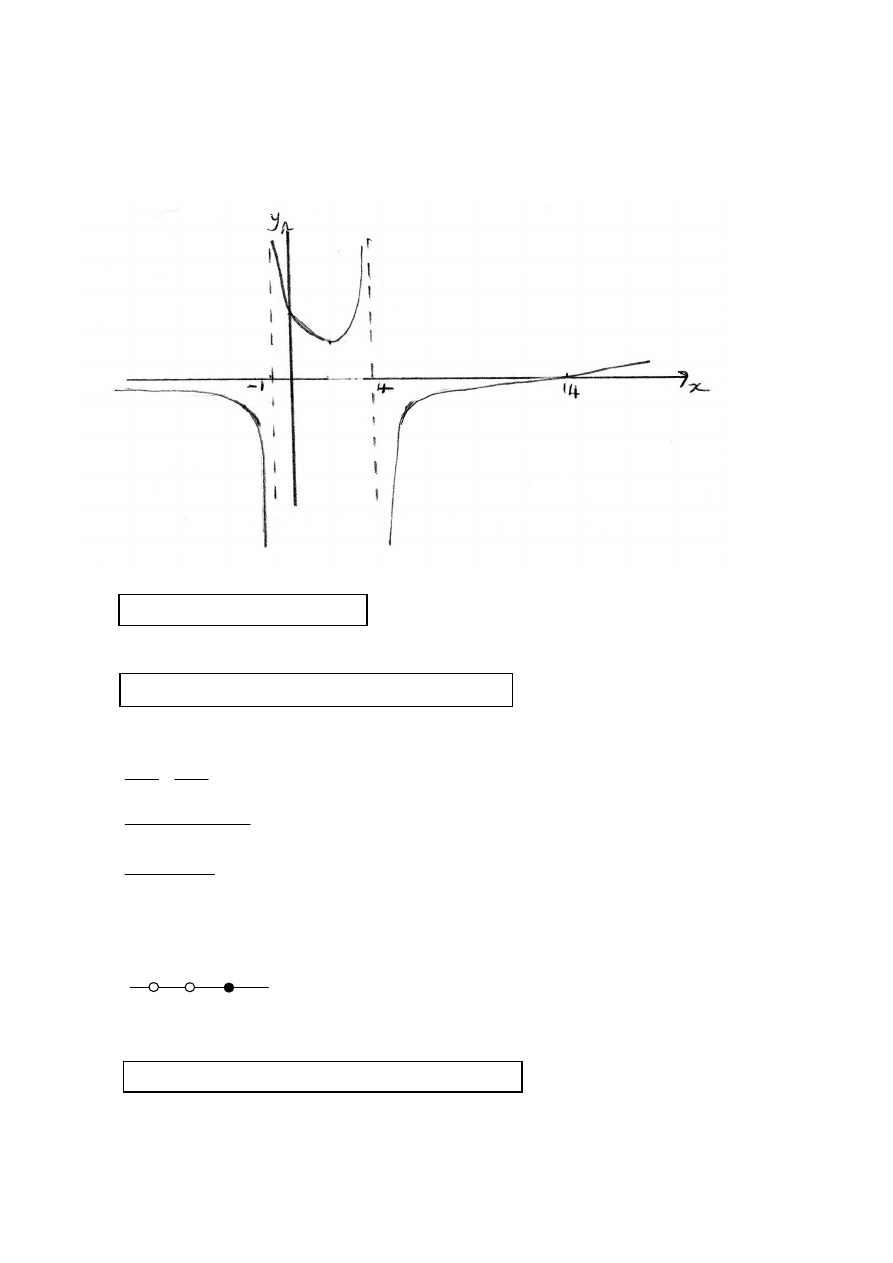
18. METHOD 1
Graph
of ( )
( )
f x
g x
−
M1
A1A1A1
1 or 4
14
x
x
< −
< ≤
A1 A1 N3
METHOD
2
4
2
0
1
4
x
x
x
x
+
−
−
≤
+
−
M1
(
)(
)
2
2
16
2
0
1
4
x
x
x
x
x
−
−
+ +
≤
+
−
(
)(
)
14
0
1
4
x
x
x
−
≤
+
−
A1
Critical value of
14
x
=
A1
Other
critical
values 1
x
= − and
4
x
=
A1
1 or 4
14
x
x
< −
< ≤
A1 A1 N3
Note: Each value and inequality sign must be correct.
Note: Award A1 for each branch.
Note: Each value and inequality sign must be correct.
14
4
−1
−
−
+
+

- 9 -
SPEC/5/MATHL/HP1/ENG/TZ0/XX/M
19.
2
2
d
d
1,
1
d
d
y
y
x
y
x
y
x
x
−
= ⇒
=
+
Separating
variables
2
d
d
1
y
x
y
x
=
+
(M1)
A1
arctan
ln
y
x c
=
+
A1A1
0,
2
arctan 0 ln 2
y
x
c
=
= ⇒
=
+
ln 2
c
−
=
(A1)
arctan
ln
ln 2 ln
2
x
y
x
=
−
=
tan ln
2
x
y
⎛
⎞
=
⎜
⎟
⎝
⎠
A1 N3
20. For multiplying
(
)
(
)
2
+
+
−
I
X
I
X
X
M1
2
2
2
3
+
+
=
−
−
−
I
IX
IX
XI
X
X
2
2
3
=
+
+
−
−
−
I
X
X
X
X
X
(A1)(A1)
3
=
−
I
X
A1
= I
A1
1
=
=
−
⇒
AB I
A
B
(R1)
(
)
(
)
2
+
+
−
= ⇒
I
X
I
X
X
I
-1
2
(
) = +
+
−
I X
I X
X
AG N0


j
IB DIPLOMA PROGRAMME
PROGRAMME DU DIPLÔME DU BI
PROGRAMA DEL DIPLOMA DEL BI
22xx-72xx
4
pages
SPEC/5/MATHL/HP2/ENG/TZ0/XX
MATHEMATICS
HIGHER LEVEL
PAPER 2
SPECIMEN
2 hours
INSTRUCTIONS TO CANDIDATES
• Do not open this examination paper until instructed to do so.
• Answer all the questions.
• Unless otherwise stated in the question, all numerical answers must be given exactly or to three
significant figures.

− 2 − SPEC/5/MATHL/HP2/ENG/TZ0/XX
22xx-72xx
Please start each question on a new page. Full marks are not necessarily awarded for a correct
answer with no working. Answers must be supported by working and/or explanations. In
particular, solutions found from a graphic display calculator should be supported by suitable
working, e.g. if graphs are used to find a solution, you should sketch these as part of your answer.
Where an answer is incorrect, some marks may be given for a correct method, provided this is
shown by written working. All students should therefore be advised to show their working.
1.
[Maximum mark: 21]
The function f is defined on the domain x
≥ 1 by f x
x
x
( )
ln
=
.
(a) (i) Show, by considering the first and second derivatives of f, that
there is one maximum point on the graph of f.
(ii)
State
the
exact coordinates of this point.
[9 marks]
(iii) The graph of f has a point of inflexion at P. Find the x-coordinate of P.
[3 marks]
Let R be the region enclosed by the graph of f, the x-axis and the line
5
x
=
.
(c) Find the exact value of the area of R.
[6 marks]
(d)
The
region
R is rotated through an angle 2
π about the x-axis. Find the
volume of the solid of revolution generated.
[3 marks]
2.
[Maximum mark: 20]
A farmer owns a triangular field ABC. The side [AC] is 104 m, the side [AB]
is 65 m and the angle between these two sides is
60
!
.
(a) Calculate the length of the third side of the field.
[3 marks]
(b) Find the area of the field in the form
p 3
, where p is an integer.
[3 marks]
Let D be a point on [BC] such that [AD] bisects the
60
!
angle. The farmer divides
the field into two parts by constructing a straight fence [AD] of length x metres.
(c) (i)
Show that the area of the smaller part is given by
65
4
x
and find an
expression for the area of the larger part.
(ii) Hence, find the value of x in the form
q 3
, where q is an integer.
[8 marks]
(d) Prove
that
BD
5
DC
8
=
.
[6 marks]

− 3 − SPEC/5/MATHL/HP2/ENG/TZ0/XX
22xx-72xx
Turn over
3.
[Maximum mark: 29]
(a) Show that lines
2
2
3
1
3
1
x
y
z
−
−
−
=
=
and
2
3
4
1
4
2
x
y
z
−
−
−
=
=
intersect
and find the coordinates of P, the point of intersection.
[8 marks]
(b) Find the Cartesian equation of the plane
∏
that contains the two lines.
[6 marks]
(c) The point Q
(3, 4, 3)
lies on
∏
. The line L passes through the midpoint
of [PQ]. Point S is on L such that PS
QS
3
=
=
""#
"""#
, and the triangle PQS
is normal to the plane
∏
. Given that there are two possible positions
for S, find their coordinates.
[15 marks]
4.
[Total maximum mark: 25]
Part
A
[Maximum mark: 13]
Bag A contains 2 red and 3 green balls.
(a) Two balls are chosen at random from the bag without replacement. Find
the probability that 2 red balls are chosen.
[2 marks]
Bag B contains 4 red and n green balls.
(b) Two balls are chosen without replacement from this bag. If the
probability that two red balls are chosen is
2
15
, show that
6
n
=
.
[4 marks]
A standard die with six faces is rolled. If a 1 or 6 is obtained, two balls are
chosen from bag A, otherwise two balls are chosen from bag B.
(c) Calculate the probability that two red balls are chosen.
[4 marks]
(d) Given that two red balls are chosen, find the probability that a 1 or a 6
was obtained on the die.
[3 marks]
(This question continues on the next page)

− 4 − SPEC/5/MATHL/HP2/ENG/TZ0/XX
22xx-72xx
(Question 4 continued)
Part
B
[Maximum mark: 12]
The continuous random variable X has probability density function
2
1
( )
(1
)
6
f x
x
x
=
+
for 0
≤ x ≤ 2,
f x
( )
= 0
otherwise.
(a) Sketch the graph of
f
for 0
≤ x ≤ 2.
[2 marks]
(b) Write down the mode of X.
[1 mark]
(c) Find the mean of X.
[4 marks]
(d) Find the median of X.
[5 marks]
5.
[Total maximum mark: 25]
Part A
[Maximum mark: 9]
Use mathematical induction to prove that
5
9
2
n
n
+
+
is divisible by 4, for
n
+
∈Z
.
[9 marks]
Part B
[Maximum mark: 16]
Consider the complex geometric series
i
2i
3i
1
1
e
e
e
...
2
4
θ
θ
θ
+
+
+
(a) Find an expression for z, the common ratio of this series.
[2 marks]
(b) Show that
1
z
< .
[2 marks]
(c) Write down an expression for the sum to infinity of this series.
[2 marks]
(d) (i) Express your answer to part (c) in terms of
sin
θ and
cos
θ .
(ii) Hence show that
1
1
4 cos
2
cos
cos 2
cos 3
...
2
4
5 4 cos
θ
θ
θ
θ
θ
−
+
+
+ =
−
[10 marks]

13 pages
MARKSCHEME
SPECIMEN PAPERS
MATHEMATICS
Higher Level
Paper 2
c
IB DIPLOMA PROGRAMME
PROGRAMME DU DIPLÔME DU BI
PROGRAMA DEL DIPLOMA DEL BI
SPEC/5/MATHL/HP2/ENG/TZ0/XX/M

- 2 -
SPEC/5/MATHL/HP2/ENG/TZO/XX/M
Markscheme Instructions
A. Abbreviations
M
Marks awarded for attempting to use a correct Method: the working must be seen.
(M)
Marks awarded for Method: this may be implied by correct subsequent working.
A
Marks awarded for an Answer or for Accuracy, usually dependent on preceding M marks: the
working must be seen.
(A)
Marks awarded for an Answer or for Accuracy: this may be implied by correct subsequent
working.
R
Marks awarded for clear Reasoning
N
Marks awarded for correct answers, if no working (or no relevant working) shown: in general, these
will not be all the marks for the question. Examiners should only award these N marks for correct
answers where there is no working (or if there is working which earns no other marks).
B. Using the markscheme
Follow through (ft) marks: Only award ft marks when a candidate uses an incorrect answer in a subsequent
part. Any exceptions to this will be noted on the markscheme. Follow through marks are now the exception
rather than the rule within a question or part question. Follow through marks may only be awarded to work
that is seen. Do not award N (ft) marks. If the question becomes much simpler then use discretion to award
fewer marks.
If a candidate mis-reads data from the question apply follow-through.
Discretionary (d) marks: There will be rare occasions where the markscheme does not cover the work seen.
In such cases, (d) should used to indicate where an examiner has used discretion. It must be accompanied by
a brief note to explain the decision made.
It is important to understand the difference between “implied” marks, as indicated by the brackets, and
marks which can only be awarded for work seen - no brackets. The implied marks can only be awarded if
correct work is seen or implied in subsequent working. Normally this would be in the next line.
Where M1 A1 are awarded on the same line, this usually means M1 for an attempt to use an appropriate
formula, A1 for correct substitution.
As A marks are normally dependent on the preceding M mark being awarded, it is not possible to award M0
A1.
As N marks are only awarded when there is no working, it is not possible to award a mixture of N and other
marks.
Accept all correct alternative methods, even if not specified in the markscheme Where alternative methods
for complete questions are included, they are indicated by METHOD 1, METHOD 2, etc. Other
alternative (part) solutions, are indicated by EITHER….OR. Where possible, alignment will also be used to
assist examiners to identify where these alternatives start and finish.

- 3 -
SPEC/5/MATHL/HP2/ENG/TZO/XX/M
Unless the question specifies otherwise, accept equivalent forms. On the markscheme, these equivalent
numerical or algebraic forms will generally be written in brackets after the required answer The markscheme
indicate the required answer, by allocating full marks at that point. Once the correct answer is seen, ignore
further working, unless it contradicts the answer.
Brackets will also be used for what could be described as the well-expressed answer, but which candidates may
not write in examinations. Examiners need to be aware that the marks for answers should be awarded for the form
preceding the brackets eg in differentiating ( ) 2sin (5
3)
f x
x
=
− , the markscheme says
(
)
( )
2cos(5
3) 5
f x
x
′
=
−
(
)
10cos(5
3)
x
=
−
A1
This means that the A1 is awarded for seeing
(
)
2cos(5
3) 5
x
−
, although we would normally write the
answer as 10cos(5
3)
x
− .
As this is an international examination, all alternative forms of notation should be accepted.
Where the markscheme specifies M2, A3, etc, for an answer do NOT split the marks unless otherwise
instructed.
Do not award full marks for a correct answer, all working must be checked.
Candidates should be penalized once IN THE PAPER for an accuracy error (AP). There are two types of
accuracy error:
• Rounding errors: only applies to final answers not to intermediate steps.
• Level of accuracy: when this is not specified in the question the general rule is unless otherwise
stated in the question all numerical answers must be given exactly or to three significant figures.

- 4 -
SPEC/5/MATHL/HP2/ENG/TZO/XX/M
1.
(a)
(i)
Attempting to use quotient rule
2
1
ln
1
( )
x
x
x
f x
x
−
×
′
=
(M1)
′
=
−
f x
x
x
( )
ln
1
2
A1
(
)
2
4
1
1 ln
2
( )
x
x x
x
f x
x
⎛
⎞
−
− −
⎜
⎟
⎝
⎠
′′
=
(M1)
3
2ln
3
( )
x
f x
x
−
′′
=
A1
Stationary
point
where
( ) 0
f x
′
= ,
M1
ie ln
1
x
= , (so
e
x
=
)
A1
(e) 0
f ′′
< so maximum.
R1AG N0
(ii)
Exact
coordinates
1
e,
e
x
y
=
=
A1A1 N2
[9 marks]
(b)
Solving
(0) 0
f ′′
=
M1
3
ln
2
x
=
(A1)
3
2
e (4.48)
x
=
A1 N2
[3 marks]
continued …
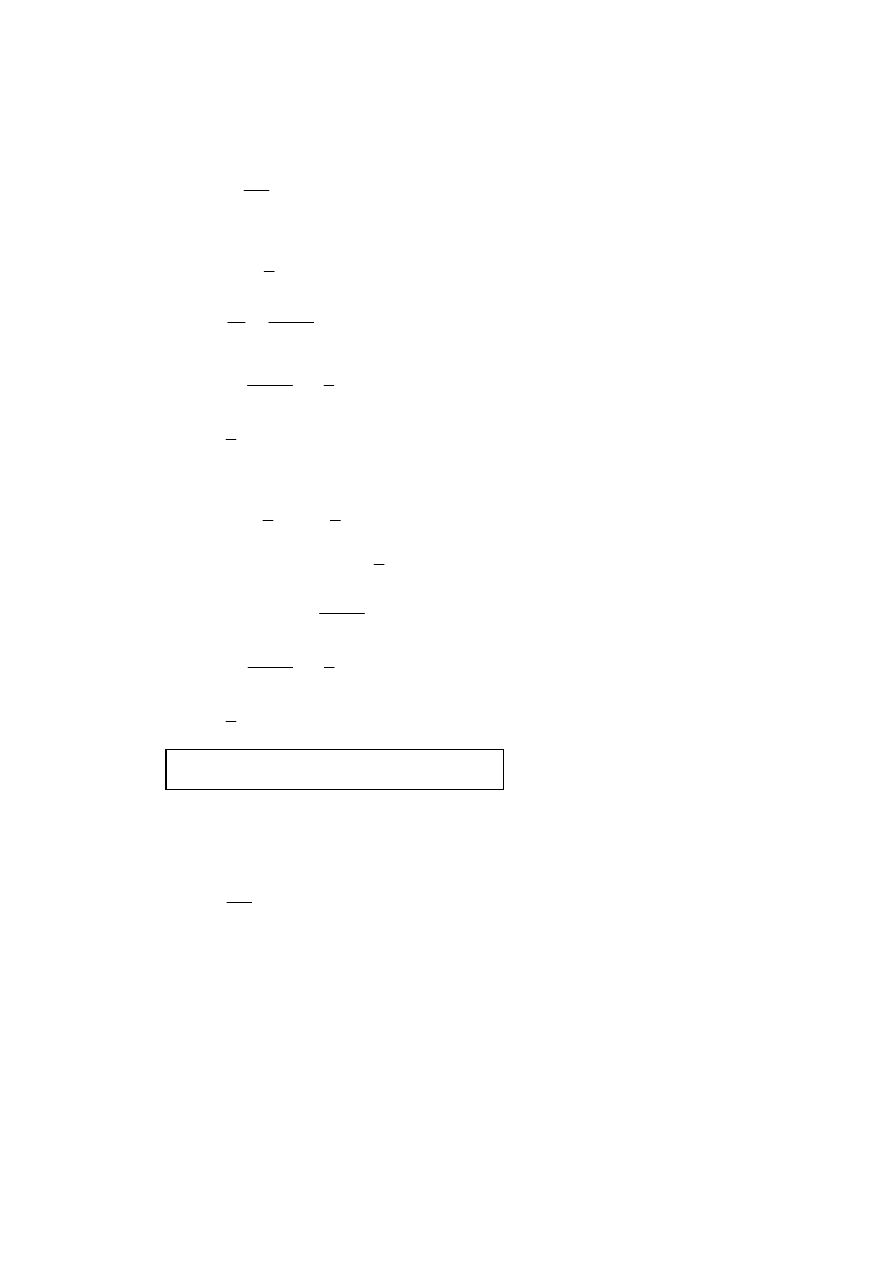
- 5 -
SPEC/5/MATHL/HP2/ENG/TZO/XX/M
Question 1 continued
(c)
Area
=
5
1
ln
d
x
x
x
∫
A1
EITHER
Finding the integral by substitution/inspection
1
ln ,d
d
u
x u
x
x
=
=
(M1)
( )
2
2
ln
d
2
2
x
u
u u
⎛
⎞
⎜
⎟
=
=
⎜
⎟
⎝
⎠
∫
M1A1
Area
=
( )
( ) ( )
(
)
5
2
2
2
1
ln
1
ln 5
ln1
2
2
x
⎡
⎤
=
−
⎢
⎥
⎢
⎥
⎣
⎦
A1
Area
( ) (
)
2
1
ln 5
1.30
2
=
=
A1 N2
OR
Finding
the
integral
I by parts
(M1)
1
1
ln ,d
d
,
ln
u
x v
u
v
x
x
x
=
= ⇒
=
=
( )
( )
2
2
1
d
ln
ln
d
ln
I uv
u v
x
x
x
x
I
x
=
−
=
−
=
−
∫
∫
M1
( )
( )
2
2
ln
2
ln
2
x
I
x
I
⇒
=
⇒ =
A1
( )
( ) ( )
(
)
5
2
2
2
1
ln
1
area
ln 5
ln1
2
2
x
⎡
⎤
⇒
=
=
−
⎢
⎥
⎢
⎥
⎣
⎦
A1
Area
( ) (
)
2
1
ln 5
1.30
2
=
=
A1 N2
[6 marks]
(d)
Using
2
π d
b
a
V
y x
=
∫
(M1)
2
5
1
ln
π
d
x
x
x
⎛
⎞
=
⎜
⎟
⎝
⎠
∫
A1
1.38
=
A1 N2
[3 marks]
Total [21 marks]
Note:
Award N1 for 1.30 with no working.
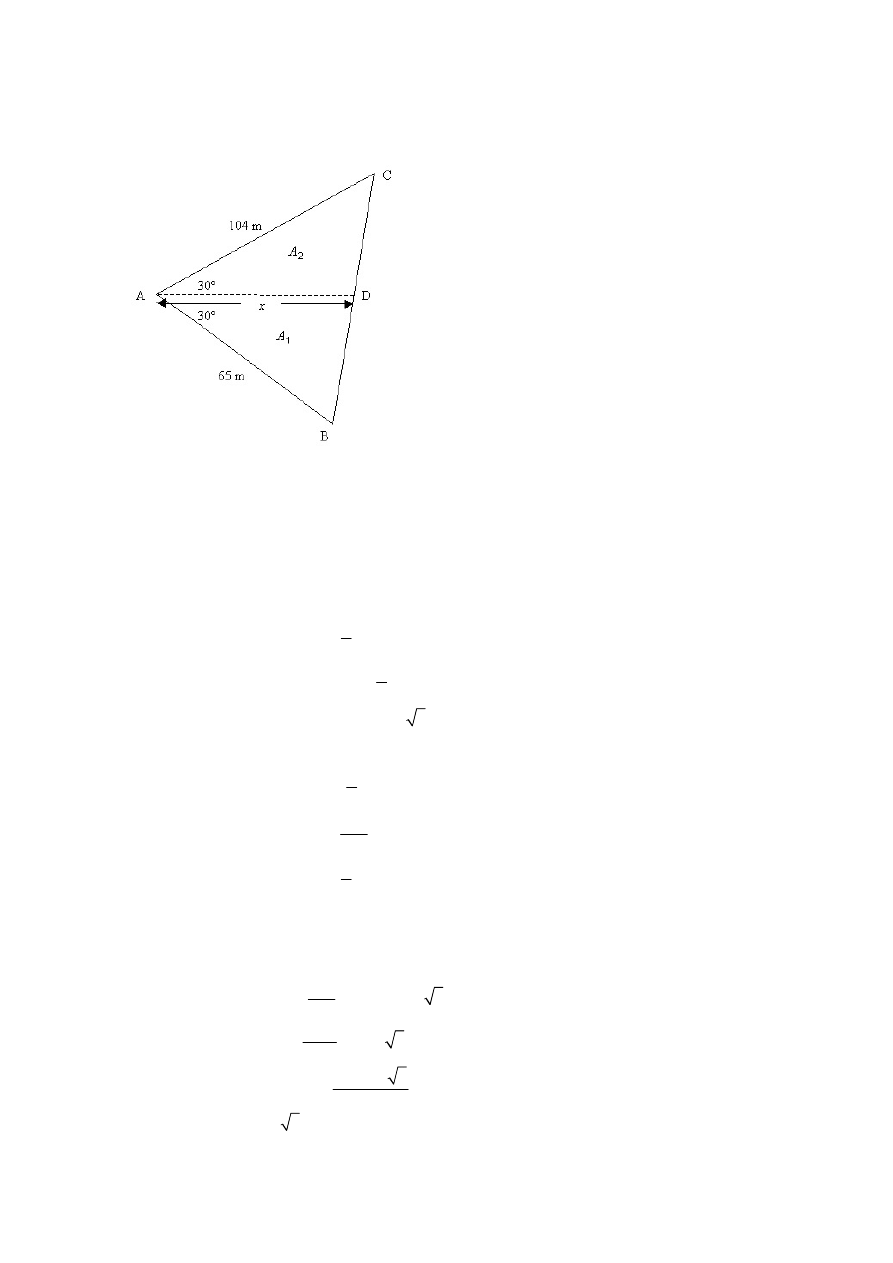
- 6 -
SPEC/5/MATHL/HP2/ENG/TZO/XX/M
2.
(a)
Using the cosine rule
(
)
2
2
2
2
cos
a
b
c
bc
A
=
+
−
(M1)
Substituting
correctly
2
2
2
BC
65
104
2(65)(104)cos60
=
+
−
!
A1
4225 10816 6760 8281
=
+
−
=
BC 91 m
⇒
=
A1 N2
[3 marks]
(b)
Finding the area using
1
sin
2
bc
A
=
(M1)
Substituting correctly, area
1
(65)(104)sin 60
2
=
!
A1
1690 3
=
(Accept
1690
p
=
)
A1
N2
[3 marks]
(c)
(i)
Smaller
area
1
1
(65)( )sin 30
2
A
x
⎛ ⎞
= ⎜ ⎟
⎝ ⎠
!
(M1)A1
65
4
x
=
AG N0
Larger
area
2
1
(104)( )sin 30
2
A
x
⎛ ⎞
= ⎜ ⎟
⎝ ⎠
!
M1
26x
=
A1
N1
(ii)
Using
1
2
A
A
A
+
=
(M1)
Substituting
65
26
1690 3
4
x
x
+
=
A1
Simplifying
169
1690 3
4
x =
A1
Solving
4 1690 3
169
x
×
=
40 3
x
⇒ =
(Accept
40
q
=
)
A1
N1
[8 marks]
continued …

- 7 -
SPEC/5/MATHL/HP2/ENG/TZO/XX/M
Question 2 continued
(d)
using sin rule in ADB
∆
and ACD
∆
(M1)
Substituting
correctly
BD
65
BD
sin 30
ˆ
ˆ
65
sin 30
sin ADB
sin ADB
=
⇒
=
!
!
A1
and
DC
104
DC
sin 30
ˆ
ˆ
104
sin 30
sin ADC
sin ADC
=
⇒
=
!
!
A1
Since
ˆ
ˆ
ADB ADC=180
+
!
It
follows
that ˆ
ˆ
sin ADB sin ADC
=
R1
R1
BD
DC
BD
65
65
104
DC 104
=
⇒
=
A1
BD
5
DC
8
⇒
=
AG
N0
[6 marks]
Total [20 marks]

− 8 − SPEC/5/MATHL/HP2/ENG/TZO/XX/M
3. (a)
L x
y
z
1
2
2 3
3
:
= +
= +
= +
λ
λ
λ
;
;
(A1)
L x
y
z
2
2
3 4
4 2
:
= +
= +
= +
µ
µ
µ
;
;
(A1)
At the point of intersection
(M1)
2
2
+ = +
λ
µ
(1)
2 3
3 4
+
= +
λ
µ
(2)
3
4 2
+ = +
λ
µ
(3)
From
(1),
λ µ
=
.
A1
Substituting
in
(2),
2 3
3 4
λ
λ
+
= +
1.
λ µ
⇒ = = −
A1
We need to show that these values satisfy (3).
They do because LHS = RHS = 2; therefore the lines intersect.
(M1)
R1
So
P
is
(
)
1, 1, 2
−
.
A1 N3
[8 marks]
(b)
The
normal
to
Π
is normal to both lines. It is therefore given by the
vector product of the two direction vectors.
Therefore, normal vector is given by 1 3 1
1 4 2
⎛
⎞
⎜
⎟
⎜
⎟
⎜
⎟
⎝
⎠
i
j k
M1A1
2
=
− +
i
j k
A2
The
Cartesian
equation
of
Π
is 2
2 1 2
x y z
− + = + +
(M1)
i.e. 2
5
x y z
− + =
A1 N2
[6 marks]
(c)
The midpoint M of [PQ] is (2, 3/2, 5/2).
M1A1
The
direction
of
MS
"""#
is the same as the normal to
Π
, ie 2
− +
i
j k
(R1)
The coordinates of a general point R on
MS
"""#
are therefore
3
5
2 2 ,
,
2
2
λ
λ
λ
⎛
⎞
+
−
+
⎜
⎟
⎝
⎠
(M1)
It
follows
that
(
)
5
1
PR
1 2
2
2
λ
λ
λ
⎛
⎞
⎛
⎞
= +
+
−
+
+
⎜
⎟
⎜
⎟
⎝
⎠
⎝
⎠
"""#
i
j
k
A1 A1 A1
At S, length of
PR
"""#
is 3, ie
(M1)
2
2
2
(1 2 )
(5/ 2
)
(1/ 2
)
9
λ
λ
λ
+
+
−
+
+
=
A1
1 4
4
25 4 5
1 4
9
2
2
2
+
+
+
−
+
+
+ +
=
λ
λ
λ λ
λ λ
/
/
(A1)
2
6
6
4
λ
=
A1
λ
= ±
1
2
A1
Substituting these values,
the possible positions of S are
(
)
3, 1, 3
and
(
)
1, 2, 2
(M1)
A1A1
N2
[15 marks]
[29 marks]
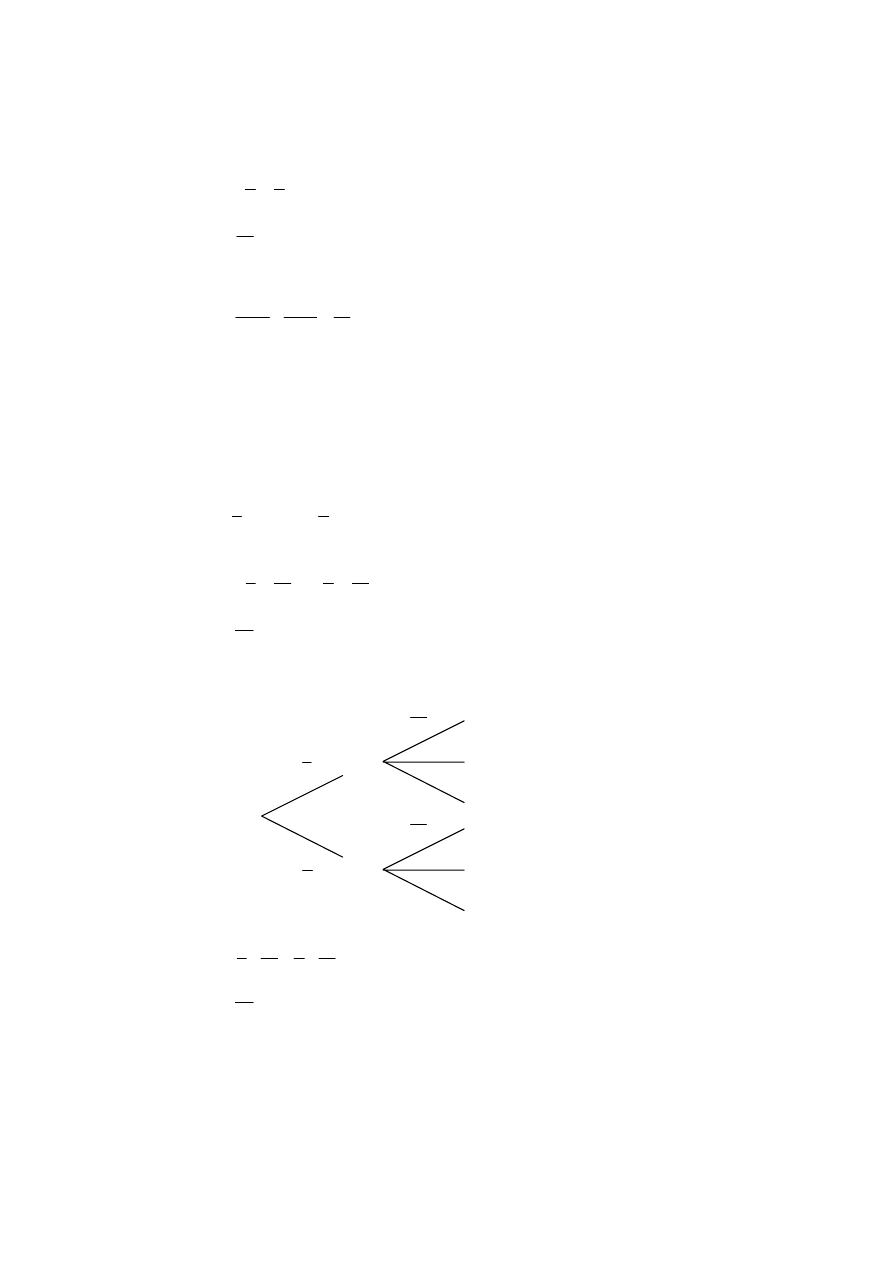
− 9 − SPEC/5/MATHL/HP2/ENG/TZO/XX/M
4.
Part A
(a)
2
1
P (
)
5
4
RR
⎛ ⎞⎛ ⎞
= ⎜ ⎟⎜ ⎟
⎝ ⎠⎝ ⎠
(M1)
1
10
=
A1 N2
[2 marks]
(b)
4
3
2
P(
)
4
3
15
RR
n
n
=
×
=
+
+
A1
Forming
equation
12 5 2(4
)(3
)
n
n
× =
+
+
(M1)
2
12 7
90
n n
+
+
=
A1
2
7
78 0
n
n
⇒
+
−
=
A1
6
n
=
AG N0
[4 marks]
(c) EITHER
1
2
P ( )
P ( )
3
3
A
B
=
=
A1
P (RR) P (A
RR) P(B RR)
=
∩
+
∩
(M1)
1
1
2
2
3
10
3
15
⎛ ⎞⎛
⎞ ⎛ ⎞⎛
⎞
=
+
⎜ ⎟⎜
⎟ ⎜ ⎟⎜
⎟
⎝ ⎠⎝
⎠ ⎝ ⎠⎝
⎠
11
90
=
A1
N2
OR
A1
1
1
2
2
P (
)
3 10
3 15
RR
= ×
+ ×
M1
11
90
=
A1
N2
[3 marks]
continued …
A
B
RR
RR
2
3
1
3
1
10
2
15
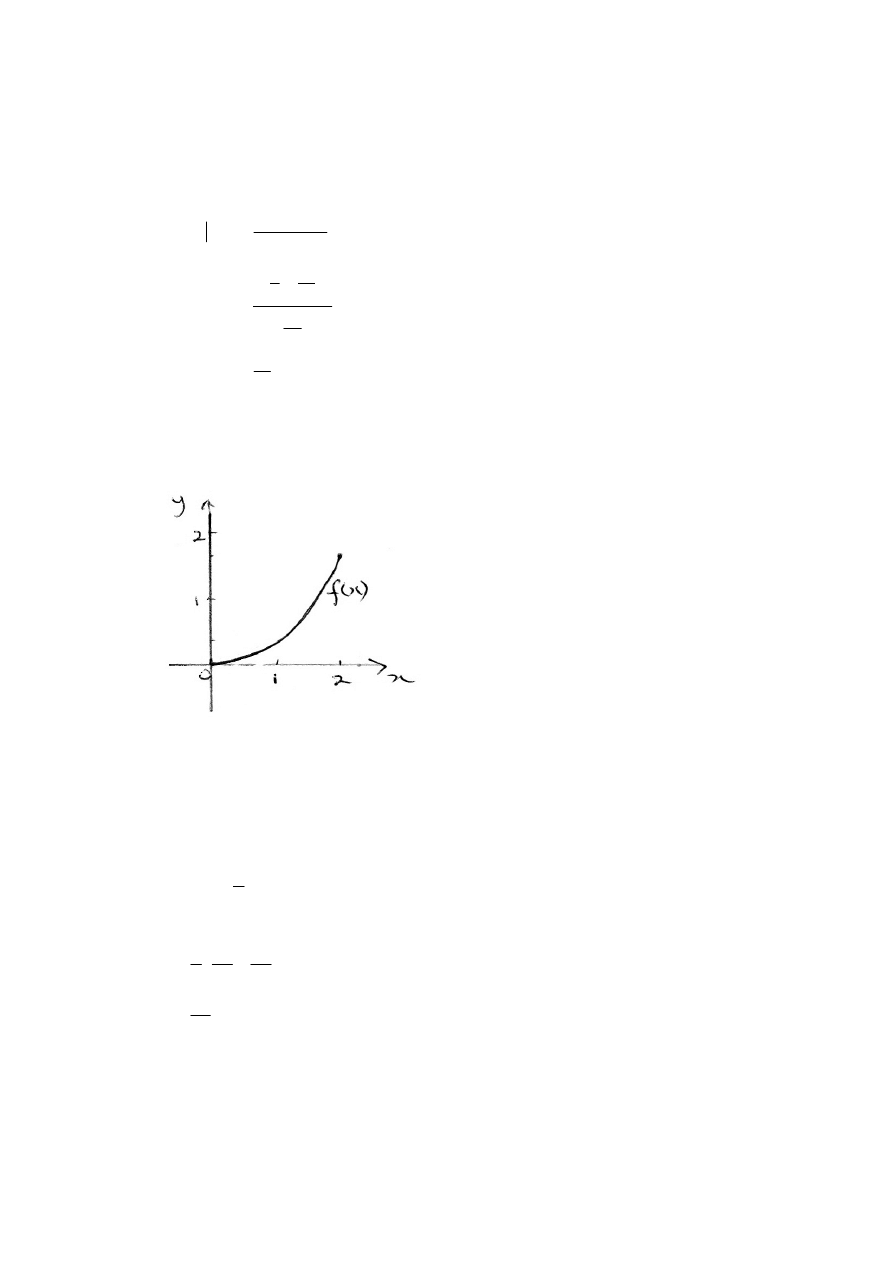
− 10 − SPEC/5/MATHL/HP2/ENG/TZO/XX/M
Question 4 Part A continued
(d)
P (1 or 6) P( )
A
=
M1
(
)
P (
)
P
P (
)
A RR
A RR
RR
∩
=
(M1)
1
1
3
10
11
90
⎡
⎤
⎛ ⎞⎛
⎞
⎜ ⎟⎜
⎟
⎢
⎥
⎝ ⎠⎝
⎠
⎣
⎦
=
M1
3
11
=
A1
N2
[4 marks]
Part B
(a)
A2
[2 marks]
(b)
Mode
=
2
A1
[1 mark]
(c)
Using
E( )
( )d
b
a
X
x f x x
=
∫
(M1)
Mean
=
1
6
2
0
2
4
(
)
x
x
x
∫
+
d
A1
=
1
6 3
5
3
5
0
2
x
x
+
⎡
⎣
⎢
⎤
⎦
⎥
(A1)
=
68
45
(1.51)
A1 N2
[4 marks]
continued …

− 11 − SPEC/5/MATHL/HP2/ENG/TZO/XX/M
Question 4 Part B continued
(d)
The
median
m satisfies
1
6
1
2
0
3
(
)
x x
x
m
∫
+
=
d
M1
A1
2
4
3
2
4
m
m
+
=
(A1)
4
2
2
12 0
m
m
⇒
+
−
=
2
2
4 48
2.60555...
2
m
− ±
+
=
=
(A1)
m = 1.61
A1 N3
[5 marks]
Total [25 marks]

− 12 − SPEC/5/MATHL/HP2/ENG/TZO/XX/M
5.
Part A
Let
( ) 5
9
2
n
n
f n
=
+
+ and let
n
P
be the proposition that ( )
f n
is divisible
by 4.
Then
(1) 16
f
=
A1
So
1
P
is true
A1
Let
n
P
be true for n k
= ie ( )
f k
is divisible by 4
M1
Consider
(
)
1
1
1
5
9
2
k
k
f k
+
+
+ =
+
+
M1
(
)
(
)
5 4 1
9 8 1
2
k
k
=
+ +
+ +
A1
( )
(
)
4 5
2 9
k
k
f k
=
+
+ ×
A1
Both terms are divisible by 4 so
(
)
1
f k
+ is divisible by 4.
R1
k
P
true
⇒
1
k
P
+
true
R1
Since
1
P
is true,
n
P
is proved true by mathematical induction for n
+
∈$ .
R1 N0
[9 marks]
Part B
(a)
z =
2i
i
1
e
e
2
z
θ
θ
=
÷
(M1)
i
1
e
2
z
θ
=
A1 N2
[2 marks]
(b)
1
2
z
=
A2
1
z
<
AG
[2 marks]
(c)
Using
1
a
S
r
∞
=
−
(M1)
i
i
e
1
1
e
2
S
θ
θ
∞
=
−
A1 N2
[2 marks]
continued …
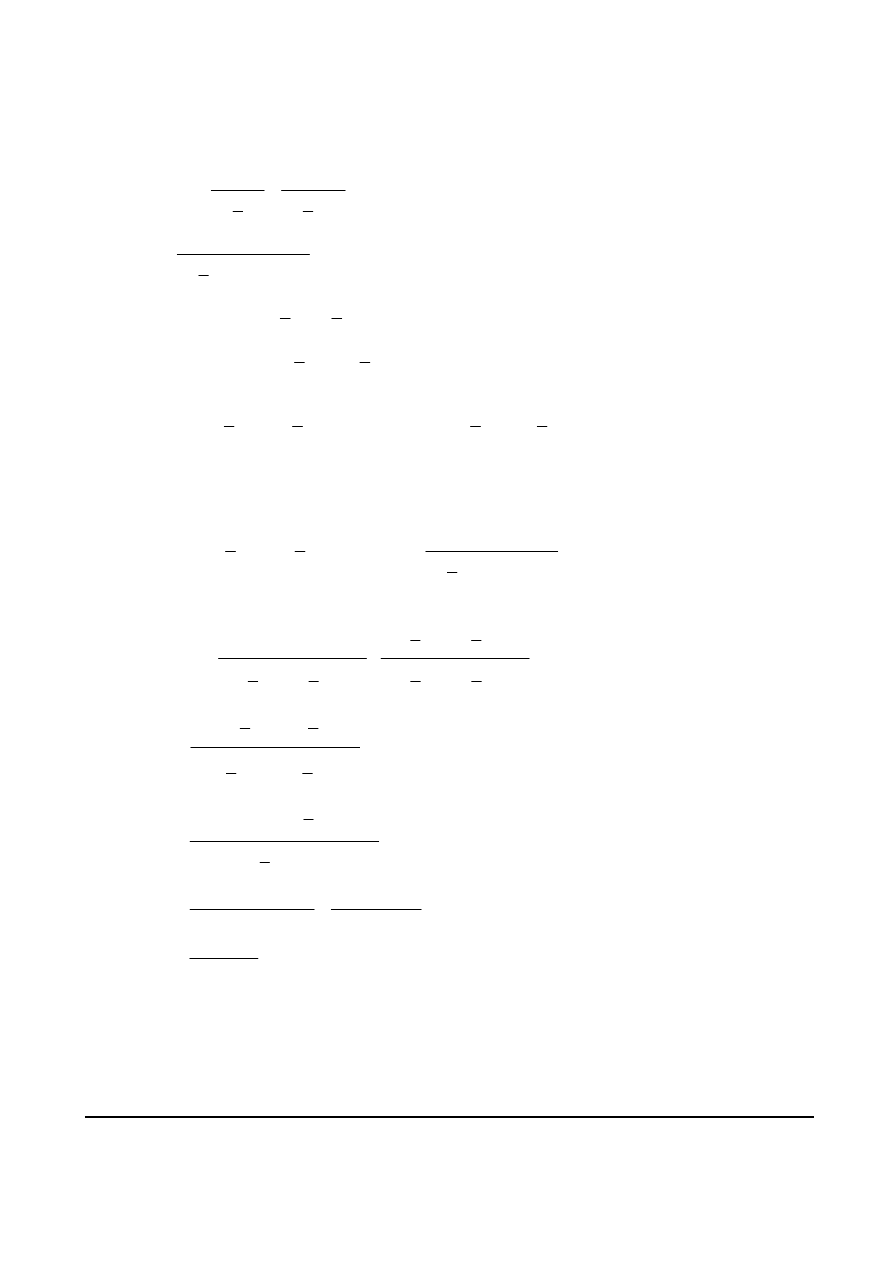
− 13 − SPEC/5/MATHL/HP2/ENG/TZO/XX/M
Question 5 Part B continued
(d) (i)
i
i
e
cis
1
1
1
e
1
cis
2
2
S
θ
θ
θ
θ
∞
=
=
−
−
(M1)
(
)
cos
sin
1
1
cos
sin
2
i
i
θ
θ
θ
θ
+
−
+
(A1)
Also
i
2i
3i
1
1
e
e
e
........
2
4
S
θ
θ
θ
∞
=
+
+
+
1
1
cis
cis2
cis3
..........
2
4
θ
θ
θ
=
+
+
+
(M1)
1
1
1
1
cos
cos2
cos3
.......
i sin
sin 2
sin 3
...
2
4
2
4
S
θ
θ
θ
θ
θ
θ
∞
⎛
⎞
⎛
⎞
=
+
+
+
+
+
+
+
⎜
⎟
⎜
⎟
⎝
⎠
⎝
⎠
A1
(ii) Taking real parts,
(
)
1
1
cos +isin
cos
cos 2
cos3
... Re
1
2
4
1
cos
isin
2
θ
θ
θ
θ
θ
θ
θ
⎛
⎞
⎜
⎟
+
+
+ =
⎜
⎟
⎜
⎟
−
+
⎝
⎠
A1
(
)
1
1
1
cos
isin
cos +isin
2
2
Re
1
1
1
1
1
cos
isin
1
cos
isin
2
2
2
2
θ
θ
θ
θ
θ
θ
θ
θ
⎛
⎞
−
+
⎜
⎟
⎜
⎟
=
×
⎛
⎞ ⎛
⎞
⎜
⎟
−
−
−
+
⎜
⎟ ⎜
⎟
⎜
⎟
⎝
⎠ ⎝
⎠
⎝
⎠
M1
=
2
2
2
2
1
1
cos
cos
sin
2
2
1
1
1
cos
sin
2
4
θ
θ
θ
θ
θ
−
−
⎛
⎞
−
+
⎜
⎟
⎝
⎠
A1
(
)
2
2
1
cos
2
1
1 cos
sin
cos
4
θ
θ
θ
θ
⎛
⎞
−
⎜
⎟
⎝
⎠
=
−
+
+
A1
(
)
(
)
(
)
(
)
2cos
1
2
4 2cos
1
4 4cos
1
4
2 5 4cos
θ
θ
θ
θ
− ÷
−
=
=
−
+ ÷
−
A1
4cos
2
5 4cos
θ
θ
−
=
−
A1AG N0
[10 marks]
Total [25 marks]


j
IB DIPLOMA PROGRAMME
PROGRAMME DU DIPLÔME DU BI
PROGRAMA DEL DIPLOMA DEL BI
22xx-72xx
11
pages
SPEC/5/MATHL/HP3/ENG/TZ0/XX
MATHEMATICS
HIGHER LEVEL
PAPER 3
SPECIMEN
1 hour
INSTRUCTIONS TO CANDIDATES
• Do not open this examination paper until instructed to do so.
• Answer all the questions in one section.
• Unless otherwise stated in the question, all numerical answers must be given exactly or to three
significant figures

- 2 -
SPEC/5/MATHL/HP3/ENG/TZ0/XX
22xx-72xx
Please start each question on a new page. Full marks are not necessarily awarded for a correct
answer with no working. Answers must be supported by working and/or explanations. In particular,
solutions found from a graphic display calculator should be supported by suitable working, e.g. if
graphs are used to find a solution, you should sketch these as part of your answer. Where an answer
is incorrect, some marks may be given for a correct method, provided this is shown by written
working. All students should therefore be advised to show their working.
SECTION A
Statistics and probability
1.
[Maximum mark: 12]
When a fair die is thrown, the probability of obtaining a ‘6’ is
1
6
.
Charles throws such a die repeatedly.
(a) Calculate the probability that
(i) he throws at least two ‘6’s in his first ten throws;
(ii) he throws his first ‘6’ on his fifth throw;
(iii) he throws his third ‘6’ on his twelfth throw.
[10 marks]
(b) On which throw is he most likely to throw his first ‘6’?
[2 marks]
2.
[Maximum mark: 11]
In an opinion poll, 540 out of 1200 people interviewed stated that they support
government policy on taxation.
(a) (i) Calculate an unbiased estimate of the proportion, p, of the whole
population supporting this policy.
(ii) Calculate the standard error of your estimate.
(iii) Calculate a 95 % confidence interval for p.
[9 marks]
(b) State an assumption required to find this interval.
[2 marks]
- 3 -
SPEC/5/MATHL/HP3/ENG/TZ0/XX
22xx-72xx
Turn over
3.
[Maximum mark: 13]
The 10 children in a class are given two jigsaw puzzles to complete. The time
taken by each child to solve the puzzles was recorded as follows.
Child
A B C D E F G H I J
Time to solve
Puzzle 1 (mins)
10.2 12.3 9.6 13.8 14.3 11.6 10.5 8.3 9.3 9.9
Time to solve
Puzzle 2 (mins)
11.7 12.9 9.9 13.6 16.3 12.2 12.0 8.4 9.8 9.5
(a) For each child, calculate the time taken to solve Puzzle 2 minus the time
taken to solve Puzzle 1.
[2 marks]
(b) The teacher believes that Puzzle 2 takes longer, on average, to solve than
Puzzle 1.
(i) State hypotheses to test this belief.
(ii)
Carry
out
an
appropriate
t-test at the 1 % significance level and state
your conclusion in the context of the problem.
[11 marks]

- 4 -
SPEC/5/MATHL/HP3/ENG/TZ0/XX
22xx-72xx
4.
[Maximum mark: 24]
Let
X X
X
1
2
12
,
,...,
be a random sample from a continuous uniform distribution
defined on the interval [0,1]. The random variable Z is given by
12
1
6
n
n
Z
X
=
=
−
∑
.
(a) Show that E(Z) = 0 and Var(Z) = 1.
[6 marks]
(b) Jim states that Z is approximately N(0,1) distributed. Justify this statement.
[2 marks]
(c) Jim writes a computer program to generate 500 values of Z. He obtains the
following table from his results.
Range of values of Z Frequency
(
−∞,−2)
16
[
−2,−1)
66
[
−1,0)
180
[0,1) 155
[1,2) 65
[2,
∞)
18
(i) Use a chi-squared goodness of fit test to investigate whether or not, at
the 5 % level of significance, the N(0,1) distribution can be used to
model these results.
(ii) In this situation, state briefly what is meant by
(a) a Type I error;
(b) a Type II error.
[16 marks]

- 5 -
SPEC/5/MATHL/HP3/ENG/TZ0/XX
22xx-72xx
Turn over
SECTION B
Sets, relations and groups
1.
[Maximum mark: 6]
Using deMorgan’s laws, prove that
(
) (
)
A B
A B
A B ′
∆ =
∪
∩
∩
.
[6 marks]
2.
[Maximum mark: 11]
The binary operation
a b
∗
is defined by
ab
a b
a b
∗ =
+
, where ,
a b
+
∈!
(a) Prove
that
∗ is associative.
[7 marks]
(b) Show that this binary operation does not have an identity element.
[4 marks]
3. [Maximum mark: 16]
(a) Consider the functions f and g, defined by
:
f
→
!
!
where
( ) 5
4
f n
n
=
+
,
:
g
× → ×
" "
" " where
( , ) (
2 , 3
5 )
g x y
x
y x
y
=
+
−
(i) Explain whether the function f is
(a) injective;
(b) surjective.
(ii) Explain whether the function g is
(a) injective;
(b) surjective.
(iii) Find the inverse of g. [13
marks]
(b) Consider any functions f : A → B and g : B → C. Given that
g f
#
: A → C
is surjective, show that g is surjective.
[3 marks]

- 6 -
SPEC/5/MATHL/HP3/ENG/TZ0/XX
22xx-72xx
4.
[Maximum mark: 11]
Let the matrix
T
be defined by
2
5
x
x
x
x
+
⎛
⎞
⎜
⎟
−
−
⎝
⎠
such that
det
1
=
T
.
(a) (i) Show that the equation for
x is
2
2
3
9 0
x
x
−
− =
.
(ii) The solutions of this equation are
a and
b , where
a b
>
.
Find
a and
b .
[5 marks]
(b) Let
A
be the matrix where
3
x
=
(i)
Find
2
A .
(ii) Assuming that matrix multiplication is associative, find the smallest
group of
2 2
×
matrices which contains A, showing clearly that this is a
group.
[6 marks]
5.
[Maximum mark: 16]
The group
(
)
,
G
× has a subgroup
(
)
,
H
× . The relation
R
is defined on G
1
(
)
(
),
x R y
x y H
−
⇔
∈
for
,
x y G
∈
.
(a) Show
that
R
is an equivalence relation.
[8 marks]
(b)
Given
that
2
2
{ , ,
, ,
,
},
G
e p p q pq p q
=
where e is the identity element,
e
q
p
=
=
2
3
, and
,
2
q
p
qp
=
prove that
pq
qp
=
2
.
[3 marks]
(c) Given also that
2
{ ,
},
H
e p q
=
find the equivalence class with respect to
R
which contains pq. [5
marks]

- 7 -
SPEC/5/MATHL/HP3/ENG/TZ0/XX
22xx-72xx
Turn over
SECTION C
Series and differential equations
1.
[Maximum mark: 6]
Calculate
0
1
1
lim
sin
x
x
x
→
⎛
⎞
−
⎜
⎟
⎝
⎠
.
[6 marks]
2.
[Maximum mark: 6]
Use the integral test to show that the series
1
1
n
p
n
=
∞
∑
is convergent for p > 1.
[6 marks]
3.
[Maximum mark: 24]
(a) (i) Find the first four derivatives with respect to x of
y
x
=
+
ln(
sin )
1
(ii) Hence, show that the Maclaurin series, up to the term in
4
x
, for
y
is
2
3
4
1
1
1
...
2
6
12
y x
x
x
x
= −
+
−
+
[10 marks]
(b) Deduce the Maclaurin series, up to and including the term in
x
4
, for
(i)
y
x
=
−
ln(
sin )
1
;
(ii)
y
x
= ln cos
;
(iii)
y
x
= tan
.
[10 marks]
(c) Hence calculate
2
0
tan( )
lim
ln cos
x
x
x
→
⎛
⎞
⎜
⎟
⎝
⎠
.
[4 marks]

- 8 -
SPEC/5/MATHL/HP3/ENG/TZ0/XX
22xx-72xx
4.
[Maximum mark: 24]
Consider the differential equation
d
d
y
x
xy
x
+
−
=
4
1
2
, where
2
x
< and
1
y
=
when
0
x
=
.
(a) Use Euler’s method with h = 0.25, to find an approximate value of y when
1,
x
=
giving your answer to two decimal places.
[10 marks]
(b) (i) By first finding an integrating factor, solve this differential equation.
Give your answer in the form
y
f x
= ( ).
(ii) Calculate, correct to two decimal places, the value of y when x = 1.
[10 marks]
(c) Sketch the graph of
y
f x
= ( )
for 0
≤ x ≤ 1. Use your sketch to explain why
your approximate value of y is greater than the true value of y.
[4 marks]

- 9 -
SPEC/5/MATHL/HP3/ENG/TZ0/XX
22xx-72xx
Turn over
SECTION D
Discrete mathematics
1.
[Maximum mark: 11]
(a) Write the number
10 201
in base 8.
[4 marks]
(b) Prove that if a number is divisible by 7 that the sum of its base 8 digits is
also divisible by 7.
[5 marks]
(c) Using the result of part (b), show that the number
10 201
is not divisible by
7.
[2 marks]
2.
[Maximum mark: 13]
Let
a
and
b
be two positive integers.
(a)
Show
that
gcd(
) lcm(
)
a b
a b
ab
, ×
, =
[6 marks]
(b)
Show
that
gcd(
) gcd(
)
a a b
a b
, +
=
,
[7 marks]
3.
[Maximum mark: 6]
Find the remainder when
101
67
is divided by 65.
[6 marks]
4.
[Maximum mark: 6]
Solve the system of linear congruences
(
)
1 mod 3
x
≡
;
(
)
2 mod 5
x
≡
;
(
)
3 mod 7
x
≡
.
[6 marks]

- 10 -
SPEC/5/MATHL/HP3/ENG/TZ0/XX
22xx-72xx
5.
[Maximum mark: 10]
The matrix below is the adjacency matrix of a graph
H
with 6 vertices A, B, C,
D, E, F.
A B C D E F
A 0 1 0 1 1 0
B 1 0 1 0 0 1
C 0 1 0 1 1 0
D 1 0 1 0 0 1
E 1 0 1 0 0 1
F 0 1 0 1 1 0
⎛
⎞
⎜
⎟
⎜
⎟
⎜
⎟
⎜
⎟
⎜
⎟
⎜
⎟
⎜
⎟
⎜
⎟
⎝
⎠
(a)
Show
that
H
is not planar.
[3 marks]
(b) Find a planar subgraph of
H
by deleting one edge from it.
[3 marks]
(c) Show that any subgraph of
H
(excluding H itself) is planar.
[4 marks]
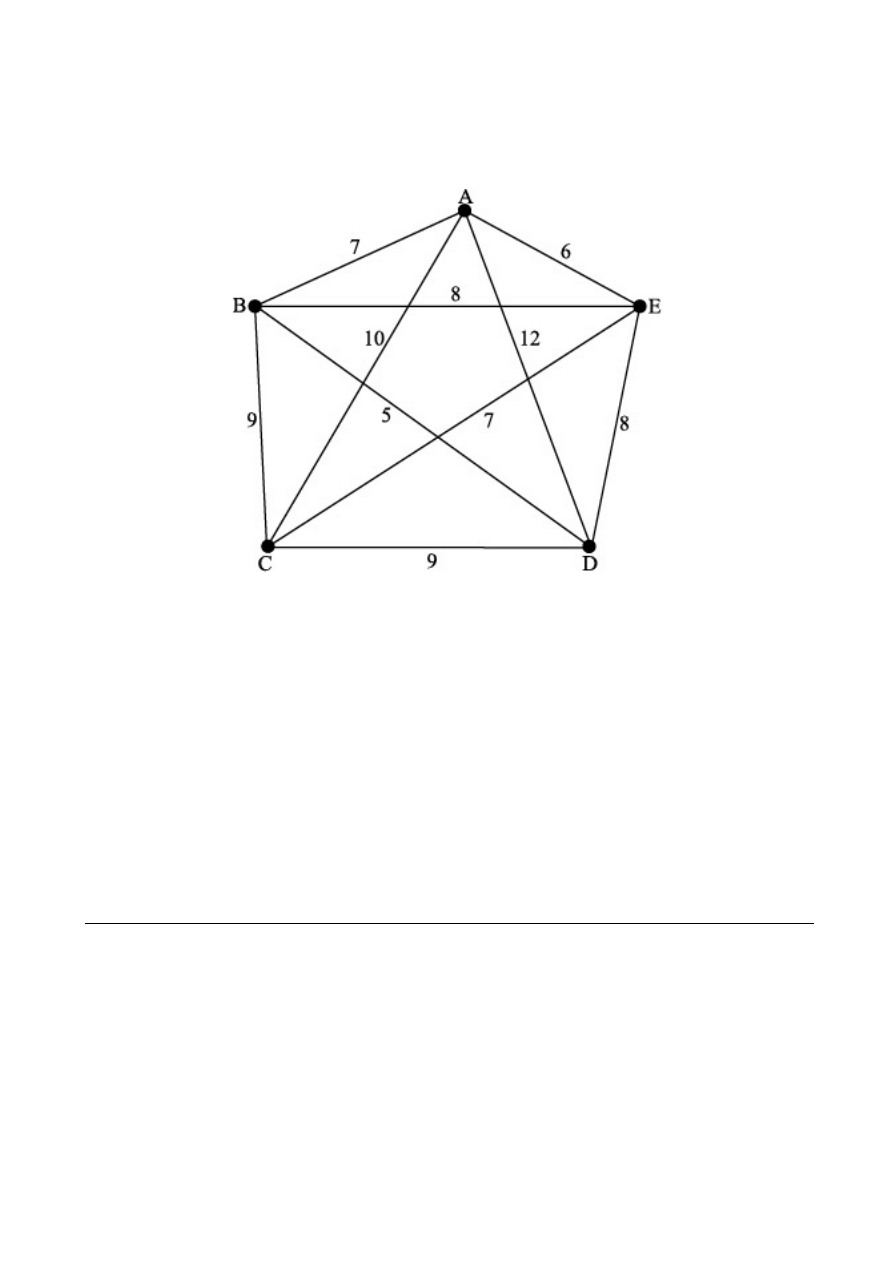
- 11 -
SPEC/5/MATHL/HP3/ENG/TZ0/XX
22xx-72xx
Turn over
6.
[Maximum mark: 14]
Let
G
be the graph below.
(a) Find the total number of Hamiltonian cycles in
G
, starting at vertex A.
Explain your answer.
[3 marks]
(b) (i) Find a minimum spanning tree for the subgraph obtained by deleting A
from G. [3
marks]
(ii) Hence, find a lower bound for the travelling salesman problem for G.
[3 marks]
(c) Give an upper bound for the travelling salesman problem for the graph
above.
[2 marks]
(d) Show that the lower bound you have obtained is not the best possible for the
solution to the travelling salesman problem for G.
[3 marks]


18 pages
MARKSCHEME
SPECIMEN PAPERS
MATHEMATICS
Higher Level
Paper 3
c
IB DIPLOMA PROGRAMME
PROGRAMME DU DIPLÔME DU BI
PROGRAMA DEL DIPLOMA DEL BI
SPEC/5/MATHL/HP3/ENG/TZ0/XX/M

− 2 − SPEC/5/MATHL/HP3/ENG/TZ0/XX/M
18 pages
Markscheme Instructions
A. Abbreviations
M
Marks awarded for attempting to use a correct Method: the working must be seen.
(M) Marks awarded for Method: this may be implied by correct subsequent working.
A
Marks awarded for an Answer or for Accuracy, usually dependent on preceding M marks: the
working must be seen.
(A) Marks awarded for an Answer or for Accuracy: this may be implied by correct subsequent working.
R
Marks awarded for clear Reasoning
N
Marks awarded for correct answers, if no working (or no relevant working) shown: in general, these
will not be all the marks for the question. Examiners should only award these N marks for correct
answers where there is no working (or if there is working which earns no other marks).
B. Using the markscheme
Follow through (ft) marks: Only award ft marks when a candidate uses an incorrect answer in a subsequent
part. Any exceptions to this will be noted on the markscheme. Follow through marks are now the exception
rather than the rule within a question or part question. Follow through marks may only be awarded to work
that is seen. Do not award N (ft) marks. If the question becomes much simpler then use discretion to award
fewer marks.
If a candidate mis-reads data from the question apply follow-through.
Discretionary (d) marks: There will be rare occasions where the markscheme does not cover the work seen.
In such cases, (d) should used to indicate where an examiner has used discretion. It must be accompanied by
a brief note to explain the decision made.
It is important to understand the difference between “implied” marks, as indicated by the brackets, and
marks which can only be awarded for work seen - no brackets. The implied marks can only be awarded if
correct work is seen or implied in subsequent working. Normally this would be in the next line.
Where M1 A1 are awarded on the same line, this usually means M1 for an attempt to use an appropriate
formula, A1 for correct substitution.
As A marks are normally dependent on the preceding M mark being awarded, it is not possible to award M0
A1.
As N marks are only awarded when there is no working, it is not possible to award a mixture of N and other
marks.
Accept all correct alternative methods, even if not specified in the markscheme Where alternative methods
for complete questions are included, they are indicated by METHOD 1, METHOD 2, etc. Other
alternative (part) solutions, are indicated by EITHER….OR. Where possible, alignment will also be used to
assist examiners to identify where these alternatives start and finish.

− 3 − SPEC/5/MATHL/HP3/ENG/TZO/XX/M
Unless the question specifies otherwise, accept equivalent forms. On the markscheme, these equivalent
numerical or algebraic forms will generally be written in brackets after the required answer The markscheme
indicate the required answer, by allocating full marks at that point. Once the correct answer is seen, ignore
further working, unless it contradicts the answer.
Brackets will also be used for what could be described as the well-expressed answer, but which candidates may
not write in examinations. Examiners need to be aware that the marks for answers should be awarded for the form
preceding the brackets eg in differentiating ( ) 2sin (5
3)
f x
x
=
− , the markscheme says
(
)
( )
2cos(5
3) 5
f x
x
′
=
−
(
)
10cos(5
3)
x
=
−
A1
This means that the A1 is awarded for seeing
(
)
2cos(5
3) 5
x
−
, although we would normally write the
answer as 10cos(5
3)
x
− .
As this is an international examination, all alternative forms of notation should be accepted.
Where the markscheme specifies M2, A3, etc, for an answer do NOT split the marks unless otherwise
instructed.
Do not award full marks for a correct answer, all working must be checked.
Candidates should be penalized once IN THE PAPER for an accuracy error (AP). There are two types of
accuracy error:
• Rounding errors: only applies to final answers not to intermediate steps.
• Level of accuracy: when this is not specified in the question the general rule is unless otherwise stated
in the question all numerical answers must be given exactly or to three significant figures.

− 4 − SPEC/5/MATHL/HP3/ENG/TZO/XX/M
SECTION A
Statistics and probability
Note: Values obtained from a GDC may differ slightly from those obtained from tables.
1.
(a) (i)
Number of 6s obtained is
1
B 10,
6
⎛
⎞
⎜
⎟
⎝
⎠
.
(M1)
Prob
(at
least
2)
10
9
5
5
1
1
10
6
6
6
⎛ ⎞
⎛ ⎞ ⎛ ⎞
= −
−
⎜ ⎟
⎜ ⎟ ⎜ ⎟
⎝ ⎠
⎝ ⎠ ⎝ ⎠
(A1)
0.515
=
A1
N3
(ii) We require the first 4 throws not to be 6s followed by a 6 on the 5
th
throw. (M1)
4
5
1
Prob
6
6
⎛ ⎞ ⎛ ⎞
=
×
⎜ ⎟ ⎜ ⎟
⎝ ⎠ ⎝ ⎠
(A1)
0.0804
=
A1
N3
(iii) If he throws his third 6 on the X
th
throw, X has a negative binomial
distribution.
(R1)
9
3
11
5
1
P(
12)
2
6
6
X
⎛ ⎞ ⎛ ⎞ ⎛ ⎞
=
=
×
×
⎜ ⎟ ⎜ ⎟ ⎜ ⎟
⎝ ⎠ ⎝ ⎠
⎝ ⎠
(M1)(A1)
0.0493
=
A1
N4
[10 marks]
(b)
Probability
of
1
st
six on n
th
throw
1
5
1
6
6
n
−
⎛ ⎞
=
×
⎜ ⎟
⎝ ⎠
M1
This is a decreasing function so most likely throw is the first.
A1
N1
[2 marks]
Total [12 marks]
2.
(a) (i) Estimated
proportion
(
)
540
0.45
1200
=
=
(M1)A1
N2
(ii)
Estimated
standard
error
3
540 660
1200
×
=
M1A1
0.0144
=
A1
N1
(iii)
95
%
confidence
limits
are
3
540
540 660
1.96
1200
1200
×
±
(M1)(A1)
0.45 1.96 0.0144
=
±
×
(A1)
The 95 % confidence interval is
[
]
0.422, 0.478
A1
N4
[9 marks]
continued …
− 5 − SPEC/5/MATHL/HP3/ENG/TZO/XX/M
Question 2 continued
(b)
EITHER
The sample needs to be random.
R2
OR
We can approximate a binomial distribution by a normal distribution.
R2
[2 marks]
Total [11 marks]
3.
(a) The values are
Child A B C D E F G H I J
difference 1.5 0.6 0.3 -0.2 2.0 0.6 1.5 0.1 0.5 -0.4
[2 marks]
(b)
(i)
0
1
2
H :
µ
µ
=
:
1
1
2
H :
µ
µ
<
A1A1
(ii)
EITHER
6.5
d
=
∑
:
2
9.77
d
=
∑
2
2
9.77 6.5
ˆ
9
90
σ
=
−
(M1)(A1)
0.6161111
=
A1
6.5
10
0.6161111
10
t
=
(M1)
2.62
=
A1
Degrees
of
freedom
=
9
A1
Critical
value
=
2.82
A1
OR
0.0139
p
=
A7
THEN
Insufficient evidence to support the teacher’s belief
R1
that puzzle 2 takes longer than puzzle 1.
R1
[11 marks]
Total [13 marks]
A2

− 6 − SPEC/5/MATHL/HP3/ENG/TZO/XX/M
4. (a)
1
E( )
2
X
= ,
1
Var( )
12
X
=
A1A1
( )
( )
12
1
E
E
6
n
i
Z
X
=
=
−
∑
(M1)
1
12
6
2
= × −
A1
0
=
AG
N0
( )
( )
12
1
Var
Var
n
i
Z
X
=
=
∑
(M1)
1
12
12
= ×
A1
1
=
AG
N0
[6 marks]
(b) Since
n is reasonably large,
R1
the central limit theorem ensures that Z is approximately normal.
R1
[2 marks]
(c) (i)
Range of values of z Observed
frequency
Expected
frequency
(
)
, 2
−∞ −
16
11.35
(A1)
[
)
2, 1
− −
66
68.00
(A1)
[
)
1, 0
−
180
170.65
(A1)
[
)
0, 1
155
170.65
(A1)
[
)
1, 2
65
68.00
(A1)
[
)
2,
∞
18
11.35
(A1)
(
)
2
2
16 11.35
...
11.35
χ
−
=
+
(M1)
7.94
=
A1
Degrees
of
freedom
=
5
A1
Critical
value 11.07
=
A1
We
conclude
that
the
data
fit
the
( )
N 0, 1
distribution.
R1
at the 5% level of significance
A1
(ii) (a) Type I error concluding that the data do not fit
( )
N 0, 1
when in fact they do.
R2
(b) Type II error concluding that data fit
( )
N 0, 1
when
in
fact
they
do
not.
R2
[16 marks]
Total [24 marks]
− 7 − SPEC/5/MATHL/HP3/ENG/TZO/XX/M
SECTION B
Sets, relations and groups
1.
(
) (
)
(
) (
)
\
\
A B
A B
B A
A B
B
A
∆ =
∪
′
′
=
∩
∪
∩
(
)
(
)
(
)
(
)
A B
B
A B
A
′
′
′
=
∩
∪
∩
∩
∪
M1A1
(
) (
)
(
)
(
) (
)
(
)
A B
B
B
A
A
B
A
′
′
′
′
=
∪
∩
∪
∩
∪
∩
∪
M1A1
(
)
(
)
(
)
(
)
A B
U
U
B
A
′
′
=
∪
∩
∩
∩
∪
A1
(
) (
)
A B
A
B
′
′
=
∪
∩
∪
(
) (
)
A B
A B ′
=
∪
∩
∩
A1
[6 marks]
2.
(a)
(
)
ab
a b
c
c
a b
⎛
⎞
∗ ∗ =
∗
⎜
⎟
+
⎝
⎠
(M1)
abc
a b
ab
c
a b
+
=
+
+
A1
abc
ab ac bc
=
+
+
A1
(
)
bc
a
b c
a
b c
⎛
⎞
∗ ∗ = ∗⎜
⎟
+
⎝
⎠
(M1)
abc
a b
bc
a
b c
+
=
+
+
A1
abc
ab ac bc
=
+
+
A1
(
)
(
)
a b
c a
b c
∴
∗ ∗ = ∗ ∗
R1
so
∗
is associative.
AG
[7 marks]
(b)
Suppose
e is an identity element, then e a a e a
∗ = ∗ =
(M1)
ea
a
e a
=
+
A1
ea ea a
=
+
M1
ea cancels on both sides so there is no solution for e.
R1
i.e.
no
identity
element
AG
[4 marks]
Total [11 marks]
Note: Illustration using a Venn diagram is not a proof.

− 8 − SPEC/5/MATHL/HP3/ENG/TZO/XX/M
3. (a) (i)
(a) f is an increasing function
R1
so it is injective.
A1
(b)
Let
( )
1
f n
= (or any other appropriate value)
M1
Then 5
4 1
n
+ = ,
3
5
n
= − which is not in the domain
f
∴ is not surjective.
A1
(ii)
( ) (
)
,
2 , 3
5
g x y
x
y x
y
=
+
−
so
1
2
2
3
5
3 5
x
x
y
y
y
+
⎛
⎞⎛ ⎞ ⎛
⎞
=
⎜
⎟⎜ ⎟ ⎜
⎟
−
−
⎝
⎠⎝ ⎠ ⎝
⎠
METHOD 1
(a)
Let
( )
( )
,
,
g x y
g s t
=
so
(
) (
)
2 , 3
5
2 , 3
5
x
y x
y
s
t s
t
+
−
= +
−
M1
2
2 , 3
5
3
5
x
y s
t x
y
s
t
+
= +
−
=
−
M1
y t
= and x s
=
( ) ( )
,
,
x y
s t
⇒
=
g
is injective.
A1
(b)
Let
( )
,
u v
be an element of the codomain.
2
, 3
5
x
y u x
y v
+
=
−
=
M1
Then 11
3
y
u v
−
= − + so
3
11
u v
y
−
=
A1
and
11
5
2
x
u
v
=
+
so
5
2
11
u
v
x
+
=
A1
Since
5
2
3
,
11
11
u
v
u v
+
−
⎛
⎞
⎜
⎟
⎝
⎠
is in the domain then g is surjective. R1
continued …

− 9 − SPEC/5/MATHL/HP3/ENG/TZO/XX/M
Question 3 (a) (ii) continued
METHOD 2
(a)
1
2
1
2
3
5
3
5
x
s
y
t
⎛
⎞⎛ ⎞ ⎛
⎞⎛ ⎞
=
⎜
⎟⎜ ⎟ ⎜
⎟⎜ ⎟
−
−
⎝
⎠⎝ ⎠ ⎝
⎠⎝ ⎠
M1
1
2
since det
0
3
5
x
s
y
t
⎛ ⎞ ⎛ ⎞
⎛
⎞
=
≠
⎜ ⎟ ⎜ ⎟
⎜
⎟
−
⎝ ⎠ ⎝ ⎠
⎝
⎠
, A1
( ) ( )
,
,
x y
s t
=
g is injective.
A1
(b) Let
( )
,
u v
be an element of the codomain.
1
2
3
5
x
u
y
v
⎛
⎞⎛ ⎞ ⎛ ⎞
=
⎜
⎟⎜ ⎟ ⎜ ⎟
−
⎝
⎠⎝ ⎠ ⎝ ⎠
M1
1
1
2
3
5
x
u
y
v
−
⎛ ⎞ ⎛
⎞ ⎛ ⎞
=
⎜ ⎟ ⎜
⎟ ⎜ ⎟
−
⎝ ⎠ ⎝
⎠ ⎝ ⎠
A1
5
2
1
3
1
11
x
u
y
v
⎛ ⎞
⎛
⎞⎛ ⎞
=
⎜ ⎟
⎜
⎟⎜ ⎟
−
⎝ ⎠
⎝
⎠⎝ ⎠
A1
Since
5
2
3
,
11
11
u
v
u v
+
−
⎛
⎞
⎜
⎟
⎝
⎠
is in the domain then g is surjective.
R1
(iii)
( )
1
5
2
3
,
,
11
11
x
y
x y
g
x y
−
+
−
⎛
⎞
= ⎜
⎟
⎝
⎠
A2
[13 marks]
(b)
g f
! is surjective, so for every z
∈" there exists x A
∈
such
that
(
)( )
g f
x
z
=
!
(ie
( )
(
)
g f x
z
= )
R1
Let ( )
y
f x
B
=
∈ .
R1
For
every
z
∈" there exists y B
∈ such that
( )
g y
z
= .
R1
g
∴ is surjective.
AG
[3 marks]
Total [16 marks]

− 10 − SPEC/5/MATHL/HP3/ENG/TZO/XX/M
4. (a) (i) det
(
) (
2)(
5)
x x
x
x
= − − +
−
T
M1
2
2
3
10
x
x
x
= − −
+
+
A1
2
1
2
3
10
x
x
= −
+
+
(A1)
2
0 2
3
9
x
x
=
−
−
AG
N0
(ii)
(
)(
)
0
2
3
3
x
x
=
+
−
3
or
3
2
x
x
= −
=
3
3,
2
a
b
=
= −
A1 A1
N2
[5 marks]
(b)
(i)
2
3
5
1 0
2
3
0
1
−
⎛
⎞
⎛
⎞
=
⇒
=
⎜
⎟
⎜
⎟
−
−
−
⎝
⎠
⎝
⎠
A
A
A1
(ii)
3
3
5
2
3
−
−
⎛
⎞
= ⎜
⎟
⎝
⎠
A
A1
4
1 0
0 1
⎛
⎞
= ⎜
⎟
⎝
⎠
A
(= I)
A1
2
A
is a self-inverse
A1
3
1
−
=
A
A
.
A1
∴
the set
{
}
2
3
,
,
,
A A A I
is closed under matrix multiplication;
has
an
identity I ; is associative and each element has an inverse.
Therefore it is a group.
R1AG
N0
[6 marks]
Total [11 marks]

− 11 − SPEC/5/MATHL/HP3/ENG/TZO/XX/M
5.
(a)
1
x x e H
−
= ∈ .
M1
is reflexive
x R x
R
⇒
⇒
R1
1
x R y
x y H
−
⇒
∈
( )
1
1
x y
H
−
−
⇒
∈
A1
( )
1
1
1
x y x y
e
−
−
−
=
so
( )
1
1
1
x y
y x
−
−
−
=
A1
1
is symmetric
y x H
y R x
R
−
⇒
∈ ⇒
⇒
R1
1
1
and
and
x R y
y R z
x y H
y z H
−
−
⇒
∈
∈
∴
( )( )
1
1
x y y z
H
−
−
∈ since H is closed.
A1
(
)
1
1
x
y y
z H
−
−
∈
1
x z H
−
∈
A1
x R z
R
⇒
⇒
is transitive.
R1
R
∴ is an equivalence relation.
AG
[8 marks]
(b)
3
2
p
q
e
=
=
2
qp
p q
=
( )
2
qp
qp p
=
( )
2
p q p
=
A1
( )
2
p qp
=
( )
2
2
p p q
=
A1
( )
3
p pq
=
A1
pq
=
AG
[3 marks]
(c)
{
}
2
,
H
e p q
=
1
y R pq
y pq e
pq y
−
⇒
= ⇒
=
A1
or
1
2
2
y pq
p q
pq yp q
−
=
⇒
=
2
2 2
pq
yp q
=
A1
2
p yp
=
2
3
p
yp
=
A1
2
p
y
=
A1
∴ The equivalence class is
{
}
2
,
p pq
A1
[5 marks]
Total [16 marks]

− 12 − SPEC/5/MATHL/HP3/ENG/TZO/XX/M
SECTION C
Series and differential equations
1. Let
sin
( )
sin
x x
f x
x
x
−
=
(M1)
0
0
cos
1
lim ( ) lim
sin
cos
x
x
x
f x
x x
x
→
→
−
⎛
⎞
=
⎜
⎟
+
⎝
⎠
A1A1
0
sin
lim
2cos
sin
x
x
x x
x
→
−
⎛
⎞
=
⎜
⎟
−
⎝
⎠
A1A1
0
=
A1 N2
[6 marks]
2.
For
1
p
> ,
1
p
x
is
positive
for
1
x
≥ , and decreasing for
1
x
≥ .
A1A1
1
1
1
1
1
lim
d
lim
(1
)
L
L
p
p
L
L
x
x
p x
−
→∞
→∞
⎡
⎤
=
⎢
⎥
−
⎣
⎦
∫
(M1)
1
1
1
lim
(1
)
1
p
L
p L
p
−
→∞
=
−
−
−
A1
1
1
p
=
−
A1
The convergence of this integral ensures the convergence of the series using
the integral test.
R1AG N0
[6 marks]
3.
(a) (i)
y
x
=
+
ln(
sin )
1
cos
1 sin
x
y
x
′ =
+
A1
1
1 sin
y
x
′′ = −
+
A1
(3)
2
cos
(1 sin )
x
y
x
=
+
A1
2
2
(4)
4
sin (1 sin )
2(1 sin )cos
(1 sin )
x
x
x
x
y
x
−
+
−
+
=
+
(M1)A1
(ii)
(0) 0
y
= ; (0) 1
y′
=
A1A1
(0)
1
y′′
= − ;
(3)
(0) 1
y
= ;
(4)
(0)
2
y
= −
A1A1
A1
2
3
4
1
1
1
ln(1 sin )
...
2
6
12
x
x
x
x
x
+
= −
+
−
+
AG N0
[10 marks]

− 13 − SPEC/5/MATHL/HP3/ENG/TZO/XX/M
(b)
(i)
( )
(
)
ln(1 sin ) ln 1 sin
x
x
−
=
+
−
(M1)
2
3
4
1
1
1
...
2
6
12
x
x
x
x
= − −
−
−
+
A1 N2
(ii)
2
ln(1 sin ) ln(1 sin ) ln(1 sin )
x
x
x
+
+
−
=
−
(M1)
2
ln cos x
=
A1
So
2
2
4
1
ln cos
...
6
x
x
x
= − −
+
A1
2
4
1
1
ln cos
...
2
12
x
x
x
= −
−
+
A1 N2
(iii)
Differentiating,
(
)
(
)
d
1
ln cos
sin
d
cos
x
x
x
x
=
× −
(M1)
tan x
= −
A1
3
1
tan
...
3
x x
x
= +
+
A2 N3
[10 marks]
(c)
( )
4
2
2
2
4
...
tan
3
ln cos
...
2
12
x
x
x
x
x
x
+
+
=
−
−
+
(M1)
4
2
1
...
3
1
...
2 12
x
x
+
+
=
− −
+
A1
2 as
0
x
→ −
→
A1
so
2
0
tan( )
lim
2
ln cos
x
x
x
→
⎛
⎞
= −
⎜
⎟
⎝
⎠
A1 N3
[4 marks]
Total [24 marks]
Note: No term in
4
x
since tan(
)
tan
x
x
− = −
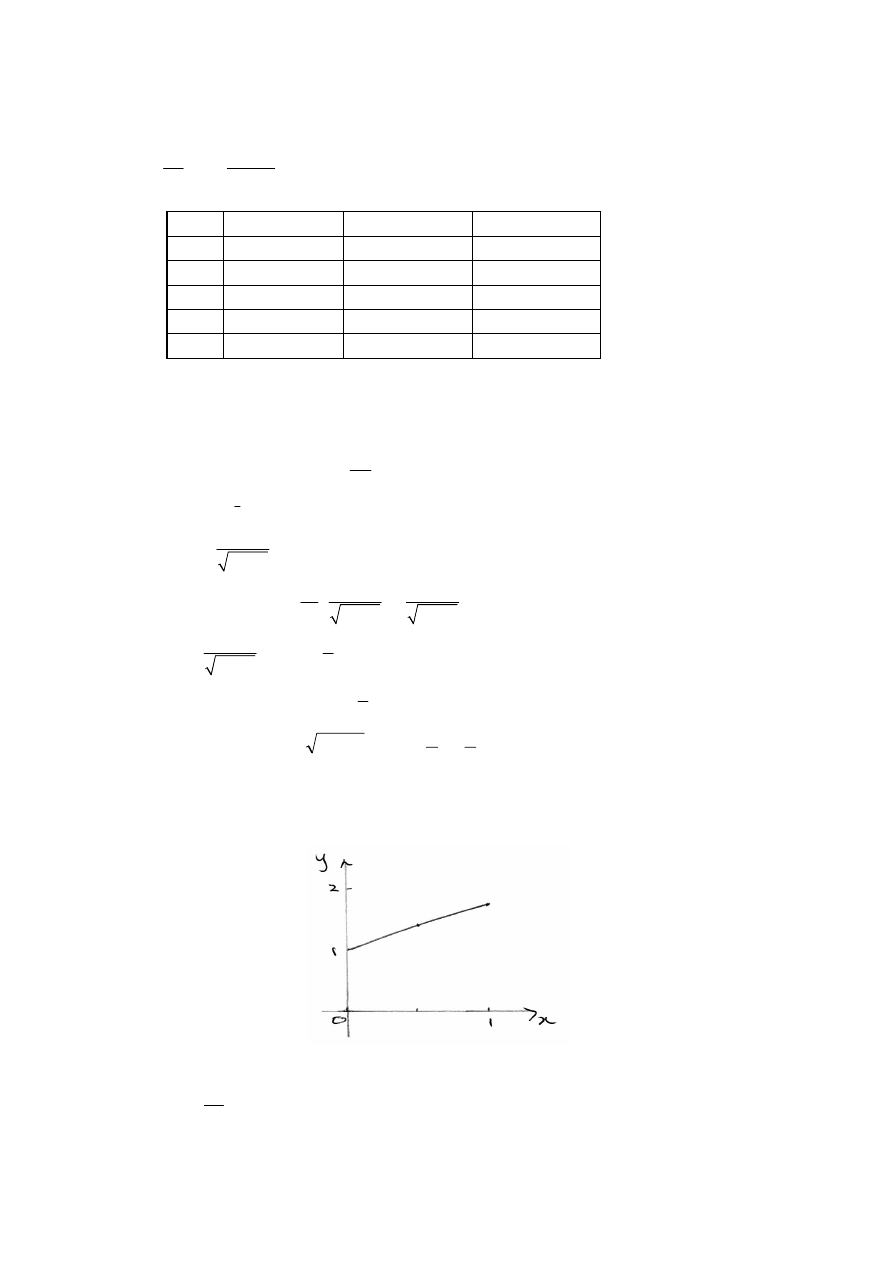
− 14 − SPEC/5/MATHL/HP3/ENG/TZO/XX/M
4.
(a)
d
d
y
x
xy
x
= −
−
1
4
2
x y
dy/dx
h
× dy/dx
0 1
1
0.25
A2
0.25 1.25 0.9206349206
0.2301587302
A2
0.5 1.48015873 0.8026455027 0.2006613757
A2
0.75 1.680820106 0.6332756132 0.1583189033
A2
1 1.839139009
A1
To two decimal places, when x = 1, y = 1.84.
A1 N0
[10 marks]
(b) (i) Integrating
factor
2
d
4
e
x
x
x
⎛
⎞
⎜
⎟
−
⎝
⎠
∫
=
(M1)
2
1
ln(4
)
2
e
x
⎛
⎞
−
−
⎜
⎟
⎝
⎠
=
A1
2
1
4 x
=
−
A1
It
follows
that
2
2
d
1
d
4
4
y
x
x
x
⎛
⎞
=
⎜
⎟
−
−
⎝
⎠
(M1)
2
arcsin
2
4
y
x
C
x
⎛ ⎞
=
+
⎜ ⎟
⎝ ⎠
−
A1A1
Putting
x = 0, y = 1,
1
2
C
⇒ =
A1
Therefore,
y
x
x
=
−
⎛
⎝⎜
⎞
⎠⎟ +
⎛
⎝⎜
⎞
⎠⎟
4
2
1
2
2
arcsin
A2 N0
(ii)
When
x = 1, y = 1.77.
A1 N1
[10 marks]
Since
d
d
y
x
is decreasing the value of y is over-estimated at each step.
R1A1
[4 marks]
Total [24 marks]
(c)
A2

− 15 − SPEC/5/MATHL/HP3/ENG/TZO/XX/M
SECTION D
Discrete mathematics
1. (a)
4
3
2
10201
8
8
8
8
a
b
c
d
e
= × + × + × + × +
M1
4096
512
64
8
a
b
c
d e
=
+
+
+
+
2
a
⇒ =
A1
10201 2 4096 2009 512
64
8
3
b
c
d e
b
− ×
=
=
+
+
+ ⇒ =
2009 3 512 473 64
8
c
d e
− ×
=
=
+
+
7
c
⇒ =
473 7 64 25 8d e
− ×
=
=
+
3
d
⇒ = and
1
e
=
10201 23731
=
(base 8)
A2 N2
[4 marks]
(b)
8
1
n
≡ (mod 7) for positive integer n
A1
Consider
the
octal
number
1
1
...
n n
o
u u
u u
−
=
0
1
1
u
u
u
u
n
n
+
+
+
−
(mod 7)
(M1)
from which it follows that an octal number is divisible by 7 if and only if
A1
the sum of the digits is divisible by 7.
R1
Hence 10201
(mod 7)
a b c d e
≡ + + + +
A1
[5 marks]
(c) 10201 2 3 7 3 1 2 (mod 7)
≡ + + + + ≡
A2
[2 marks]
Total [11 marks]
2. (a) Let
1
,...,
n
p
p
be the set of primes that divide either a or b
M1
Then
1
2
1
2
...
n
n
a
p p
p
α
α
α
=
and
1
2
1
2
...
n
n
b
p p
p
β
β
β
=
A1A1
Hence
1
1
2
2
1
2
...
n
n
n
ab
p
p
p
α β
α β
α β
+
+
+
=
A1
Furthermore
{
}
{
}
min
,
max
,
j
j
j
j
j
j
α β
α β
α
β
+
=
+
for
1,2,...,
j
n
=
A1
Hence
{
}
{
}
{
}
{
}
1
1
1
1
min
,
max
,
min
,
max
,
1
...
n
n
n
n
n
ab
p
p
α β
α β
α β
α β
+
+
=
A1
gcd( , ) lcm( , )
ab
a b
a b
=
×
AG
[6 marks]
(b) gcd( , )
a b a
and gcd( , )
a b b
A1
Hence
gcd( , )
a b a b
+
A1
so that gcd( , ) gcd( ,
)
a b
a a b
+ *
A1
Also gcd( ,
)
a a b a
+
and gcd( , )
a b a b
+
A1
Hence
gcd( ,
)
a a b b
+
A1
so that gcd( ,
) gcd( , )
a a b
a b
+
**
A1
From * and ** : gcd( , ) gcd( ,
)
a b
a a b
=
+
A1 AG
[7 marks]
Total [13 marks]
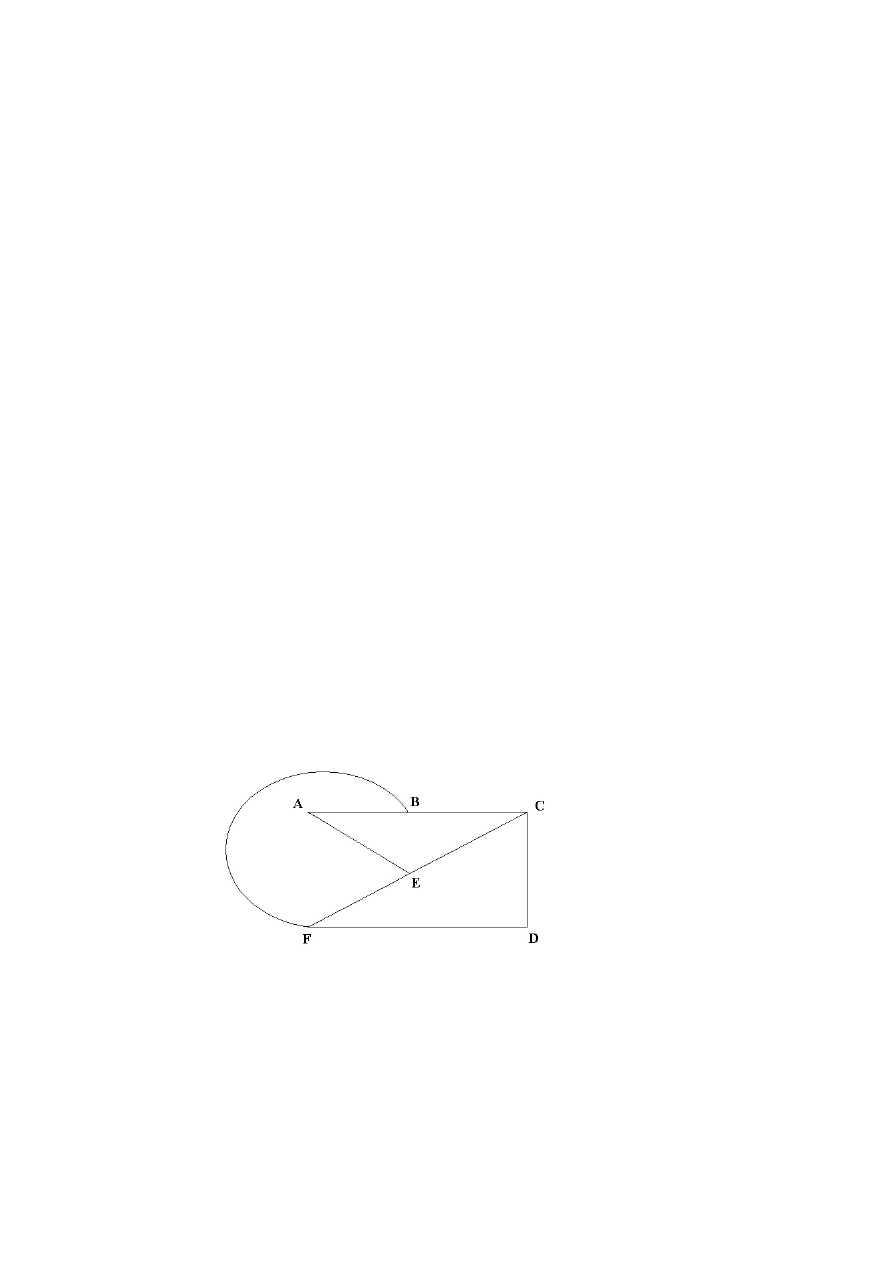
− 16 − SPEC/5/MATHL/HP3/ENG/TZ0/XX/M
18 pages
3.
101
101
67
2 (mod 65)
≡
A1
6
2
1(mod 65)
≡ −
(M1)
( )
16
101
6
5
2
2
2
≡
×
A1
( )
16
1
32(mod 65)
≡ −
×
A1
32(mod 65)
≡
A1
∴ remainder is 32
A1 N2
[6 marks]
4.
1 (mod 3)
3
1
x
x
k
≡
⇒ =
+
A1
Choose
k such that 3
1 2 (mod5)
k
+ ≡
M1
With Euclid’s algorithm or otherwise we find
7 5
k
h
≡ +
A1
Choose
h such that 22 15
3 (mod 7)
k
+
≡
M1
With Euclid’s algorithm or otherwise
2 7
k
j
≡ +
A1
Hence 22 15(2 7 ) 52 105
x
j
j
=
+
+
=
+
A1 N3
[6 marks]
5. (a) H is not planar because if it were then
2
4
e
v
≤
−
M1
But
here 9 and
6
e
v
=
=
A1
And hence the inequality is not satisfied
A1
So H is not planar
AG N0
[3 marks]
(b) Deleting the edge connecting A with D we can draw the graph as below
which shows that it is planar.
A1
[3 marks]
continued …
M1A1

− 17 − SPEC/5/MATHL/HP3/ENG/TZ0/XX/M
Question 5 continued
(c) The adjacency matrix can also be written as:
A C F B D E
A 0 0 0 1 1 1
C 0 0 0 1 1 1
F 0 0 0 1 1 1
B 1 1 1 0 0 0
D 1 1 1 0 0 0
E 1 1 1 0 0 0
⎛
⎞
⎜
⎟
⎜
⎟
⎜
⎟
⎜
⎟
⎜
⎟
⎜
⎟
⎜
⎟
⎜
⎟
⎝
⎠
Hence with a suitable permutation of the last three rows and of the last
three columns the general case can be reduced to part (b).
R1A1
Any subgraph of H (excluding H itself) is planar
AG
[4 marks]
Total [10 marks]
6. (a) Starting from vertex A there are 4 choices. From the next vertex there
are
three
choices,
etc…
M1R1
So the number of Hamiltonian cycles is 4! 24
=
.
A1 N1
[3 marks]
(b) (i)
Start (for instance) at B, using Prim’s algorithm
Then D is the nearest vertex
M1
Next E is the nearest vertex
A1
Finally C is the nearest vertex
So a minimum spanning tree is B
D
E
C
→ → →
A1 N1
[3 marks]
(ii) A lower bound for the travelling salesman problem is then obtained by
adding the weights of AB and AE to the weight of the minimum
M1
spanning tree (ie 20)
A1
A
lower
bound
is
then 20 7 6 33
+ + =
A1 N1
[3 marks]
continued …
M1A1

− 18 − SPEC/5/MATHL/HP3/ENG/TZ0/XX/M
Question 6 continued
(c) A minimum spanning tree for G would be B
A
E
C
D
→ → →
#
of weight 26
A1
Thus an upper bound is given by 26 2 52
× =
A1
[2 marks]
(d) Eliminating C from G a minimum spanning tree is E
A
B
D
→ → →
M1
of
weight
18
A1
Adding BC to CE(18+9+7) gives a lower bound of 34 33
>
A1
So 33 not the best lower bound
AG N0
[3 marks]
Total [14 marks]


Wyszukiwarka
Podobne podstrony:
Mathematics HL Nov 2006 TZ1 P2$
Mathematics HL Nov 2006 TZ1 P2
Mathematics HL Nov 2006 TZ1 P2$
Mathematics HL Nov 2006 TZ1 P1
Mathematics HL Nov 2006 TZ1 P3
Mathematics HL Nov 2006 TZ1 P3$
Mathematics HL Nov 2006 TZ1 P1$
Mathematics HL Nov 2006 TZ1 P1
Mathematics HL May 2003 P1
Mathematics HL Nov 2002 P1 $
MATHEMATICS HL May 1999 P1
Mathematics HL May 2004 TZ1 P2 $
więcej podobnych podstron