A Guide and Rules System for Fantasy Roleplaying
by
Robert Doyel
& Stephen Chenault
Cover art, interior art, logos and logo designs by Peter “20 Dollar”
Bradley,and Cover Design and Layout by Clayton Bunce & Peter Bradley
With Christian Harris, Mac Golden, Davis Chenault,
Mark Sandy and Todd Gray
©2004 Troll Lord Games. All Rights Reserved. Castles & Crusades, C&C, Castle Keeper, SIEGE engine,
Troll Lord Games, and the Castles & Crusades, SIEGE engine, and Troll Lord Games logos are Trademarks of
Troll Lord Games. All Rights Reserved.
For more information on Castles & Crusades, and related products or
to Join the Castles & Crusades Society please contact us at
Troll Lord Games
PO Box 251171, Little Rock, AR 72225
or on the web at www.trolllord.com or email at troll@trolllord.com or
www.castlesandcrusades.com

Castles & Crusades Monsters and Treasure
Using Monsters
A monster’s Hit Dice is equivalent to the monster’s attack roll modier. For example, a 3 Hit Dice creature attacks by rolling a d20 and
adding its Hit Dice to the result. This can be modied by circumstances.
Damage is assessed by individual weapons.
Saving throws and attribute checks for monsters work in the same manner. Each monster is listed as having either a physical (P),
mental (M), both (P+M) or none (N) as it saving throw category. This equates to their primary or secondary attributes and the base
number needed to make a saving throw. So, a goblin has a physical saving throw category so makes physical saving throws on 12 or
better and mental saving throws on 18 or better. Physical attributes are Strength, Constitution and Dexterity.
Monster Experience points
HD
Base
special 1
special 2 special 3
1
10
5
7
10
2
20
10
15
20
3
40
20
30
40
4
80
40
60
80
5
160
80
120
160
6
240
120
180
240
7
360
180
270
360
8
540
270
400
540
9
810
400
600
810
10
1215
600
900
1215
11
1520
760
1150
1520
12
1900
950
1425
1900
13
2375
1200
1800
2375
14
2970
1500
2200
2970
15
3710
1800
2800
3710
16
4150
2075
3100
4150
17
4650
2325
3500
4650
18
5210
2600
4000
5210
19
5830
2900
4400
5830
20
6530
3250
4900
6530
Experience per Hit Point: The number of hit points a monster has inuences the amount of experience it confers. To gure this,
simply multiply the number of Hit Points by the Hit Dice of the creature. For example, a 5d10HD creature has an average of
15 hit points. The base is160 experience points plus 5 experience points per hit point. So 125 extra experience points would be
awarded for this creature.
Special: There are three categories of special abilities. Though the categories have not been rened, an idea has been listed below
and should be intuitive. Special experience is added to the base experience for the monster. For example, an Skagg (4hd) has four
swings a round so has a category special 1 ability. So its base experience points are increased by .5 or 40 points (for a total of
120) plus 1 per hit point.
Special 1: This category includes three or more swings a round, spell use of 1-3rd level (equivalent nature spells), unique abilities
such as tracking, hiding, back attacks etc.
Special 2: This category includes 5 or more swings a round, damage of 4d6+ die or dice type, spell use of 4-7
th
level or equivalent,
ability to move invisibly etc.
Special 3: This category includes those monsters with death attacks, use of poisons that kill, 8
th
level or above magic use equivalent,
etc.

Bear, Grizzly
Size: Large
HD: 5d8+15
Move: 40 ft.
AC: 15
Attacks: 2 claws +3 (1d8+3), bite +3 (2d8+3)Special: Hug,
Saves: P
Int: Animal
Alignment: Neutral
Type: Animal
Treasure: –
XP:400+5
Brown bears attack by rending opponents with their claws, drag-
ging them in and biting them. A successful hit with both paws
indicates a hug attack for an additional 2d6 damage. Brown bears
will ght until they reach -9 hit points.
Boar, Wild
Size: Medium
HD: 3d8+3
Move: 40 ft.
AC: 14
Attacks: gore +3 (1d8+3)
Special: see text
Saves: P
Int: Animal
Alignment: Neutral
Type: Animal
Treasure: –
XP: 80+3
Wild boars continue to ght until reaching -7 hit points or less.
Cat
Size: Small
HD: 1d4
Move: 30 ft.
AC: 14
Attacks: claw (1) or bite (1)
Special: Hide, Move Silently
Saves: P
Int: AnimalAlignment: Neutral
Type: Animal
Treasure: –
XP:5+1
Cats can move silently (+1) and hide (+1) like a rogue.
Corpse Worm
Size: Small
HD: 2d8
Move: 30 ft.
AC: 13
Attacks: 2 claws (1d3)
Special: Paralysis
Saves: P
Int: Animal
Alignment: Neutral
Type: Magical Beast
Treasure: –
XP:30+2
These small worms are deadly and vile. They are segmented with
many legs and two grasping claws. They weave cocoons around
their victims, and then drag them to their lair. Corpse worm
lairs are covered in sticky ichor, hardened into bizarre shapes.
In combat, a successful claw attack requires the victim to save
versus poison or become paralyzed for 1d3 turns. During such
time, the corpse worm cocoons the victim with an ichor that hard-
ens. Once cocooned, a victim becomes permanently paralyzed
until freed or death.
Eagle, Giant
Size: Large
HD: 4d8+4
Move: 10 ft., y 120 ft.
AC: 14
Attacks: 2 claws (1d6+2), bite (1d12)
Special: Dive attack
Saves: P
Int: Average to high
Alignment: Neutral Good or Neutral
Type: Magical Beast
Treasure: –
XP:120+4
These majestic creatures are intelligent and can speak common.
They typically attack from a great height, diving earthward at tre-
mendous speed and attacking with both claws for double normal
damage. When it cannot dive, it uses its powerful talons and
slashing beak to strike at its target’s head and eyes. Giant eagles
can see great distances, much like an elf.
Giant, Hill
Size: Large
HD: 8d12+8
Move: 40 ft.
AC: 16
Attacks: large weapon/st (2d8+3)
Special: Throw boulder
Saves: P
Int: Low
Alignment: Chaotic Evil
Type: Giant
Treasure: –
XP: 810+8
The smallest of giants, hill giants still stand between ten and
twelve feet in height. They speak crude common. Whether attack-
ing with a weapon or st, hill giants deal 2d8+3 damage. They are
accomplished rock throwers with an effective range increment of
20 ft. When hurling small boulders they gain a +1 to hit and deal
2d6+3 damage. Hill giants often keep worgs as pets.
Gibbering Mouther
Size: Medium
HD: 4d8+3
Move: 6 feet, 12 feet (swim)
AC: 19
Attacks: Bite x6 (1+Blood Drain) and Spittle
Special: Gibbering, Spittle, Blood Drain, Engulf, Ground Manip-
ulation, Amorphous, Darkvision 60 ft
Saves: P
Int: Inferior
Alignment: Neutral (Neutral)

4
Castles & Crusades Monsters & Treasure
Type: Aberration
Treasure: Individual
XP: 700
A Gibbering Mouther is an amoebic mass of slime and sludge,
covered with eyes and mouths. They are perpetually hungry, and
eat anything they can, revealing their presence by the lack of
everything else“ Gibbering Mouthers eat minerals, vegetables,
animals; everything it can get its mouths on is potential food. For
this reason, the creature nds subterranean and cold environments
more conducive to its survival, since it cannot be easily located.
Combat: To avoid attention and ambush potential meals, a Gib-
bering Mouth waits silently, its eyes and mouths closed. When
something approaches, they launch a nasty assault, spitting,
biting, and producing a bewildering assortment of odd noises.
Gibbering (Wisdom): Gibbering Mouthers can vocalize a
strange plethora of smacks, grunts, and other noises from its
multiple mouths, effectively producing the effects of a Confusion
spell. All opponents within hearing distance of a Gibbering
Mouther must make a save to avoid suffering from this effect;
each round, a new save is required.
Spittle (Dexterity and Constitution): Gibbering Mouthers are
able to release an acidic digestive chemical, spitting it at an
opponent within 10 feet. If the target is successfully hit, a Dexter-
ity save is allowed to reduce taking 1d4 points of acid damage;
a save reduces damage by half. If this save is failed, a second,
Constitution save, is required to avoid becoming blinded by the
acid.
Blood Drain (Strength): The mouths of a Gibbering Mouther
are strong and have an incredible grip. Whenever an opponent is
bit, the mouth retains a hold, automatically inicting 1 point of
damage on each successive round, unless the hold is broken by a
successful save. If the victim has more than one mouth on it at
once, the save is modied by
1 per mouth, to a maximum of
12.
Engulf (Dexterity): If an opponent is struck by 3 or more bite
attacks in the same round, the Gibbering Mouther attempts to
pull that victim to the ground and ow across it. The victim is
allowed a Dexterity save to avoid this effect, but if it fails, the
Gibbering Mouther makes 12 bite attacks against the opponent in
the following round, but must release all blood draining mouths to
do so; the Gibbering Mouther also cannot attack any other victim
in the same round it uses this ability.
Ground Manipulation: A Gibbering Mouther can cause the
earth beneath it to soften, or harden, as it wills. The effects of
this ability are identical to those created by the spell Soften Soft,
except that the Gibbering Mouther can turn something as soft as
quicksand into a stable landmass.
Amorphous: Gibbering Mouthers can attack opponents in any
direction, and cannot be subjected to a backstab, having no front
or back to dene the creature.
Note: Put this creature under the entry for Gorilla/Ape, making
it a Subrace.
Goblin
Size: Small
HD: 1d6
Move: 20 ft.
AC: 14
Attacks: by weapon
Special: Deepvision 60 ft.
Saves: P
Int: Average
Alignment: Neutral Evil
Type: Humanoid
Treasure: –
XP: 8+1
Enemies to dwarves, goblins are wicked, smart humanoids that
favor ambushes, overwhelming odds, dirty tricks, and any other
edge they can devise. Some ride worgs into combat, and large
groups of goblins will often employ worgs to track and attack.
Survivors of goblin attacks have reported goblin rangers, clerics,
rogues, assassins, and wizards.
Harpy
Size: Medium
HD: 3d8
Move: 12 feet, 30 feet (y, average)
AC: 13
Attacks: 2 Claw (1d3) and Weapon
Special: Captivating Song, Darkvision 60 ft
Saves: P
Int: Low
Alignment: Chaotic Evil
Type:Humanoid
Treasure: Individual
XP: 175
Harpies look like enlarged vultures bearing the torso and face of
a human female. They always carry some weapon constructed of
the body of a previous victim, and love to sing. They normally
gather in ocks, ranging up to 12 in number and attack with
voracious appetite.
Combat: A Harpy lays back, its wings folded, in a suggestive
pose, waiting for an unsuspecting victim to succumb to its song.
There, it charms the unfortunate, taking the victim to be tortured
before being devoured.
Captivating Song (Wisdom): A Harpy’s most insidious ability is
its song. When a Harpy sings, all creatures (other than Harpies)
within a 300-foot area must succeed on a save or become capti-
vated; Elven resistance to Charms does apply. The same Harpy’s
song cannot affect a creature that successfully saves again for 24
hours. A captivated victim walks toward the Harpy, taking the
most direct route available. If the path leads into a dangerous
area (through ame, off a cliff, or the like), that creature gets
a second saving throw. Captivated creatures can take no actions
other than to defend themselves. A victim within 5 feet of the
Harpy stands there and offers no resistance to the monster’s
attacks. The effect continues for as long as the Harpy sings and
5
Castles & Crusades
for 1 round thereafter. A Bard’s Countersong ability allows the
captivated creature to attempt a new save but it does not negate
the effects.
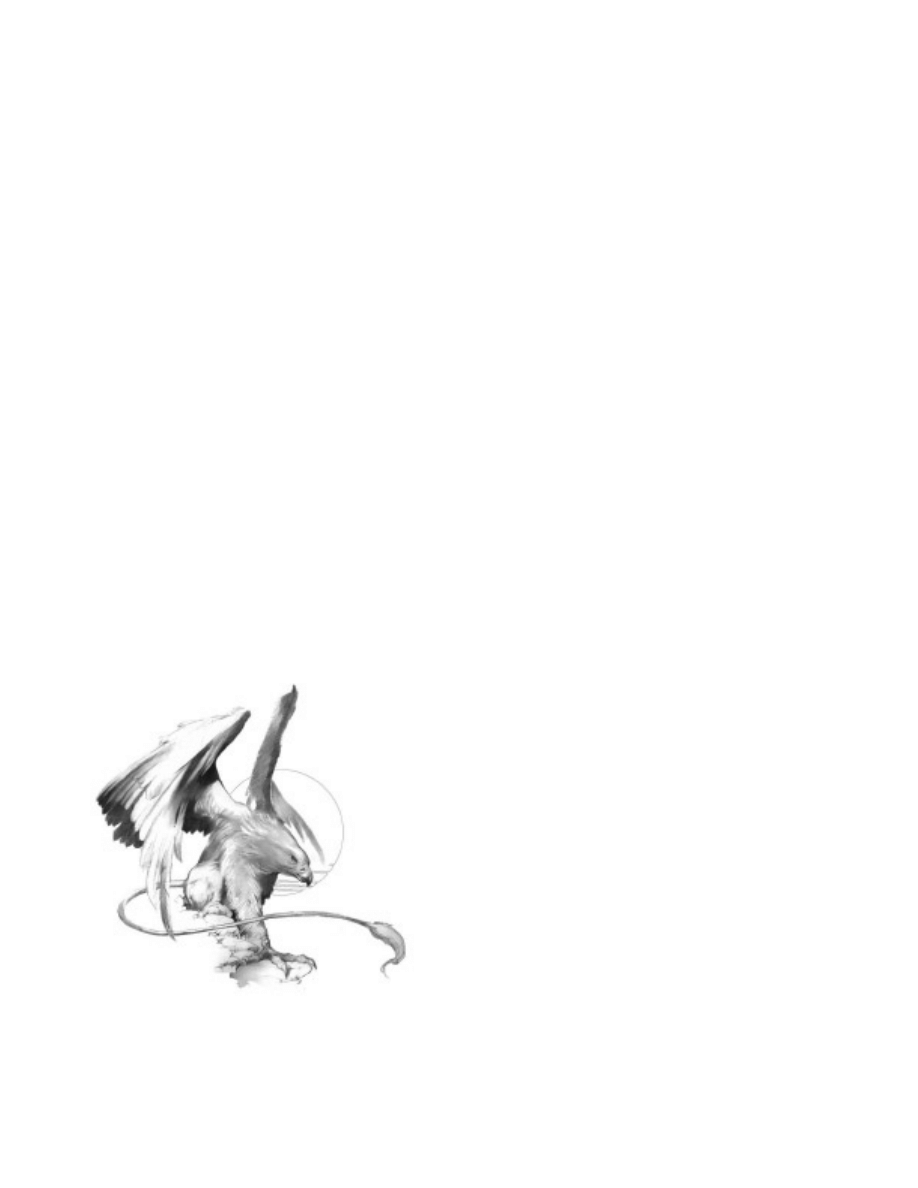
Griffon
Size: Large
HD: 7d10
Move: 24 feet, 60 feet (y, average)
AC: 17
Attacks: 2 Claw (1d4), Bite (2d8)
Special: Darkvision 60 ft, Low-Light Vision, Scent
Saves: P
Int: High
Alignment: Neutral (Neutral)
Type: Magical Beast
Treasure: Incidental
XP: 425
Griffons are large carnivorous avians, nesting in high mountain-
tops, soaring down to feed on horses, the beast’s preferred prey.
Griffons hunt and travel in ocks, ranging up to 12 in number.
Combat: A Griffon will attack a horse over anything else, diving
low to swipe with claw. They are not above retreating and coming
back later, when there may be less of a defense mounted.
Scent (Wisdom): A Griffon can identify locations, items, and
even people by making a successful check. Scent functions to
a range of 30 feet. Griffons, being natural bloodhounds, can
“sniff out” singular scents, even when that odor is overpowered
by another. Winds, weather conditions, and other situations may
render this ability useless or reduce its potency; multiple strong
odors will cause confusion, for example. Other effects are at the
CKs discretion.
Hell Hound
Size: Medium
HD: 4d8
7d8
Move: 24 feet
AC: 16
Attacks: Bite (1d6+1d6)
Special: Breath Weapon, Fiery Bite, Darkvision 60 ft, Immunity
to Fire, Scent, Vulnerability to Cold, Extraplanar, Fire Subtype
Saves: P
Int:Low
Alignment: Lawful Evil
Type: Outsider
Treasure: Individual
XP: 225
Hell Hounds are native to another plane, where they roam in
freely, or are used as watchdogs, for they are indeed, canine
creatures sheathed in a hellish ame. These creatures travel and
hunt in packs, and are exceptionally acute, and easily trained,
provided one is evil, powerful, and able to withstand the ery
assault of a Hell Hound.
Combat: Moving with great stealth and speed, a pack of Hell
Hounds descends on its enemies, burning them into cinders,
gnashing with their teeth.
Breath Weapon (Dexterity): A Hell Hound is able to exhale a
aming pellet of heat, large enough to explode on contact with
an opponent, dealing 1 hit point of damage per HD of the Hell
Hound; a successful save reduces damage by half.
Fiery Bite: The bite of a Hell Hound is consumed in a wrapping
layer of intense heat, dealing an extra 1d6 points of re damage
with each successful attack.
Scent (Wisdom): A Hell Hound can identify locations, items, and
even people by making a successful check. They gain a +2 bonus
when using their Tracking ability. Scent functions to a range of
30 feet. Hell Hounds, being natural bloodhounds, can “sniff out”
singular scents, even when that odor is overpowered by another.
Winds, weather conditions, and other situations may render this
ability useless or reduce its potency; multiple strong odors will
cause confusion, for example. Other effects are at the CKs discre-
tion.
Special: Hell Hounds possess the Tracking ability of the Ranger
class.
Hippogriff
Size: Large
HD: 3d10
Move: 36 feet, 72 feet (y, average)
AC: 15
Attacks: 2 Claw (1d6) and Bite (1d10)
Special: Darkvision 60 ft, Low-Light Vision, Scent
Saves: P
Int: Animal
Alignment: Neutral (Neutral)
Type: Magical Beast
6
Castles & Crusades Monsters & Treasure
Treasure: Individual
XP: 125
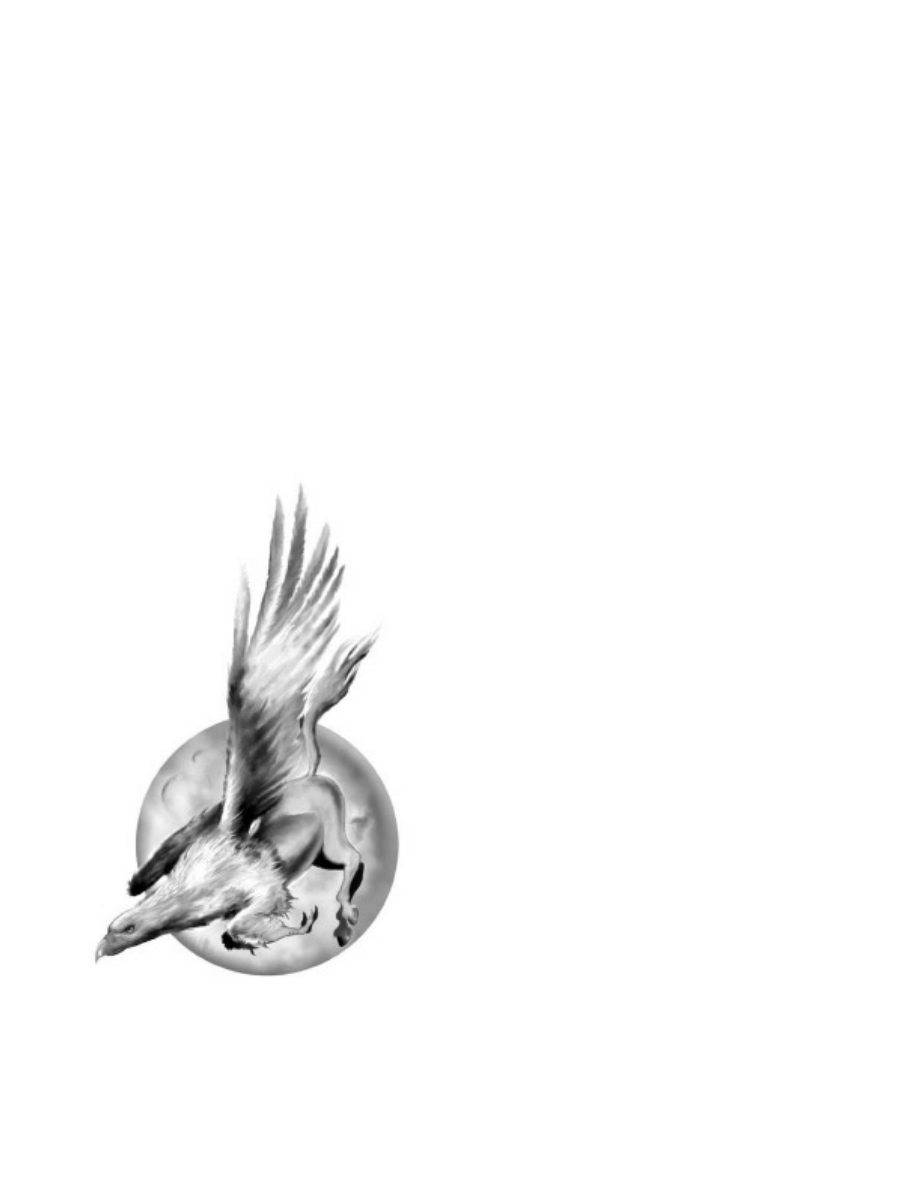
Resembling large ying horses with the forefront of a bird of
prey, a Hippogriff avoids the territories and civilizations of other
creatures, dwelling in extreme altitudes. Griffons (q.v.) some-
times attack them and the Hippogriff will attack those creatures
on sight. Preferring their own company, of which up to 12 can be
encountered, a Hippogriff shies from the presence of a Pegasus
(q.v.)
Combat: Hippogriffs are omnivorous; entering combat only as
defense, save for those times a Griffon is met, Hippogriffs rarely
see violence, but they are still formidable.
Scent (Wisdom): A Hippogriff can identify locations, items, and
even people by making a successful check. Scent functions to
a range of 30 feet. Hippogriffs, being natural bloodhounds, can
“sniff out” singular scents, even when that odor is overpowered
by another. Winds, weather conditions, and other situations may
render this ability useless or reduce its potency; multiple strong
odors will cause confusion, for example. Other effects are at the
CKs discretion.
Hobgoblin
Size: Medium
HD: 1d8+1
Move: 30 ft.
AC: 15
Attacks: by weapon
Special: Deepvision 60 ft.
Saves: P
Int: Average
Alignment: Lawful Evil
Type: Humanoid
Treasure: –
XP:10+1
These creatures have a strong grasp of strategy and tactics and
are capable of carrying out sophisticated battle plans. Under the
leadership of a skilled strategist or tactician, their discipline can
prove a deciding factor. Hobgoblins hate elves and attack them
rst, in preference to other opponents.
Horse, Heavy War
Size: Large
HD: 4d10+12
Move: 50 ft.
AC: 14Attacks: 2 hooves (1d6+3), bite (1d4+2)
Special: None
Saves: P
Int: Average
Alignment: Neutral
Type: Animal
Treasure: –
XP: 80+4
These animals are trained and bred for strength and aggression.
A heavy warhorse can ght while carrying a rider, but the rider
cannot also attack at the same time. A light load for a heavy
warhorse is up to 300 pounds; a medium load, up to 600 pounds;
a heavy load, up to 900 pounds. A heavy warhorse can drag 4,500
pounds.
Horse, Light War
Size: Large
HD: 3d10+6
Move: 60 ft.AC: 13
Attacks: 2 hooves (1d4+2), bite (1d4)
Special: None
Saves: P
Int: Average
Alignment: Neutral
Type: Animal
Treasure: –
XP:40+3
These animals are trained and bred for combat. A light warhorse
can ght while carrying a rider, but the rider cannot also attack.
A light load for a light warhorse is up to 225 pounds; a medium
load, up to 450 pounds; a heavy load, up to 700 pounds. A light
warhorse can drag 3,500 pounds.

7
Castles & Crusades
Horse, Riding
Size: Large
HD: 2d8
Move: 60 ft.
AC: 13Attacks: 2 hooves (1d4+1)
Special: NoneSaves: P
Int: Animal
Alignment: Neutral
Type: Animal
Treasure: –
XP: 20+2
These animals are bred for speed and distance. A riding horse
cannot ght while carrying a rider. A light load for a light riding
horse is up to 150 pounds; a medium load, up to 300 pounds;
a heavy load, up to 450 pounds. A light horse can drag 2,250
pounds.
Kobold
Size: Small
HD: 1d4
Move: 20 ft.AC: 13
Attacks: claw (1d4) or weapon
Special: Deepvision 60 ft.
Saves: P
Int: Average to low
Alignment: Lawful Evil
Type: Humanoid
Treasure: –
XP: 8+1
Kobolds prefer ranged combat, closing only when they can see
that their foes have been weakened. Whenever they can, kobolds
set up ambushes near trapped areas. They aim to drive enemies
into the traps, where other kobolds wait to pour aming oil over
them, shoot them, or drop poisonous vermin onto them. Kobolds
suffer a -1 penalty to attack rolls in bright sunlight or within the
radius of a spells causing as such.
Lion, Mountain
Size: Medium
HD: 4d8+4
Move: 40 ft.
AC: 14
Attacks: 2 claws (1d4+1) and bite (1d8)
Special: Pounce, Rake (1d4)
Saves: P
Int: Animal
Alignment: Neutral
Type: Animal
Treasure: –
XP: 120+4
If a lion leaps upon a foe during the rst round of combat, it
can make an extra attack as if it surprised the opponent. If a lion
successfully bites, it can make two rake attacks with its hind legs
at +3 to hit for 1d4+2 damage each.
Manticore
Size: Large
HD: 6d10
Move: 24 feet, 36 feet (y, clumsy)
AC: 17
Attacks: 2 Claw (1d3), Bite (1d8), or 6 Tail Spike (1d6)
Special: Tail Spikes, Darkvision 60 ft, Low-Light Vision, Scent
Saves: P
Int: Low
Alignment: Lawful Evil
Type: Magical Beast
Treasure: Individual
XP: 500
Manticores look like an overgrown lion, mounted to thick leath-
ery wings, and a humanoid face, often like that of a human or
bearded dwarf. Their tail ends in an assortment of spikes, which
the beast uses to impale victims. Manticores are normally only
found in swamps, and in very small numbers.
Combat: A Manticore attacks to kill from above, seeking to end
a ght before it even begins, by launching a volley of deadly
spikes.
Tail Spikes: Four times a day, a Manticore can release a barrage
of tail spikes, each inicting 1d6 points of damage. These spikes
must be directed at a single creature, or at all creatures in a
10-foot area. In this case, average the ACs of the potential targets,
and make a single attack roll; if it is successfully, all targets in
the area must make a Dexterity save, to avoid taking half of 6d6
points of damage.
Scent (Wisdom): A Manticore can identify locations, items, and
even people by making a successful check. Scent functions to
a range of 30 feet. Manticores, being natural hunters, can “sniff
out” singular scents, even when that odor is overpowered by
another. Winds, weather conditions, and other situations may
render this ability useless or reduce its potency; multiple strong
odors will cause confusion, for example. Other effects are at the
CKs discretion.
Ogre
Size: Large
HD: 4d8+4
Move: 25 ft.
AC: 15
Attacks: large weapon (2d6) or st (1d10)
Special: noneSaves: P
Int: Low
Alignment: Chaotic Evil
Type: Giant
Treasure: –
XP: 80+4
Ogres appear as large, less-evolved humans standing around
seven-feet tall. They have low intelligence, but speak crude
common. They employ direct attacks in combat, typically using
large clubs, axes, or pole arms, causing 2d6 damage no matter
the weapon type. Aquatic ogres are called merrow, and they can
swim 40 ft. per round.

8
Castles & Crusades Monsters & Treasure
Orc
Size: Medium
HD: 1d8
Move: 30 ft.
AC: 14
Attacks: by Weapon
Special: Darkvision 60 ft.
Saves: P
Int: Average
Alignment: Chaotic Evil
Type: Humanoid
Treasure: –
XP:10+1
Orcs are grotesque humanoids bent on war and domination. They
utilize all manner of weapons and armor scavenged from bat-
tleelds, and the CK should adjust AC and damage as appropri-
ate. They suffer a -1 penalty to hit in bright sunlight or within
the radius of a spell causing magical light. They speak a crude
common and goblin.
Owl
Size: Small
HD: 1d4Move: 10 ft., y 40 ft.AC: 16
Attacks: 2 claws (1d2)
Special: Listen, Duskvision 120 ft.
Saves: P
Int: Animal
Alignment: Neutral
Type: Animal
Treasure: –
XP: 5+1
Owls can listen like a rogue.
Owlbear
Size: Large
HD: 5d10
Move: 24 feet
AC: 15
Attacks: 2 Claw (1d6), Bite (2d6)
Special: Improved Grab, Scent
Saves: P
Int: Average
Alignment: Neutral (Neutral)
Treasure: Individual
XP: 225
An Owlbear is a massive fur and feathered abomination, roughly
about 10 feet tall, standing bipedially, with sharp, clawed paws
and a razor beak. Their facial features are like those of an owl,
while the body is muscled like that of a bear. These creatures
live in the most remote areas of thick, tangled forests, harboring
a ravenous appetite. Owlbears hunt in small packs, usually up to
ve in number.
Combat: Owlbears attack anything they consider food on sight
and always ght to the death.
Improved Grab (Strength): If an Owlbear strikes with both
claws, it pulls the victim into itself, hugging and dealing 2d8
points of damage. A save is allowed to resist being rendered
immobilized for one round. The Owlbear deals bite damage auto-
matically each round the hug is maintained, as well as dealing
2d8 points of damage. Each round, a new save is allowed to
escape.
Scent (Wisdom): An Owlbear can identify locations, items, and
even people by making a successful check. Scent functions to
a range of 30 feet. Owlbears, being natural bloodhounds, can
“sniff out” singular scents, even when that odor is overpowered
by another. Winds, weather conditions, and other situations may
render this ability useless or reduce its potency; multiple strong
odors will cause confusion, for example. Other effects are at the
CKs discretion.
Pony
Size: Medium
HD: 2d8+2Move: 40 ft.AC: 13
Attacks: 2 hooves (1d3+1)
Special: None
Saves: P
Int: Animal
Alignment: Neutral
Type: Animal
Treasure: –
XP: 20+2
A light load for a pony is up to 75 pounds; a medium load, up
to 150 pounds; and a heavy load, up to 225 pounds. A pony can
drag 1,125 pounds.
Pony, War
Size: Medium
HD: 3d8+6Move: 40 ft.AC: 13
Attacks: 2 hooves (1d4+1)
Special: None
Saves: P
Int: Animal
Alignment: Neutral
Type: Animal
Treasure: None
XP: 20+2
A warpony can ght while carrying a rider, but the rider cannot
also attack. A light load for a warpony is up to 100 pounds; a
medium load, up to 200 pounds; and a heavy load, up to 300
pounds. A warpony can drag 1,500 pounds.
Skeleton
Size: Medium
HD: 1d8Move: 30 ft.
AC: 13Attacks: claw or weapon (1d6)
Special: Immunities
Saves: M and P
Int: Special
Alignment: Neutral
Type: Undead
Treasure: –
XP: 10+1
These undead are animated by spell or other divine power. They
have no effective intelligence, and often act at the command of
an evil cleric or other master. Even when not under command,
they seem to follow their own unknown purpose, often becoming

9
Castles & Crusades
bent on destroying the living. Despite their state of being, they
are surprisingly agile. Skeletons are immune to mind-inuencing
effects, poison, sleep, charm, hold, paralysis, stunning, cold, and
disease. Because they lack esh or internal organs, they take
only half damage from piercing or slashing weapons. Holy water
inicts 2d4 damage per splash.
Snake, Giant Constrictor
Size: Large
HD: 5d10+5
Move: 20 ft., climb 30 ft.
AC: 15
Attacks: Bite (1d8+4)
Special: Constrict (2d8)
Saves: P
Int: Animal
Alignment: Neutral
Type: Animal
Treasure: –
XP: 240+5
A giant constrictor can entwine an opponent after a successful
bite attack. If it gets a hold, a successful grapple check on the
following round against medium-size or small creatures deals 2d8
damage.
Stirge
Size: Small
HD: 1d10
Move: 30 ft., 45 ft. y
AC: 14
Attacks: bite (1d3)
Special: Blood DrainSaves: P
Int: Animal
Alignment: Neutral
Type: Beast
Treasure: –
XP: 20+1
Stirges are wicked creatures. They attack by landing on a victim,
nding a vulnerable spot, and plunging its proboscis into the
esh. This is a touch attack. If a stirge hits with a touch attack,
it uses its eight pincers to latch onto the opponent’s body. An
attached stirge has an AC of 12. A stirge drains blood, dealing
1d4 hit points damage and 1 point of constitution each round it
remains attached. Once it has drained 4 points of constitution,
it detaches and ies off to digest the meal. Constitution points
return at the rate of 1 point per hour thereafter.
Troll
Size: Large
HD: 6d8+6
Move: 30 ft.
AC: 16
Attacks: 2 claws (1d6+3), bite (1d8+3)
Special: Darkvision 90 ft., Regenerate, RendSaves: P
Int: Low
Alignment: Chaotic Evil
Type: Giant
Treasure: –
XP: 480+6
Trolls have no fear of death: They launch themselves into combat
without hesitation, ailing wildly at the closest opponent. Even
when confronted with re, they try to get around the ames and
attack. If a troll hits with both claw attacks, it latches onto the
opponent’s body and tears the esh. This attack automatically
deals an additional 2d6 points of damage.
A troll regenerates damage at a rate of 4 hit points per round.
Fire and acid deal normal damage to a troll. If a troll loses a
limb or body part, the lost portion regrows in 3d6 minutes. The
creature can reattach the severed member instantly by holding it
to the stump.
Wolf
Size: Medium
HD: 2d8Move: 50 ft.AC: 13
Attacks: Bite (1d4+1)
Special: Track
Saves: P
Int: Average
Alignment: Neutral
Type: Animal
Treasure: None
XP: 20+2
Wolves are found in many environments, and they hunt in packs.
Wolves have a superior sense of smell and can track like a ranger.
Worg
Size: Medium to Large
HD: 4d8Move: 50 ft.
AC: 14
Attacks: Bite (2d4)
Special: TrackSaves: P
Int: Average
Alignment: Neutral Evil
Type: Magical Beast
Treasure: –
XP: 80+4
Worgs are evil, intelligent wolves that speak their own language
and sometimes common or goblin. They often serve goblins, orcs
or other humanoids. Some are ridden as mounts. In combat,
they use hit-and-run tactics to exhaust their quarry, and work in
pairs to bring down large game. A pack usually circles their prey,
with each wolf attacking in turn, biting and retreating, until the
creature is exhausted, at which point the pack moves in for the
kill. Worgs have a superior sense of smell and can track like a
ranger.
Wyvern
Size: Large
HD: 7d8+5
Move: 20 ft., y 60 ft.
AC: 17
Attacks: Bite (1d8+2), 2 claws (1d6), Sting (1d8)
Special: Poison
Saves: P
Int: Inferior
Alignment: Neutral
Type: Dragon
Treasure: –
XP: 720+7
A wyvern is a dragonlike creature with a poisonous sting. It can

10
Castles & Crusades Monsters & Treasure
slash with its claws when making a ying attack, but bites and
attempts to sting with its tail when engaging in melee. A success-
ful sting attack forces the victim to make a saving throw versus
poison, with failure indicating 2d6 hit points damage and a loss of
1d8 points of constitution for 1d4 days. A successful save results
in 1d6 damage. A favorite combat tactic of the wyvern is to snatch
a creature with both claws while ying, and then dropping them
from a height. Wyverns are immune to sleep or paralysis effects
caused by spells or other sources.
Xorn
Size: Mediun
HD: 5d8
Move: 20 feet, 20 feet (burrow)
AC: 23
Attacks: 3 Claw (1d3), Bite (2d8)
Special: All-Around Vision, Earth Glide, Darkvision 60 ft,
Immunity: Cold and Fire, Resistance to Electricity, Tremorsense
60 ft, Extraplanar, Earth Subtype
Saves: P
Int: Average
Alignment: Neutral (Neutral)
Type: Outsider
Treasure: Trove
XP: 225
Minor Xorn are natives to the Elemental Plane of Earth, resem-
bling a stony tripod, topped with a gem-hungry voracious mouth.
Arching from the creature’s triangulated body, three arms are
exposed, one on each side, slightly below an eye. Xorn are always
searching for more gems, always hungry for them. Up to 4 of
these creatures can be encountered.
Combat: Minor Xorn burrow underground, rising out of the
ground to strike with claws and bite, then sink back into the earth
before a defense can be readied.
All-Around Vision: A Minor Xorn cannot be backstabbed, and it
can detect creatures moving on all sides. However, it suffers a
4 penalty on all saves to resist the effects of gaze attacks.
Earth Glide: A Xorn can glide through stone, dirt, or almost any
other sort of earth except metal as easily as a sh swims through
water. Its burrowing leaves behind no tunnel or hole, nor does
it create any ripple or other signs of its presence. A Move Earth
spell cast on an area containing a burrowing Xorn ings it back
30 feet, stunning it for 1 round unless a successful Constitution
save is made. If Phase Door is cast on the Xorn while it is moving
this way, it is slain instantly.
Zombie
Size: Medium
HD: 2d12
Move: 12 feet
AC: 12
Attacks: Slam (1d8)
Special: Slow, Undead
Saves: P
Int: Low
Alignment: Neutral (Neutral)
Type: Undead
Treasure:
XP: 15
Zombies are the reanimated corpses of humanoid creatures,
slowly, and methodically stalking the earth. They appear as
slowly rotting bodies, and always gather in masses, typically
reaching 24 at the most. They are deathly slow, but they have a
powerful attack.
Combat: A Zombie is mindless, fearless, and only seeks to kill
so it can eat.
Slow: A Zombie never has initiative and always acts last in any
given round.

11
Castles & Crusades
This book is published under the Open Game License (OGL) version 1.0a by permission of Wizards of the Coast, Inc. The Open Game Content appearing in this
book is derived from the 3.0 System Reference Document, copyright 2000 Wizards of the Coast, Inc. All contents, excluding the OGL, is property of and copyright
2004 Troll Lord Games. All Rights Reserved.
Designation of Open Game Content: The following is designated Open Game Content pursuant to the OGL v1.0a: all text.
Designation of Product Identity: Product identity is not Open Game Content. The following is designated as product identity pursuant to OGL v1.0a(1)(e) and (7):
(A) product and product line names, including Castles & Crusades, Castles & Crusades: Player’s Handbook, Castles & Crusades: Monsters and Treasures, Castles
& Crusades: Castle Keeper’s Guide; (B) logos, identifying marks, and trade dress; (C) all artwork, logos, symbols, graphic designs, depictions, likenesses, formats,
poses, concepts, themes and graphic, photographic and other visual representations; (D) logos and trademarks, including Castles & Crusades, Castle Keeper, SIEGE
engine, and Troll Lord Games, or any other trademark or registered trademark clearly identied as product identity by the owner of the product identity, and which
specically excludes the open game content.
OPEN GAME LICENSE Version 1.0a: The following text is the property of Wizards of the Coast, Inc. and is Copyright 2000 Wizards of the Coast, Inc
(”Wizards“). All Rights Reserved.
1. Denitions: (a)“Contributors“ means the copyright and/or trademark owners who have contributed Open Game Content; (b)“Derivative Material“ means copyrighted
material including derivative works and translations (including into other computer languages), potation, modication, correction, addition, extension, upgrade,
improvement, compilation, abridgment or other form in which an existing work may be recast, transformed or adapted; (c) ”Distribute“ means to reproduce, license,
rent, lease, sell, broadcast, publicly display, transmit or otherwise distribute; (d)“Open Game Content“ means the game mechanic and includes the methods, procedures,
processes and routines to the extent such content does not embody the Product Identity and is an enhancement over the prior art and any additional content clearly
identied as Open Game Content by the Contributor, and means any work covered by this License, including translations and derivative works under copyright law,
but specically excludes Product Identity. (e) ”Product Identity“ means product and product line names, logos and identifying marks including trade dress; artifacts;
creatures characters; stories, storylines, plots, thematic elements, dialogue, incidents, language, artwork, symbols, designs, depictions, likenesses, formats, poses,
concepts, themes and graphic, photographic and other visual or audio representations; names and descriptions of characters, spells, enchantments, personalities, teams,
personas, likenesses and special abilities; places, locations, environments, creatures, equipment, magical or supernatural abilities or effects, logos, symbols, or graphic
designs; and any other trademark or registered trademark clearly identied as Product identity by the owner of the Product Identity, and which specically excludes the
Open Game Content; (f) ”Trademark“ means the logos, names, mark, sign, motto, designs that are used by a Contributor to identify itself or its products or the associated
products contributed to the Open Game License by the Contributor (g) ”Use“, ”Used“ or ”Using“ means to use, Distribute, copy, edit, format, modify, translate and
otherwise create Derivative Material of Open Game Content. (h) ”You“ or ”Your“ means the licensee in terms of this agreement.
2. The License: This License applies to any Open Game Content that contains a notice indicating that the Open Game Content may only be Used under and in terms of
this License. You must afx such a notice to any Open Game Content that you Use. No terms may be added to or subtracted from this License except as described by the
License itself. No other terms or conditions may be applied to any Open Game Content distributed using this License.
3.Offer and Acceptance: By Using the Open Game Content You indicate Your acceptance of the terms of this License.
4. Grant and Consideration: In consideration for agreeing to use this License, the Contributors grant You a perpetual, worldwide, royalty-free, non-exclusive license
with the exact terms of this License to Use, the Open Game Content.
5.Representation of Authority to Contribute: If You are contributing original material as Open Game Content, You represent that Your Contributions are Your original
creation and/or You have sufcient rights to grant the rights conveyed by this License.
6.Notice of License Copyright: You must update the COPYRIGHT NOTICE portion of this License to include the exact text of the COPYRIGHT NOTICE of any
Open Game Content You are copying, modifying or distributing, and You must add the title, the copyright date, and the copyright holder’s name to the COPYRIGHT
NOTICE of any original Open Game Content you Distribute.
7. Use of Product Identity: You agree not to Use any Product Identity, including as an indication as to compatibility, except as expressly licensed in another, independent
Agreement with the owner of each element of that Product Identity. You agree not to indicate compatibility or co-adaptability with any Trademark or Registered
Trademark in conjunction with a work containing Open Game Content except as expressly licensed in another, independent Agreement with the owner of such
Trademark or Registered Trademark. The use of any Product Identity in Open Game Content does not constitute a challenge to the ownership of that Product Identity.
The owner of any Product Identity used in Open Game Content shall retain all rights, title and interest in and to that Product Identity.
8. Identication: If you distribute Open Game Content You must clearly indicate which portions of the work that you are distributing are Open Game Content.
9. Updating the License: Wizards or its designated Agents may publish updated versions of this License. You may use any authorized version of this License to copy,
modify and distribute any Open Game Content originally distributed under any version of this License.
10 Copy of this License: You MUST include a copy of this License with every copy of the Open Game Content You Distribute.
11. Use of Contributor Credits: You may not market or advertise the Open Game Content using the name of any Contributor unless You have written permission
from the Contributor to do so.
12 Inability to Comply: If it is impossible for You to comply with any of the terms of this License with respect to some or all of the Open Game Content due to statute,
judicial order, or governmental regulation then You may not Use any Open Game Material so affected.
13 Termination: This License will terminate automatically if You fail to comply with all terms herein and fail to cure such breach within 30 days of becoming aware of
the breach. All sublicenses shall survive the termination of this License.
14 Reformation: If any provision of this License is held to be unenforceable, such provision shall be reformed only to the extent necessary to make it enforceable.
15 COPYRIGHT NOTICEOpen Game License v 1.0 Copyright 2000, Wizards of the Coast, Inc.
System Reference Document Copyright 2000, Wizards of the Coast, Inc; Authors Jonathan Tweet, Monte Cook, Skip Williams, based on original material by E.
Gary Gygax and Dave Arneson.
Castles & Crusades: Players Handbook, Copyright 2004, Troll Lord Games; Authors Davis Chenault and Mac Golden.
Castles & Crusades: Monsters Product Support, Copyright 2005, Troll Lord Games.
Wyszukiwarka
Podobne podstrony:
Castles & Crusades Alternate Monster Experience Matrix
Castles & Crusades Wilderlands of High Adventure
Castles & Crusades Errata
Castles & Crusades Inzae World Map
Castles & Crusades Multi Classing
Castles & Crusades Aihrde World Map
Castles & Crusades The Eel's Head Brewery
Castles & Crusades Castle Zagyg The Workhouse of Yggsburgh Town
Castles & Crusades Druid Pets
Castles & Crusades Treasure Types
Castles & Crusades Martial Artist Class
Castles & Crusades Ilshara City of Jendar Map
Castles & Crusades Dragonlance Adventures
Castles & Crusades Castle Keeper's Aids
Castles & Crusades Wilderlands of High Adventure
Castles & Crusades Errata
Castles & Crusades Inzae World Map
Castles & Crusades Multi Classing
List of Crusader castles
więcej podobnych podstron