
Macedonian
by Victor Friedman
© SEELRC 2001

LW/M
117
1
MACEDONIAN
Contents
Abbreviations................................................................................................................................... 3
0
Sociolinguistic and Geolinguistic Situation ...................................................................... 4
0.1
Geography........................................................................................................................ 4
0.2
Terminology and History ................................................................................................. 4
0.3
Standardization................................................................................................................. 5
0.4
Status................................................................................................................................ 6
0.5
Dialects............................................................................................................................. 6
0.5.1 Major
Isoglosses.............................................................................................................. 6
0.5.2
Vocalic Inventories ........................................................................................................... 6
0.5.3
Prosody............................................................................................................................ 7
0.5.4
Morphology ..................................................................................................................... 7
0.6
Number of Speakers......................................................................................................... 8
1
Phonology........................................................................................................................ 9
1.1
Orthography..................................................................................................................... 9
1.2
Phonemic Inventory and Phonotactics............................................................................ 10
1.2.1
Vowels............................................................................................................................ 10
1.2.2
Consonants..................................................................................................................... 11
1.3
Prosody.......................................................................................................................... 13
1.3.1
Lexical Exceptions.......................................................................................................... 13
1.3.2
Phrasal Exceptions ......................................................................................................... 13
1.4
Morphophonemic Alternations....................................................................................... 14
1.4.1
Velar with Palatal............................................................................................................ 14
1.4.2
Velar with Dental............................................................................................................ 14
1.4.3 Dental or Velar with Palatal ............................................................................................ 14
1.4.4
Cluster Simplification..................................................................................................... 14
1.4.5
Dissimilation with -c
#e..................................................................................................... 15
1.4.6
Progressive Voicing Assimilation................................................................................... 15
1.4.7
Isolated Consonantal Alternations .................................................................................. 15
1.4.8
Vowel~Zero Alernations................................................................................................. 15
1.4.9
Vocalic Alternations........................................................................................................ 16
2
Morphology ................................................................................................................... 17
2.1
Nouns............................................................................................................................. 17
2.1.1 Gender............................................................................................................................ 17
2.1.2
Number .......................................................................................................................... 18
2.1.3
Definiteness.................................................................................................................... 20
2.1.4
Case................................................................................................................................ 22
2.1.5
Noun Derivation............................................................................................................. 23
2.2
Adjectives ....................................................................................................................... 26
2.2.1
Gender/Number.............................................................................................................. 26
2.2.2
Definiteness.................................................................................................................... 27
2.2.3
Gradation........................................................................................................................ 27
2.2.4
Adjective Derivation........................................................................................................ 27

LW/M
117
2
MACEDONIAN
2.3
Pronouns.........................................................................................................................29
2.3.1
Personal ..........................................................................................................................29
2.3.2 Possessive.......................................................................................................................29
2.3.3
Deictic.............................................................................................................................29
2.3.4
Interrogative ....................................................................................................................29
2.3.5
Totalizing ........................................................................................................................30
2.4
Numerals.........................................................................................................................31
2.4.1
Cardinal (non-virile)........................................................................................................31
2.4.2
Virile ...............................................................................................................................31
2.4.3
Definiteness ....................................................................................................................31
2.4.4
Ordinals ..........................................................................................................................32
2.5
Verbs...............................................................................................................................33
2.5.1
Inflection.........................................................................................................................33
2.5.2
Verbal Categories............................................................................................................39
2.5.3
Verb Derivation...............................................................................................................45
2.6
Adverbs...........................................................................................................................47
2.7
Prepositions ....................................................................................................................48
3 Syntax.............................................................................................................................49
3.1
Element Order in Declarative Sentences..........................................................................50
3.2
Nondeclarative Sentence Types.......................................................................................54
3.3
Copular and Existential Sentences...................................................................................56
3.4
Coordination and Comitativity.........................................................................................57
3.5
Subordination..................................................................................................................58
3.6
Negation..........................................................................................................................61
3.7
Anaphora and Pronouns..................................................................................................63
3.8
Reflexives and Reciprocals..............................................................................................64
3.9
Possession ......................................................................................................................68
3.10 Quantification..................................................................................................................68
Texts
........................................................................................................................................70
References......................................................................................................................................74
Acknowledgments..........................................................................................................................76
Map
........................................................................................................................................77

LW/M
117
3
MACEDONIAN
Abbreviations
ACC
accusative
NOM
nominative
ADJ
adjective
O
object
ADV
adverb
QU
interrogative
AO
aorist
P
perfective
AUG
augmentative
PL
plural
AUX
auxiliary
PR
present
C
consonant
PRO
pronoun
COL
collective
PX
proximal
DAT
dative
S
subject
DEF
definite
SU
subjunctive
DIM
diminutive
SG
singular
DS
distal
TR
transitive
EX
expectative (future)
V
verb
F
feminine
VA
verbal adjective
HY
hypothetical
VL
vowel
HUM
human
VN
verbal noun
I
imperfective
VV
verbal adverb
IDF
indefinite
Ø
morphological zero
IM
imperfect
[ ]
phonetic transcription
ITR
intransitive
{ }
morphemic transcription
IV
imperative
/ /
phonemic transcription
LF
l-form
< >
orthographic symbol
M
masculine
>
results in
N
neuter
<
comes from
NEG
negative
~
alternates with
NN
noun
' '
English glosses
Italics are used for the transliteration of Macedonian Cyrillic orthography, which is mostly
phonemic.
The citation form for verbs is the third singular present unless otherwise indicated.

LW/M
117
4
MACEDONIAN
0 Sociolinguistic and Geolinguistic Situation
0.1 Geography
Macedonia has been the name of a Balkan region since ancient times, when it was bounded by
Epirus, Thessaly, and Thrace on the southwest, south, and east. At present geographic Macedonia is
best defined as the region bounded by a series of mountains and ranges (Olympus, Pindus, S
‹ar,
Rhodopes) and the lower course of the river Mesta (Greek: Néstos). It comprises the Republic of
Macedonia, the Blagoevgrad District in southwestern Bulgaria (Pirin Macedonia), and the district of
Makedhonía in the province of Northern Greece (Aegean Macedonia). Two small parts of eastern
Albania — one around Lakes Ohrid and Prespa and the other around Golo Brdo (Albanian:
Golobordë) — can also be included in a geographic definition of Macedonia (cf. Vidoeski in
Koneski 1983:117).
0.2 Terminology and History
The geographic region, like the rest of the Balkans, has always been multilingual. For our purposes,
Modern Macedonian (henceforth, Macedonian) can be defined as the Slavic dialects spoken on the
territory of geographic Macedonia.
1
Macedonian is a South Slavic language in the Indo-European
language family. Together with Bulgarian, Macedonian comprises the East South Slavic sub-group.
The West South Slavic languages are Slovenian and the former Serbo-Croatian.
2
Ancient Macedonian, an independent Indo-European language of uncertain affiliation, was spoken
in at least part of Macedonia in the fifth and fourth centuries B.C. and presumably both earlier and
later. This gave way to Greek, which was in turn supplanted by Slavic when the Slavs invaded and
settled in the Balkans in the sixth and seventh centuries A.D. The Ottoman conquest of the Balkan
peninsula in the fourteenth and fifteenth centuries brought about a disruption of cultural continuity
with regard to Slavic literacy in that region. The history of Modern Literary (or Standard, for the
purposes of this exposition, the two terms are synonymous) Macedonian begins in the latter part of
the eighteenth century with the birth of South Slavic nationalism. Until about 1840, publications
using Macedonian dialects were ecclesiastical and didactic works that were influenced by Church
Slavonic but had clearly identifiable colloquial bases. The goal was to establish a vernacular-based
Slavic literary language in opposition to both the archaizing influence of those who would have
imposed some form of Church Slavonic and the Hellenizing attempts of the Greek Orthodox
Church, to which the majority of Macedonians and Bulgarians belonged. The authors of this period
on the Ottoman territory that later became Macedonia and Bulgaria called their vernacular language
Bulgarian. By the mid-nineteenth century, a struggle over the dialectal base of the emerging
vernacular literary language became manifest. Two principal literary centres arose: One in
northeastern Bulgaria and the other in southwestern Macedonia. Macedonian intellectuals
1
The dialects of the Slavic-speaking Muslims of the Gora region on the eastern and northern slopes of Mts.
Korab and S
‹ar in Albania and Kosovo are also classed as Macedonian by Vidoeski (1986), a view that is
implicitly accepted by the Croatian and Serbian linguists Brozovic
! and Ivic! (1988:70-71). Other languages
spoken on the territory of geographic Macedonia include Albanian, Aromanian, Bulgarian, Greek, Megleno-
Romanian, Romani, Serbian, and Turkish. Until the Holocaust, Judezmo was also an important language i n
Macedonia, and it is still spoken by some survivors.
2
The West South Slavic dialects adjacent to Macedonian are all Serbian, and the variant of the former
Serbo–Croatian standard of the former Yugoslavia that had the most influence in Macedonia was the Serbian
variant. Thus, in this work I use the term Serbian, depending on the context, to refer to the Serbian variant of
the former Serbo–Croatian, the current standard of the Federal Republic of Yugoslavia, or to the Serbian
dialects. The term Serbo–Croatian is used to refer to the standard language of former Yugoslavia as such.

LW/M
117
5
MACEDONIAN
envisioned a Bulgarian literary language based on Macedonian dialects or a Macedo-Bulgarian
dialectal compromise. Bulgarians, however, insisted that their Eastern standard be adopted without
compromise. This period was marked by considerable struggles and polemics over the publication
and use of textbooks with Macedonian dialectal bases.
The establishment of an independent Bulgarian Church (the Exarchate) in 1870-72 marked a
definitive victory over Hellenism. It is from this period that we have the first published statements
insisting on Macedonian as a language separate from both Serbian and Bulgarian (Pulevski
1875:48-49), although these ideas were expressed during the preceding period in private
correspondence and similar documentation. In his book Za makedonckite raboti ‘On Macedonian
matters’ (Sofia, 1903), Krste Misirkov outlined the principles of a Macedonian literary language
based on the Prilep-Bitola dialect group, i.e. precisely the dialects which later served as the basis of
Literary Macedonian. This work documents the coherent formulation of a Macedonian literary
language and nationality from the beginning of the twentieth century, thus belying the claim that
Macedonian separateness dates only from the end of World War Two.
On 18 October 1912 the Kingdoms of Bulgaria, Greece, and Serbia united against Turkey in the
First Balkan War. Less than a year later Macedonia was partitioned among these three allies,
essentially marking the end of the development of Literary Macedonian outside the borders of
Yugoslavia except for the period 1946-1948, during which the Macedonians of Pirin Macedonia
were recognized as a national minority in Bulgaria with their own schools and publications in
Literary Macedonian. In accordance with article 9 of the Treaty of Sèvres (10 August 1920)
concerning minority population language rights in Greece, a commission of three men, probably
from Bitola and of Aromanian origin, composed a Macedonian primer entitled Abecedar printed in
Athens in 1925 using a Latin orthography and based on dialects spoken between Bitola and Lerin
(Greek Florina). The book was never used, however, and most copies were destroyed. In
Yugoslavia, Macedonian was treated as a South Serbian dialect, which was consistent with claims
that had been advanced since the nineteenth century, but the Yugoslav government permitted
Macedonian literature to develop on a limited basis as a dialect literature. Some Macedonian
poetry was also published in Bulgaria under the guise of (Bulgarian) dialect literature. It was during
this interwar period that linguists from outside the Balkans published studies in which they
emphasized the distinctness of Macedonian from both Serbo-Croatian and Bulgarian (Vaillant
1938).
0.3 Standardization
Although efforts at the creation of a Macedonian literary language date from the nineteenth century,
it was not until 2 August 1944 that Macedonian was formally declared the official language of the
Republic of Macedonia. The standardization of Literary Macedonian proceeded rapidly after its
official recognition, in part because an inter-dialectal koine was already functioning. The West
Central dialect (Bitola-Veles-Prilep-Kic
#evo), which was the largest in both area and population,
supplied a base to which speakers from other areas could adjust their speech most easily. In many
respects these dialects are also maximally differentiated from both Serbian and Bulgarian, but
differentiation was not an absolute principle in codification. A significant sociolinguisitc issue now,
for Literary Macedonian, is the fact that Skopje — the capital and principal cultural and population
centre — is peripheral to the West Central dialect area and the Republic as a whole has been subject

LW/M
117
6
MACEDONIAN
to considerable Serbian influence (see Minova-G
Úurkova 1987). For more details see Friedman
(1985, 1998, 2000), and Lunt (1984, 1986).
0.4 Status
Literary Macedonian is the official language of the Republic of Macedonia. It was recognized as
such by all countries except Bulgaria — where it was an official minority language 1946-48 and
subsequently officially viewed as a “regional norm” or "dialect" of Bulgarian — and Greece,
where Macedonian is usually claimed not to exist — except in proclamations banning its use — or
it is claimed that the term Macedonian can only be used to refer to the Greek dialects of Macedonia
or to Ancient Macedonian (see Human Rights Watch/Helsinki 1994). In 1999, the Bulgarian
government officially recognized the standard language of the Republic of Macedonia as an
independent language, but did not recognize the dialects spoken outside the Republic as part of that
language. Nonetheless, there are citizens of and emigrants from both Bulgaria and Greece who
identify their native (Slavic) language as Macedonian. It is also spoken in about 50 to 75 villages in
eastern Albania and Southwestern Kosovo, where it is used as a language of instruction in
elementary schools up through grade 4 only in the southwestern villages of the Ohrid-Prespa
region. The relationship of Macedonian to Bulgarian is mutatis mutandis, comparable to that of
Dutch to German. The main difference is that no serious modern scholar, nor even journalistic
authors, would describe Dutch as a codified German dialect, whereas such misstatements of the
relationship of Macedonian to Bulgarian continue to appear. See Haugen (1968) for relevant
comparative material on the Scandinavian languages.
0.5 Dialects
The map shows the location of the thirty pre-1996 municipal centers of the Republic of Macedonia
as well as rivers and regions of dialectological significance.
3
Locations outside the Republic of
Macedonia of significance for Macedonian dialectology are also indicated. Names in parentheses in
Greece and Albania are in Greek and Albanian, respectively. In Bulgaria, the pre-1950 names are
given in parentheses. The names of the major dialect groups are given below the map. The towns
given in parentheses are included in the given group.
0.5.1 Major Isoglosses
The major East-West bundle of isoglosses runs roughly from Skopska Crna Gora along the rivers
Vardar and Crna, east of Lerin (Greek Florina) and then bifurcates south of Lerin separating the
Korc
#a-Kostur (Albanian Korçë, Greek Kastoria) dialects into a separate group (see Vidoeski in
Koneski 1983). A significant North-South bundle separates the Lower Polog and Kratovo-Kriva
Palanka dialects from the rest. Skopje is located roughly at the intersection of these two main
bundles of isoglosses.
0.5.2 Vocalic Inventories
The vocalic inventories of the West Central dialects are characterized by a five-vowel system, /a, e, i,
o, u/. With the exception of Mala Reka, Reka, Drimkol-Golobrdo, Radoz
#da-Vevc#ani, Nestram,
Korc
#a, and parts of Lower Prespa, all the remaining dialects also have phonemic schwa. Phonemic
/å/ or /
O/ is found in all of these latter schwa-less dialects except Mala Reka and Korc#a. Phonemic
3
For administrative purposes, Skopje was divided into five municipalities, bringing to total to 34. The number
of municipalities was increased from from 34 to 122 on 14 September 1996.

LW/M
117
7
MACEDONIAN
/ä/ occurs in Radoz
#da-Vevc#ani, Suho and Visoka, and Korc#a. Vocalic /lfi/ occurs in Mala Reka.
Vocalic /r
9/ is absent from those dialects that decompose original *r
9, except Radoz#da-Vevc#ani.
Korc
#a also has phonemic /ü/.
Table 0.1: Diagnostic reflexes of Common Slavic phonemes
phoneme
u
*
i
*
r›
lfi
o˛
North
sa
*n
da
*n
krv
vuk
put
Central (east)
son
den
krv
va
*k
pat
Central (west)
son
den
krv
volk
pat
Debar*
son
den
korv
volk
pot
Peripheral†
son
den
ka
*rv
va
*lk
pa
*t
Seres/Nevrokop
sa
*n
den
ka
*rv
va
*lk
pa
*t††
‘dream’
‘day’ ‘blood’
‘wolf’
‘road’
*Debar itself has the Peripheral reflexes. Those given in the table represent Reka, Drimkol, and
Golobrdo, where /o/ stands for /o/, /
O/, or /å/. Mala Reka has krv, vlk, pot. Gora has den, son, krv,
vuk, pa
*t but *lfi generally gives /la*, a*l, a*v, ov, ou8/, depending on village and lexical item.
†For /a
*/ Nestram has /å/, Korc#a and the northernmost villages of Kostur have /a/. Kostur-Korc#a
has vowel plus nasal sonorant from Common Slavic nasal vowels before some stops: Kostur
za
*mb, Nestram zåmb, Korc#a zamb ‘tooth’. Radoz#da-Vevc#ani has påt, kärv, volk (but kälk ‘thigh’),
historically /å/ after bilabials, /ä/ elsewhere; both only under stress. Lower Prespa (eastern shore
from German and Dolno Dupeni southward) has påt, krv, våk, (but pålno ‘full’).
†† pa
*nt’ in Suho and Visoka (northeast of Salonika).
0.5.3 Prosody
Stress in the dialects of the Western region is normally fixed, antepenultimate in the Republic of
Macedonia, penultimate in Greece and Albania. The dialects of the Eastern region all have varying
degrees of non-fixed stress. In Tikves
#-Mariovo stress is paradigmatically mobile and limited to the
antepenultimate and penultimate syllables. In Dojran-Gevgelija/Lower Vardar stress is
paradigmatically fixed and limited to the final two syllables, but is not permitted on final open
syllables in substantives. Kumanovo-Kriva Palanka and S
‹tip-Strumica have free but
paradigmatically fixed stress and do not permit stressed final open syllables in substantives, while
Males
#evo-Pirin and Nevrokop/Seres-Drama have free and paradigmatically mobile stress. In the
Lower Vardar and Seres-Nevrokop dialects unstressed /a, e, o/ are reduced, i.e. raised. Reduction is
strongest in the south, most restricted in the north and west.
0.5.4 Morphology
The dialectal morphological and syntactic features of the greatest relevance to the codification of
Literary Macedonian are given in Table 0.2.

LW/M
117
8
MACEDONIAN
Table 0.2: Morphological and syntactic features
West East
M-DEF -o
M-DEF -ot
Deictic definite articles -v, -n
No deictic definite articles
Synthetic dative pronouns (1-SG nam)
Analytic dative pronouns (na nas)
3 SG M NOM PRO toj (also Seres-Drama, Nevrokop)
on (also Northwest )
Monosyllabic M-PL -ovi, -oj (also Tikves
#-Mariovo)
Monosyllabic M-PL -ove
Oblique forms of personal nouns (also Northeast)
No oblique noun forms
Quantitive plural not used consistently
Quantitative plural used consistently
(also Northwest)
3-SG-PRES -t
3-SG-PRES -Ø (also Northwest)
se ‘they are’
sa (also Northwest)
no 3-SG/PL-AUX with l-form
3-SG/PL-AUX with l-form
perfect series with ima ‘have’
no perfect series with ima ‘have’
Imperfective aorist obsolete
Imperfective aorist used
Perfective present always subordinated
Perfective present occurs independently
Sentence initial clitics
Clitics never sentence initial
0.6 Number of Speakers
According to the final results of the 1994 census in the Republic of Macedonia, out of a total
population of 1,945,932, the number of those declaring Macedonian as their mother tongue was
1,332, 983. In addition to Macedonian, the following languages are in official use in the Republic of
Macedonia: Albanian, Turkish, Romani, Aromanian, and Serbian. The vast majority of Macedonian
citizens declaring a different mother tongue also speak Macedonian. No reliable population figures
are available for the Macedonian dialects of Bulgaria, Greece, or Albania nor for those
Macedonians living abroad. The Albanian census of 1989 officially registered about 5,000
Macedonians, but sources in Macedonia insist the number is twenty to thirty times greater (Nova
Makedonija Feb. 2, 1990). This insistence is based on the fact that this Albanian census only
counted the Macedonian-speaking Christians of the Ohrid-Prespa region of Albania, whereas
Macedonian-speaking Christians and Muslims live in villages all along Albania’s border with
geographic Macedonia as well as in larger cities and towns. The 1991 Albanian census did not
record ethnicity. The number of Macedonians living in Bulgaria has been estimated at 250,000
(Nova Makedonija 16 May 1991), and a similar figure has been cited for Greece (Human Rights
Watch/Helsinki 1994:11). See Popovski (1981) for details. Based on 1994 census figures and
other estimates, the total number of speakers with Macedonian as a first or second language is
probably somewhere around 3,000,000, many of whom have emigrated to Australia, Canada, and
the United States (Friedman 1985).

LW/M
117
9
MACEDONIAN
1 Phonology
1.1 Orthography
The Macedonian alphabet follows the phonemic principle of Serbian Cyrillic. With certain
exceptions, each letter corresponds to a single phoneme and words are pronounced as they are
spelled. The alphabet was officially established on 3 May 1945 and is given in Table 1.1 with its
codified Latin transcription equivalent.
Table 1.1: Standard Macedonian orthography
Aa
a
Ee
e
Kk
k
Oo
o
Uu
u
Bb
b
ÛΩ
z
#
Ll
l
Pp
p
Ff
f
Vv
v
Zz
z
Ò¬
lj or l´
Rr
r
Xx
h
Gg
g
Íß
dz
Mm
m
Ss
s
Cc
c
Dd
d
Ii
i
Nn
n
Tt
t
c
#
G°g•
g
!
Jj
j
ˆ~
nj
K°k•
k
!
Ù≈
dz
#
Ww
s
#
In standard orthography, schwa, which is not considered part of the alphabet, is indicated by means
of an apostrophe, in standard transcription, by means of <a
*> (see 1.2.1.3). Orthographic rules are
given in the paragraphs concerning the relevant phonemes and alternations (see 1.2.1.5-7, 1.2.2.11-
13)
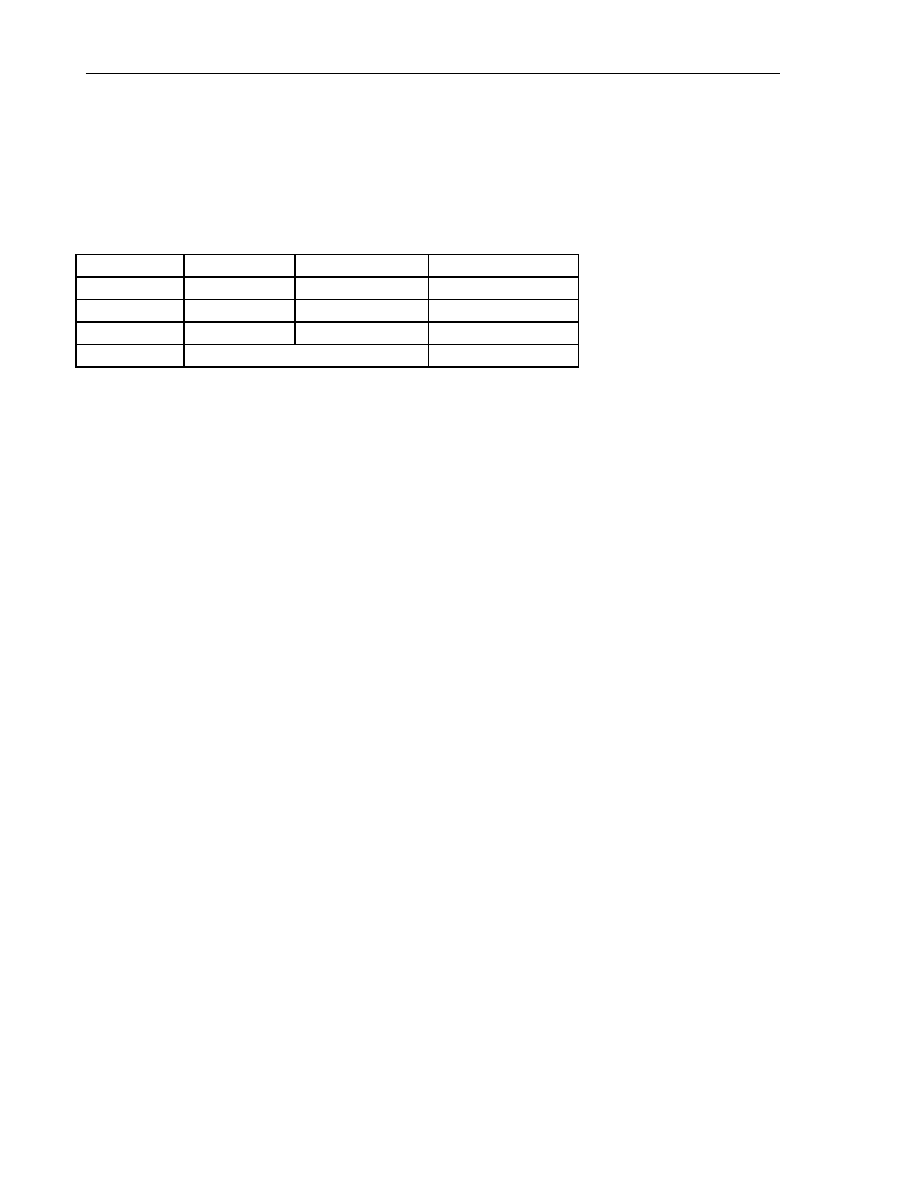
LW/M
117
10
MACEDONIAN
1.2 Phonemic Inventory and Phonotactics
1.2.1 Vowels
The vocalic phonemic inventory of standard Macedonian is given in Table 1.2
Table 1.2: Vocalic phonemic inventory
front
central
back
high
i
u
mid
e
( a
* )
o
low
a
unrounded
rounded
1.2.1.1 Unstressed vowels are not reduced, although they are slightly laxer and shorter, especially
post-tonically, and they can be devoiced word or phrase finally in informal speech.
1.2.1.2 There is considerable variation among speakers in the realization of the mid vowels /e/ and
/o/ from [
ε] and [o] to [eÚ] and [oÚ]. The higher variants are particularly characteristic of the Western
dialects and also of modern educated Skopje speech, especially among women of the younger
generation. This general raising is different from the vowel reduction characteristic of the
southeastern dialects. Under expressive stress in open syllables, /e/ may be realized almost as [æ],
e.g., le le [læ læ] ‘Oh dear!’
1.2.1.3 Although schwa is phonemic in many dialects, where its realization varies in its closeness
to [ä] or [i- ], its status in the literary language is marginal. According to the norm, it is limited to
three environments: (1) before syllabic /r/ in absolute initial position and when preceded by a
morpheme ending in a vowel (see 1.2.1.5); (2) for dialectal effect in words of Slavic or Turkish
origin as in [pa
*t] for standard pat ‘road’, [sa*za] for standard solza ‘tear’, [ka*smet] for standard
kasmet (< Turkish kısmet) ‘fate’; (3) in spelling aloud, each consonant is followed by schwa:
Friedman [fa
*-ra*-i-e-da*-ma*-a-na*]. The names of letters in some abbreviations are pronounced
differently, e.g. SSSR [eSeSeSeR] ‘USSR’, MT [emte] a brand of cigarrettes, but MVR [ma
* va* ra*] =
Ministerstvo na Vnatres
#ni Raboti ‘Ministry of Internal Affairs’. The exceptions should probably
be considered lexicalized acronyms.
1.2.1.4 Phonemic /i/ is realized as /j/ in final position after a vowel colloquially, but can contrast
with /j/ in careful speech: odai ‘Turkish style room’ PL – odaj ‘betray’ IV.
1.2.1.5 The consonant /r/ can normally be viewed as having a vocalic (syllabic) realization between
consonants and between a word or morpheme boundary and a consonant. It is possible to have
minimal or near minimal pairs with vocalic /r/ between a vowel and consonant when the vowel
preceding vocalic /r/ is at a morpheme boundary: porti – po’rti ‘doors’ – ‘begin to sprout’.
However, the realization of vocalic /r/ can be [a
*r] (see 1.2.1.3). Note that vocalic /r/ is to be spelled
<’
r
> in initial position and after a vocalic morpheme boundary. Vocalic /r/ occurs in final position
only in a few foreign and onomatopoetic words: tembr ‘timbre’, kotrr ‘cry used for driving cattle’,
prr ‘sound of birds taking flight’.
1.2.1.6 Sequences of two identical vowels are permitted: taa ‘she’, pee ‘sing’, sesii ‘sessions’,
poora ‘plough a bit’, uu! ‘Goodness gracious!’. Literary pronunciation has two syllable peaks,
some speakers have one long vowel. A third vowel is usually separated from the second by /j/ in
both speech and orthography: bea ‘be’ 3.PL.IM, z
#iveeja ‘live’ 3.PL.IM, but naii ‘nahija’ PL
(Ottoman administrative unit; the variant nahii is preferred). Cyrillic <j> is always written between
the sequence <
i
> plus <
a
>.
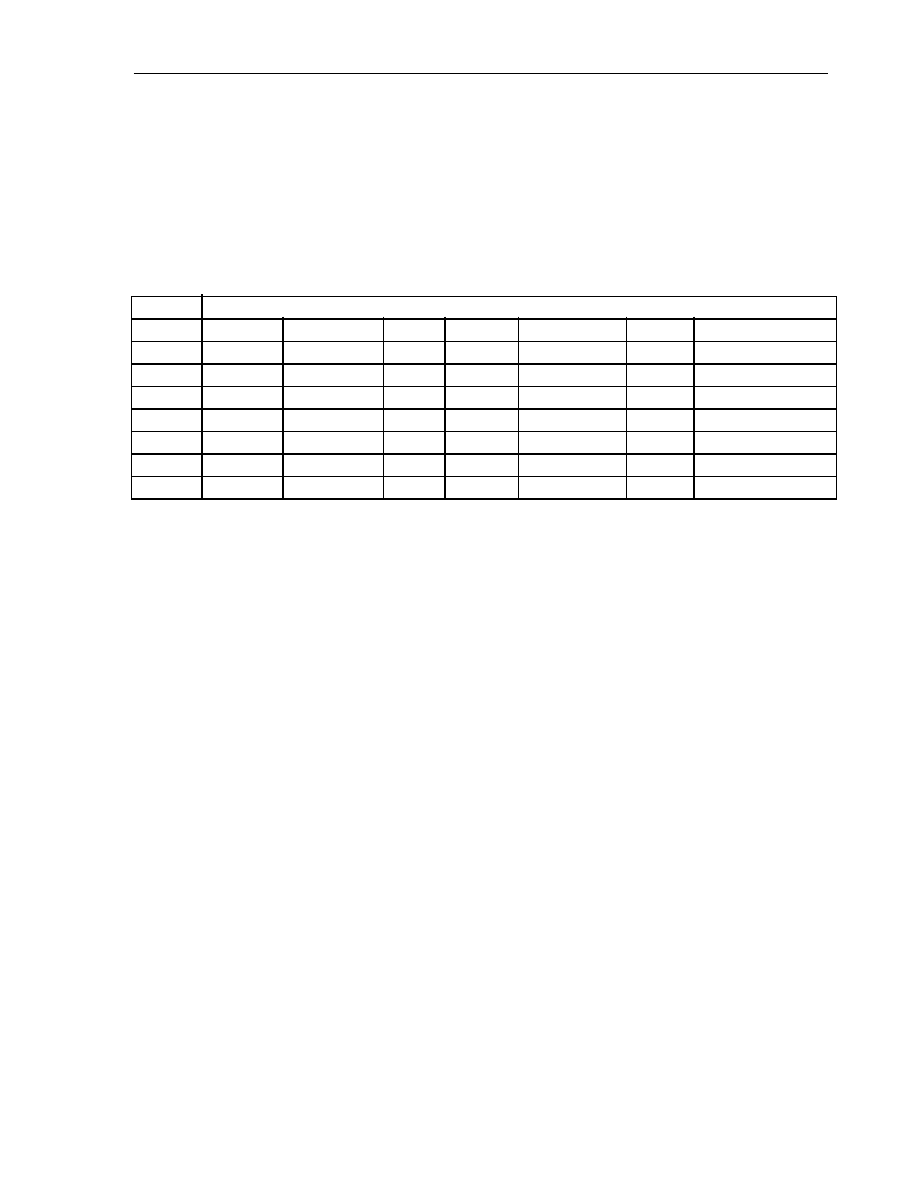
LW/M
117
11
MACEDONIAN
1.2.1.7 The grave accent is used to distinguish the following homonyms:
se
Ÿ / sè ‘everything’ -
se
/ se ‘are, self, ITR’;
ne
Ÿ / nè ‘us’ ACC -
ne
/ ne ‘not';
i
Ÿ / ì ‘her’ DAT –
i
/ i ‘and’.
1.2.2 Consonants
Table 1.3 gives the consonantal phonemic inventory of standard Macedonian. Voiceless consonants
precede voiced.
Table 1.3: Consonantal phonemic inventory
PLACE
TYPE
bilabial
labio-dental
dental
alveolar
alveo-palatal
palatal
velar
stop
p b
t d
k
! g!
k g
fricative
f v
s z
s
# z#
x
affricate
c
Z
c
# Z#
glide
j
lateral
ł
l
nasal
m
n
n
!
trill
r
1.2.2.1 Stops are not aspirated.
1.2.2.2 Consonantal /r/ is trilled not flapped.
1.2.2.3 The phoneme /n/ is velarized to [
N] before /k, g/: banka [baNka] ‘bank’, mangal [maNgal]
‘brazier’. Palatal /n
!/ does not occur initially except in a few loans such as Nju Delhi ‘New Delhi,
Njutn ‘Newton’ (note also vocalic /n/, which is not otherwise permitted).
1.2.2.4 The phoneme /
Z/ is more widespread in the dialects than in the literary language.
Underlying /
Z/ does not occur word finally (cf. 1.2.2.8). Phonemic /Z#/ occurs in the following
contexts: (1) loans: dz
#udz#e ‘dwarf’, budz#et ‘budget’, (2) voicing of underlying /c#/: lidz#ba
‘beauty’ derived from lic
#i ‘suit’, (3) affrication of etymological /z#/, generally before a consonant,
sometimes for expressive effect: dz
#vaka ‘chew’, dz#bara ‘rummage’, dz#gan ‘mob’.
1.2.2.5 The velars /k, g, x/ may be slightly fronted before front vowels, but the norm separates
pairs such as kuka ‘hook’ – PL kuki from kuk
!a ‘house’ – PL kuk!i and laga ‘lie’ – PL lagi ‘lie’
from lag
!a ‘boat’ – PL lag!i (pace de Bray 1980:147). The palatal stops /k!, g!/ vary considerably
both in their position and manner of articulation, although the variation for any individual speaker is
quite narrow (Lunt 1952:13). The prescribed norm is that they are dorso-palatal stops, and this is
native for some speakers (Minissi et al. 1982:22, 30-34). Possible realizations vary from [t’, d’]
(for example, Ohrid speakers of the oldest generation) to [c
!, ΩÚ] to complete merger with /c#, Ω#/ (for
example, Prilep speakers born after 1930, cf. Lunt 1952:13). The velar fricative /x/, which is
rendered by h in standard transliteration and transcription, does not occur natively in the West
Central dialects on which the standard language is based. It has been introduced or retained in
Literary Macedonian under the following circumstances: (1) new foreign words: hotel ‘hotel’, (2)
toponyms: Ohrid, (3) Church Slavonicisms: duh ‘spirit’, (4) new literary words: dohod ‘income’,
(5) disambiguation: hrana ‘food’, rana ‘injury’.
1.2.2.6 The chief exception to the one-to-one correspondence between letters and phonemes is in
the lateral liquids, where Cyrillic <
l
> represents clear /l/ before front vowels and /j/ but velar /
ł/
elsewhere, while <
¬
> is used for clear /l/ before back vowels, consonants, and finally. There is
considerable difference between the prescribed norm and actual pronunciation:
¬ubov/
ljubov

LW/M
117
12
MACEDONIAN
‘love’,
bi¬bi¬
/biljbilj ‘nightingale’, but
bi¬bili
/biljbili ‘nightingales’. An example of a
minimal pair is
bela/
bela [be
ła] ‘white’ F –
be¬a/
belja [bela] ‘trouble’. The contrast between
clear [l] and the sequence [lj] is illustrated by
zele/
zele [zele] ‘took’ 3.PL.LF –
zelje/
zelje
[zelje] ’greens’ COL. Note that in the standard transliteration, which is influenced by Serbo-
Croatian practice, the sequence <lj> can represent both [l] and [lj]. In actual pronunciation, there is a
tendency to pronounce
¬
as [lj] or like the Serbian palatal /l
!/ due to the influence of that language
and of the local Skopje dialect, which also has palatal /l
!/. Thus, for example, the proper name
Liljana/
Liljana is sometimes misspelled
Li¬ana
due to confusion between the norm and
colloquial usage. There is also a tendency among some speakers of the youngest generation to
pronounce
l
as [
ł] in all positions.
1.2.2.7 Geminate /t, d, s, z, l, m, j/ are permitted at some morpheme boundaries, but not if the result
would be more than two consonants: zaben ‘toothed’ – bezzaben ‘toothless’, but zvuc
#en
‘sonorous’ – bezvuc
#en ‘soundless’. Geminates are sometimes eliminated where they could be
permitted: rassali ‘render (fat)’, but sec
#e ‘chop’ I – rasec#e ‘chop up’ P. There are also some
doublets: odade and oddade ‘give up’. Geminate /n/ is avoided: kamenen ‘(made of) stone’, F
kamena. Other geminate sonorants are permitted: najjak ‘strongest’, kalliv ‘muddy’, osummina
‘eight’ M.HUM, also titovveles
#ki ‘(pertaining to) Titov Veles’ M/P.
4
Gemination can be
distinctive: proleta ‘fly by’ – proletta ‘spring’ DEF. (See also 1.2.2.12). Colloquially, consonant
clusters are simplified word finally: radost = [rados] ‘joy’.
1.2.2.8 Distinctively voiced consonants /b, v, d, z,
Z, z#, Z#, g, g!/ are automatically devoiced in final
position and before a voiceless consonant: zob [zop] ‘oats’, DEF zobta [zopta] ‘oats’, zobnik
[zobnik] ‘oat-sack’. Non-distinctively voiced consonants may be finally devoiced, especially in
informal speech. Voiceless consonants are voiced before distinctively voiced consonants: sretne
[sretne] ‘meet’ P, sredba [sredba] ‘meeting’ NN. There is some regressive assimilation of voicing
across word boundaries within a phrase: Jas da si odam = [Jaz da si odam] ‘Let me go’. Final
devoicing of distinctively voiced consonants is never spelled, while regressive assimilation of
voicing or voicelessness is spelled in the results of some suffixal and other morphological
processes, but not in others: Cyrillic <
v
> is never altered, in numerals <
t
> is not altered, <
d
> and
<
g
> are retained before certain voicelesss suffixes, e.g. -ski, -stven, -stvo, as in gradski ‘urban’,
begstvo ‘escape’. The feminine definite article does not alter the spelling of a final voiced
consonant.
1.2.2.8.1 Cyrillic <
v
> is pronounced [f] in the first person plural aorist/imperfect marker, for
example bevme [befme] ‘were’ 1.PL.IM, by analogy with the first singular and second plural as in
bev [bef] ‘was’ 1.SG.IM and bevte [befte] ‘were’ 2.PL.IM. After /s/, /v/ can be pronounced [f]:
svoj [sfoj] ‘one’s own’ M.SG, but tvoj [tfoj] ‘your’ M.SG is substandard, and /v/ is always
pronounced [v] in words like kvasec ‘yeast’, z
#etva ‘harvest’. There is considerable dialectal
variation in this regard, and /v/ remains [v] even after /s/ in the younger generation.
1.2.2.9 The prefixes bez-, iz-, raz- are spelled bes-, is-, ras- before c
#/s# and are pronounced [bes#-,
is
#-, ras#-]. Prefixal s-, z- are pronounced [s#, z#] before /c#, Z#, s#, z#/ (if the result would be [s#s#, z#z#], this is
simplified to /s
#, z#/): rasc
#isti [ras#c#isti] ‘clean up’, izdz#vaka [iz#Z#vaka] ‘chew up’, obess#teti [obes#teti]
‘reimburse’, izz
#ivee [iz#ivee] ‘live through’. Although the devoicing of underlying /z/ in the prefixes
raz-, iz-, bez-, is spelled, the shift to a palatal articulation before a palatal is not.
4
The town's name has been changed back to Veles.

LW/M
117
13
MACEDONIAN
1.3 Prosody
Literary Macedonian has fixed antepenultimate stress (see Franks 1987): vodénic
#ar ‘miller’ SG,
PL vodeníc
#ari, PL-DEF vodenic#árite, but there is considerable variation in the dialects and in
colloquial speech. Exceptions in standard Macedonian can be classed as lexical, usually unadapted
loanwords or suffixes, and phrasal, usually from an expanded word boundary, that is
antepenultimate stress within a phrasal (accentual) unit.
1.3.1 Lexical Exceptions
Lexical exceptions only permit penultimate or final stress. Some are idiosyncratic: eptén
‘completely’. Others result from contraction: the verbal adverb suffix -ájk
!i, -éjk!i < -áek!i, -éek!i,
sabájle < sabah ile ‘in the morning’ (Turkish). A number of productive derivational morphemes
have penultimate or final stress, e.g. verbal-íra- , nominal -íst, (M) -ístka (F). Due to lexical
exceptions, stress can be distinctive: kraváta ‘necktie’ but krávata ‘cow’ DEF. Note also the
following type of minimal pair, originally due to contraction: letóvo ‘this summer’ ADV, godináva
‘this year’ ADV versus létovo ‘this summer’ NN.DEF.PX, godínava ‘this year’ NN.DEF.PX
There is also a strong tendency among some speakers to violate the antepenultimate stress rule in
foreign words regardless of the prescribed norm, e.g. Kana
!da for Ka!nada ‘Canada’, sendvíc# for
se
!ndvic# ‘sandwich’. The norm also permits some variation, e.g. bálet or balét ‘ballet’.
1.3.2 Phrasal Exceptions
Phrasal exceptions can have stress more than three syllables from the end of the unit:
noséjk
!i_mu_go ‘while carrying it to him’. Many accentual units prescribed in normative grammars
are now considered localisms or dialectisms by educated Macedonians, especially in the younger
generations. This is due to the influence of the Skopje dialect (and Serbian) on the literary language
combined with apparent resistance on the part of speakers from outside the Western area to adopt
these specifically Western types of pronunciation. Thus, prescribed pronunciations such as
Evé_ti_go (as opposed to E
Úve_ti_go) ‘Here he/it is for you’ are now considered Western
regionalisms rather than literary pronunciations. Even in those areas where accentual units are
native, it seems that the educated younger generation tends to avoid them. Certain shifts occur
regularly, however, especially with negated and interrogated mono- and disyllabic verbs: Né_znam
‘I don’t know’ S
‹tó!_sakas#? ‘What do you want?’ Shifts onto monosyllabic prepositions with
pronouns is also regular: só_mene ‘with me’.

LW/M
117
14
MACEDONIAN
1.4 Morphophonemic Alternations
1.4.1 Velar with Palatal
Velar with palatal: /k/ ~ /c
#/, /g/ ~ /z#/, /x/ ~ /s#/ (also /c/ from etymological /k/ ~ /c#/ and /v/ from
etymological /x/ ~ /s
#/). These are productive in some nominal derivations: grev ‘sin’, gres
#ka
‘mistake’; glupak ‘fool’ M, glupac
#ka ‘fool’ F; gramatika ‘grammar’, gramatic#ki ‘grammatical’.
They also occur in the vocative: bog ‘god’, VOC boz
#e; Vlav ‘Vlah (Aromanian)’, VOC Vlas#e;
volk ‘wolf’, VOC volc
#e; starec ‘old man’, VOC starc#e. Two plurals also show the alternation: oko
‘eye’, PL oc
#i; uvo ‘ear’, PL us#i. In verbs, the alternation is reflected in both conjugation and
derivation but is not productive: rec
#e ‘say’, 1.SG.AO rekov; potstriz#i ‘trim’, 1.SG.AO potstrigov;
P izvlec
#e ‘drag’, I izvlekuva.
1.4.2 Velar with Dental
Velar with dental: /k/ ~ /c/, /g/ ~ /z/, /x/ ~ /s/. In nouns, the morphophonemic alternation is
productive in the masculine plural: parking ‘parking space’, PL parkinzi, uspeh ‘success’, PL
uspesi. Nouns ending in -a do not have the alternation except, vladika ‘bishop’, PL vladici (as
opoosed to, for example, motika ‘hoe’, PL motiki). This alternation applies to v (from etymological
x) only in two items: Vlav ‘Vlah (Aromanian)’, PL Vlasi, and siromav ‘pauper’, PL siromasi.
There are also two feminine plurals (etymologically duals) with the alternation: raka ‘hand’ PL
race, noga ‘leg’, PL noze. In verbs, the alternation occurs only in two stems, namely -lez- ‘go’ and
molz- ‘milk’ show /g/ in the aorist stem: vleze ‘enter’, 1.SG.AO vlegov, molze ‘milk’, 1.SG.AO
(iz)molgov. Younger speakers now have (iz)molzev (identical with the IM).
1.4.3 Dental or Velar with Palatal
Dental or velar with palatal: /t, k/ ~ /k
!/, /d, g/ ~ /g!/, /ł/ ~ /l/, /n/ ~ /n!/, /st/ ~ /s#t/ (verbs only). In verbal
derivation, the imperfectivizing suffixes {-(j)a} and {-(j)ava} condition these alternations but are
limited to a few lexical items. Many verbs originally prescribed or at least accepted with /-(j)ava/
have been replaced by corresponding forms with /-uva/ in educated practice: P fati, I fak
!a ‘grab,
get’, P rodi, I rag
!a ‘give birth’, gosti (biaspectual), I gos#tava ‘treat’ (now archaic, replaced by
(na)gostuva), P meni, I menjava ‘exchange’ (now replaced by menuva). The collective suffixes
{-je} and {-ja} condition these alternations in nouns: rabota ‘work’, COL rabok
!e; livada, COL
livag
!e ‘meadow’; godina ‘year’, COL godinje. Alternations of dental with dorso-palatal stops are
facultative in monosyllabics: prat ‘twig’, COL pratje~prak
!e; grad ‘town’, COL gradje~grag!e; rid
‘hill’, COL ridje~ridje. Note that the specific collective forms produced by these suffixes differ
among themselves in use and meaning, but this is irrelevant to morphophonemic alternations.
1.4.4 Cluster Simplification
Simplifications of clusters of the type fricative plus stop plus consonant to fricative plus consonant
occur in certain feminine definite nouns, collective plurals, masculine definite and (in the same
lexical items) all non-masculine adjectives with vowel~zero alternations (see 1.4.7), and rarely in the
aorist stem of verbs: {radost + ta} gives radosta ‘joy’ DEF, {list + je} gives lisje ‘leaves’ COL,
similarly grozd ‘grape’, COL grozje, {mest- + na} gives mesna’ ‘local’ F, postele ‘spread’ has
3.SG.AO posla.

LW/M
117
15
MACEDONIAN
1.4.5 Dissimilation with -c
#e
The addition of the diminutive suffix {-c
#e} causes a dissimilation peculiar to Macedonian: /g, s, z, s#,
z
#, st, sk, s#k, zd/ (in principle also /zg, z#g/ but the few such nouns take different diminutive suffixes)
all become {v}, pronounced [f], before {-c
#e}, for example voz ‘train’ and vos
#ka ‘louse’ both give
DIM vovc
#e; similarly noz# ‘knife’ and noga ‘leg’ give DIM novc#e, grozd ‘nail’ and gros# ‘penny’
give DIM grovc
#e, guska ‘goose’and gus#a ‘throat’ give DIM guvc#e, gluz#d ‘ankle’ and glus#ec
‘mouse’ give DIM gluvc
#e; other examples are klas ‘ear (grain)’, DIM klavc#e, list ‘leaf’, DIM
livc
#e, maska ‘mule’, DIM mavc#e, kniga ‘book’, DIM knivc#e. However, glasc#e ‘voice’ DIM is
prescribed for glas to avoid homonymy with glavc
#e ‘head’ DIM from glava. Other consonants
simply drop before this suffix, although /j/ can also be retained as /i/ or, by analogy, it can also be
replaced by /v/: s
#amija ‘scarf’ DIM s#amic#e is prescribed but s#amivc#e and s#amiic#e also occur, the
same is true of other nouns in /-ija/, most of them of Turkish origin.
1.4.6 Progressive Voicing Assimilation
The progressive devoicing of /
Z#/ to /c#/ in the suffix /-Z#ija/ (FEM /-Z#ika/) constitutes a
morphophonemic alternation in Macedonian whose origin is an automatic alternation in Turkish,
e.g., sladoletc
#ija ‘ice-cream seller’ from sladoled = [sladolet] ‘ice-cream’ (see 2.1.5.6).
1.4.7 Isolated Consonantal Alternations
Isolated consonantal alternations: dete ‘child ‘ PL deca, (also DIM detence PL dec
#inja), Turc#in
‘Turk’, PL Turci, pes ‘dog’, PL pci.
1.4.8 Vowel~Zero Alernations
Vowel~zero alternations occur in masculine definite and both definite and indefinite non-masculine
adjectives, in plural nouns, the vocative, and in verbal conjugation (aorist stem, non-masculine verbal
l-form) and derivation (perfective). High vowels do not participate in this alternation except in the
word ogin ‘fire’ PL ognovi (DEF oginot and variant ogan DEF ognot).
5
Some masculine
substantival suffixes show the alternation in both the definite and plural, others only in the plural,
and some substantives permit variation, e.g. realízam ‘realism’ DEF realízmot, PL realízmi but
starec ‘old man’ (< star ‘old’) DEF starecot, PL starci, VOC starc
#e, veter ‘wind’ DEF vetrot or
vetar DEF vetarot PL vetrovi. The most common adjectival suffixes involved are /-en/ and /-ok/
(the unspecified citation form for adjectives is the masculine). Other phonotactic and orthographic
rules also apply: nizok ‘low’, F niska; mesten ‘local’, N mesno; dostoen ‘worthy’, M.DEF
dostojniot. The relevant noun suffixes are /-en/, /-el/, /-ol/, /-ot/, /-ok/: kamen ‘stone’, PL kamni (but
now replaced by COL kamenja); jazel ‘knot’, PL jazli; sokol, PL sokli also sokoli ‘falcon’; nokot
‘(finger/toe)nail’, PL nokti; predok ‘ancestor’, PL predci. Note fleeting vowels in lexical items
such as den ‘day’, PL dni. Note also that vowel~zero alternation is not predictable from surface
shape, e.g. drven~drvna ‘pertaining to wood’ M~F, drven~drvena ‘wooden’ M~F. The
alternation is highly limited in verbs (classes 3c, 3d, 3g, see 2.5.1.2.2), e.g., bere ‘gather’, 2.SG.AO
-bra; AO.M.LF rekol ‘said’, F rekla; P umre ‘die’, I umira.
5
Note that the form ognevi is not sanctioned in Tos
#ev (1970) or Koneski (1999), pace Mares# (1994:22).

LW/M
117
16
MACEDONIAN
1.4.9 Vocalic Alternations
Remnants of etymological length alternations occur in verbal derivation (perfective becoming
imperfective): P rodi ‘give birth’, I rag
!a; P sobere ‘gather’, I sobira; but P zatvori ‘close’, I
zatvora.

LW/M
117
17
MACEDONIAN
2 Morphology
2.1 Nouns
2.1.1 Gender
The gender opposition masculine-feminine-neuter exists only in the singular. It is neutralized in the
plural, except for a highly restricted distinction in qunatified plurals (see 2.4.2). Masculine nouns
(kinship terms, hypocorisms, pejoratives, or recent loans) can end in any vowel, in which case they
are animate, usually human; such nouns in a high vowel are all recent loans: sluga ‘servant’, tatko
‘father’, atas
#e ‘attaché’, dendi ‘dandy’, guru ‘guru’. The names of the months that end in -i are
masculine: juni ‘June’. Most nouns ending in a consonant are masculine, a few are feminine, and
some vacillate. All other nouns in a vowel are feminine if they end in -a or refer to a female being,
e.g. Bosanskata ledi ‘the Bosnian lady’, otherwise they are neuter. Some recent loans such as viski
‘whiskey’ show hesitation between masculine and neuter, although prescriptively they are neuter.
Neuter gender can refer to animate beings:
Lic
#noto
momc
#e
dos
#lo
handsome-N.DEF
lad
came-N.LF
‘The handsome lad has come’
Ubavoto
devojc
#e
dos
#lo
beautiful-N.DEF
girl
came-N.LF
‘The beautiful girl has come’
Feminine nouns can be used expressively to refer to males as in the following example, where the
referent is bradata ‘the beard’ used as the nickname of a man:
i
koga
ovaa
ides
#e
v o
Veprc
#ani
and
when
this-F
came-3.SG.IM
i n
V.
‘and when he (literally ‘this one’ F) came to Veprc
#ani’
Since animacy is distinguished by the use of special quantifiers for some male humans and mixed
groups (see 2.4.2) and the rare oblique forms are limited to nouns denoting male humans (see
2.1.4.1), one can describe Macedonian as having virile or animate gender distinctions.

LW/M
117
18
MACEDONIAN
2.1.2 Number
Macedonian plural formation is based on a combination of form and gender. Most nouns ending in
a consonant add -i, but masculine nouns with the singulative suffix -in drop that suffix in the plural.
The vowel of the singular drops before the ending of the plural unless it is stressed. The majority of
masculine and feminine nouns take -i, most neuters take -a. Most monosyllabic masculines,
including new loanwords, take -ovi, e.g. sin ‘son’ PL sinovi, fri-s
#op ‘duty free shop’ PL fri-s#opovi
(note that the element fri- is treated as an uninflecting modifier). There are about ten exceptions that
take -i and ten more that vacillate between the two possibilities. A few monosyllabic nouns in -j or a
palatal can take -evi, e.g. kraj ‘region’ PL kraevi (also krais
#ta) noz# ‘knife’ PL noz#evi or noz#ovi,
and this suffix has spread by analogy to a few other nouns, all ending in dentals, e.g. kurs ‘course’
PL kursevi. Masculines in unstressed -o, -e add -vci: tatko ‘father’, PL tatkovci.
6
Neuters in
unstressed -e not preceded by -c, -s
#t, -i, -j take -inja. This same suffix pluralizes nouns in -ce with
a diminutive meaning (but diminutives in -ence have PL -enca). Some neuter loans in stressed -é
take -inja, in which case the stress becomes antepenultimate. Other loans in stressed -é normally
add -a, but the use of -inja is spreading. Occasionally plural formation is influenced by the
collective: pat means both ‘road’ and ‘time’, but the regular plural pati means ‘times’ while the
collective patis
#ta is the normal plural meaning ‘roads’. Because the vocative and oblique forms (see
2.1.4) are marginal, facultative phenomena, it is misleading to present them together with plural
formation as a reduced declensional paradigm.
Table 2.1 Examples of Plural Formation
MASCULINES
grad
zab
pat
den
prsten
Srbin
kolega
c
#ic#o
gradovi
zabi
pati/patis
#ta
dni/denovi
prsteni
Srbi
kolegi
c
#ic#ovci
‘town’
‘tooth’
‘time/way’
‘day’
‘ring’
‘Serb’
‘colleague’
‘uncle’
FEMININES
z
#ena
c
#est
ledi
z
#eni
c
#esti
ledi
‘woman’
‘honor’
‘lady’
NEUTERS
mesto
srce
uc
#enje
seme
nivó
taksí
klis
#é
mesta
srca
uc
#enja
seminja
nivóa
taksíja
klis
#éa/klís#inja
‘place’
‘heart’
‘study’
‘seed’
‘level’
‘taxi cab’
‘cliché’
2.1.2.1 Exceptions. Morphonemic alternations in plural formation are treated in 1.4.1, 1.4.2, 1.4.6,
1.4.7, 1.4.8. The chief remaining exceptions are all masculine and neuter: s
#ura ‘wife’s brother’, PL
s
#urevi, domak!in ‘master of the house’, PL domak!ini, brat ‘brother’, PL brak!a, c#ovek ‘person’, PL
lug
!e ‘people’, z#ivotno ‘animal’, PL z#ivotni, ramo ‘shoulder’, PL ramena, nebo ‘sky’, PL nebesa.
2.1.2.2 Collectives. Nouns of all genders can form collective plurals in {-je}, although these forms
are fairly restricted in Literary Macedonian usage (see 1.4.3, 1.4.4 on morphophonemic
alternations). At one time these collectives could form a plural in {-ja}, but this is now merely a
competing variant (Koneski 1967:224, pace Lunt 1952:31, de Bray 1980:170-71). Some nouns
6
The suffix -(o/e)vci can be added to any masculine proper name to mean 'the family of...', e.g. Jordan gives
Jordanovci, Metodija gives Metodievci, Blaz
#e gives Blaz#evci, Boz#o gives Boz#ovci.

LW/M
117
19
MACEDONIAN
form collective plurals with -is
#ta, which is homonymous with the plural of the augmentative
pejorative suffix (see 2.1.5.5). Collectives have singular morphology and plural agreement, e.g. svet
‘light, world’ in the meaning ‘people’, lisje ‘leaves’:
Videte
g i
svetot
s
#to
s i
ja
gledaat
rabotata
see-2.PL.IV
them-ACC
people-DEF
that
self-DAT
it-F.ACC
watch-3.PL.PR work-DEF
‘Look at the people who mind their own business’ (Lunt 1952:26; folk expression)
Lisjeto
se
vek
!e
poz
#olteni
leaf-COL.DEF
are-3.PL.PR
already
yellowed-PL
‘The leaves are already yellowed’
The singular of non-human animates can function as a kind of collective, e.g. odi po riba ‘go after
(hunt) fish’ but odi po z
#eni ‘go after (chase) women’.
2.1.2.3 Quantitative plurals. Non-personal masculine nouns (and a few personal ones) also have a
quantitative plural: -a. This suffix does not cause vowel~zero alternation: den ‘day’, PL dni and
denovi, dva dena ‘two days’ (see 2.4.2).
2.1.2.4 Pluralia tantum: alis
#ta ‘clothes’, bec#vi ‘trousers’ (archaic), gak!i ‘underpants, shorts’, gradi
‘chest’, jasli ‘manger’, nogari ‘leggings’, nok
!vi ‘bread-trough’, oc#ila ‘glasses’, plek!i ‘shoulders’,
s
#alvari ‘pantaloons’.

LW/M
117
20
MACEDONIAN
2.1.3 Definiteness
Definiteness (see also sections 3.4 and 3.7). Macedonian is the only Slavic literary language with a
tripartite distinction mirroring the same distinction in demonstratives, viz. unmarked {-t-} proximate
{-v-}, distal {-n-}. Tradition treats the articles as affixes, but they are sometimes analyzed as clitics,
which is their etymological origin. This origin is reflected in the inconsistency with which the
masculine definite article triggers vowel~zero alternations in substantives (see 1.4.7). Lunt
(1952:41) equivocates: “They are enclitics and can be termed suffixes.” The article attaches to the
end of the first nominal in the noun phrase, that is nouns, adjectives, pronouns, numerals, but not
adverbs:
ne
mnogu
postarite
deca
not
much
older-DEF
children-PL
‘the not much older childern’ = ‘the children that are not much older’
edna
od
mnogute
nas
#i
zadac
#i
one
from
many-DEF
our-PL
problems-PL
‘one of our many problems’
A noun phrase modified by a demonstrative does not take a definite article according to the norm,
but does so in substandard speech: ovie decava ‘these here children’. Proximal and distal articles,
which are difficult to translate into English, do not always refer to literal location, as can be seen
from the following colloquial example:
Edno
rakivc
#e
k
!e
mu
dades
#
na
prijatelov
od
nas
#ana
v o frizerov
one-N brandy-DIM EX
him-DAT give-2.SG.PR t o
friend-DEF.PX from
our-DEF.DS
i n
freezer-DEF.PX
‘Give a little glass of brandy to our friend here, from that stuff of ours, in the freezer here’
In this example, the freezer marked by the proximal article and the ‘our stuff’ marked by the distal
article are physically equidistant from the speaker (although the brandy is inside the freezer). The
choice is determined by other factors such as speaker attitude or the fact that the brandy in the
freezer is taken from a larger whole (insofar as there are other bottles not in the freezer) or
temporally distant (insofar as it was distilled at some earlier date). Although the proximal article is
often used literally, e.g. Vo pismovo se vkluc
#uva... ‘In this letter is included...', the distal article
often has an affective value. Long-time residents of Skopje refer to the landmark old stone bridge in
the center of town as moston ‘that bridge’, while a spouse who does not get along with his/her
partner might refer to her/him as z
#enana/maz#on ‘that woman[wife]/man[husband]’. The numeral
eden ‘one’ functions with the meaning of an indefinite article denoting specificity and can even
trigger object reduplication, especially colloquially (see 3.7 and Naylor 1989).
2.1.3.1 The shape of the definite article is based primarily on form, with some regard for gender
and number. In the singular, masculines in a consonant take -ot, feminines in a consonant and all
nouns in -a take -ta (a resulting -tt- simplifies to -t if preceded by a consonant), all remaining
singulars (and collectives, including lug
!e ‘people’) take -to. In the plural, nouns in -a take -ta, and
all other plurals take -te. The addition of a definite article does not trigger vowel~zero alternation
(1.4.7) as seen in the following paradigm of ‘old man’: SG starec, DEF SG starecot, PL starci,
DEF PL starcite. Table 2.2, based on Table 2.1 and its exposition, illustrates the forms.

LW/M
117
21
MACEDONIAN
Table 2.2: Definite Singulars and Plurals
gradot
c
#esta
z
#enata
mestoto
semeto
c
#ic#oto
taksito
gradovite
c
#estite
z
#enite
mestata
seminjata
c
#ic#ovcite
taksijata
‘town’
‘honor’
‘woman’
‘place’
‘seed’
‘father’
‘taxi’

LW/M
117
22
MACEDONIAN
2.1.4 Case
The maximum possible differentiation in the noun is nominative/oblique/vocative, and this only in
certain male proper names and kinship terms. The vocative forms occur in some other masculine
and feminine nouns. There is a tendency to eliminate non-nominative forms, which are always
optional. Some masculine adjectives have a facultative vocative that is identical to the indefinite
plural
(see 2.2.1). In the
pronoun,
the maximum possible
differentiation is
nominative/accusative/dative. All other cases that occurred in earlier stages of the language have
been replaced by prepositional or other syntactic constructions, although a few frozen forms survive
as lexical items, e.g. zbogum ‘farewell, adieu’ (from older s Bog-om ‘with God-instrumental.case’)
2.1.4.1 The oblique form is a Westernism accepted into Literary Macedonian. It is always
facultative and is limited to masculine proper and family names, kinship terms ending in a
consonant, -i, -o, or -e, and the nouns c
#ovek ‘person’, bog ‘god’, g!avol ‘devil’, and gospod
‘lord’. Nouns in a consonant, -o, or -i take -a, nouns in -e add -ta: brat ‘brother’ OBL brata,
tatko ‘father’, OBL tatka, Dragi, OBL Dragija, Goce, OBL Goceta. The use of oblique forms for
names of domestic animals is now considered dialectal. These forms can occur wherever an oblique
pronoun would occur:
Go
vidov
Ivana
him-ACC
saw-1.SG.AO
Ivan-OBL
‘I saw Ivan’
Mu
rekov
na
Ivana
pred
Goceta
him-DAT
said-1.SG.AO
t o
Ivan-OBL
before
Goce-OBL
‘I said to Ivan in front of Goce’
Ene
g o
Dragija
behold
him-ACC
Dragi-OBL
‘There’s Dragi!’
Toj
s i
otide
nakaj
Panka
Biserina
he
self-DAT
went-3.SG.AO
t o
Panko-OBL
Biserin-OBL
‘He went to Panko Biserin’s’

LW/M
117
23
MACEDONIAN
but also
Zemjata
na
Panka
Biserin
land-DEF
of
Panko-PBL
Biserin-NOM
‘The land of Panko Biserin’
2.1.4.2 The vocative is limited almost entirely to the masculine and feminine singular. The
following have no vocative form: masculine nouns in -c, -o, -e; masculine proper names in -a, -i, -k,
-g, feminine nouns in a consonant and hypocorisms in -e, -i (Lile, Viki). Nouns in -dz
#ija drop the
-ja (see 2.1.4.6). Feminines in -ka and -ica take -e while according to the norm other feminines take
-o: Stanka, VOC Stanke, sestra ‘sister’, VOC sestro. Note that for majka ‘mother’ and tetka
‘aunt’, vocatives in -o are normal while those in -e are hypcoristic. Also svak
!a ‘in-law’ and popag!a
‘priest’s wife’ take -e. The normative generalization for masculines is that monosyllabics take -u
and polysyllabics take -e, although there are exceptions and vacillations (c
#ovek ‘person’ VOC
c
#oveku/c#ovec#e, brat ‘brother’ bratu (kinship)/brate (generalized familiar). Note also pop ‘priest’
VOC pope, kum ‘godfather’ VOC kume, (vs dzver ‘beast’ VOC dzveru). The neuter plural deca
‘children’ has a vocative deco. The vocative is facultative, and there is an increasing tendency to
avoid it because it is felt to be rude, humorous, or dialectal; this is especially true of the vocative
marker -o. Thus, for example, the name Liljana does not form a vocative *Liljano in the literary
language. To the extent that the vocative is preserved, the tendency is to generalize -u for masculines
and -e, which has hypocoristic overtones, for feminines. (See 1.4.1 on morphophonemic
alternations in the vocative.)
2.1.5 Noun Derivation
2.1.5.1 The suffix /-n
!e/ derives concrete deverbal nouns from imperfectives (but see 2.1.5.6); /-nie/
derives abstractions from perfective verbs; /-ba/ is permitted with either aspect and either meaning:
samoopredeluvanje ‘an act of self-determining’, samoopredelba ‘self-determination’, res
#avanje ‘
an act of deciding’, res
#enie ‘decision’, cf. also sredba ‘meeting’, pras#anje ‘question’. The relative
productivity of these suffixes can be seen in Milic
#ik! (1967): approximately 8, 500 entries with -nje,
220 with -ba, and 150 with -nie. Other suffixes for deverbal nouns are -Ø or -a, -ac
#ka ( circa 275
total including both abstract nouns and feminine actors), -ez
# (circa 75), -stvo (circa 600 items), -ka:
vleze ‘enter’ gives vlez ‘entry’, nameri ‘intend’ gives namera ‘intention’, jade ‘eat’ gives jadac
#ka
‘food’, prdi ‘fart’ V gives prdez
# ‘fart’ NN, bakne ‘kiss’ V gives baknez# ‘kiss’ NN, izraboti
‘produce’ gives izrabotka ‘production’, predava ‘betray’ gives predavstvo ‘betrayal’. The suffix -
stvo (-s
#tvo when combining with a velar stem, which will lose the velar) can also be used to derive
abstract nouns from other parts of speech: car ‘king’ gives carstvo ‘kingdom’, bogat ‘rich’ gives
bogatstvo ‘wealth’, junak ‘hero’ gives junas
#tvo ‘heroism’.
2.1.5.2 The masculine agentive suffixes /-ar/, /-ac
#/, and /-tel/, all add /-ka/ to form the feminine
whereas /-ec/ and /-nik/ have the feminine forms /-ica/ and /-nica/. The suffixes /-ec/, /-ka/, /-ica/ are
sometimes extended by /-al-/ or /-av-/. The verb vraz
#a ‘perform sorcery, tell fortunes’ provides
examples of many of these suffixes in Koneski (1967), according to which they are synonymous in
the case of this particular verbal base all meaning ‘sorcerer’ and ‘sorceress’: vraz
#ar, vraz#ac#,
vraz
#alec, vraz#arka, vraz#ac#ka, vraz#alka, vraz#alica; cf. aslo predava ‘betray’, predavnik -
predavnica ‘traitor’ M - F; with deverbal adjectives to indicate patient: from zatvori ‘imprison’ the
adjective zatvoren ‘imprisoned’ gives zatvorenik - zatvorenica ‘prisoner’ M - F. Inanimates also
have the suffix /-lo/: lepi ‘stick’ lepilo ‘glue’.

LW/M
117
24
MACEDONIAN
2.1.5.3 Although the suffix /-ac
#/ was recommended by codifiers over /-tel/ in Literary Macedonian,
actual usage varies. Thus, for example, gledac
#(ka) ‘viewer’ but slus#atel(ka) ‘listener’. The word
slus
#ac# is used for inanimate objects as well as animate agents, i.e. ‘listening device’ as well as
‘auditor’. There is also slus
#alka which means ‘stethoscope, telephone receiver, earphone’. Of the
other suffixes used with verbs, one of the more productive is /-is
#te/ meaning ‘place’, e.g. c
#ekalis#te
‘place where one waits’, lovis
#te ‘hunting site’.
2.1.5.4 For deadjectival nouns, the main suffixes are /-ec/, /-ica/, /-(n)ik/, /-(j)ak/, /-(j)ac
#ka/, /-ina/,
/stvo/, /-ost/, /-ez
#/: ubavec ‘handsome one’ M, ubavica ‘beautiful one’ F, ubavina ‘beauty’. Many
of these same deverbal and deadjectival suffixes can derive nouns from other nouns: svinja ‘swine’,
svinjar(ka) ‘swineherd’ M (F), svinjarnik or svinjarnica ‘pigsty’, svinjarstvo ‘hog raising’,
svins
#tina ‘swinishness’.
2.1.5.5 Diminutives apply to all three genders: brat ‘brother’, DIM brate, bratle, bratc
#e, bratence,
bratec, bratule, bratok; kniga ‘book, sheet of paper (arch.)’, DIM kniz
#e, kniz#ica, knivc#e, knis#ka,
kniz
#ule; moma ‘maid’, DIM momic#ka, momic#e, momic#ence; meso ‘meat’, DIM mevce, dete
‘child’, DIM detence, sonce ‘sun’, DIM soncule (see also 1.4.5, 2.1.2, 2.2.4.5, 2.5.3.5). The
augmentative suffix is neuter /-is
#te/:
Mu
svikalo
z
#enis#teto
him-DAT
yelled-N
woman-AUG
‘His shrewish wife yelled at him’
The chief pejorative suffixes are all neuter in appearance but agree with real gender if they refer to
animate beings: /-ko/, /-(a)-lo/, /-le/: moc
# ‘urine’, moc#ko and moc#lo ‘little squirt’, moc#alo ‘organ of
urination’ (colloquial), nos ‘nose’, gives nosle ‘snout’, rilo ‘jowl’ gives rilc
#e, rilc#o ‘jowly
person’.
2.1.5.6 There are also three derivational suffixes of Turkish origin that are still productive with
nouns (pace Koneski 1967:288): /-dz
#ija/ (FEM /-dz#ika/; (/Z#/ > /c#/ after voiceless consonants due to
Turkish rules for voicing assimilation) meaning ‘someone who does something regularly’ (about
250 items), /-lak/ for abstract nouns (about 200 items), and /-ána/ for nouns of location (about 50
items). These suffixes are used in common words of Turkish origin: jabandz
#ija ‘foreigner’,
javas
#lak ‘slowness’ (pejorative), meana ‘tavern’ (archaic). They are productive with Slavic roots:
lovdz
#ija ‘hunter’, vojniklak ‘army service’ (colloquial), pilana ‘saw mill’. They remain productive
in recent loanwords, although frequently with pejorative or ironic overtones: fudbaldz
#ija ‘(inept)
soccer-player’, asistentlak ‘assistantship’ (ironic), hidroelektrana ‘hydroelectric power station’
(colloquial but neutral). The fate of these suffixes reflects the fate of Turkisms in general. They
remain vital and producitve but colloquial and in many cases stylistically shifted downward to the
informal or the ironic. This stylistic shift has been reversed for some Turkisms since 1991,
especially in the press, where many such words now occur in formal contexts. This trend is a result
of an ideological equation between democratization and colloquialization (see Friedman 1998).
There are also a few derivational affixes of more recent foreign origin: /-íst/ ‘-ist’, /-ízam/ ‘-ism’.
2.1.5.7 Compounding with the linking vowel /-o-/ is still productive: zemjotres ‘earthquake’ (=
zemj-a ‘earth’ + tres ‘shake’), zemjodelec ‘farmer’ (= zemj-a ‘earth’ + del-ec ‘do-er’), minofrlac
#
‘mine-thrower’ (= mina ‘mine’; + frl-ac
# throw-er’). The Turkish type of compound lacks a
linking vowel: tutunk
!ese ‘tobacco pouch’ (= tutun ‘tobacco’ k!ese ‘sack’). There are also native
formations without linking vowels, although these generally use disparate parts of speech: adverb +
noun domazet ‘son-in-law who lives with his wife’s parents’ (= doma ‘at home’ + zet ‘son-in-

LW/M
117
25
MACEDONIAN
law’), adjective + noun Ilinden ‘St. Elijah’s day’ (= Ilin ‘Elijah’s’ + den ‘day’), imperative +
noun zajdisonce ‘sunset’ (= zajdi ‘go down!’ + sonce ‘sun’).
2.1.5.8 Noun prefixation is limited and marginal. The border between suffixation and
compounding is clear (suffixes do not possess independent lexical meaning and never stand alone),
but the border between prefixation and compounding is hazy. Many items functioning prefixally
also function as independent words: samo- ‘self-‘ as in samopridones ‘voluntary contribution’
also functions as an independent adjective sam(o) ‘oneself’ (N). Other prefixal items are capable
of standing alone: anti- ‘anti-’ can be used predicatively to mean ‘against’ or ‘opposed’. Some
prefixes such as pra- ‘proto-, great-’ are capable of being repeated: prapradedo ‘great-great-
grandfather’.
2.1.5.9 Acronyms such as SAD (pronounced [sat] from Soedinenite Amerikanski Drz
#avi ‘United
American States’) ‘U.S.A.' also occur, but are not as important as the various processes already
discussed thus far.

LW/M
117
26
MACEDONIAN
2.2 Adjectives
2.2.1 Gender/Number
Most adjectives inflect for gender and number. A few inflect only for number and some do not
inflect at all; these last two types are all of Turkish or more recent foreign origin. Most masculines
end in a consonant, a few end in /-i/, feminines all end in /-a/, neuters normally end in /-o/, a very
few — all possessive — end in /-e/, plurals all end in /-i/. Masculines in /-i/ include derived
adjectives in /-sk-/, some toponymic, anthroponymic and other lexicalized expressions, e.g. dolen
‘lower’ but Dolni Saraj ‘Lower Saraj’ (a neighbourhood in Ohrid), premudar ‘extremely wise’
premudri Solomon ‘Solomon the most wise’ toj pusti/kutri...'that wretched...', also nivni ‘their’
(but also niven according to Koneski 1999), and a few ordinal numerals (see 2.4). A few adjectives
also have an optional masculine vocative in /-i/, e.g. drag ‘dear’, dragi moj ‘my dear!’, poc
#ituvan
‘respected’ Poc
#ituvani Profesore ‘Dear Professor’ (opening for a semi-formal letter). Table 2.3
illustrates the possibilities for indefinite adjectves:
Table 2.3: Adjectives
type
M-Ø
M-i
N-e
number only
uninflecting
M
nov
makedonski
ptic
#ji
kasmetlija
fer / taze
F
nova
makedonska
ptic
#ja
kasmetlija
fer / taze
N
novo
makedonsko
ptic
#je
kasmetlija
fer / taze
PL
novi
makedonski
ptic
#ji
kasmetlii
fer / taze
‘new’
‘Macedonian’
‘bird’s’
‘lucky’
‘impartial’ / ‘fresh’

LW/M
117
27
MACEDONIAN
2.2.2 Definiteness
The definite article in masculine adjectives is /-ot/ (/-i-/ is inserted before /-ot/ if the adjective ends in
a consonant); feminines add /-ta/, neuters /-to/, plurals /-te/. The article can trigger vowel~zero
alternation, e.g. dobar ‘good’ M dobriot ‘good’ M.DEF. For the proximate and distal articles /-v-/
and /-n-/, respectively, are substituted for /-t-/, e.g. noviot zab ‘the new tooth’, noviov zab ‘the new
tooth here’, novine zabi ‘the new teeth there’.
2.2.3 Gradation
Comparison is entirely analytic. The comparative marker is /po-/, the superlative /naj-/ written
unseparated from the adjective: ponov ‘newer’ M, najnov ‘newest’. The only irregular comparative
is mnogu ‘much, many’, povek
!e ‘more’, najmnogu ‘most’ (najpovek!e is no longer literary; note:
povek
!eto ‘the majority’). The comparative and superlative markers can also be added to nouns,
verbs, and adverbial phrases: prijatel ‘friend’, poprijatel ‘more of a friend’ na jug ‘to/in the south’,
ponajug ‘more southerly’ ne saka ‘dislike’, najnesaka ‘dislike the most’. If there are proclitic
object pronouns attached to such a verb, however, then each morpheme is spelled as a separate
word: naj ne go saka ‘he dislikes him the most’.
2.2.4 Adjective Derivation
2.2.4.1 There are three suffixes used to derive possessives: (1) /-in/ for nouns in /-a/: mec
#ka
‘bear’, mec
#kin ‘bear’s’, (2) /-ov/ for masculine and neuter nouns in a consonant or /-o/ (/-ev/ with
palatals or /-e/): tatko ‘father’, tatkov ‘father’s’, dab ‘oak’, dabov ‘of oak’; Goce ‘Georgie’,
Gocev ‘Georgie’s’ and (3) /-ji, -ki, -i/ for people and animals: z
#aba ‘frog’, z#abji ‘frog’s’, volk
‘wolf’, volc
#(k)i ‘wolf’s’, ovce ‘sheep’, ovc#(k)i ‘sheep’s’, pes ‘dog’, pes(j)i ‘dog’s’.
2.2.4.2 Adjectives of quality can be formed with /-est/, /-at/, /-(ov)it/, /-(l)iv/ (highly productive):
brada ‘beard’, bradat (preferred) / bradest ‘bearded’, jad ‘poison’, jadovit ‘poisonous’, trn
‘thorn’, trnliv ‘thorny’. Another highly productive suffix is /-ski/, /-s
#ki/, which shows regressive
assimilation of voicing and velar alternations of the type described 1.4.1: benzin ‘gasoline’ NN
benzinski ‘gasoline’ ADJ, jagne ‘lamb’ NN, jagnes
#ki ‘lamb’ ADJ, filologija ‘philology’, filolos#ki
‘philological’, gramatika ‘grammar’, gramatic
#ki ‘grammatical’, sadist ‘sadist’, sadistic#ki
‘sadistic’.
2.2.4.3 The following suffixes are most common for deverbal adjectives: /-en/, /-liv/, /-c
#ki/, /-telen/
(bookish), /-kav/: res
#i ‘decide’ P gives res#en ‘decided’, res#liv ‘soluble’, res#itelen ‘decisive’
(person), res
#avac#ki ‘deciding’ (moment), also lepi ‘stick’ gives lepkav, lepliv ‘sticky’.
2.2.4.4 The suffixes /-(s
#)en/ and /ski/ derive adjectives from adverbs: nadvor ‘outside’, nadvoren /
nadvores
#en (preferred) ‘external’, sega ‘now’ segas#en ‘present’, deneska ‘today’, denes#en
‘today’s’, lani ‘last year’, lanski ‘last year’s’.
2.2.4.5 Adjectives can be rendered expressive by a variety of suffixes, some of which are illustrated
here with the adjective crn ‘black: crnikav, crnic
#ok, crnkavest, crnulav, crnulest.
2.2.4.6 Two of the most productive suffixes are /-av/ and /-en/: krv ‘blood’, krvav ‘bloody’, olovo
‘lead’, oloven ‘lead’, rakija ‘brandy’ NN rakien ‘brandy’ ADJ, kamen ‘stone’ NN, kamenen
‘stone’ ADJ, elektrika ‘electricity’, elektric
#en ‘electric(al)’, sila ‘strength’, silen ‘forceful’. Nouns
in /-stvo/ produce adjectives in /-stven/. These suffixes can also be added to many loans to create
doublets: al or alen ‘scarlet’, k
!or or k!orav ‘blind, one-eyed’. The Turkish suffix /-lija/ (no gender,
PL /-lii/) is used to form about 250 adjectives and nouns from all types of nouns — Turkish,
Slavic, and International: kasmetlija ‘lucky’, dzvezdallija ‘kind’, pubertetlija ‘teenager’ (ironic).

LW/M
117
28
MACEDONIAN
2.2.4.7 Compound adjectives can be formed with the linking vowel -o-: temnozelen ‘dark green’
(= temen + zelen). Some compound adjectives use a bare nominal stem, others add a suffix such
as /-en/: from glava ‘head’ gologlav ‘bareheaded’, glaven ‘chief, head’, obezglaven ‘beheaded’;
from raka ‘hand, arm’ golorak ‘empty-handed’, ednorak ‘one-armed’, rac
#en ‘handmade’,
svoerac
#en ‘personally, with one’s own hand’. Cf. also osmi mart ‘eighth of March’,
osmomartovski ‘pertaining to March 8th (International Women’s Day)’.

LW/M
117
29
MACEDONIAN
2.3 Pronouns
2.3.1 Personal
The personal pronouns are given in Table 2.4. Short forms are clitics and are used for the objects
of verbs and for possessive and ethical datives (see 3.9). Long forms are used as the objects of
prepositions. The two forms are used together for emphasis and in connection with object
reduplication (see 3.7). In addition to 3 NOM forms based on /t-/, the literary norm also permits 3
NOM personal on M, ona F, ono N, oni PL, characteristic of the northern and eastern dialects.
Table 2.4: Personal Pronouns
case: NOM ACC-long DAT-long ACC-short DAT-short
1 SG
jas
mene
mene
me
mi
2 SG
ti
tebe
tebe
te
ti
REFL
—
sebe(si)
sebe(si)
se
si
1 PL
nie
nas
nam
nè
ni
2 PL
vie
vas
vam
ve
vi
3 SG M
toj
nego
nemu
go
mu
3 SG N
toa
nego
nemu
go
mu
3 SG F
taa
nea
nejze
ja
ì
3 PL
tie
niv
nim
gi
im
2.3.2 Possessive
Exemplary possessive pronominals are given in Table 2.5; tvoj ‘your’, and svoj ‘reflexive
possessive’ inflect like moj; vas
# ‘your’ PL inflects like nas#; nejzin ‘her’ inflects like negov. The
possessive nivni ‘their’ M.IDF (M.DEF nivniot, F.DEF nivnata, etc.) inflects like negov elsewhere
(cf. 2.2.1). According to Koneski (1999) M.IDF niven is also acceptable.
Table 2.5: Possessive Pronominal Adjectives ‘my’, ‘our’, ‘his’
IDF
DEF
IDF
DEF
IDF
DEF
M
moj
mojot
nas
#
nas
#iot
negov
negoviot
F
moja
mojata
nas
#a
nas
#ata
negova
negovata
N
moe
moeto
nas
#e
nas
#eto
negovo
negovoto
PL
moi
moite
nas
#i
nas
#ite
negovi
negovite
‘my’
‘our’
‘his’
2.3.3 Deictic
The third person pronoun toj, etc. also functions as the unmarked demonstrative. The proximate
demonstratives are M ovoj, F ovaa, N ova, PL ovie ‘this’. The distal demonstratives substitute /-n-/
for /-v-/. M.OBL forms ovega and onega are more or less obsolete.
2.3.4 Interrogative
Koj is both the animate interrogative pronoun ‘who?’ (ACC kogo, DAT komu) and the interrogative
adjective ‘which’ (koja, koe, koi F, N, PL). In the east, analytic na kogo will replace the synthetic
dative komu. In colloquial practice, oblique forms are dispensed with altogether, e.g. So koj bes
#e
instead of So kogo bes
#e ‘With who(m) was (she)?’. The inanimate interrogative pronoun is s#to
‘what’. Pronominal adjectives are c
#ij, c#ija, c#ie, c#ii ‘whose’ M, F, N, PL, kakov, kakva, kakvo, kakvi,

LW/M
117
30
MACEDONIAN
M, F, N, PL ‘what kind’, kólkáv, kólkáva, kólkávo, kólkávi ‘what size, how big’ M, F, N, PL.
Similarly vakov ‘this kind’, takov ‘of such a kind’, onakov ‘that kind’, inakov ‘another kind’,
ólkáv ‘this big’, tólkáv ‘so big’, ónolkáv ‘that big’. The interrogative pronouns, adjectives and
adverbs can all be relativizers (see 3.5) and can be prefixed with /ni-/ ‘no’, /se-/ ‘every’ and /ne-/
‘some’ (specific): nikoj ‘nobody’, sekoj ‘everybody, each’, nekoj ‘somebody’. Non-specific
indefinites are formed from interrogatives according to the following models, given in order of
relative frequency: koj bilo, koj (i) da e, koj-gode ‘anybody, whoever’ (non-specific). The first two
are roughly equivalent, although some speakers judge the first as more literary and the second as
more colloquial, while the last is significantly less common and is not used or regarded as
pejorative by some speakers.
2.3.5 Totalizing
The word for ‘all’ siot, seta, seto, site M, F, N, PL, is always definite except the neuter se
‘everything’, ‘constantly’, ‘even’, ‘all the more’, and the archaic adverbial sa limited to a few time
expressions e.g. sa leto ‘all summer’, sa zima ‘all winter’.

LW/M
117
31
MACEDONIAN
2.4 Numerals
2.4.1 Cardinal (non-virile)
The numerals ‘one’ and ‘two’ are adjectival, as are any numerals terminating in one or two.
Numerals above 999 are nouns: 1: eden/edna/edno/edni M/F/N/PL; 2: dva/dve = M/N and F; 3: tri;
4: c
#etiri; 5: pet; 6: s#est; 7: sedum; 8: osum; 9: devet; 10: deset; 11: edinaeset; 12: dvanaeset; 13:
trinaeset; 14: c
#etirinaeset; 15: petnaeset; 16: s#esnaeset; 17: sedumnaeset; 18: osumnaeset; 19:
devetnaeset; 20: dvaeset; 23: dvaeset i tri; 30: trieset; 40: c
#etirieset; 50: pedeset; 60: s#eeset; 70:
sedumdeset; 80: osumdeset; 90: devedeset; 100: sto; 200: dveste; 300: trista; 400: c
#etiristotini; 500:
petstotini; 600: s
#estotini; 700: sedumstotini; 800: osumstotini; 900: devetstotini; 1,000: iljada;
2,000: dve iljadi; 1,000,000: millión; 1,000,000,000: milijárda.
7
2.4.2 Virile
Virile numerals are used for groups of male humans or mixed gender human groups (when nouns
have masculine and feminine forms, the masculine is used for mixed gender groups), e.g. dvajca
maz
#i ‘two men’, dvajcata roditeli ‘both parents’, but dva konja ‘two horses’, dve sestri ‘two
sisters’. There is some competition between quantitative plural and virile numerals in monosyllabic
masculine nouns: dva popa ‘two priests’ but dvajcata popovi ‘both priests’. In general virile
numerals are limited to 10 and below plus hundred and thousand: 2: dvajca; 3: trojca; 4: c
#etvorica;
5: petmina; 6: s
#estmina; 7: sedummina; 8: osummina; 9: devetmina; 10: desetmina; 100: stomina;
1, 000: iljadamina. Note, however, that quantifiers also have virile forms: mnozina ‘many’,
nekolkumina ‘a few’, and so on.
2.4.3 Definiteness
‘One’ is an adjective: edniot, ednata, ednoto, ednite. It can function with a meaning like that of an
indefinite article, and in the plural it means ‘some’. All non-virile cardinals ending in /-a/ and virile
cardinals ending in /-ca/ have the definite article /-ta/, all others add /-te/ immediately after the
numeral itself: dvata, dvajcata, pettemina. Milion is a noun, hence milionot.
7
The form -stotini is replaced by -sto in colloquial usage and in compounding, e.g. c
#etiristogodis#en ‘four-
hundred-year-old’ M.ADJ.

LW/M
117
32
MACEDONIAN
2.4.4 Ordinals
The first eight masculine ordinals are formed as follows: prv(i), vtor, tret, c
#etvrti, petti, s#esti, sedmi,
osmi. The remaining non-compound numerals up to 100 add /-ti/ to the cardinal. Other genders add
/-a, -o, -i/ like other adjectives. The numerals 100-400 have two possible bases: /-stoten, -stotna/ and
/-stoti, -stota/. The remaining hundreds use only /-stoten/. The ordinals for ‘thousand’, ‘million’,
and ‘billion’ are the following: iljaden, F iljadna ‘thousandth’, dveiljaden ‘two thousandth’,
milionski (also milioniti) ‘millionth’, milijardski ‘billionth’. Ordinals are made definite just like
other adjectives.

LW/M
117
33
MACEDONIAN
2.5 Verbs
2.5.1 Inflection
Person and number are expressed in the synthetic paradigms (present, imperfect, aorist) and by the
conjugated auxiliary verbs sum ‘be’ and ima ‘have’ which form paradigmatic sets with the verbal l-
form, which inflects for gender and number (sum series), and the neuter verbal adjective (ima
series), respectively. All verbs enter into the superordinate aspectual distinction perfective /
imperfective (although some are biaspectual). The following categories are conjugational, i.e.
together with person, number, and gender they define paradigmatic sets: tense (present/past),
subordinate aspect (aorist/imperfect), mood (indicative, hypothetical conditional, imperative), status
(confirmative / nonconfirmative ["evidential"]), taxis (pluperfect), resultativity (perfect).
8
Other
categories, including voice (see 2.5.2.11 and 3.8), futurity, and other types of modality (see 2.5.1.1),
are all expressed syntactically (by context or particles). The non-finite forms are the verbal noun,
verbal adjective, and verbal adverb.
9
The verbal l-form (old resultative participle) has non-finite
properties but occurs exclusively in analytic conjugations, i.e. it cannot be used attributatively.
10
2.5.1.1 Owing to the high degree of analyticity in Macedonian, there is considerable difference of
opinion regarding what should be considered an analytic part of the conjugational paradigm and
what should be treated as a syntactic construction. The following criteria are used here to
distinguish analytic paradigms from syntactic constructions:
(1) Analytic constructions with inflecting auxiliaries must require that they precede the main verb.
This distinguishes the sum and ima series from constructions with ‘be’ plus verbal adjective
agreeing with the subject, which permit both orders.
(2) Analytic constructions with uninflecting clitics must require that they be bound exclusively to a
single type of verb form. This distinguishes the hypothetical conditional — bi plus verbal l-form —
from analytic constructions with expectative (future) k
!e, subjunctive (modal) da, and
hortative/optative neka, which are clitics but occur with more than one type of verb form..
2.5.1.2 Most verb forms can be predicted from the third singular present. Remaining forms can
usually be predicted from the first singular aorist, which preserves some of the alternations
characteristic of the infinitive stem in other Slavic languages. There are a few anomolies. It should
be noted that there is an enormous amount of dialectal variation in conjugation (see Elson 1983).
Synthetic paradigms are formed by adding the person/number markers of Table 2.6 to the stem.
The third singular present ends in /-a/, /-i/, or /-e/, and is identical to the present stem. In the
imperfect, /-i/ becomes /-e/. In the aorist, /-e/ usually becomes /-a/. The aorist and imperfect stems
are obtained by dropping the first singular /-v/.
2.5.1.2.1 All stem-vowels truncate before the first person singular /-am/. The stem-vowels /-i-/ and
/-e-/ truncate before the third person plural /-at/. Aside from 1.SG znam ‘know’ (3.SG znae),
which has effectively replaced the regular znaam (Tos
#ev 1970, Koneski 1999), and the verb sum
‘be’, there are no irregularities or alternations in the present tense. According to the norm, even
prefixed forms of znae do not permit variation, although it occurs.
8
The aorist/imperfect opposition is prescribed for both perfective and imperfective verbs, and occasional
examples of imperfective aorists occur in literature through the first half of the twentieth century (Koneski
1967:423, Lunt 1952:90). Today, however, imperfective aorists are virtually obsolete, unlike in Bulgarian.
In the tables and rules, imperfective aorist forms are given with a preceding hyphen to indicate that they now
occur only as perfectives.
9
Joseph (1983:24, 110-13) gives morphological and syntactic arguments for treating imperatives as
nonfinite: Lack of person oppositions (it is always second) and clitic placement (see (3.1).
10
Joseph (1983:113-14) classes it as finite on the basis of clitic placement.

LW/M
117
34
MACEDONIAN
Table 2.6: Synthetic Endings and Present of ‘be’
Present
Imperfect
Aorist
present of ‘be’
1SG
-am
-v
-v
sum
2SG
-s
#
-s
#e
-Ø
si
3SG
-Ø
-s
#e
-Ø
e
lPL
-me
-vme
-vme
sme
2PL
-te
-vte
-vte
ste
3PL
-at
-a
-a
se
2.5.1.2.2 The principle exceptions to the rules given in 2.5.1.2.1 occur in the aorist and the forms
based on it and are illustrated in Table 2.7.
11
Table 2.7: Main Morphological Verb Classes
1
2a
2b
2c
3a
3b
3SG
PRES
c
#ita
moli
ozdravi
broi
pis
#e
plac
#e
lSG
IM
c
#itav
molev
ozdravev
broev
pis
#ev
plac
#ev
lSG
AO
-c
#itav
-moliv
ozdravev
-brojav
pis
#av
-plakav
23SG
AO
-c
#ita
-moli
ozdrave
-broja
pis
#a
-plac
#e
'read'
'beg'
'get well'
'count'
'write'
'weep'
________________________________________________________________________
3c
3d
3e
3f
3g
3h
3SG
PRES
bere
umre
trese
dade
rec
#e
bie
lSG
IM
berev
umrev
tresev
dadev
rec
#ev
biev
lSG
AO
-brav
umrev
tresov
dadov
rekov
-biv
23SG
AO
-bra
umre
trese
dade
rec
#e
-bi
'gather'
'die'
'shake'
'give'
'say'
'beat'
1 = a-stem
3 e-stem
e = o - AO
2 = i-stem
a = a-AO
f = o - AO + C ( = dental ) > Ø / AO.LF
a = i-AO
b = a-AO + velar alternation
g = o - AO + velar alternation
b = e-AO
12
c = a-AO + VL~ Ø alternation
h = Ø -AO
c = a-AO
13
d = e-AO
11
In the tables and rules, imperfective aorist forms are given with a preceding hyphen to indicate that they now
occur only as (prefixed) perfectives. See 2.5.2.3.1.
12
Generally intransitives of state/becoming or unprefixed imperfectives.
13
All have roots ending in {-o(j)} or a palatal

LW/M
117
35
MACEDONIAN
2.5.1.2.3 Note the following irregularities:
2.5.1.2.3.1 When /-st-/ and /-l-/ are separated by a fleeting vowel, the resulting cluster simplifies to
/-sl-/ when the vowel drops: postele ‘spread’, 1.SG.AO poslav (type 3c).
2.5.1.2.3.2 vidi ‘see’ and -sedi ‘sit’ have type 3e o-aorists. Some i-stem verbs have facultative
o-aorists: -vadi ‘extract’, -vrti ‘turn’.
2.5.1.2.3.3 spie ‘sleep’, 1.SG.AO -spav
2.5.1.2.3.4 mele ‘grind’, 1.SG.AO -mlev
2.5.1.2.3.5 zeme ‘take, 1.SG.AO zedov 23.SG.AO zede
2.5.1.2.3.6 There is a strong tendency to regularize verbs. Two of the four verbs cited in Lunt
(1952:77) as following type 3e are cited in Tos
#ev (1970) and Koneski (1999) as following type 3a,
although some middle-aged speakers would still treat them as 3e in 1990. The two that vacillate are
veze ‘embroider’ and grize ‘gnaw’; the other two are pase ‘pasture’ and trese ‘shake’. Similarly,
there is no morphophonemic alternation of the type z
# ~ z in prefixed forms of kaz
#e ‘tell’ (pace
Lunt 1952:74).
2.5.1.3 For the verbal l-form add /-l/ (M.SG), /-la/ (F.SG), /-lo/ (N.SG), /-le/ (PL) to the
imperfect and aorist stems. The l-form agrees in gender and number with the subject. The following
alternations and irregularities occur in the formation of l-forms:
2.5.1.3.1 The /-o-/ of the aorist stem (types 3e, f, g) drops when there is a vowel in the following
syllable: tresol/tresla ‘shake’ M/F.
2.5.1.3.2 Verbs in class 3f lose both the /-o-/ and the preceding consonant in the l-form: dal/dala
‘give’ M/F.
2.5.1.3.3 Some verbs vacillate between 3e and 3f: donese ‘carry’ has AO.LF M donesol, F
donesla or M donel, F donela (Tos
#ev 1970; Koneski 1999). The former is more common and is
preferred (Korubin 1969:86).
2.5.1.3.4 The verb zeme ‘take’ patterns with type 3f in this respect: AO.LF M zel, F zela..
2.5.1.3.5 Verbs based on ide ‘come’ have suppletion in the aorist l-form: the root consonant /-d-/
is replaced with /-s
#-/. If the prefix ends in a vowel, /i/ becomes /j/ except in the l-forms, where it
disappears: otide ‘leave’, 1.SG.AO otidov, AO.LF M otis
#ol, F otis#la ‘leave’; najde ‘find’,
1.SG.AO najdov, AO.LF M nas
#ol, F nas#la.
2.5.1.3.6 For i-stem verbs with an o-aorist such as vidi the aorist stem is based on the second/third
singular: AO.LF M videl, F videla. Verbs that vacillate in the formation of the aorist such as -vrti
‘turn’, may also vacillate between /-e-/ and /-i-/ in the aorist l-form.
2.5.1.3.7 If the loss of a fleeting /-o-/ would create a cluster of the type -/stl-/, it simplifies to /-sl-/:
raste ‘grow’1-SG-AO rastov, AO.LF M rastol, F rasla (Tos
#ev 1970, Koneski 1999). According
to younger educated speakers, however, the aorist l-form is now rastel, by analogy with the type
vidov, videl.
2.5.1.4 The verbal adjective is based on the aorist stem if that stem ends in /-a/, otherwise the
imperfect stem is used, then /-t/ is added to stems where the vowel is preceded by /-n/ or /-n
!/,
otherwise /-n/ is added: pokani ‘invite’ gives pokanet ‘invited’, dojde ‘come’ gives dojden
‘arrived’. Verbs with se drop it. There are three types of verbs that can use both aorist and
imperfect stems: (1) i-verbs with an a-stem aorist (type 2c): -brojan and broen; (2) regular
e-verbs (type 3a) in which the stem vowel is preceded by another vowel: pee ‘sing’ > -pean and
peen; (3) e-verbs that lose their root vowel in the aorist (type 3c): -bran and beren. Tos
#ev (1970)
also permits both stems for some other e-verbs: crpan and crpen ‘haul’ (type 3a), plakan and
plac
#en (type 3b), strigan and striz#en ‘trim’ (type 3g), but Koneski (1967) and Usikova (1985)

LW/M
117
36
MACEDONIAN
indicate only the aorist stem for these classes of verbs, while Koneski (1999) gives both
possibilities for plac
#e and striz#e but only crpen. Note that the norm has changed considerably since
Lunt (1952:75): pos
#te ‘search for lice’ belongs to type 3d, pcue ‘curse’ (type 3h) and dreme
‘doze’ (type 3a) no longer permit variation according to Tos
#ev (1970) and Koneski (1999), and
niz
#e ‘string’ (type 2c) and pee ‘sing’ (type 3a) are regular within their classes. In verbs that permit
both stems the literary norm is to generalize the aorist stem when the verb is perfectivized by
prefixation. This is strongly prescribed for class 3c and members of 3a with the root vowel /-e-/,
weakly for the others (Koneski 1967:434).
2.5.1.5 The verbal adverb is formed from the imperfect stem by adding the invariant suffix /-jk
!i/.
This suffix always entails penultimate stress. (Historically, the /-j-/ comes from an earlier *-e-,
hence the unusual stress pattern.) The verbal adverb is formed only from imperfective verbs with
the lexicalized exception of bidejk
!i ‘because’.
2.5.1.6 The verbal noun is formed by adding /-n
!e/ to the imperfective imperfect stem: nosi
‘carry’, nosenje ‘carrying’. The perfective verb venc
#a ‘wed’ has a lexicalized verbal noun:
venc
#anje ‘wedding’.
2.5.1.7 The imperative is based on the present stem. The stem vowel /-i/ or /-e/ is dropped, the
stem vowel /-a/ is retained. When the result ends in a vowel, /-j/ is added for the singular, /-jte/ for
the plural. When the result ends in a consonant, /-i/ is added for the singular, /-ete/ for the plural:
gleda ‘look’
gledaj, gledajte
nosi ‘carry’
nosi, nosete
pie ‘drink’
pij, pijte
zeme ‘take’
zemi, zemete
pee ‘sing’
pej, pejte
2.5.1.7.1.Exceptions:
dade ‘give’
daj, dajte (also for prefixed forms, e.g. prodade ‘sell’ IV prodaj, prodajte)
klade ‘put’
klaj, klajte
2.5.1.7.2 Colloquialisms:
ela - elate (from Greek) ‘come (here)’ is classed as a verb that occurs only in the imperative. It is
synonymous with dojdi - dojdete but limited to contexts in which the speaker wishes the addressee
to come immediately (as opposed to at some later time). Often followed by vamu ‘hither’. The
following are classed as particles or nouns, but in colloquial language they can also take the /-te/ of
the plural imperative:
ajde ‘let’s go, c’mon’. Classed as a particle. Often used some other command or request. Also
shortened to aj in informal conversation.
aman (< Turkish). This is a noun meaning ‘mercy’, but as an exclamation it means ‘have mercy!’
bujrum (< Turkish buyurun) ‘if you please, at your command, come in, sit down, help yourself’.
Considered archaic, often used humorously. The Literary Macedonian expression is a literal
translation, the imperative of poveli ‘command’, which is now rare except in this polite expression:
poveli - povelete. The Serbism izvolte (< izvolite) was very common, but is on the decline since
1991.
Verbs in /-uva/ have alternative imperatives in /-uj(te)/, which is now considered slang or dialectal
(pace Lunt 1952:76 and Koneski 1967:415).
2.5.1.2.8 Table 2.8 illustrates a complete verb conjugation . See note 11.
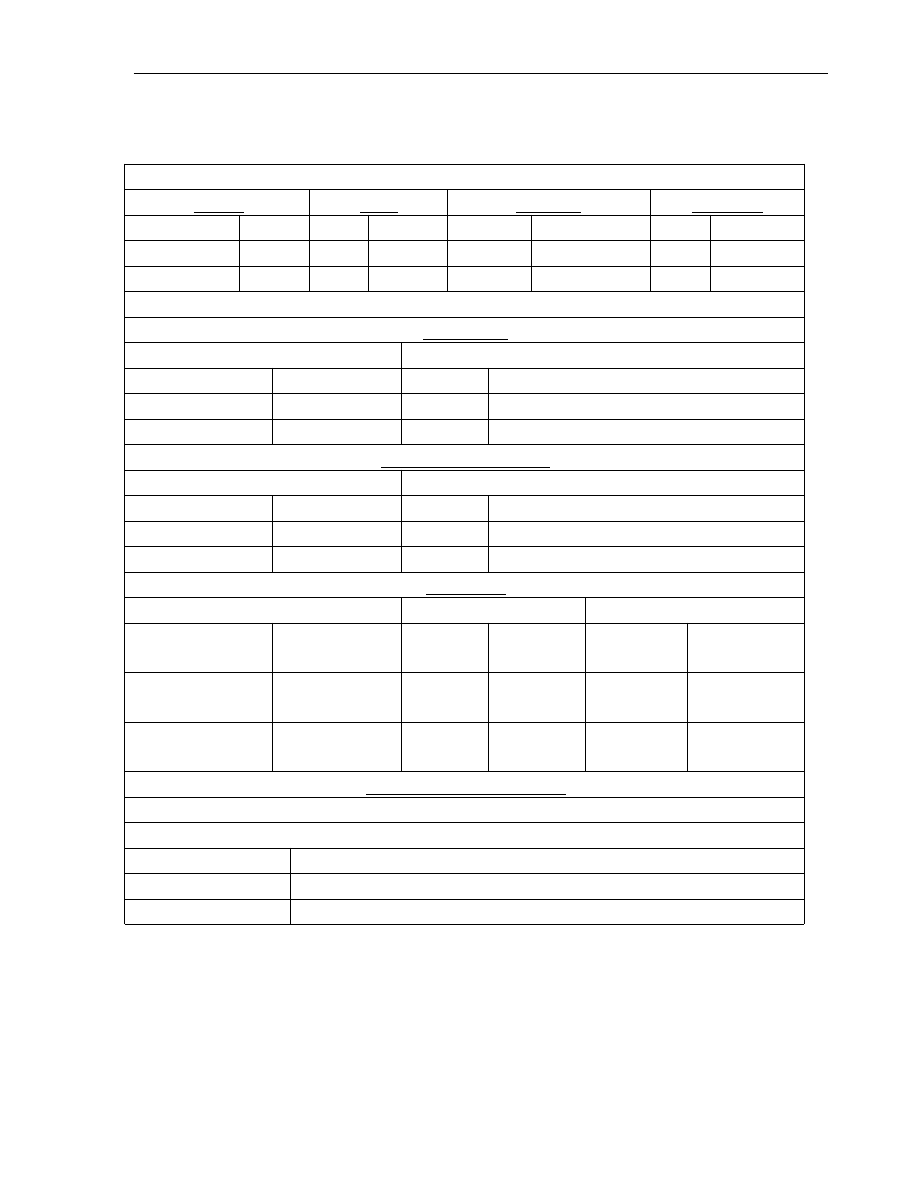
LW/M
117
37
MACEDONIAN
Table 2.8
Illustrative Paradigm using the verb gali ‘caress’
S Y N T H E T I C S E R I E S
present
aorist
imperfect
imperative
galam
galime
-galiv
-galivme
galev
galevme
galis
#
galite
-gali
-galivte
gales
#e
galevte
gali
galete
gali
galat
-gali
-galija
gales
#e
galea
A N A L Y T I C S E R I E S
Sum Series
sum aorist
sum imperfect
sum -galil
sme -galile
sum galel
sme galele
si -galil
ste -galile
si galel
ste galele
-galil
-galile
galel
galele
Bes
#e Pluperfect Series
bes
#e aorist
bes
#e imperfect
bev -galil
bevme -galile
bev galel
bevme galele
bes
#e -galil
bevte -galile
bes
#e galel bevte galele
bes
#e -galil
bea -galile
bes
#e galel bea galele
Ima Series
ima perfect
imas
#e pluperfect
imal perfect
imam galeno
imame galeno
imav
galeno
imavme
galeno
sum imal
galeno
sme imale
galeno
imas
# galeno
imate galeno
imas
#e
galeno
imavte
galeno
si imal
galeno
ste imale
galeno
ima galeno
imaat galeno
imas
#e
galeno
imaa
galeno
imal galeno
imale galeno
Hypothetical Conditional
bi galel, bi galela, bi galelo, bi galele
N O N F I N I T E S E R I E S
Verbal Adverb:
galejk
!i
Verbal Noun:
galenje
Verbal Adjective :
galen, galena, galeno, galeni
2.5.1.9. The verb sum ‘be’ is the only verb whose dictionary citation form is first singular present;
all others are third singular. The verb sum occurs in the present, imperfect (1SG bev), a rare
(marginal) third singular aorist (bi), and the l-form (M bil). The present and imperfect of sum are
used with the l-form in the sum series (l SG.M sum bil) and the bes
#e series (l SG.M bev bil). The
regular perfective verb bide supplies the perfective present, imperative, and verbal adjective, whose
use is limited to the extreme southwest, as is the verbal adjective of ima ‘have’. Ima series forms of

LW/M
117
38
MACEDONIAN
the type l SG imam bideno, imam imano occur only in the southwest. The verbal adverb from bide
(bidejk
!i) has been lexicalized as a conjunction meaning ‘because’. The verbal noun of sum can be
supplied by sus
#testvuva ‘exist’.

LW/M
117
39
MACEDONIAN
2.5.2 Verbal Categories
2.5.2.1 Person. The widespread use of the second person plural as a polite singular form is a
relatively recent, urban phenomenon copied from other languages (Lunt 1952:37l; Koneski
1967:332) resulting in hesitation in its application and variation in the agreement of adjectives
(singular or plural): Vie ste izmoren - izmorena - izmoreni ‘You are tired’ M.SG, F.SG, PL. The
singular is prescribed, but plurals are frequently heard.
2.5.2.2. Superordinate aspect. Macedonian has a superordinate imperfective/perfective aspectual
distinction. Traditionally, perfective aspect is defined as marked for completion, and imperfective
aspect is unmarked. Aspect can be inherent in the stem or derived by prefixation (perfectives) or
suffixation (both perfectives and imperfectives; see 2.5.3.3). Unlike Bulgarian, the Macedonian
perfective present and imperfect cannot occur independently but only in subordination to a class of
eight modal markers (pace de Bray 1980:200):
k
!e
expectative marker (future, conditional)
neka
optative marker (first and third persons only)
da
subjunctive marker
ako
‘if’
dodeka (da, ne)
‘while, until’
duri (da, ne)
‘while, until’
dokolku
‘insofar as’ (frequent, but rejected by some speakers as journalistic
jargon)
li
interrogative marker when used to mean ‘if’ (marginal: archaic or dialectal
for many speakers)
2.5.2.2.1 The perfective present can occur independently in negative-interrogative sentences
colloquially but not in ordinary affirmative or interrogative sentences (Kramer 1986:163):
S
‹to
ne
sednes
#?
v s
*S
‹to
sednes
#?
what
not
sit down-2SG.P.PR
What
sit down-2.SG.P.PR
‘Why don’t you sit down?’
v s
‘Why do you sit down?’
2.5.2.2.2 Many verbs in /-ira/ are biaspectual (Minova-G
Úurkova 1966), and Teunisen (1986) gives
a list of 42 simple biaspectuals. Imperfective verbs can occur independently in the present and
imperfect, or subordinated to phasal verbs like poc
#na ‘begin’. Perfective verbs can occur with
otkako ‘since’, otkoga ‘after’, s
#tom ‘as soon as’ or subordinated to uspee, uspeva ‘succeed’ P, I.
Biaspectuals can do both.
14
2.5.2.3 Subordinate aspect. Most linguists agree that the imperfect is marked, either for duration in
time (Koneski 1967:427, Usikova 1985:97) or coordination with other events (Lunt 1952:87). A
few hold that the aorist is marked (Elson 1989) or that the marking is equipollent. Friedman
(1977:30-33) argues in favor of the durative viewpoint on the basis of examples in which
imperfects are used to describe acts with duration in time that are in sequence with rather than
coordinated with events described by aorists, but with the death of the imperfective aorist, it could
be argued that the aorist is becoming marked.
Rabotnic
#ki
igras
#e
prvoligas
#ki
v o
Kosovska Mitrovica
i
worker-ADJ.SG.M
played-3.SG.IM
first.league-ADV
i n
K.M.
and
14
The use of otkoga ‘after’ and s
#tom ‘as soon as’ are considered dialectally marked.

LW/M
117
40
MACEDONIAN
ottamu
se
vrati
s o
dva
boda
from.there
ITR
return-3.SG.AO
with
2
points-PL.Q
‘The ‘Workers’ (a soccer team) played big league ball in Kosovska Mitrovica and returned from there with two
points’
Toj
ja
dade
svojata
poema
na
konkurs i
s o
razbirlivo
he-NOM it-F.ACC gave-3.SG.AO own-F.DEF
poem
t o
contest and
with
understandable-N
netrpenie
g o
c
#ekas#e
rezultatot
impatience
it-M.ACC
awaited-3.SG.IM
result-DEF
'He submitted his poem to the contest and with understandable impatience awaited the result’
Taa
spies
#e
eden
c
#as
i
poc
#na
da
raboti
she-NOM
slept-3.SG.IM
one-M
hour
and
began-3.SG.IM
SU work-3.SG.PR
‘She slept for an hour and began to work’
2.5.2.3.1 The aorist/imperfect opposition is prescribed for both perfective and imperfective verbs,
and occasional examples of imperfective aorists occur in literature through the first half of the
twentieth century (Koneski 1967:423, Lunt 1952:90). Today, however, imperfective aorists are
virtually obsolete, unlike in Bulgarian. Instead either an imperfective imperfect or perfective aorist
will be used, depending on the context and the lexical content of the verb (see Friedman 1993).
2.5.2.4. Perfects. Macedonian has preserved the Common Slavic perfect in the sum series and has
created a new series of perfects: the ima series. The new perfect is characteristic of Western
Macedonian and is marked for present statal resultativity (resultant state). The sum series has lost
its marking for resultativity in connection with the rise of the category of status (see 2.5.2.10).
Speakers from Eastern Macedonia use the ima-perfect less than speakers from Western Macedonia
or not at all, and consequently the sum series in their speech and writing has a broader range.
15
In
the southwest (Ohrid-Struga), the sum series has become limited to the expression of status, while
in the extreme southwest (Kostur-Korc
#a) the l-form and its paradigms have disappeared entirely or
nearly so. In the rest of Western Macedonia, the sum series retains some of its perfect uses as well
as entering into status oppositions.
2.5.2.5 Tense. The major tense opposition is present/past. The imperfective present can describe
past and future as well as present events: doag
!am utre ‘I am coming tomorrow’, doag!a kobna
1912 godina ‘the fatal year 1912 comes’. The perfective present is limited to occurrence after the
eight subordinators listed in 2.5.2.2. The invariant verbal particle k
!e added to the perfective or
imperfective present expresses future or habitual actions. When negated, k
!e is usually replaced by
invariant nema da. Negative ne k
!e and positive ima da also mark futurity, but carry nuances of
volition and obligation, respectively. When k
!e is added to the imperfect (negative ne k!e + imperfect
or nemas
#e da + present), it forms the future-in-the-past (anterior future), the expectative
unfulfillable (irreal) conditional, or the past iterative: k
!e dojdes#e can be translated ‘he will have
come’, ‘he would have come’ or ‘he would come’. Lunt (1952) and Kramer (1986) treat all
constructions with k
!e as modal. Lunt terms the traditional future the projective mood. Kramer uses
the term expectative and extends it to conditionals marked with k
!e. The relationship of future to
anterior future is taxic if one takes future as a temporal category.
2.5.2.6. Taxis. Taxis is more important for distinguishing pluperfects in the sum series and ima
series. The bes
#e pluperfect normally uses the perfective aorist stem. The imas#e pluperfect and imal
perfect are distinguished on the basis of the category of status (see 2.5.2.10). The bes
#e pluperfect
15
Younger generations from Eastern Macedonia, however, use the ma-perfect more frequently as a result of the
influence of the literary language.

LW/M
117
41
MACEDONIAN
specifies one past event as anterior to another, whereas the imas
#e pluperfect specifies a past result
(resultant state) of an anterior event. In other words, the bes
#e pluperfect is marked for past taxis,
whereas the imas
#e pluperfect is marked for past statal resultativity. The difference is illustrated by
the following two sentences. The first implies I spotted her before he did while the second could
only be used if I had seen her on some previous occasion:
Toj m i
ja
pokaz
#a, no
jas
vek
!e
ja
b e v
v i d e l
he
me-DAT
her-ACC showed-3.SG.AO but
I-NOM
already
her-ACC be-1-SG.IM see-M.SG.LF
‘He pointed her out to me, but I had already seen her’
Toj m i
ja
pokaz
#a, no
jas
vek
!e
ja
i m a v
v i d e n o
he
me-DAT
her-ACC showed-3-SG.AO
but
I-NOM
already her-ACC have-1.SG.IM see-N.VA
‘He pointed her out to me, but I had already seen her’

LW/M
117
42
MACEDONIAN
2.5.2.7 Imperatives. The imperative is used for commands (see 3.2). Both perfective and
imperfective imperatives are also used in reference to all three persons where other Slavic languages
can use the independent perfective present for repeated past acts and habitual acts without reference
to time:
Jas
rec
#i,
toj
stori
I
speak-SG.IV
he
do-SG.IV
‘He does whatever I say’ or ‘He will do whatever I say’
Tie
brkaj
nas, nie
krij
se
v o dupkata
they
chase-SG.IV
us-ACC
we-NOM
hide-SG.IV
ITR
i n
hole-DEF
‘They chase us, we hide in the hole’
2.5.2.8 Conditionals. There are two morphosyntactic types of conditional apodoses: The
hypothetical (potential) formed with bi plus verbal l-form, and the expectative (real and irreal)
formed with k
!e plus present (real, or fulfillable) and imperfect (irreal, or unfulfillable). The negative
is formed with ne k
!e + present/imperfect or invariant nema da + imperfect or nemas#e da + present.
Kramer (1986) points out that hypothetical conditions can also be fulfillable or unfulfillable.
Hacking (1998:91-141) surveys all the relevant literature and, on the basis of her own field work,
provides a re-analysis in which hypotheticality as graded from low to high along an access the
major division of which is expectative/non-expectative. Within the non-expectative, there is a tri-
partite division among past, present, and future. The following sentences illustrate the four
possibilities: fulfillable-expectative (expectative), fulfillable-hypothetical (future non-expectative),
unfulfillable-expectative (past non-expectative), unfulfillable-hypothetical (present non-expectative).
A k o
m i
se
javite, k
!e
dojdam
if
me-DAT
ITR
call-2.PL.P.PR
EX
come-1.SG.P.PR
If you call me, I will come’
A k o
m i
se
javite, b i
dos
#ol
if
me-DAT
ITR
call-2.PL.P.PR
HY
come-M.SG.P.LF
‘If you called/were to call me, I would come’
A k o
m i
se
javevte, k
!e
dojdev
if
me-DAT
ITR
call-2.PL.P.IM
EX
come-1.SG.P.IM
‘If you had called me, I would have come’
Da
moz
#e
bebeto
da
prozboruva, b i
t i
reklo
SU
can-3.SG.I.PR
baby-DEF.N
SU
speak-3.SG.I.PR
HY
you-DAT
say-N.SG.P.LF
‘If the baby could talk it would say to you...'
2.5.2.8.1 The hypothetical conditional also occurs in the protasis of conditional sentences with ako
‘if’ and koga ‘if’ (literally ‘when’), although such usage with ako is not standard. In the protasis
of unfulfillable-expectative conditional sentences, the imperfect is used after ako ‘if’ or da in the
meaning ‘if’. It should be noted that there is some variation in the use of k
!e and bi in unfulfillable
conditions. Although k
!e is still preferred for all expectatives and bi for all hypotheticals, bi is
expanding into the unfulfillable-expectative at the expense of k
!e in educated formal style (under the
influence of Serbian) while k
!e is encroaching on bi in unfulfillable-hypotheticals in educated
colloquial style.

LW/M
117
43
MACEDONIAN
2.5.2.9 The particles da and neka in simple independent clauses express directives, that is
permission, tolerance, concession, request, exhortation, wish: Neka dojde! ‘Let him come!’; Da
dojdam! ‘Let me come!’ Ordinarily, neka occurs with the third person present. Some speakers can
also use it with the first person, but others reject this. On the rare occasions when neka is used with
a past tense form (imperfect, sum imperfect), it expresses an unfulfillable directive. Thus, neka can
be termed an optative marker. Unlike Bulgarian, Macedonian does not permit the collocation neka
da.
2.5.2.9.1 The modal particle da occurs with all persons and all finite verb forms (if we take the
imperative to be nonfinite, see note 9), although some of these collocations are highly restricted,
marginal, or dialectal. A traditional cover term for da is the marker of the subjunctive (see 3.5).
2.5.2.10 Status. Like Bulgarian, Macedonian has developed a distinction often described as based
on the opposition witnessed/reported (so-called renarration). This distinction is traditionally
described as modal in Bulgarian grammar and also by Usikova (1985). Both Lunt (1952) and
Koneski (1967) avoid the issue of how to characterize the opposition. I have argued for Aronson’s
use of the term status as opposed to Jakobson’s evidential in this respect (Friedman 1977:7),
taking mood as specifying the ontological qualification of the narrated event and status as the
speaker’s qualification of the validity of the event. In traditional descriptions, the synthetic aorist
and imperfect together constitute what is known as the definite past and are opposed to the sum
aorist/imperfect (the old perfect) — known as the indefinite past — in two ways: The definite past
denotes events witnessed by the speaker at a definite time, the indefinite past denotes events that did
not take place at a definite point in time — a remnant of its old perfect function — and events that
were reported to the speaker regardless of time orientation. These are the most common uses of
these paradigms, but they do not constitute invariant meanings. Friedman (1977:52-81) argues that
synthetic pasts are marked for confirmativity while Lunt (1952:91-94) describes the sum
aorist/imperfect as marked for distance in time or reality, that is resultative or nonconfirmative (see
also Usikova 1985:94-106). Definite past time adverbs can be used with both the synthetic pasts
and the sum series. Indefinite past time adverbs can be used with the synthetic pasts. The synthetic
pasts are normally used to describe events witnessed by the speaker but will also be used for events
not witnessed by the speaker when the speaker has reason to vouch for (confirm) their truth. The
following example demonstrates clearly that synthetic pasts can be used for unwitnessed, reported,
but vouched-for events:
No
potoa
se
sluc
#ija
raboti za
k o i
ne
znaev
but
after-that
ITR
happen-3.PL.AO works about
which-PL
not
know-1.SG.AO
‘But then things happened that I did not know about’
The sum perfect will have a resultative or indefinite meaning when the surrounding context makes it
clear that the speaker is vouching for the truth of the statement. The sum perfect is used when the
speaker does not wish to vouch for (confirm) the truth of an event because it is based on second-
hand information (report), a deduction based on evidence, or when the speaker wishes to place
distance between her/himself and the statement due to a variety of factors, e.g. the speaker
expresses surprise at an unexpected event or fact (admirative), the speaker sarcastically repeats the
statement of another (dubitative), the event occurred by accident, etc. For example, Toj bes
#e vo
Skopje means ‘He was in Skopje (I vouch for it)’ while Toj bil vo Skopje means either ‘He has
been in Skopje’ or ‘He is/was in Skopje (apparently)/(much to my surprise)/(supposedly)’.

LW/M
117
44
MACEDONIAN
2.5.2.10.1 The bes
#e pluperfect does not enter into this opposition. In the ima series, the imal
perfect is limited to nonconfirmed, usually nonwitnessed (but also deduced) events. The imas
#e
pluperfect when used without a modal modifier is limited to witnessed events. The expectative
marker k
!e with the sum-imperfect (marginally also the sum-aorist) is always nonconfirmative,
usually reported, and is the nonconfirmative equivalent of k
!e plus imperfect or present. The negated
realization is nemalo da plus the conjugated present tense. Using k
!e with the bes#e pluperfect is
marginal and is not semantically differentiated from k
!e plus sum-imperfect in its past and modal
meanings (Koneski 1967:498). Similarly, k
!e plus the ima series is a marginal southwesternism
(Friedman 1977:19-20, 190). The examples I have found or elicited indicate that k
!e plus ima perfect
is suppositional (pace Lunt’s [1952:99] elicited future anterior example, (see 3.1)), k
!e plus imas#e
pluperfect is unfulfillable expectative, and k
!e plus imal perfect would be the reported or
nonconfirmative equivalent of the other two.
2.5.2.11 The category of transitivity may be inherent in the stem or marked by se: zaspie ‘fall
asleep’ ITR se nadeva ‘hope’ ITR. In some verbs, se is used as an intransitivizer: razbudi ‘wake
up’ TR se razbudi ‘wake up’ ITR. Lexical intransitives can also be used as causative transitives
with definite objects: go zaspav ‘I put him to sleep’. For transitive verbs, ‘be’ plus verbal adjective
is one way of forming the passive. For intransitive verbs (including some objectless transitives),
‘be’ plus verbal adjective is a type of perfect. The construction generally occurs with verbs of
motion and in a few colloquial expressions: dojden sum vc
#era ‘I came yesterday’, vek!e sum jaden
‘I’ve already eaten’.
The passive is formed either with se or with ‘be’ plus verbal adjective:
Starite
treba
da
se
slus
#aat
old-PL.DEF
should
SU
ITR
obey-3.PL.PR
‘The old folks should be obeyed’
Toj
naredi
da
bide
razbuden
v o
dva
saatot
he
order-3.SG.AO
SU
be-3.SG.P.PR
awaken-VA.M
at
two
hour-DEF
‘He ordered that he be awakened at two o’clock’
Zelkata
se
vari
cabbage-DEF
ITR
boil-3.SG.PR
‘The cabbage cooks/is being cooked’
Zelkata
e
varena
cabbage-DEF
i s
boil-VA.F
‘The cabbage is cooked’
The agent in a passive construction is usually expressed with the preposition od ‘from, of, by’:
Toj
bes
#e
razbuden
od
slugata
he
was
awaken-VA.M
b y
servant-DEF
‘He was awakened by the servant’
The meaning of se is ‘intransitive’, including impersonals, reflexives, reciprocals:
Se
gleda
deka
ITR
see-3.SG.PR
that
‘It can be seen that’
Ednas
#
se
z
#ivee

LW/M
117
45
MACEDONIAN
once
ITR
live-3.SG.PR
‘One only lives once’
Tes
#ko
e
da
se
bide
glup.
Ima
golema
konkurencija.
difficult-N is-3.SG.PR
SU
ITR
be.3.SG.P.PR
stupid--M
has-3.SG.PR
big-F
competition
‘It is difficult to be stupid. There is a lot of competition.'
Ne
m i
se
raboti
NEG
me-DAT
ITR
work-3.SG.PR
‘I don’t feel like working’
Toj
se
gleda
v o
ogledaloto
he
ITR
watch-3.SG.PR
i n
mirror-DEF
‘He looks at himself in the mirror’
K
Úe
se
bric
#am
na
berber
EX
ITR
shave-3.SG.PR
at
barber
‘I’ll get shaved at the barber’s’
Se
gledaat
kako
mac
#ori
ITR
watch-3.PL.PR
like
cat-PL
‘They look at one another like cats’
2.5.2.12 Non-finite forms in historical-comparative perspective. Unlike Bulgarian, Macedonian has
no remnants of the Common Slavic infinitive, and the Common Slavic participles have all been lost
or transformed. Infinitival clauses in other Slavic languages correspond to constructions with da
plus finite verb (da-clauses) or constructions with the verbal noun (see 2.5.1.6, 3.5). The present
active participle survives as the verbal adverb. The past passive participle survives as the verbal
adjective, which inflects and behaves like any other adjective and can be formed from any verb,
including intransitives. The resultative participle survives as the verbal l-form, which is limited to the
sum series, the imal perfect, and the hypothetical conditional. It is therefore no longer a participle in
Macedonian since it can never function attributively. The present passive participle survives in
isolated adjectives, e.g. lakom ‘greedy’. The past active participle survives in a single lexical item:
bivs
# ‘former’. The verbal noun survives productively (see 2.5.1.6).: i productively (see 2.5.1.6).
2.5.3 Verb Derivation
Taking unprefixed imperfectives as basic, perfectives are derived by prefixation and suffixation.
The following preverbs are used: v-, vo-, do-, za-, iz-, na-, nad-, o-, ob-, od-, po-, pod-, pre-,
pred-, pri-, pro(z)-, raz-, s-, so-, u;-, (o)bez-, (s)protiv-, su-. Preverbs can also be added to one
another: tepa ‘beat’ po-iz-na-tepa ‘beat to a pulp’ (see Ugrinova-Skalovska 1960 for detailed
discussion). The suffix /-ne/ usually forms perfective verbs: sedi ‘sit’, sedne ‘sit down’, although a
few verbs in -ne are imperfective or biaspectual: kisne ‘become sour’ I, gasne ‘quench, extinguish’
(biaspectual). Imperfectives are derived productively from perfectives by means of the suffix /-uva/:
sednuva ‘keep sitting down’. Other suffixes such as {-(j)a(va)} are unproductive or obsolete (see
1.4.3).
2.5.3.1 The suffix /-uva/ is also productive in forming verbs from other parts of speech: zbor
‘word’, zboruva ‘speak’, start ‘kick-off’ (noun) startuva ‘kick-off’ (verb).
2.5.3.2 Verbs with the highly productive suffix /-ira/ (from Latin through French to German to
Slavic) are often biaspectual, but they show a tendency to be treated as imperfective, with perfectives
being derived by means of prefixation (see 3.2.1): interes ‘interest’ NN interesira ‘interest’
V.I.TR, zainteresira. V.P.TR

LW/M
117
46
MACEDONIAN
2.5.3.3 In some cases, the suffixes contribute to semantic differentiation: kritika ‘criticism’,
kritikuva ‘critique’ V, kritizira ‘criticize’. While some new loans permit formation freely with
more than one of these suffixes, others do not: flert ‘flirt’ permits the formation of the verb
flertuva but not flertira (see Minova-G
Úurkova 1966).
2.5.3.4 Another productive suffix is the Greek /-sa/ (Greco-Turkish /-disa/). Verbs in /-sa/ are
often perfective and form imperfectives by means of /-uva/ with prefixation deriving new
perfectives: kalaj ‘tin’ NN, kalaisa ‘plate with tin’ P, kalaisuva I, prekalaisa ‘re-tin’ P.
2.5.3.5 The suffixes /-ka/ and /-oti/ are diminutive and augmentative, respectively: kopa ‘dig’,
kopka ‘scratch the surface’; tropa ‘knock’, tropoti ‘pound’.
2.5.3.6 The suffix /-i/ can form verbs from nouns and adjectives, and some of the deadjectival
causatives in /-i/ form intransitives in /-ee/: crn ‘black’, crni ‘blacken’, crnee ‘become black’.
2.5.3.7 Verbs are also derived by compounding: obelodenuva ‘reveal’ from bel den ‘broad
daylight’ (literally ‘white day’).

LW/M
117
47
MACEDONIAN
2.6 Adverbs
Neuter indefinite adjectives also function as adverbs, unless the masculine indefinite ends in a
vowel, in which case that is the adverb. Adverbs of manner, quantity, location, and time usually end
in a vowel as seen in the following selected examples: kako ‘how’, vaka ‘this way’, taka ‘thus’,
onaka ‘that way’, nikako ‘no way’, nekako ‘somehow’, kolku ‘how much’, olku ‘this much’, tolku
‘so much’, onolku ‘that much’, kade ‘where, whither’, otkade ‘whence’, vamu ‘here, hither’, tamu
‘here, there’, onamu ‘over there’, onde(ka) ‘there’, tuka ‘here’, ovde ‘here’, ottuka ‘hence’,
odovde(ka) ‘hence’, ottamu ‘hence, thence’, odonde ‘thence’, koga ‘when’, sega ‘now’ togas
#
‘then’, sekogas
# ‘always’, nikogas# ‘never’, (po)nekogas# ‘sometimes’, etc. (cf. 2.3.4, see also 3.2).
See 2.5.2.12 for the discussion of participles. For further discussion see Koneski (1967:343-53).

LW/M
117
48
MACEDONIAN
2.7 Prepositions
Prepositions are invariant in shape with the exception of v ~ vo ‘in’ (also ‘on’, at’, etc. in context).
In general vo is used unless the object of the preposition is an indefinite substantive that does not
begin with /v/ or /f/ and is not being used in focus or contrast. Even then, there is some vacillation
(see Koneski 1967:509-514). According to the norm, usage with days of the week constitute a
special case, illustrated by the following examples: vo sreda ‘on Wednesdays, every Wednesday’;
v sreda ‘this (next, coming) Wednesday’; vo sredata ‘last (this past) Wednesday’.
16
16
This distinction is not maintained by all speakers.

LW/M
117
49
MACEDONIAN
3 Syntax
Like Bulgarian and the southernmost dialects of Serbian and unlike the rest of Slavic, Macedonian
has lost all but a few traces of the synthetic declensions of Common Slavic and uses prepositional
or other syntactic constructions to express case relations. Nominal adposition expresses partitivity,
e.g. c
#as#a voda ‘glass (of) water’. The predicative instrumental constructions of North Slavic are
replaced by simple nominals: Toj rabotel papudz
#ija ‘He worked (as a) slipper-maker’. After
prepositions, pronouns are accusative, nouns can be oblique in the rare instances where they occur,
all other nominal forms are nominative. The preposition na can have local and motional meanings
‘on, to, at’ but also marks the indirect object (dative) and possession (genitive). Likewise od and so
retain their literal meanings of ‘from’ and ‘with’, but od can also mark possession (especially in
the West) and agentive ‘by’ in passives, while so marks instrumental ‘by’:
Mu
rekov
na
brat
m i
deka
molbata
bila
potpis
#ana
him-DAT said-1.SG.AO t o
brother
mi-DAT
that
request-DEF
was-LF.F
signed-VA.F
od
tatkoto
na
uc
#enikot
s o
moliv
from
father-DEF
t o
pupil-DEF
with
pencil
‘I said to my brother that the request had been signed with a pencil by the father of the pupil’

LW/M
117
50
MACEDONIAN
3.1 Element Order in Declarative Sentences
The unmarked order of main constituents is subject-verb-object (if the object is definite, a
reduplicative object pronoun must precede the finite verb):
Kuc
#eto
ja
kasa
mac
#kata
dog-N.DEF
it-F.ACC
bites-3.SG.PR
cat-F.DEF
‘the dog bites the cat’
In unmarked order, the subject is topic and no constituent bears special sentential emphasis (focus).
Topicalization and focus are rendered by a combination of word order and intonation within the
context of the discourse. In general, given the appropriate intonation, the position immediately
before the verb phrase is that of the topic. If the verb phrase is initial, it is the focus of the sentence,
and the topic will be the constituent closest to it. Inversion of subject and object will topicalize the
object without focusing on it, while placing both consituents before the verb will focus on the topic.
The following examples illustrate the possibilities:
Mac
#kata ja kasa kuc#eto
‘the dog bites the cat (topic)’
Kuc
#eto mac#kata ja kasa
‘the dog bites the cat (topic/focus)’
Mac
#kata kuc#eto ja kasa
‘the dog (topic/focus) bites the cat’
Ja kasa kuc
#eto mac#kata
‘the dog (topic) bites (focus) the cat’
Ja kasa mac
#kata kuc#eto
‘the dog bites (focus) the cat (topic)’
There are four possible positions for an adverb, e.g. svirepo ‘viciously’ or vc
#era ‘yesterday’
illustrated by the numbers in square brackets:
[I] Kuc
#eto
[II] ja kasa
[III] mac
#kata
[IV]
‘[I] The dog
[II] bites
[III] the cat
[IV]’
The neutral position for the adverb is usually [I] or [IV]. The position of focus is usually [II] or
[IV]. Position [IV] is more likely to be neutral with time adverbs but to entail focus with manner
adverbs. However, judgments vary from speaker to speaker. Position [III] is acceptable but more
likely if the subject is omitted.
Clitics precede finite verb forms. The order is subjunctive - negator - mood marker - auxiliary -
ethical dative - dative object - accusative object - verb:
17
Da
ne
k
!e
sum
s i
mu
g o
dal
SU
NEG
EX
am
self-DAT
him-DAT
it-ACC.M/N
gave-M.LF
‘(They didn’t say) that I won’t have given it to him (did they)?’.
The subjunctive marker follows the expectative in colloquial suppositions:
Pa
k
!e
da
ima
kaj
c
#etirieset
well
EX
SU
have.3.SG.PR
at
forty
17
If the dative object clitic and accusative object clitic are both non-third-person, their co-occurrence is unacceptable. A
non-third person accusative object clitic is unacceptable if there is a preceding dative object clitic. (See Rudin 2002).

LW/M
117
51
MACEDONIAN
‘Well, he must be around 40’.
The hypothetical marker does not occur after the subjunctive except in old fashioned curses and
blessings, in which case clitic order can be violated:
Da
b i
volci
te
jale
SU
HY
wolf-PL
you-SG.ACC
eat-3.PL.LF
‘May wolves eat you’.
Clitic pronouns occur on either side of the auxiliary in the bes
#e pluperfect: se bes#e zaborc#il ~ bes#e
se zaborc
#il ‘he had gotten into debt’. The sense of past resultativity is stronger when the auxiliary
is closer to the verb (Koneski 1967:482-83). Clitics precede the forms of ima in the ima series, and
nonclitic words may come between ima and the neuter verbal adjective:
Ne
g i
ima
napolneto
NEG
them-ACC
have-3.SG.PR
filled.N-VA
‘He has not filled them’
Gi
nemam
videno
them-ACC
not have.1.SG.PR seen-N.VA
‘I have not seen them’
Go
imas
#e
sam
napraveno
it-ACC.M/N
have-3.SG.IM
self-M
done-N.VA
‘He has done it himself’

LW/M
117
52
MACEDONIAN
K
Úe
ima
namesto
tri
c
#etiri
c
#as#ki
napieno
EX
have-3.SG.PR
instead
three
four
cups-DIM
drunk-N.VA
‘He must have drunk four instead of three shots (of liquor)’
The negative equivalents of k
!e using nema da (see 2.5.2.2) have clitics attaching to the main verb:
nema da gi vidam ‘I will not see them’. The form bes
#e can also function as an emphatic marker
added to the sum perfect, in which case it is not bound by the rules of auxiliary order and does not
mark person: bes
#e sum dos#ol ‘I did come’, tie dos#le bes#e ‘they did come’, bes#e sum imal dojdeno
‘(they say/apparently) I have come’. The interrogative clitic li normally comes after the first
stressed word in the clause or after the verb (Wackernagel’s law; see 3.2).
Present tense forms of sum ‘be’ that function as auxiliaries, i.e. the first two persons, have auxiliary
clitic order even when functioning as the copula. Other forms of ‘be’ behave as full verbs when
functioning as the copula and are preceded by clitic elements:
Jas sum mu
prijatel
I
am
him-DAT friend
‘I am his friend’
Toj m i
e
prijatel
He me-DAT
i s
friend
‘He is my friend’
Jas mu
bev
prijatel
I
him-DAT
was-IM
friend
‘I was his friend’
Clitics follow non-finite verb forms (including the imperative) donesete mi ja knigata ‘Bring me
the book’; donesuvajk
!i mu ja knigata ‘bringing him the book’.
Macedonian permits both head-genitive and genitive-head order in prepositional possessive
constructions. A dative possessive clitic -- limited to a few kinship terms -- must follow the kinship
term:
majka
mu
na
carot
mother
him-DAT
t o
king-DEF
‘The mother of the king’
na
carot
majka
mu
t o
king-DEF
mother
him-DAT
‘The mother of the king/The king’s mother’ (more colloquial)
In attributive noun phrases, the clitic comes after the first element. Note that attributes normally
precede but can also follow the nouns they modify: starata mu majka or majka mu stara; ‘his old
mother’. With spousal terms, the possessive marker often follows a definite noun:
maz
#ot
m i
man-DEF
me-DAT
‘my husband’

LW/M
117
53
MACEDONIAN
soprugot
nejzin
spouse-DEF
her-M
‘her spouse’
The normal order within the noun phrase is determiner - adjective - noun:
site
ovie
tri
bedni
mac
#ki
all-DEF.PL
these-PL
thee
poor-PL
cats
‘all three of these poor cats’
istite
ovie
tri
bedni
mac
#ki
same-DEF.PL
these-PL thee poor-PL
cats
‘these same three poor cats’
A possessive adjective normally precedes a numeral as in English:
moite
tri
prijateli
my-DEF.PL three
friends
‘my three friends’
However, the numeral precedes if the quantity is not the totality (cf. partitivity discussed above):
eden
moj
prijatel
one
my.M
friend
‘a friend of mine’ (one of my friends)
Adjectives can follow their heads for stylistic and emotive purposes:
jazikot
nas
#
denes
#en
language-DEF
our
today-ADJ
‘our daily language’
metla
rasipana
broom spoiled-F.VA
‘ruined broom’ (idiomatic expression for a scanty beard)
In colloquial speech, a dative possessive clitic can be combined with a possessive pronoun for
emphasis:
tatko
mi moj
father
me-DAT
my-M
‘my dad’

LW/M
117
54
MACEDONIAN
3.2 Nondeclarative Sentence Types
Interrogatives are marked by a rising intonation on the verb or the focus of the question:
K
Úe
odis
#
v o
Bitola?
EX
go-2.SG.PR i n
B.
‘Are you going to Bitola?’
Focus on the topic can also be achieved by inversion:
V o
Bitola
k
!e
odis
#?
i n
B.
EX
go-2.SG.PR
‘Are you going to Bitola?’

LW/M
117
55
MACEDONIAN
The interrogative particle li is used less in Macedonian than in Bulgarian. In Englund’s
(1977:137-43) corpus of yes/no questions, 60.4% of the Bulgarian questions used li as opposed to
30% in Macedonian, and 44.1% of her Macedonian questions had no lexical interrogative marker
but only 19.9% in Bulgarian. Another difference between Macedonian and Bulgarian is that li is
more strictly bound to follow the first stressed element in the clause or the verb in Macedonian.
Thus if the focus is anywhere but on the verb, that element must be at the beginning of the clause:
K
Úe
odis
#
l i
v o
Bitola?
EX
go-2.SG.PR QU
i n
B.
‘Will you go to Bitola?’
V o
Bitola
l i
k
!e
odis
#?
i n
B.
QU
EX
go-2.SG.PR
‘Is it to Bitola you will be going?’
V o
Bitola
k
!e
odis
#
li?
i n
B.
EX
go-2.SG.PR QU
‘Are you going to go to Bitola?’
*K
Úe
odis
#
v o
Bitola
li?
EX
go-2.SG.PR i n
B.
QU
Englund’s corpus contains 6 exceptions to these generalizations, but I found that speakers rejected
such sentences, indicating that this aspect of the norm has become more stable. A conceptual entity
is treated as one stressed unit:
Nova
Makedonija
l i
mu
ja
donese?
New
Macedonia
QU
him-DAT
it-F.ACC
bring-2.SG.AO
‘Was it (the newspaper) Nova Makedonija that you brought him’?
Other interrogative particles for yes/no questions:
dali
‘request for information’:
Dali znaes
# ‘Do you know?’
zar
‘surprise’:
Zar znaes
# ‘You mean, you know?!’
Zar ne znaes
# ‘Don’t you know?!’
da ne
‘tag question’:
Da ne si nes
#to bolen ‘You’re not sick, are you?’
(Unlike Bulgarian, Macedonian rarely uses da by
itself for a yes/no question)
ali
colloquial variant of dali.
zer
dialectal variant of zar
zarem less preferred variant of zar.
neli
introduces a negative interrogative
Neli znaes
# ‘Don’t you know?’
or follows as a tag
Znaes
#, neli ‘You know, don’t you?’
a
tag request for affirmation
Znaes
#, a ‘You know, right?’
Macedonian can also introduce question with the following WH words:
koj
who, which
kako
how
kolku
how much, how many
kakov
what kind

LW/M
117
56
MACEDONIAN
kolkav
how big
s
#to
what
kade/kaj
where
koga
when
zos
#to
why
c
#ij
whose
Indirect questions can be introduced by a WH word or the interrogative marker dali:
Toj
me
pras
#a
kolku
godini imam
he
me-ACC
ask-3.SG.AO how many
years
have-1.SG.PR
‘He asked me how old I was’
Toj
me
pras
#a
dali
k
!e
dojdam
he
me-ACC
ask-3.SG.AO QU
EX
come-3.SG.P.PR
‘He asked me whether I would come’
An interrogative can be answered with da ‘yes’, ne ‘no’ or with a repetition of the focus of the
question, which in itself can constitute affirmation.
Zar
ne
sakas
#
da
dojdes
#?
QU
NEG
want-2.SG.PR
SU
come-2.SG.P.PR
‘Don’t you want to come?’
Typical responses include Kako ne ‘Of course’ (literally ‘how not’), Da ‘Yes’, Sakam ‘I want
(to)’, or Ne ‘No’, Pa nejk
!am ‘Well, I don’t (want)’ or Ne sakam ‘I don’t want (to)’, Jok! ‘No
way!’ (Turkish borrowing).
18
The normal form of a command is the perfective imperative, (all examples are singular, the plural
can also be a polite singular): Dojdi ‘Come!’ A da-clause with the perfective present expresses a
wish and can function as a more polite command or request: Da mi go napis
#es# ‘Write it down for
me’. Negative commands are normally formed with the corresponding imperfective: Ne doag
!aj, Da
ne doag
!as# ‘Don’t come’. The expression nemoj (plural nemojte) ‘Don’t!’ can be used by itself or
with a perfective da-clause to form a negative imperative with other verbs: nemoj da dojdes
# ‘Don’t
come’. A negative da-clause with a perfective verb constitutes a warning: Da ne dojdes
# ‘You’d
better not come’. A negated perfective imperative is a challenging threat commanding the addressee
to perform the action: Ne dojdi ‘Just don’t you come (and see what happens)!’ A da-clause with
an imperfect can function as a request: da mi ja doneses
#e knigata ‘bring me the book, would you
please’. A da-clause with a sum perfect is urgent or rude: Vednas
# da si dos#ol! ‘Get over here
immediately!’ The second person future (k
!e + present) can also be used as an imperative either
peremptorily or in giving directions: k
!e odis# pravo, pa desno ‘Go straight, then (take a) right’.
Indirect commands are expressed with da-clauses: Kaz
#i mu da odi ‘tell him to go’.
3.3 Copular and Existential Sentences
The usual copula is the verb sum ‘be’ and is not normally omitted (see 3.1 on word order). Lexical
verbs such as se naog
!a ‘be located’ ostane ‘remain’ are sometimes used in functions resembling
18
Note that there is a distinction between the interrogative particle neli and the negative particle ne plus interrogative
particle li, as in the following pair: Neli dojdes
# so mene? ‘Aren’t you coming with me?’ vs Ne li dojdes# so mene
‘You’re NOT coming with me?! [but I thought you said you were]’ The two sentences will have different intonation
patterns. (I wish to thank Elena Petroska for this example; see also Rudin, Kramer, Billings, and Baerman 1999).

LW/M
117
57
MACEDONIAN
those of ‘be’ in English. In newspaper headlines, the copula can be omitted, but not in the article
itself:
IMER IMERI NOV LIDER NA PDP
Dr. Imer Imeri, specijalist po ops
#ta medicina po poteklo od C‹egrane e noviot lider na Partijata za demokratski
prosperitet. (MILS 00.03.06)
‘Imer Imeri new leader of PDP
Dr. Imer Imeri, a specialist in general medicine originally from C
‹ergane, is the new leader of the Party for
Democratic Prosperity’
The admirative (mentioned in 2.5.2.10) is a usage that in principle can occur with any verb to refer
to the unexpected result of a pre-existing state of which the speaker was unaware until the moment
of discovery. In practice, however, the usage occurs almost exclusively with the copula and
existentials. In the extreme southwest, where the verbal l-form is almost completely lost, such
usages are the last to disappear. Although the form is past, referring as it does to a pre-existing
state, the correct translation into English is a present tense form, referring to the moment of
discovery:
Ti
s i
bil
Rom!
Ne
sum
znael.
you are.2.SG.PR
be.M.LF Rom (Gypsy).
NEG
am.1.SG.PR know.M.LF
‘You are a Rom! I didn’t know!’
Existence is signaled by the verb ima literally ‘one has’. If the existent item is a pronoun, it will be
accusative:
Ima
mec
#ki
v o
planinite
has-3.SG.PR
bears
i n
mountains-DEF
‘There are bears in the mountains’
Gi
ima
mnogu
them
has-3.SG.PR
many
‘There’s a lot of them’
3.4 Coordination and Comitativity
Coordination normally occurs between the last two elements (orthographically, a comma is never
used in this position): Seminar za makedonski jazik, literatura i kultura ‘Seminar for Macedonian
language, literature, and culture’. An i ‘and’ before each element gives the meaning
‘both … and …’. Prepositions can be conjoined:
sostojbata
v o
Makedonija
v o
i
neposredno
p o
prvata
svetska
vojna
situation-DEF
i n
Macedonia
i n
and
directly
after
first-F.DEF world.F
war
‘the situation in Macedonia during and immediately after the First World War’
Coordinated singular adjectives modifying the same noun but denoting different entities are both
definite and have a singular noun but plural verb agreement while coordinated adjectives modifying
a single entity will take one article and singular agreement:
Nas
#ata
i
vas
#ata
ekipa
bea
tamu
our-F.DEF
and
your-F.PL.DEF
team-SG
were-3.PL.IM there
‘Your team and our team were there’

LW/M
117
58
MACEDONIAN
Nas
#ata
i
vas
#a
ekipa
bes
#e
tamu
our.F.DEF
and
your.F.PL.IDF
team-SG
was.3.SG.IM
there
‘Your team and ours was there’
Adjectives modifying conjoined nouns of different genders can be plural: Ljubezni Elena i Viktor
‘Kind Elena and Victor’, but *Ovie maz
# i z#ena ‘*These man and woman’. Conjoined subject
nouns govern a plural verb regardless of word order (but see the end of 4.10).
Comitative constructions with a coordinative meaning occur colloquially:
Nie
s o
Jola
odevme
kraj
nego
we
with
J .
went.1.PL.IM
along
him-ACC
‘Jola and I (literally ‘we with Jola’) walked alongside him’
There is significant variation in the treatment of agreement; considerations of style, region, and
generation all appear to be relevant:
Toj
s o
Viktor otide/otidoa
he
with
V.
went-3.SG.AO/3.PL.AO
‘He left with Victor’/‘Victor and he left’
The use of singular agreement is favoured by the younger generation of Skopje speakers and is
considered correct by strict normativists, the use of plural agreement is favored by some older
speakers, who consider it more literary, and in the southwest.
3.5 Subordination
All the WH words given in 3.2 except zos
#to ‘why’ can function as relativizers. Except for s#to
‘which, that, who’ and -- according to the modern norm -- koga ‘when’, the relativizing function
can be indicated by adding s
#to, written without any space after koj and c#ij (hence, kojs#to), and
written as a separate word after all others (pace Lunt 1952:52). Korubin (1969) suggests that s
#to
be used for restrictive clauses and koj(s
#to) for the nonrestrictive, but practice varies. In general
koj(s
#to) is preferred after a preposition:
deteto
s
#to
g o
sretnavme
child-DEF
that it-ACC
met-1.PL.AO
‘the child whom we met’
c
#ovekot
s o
kogo(s
#to)
se
s
#etas#e
vc
#era
person-DEF
with
whom(that)
ITR
stroll.3.SG.IM yesterday
‘the person with whom he walked yesterday’

LW/M
117
59
MACEDONIAN
A specific indefinite referent triggers pronoun reduplication:
V o
odajata
vleze
eden
c
#ovek
k o g o
g o
vidov
porano
na
ulica
i n
room-DEF
entered.3.SG.AO
one
person
whom him-ACC saw-1.SG.AO earlier
o n
street
‘Into the room came a person whom I had seen (him) earlier on the street’ (Topolin
!ska 1981:114)
Relativizers can occur without any overt antecedent:
Koj
v i n o
pie, bez
nevesta
spie
who
wine
drinks-3.SG.PR,
without
bride
sleeps.3.SG.PR
‘He who drinks wine sleeps without a bride’
When a relative clause of quality modifies an antecedent conceived of as one of many, the relative
pronominal adjective sometimes occurs in the plural, referring to the unmentioned group of which
the antecedent is a member:
Vidov
edna
takva
kuk
!a,
kakvi
s
#to
ne
se
srek
!avaat
v o
toj
kraj
saw-1.SG.AO one-F
such-F
house
such-PL that
NEG
ITR
meet-3.PL.PR
i n
this region
‘I saw a house such as are not met with in that region’
Subjects and objects can both be extracted out of subordinate clauses:
c
#ovekot
za
kogo(s
#to)
mislam
deka
(ti)
s i
g o
videl
person-DEF
about
whom(that) think-1.SG.PR
that
(you)
are.2.SG.PR
him-ACC saw-M.LF
‘the person that I think you saw’
c
#ovekot
koj(s
#to)
mislam
deka
(toj)
te
videl
tebe
person-DEF
whom(that)
think-1.SG.PR
that
(he)
you-ACC.SG saw-M.LF
you-OBL.SG
‘the person that I think saw you’
The chief phrase subordinators are the indicative deka, oti, s
#to and the subjunctive da (see 2.5 and
3.1):
Im
rekov
da
dojdat
them-DAT
told-1.SG.AO
SU
come-3.PL.P.PR
‘I told them to come’
Im
rekov
deka/oti
k
!e
dojde
them-DAT
told-1.SG.AO
that
EX
come-3.SG.P.PR
‘I told them that he will come’
Dobro
e
s
#to
g i
gledas
#
good-N
is-3.SG.PR
that
them-ACC
watch-2.SG.PR
‘It is good that you are watching them’
Dobro
e
da
g i
gledas
#
good-N
is-3.SG.PR
SU
them-ACC
watch-2.SG.PR
‘It is good (for you) to watch them’
The verbal adverb normally denotes an action performed by the subject simultaneously with the
action of the main verb:

LW/M
117
60
MACEDONIAN
Odejk
!i
p o
patot, toj
s i
najde
edno
k
!ese pari
go-VV
along
road-DEF
he
self-DAT
find-3.SG.AO
one-N
sack
money
‘While going along the road, he found a bag of money’
Occasionally the verbal adverb does not refer to the grammatical subject of the main verb or the
action is not simultaneous with it:
Odejk
!i
p o
patot, m i
padna
c
#antata
go-VV
along
road-DEF
me-DAT
fell-3.SG.AO
bag-DEF
‘While walking along the road, my handbag fell’
Zatvorajk
!i
ja
vratata, se
upativ
kaj
Viktor
closing-VV
it-F.ACC
door-DEF ITR
set out-1.SG.AO
at
V.
‘Having closed the door, I set out for Victor’s’
Such usage is rejected by strict normativists.
The verbal adjective phrase can modify a noun in a relativizing function:
c
#etvorica do
zabi
vooruz
#eni
hrvatski
gardisti
foursome
until
teeth-PL armed-VA.PL
Croatian-PL
militiamen-PL
‘four Croatian militiamen (who are) armed to the teeth’
The most common equivalent of the infinitive is a da-clause:
Sakam
t i
da
m i
kaz
#es#
want-1.SG.PR
you-NOM
SU
me-DAT
tell-1.SG.P.PR
‘I want you to tell me’
As C
‹as#ule (1988) points out, the verbal noun can also serve this function:
Toj
ima
z
#elba
za
pravenje
s
#teta
he
has.3.SG.PR
desire
for
making.VN
damage
‘He likes to cause damage’

LW/M
117
61
MACEDONIAN
3.6 Negation
Sentence negation is expressed by placing ne before the verb:
Tomislav
ne
dojde
vc
#era
T. NEG
come-3.SG.AO
yesterday
‘Tomislav didn’t come yesterday’
Constituents can also be negated by ne:
Nego
g o
najdov
a
ne
nea
him-ACC
him-ACC
found-1.SG.AO but/and
NEG
her-ACC
‘I found him, but not her’
Nina
dojde
ne
vc
#era
tuku
zavc
#era
N.
came-3.SG.AO
NEG yesterdy
but rather
day before yesterday
‘Nina came not yesterday but the day before yesterday’

LW/M
117
62
MACEDONIAN
s o
kuc
#e a
ne
s o
pile
with
dog
and/but
not
with
chicken
‘with a dog and/but not with a chicken’
The position of ne with relation to da affects meaning:
Jas dojdov
ne
da
te
spasam, ami da
te
ubijam
I
came-1.SG.AO NEG SU
you-SG.ACC
save-!.SG.PR but
SU
you-SG.ACC
kill-1.SG.PR
‘I have come not to save you but to kill you!’
Da
ne
te
spasam
SU
NEG
you-SG.ACC
save-1.SG.PR
‘Let me not save you’
A sentence can have more than one negative element, and if a negative pronoun is used the verb
must also be negated:
Nikoj
nikomu/na nikogo
nis
#to
ne
rec
#e
nobody-NOM
nobody-DAT/to nobody-ACC
nothing
NEG
said-3.SG.AO
‘No one said anything to anyone (West, literary/East, Skopje)’
Nema
n i
meso
not have
nor
meat
‘There isn’t even any meat/There isn’t any meat, either’
However, if negation is rendered by a privative rather than a negative element, no overt negator is
used:
bez
da
kaz
#e
nes
#to/*nis#to
without
SU
say-3.SG.PR
something/*nothing
‘Without (his) saying anything’
Absence is signaled by the impersonal nema ‘it is not’ (literally: ‘it does not have’):
Nema
nikakvi
direktori tuka
not-have
no-kind-PL
directors here
‘There aren’t any directors here at all’
If the entity is definite, the verb takes an accusative reduplicative pronoun:
Direktorot
g o
nema
director-DEF
him-ACC
not have
‘The director isn’t here’
The verb ‘be’ cannot be used in this way:
*Direktorot (go) ne bil/bilo.

LW/M
117
63
MACEDONIAN
3.7 Anaphora and Pronouns
Macedonian has pronominal anaphora and anaphora without an overt lexical marker (zero
anaphora). It also omits unstressed subject pronouns, which normally occur only for emphasis,
contrast, disambiguation, or formality. Definite and sometimes specific direct objects and all
indirect objects trigger reduplicative clitic pronouns within the verb phrase agreeing in gender,
number and case with their referent. Subject nominals can have zero anaphora subject marking on
the finite verb:
C
‹ovekot
vleguvas
#e
v o
sobata
i
se
sopna
person-DEF
entered-3.SG.IM
i n
room-DEF
and
ITR
tripped
‘The person entered the room and (he) tripped’.
A subject nominal eligible for anaphora is replaced by a personal pronoun for emphasis, contrast,
or disambiguation:
Gi
c
#ekav
Kiril
i
Lile.
Toj
dojde, a
taa
ne
them-ACC
waited-1.SG.IM K.
and
L.
He
came-3.SG.AO and/but
she
NEG
‘I was waiting for Kiril and Lile. He came, but she didn’t’.
Otherwise, the presence of a subject pronoun is normally interpreted as nonanaphoric:
Go
vidovme
Vlado, koga
Ø/toj
vleze
him-ACC
saw-1.PL.AO V.
when
Ø/he
entered-3.SG.AO
‘We saw Vlado when he (Vlado/someone else) entered’.
However, if this were part of a sentence that began: "We were expecting Peter, but...", then the
subject pronoun could be interpreted as coreferential with Vlado.
Direct object nominals are eligible for zero anaphora only when they are nonspecific indefinite:
Barav
edna
marka
n o
ne
najdov
sought-1.SG.IM
one
stamp
but
NEG
find-1.SG.AO
‘I was looking for a stamp but didn’t find one’.
If there is an anaphoric pronoun, the indefinite object nominal is interpreted as specific (note that ja
is the third person accusative clitic pronoun):
Barav
edna
marka
n o
ne
ja
najdov
sought-1.SG.IM
one
stamp
but
NEG
it-F.ACC find-1.SG.AO
‘I was looking for a stamp but didn’t find it’.
Although not in the norm, it is also possible to mark an indefinite object as specific by means of a
reduplicated object pronoun within the verb phrase, in which case the anaphoric pronoun is
required:
Ja
barav
edna
marka n o
ne
*Ø/ja
najdov
it-F.ACC
sought-1.SG.IM
one
stamp but
NEG
Ø/ it-F.ACC
find-1.SG.AO
‘I was looking for a stamp but didn’t find it’.
If the direct object is definite, both reduplicated and anaphoric pronouns are required:

LW/M
117
64
MACEDONIAN
Ja/*Ø
barav
markata
i
ne
*Ø/ja
najdov
it-F.ACC/Ø
sought-1.SG.IM stamp-DEF
and
NEG
Ø/ it-F.ACC find-1.SG.AO
‘I was looking for the stamp and didn’t find it’
Anaphora with other nominals is by means of pronouns. Macedonian also has anaphoric
expressions such as gorespomenatiot ‘the abovementioned’ and prethodniot ‘the preceding’.
3.8 Reflexives and Reciprocals
Reflexivity is expressed by reflexive personal pronouns (se, si, sebe, sebesi), the reflexive
pronominal adjective (svoj), the emphatic pronominal adjective (sam), the adjective sopstven ‘one’s
own’ (also ‘characteristic’), and the verbal prefix samo-. For details on the uses of se, see 2.5.2.11.
On the possessive use of si, see 3.9. The prefix samo- and the pronoun sebe(si) refer
unambiguously to the subject as both the source and the goal of the action, whereas the intransitive
marker se has additional uses and interpretations: zalaz
#e se ‘be deceived’ or ‘deceive oneself’, but
samozalaz
#e se = zalaz#e sebesi ‘deceive oneself’. The emphatic pronominal adjective sam is
normally definite when it means ‘self’ and indefinite when it means ‘alone’ (Topolin
!ska 1981:94-
95):
Petre
dojde
samiot
P. came.3.SG.AO
self-M.DEF
‘Peter came himself’
Petre
dojde
sam
P. came.3.SG.AO
self-M.IDF
‘Peter came alone’
Samiot
Petre
dojde
self-M.DEF
P.
came.3.SG.AO
‘Peter himself came’
*Sam Petre dojde.
With marked intransitives, however, the indefinite can have a reflexive meaning:
sam
koga
k
!e
se
udri
c
#ovek
self-M.IDF
when
EX
ITR
hit-3.SG.PR person
‘When a person hits himself’ (Lunt 1952:39).
A nonreflexive preceding a noun phrase is interpreted as referring to someone else:
Kaj nego/Kaj sebesi
Kosta
g i
najde
potrebnite
pari
at him-ACC/at self-OBL
K.
them-ACC
found-3.SG.AO necessary-PL.DEF
money
‘Kosta found the necessary money on him (someone else/himself)’
If the pronoun follows, however, it is possible for the regular third person to have a reflexive
interpretation:
Kosta
s i
g i
nas
#ol
parite
kaj
nego/sebesi
K.
self-DAT them-ACC
found-M.LF
money-DEF
at
him-ACC/self-OBL
‘Kosta found the necessary money on him (someone else or himself/himself)’
Unlike other Slavic languages, the pronominal adjective svoj is becoming like the English emphatic
‘one’s own’, as in the following example:

LW/M
117
65
MACEDONIAN
Direktorot
dojde
s o
negovata/svojata
sopruga
director-DEF came-3.SG.AO
with
his-F.DEF/own-F.DEF
spouse
‘The Director came with his/his own spouse’
Although normal usage would have no possessive pronominal adjective and ‘spouse’ would simply
be definite, the use of negovata ‘his’ is unremarkable and would not be interpreted as referring to
someone else’s wife. Rather, the use of svojata ‘his own’ would be taken to imply that it was
unusual for him to come with his own wife rather than someone else’s.
Reflexives normatively have subject-nominative antecedents, and although the following examples
show dative object referents, they are unusual or marginal. The following sentence was uttered in a
formal speech, but a strict normativist informant rejected it when it was submitted for testing:
Poz
#eluvajk!i
V i
srek
!no
vrak
!anje
v o
svojata
sredina
wish-VV
you-PL.DAT
happy-N
return-VN i n
own-F.DEF
surrounding
‘Wishing you a happy return to your surroundings’
Only some speakers accepted the following invented sentence:
Svojata
slika
ì
se
pokaz
#a
na
nea
own-F.DEF picture
her-DEF
ITR
show-3.SG.AO
t o
her-ACC
‘Her own picture appeared to her’
Reflexives are normally bound to the clauses in which they occur, but the following example shows
a reflexive referring outside its clause:
Rada
me
zamoli
da
kupam
edna
kutija
cigari
za
k
!erka
ì
R.
me-ACC ask-3.SG.AO
SU buy-1.SG.PR one-F
box
cigarettes for daughter her-DAT
i
edna
za
sebesi
and
one-F
for
self-OBL
‘Rada asked me to buy a package of cigarrettes for her daughter and one for herself’
The following expressions render reciprocity: eden (na) drug ‘(to) one another’ (other
prepositions can also be used, e.g. eden so drug ‘with one another’); meg
!u sebe ‘among our-,
your-, them- selves’; meg
!usebno ‘mutually’; se ‘ITR’ (see 2.5.2.11). The following sentences
illustrate various possibilities of order and scope:
Tie
s i
davaat
pari
eden
na
drug
they-NOM
self-DAT
give-3.PL.PR
money
one-M
t o
other-M
‘They give money to one another’
Eden
na
drug
s i
davaat
pari
one-M
t o
other-M
self-DAT
give-3.PL.PR
money
‘To one another they give money’
Tie
sakaat
da
s i
pomognat
eden
na
drug
They-NOM
want-3.PL.PR
SU
self-DAT
help-3.PL.PR one-M
t o
other-M
Tie
sakaat
eden
na
drug
da
s i
pomognat
They-NOM
want-3.PL.PR
one-M t o
other-M
SU
self-DAT
help-3.PL.PR
‘They want to help one another’ (The upper version is preferred, but the lower is acceptable)
Jas
b i
sakal
tie
da
s i
pomognat
eden
na
drug

LW/M
117
66
MACEDONIAN
I-NOM HY
want-M.LF they-NOM
SU
self-DAT help-3.PL.PR
one-M
t o
other-M
‘I would like them to help one another’

LW/M
117
67
MACEDONIAN
Eden
na
drug
da
s i
pomognat
tie, taa
e
mojata
z
#elba
one-M t o
other-M
SU
self-DAT
help-3.PL.PR
they-NOM, that-F is-3.SG.PR my-F.DEF
desire
‘That they help one another is my desire’ (acceptable if the referent of ‘they’ is already known)
Ti
g i
stavas
#
c
#iniite
edna
vrz
druga
You-SG.NOM
them-AC
put-2.SG.PR
dishes-DEF
one-F
o n
other-F
‘You put the plates one on another’

LW/M
117
68
MACEDONIAN
3.9 Possession
The verb ima ‘have’ is the normal clausal expression of possession. The prepositions na ‘to, at,
on’ and od ‘of, from’ mark nominal possession: Knigata na/od Blaz
#eta ‘Blaz#e’s book’. The use
of od in this meaning is a Westernism but is sanctioned by the literary norm. The normal order is
head-prepositional phrase, but the order prepositional phrase-head also occurs, especially
colloquially (see 3.1):
Daj
m i
ja
od
Koneski
gramatikata
give-IV.SG
me-DAT
it-F.ACC
from
K.
grammar-DEF
‘Give me Konseki’s grammar’
Unlike Bulgarian, Macedonian clitic dative pronouns are not used with noun phrases to indicate
possession, except with kinship terms and similar expressions (see 3.1). Such constructions do not
normally take the definite article, but, as with body parts, the definite form by itself can be
understood to refer to the possessor. Terms denoting close relationships can add a possessive
pronominal adjective (without the definite article) for emphasis: tatko mi moj ‘my father’. The
reflexive dative clitic si can be used in a verb phrase with the definite form of a noun that does not
normally take the possessive dative clitic to indicate possession: zemi si go paltoto ‘take your
coat!’
Possessive adjectives, both pronominal (see 2.3.2) and those derived from proper nouns and
kinship terms (see 2.2.4.1), normally precede the head, but can also follow, especially colloquially
and vocatively. The first item in a phrase involving a possessive adjective normally takes the definite
article: nejziniot soprug or soprugot nejzin ‘her spouse’. Phrases with certain kinship terms or the
vocative do not take the article, e.g. Dragi moj prijatele! ‘O my dear friend’ versus dragiot moj
prijatel or mojot drag prijatel ‘my dear friend’.
3.10 Quantification
Quantifiers normally take the plural. Singular agreement is prescribed for numerals ending in
‘one’, but in practice only the nearest item or noun phrase will be singular. Thus ‘thirty-one
beautiful girls were dancing’ is prescribed as Trieset i edno ubavo devojc
#e igras#e, but most
speakers use a plural verb igraa and some even use a plural noun devojc
#inja. A verb preceding
such a numeral is plural. See 2.1.2.3 and 2.4.2 on the morphology of quantitative plurals and virile
numerals. The quantitative plural is obligatory only after dva ‘two’ and nekolku ‘a few’. It is
especially common with certain frequently counted nouns such as den ‘day’. The most likely
environments for the quantitative plural are unmodified monosyllabic nouns of Slavic origin
quantified by numerals under ‘eleven’. Although according to Topolin
!ska (1981:71) adjectives
block the quantitative plural as in pet toma ‘five volumes’ but pet debeli tomovi ‘five thick
volumes’, one can also encounter examples such as dva lic
#ni dohoda ‘two incomes’. Virile
numerals, used for masculine persons or groups of mixed gender (dvajcata roditeli ‘both parents’),
are not used with absolute consistency: dva c
#oveka ‘two persons’ as opposed to dvajca lug!e ‘two
people’.

LW/M
117
69
MACEDONIAN
Collective nouns are not quantified, except by indefinite quantifiers:
Izminale
mnogu
godinje
passed-PL.LF many
years-COL
‘Many years passed’
The neuter numerical adjective edno ‘one’ can be used to collectivize, quantify, or approximate
other numerals, except ‘two’, which is rendered approximate by being postposed, an option not
open to other numerals: edno osum godini ‘about eight years’; godina dve ‘a year or two’; *godini
osum; *edno dve godini. Approximation can also be rendered by juxtaposing two adjacent
numerals: dve-tri ‘two or three’, dva-trieset ‘twenty or thirty’. Partitive quantification is done
without any preposition: c
#as#a voda ‘a cup of water’. With definite quantified entities, od can mean
‘some of’, ‘any of’:
Daj
m i
od
mlekoto
give-IV.SG me-DAT
from
milk-DEF
‘Give me some of the milk’
Imate
l i
od
tie
mali
slivi
have-2.PL.PR
QU
of
those
little-PL
plums
‘Do you have any of those little plums?’
Since quantification does not involve the case complications found in most other Slavic languages,
neither does verb agreement. It is now the norm for collectives to take plural agreement, although
singular agreement also occurs. Collective entities that are not morphologically collective take
singular agreement: javnosta znae ‘the public knows (SG)’. Expressions such as narodot dojdoa
‘the people came (PL)’ are now considered dialectal but occur colloquially. Quantifiers that take
the plural can be used with singulars in an expressive collective meaning :
Kaj
se
najde
tolku
skakulec?!
where
ITR
find-3.SG.AO
so many
grasshopper
‘Where did all these grasshoppers come from?!’
One problem is when a singular noun quantifies a plural which is followed by a verb: ‘A group of
journalists came’. The singular quantifier meaning ‘group’ should determine the number of the
verb, but in practice the proximity of the plural quantified entity often causes plural verb agreement
as in the following translations: Grupa novinari dojde (SG) Grupa novinari dojdoa (PL). Some
Macedonians faced with this stylistic problem solve it by moving the verb: Dojde edna grupa
novinari.

LW/M
117
70
MACEDONIAN
Texts
Ljubovta
na
stariot
Sokole Kipro
se
zarodi
tokmu
ovde, pred
love-DEF
to
old-M.DEF S.
K.
ITR born-3.SG.AO precisely
here
before
Bocevata
berbernica, kade
s
#to toj pos#etuva
i
sega, rano
vo
Boce’s.F.DEF
barber shop where that he
strolls.3.SG.PR and
now
early.N in
ova
septemvrisko
utro.
Ponedelnik
e, i
toj znae
deka
this-N sepember.ADJ.N
morning Monday
is-3.SG.PR and he
knows.3.SG.PR that
berbernicata
ne
e
otvorena,
Boce sigurno otis
#ol
so
barbershop-DEF NEG is-3.SG.PR open-F.VA B.
surely
went.M.LF with
decata
na tutun.
No
drugo
nes
#to
go
vodi
olku
children-DEF to tobacco but
other-N
something him-ACC
leads-3.SG.PR so
rano
ovde: deneska, po
letniot
raspust, pak
se
otvora
early
here
today
after
summer-ADJ.M.DEF vacation,
again
ITR
open-3.SG.PR
gimnazijata.
Ovoj
den go
c
#ekas#e
Sokole
nestrplivo
celo
high school-DEF
this-M day it-ACC awaited-3.SG.IM
S.
impatient-N
all-N
leto.
Toj e
odamna
sekidneven
posetitel
na
berbernicata.
summer he
is-3.SG.PR
long ago
daily-M
visitor
to
barbershop-DEF
Old Sokole Kipro's love was born precisely here, in front of Boce's barber shop, whither he is
walking even now, early on this September morning. It is Monday, and he knows that the barber
shop is not open; Boce surely must have gone with his children to pick tobacco. But something else
brings him here so early in the morning: Today, after the summer break, the high school is opening
again. Sokole has been waiting impatiently for this day all summer. He has been a daily visitor to
the barbershop for a long time.
_________________
Slus
#aj, sinko,
—rec
#e
Sokole, —da
ti
kaz
#am
listen-IV.SG
son-DIM.VOC
said-3.SG.AO
S., —SU
you-DAT
tell-3.SG.PR
malku
od
mojata
istorija. Koga bevme
deca, nè
little-ADV
from
my-F.DEF
story
when
were-1.PL.IM children us-ACC
ranea
so
sol-piper, nè
oblekuvaa
vo s
#ajac#no.
Vo Solun
fed-3.PL.IM
with salt-pepper
us-ACC dressed-3.PL.IM in homespun in
Salonica
sum
gledal
malku
kako se
nosi
svetot
i
kako
am-1.SG.PR watch-M.LF little-ADV how
ITR carry world-DEF and how

LW/M
117
71
MACEDONIAN
z
#ivee.
Otade
me
zedoa, me
kladoa
vo edna
live-3.SG.PR from-there me-ACC took.3.PL.AO me-ACC put.3.PL.AO
in one-F
bakalnica, vo
c
#ars#ijata.
Mlad
kolku
tebe, da
znaev
grocery
in
bazaar-DEF
young-M how-much
you-ACC
SU
know-1.SG.IM
s
#to
e
z
#ena, da znaev
s
#to
bilo
ljubov
—ne.
what
is-3.SG.PR
woman SU know-1.SG.IM what was-N.LF love
—NEG
Posle
me
proz
#enija
i
sè
pomina.
Tuku
ne
afterward me-ACC married-off.3.PL.AO and all-N passed.3.SG.AO but
NEG
pominalo.
Ova
mi
e
sega kako
nakazanie
deka
passed-N.LF this-N me-DAT
is-3.SG.PR now
like
punishment
that
sum
nemal
mladost. Ako
moz
#es#
da
razberes
#,
am-1.SG.PR not-have-M.LF
youth
if
can-2.SG.PR
SU
understand-2.SG.PR
dosta
ti
se
i
ovie
zborovi, a
ako ne
moz
#es#,
enough you-DAT
are-3.PL.PR and these-PL words
and/but if
not
can-2.SG.PR
s
#to
deka k
!e
ti
kaz
#uvam
i
cel
den.
what that
EX
you-DAT
tell-3.SG.I.PR
and
all-M
day
Listen, sonny, — said Sokole, — let me tell you a little of my story. When we were children we had
little to eat and we were dressed in homespun. In Salonica I saw a little of how people behave and
how they live. They took me from there, they put me in a grocery store in the bazaar. I was as
young as you are; if I had known what a woman is, if I had known what love can be — but, no.
Then they married me off and everything passed by. Only, apparently it hasn't passed. This now is
like my punishment for not having had a youth. If you can understand, even these words are
enough for you, if not, there would be no point in my explaining it all day to you.
Excerpts from Koneski, Blaz
#e. 1955. “Ljubov.” in the collection Lozje. Skopje: Koc#o Racin.
_________________
Zvoni
telefon
i
slus
#alkata
ja
krena
malo
devojc
#e:
rings-3.SG.PR telephone and receiver-DEF
it-F.ACC
lifts-3.SG.PR
little-N girl-DIM
—Aloooo?
Hellooo?
—Te
molam,
vikni
ja
majka
ti.
you-ACC beg-1.SG.PR
call-SG.IV
her-ACC
mother you-DAT
—Zafatena
e, ne
moz
#e.
busy-F.VA
is-3.SG.PR NEG
can-3.SG.PR
—Dobro, daj
go
tato.
good-N
give-SG.IV him-ACC
daddy

LW/M
117
72
MACEDONIAN
—Tato
e
zafaten.
daddy
is-3.SG.PR busy-M.VA
—A
imas
#
li
postar
brat?
and/but
have-2.SG.PR
QU
older
brother
—Imam.
have-1.SG.PR
—Daj
go
nego.
give-SG.IV
him-ACC
him-ACC
—Bato
e
zafaten.
older-brother
is-3.SG.PR
busy-M.VA
—A
postara
sestra
imas
#
li?
and/but
older-F
sister
have-2.SG.PR
QU
—Imam,
dve.
have-1.SG.PR, two-F
—Vikni
nekoja
od
niv.
call-SG.IV
someone-F from
them-ACC
—I
tie
se
zafateni.
and
they
are-3.PL.PR
busy-PL.VA
—Pa
dobro, s
#to
pravat
site?
well
good-N
what
do-3.PL.PR all-PL.DEF
—Me
baraat
mene!
me-ACC
seek-3.PL.PR
me-ACC
The telephone rings, and a little girl picks up the receiver: —Hellooo? —Call your mother (to the
phone), please. —She’s busy, she can’t (come). —OK, give me your daddy. —Daddy is busy.
—Do you have an older brother? —Yes. —Give me him. —Big brother is busy. —Well, do you
have an older sister? —Yes, two. —Call one of them. —They’re busy, too. —Well, OK, what are
they all doing. —They’re looking for me!
—Alo,
dali e
toa
Parlamentot?
Hello, QU is-3.SG.PR this-N
parliament-DEF
—Da,
povelete.
yes
command-PL.IV
—Sakam
da
stanam
c
#len
na parlamentot,
want-1.SG.PR
SU
become-1.SG.PR
member
to
parliament-DEF
s
#to
mi
e
potrebno
za
toa?
what
me-DAT
is-3.SG.PR
necessary-N
for
that-N
—Dali
ste
vie
budala?!
QU
are-2.PL.PR you-PL.NOM
fool
—Sum!
Treba
li
us
#te
nes
#to?
am-1.SG.PR need-3.SG.PR
QU
already
something
—Hello, is this Parliament? —Yes, how can I help you? —I want to become a member of
Parliament, what do I need for that? —Are you crazy? —Yes, I am! Is there anything else?

LW/M
117
73
MACEDONIAN
Excerpts from Konevska, Elizabeta and Dragan Mihajlov. 1995. Mala anatalogija na vicevi: na koi
sme se smeele... i sè us
#te se smeeme. Skopje: Rf Akvarel

LW/M
117
74
MACEDONIAN
References
Brozovic
!, Dalibor and Pavle Ivic!. 1988. Jezik, Srpskohrvatski/Hrvatskosrpski, Hrvatski ili Srpski.
Zagreb: Enciklopedija Jugoslavije.
C
‹as#ule, Ilija. 1988. The Development of the Macedonian Verbal Noun in the Context of the Loss of
the Infinitive. International Journal of Slavic Linguistics and Poetics 37: 61-71.
de Bray, Reginald G.A. 1980. Macedonian. Guide to the South Slavic Languages (Guide to the
Slavic Languages, Third edition, Revised and Expanded, Part 1), 137-308. Columbus, OH:
Slavica.
Elson. Mark J. 1983. On the evolution of the present tense in Macedonian dialects. Die Welt der
Slaven 28,1:131-40.
—. 1989. Macedonian Verbal Morphology: A Structural Analysis, Columbus, OH: Slavica.
Englund, Birgitta. 1977. Yes/no-questions in Bulgarian and Macedonian. Stockholm: Almqvist &
Wiksell.
Foulon-Hristova, Jadranka. 1998. Grammaire pratique du macédonien. Paris: Langues INALCO.
Franks, Steven L. 1987. Regular and Irregular Stress in Macedonian International Journal of
Slavic Linguistics and Poetics 35/36:93-1142.
Friedman, Victor A. 1977. The Grammatical Categories of the Macedonian Indicative, Columbus,
OH: Slavica.
—. 1985. The Sociolinguistics of Literary Macedonian. International Journal of the Sociology of
Language 52:31-57.
—. 1993. The Loss of the Imperfective Aorist in Macedonian: Structural Significance and Balkan
Context. American Contributions to the Eleventh International Congress of Slavists, ed. by
Robert A. MacGuire and Alan Timberlake, 285-302. Columbus: Slavica.
—. 1998. The Implementation of Standard Macedonian: Problems and Results. International
Journal of the Sociology of Language 131.31-57.
—. 2000. The Modern Macedonian Standard Language and Its Relation to Modern Macedonian
Identity. The Macedonian Question: Culture, Historiography, Politics, ed. by Victor
Roudometoff, 173-206. Boulder, CO: East European Monographs.
Joseph, Brian. 1983. The Synchrony and Diachrony of the Balkan Infinitive. Cambridge:
Cambridge University Press.
Hacking, Jane F. 1998. Coding the Hypothetical: A Comparative Typology of Russian and
Macedonian Conditionals. Amsterdam: Benjamins.
Haugen, Einar. 1968. The Scandinavian Languages as Cultural Artifacts’. Language Problems of
Developing Nations. ed. by J. A. Fishman and C.A. Ferguson, 267-84. New York: John Wiley.
Human rights Watch/Helsinki. 1994. The Macedonians of Greece. New York: Human rights
Watch.
Koneski, Blaz
#e. 1967. Gramatika na makedosnkiot literaturen jazik, I del; II del, Skopje: Kultura.
(Combines Part 1 (revised) 1957 and Part 2 1954.)
—. 1983. Macedonian Historical Phonology, With a survey of Macedonian dialects and a map by
Boz
#idar Vidoeski, translated Victor A. Friedman (Historical Phonology of the Slavic Languages,
12, series editor George Shevelov). Heidelberg: Carl Winter.
Koneski, Kiril. 1999. Pravopisen rec
#nik na makedonskiot literaturen jazik. Skopje: Prosvetno
delo.
Korubin, Blagoja. 1969. Jazikot nas
# denes#en. Skopje: Nas#a kniga.

LW/M
117
75
MACEDONIAN
Kramer, Christina. 1986. Analytic Modality in Macedonian. München: Sagner.
—. 1999. Macedonian: A Course for Beiginning and Intermediate Students. Madison: University
of Wisconsin
Lunt, Horace. 1952. A Grammar of the Macedonian Literary Language. Skopje: Drz
#avno
knigoizdatelstvo.
—. 1984. Some Sociolinguistic Aspects of Macedonian and Bulgarian. in B. Stolz, I. Titunik, and
L. Dolez
#el (eds.) Language and Literary Theory (Papers in Slavic Philology, 5), 83-132. Ann
Arbor, MI: University of Michigan.
—. 1986. On Macedonian Language and Nationalism. Slavic Review 45,4:729-34.
Mares
#, Frans#ek V. 1994. Makedonská gramatika. Skopje: MANU.
Milic
#ik!, Vladimir. 1967. Obraten rec
#nik na makedonskiot jazik. Skopje: Institut za Makedonski
Jazik.
MILS. Macedonian Information Liaison Service. (on-line e-mail news service). References are in
the order year.month.day.
Minissi, Nullo, Naum Kitanovski, and U. Cingue. 1982. The Phonetics of Macedonian. Naples:
Bibliopolis.
Minova-G
Úurkova, Liljana. 1966. Nekoi karakteristiki na glagolite na -(iz)ira vo makedonskiot
literaturen jazik. Makedonski jazik 17:117-26.
—. 1987. Normata i devijantnite pojavi. Lik 2,6(4.II.87):3.
—. 1994. Sintaksa na makedonskiot standarden jazik. Skopje: Rading.
Naylor, Kenneth E. 1989. On the Form of the Macedonian Article. Makedonski jazik 40:381-88.
Popovski, Tos
#o. 1981. Makedonskoto nacionalno malcinstvo vo Bugarija, Grcija i Albania.
Skopje: Nas
#a Kniga.
Pulevski, G
Úorg!i. 1875. Rec
#nik od tri jezika. Belgrade: Drz#avna S‹tamparija.
Teunisen, Margarita. 1986. Makedonskite dvovidski glagoli od slovensko poteklo. Makedonski
jazik 36/37:335-40.
Topolin
!ska, Zuzana. 1981. Remarks on the Slavic Noun Phrase. Wrocław: Ossolineum.
—. 1995. Zarys gramatyki j
ęzyka macedon!skiego. Cracow: Jagellonian University.
Tos
#ev, Krum (ed.) 1970. Pravopis na makedonskiot literaturen jazik. Skopje: Institut za
Makedonski Jazik.
Ugrinova-Skalovska, Radmila. 1960. Znac
#enjata na glagolskite prefiksi vo makedonskiot jazik.
Skopje: Institut za Makedonski Jazik.
Usikova, Rina. 1985. Makedonskij jazyk. Skopje: Makedosnka kniga.
Vaillant, André. 1938. Le problème du slave macédonien. Bulletin de la Société linguistique de
Paris 39:194-210.
Vidoeski, Boz
#idar. 1986. Goranskiot govor. Prilozi, Makedonska Akademija na Naukite i
Umetnostite, Oddelenie za lingvistika i literaturna nauka, 11,2:45-76.
Zavod za statstika, Republika Makedonija. 1994. Popis ‘94: Prvi rezultati, Soop
s#tenie br. 2.
Skopje: Zavod za statistika, Republika Makedonija.

LW/M
117
76
MACEDONIAN
Acknowledgments
I wish to thank the American Council of Learned Societies for two grants for East European
Studies, financed in part by the National Endowment for the Humanities and the Ford Foundation
(1986 and 2000-01). I also acknowledge a grant from the National Endowment for the Humanities
(2001). Some of my research during these grant periods is reflected in this work. I also wish to
thank the Commission for Information of the Republic of Macedonia, the Institute for Macedonian
Language, the Macedonian Academy of Arts and Sciences, the Seminar for Macedonian Language
of the University of Skopje, and the Ministry of Information of the Republic of Macedonia for their
generous help. Liljana Minova-G
Úurkova read earlier and later versions of the manuscript and
provided examples, judgments and suggestions at all stages. Blaz
#e Koneski†, Boz#idar Vidoeski†,
Ilija C
‹as#ule, Nina Dimitrova, Tomislav Trenevski, Evica Konec#ni, Zuzana Topolin!ska, Ronelle
Alexander, Emilija Crvenkovska, and Patricia Marsh-Stefanovska read the manuscript and provided
many helpful comments, suggestions, judgments, and examples. Vera Stojc
#evska-Antik!, Vlado
Cvetkovski, Aneta Duc
#evska, Maksim Karanfilovski, Keti Markovik!, Marjan Markovik!, Milica
Mirkuloska, Olga Mis
#eska-Tomik!, Liljana Mitkovska, Kosta Peev, Elena Petroska, Ljudmil Spasov,
Zdravko Stamatoski, Goran Stefanovski, Ljupc
#o Stefanovski, Ivanka Stefanovska, Stas#a Tofoska,
and many other friends and colleagues also supplied judgments and examples. I would also like to
thank Edna Andrews, Dan Swanwick and Troy Williams for their support in preparing the camera-
ready copy. I am deeply grateful to all. Responsibility for errors is mine.
Note
This outline is based on my outline entitled “Macedonian” published in The Slavonic Languages,
edited by Bernard Comrie and Greville Corbett, pp. 249-305. London: Routledge. It has been
revised, expanded and updated.
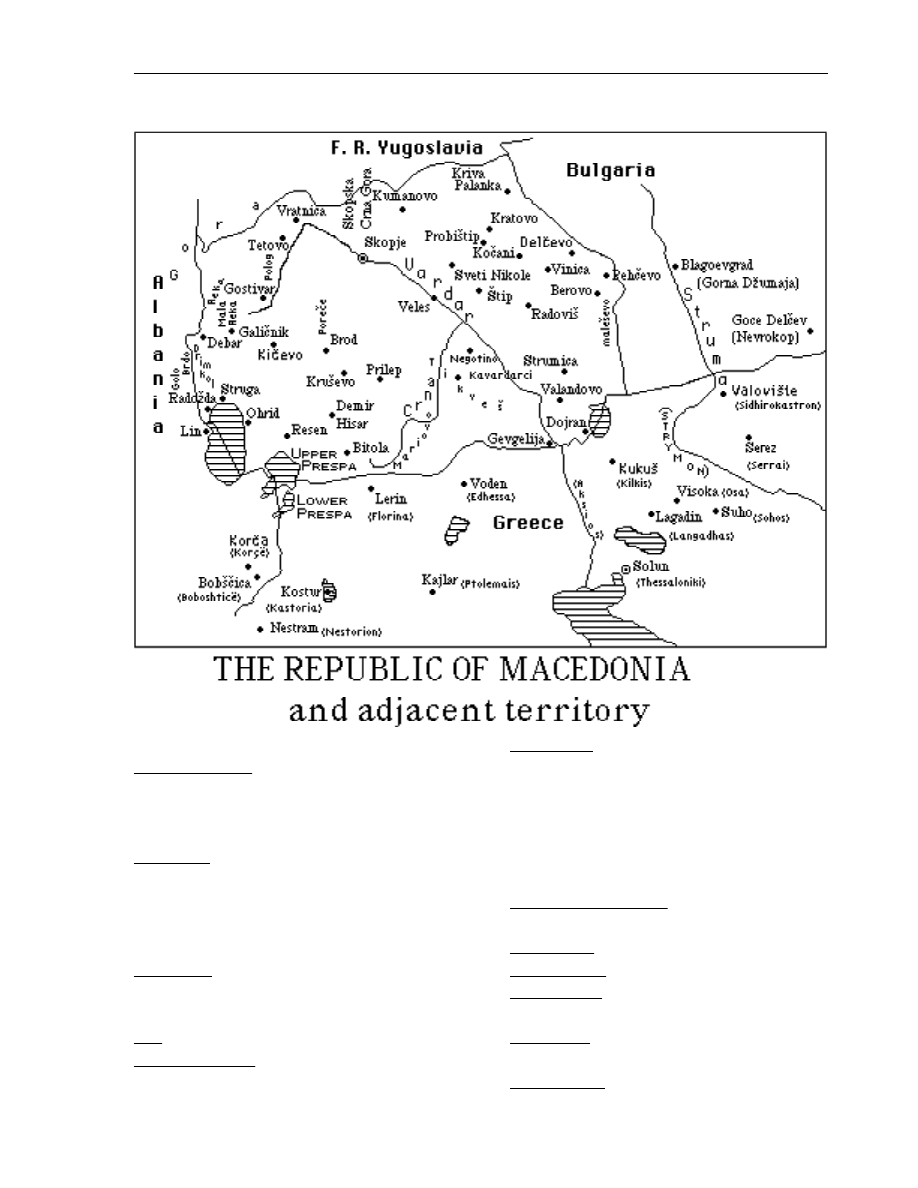
LW/M
117
77
MACEDONIAN
WESTERN DIALECTS
Ohrid-Prespa Group
Lower Prespa (East Banks of both lakes)
Ohrid-Struga (Resen)
Radoz
#da-Vevc#ani (Lin)
Debar Group
Drimkol-Golobrdo
Debar
Mala Reka (Galic
#nik)
Reka
Polog Group
Gostivar (Upper Polog)
Tetovo (Lower Polog)
Gora
Skopska Crna Gora (Vratnica)
Map
West Central (Veles, Prilep, Bitola, Lerin, Demir
Hisar, Krus
#evo, Brod, Kic#evo, Porec#e)
KOSTUR-KORC
‹A GROUP
Nestram
Korc
#a (Bobos#c#ica)
Kostur
EASTERN DIALECTS
Kumanovo-Kriva Palanka (Kratovo, Probis
#tip, Sveti
Nikole)
S
‹ tip-Strumica (Koc#ani, Radovis#)
Tikves
# -Mariovo (Negotino, Kavadarci, Valandovo)
Males
# evo-Pirin (Delc#evo, Pehc#evo, Berovo, Vinica,
Blagoevgrad)
Lower Vardar (Dojran, Gevgelija, Kukus
#, Lagadin,
Solun, Postol, Voden, Kajlar)
Seres-Nevrokop
(Visoka, Suho, Valovis
#te)

LW/M
117
78
MACEDONIAN

This topic is not addressed in the present grammar.
Wyszukiwarka
Podobne podstrony:
Gramatyka jezyka esperanto
SPRAWDZIAN Z GRAMATYKI JĘZYKA POLSKIEGO klasa III styczeń
GRAMATYKA JĘZYKA TURECKIEGO, Język TURECKI
Gramatyka języka esperanto
kompedium gramatyki jezyka angi Nieznany
Gramatyka scs - notatki z ćwiczeń, Gramatyka języka staro-cerkiewno-słowiańskiego (SCS)
test z gramatyki języka niemieckiego C7O2EC2LR2VTME4G7MCJDWLGWERLANRZNAXNPYI
100% gramatyki języka francuskiego Tablice gramatyczne
Odmiana rzeczowników scs. (tabelka), Gramatyka języka staro-cerkiewno-słowiańskiego (SCS)
Fonologia - opracowanie, Gramatyka języka polskiego
Fonetyka - opracowanie, Gramatyka języka polskiego
Gramatyka języka fińskiego
Słowniki i gramatyki języka polskiego, Polonistyka, Gramatyka historyczna
więcej podobnych podstron