Providing indoor climate comfort
COMFAIR -
HH
HH-IOM-0304-E
Installation, operating
and maintenance


INDEX
INDEX
1
INTRODUCTION
2
RECOMMENDATIONS
2
FIRST PART: FOR THE INSTALLER
IDENTIFICATION OF THE UNIT
3
TRANSPORTATION, RECEIVING, HANDLING
Safety provisions
3
DESCRIPTION OF THE UNIT
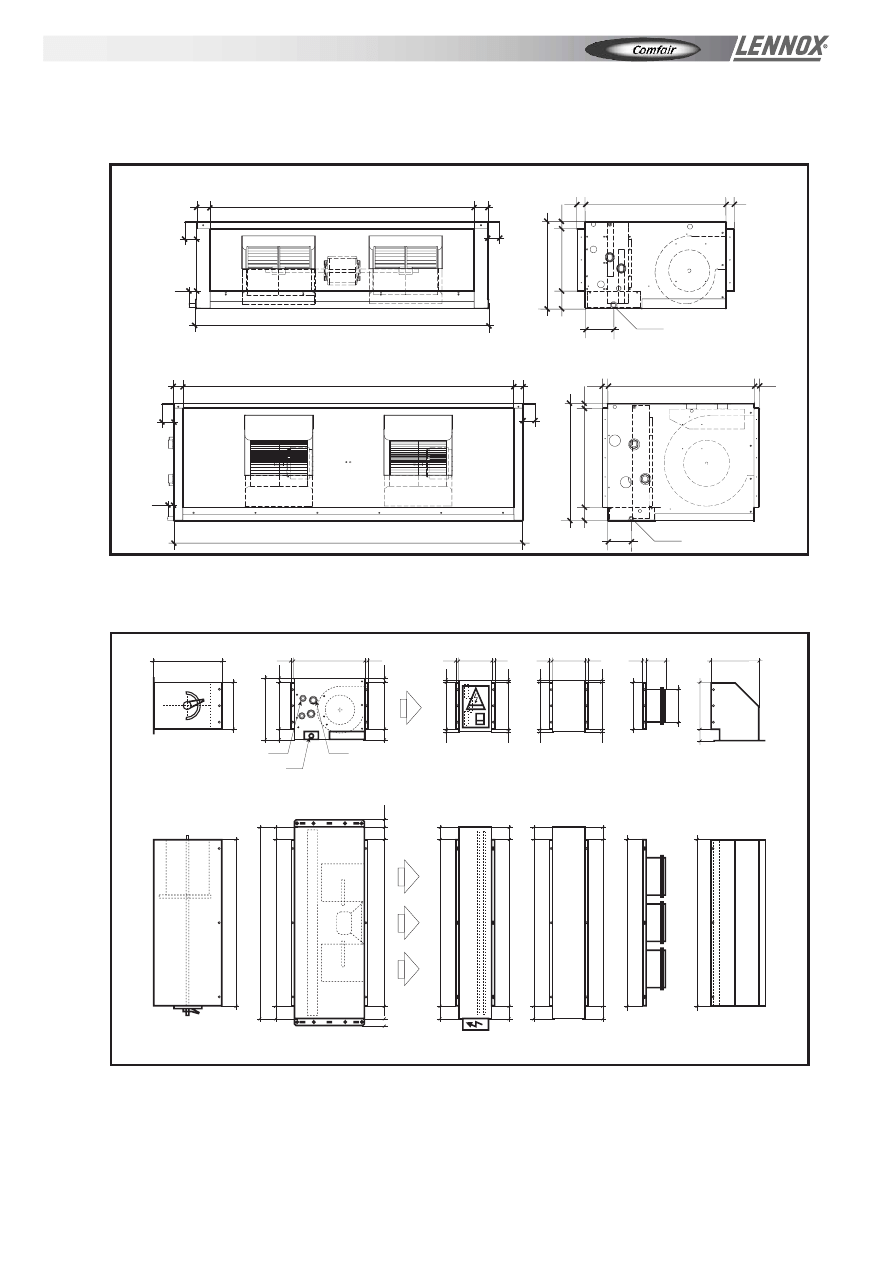
General size of the base unit
4
General technical data
5
Main parts
5
UNIT INSTALLATION
Recommendations for installation
6
Installation of the air treatment unit
6-7
Installation of the accessories for ducting the air treatment unit
7-9
WATER CONNECTIONS
Connection to the trunk line
10
Condensate water drainage
10
ELECTRICAL CONNECTIONS
Recommendations
Connections to the terminal blocks
11-13
TURNING THE COIL
14
SECOND PART: FOR THE USER
CLEANING AND MAINTENANCE
Routine maintenance
15
Cleaning the air filter
15
WHAT TO DO IF
16
DISMANTLING THE UNIT
16
INSTALLATION
- OPERATING & MAINTENANCE MANUAL
Page 1

INTRODUCTION
This installation and maintenance booklet should always accompany the air treatment unit for ready consultation by
the installer or user if necessary.
The unit should be installed in compliance with the regulations in force in each country and according to the manufacturer's
or qualified person's instructions.
The manufacturer cannot be held liable for any damage to property or injury to persons and animals caused by incorrect
installation of the unit.
Only qualified persons should install the unit and connect it to the mains electricity supply.
Before carrying out any work on the unit, ensure that it is disconnected from the electricity supply.
Read this instruction booklet prior to installation.
RECOMMENDATIONS
This unit is easy to use, but it is important to read all the contents of this guide before using it for the first time. This
will help you to:
- use the unit in all safety
- obtain best performance
- avoid incorrect actions
- respect the environment
Do not allow children or unassisted handicapped persons to use the unit.
Do not touch the unit with wet parts of the body or if barefoot.
Do not tug, pull or twist electrical cables attached to the unit, even when disconnected from the electricity supply.
Do not open the flaps giving access to the internal parts of the unit without having first put the system on-off switch to
"off".
Do not introduce sharp pointed objects through the air intake and outlet grilles.
Do not leave packing material (boards, staples, plastic bags, etc.) within reach of children since they could be a source
of danger. Dispose of correctly.
Do not spray or throw water directly on the unit.
Do not use the unit in places with suspended dust/powder or in potentially explosive atmospheres, in very damp
environments or in the presence of oil in suspension or in particularly aggressive atmospheres.
Do not cover the unit with objects or drapes that even partially obstruct the air flow.
The unit works by electricity at mains voltage (230 Vac, 50 Hz). Always bear in mind that mains voltage is potentially
dangerous and any appliance connected to it should be used with caution. Before carrying out any work on the unit,
disconnect it from the electricity supply (by pulling out the plug from the mains socket or isolating the supply line by
putting the on-off switch to off).
If the unit is not be used for long periods, make sure that the controls are in the position 0 (off). If the unit is not going
to be used in winter when temperatures are near to freezing, drain the system and ensure that the unit heat exchanger
has no water in it in order to prevent the formation of ice and consequent breakage.
To make the unit inoperable, disconnect it totally from the electricity supply.
It is unsafe to alter or try to alter the characteristics of this product. Any tampering or alteration in any case makes the
warranty null and void.
In the event of malfunction or failure, do not try to repair the unit yourself; contact a qualified technician. Repairs carried
out by incompetent persons could cause damage or accidents.
Always keep the unit clean. In particular clean the air filter periodically (at least once a month).
.
FAILURE TO COMPLY WITH THE ASSEMBLY INSTRUCTIONS GIVEN IN THIS
GUIDE RELIEVES LENNOX OF ALL AND ANY LIABILITY. INCORRECT
INSTALLATION COULD CAUSE MALFUNCTIONING OR FAILURE OF THE UNIT.
IT COULD ALSO REPRESENT A HAZARD FOR THE USER.
!
INSTALLATION
- OPERATING & MAINTENANCE MANUAL
Page
2
IDENTIFICATION OF THE UNIT
The HH air treatment units come with a rating plate, which shows:
- The manufacturer's address
- Supply voltage in "V"
- "CE" marking
- Supply frequency in "Hz"
- Model
- Number of phases, indicated with "Ph"
- Lot number
- Total cooling capacity in "W"
- Date of production
- Sensible cooling capacity in "W"
- Rated absorbed current in "A"
- Heat output.
- Input in "W"
TRANSPORTATION, RECEIVING, HANDLING
The units and their accessories are enclosed in cardboard boxes up to size 50, while the other sizes are palletised.
The packs should be kept intact until positioned in the final place of installation.
Use suitable handling equipment according to the weight of the unit, as provided for by directive 89/391/EEC and
subsequent amendments.
The weight of each single machine is given in this guide (table 2).
Upon receiving the unit, check all the parts for any damage caused in transit. Any damage should be reported to the
carrier by affixing an accepted with reservation on the accompanying note, specifying the type of damage.
In the event of prolonged storage, keep the units protected against dust and far from sources of vibration or heat.
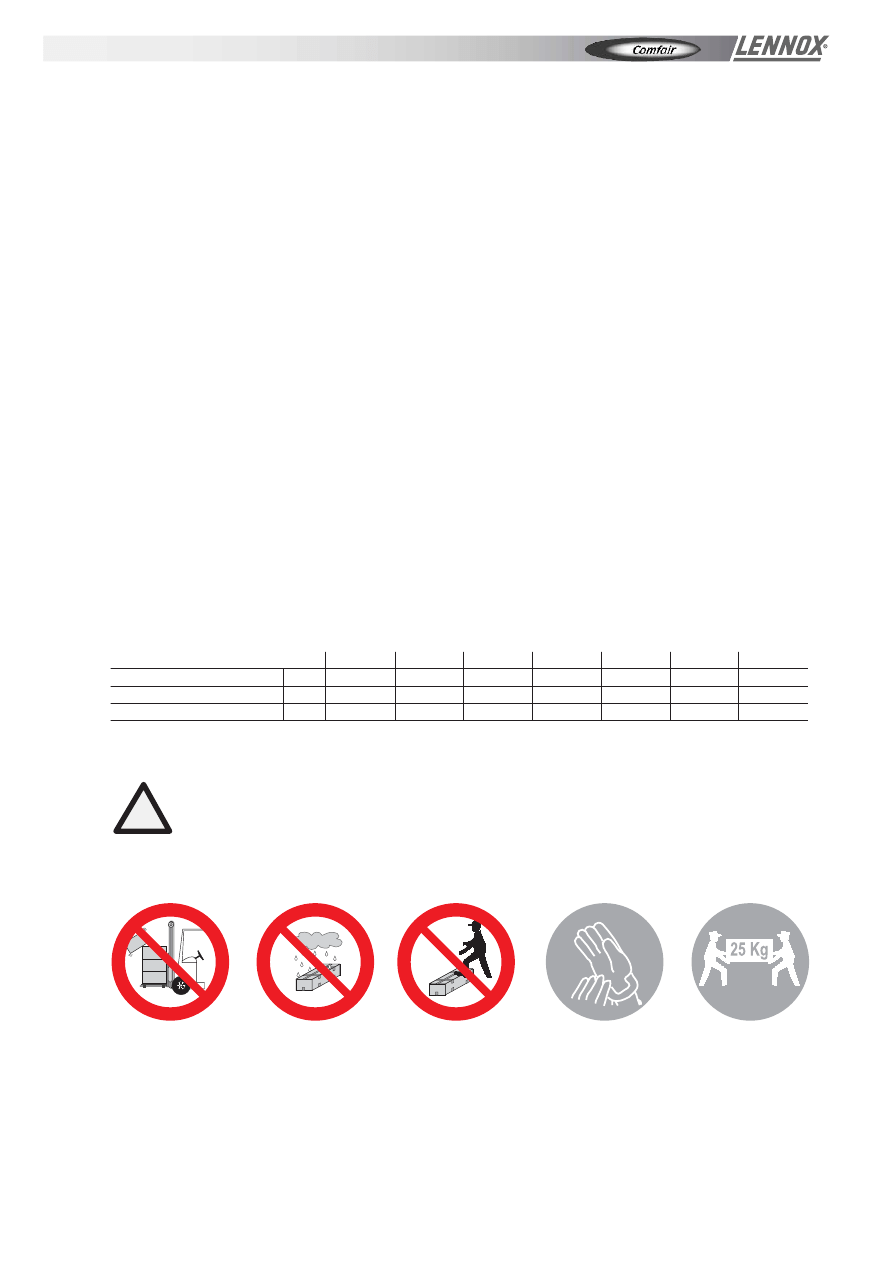
The number of units that may be positioned on one pallet are given in the table (table 1).
SAFETY PROVISIONS
Secure packs during
transportation.
Do not expose to the
elements.
Do not tread on packs.
Protect hands with work gloves
when dismantling the unit.
Work in PAIRS if the
appliance weighs
more than 25 kg.
Tab. 1
MODE HH 10 HH 20 HH 30
HH
40 HH 50 HH 60 HH 70
Max. number per pallet
Pallet size
Unit overall dim.
mm
650x533x299 1.000x533x299 1.100x533x324 1.339x533x324 1.339x533x374 1.341x853x674 2.028x853x674
N.
10
5
5
5
5
2
2
140x80
120x80
120x80
150x80
150x80
150x100
230x100
N.B.: the units may be stacked up to a maximum of 1.80 m in height
LENNOX
CANNOT BE HELD LIABLE FOR DAMAGE DUE TO INCORRECT
HANDLING OR LACK OF PROTECTION AGAINST THE ELEMENTS.
!
INSTALLATION
- OPERATING & MAINTENANCE MANUAL
Page
3
DESCRIPTION OF THE UNIT
MODELS HH
10, 20, 30, 40, 50
51
MODELS HH 60-70
51
B
44
44
37
L
51
51
B
44
44
37
L
29
29
P
26
A
76
H
107
Ø 20
29
29
P
26
A
76
H
107
Ø 20
Fig. 1
HH
UNIT BASE
400
A
SSP
SRE
PAM
BAM
RAM
B
B
50
50
B
50
50
B
B
B
50
50
B
50
50
204
26
26
A
11
11
A
11
11
341
A
11
5
204
26
26
A
11
11
A
11
11
70
A
ØBAM
30
B
51
51
L
B
51
51
44
44
P
26
H
A
29
29
76
26
A
76
ØAF
ØAC
ØC
Fig. 2
GENERAL SIZE OF THE BASE UNIT
GENERAL SIZE OF DUCTWORK ACCESSORIES
INSTALLATION
- OPERATING & MAINTENANCE MANUAL
Page
4
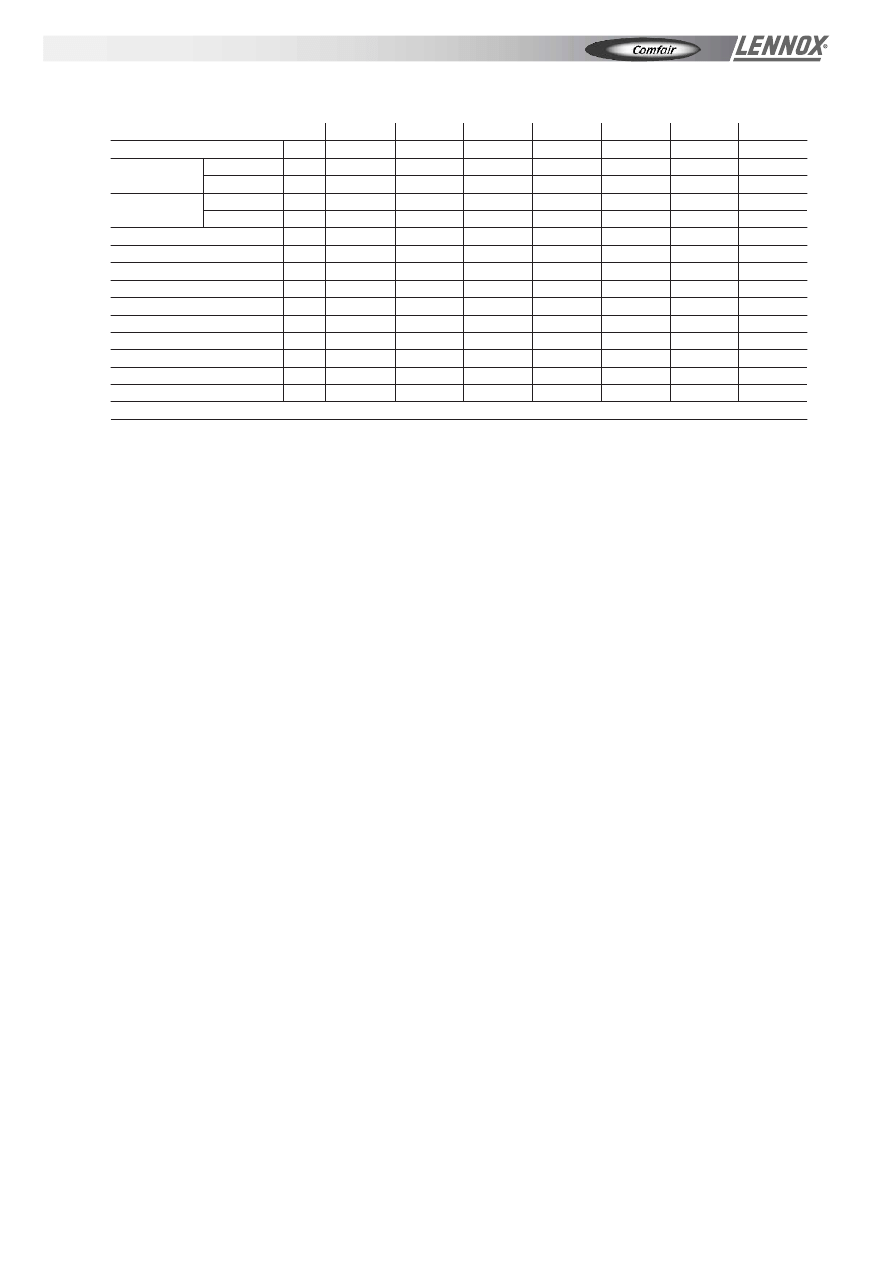
GENERAL TECHNICAL DATA
MAIN PARTS
LOAD-BEARING STRUCTURE
Galvanised (1 mm for mod. 10-50 and 1.5 mm for mod. 60-70) plate, insulated wherever it is in indirect contact with
the heat-carrying fluid. Condensate collecting tray in insulated, galvanised plate complete with fittings for condensate
drainage. Slots for easy wall-mounting and levelling of unit.
HEAT EXCHANGER COIL
Coils in copper piping expanded into aluminium fins in continuous block. Copper headers with brass connections
equipped with male fittings (gas thread) and easily accessible air valves.
Water fittings placed on the left (facing the unit). They may be supplied on the right on request.
ELECTRIC FAN UNIT
Double-inlet centrifugal fans with statically and dynamically balancing horizontally-oriented aluminium impellers.
Single-phase asynchronous electric motor with overload cutout. 3 speeds of rotation. The motor is directly coupled to
the fans and cushioned with flexible mountings to ensure low noise.
ACCESSORIES
SSP
Section with external air intake (manual). Made in galvanised sheet metal, it allows a change of air in the
rooms. Internal air flow: 100%-66.6%. External air flow: 0%¸33.3%
SRE
Heating section with electric heating element (380V), fabricated to international safety standards. It comes
complete with safety thermostat with automatic reset, interface control relay, wiring and control panel with on-
off/magnetothermal switch
FAM
Connecting flange
GAM
Vibration isolation joint
PAM
Straight intake/delivery plenum
BAM
Intake/delivery union with circular fittings
RAM
90° intake/delivery plenum
SFA
Air filter section. Filtering membrane enclosed within a metal frame for easy extraction. Filtering rate EU3.
Regenerable by washing in water, blowing, suction
AUXILIARY COIL for heating (4 rows)
4 AND 6-ROW COIL
Fans - Motors
No.
Rows
No.
Fittings (ØAF)
Ø
Rows
No.
Fittings
(ØAC)
Ø
Condensate drain fitting
(ØC)
Ø mm
Height
mm
Width
mm
Depth
mm
(A)
mm
(B)
mm
No. x Ø BAM
mm
Net weight
kg
Electric fan power
W
Electric fan current
A
Standard coil
(H)
(L)
(P)
ELECTRICITY SUPPLY 230 V/1/50 Hz
MODEL
HH 10 HH 20 HH 30 HH 40 HH 50 HH 60 HH 70
1-1
2-1
2-1
2-1
2-1
1-1
2-2
3
3
3
3
3
4
4
1/2"
1/2"
3/4"
3/4"
1"
1"1/4
1"1/2
1
1
1
1
1
2
2
1/2"
1/2"
1/2"
1/2"
3/4"
1"
1"1/4
20
20
20
20
20
20
20
299
299
324
324
374
674
674
650
1.000
1.100
1.339
1.339
1.341
2.028
533
533
533
533
533
853
853
197
197
222
222
272
572
572
548
898
998
1.237
1.237
1.239
1.926
2xØ200
3xØ200
3xØ200
4xØ200
4xØ200
2xØ200
4xØ200
28
26
41
46
57
117
192
162
218
322
340
582
1.320
2.600
0,72
0,97
1,43
1,51
2,58
5,86
11,54
Auxiliary coil
Tab. 2
INSTALLATION
- OPERATING & MAINTENANCE MANUAL
Page
5
UNIT INSTALLATION
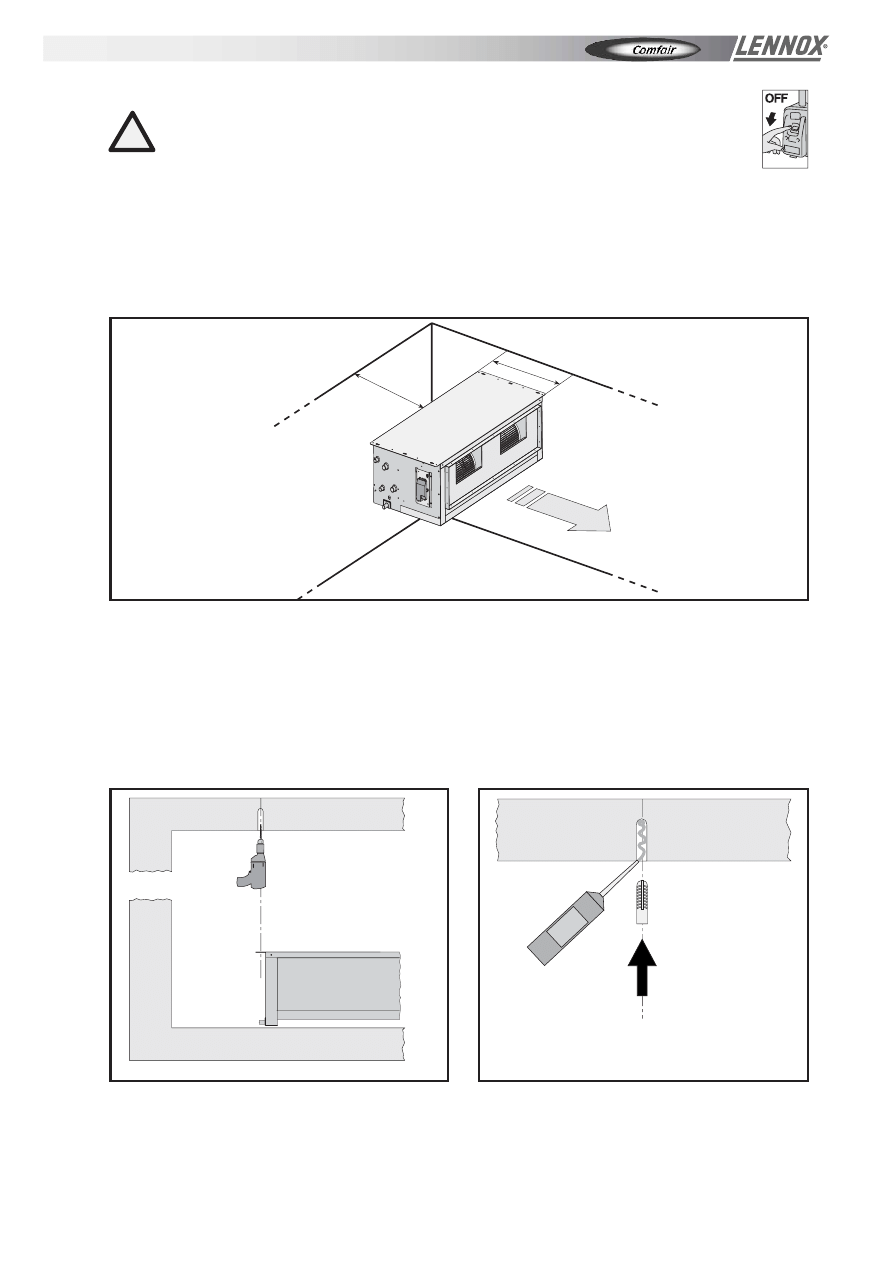
RECOMMENDATIONS FOR INSTALLATION!
Before installing the unit, ensure that:
1) the place of installation has sufficient space for carrying out installation as well as routine and extraordinary maintenance work
(see fig. 3). If the unit is installed behind a suspended ceiling, an access should be provided;
2) there are no obstructions for air intake and delivery;
3) the water fittings are of the sizes, in the position and spaced apart as required by the unit;
4) the system pressure does not exceed 8 bar for the water-filled versions;
5) the electricity supply corresponds to the data on the unit rating plate and that there is a circuit breaker switch readily accessible
to the user to cut off the power supply whenever necessary;
6) the circuit breaker is in the OFF position so that there is no voltage on the unit supply line.
!
Fig. 4
Fig. 5
Drill the holes in line with the relative slots for the 6 unit screw anchors (fig. 4). Inject thermosetting resin into the
holes and then insert the screw anchors (fig. 5).
Preliminary operations:
- check that the various unit components are perfectly intact;
- check that the installation accessories and documentation are in the pack;
- place the packed section as close as possible to the place of installation;
- do not place tools or weights of any kind on the packed unit.
Fig. 3
INSTALLATION OF THE AIR TREATMENT UNIT
P
1,5 P
INSTALLATION
- OPERATING & MAINTENANCE MANUAL
Page
6
UNIT INSTALLATION
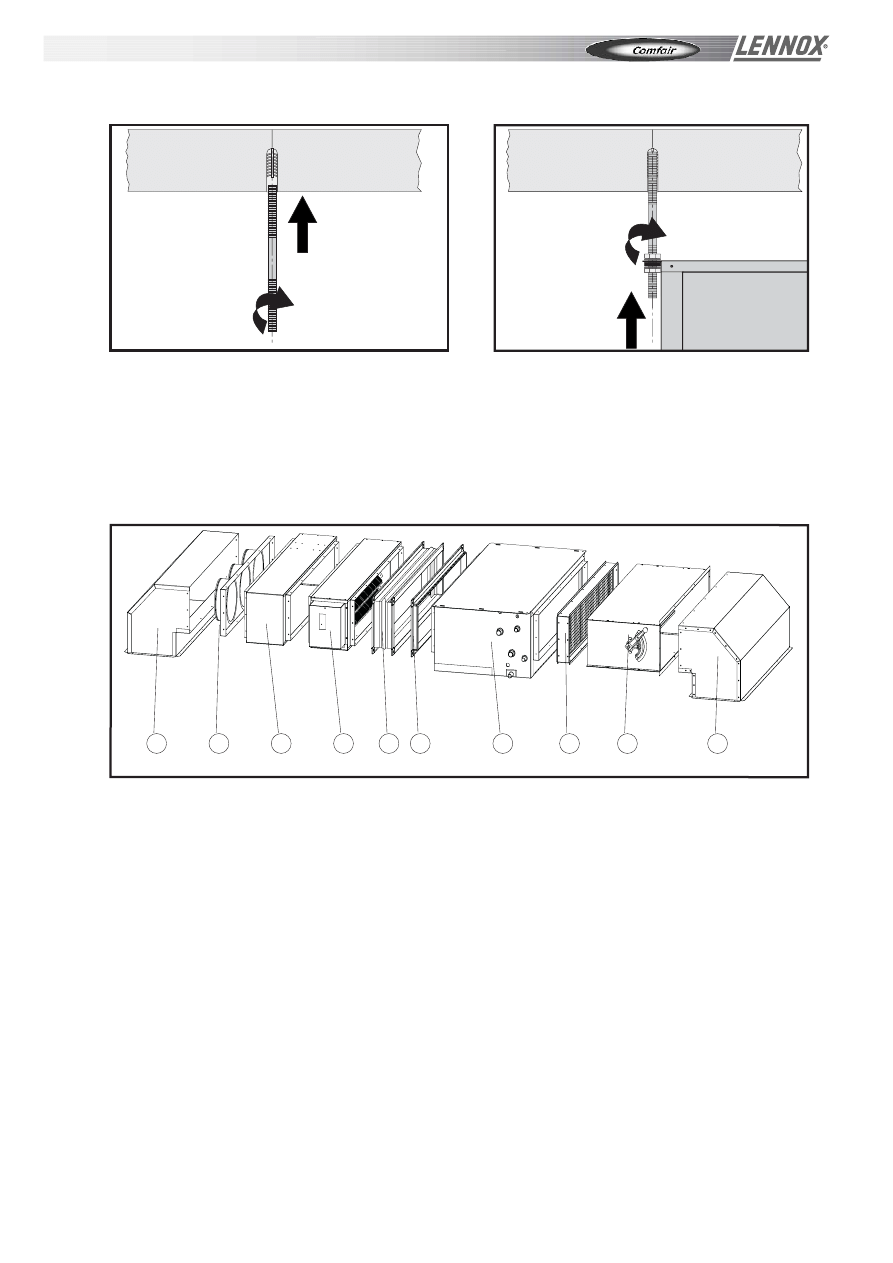
Fix the threaded rods of the correct length to the screw anchors (fig. 6) and insert them into the relative slots (fig. 7).
After having created a slope (max. 3 cm/m) in the direction of the condensate outlet, lock the threaded rod with a nut
and check nut. To prevent possible noise being created by vibrations from the unit, it is advisable to insert a vibration-
damping joint.
N.B.: the screw anchors, threaded rods and whatever else is necessary for accomplishing the installation are NOT
included in the supply of the air treatment unit.
INSTALLATION OF THE ACCESSORIES
LEGEND
1 RAM 90° intake/delivery plenum
2 BAM intake/delivery union with circular fittings
3 PAM straight intake/delivery plenum
4 SRE heating section (with electric heating element)
5 GAM vibration isolation joint
6 FAM connecting flange
7 UTC base unit
8 SFA air filter section
9 SSP section with external air intake (manual).
N.B.: Fig. 8 shows the exploded view of the unit with ALL the accessories.
Fig. 6
Fig. 7
1
2
3
4
5
6
7
8
9
1
Fig. 8
INSTALLATION
- OPERATING & MAINTENANCE MANUAL
Page
7
INSTALLATION OF THE ACCESSORIES
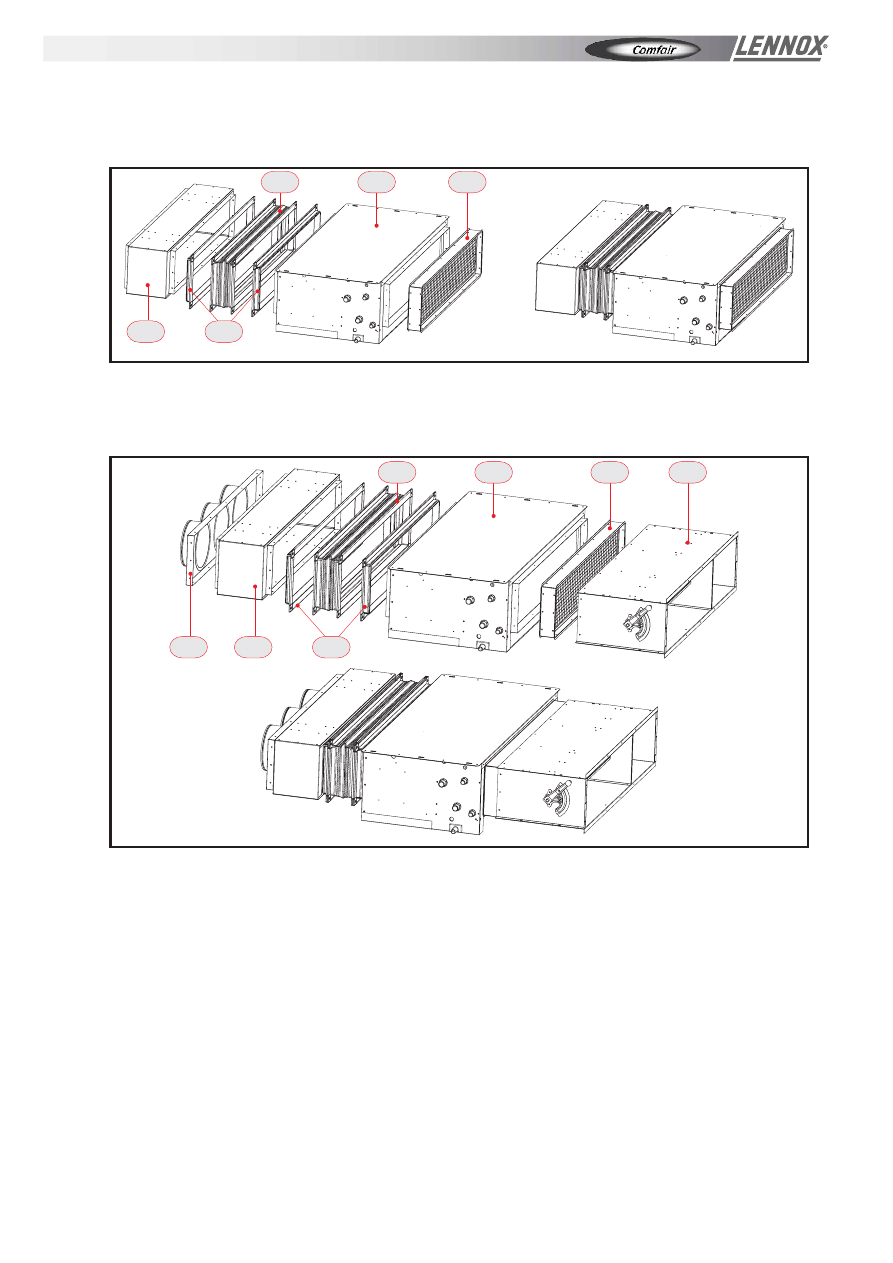
Fig. 9
First of all put the air filter section (SFA) on the unit intake, inserting it into the special rim (male-female) and fixing it
with the galvanised self-tapping screws 4.2x9.5.
Proceed as described above on the delivery end with the connecting flange (FAM).
Put the vibration isolation joint (GAM) on the flange and fix it using the cheese-headed screws M8x16 and hexagon
bolts.
Some examples are given below of assembling the accessories for ducted air treatment units.
Proceed by inserting the manual air intake section (SSP) into the air filter section (SFA) by means of the male-female
coupling.
After having secured it with the self-tapping screws (4.2 x 9.5 galvanised), anchor it to the ceiling as illustrated for the
base unit in figures 4-7.
Put another connecting flange on the vibration isolation joint (GAM) and secure it using cheese-headed screws M8x16
and hexagon bolts.
Insert the straight delivery plenum (PAM) in the connecting flange and fix it using galvanised self-tapping screws 4.2
x 9.5.
Connect the air delivery union with round fittings (BAM) with the procedure described above.
Fig. 10
GAM
PAM
FAM
FCC
SFA
GAM
PAM
FAM
FCC
SFA
SSP
BAM
INSTALLATION
- OPERATING & MAINTENANCE MANUAL
Page
8
INSTALLATION OF THE ACCESSORIES
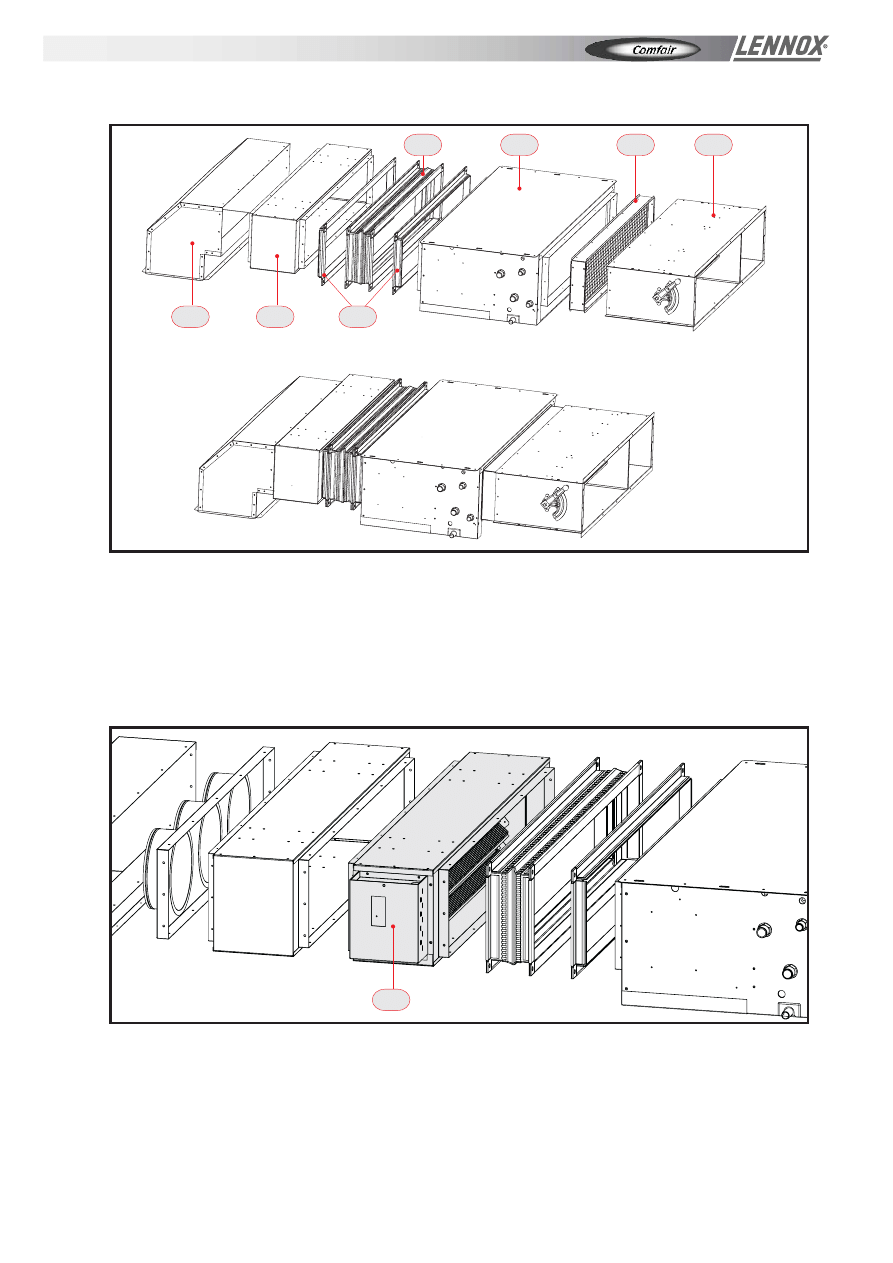
A 90° plenum (RAM) may be used instead of the air delivery union for better direction of airflow.
Insert the manual air intake section (SSP) in the air filter section (SFA) by means of the male-female coupling.
After having secured it with the self-tapping screws (4.2 x 9.5 galvanised), anchor it to the ceiling as illustrated for the
base unit in figures 4-7.
Put another connecting flange on the vibration isolation joint (GAM) and secure it using cheese-headed screws M8x16
and hexagon bolts.Insert the straight delivery plenum (PAM) in the connecting flange and fix it using galvanised self-
tapping screws 4.2 x 9.5.
Then connect the 90° plenum (RAM) with the procedure described above.
Fig. 12
The heating section with electric heating element (SRE) is usually placed on the delivery side before the straight delivery
plenum (PAM).
It may be used either with the delivery union (BAM) or with the 90° delivery plenum (RAM).
The coupling is of the male-female type with fixing by means of galvanised self-tapping screws 4.2 X 9.5
Fig. 11
GAM
PAM
FAM
FCC
SFA
SSP
RAM
SRE
INSTALLATION
- OPERATING & MAINTENANCE MANUAL
Page
9
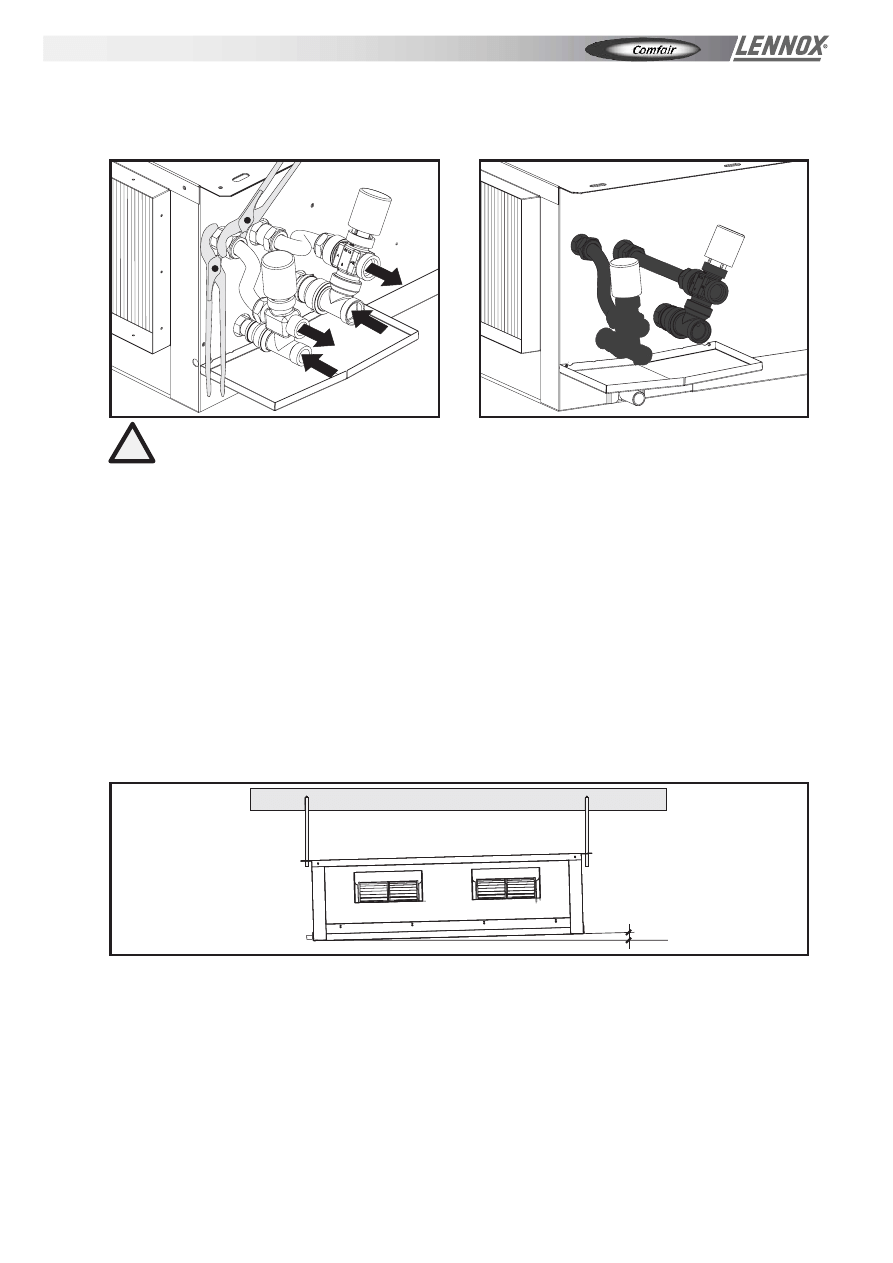
!
CAUTION!
Always use a wrench and counter-wrench for connection of the coil to the pipes (fig. 13). If the solenoid valve
is installed, suitably insulate the valve body with insulating material (fig. 14).
Connect the water inlet and outlet pipes, observing the indications given on the side of the unit. Correctly insulate the
water supply pipes to prevent dripping during the cooling mode of operation. A shutoff valve should be inserted on the
water supply pipe and a balancing valve on the outlet pipe. The valve body and balancing valve should also be properly
insulated to prevent dripping. It is the installer's responsibility to insulate properly and the manufacturer cannot be held
liable for any insulation work.
N.B.: It is always advisable to install the solenoid valve.
In the heating mode of operation the solenoid valve reduces consumption because upon reaching the set temperature the
circulation of water is stopped to avoid wasting energy (the fan coil would otherwise continue to heat like a radiator, even
with the motor at a standstill).
In the cooling mode of operation the solenoid valve stops the circulation of water when the set temperature is reached, thus
stopping the internal exchanger from continuing to condense water with possible undesirable dripping onto the floor. It also
reduces chiller operation with consequent energy saving.
CONNECTION TO THE TRUNK LINE
Fig. 13
Fig. 14
WATER CONNECTIONS
The condensate drain pipe should slope downwards by at least 3 cm/m and should not have ascending or throttled
sections in order to ensure a regular flow of water. It is advisable for a trap to be fitted. The condensate drain pipe
should be connected to a rainwater drainage system. Do not use sewage systems to avoid possible rising of odours
in the event of evaporation of the water in the trap. Upon completion of work, check that the condensate flows out
properly by pouring water into the tray. The condensate water drainage system should be fabricated in a workmanlike
manner and should be periodically checked.
The manufacturer cannot be held liable for any damage caused by dripping in the absence of a solenoid valve
or of periodic maintenance of the drainage system.
Fig. 15
3 cm/m
IN
OU
T
IN
OU
T
CONDENSATE WATER DRAINAGE
INSTALLATION
- OPERATING & MAINTENANCE MANUAL
Page 1
0
ELECTRICAL CONNECTIONS
RECOMMENDATIONS
Before carrying out electrical connections, ensure that the electricity supply to the supply line has been cut off, checking
that the on-off switch is in the OFF position.
- Only qualified electricians should carry out the electrical connections.
- Check that the mains supply is single-phase 230 Vac/1/50 Hz (± 10%).
- Operating the unit with voltages outside the above limits could cause malfunction and renders the warranty null and
void.
- The power supply line should be fitted with at least a switch isolator in conformity with European standard EN60947-3.
- Make sure that the electrical system is suitable for providing not only the working current required by the unit, but
also the necessary current for powering household and other electrical appliances already in use. Any electrical and
mechanical alterations or tampering render the warranty null and void.
!
The cables should be sufficiently long so that they are not permanently taut or create throttling or compression
on metal parts .
The power cables should be sufficiently long so that in the event of accidental tugging the active wires are subjected
to stress before the earth wire.
Connect the earth wire to the relative terminal marked with the symbol .
Check the earth connection.
Comply with the safety regulations in force in the country of installation.
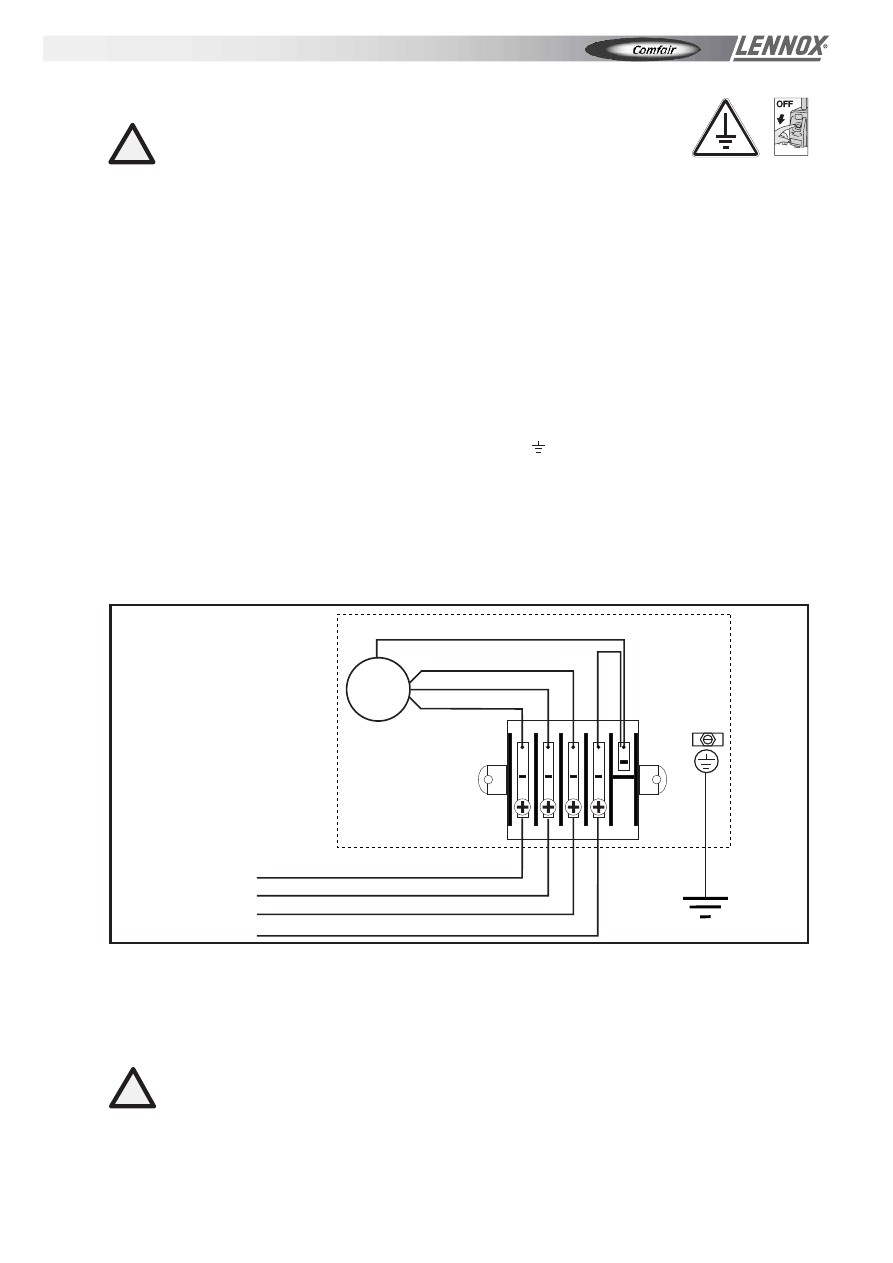
CONNECTIONS TO THE TERMINAL BLOCKS
The electrical connections should be made to the terminal block on the side of the appliance. Each terminal is identified
by the label to be found on the terminal block.
LEGEND
Ph
Phase (brown)
I Minimum speed (red)
N
Neutral (blue)
II Medium speed (blue)
T
Earth (yellow/green)
III Maximum speed (black)
M
Fan motor
Com Common (white)
CAUTION!
FAILURE TO COMPLY WITH THE INDICATED CONNECTIONS MAY CAUSE MOTOR
BURNOUT!
!
Fig. 16
T
M
com
I
II
III
Remote control
230 Vca / 1 / 50 Hz
III
II
I
COM
T
Wiring diagram of ductable air treatment unit mod. 10 - 20 - 30 - 40.
INSTALLATION
- OPERATING & MAINTENANCE MANUAL
Page 1
1
ELECTRICAL CONNECTIONS
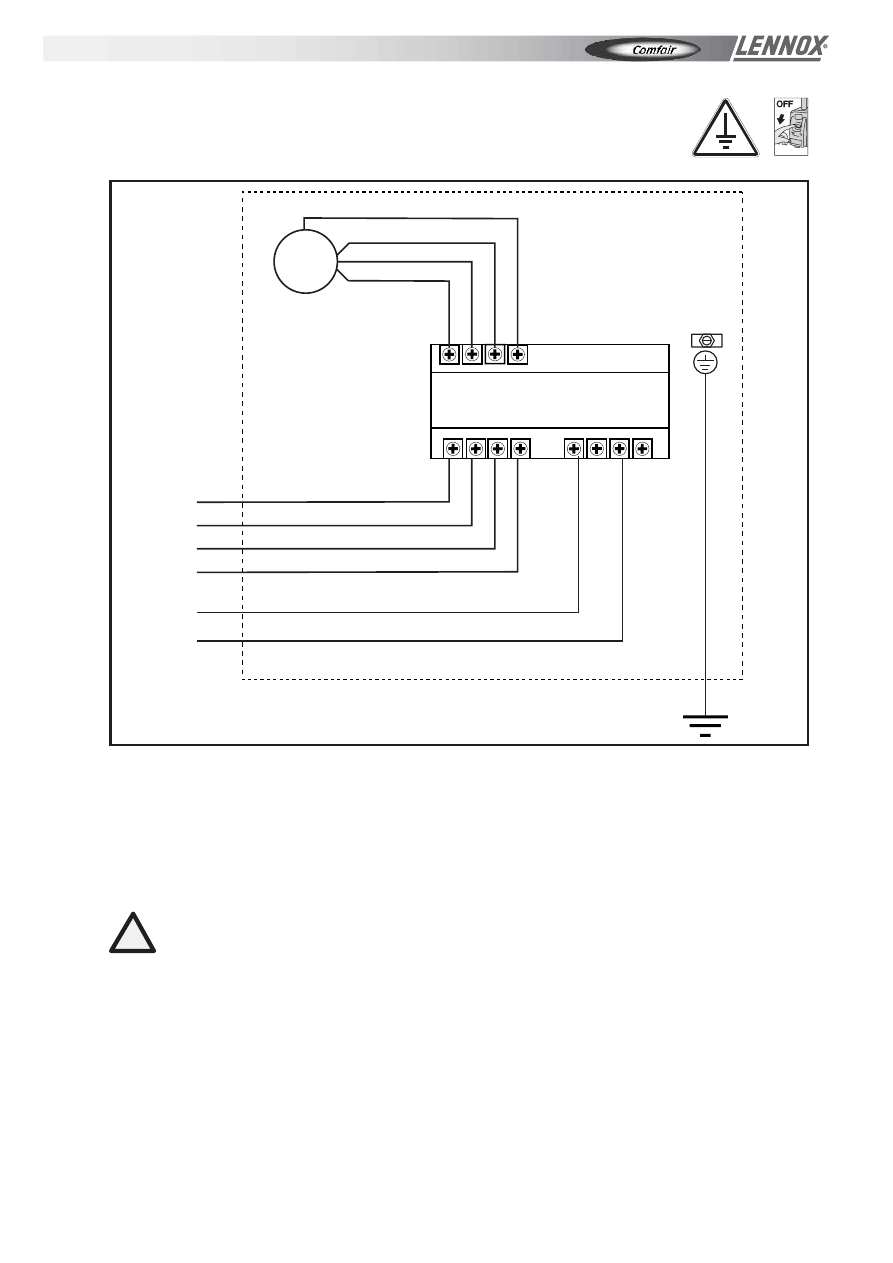
Wiring diagram of ductable air treatment unit mod. 50 - 60 .
LEGEND
Ph
Phase (brown)
N
Neutral (blue)
T
Earth (yellow/green)
M
Fan motor
I
Minimum speed (red)
II
Medium speed (blue)
III
Maximum speed (black)
Com
Common (white)
25 26 27 28
1 2 3 4
Relay interface card
14 15 16 17
M
I
II
III
com
com
I
II
III
230 V / 1 / 50 Hz motor power supply
N
Ph
T
T
CAUTION!
FAILURE TO COMPLY WITH THE INDICATED CONNECTIONS MAY CAUSE MOTOR
BURNOUT!
!
Fig. 17
INSTALLATION
- OPERATING & MAINTENANCE MANUAL
Page 1
2
ELECTRICAL CONNECTIONS
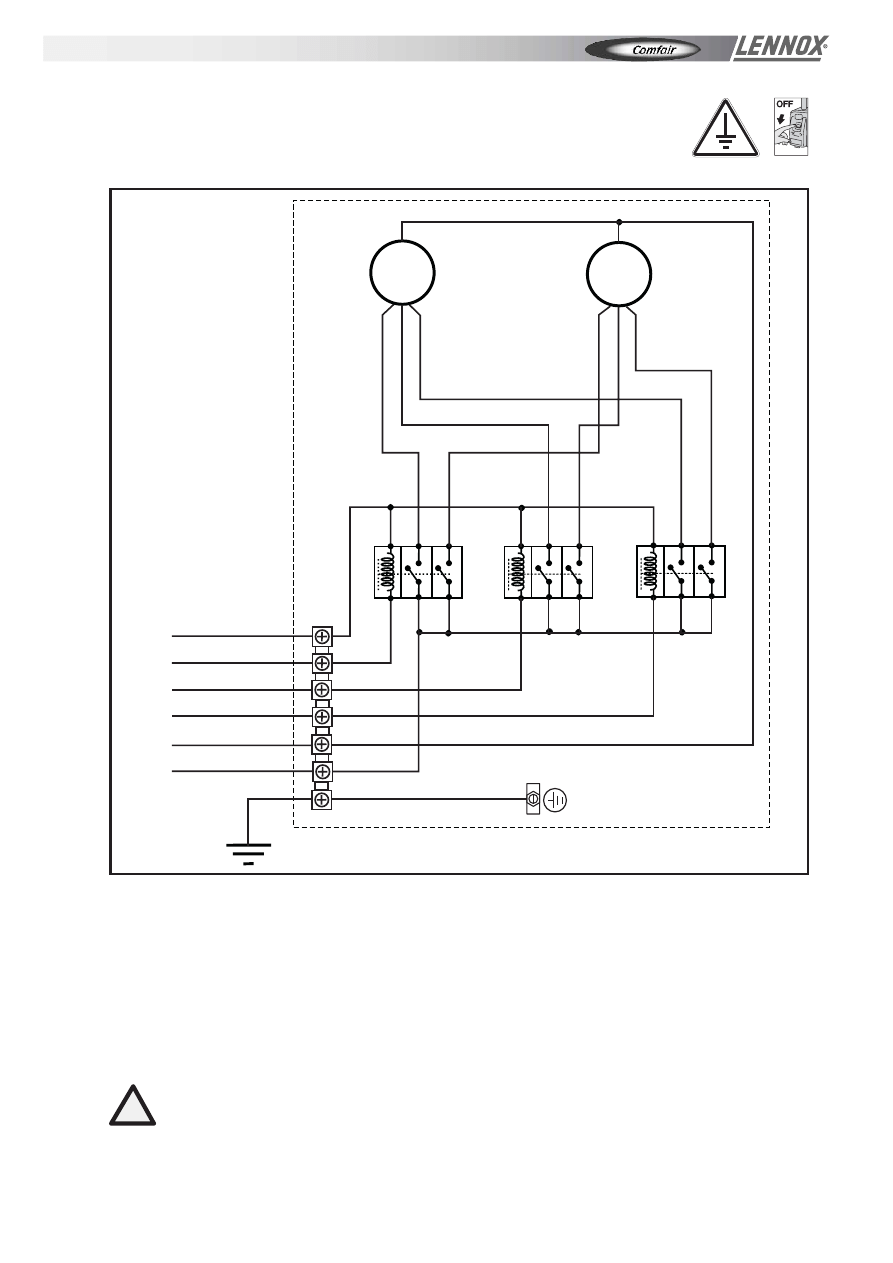
Wiring diagram of ductable air treatment unit mod. 70.
Com
I
II
III
I
II
III
Remote control
230Vca
N
Ph
T
230 V / 1 / 50 Hz
G/V
R3
I
II
III
R1
R2
A1 2
4
A1
2
4
A1 2
4
A2
1
3
A2
1
3
A2 1
3
3
3
2
2
1
1
M1
M2
T
LEGEND
Ph
Phase (brown)
N
Neutral (blue)
T
Earth (yellow/green)
M1, M2 Fan motor
Com
Common (white)
I
Minimum speed (red)
II
Medium speed (grey)
III
Maximum speed (black)
R1
Relay
R2
Relay
R3
Relay
CAUTION!
FAILURE TO COMPLY WITH THE INDICATED CONNECTIONS MAY CAUSE MOTOR
BURNOUT!
!
Fig. 18
INSTALLATION
- OPERATING & MAINTENANCE MANUAL
Page 1
3
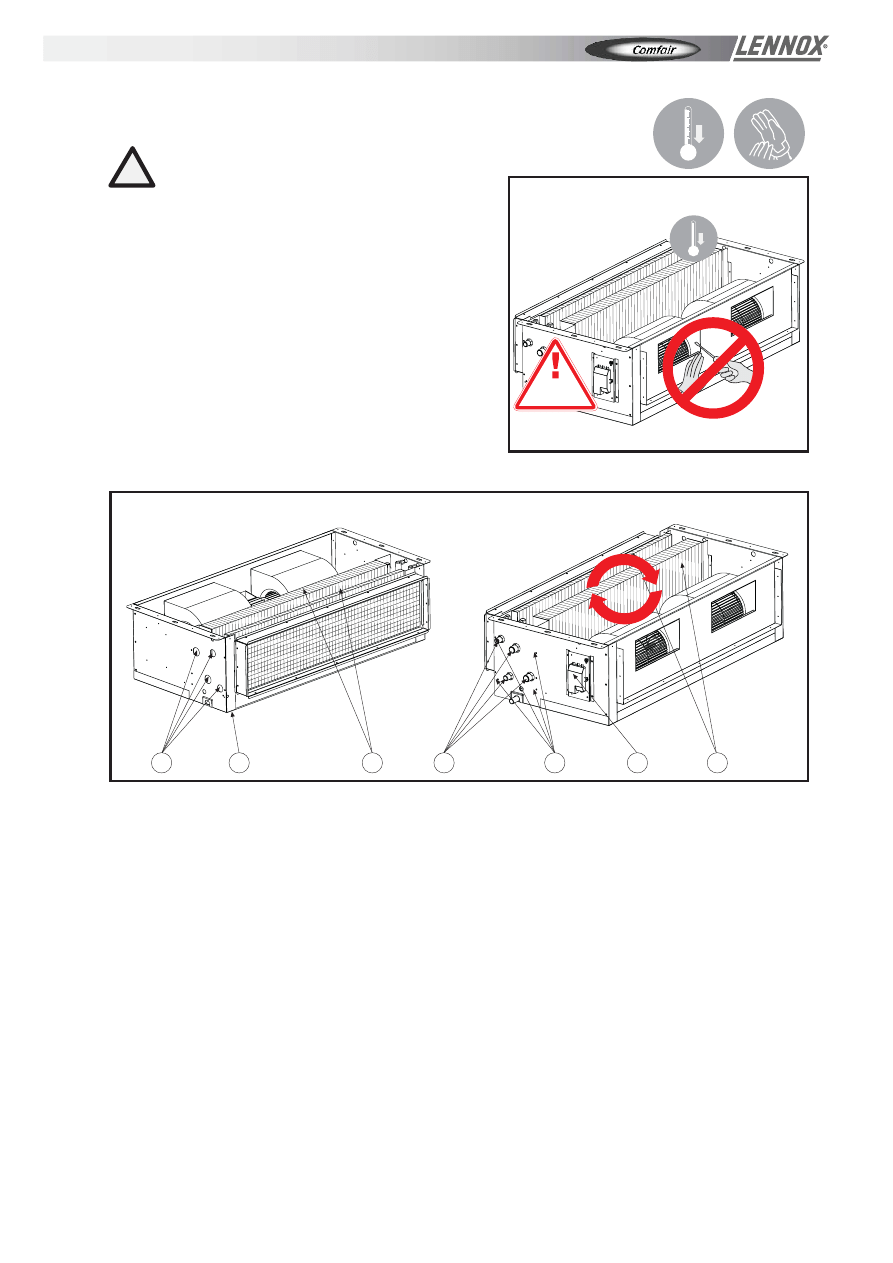
To turn the coil, proceed as follows:
Fig. 20
1. Disconnect the terminal block (6) from the side of the unit.
2. Remove the condensate collecting tray (2).
3. Remove the coil fixing screws (5).
4. Take out the coil (3), being careful not to be cut by the fins and not to damage them.
5. Remove the knockouts (1) on the opposite side of the unit (using a screwdriver) to allow the coil connections to
pass through.
6. Position the coil, turning it without tipping it upside down, so that the fittings are in line with the holes left by the
knockouts.
7. Fix the coil using the previously removed screws (5).
8. Shift the terminal block (fixing it to the side opposite the water fittings) and the motor cables, fixing them with their
clamps. Ensure that the cables pass through the hole in the side of the unit, protecting them with the relative
grommet. If it proves easier to carry out this operation by separating the wires from the terminal blocks, mark the
positions of the wires to avoid making mistakes when reconnecting.
9. Reconnect the wires to the relative terminal blocks (6), taking care that they are correctly positioned.
10. Replace the condensate collecting tray (2).
1
3
4
5
6
3
2
TURNING THE COIL
CAUTION
The fan wheels may reach the speed of 1,000 rpm. Do not insert
objects into the electric fan and certainly not hands. The motor
becomes hot during operation; wait for it to cool before touching it.
During the heating mode of operation the exchanger and the
connecting pipes may become very hot (80°C). Wait for the exchanger
to cool before touching it or protect hands with suitable gloves.
The heat exchange water coils are suitable for working up to
a maximum pressure of 8 bar.
!
0°
60°
Fig. 19
P=8
bar max
0°
60°
INSTALLATION
- OPERATING & MAINTENANCE MANUAL
Page 1
4
CLEANING AND MAINTENANCE
CAUTION! Before carrying out any cleaning or maintenance work, disconnect the unit
from the mains electricity supply!
ROUTINE MAINTENANCE
The user is duty bound to have all maintenance operations carried out by trained and qualified personnel only. If the
unit has to be dismantled, protect hands with work gloves.
Monthly checks:
- Ensure that the fan impellers are clean. If they are dirty, clean them by suction so as not to damage them.
- Check the whole of the electrical part and in particular that the electrical connections are tight.
Yearly checks:
- Check the whole of the electrical part and in particular that the electrical connections are tight.
- Check the tightness of all the bolts, nuts and whatever else may be loosened by the constant vibrations of the unit.
- Check the motor for dust, dirt or other impurities. Periodically check that the motor works without unusual vibrations
or noise and that the fan inlet is not obstructed, which could otherwise leading to overheating of the windings.
- Check the fans for dirt or any foreign matter.
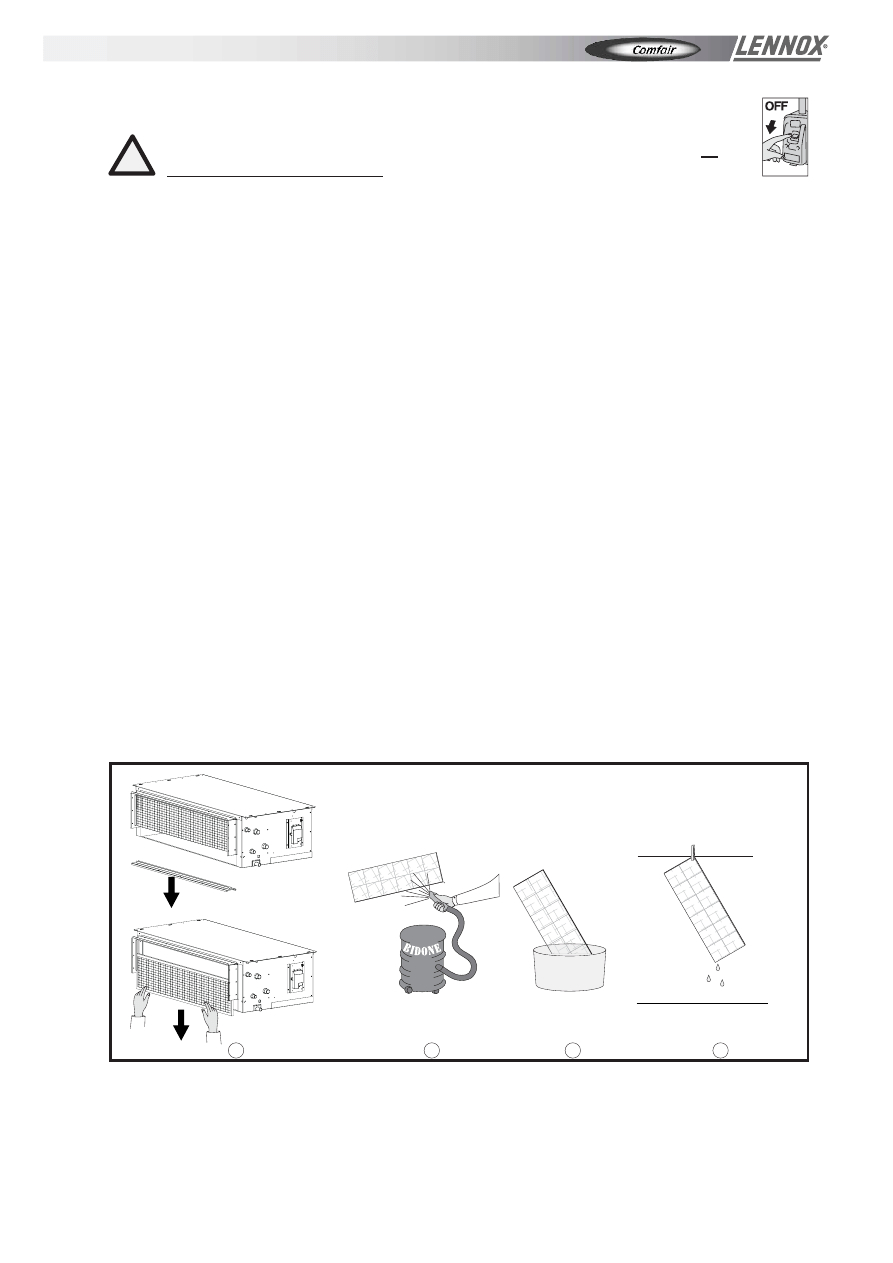
CLEANING THE AIR FILTER
The unit is fitted with an air filter on the fan inlet. During normal operation the filter holds back impurities in the air.
The filter should be cleaned periodically to keep its filtering properties and the airflow to the fan unchanged.
It is advisable to clean the filter at least once a month, proceeding as follows.
1. Take out the filter.
2. Place the filter on a flat, dry surface and remove the accumulated dust with a vacuum cleaner.
3. Wash the filter with water and detergent (no solvents).
4. Leave the filter to dry in a ventilated place in the sun.
5. Replace the filter when it is perfectly dry.
Clean the filter at the beginning and end of every season.
N.B.: the filter may also be taken out from the side or from the top.
Fig. 21
WATER
+
DETERGENT
!
1
2
3
4
INSTALLATION
- OPERATING & MAINTENANCE MANUAL
Page 1
5
R A N G E
F C C
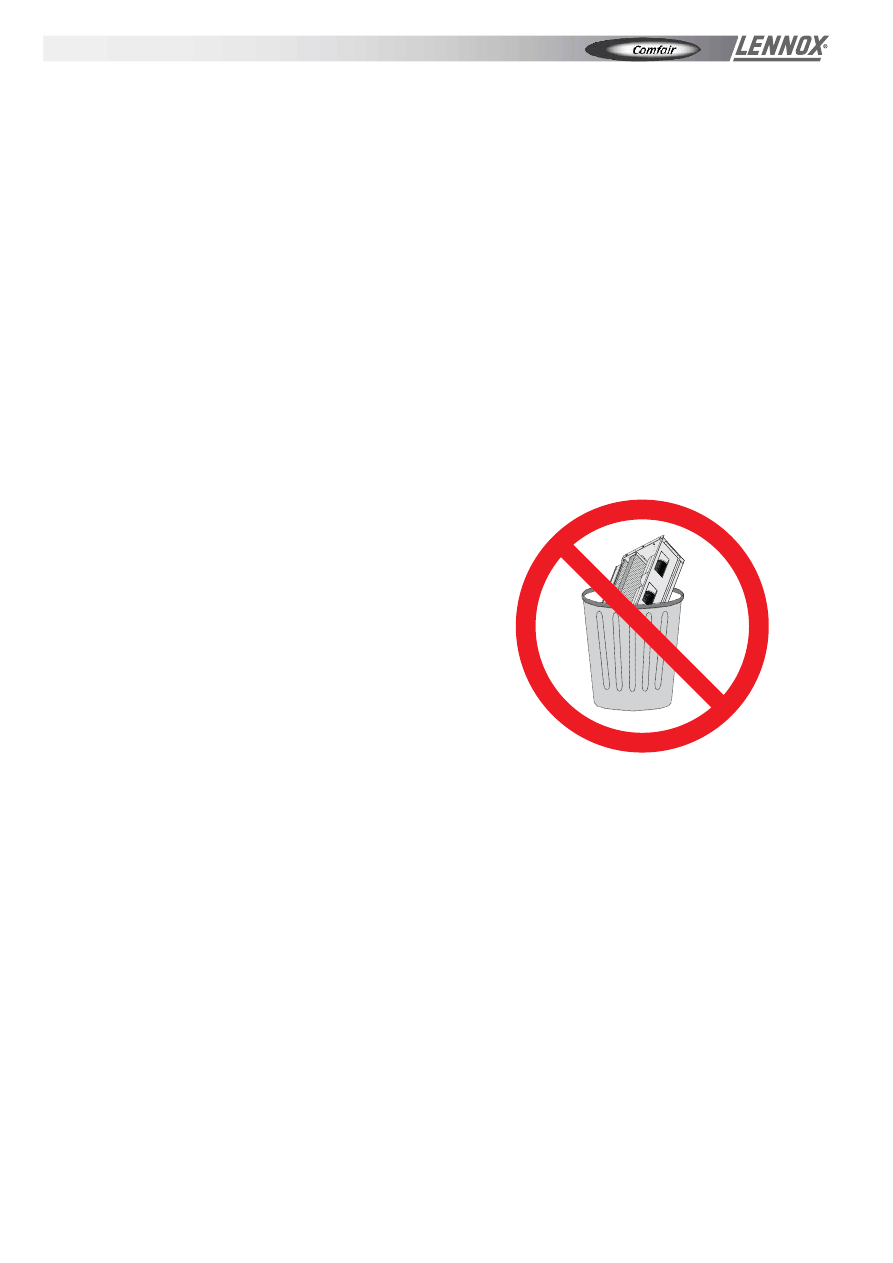
DISMANTLING THE UNIT
This unit is made to last for many years. Qualified personnel
are needed to dismantle it in all safety. The first operation
to be carried out before dismantling the unit is to disconnect
it once and for all from the electricity supply.
This unit has been made using recyclable materials (copper,
aluminium, brass, plastic) and assembled by screws and
push-fits to make separation of the parts easy.
Contact a firm specialised in differentiated waste disposal;
it is the only way to be certain of correct recycling and
thereby contribute to protection of the environment.
WHAT TO DO IF
There is little outflowing air?
- Incorrect speed setting on the control panel (select the right speed).
- Clogged filter (clean the filter)
- Obstruction of the airflow on the intake or delivery line (remove obstruction).
The motor does not turn? Check that
- the power supply is switched on;
- the switches or thermostats are in the correct operating position;
- there is no foreign matter jamming the rotation of the fan.
The unit does not heat/cool as before? Check that
- the filter and the coil are clean;
- no air has entered the water circuit by bleeding from the relative valve;
- the installation is correctly balanced;
- the boiler/chiller is in proper working order.
RIFIUTI
INSTALLATION
- OPERATING & MAINTENANCE MANUAL
Page 1
6

www.lennoxeurope.com
www.lennoxbelgium.com
www.lennoxczech.com
www.lennoxfrance.com
www.lennoxdeutschland.com
www.lennoxnederland.com
www.lennoxpolska.com
www.lennoxportugal.com
www.lennoxrussia.com
www.lennoxdistribution.com
www.lennoxspain.com
www.lennoxukraine.com
www.lennoxuk.com
www.lennoxdistribution.com
HH-IOM-0304-E
BELGIUM, LUXEMBOURG
CZECH REPUBLIC
FRANCE
GERMANY
NETHERLANDS
POLAND
PORTUGAL
RUSSIA
SLOVAKIA
SPAIN
UKRAINE
UNITED KINGDOM AND IRELAND
OTHER COUNTRIES
Due to Lennox’s ongoing commitment to quality,
the Specifications, Ratings and Dimensions are
subject to change without notice and without
incurring liability.
Improper installation, adjustment, alteration,
service or maintenance can cause property
damage or personal injury.
Installation and service must be performed by a
qualified installer and servicing agency.
Document Outline
- PAGE DE COUV IOM HD.pdf
- PAGE DE COUV IOM HD.pdf
- Guide d’utilisation
- Fonction Chaud :
- Fonction Froid :
- PAGE DE COUV IOM HD.pdf
- Guide d’utilisation
- Fonction Chaud :
- Fonction Froid :
- PAGE DE COUV IOM HD.pdf
- PAGE DE COUV IOM HD.pdf
- PAGE DE COUV IOM HD.pdf
- Guide d’utilisation
- Fonction Chaud :
- Fonction Froid :
- PAGE DE COUV IOM HD.pdf
- Guide d’utilisation
- Fonction Chaud :
- Fonction Froid :
- PAGE DE COUV IOM HD.pdf
Wyszukiwarka
Podobne podstrony:
P20 HH Mod
0304 I termin poprawkowy
owi hh
0304 I termin
wykład z anatomii (nc)
zwoje zwiÄ…zane z NC V
Etkind Mir mog byt drugim Uilyam Bullit v popytkah izmenit HH vek 403172
nc cnc dnc plc id 316059 Nieznany
Brother NC 2010h Parts Manual
instrukcja ladowarki everactiv nc 1000
Izolator wsporczy szescienny typu HH
Rozw PE G 0304 1
NC 4 6 9 gaz (PL) (2)
Kolokwium nr 3 - 101N-NC - 11102012 - 2002, astronawigacja, astro, Przykładowe kolokwia z astronawig
Lista prokuratorów na NC
nc 24 25 2014
MATERIAŁY POMOCNICZE kod NC
111?ncy flames of love
więcej podobnych podstron