
c
IB DIPLOMA PROGRAMME
PROGRAMME DU DIPLÔME DU BI
PROGRAMA DEL DIPLOMA DEL BI
N04/4/PHYSI/HP3/ENG/TZ0/XX/M+
17 pages
MARKSCHEME
NOVEMBER 2004
PHYSICS
Higher Level
Paper 3

– 2 –
N04/4/PHYSI/HP3/ENG/TZ0/XX/M+
This markscheme is confidential and for the exclusive use of
examiners in this examination session.
It is the property of the International Baccalaureate and must
not be reproduced or distributed to any other person without the
authorization of IBCA.

– 3 –
N04/4/PHYSI/HP3/ENG/TZ0/XX/M+
General Marking Instructions
Subject Details:
Physics HL Paper 3 Markscheme
General
A markscheme often has more specific points worthy of a mark than the total allows. This is intentional.
Do not award more than the maximum marks allowed for part of a question.
When deciding upon alternative answers by candidates to those given in the markscheme, consider the
following points:
Each marking point has a separate line and the end is signified by means of a semicolon (;).
An alternative answer or wording is indicated in the markscheme by a “/”; either wording can be
accepted.
Words in ( … ) in the markscheme are not necessary to gain the mark.
The order of points does not have to be as written (unless stated otherwise).
If the candidate’s answer has the same “meaning” or can be clearly interpreted as being the same
as that in the markscheme then award the mark.
Mark positively. Give candidates credit for what they have achieved, and for what they have got
correct, rather than penalizing them for what they have not achieved or what they have got
wrong.
Occasionally, a part of a question may require a calculation whose answer is required for
subsequent parts. If an error is made in the first part then it should be penalized. However, if the
incorrect answer is used correctly in subsequent parts then follow through marks should be
awarded.
Units should always be given where appropriate. Omission of units should only be penalized
once. Ignore this, if marks for units are already specified in the markscheme.
Deduct 1 mark in the paper for gross sig dig error i.e. for an error of 2 or more digits.
e.g. if the answer is 1.63:
2 reject
1.6
accept
1.63
accept
1.631
accept
1.6314 reject
However, if a question specifically deals with uncertainties and significant digits, and marks for sig
digs are already specified in the markscheme, then do not deduct again.

– 4 –
N04/4/PHYSI/HP3/ENG/TZ0/XX/M+
Option D — Biomedical Physics
D1. (a) (i)
2
L
∝ ;
[1]
(ii)
2
L
∝ ;
[1]
(iii) realization that mass scales as
3
L ;
i.e.
1
L
−
∝
or inversely proportional to L;
[2]
(b)
rate of oxygen absorption for giant amoeba
rate of oxygen absorption for normal amoeba
5
2
(8.0 10 )
(5.0 10 )
−
−
×
=
×
;
3
1.6 10
0.16%
−
=
×
=
;
[2]
(c) giant amoebae not feasible since rate of oxygen absorption per unit mass is too
low;
thus goldfish cannot rely on same method of oxygen intake / OWTTE;
[2]

– 5 –
N04/4/PHYSI/HP3/ENG/TZ0/XX/M+
D2. (a) photoelectric
effect;
which is when a photon is absorbed causing ionization. A second photon is
produced when another electron falls into the vacant level / OWTTE;
[2]
(b) (i) probability of a single photon being absorbed in 1 m of the material /
reference to
0
x
I
I e
µ
−
=
with definitions of symbols;
reference
to
I
x
I
µ
∆
= − ∆
with definitions of symbols;
[2]
Award
[0] for quoting a formula from the data booklet without any definitions.
Award partial credit to candidates who include minor errors.
(ii) thickness required to reduce the intensity of radiation to half its initial value;
reference
to
1
2
ln 2
x
µ
=
with definitions of symbols;
[2]
Award
[0] for quoting a formula from the data booklet without any definitions.
Award partial credit to candidates who include minor errors.
(c) (i)
substitution into ratio
3
3
(13.9)
(7.4)
=
;
to get ratio
6.62 6.6
=
≈
;
[2]
(ii) these X-rays able to provide good contrast for broken bone diagnosis;
importance of the fat-muscle ratio of attenuation coefficients (
1.97
=
);
realization that this is not very different from 1;
therefore not enough contrast for muscle-fat boundary / must use another
technique for muscle-fat boundary;
[4]
(d)
(i)
dose
received
330 Sv 1 330 Gy
µ
µ
=
÷ =
;
[1]
Note: Correct unit needed.
Accept
1
J kg
−
. Losing this mark does not count towards the general unit
mark on the paper.
(ii) any sensible estimate for the mass of the upper body;
e.g. 30 kg, (accept 10 kg to 50 kg)
so total energy received
330 Gy 30 9.9 mJ
µ
=
×
=
;
[2]
Award
[1 max] for an answer of 19.8 mJ (using 60 kg).
(e)
Award [1] for each sensible and appropriate precaution for the operator, up to
[2 max].
e.g.
shielding (works behind lead glass screen);
distance away (controls are remote from machine);
film
badge
monitoring
etc
.;
[2 max]

– 6 –
N04/4/PHYSI/HP3/ENG/TZ0/XX/M+
(f)
Award [1] for each appropriate possible biological effect, up to [2 max].
e.g.
sterility;
cancer;
shortening of life expectancy;
any other examples;
[2 max]
(g) (i)
to kill cancer cells / OWTTE;
[1]
(ii)
Award [1] for each sensible and appropriate comment, up to [2 max].
e.g.
cancer cells targeted to received a high dose;
aim is to minimize danger to other healthy cells while killing cancerous
ones;
malignant cells are preferentially susceptible to X-rays;
targeting achieved from different angles with tumour in overlap region;
any other examples;
[2 max]

– 7 –
N04/4/PHYSI/HP3/ENG/TZ0/XX/M+
Option E — The History and Development of Physics
E1. (a) experiments into flow of electricity through gas at low pressure / Crooke’s tubes /
OWTTE;
showed that the glass behind the anode glowed / OWTTE;
[2]
(b) particle nature / OWTTE;
Award
[0] for bald “rays”.
since waves don’t carry charge / OWTTE / any other sensible reason;
[2]
(c) wave nature / OWTTE;
Award
[0] for bald “light”.
since waves not deflected by electric field / OWTTE;
[2]
(d) (i)
(Professor J J) Thompson; (accept any spelling of “Thompson”)
[1]
(ii) general idea of beam of electrons able to be deflected by E and B fields;
each appropriate detail that would allow the measuring of e/m;
[3 max]
Award [2 max] for experiments that are described along the right lines but
would not get result in a successful calculation of e/m.
– 8 –
N04/4/PHYSI/HP3/ENG/TZ0/XX/M+
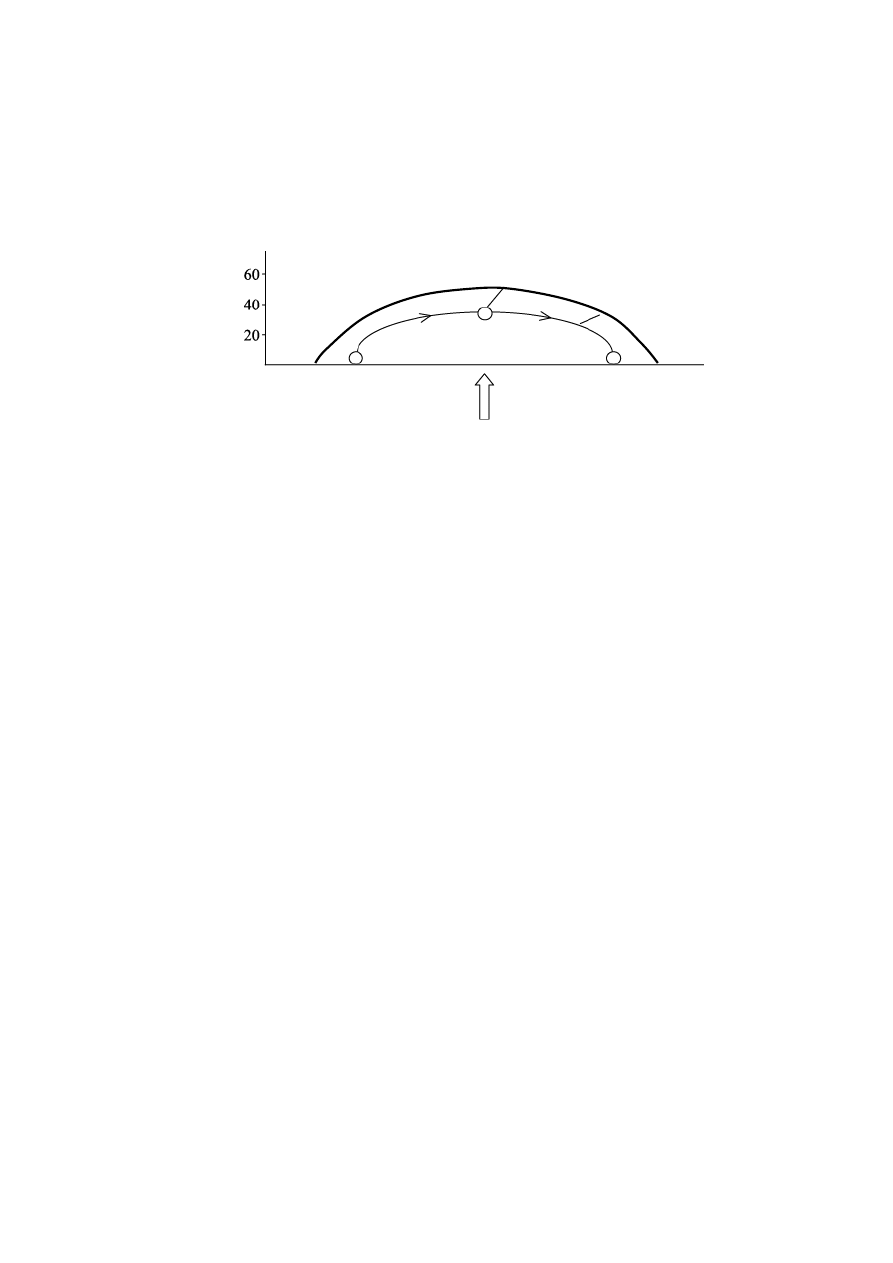
E2. (a) northern hemisphere since Sun always to the south / OWTTE;
[1]
Answers must have some appropriate explanation to receive [1]. Do not accept
“since the sun rises in the east and sets in the west” as appropriate.
(b) path of Sun still peaks in the centre and shown to rise higher;
rise starts further east on the Earth and sets further west;
[2]
Elevation
above
horizontal
south
(c)
For both part (i) and (ii) [1] is available for a simple description of the
appropriate model, and [1] is available for showing how the model explains the
change in observations over a year. If everything including the explanations are
correct but the models have been “swapped”, award [2 max].
(i)
Sun is on a (crystal) sphere that rotates around the Earth in one day;
the motion of the sphere also changes over the course of a year;
[2]
(ii) apparent motion of the Sun is due to the rotation in one day;
Earth moves around the Sun in a year and the Earth’s axis of rotation is not
the same as the axis of its rotation around the Sun / OWTTE;
[2]
(d)
(i)
appropriate
similarity;
[1]
e.g. the stars and the planets maintain their relative positions over one night
as the whole pattern rotates around the pole star.
appropriate
difference;
[1]
e.g. over several nights, the planets slowly change position (“wander”)
relative to the positions of the whole pattern of stars.
(ii) from accurate observational data of the positions of the planets at different
times (from Tycho Brahe);
[1]
Sun
path of the Sun
east
west

– 9 –
N04/4/PHYSI/HP3/ENG/TZ0/XX/M+
E3. (a) explanation of symbols in the Rydberg formula
H
2
2
1
1
1
R
n
m
λ
⎛
⎞
=
−
⎜
⎟
⎝
⎠
:
and
n and m are integers;
H
R is the Rydberg constant;
λ is wavelength in atomic hydrogen emission spectrum;
[3 max]
(b) correct application of Rydberg formula for Balmer series:
2
n
=
;
3, 4, 5
m
=
etc.;
[2 max]
(c) realization that for ionization, n = 1 and m =
∞
;
and thus the ionization wavelength is given by
H
1
R
λ
=
;
the minimum frequency for ionization is given by
8
7
15
3.0 10 1.10 10
3.30 10 Hz
f
=
×
×
×
=
×
so
ionization
energy
18
2.19 10
J 13.7 eV
hf
−
=
=
×
=
;
[3 max]
(d)
each
appropriate
limitation of the Bohr model;
e.g. only works for hydrogen;
no theoretical justification of postulates;
does not predict the fine structure;
etc.;
[2 max]

– 10 –
N04/4/PHYSI/HP3/ENG/TZ0/XX/M+
Option F — Astrophysics
F1. (a) apparent magnitude is a measure of (comparative) brightness as seen from Earth
(with 1 being brightest and 6 being dimmest);
absolute magnitude is the apparent magnitude that the star would have if it were a
fixed distance from the Earth of 10 parsecs;
[2]
(b) yes plus reason;
[1]
Note: an explanation must be provided. Award [0] for bald “yes” without an
attempt at a reason. e.g. since apparent magnitude low (less than one) therefore
one of the brightest stars.
(c)
(i)
distance
away
17
15
3.39 10
35.8ly 11.0 pc
9.46 10
×
=
=
=
×
;
[1]
(ii) since this is less than 100 pc;
the star is close enough for stellar parallax;
[2]
Award
[1] for a bald answer. Also allow ECF if conversion of units is
muddled.
(iii)
Award [1] each relevant piece of experimental description up to [4 max].
e.g. position of star compared with other star positions;
at different times of the year;
the maximum angular variation from the mean p is recorded;
the distance (in parsecs) can be calculated using geometry
1
d
p
=
if p is in
arcseconds;
Note: watch for ECF. If the response has suggested one of the other
techniques in (ii) then award full marks for appropriate descriptions.
example:
spectroscopic parallax: light from star analysed (relative amplitudes of the
absorption spectrum lines);
to give indication of stellar class;
HR diagram used to estimate the luminosity;
distance away calculated from apparent brightness;
Cepheid variables: these stars’ brightness vary over time;
the time period of the variation is related to their luminosity;
thus measurements of the time period of one star can be used to calculate its
luminosity;
its distance away is calculated from maximum apparent brightness;
[4 max]
(d) spectral type / K / OWTTE;
thus at low end of temperature scale: OBAFGKM / Sun is G / OWTTE;
[2]

– 11 –
N04/4/PHYSI/HP3/ENG/TZ0/XX/M+
(e) (i)
correct substitution into
4
A T
L
σ
=
;
to
get
28
21
2
8
4
3.8 10
A
2.62 10 m
(5.67 10
4000 )
−
×
=
=
×
×
×
;
[2]
(ii)
use
of
2
21
2
4 r = 2.62 10 m
π
×
;
to
get
10
1.44 10 m ( 0.10 AU)
r
=
×
=
;
[2]
(iii)
use
of
3
max
2.90 10
4000
λ
−
×
=
;
725 nm 730 nm
=
≈
;
[2]
(f)
red
giant;
since it’s big and it’s red / OWTTE;
[2]

– 12 –
N04/4/PHYSI/HP3/ENG/TZ0/XX/M+
F2. (a) Milky Way is a spiral galaxy with “concentration” of stars in the centre;
NGC5128 is an elliptical galaxy - form is different;
[2]
Ignore guessed references to band of dark dust outside our galaxy.
(b) (i)
recession velocity is proportional to the distance away / OWTTE;
[1]
Award
[0] for formula taken from data book unless symbols are defined.
(ii) a measurement to get recession velocity;
e.g. red shift measurement
a measurement to get distance away;
e.g. Cepheids
repeat procedure for many galaxies to get relationship from graph;
[3]
(c) (i)
correct substitution into
v Hd
=
;
and correct conversion of units to get
6
1
1
6
15 10
60
276.1km s
300 km s
3.26 10
v
−
−
⎛
⎞
×
=
×
=
≈
⎜
⎟
×
⎝
⎠
;
[2]
(ii)
correct
substitution
in
1
T
H
=
;
and correct conversion of units to get
1
0.0167 km s Mpc
T
−
=
6
15
3
(10
3.26 9.46 10 )
= 0.0167
10
×
×
×
×
17
5 10 s
≈ ×
;
[2]
Assumption that the rate of expansion has remained the same should be
given credit and can replace the marking point above if a mathematical slip
has been made.

– 13 –
N04/4/PHYSI/HP3/ENG/TZ0/XX/M+
Option G — Relativity
G1. (a) speed of light in a vacuum is the same for all inertial observers;
laws of physics are the same for all inertial observers;
[2]
The words underlined are needed for the mark. Award [1 max] if both are on the
right lines but not precise. Give benefit of the doubt if inertial is only mentioned
once.
(b) constancy of the speed of light / OWTTE;
any
sensible
comment;
[2]
e.g. Maxwell’s equations predicted a value for the speed of propagation of
electromagnetic radiation from constants associated with the medium that was
independent of the motion of the source or the observer.
(c) idea or name of appropriate experiment;
e.g.
muon
experiments
outline
of
evidence;
e.g. number of muons at a given height in the atmosphere in a given time
compared with number arriving at the ground. Number at ground seems high
given the lifetime of a muon.
link to a prediction;
[3 max]
e.g.
numbers
consistent
with time dilation formula.
G2. (a) rest mass energy is the energy that is needed to create the particle at rest /
reference to
2
0
0
E
m c
=
;
total energy is the addition of the rest energy and everything else (kinetic etc.) /
reference to mass being greater when in motion /
2
E mc
=
;
[2 max]
(b) realization that betas are electrons;
so
2
e
0.511MeV c
m
−
=
;
2.51
; ( 4.91)
0.511
γ
=
=
[3]
Ignore any spurious calculation from Lorentz factor equation here as the use of
this equation is rewarded below.
(c) (i)
correct substitution into Lorentz factor equation;
to
give
8
1
0.979
2.94 10 m s
v
c
−
=
=
×
;
[2]
(ii) correct substitution into speed
distance
time
=
;
to
give
time
1.26 ns
=
;
[2]
(d) (i)
the detector / the laboratory / OWTTE;
[1]
(ii) same answer as (c) (i)
8
1
2.94 10 m s
−
=
×
;
[1]
(iii) realization that length contraction applies;
distance
37
7.5cm
γ
=
=
;
[2 max]

– 14 –
N04/4/PHYSI/HP3/ENG/TZ0/XX/M+
G3. (a) correct
substitution into
2
2 2
2 4
0
E
p c
m c
=
+
;
2 2
2
2
2
(1.533)
(0.511)
2.089(MeV )
p c
=
−
=
1
22
so 1.45MeV c ( 7.71 10
Ns)
p
−
−
=
=
×
;
[2]
(b) realization that energy is sufficient to create electron / positron pair (at rest);
momentum must be conserved so some particles must have KE so not all the
1.533 is available for particle creation / OWTTE;
so it is not possible;
[3]
Award
[0] for a “bald” statement without any attempt at justification.
G4. (a) an observer cannot tell the difference between the effect of acceleration (in one
direction) and a gravitational field (in the opposite direction);
[1]
Accept “It is impossible to distinguish between inertial or gravitational forces”
or “there is no way in which gravitational effects can be distinguished from
inertial effects” / OWTTE.
(b) any correct argument to show that light would be expected to be bent in an
accelerating frame (e.g. observer in lift/rocket etc.);
application
of
principle
of equivalence to show that light must also be bent in a
gravitational field;
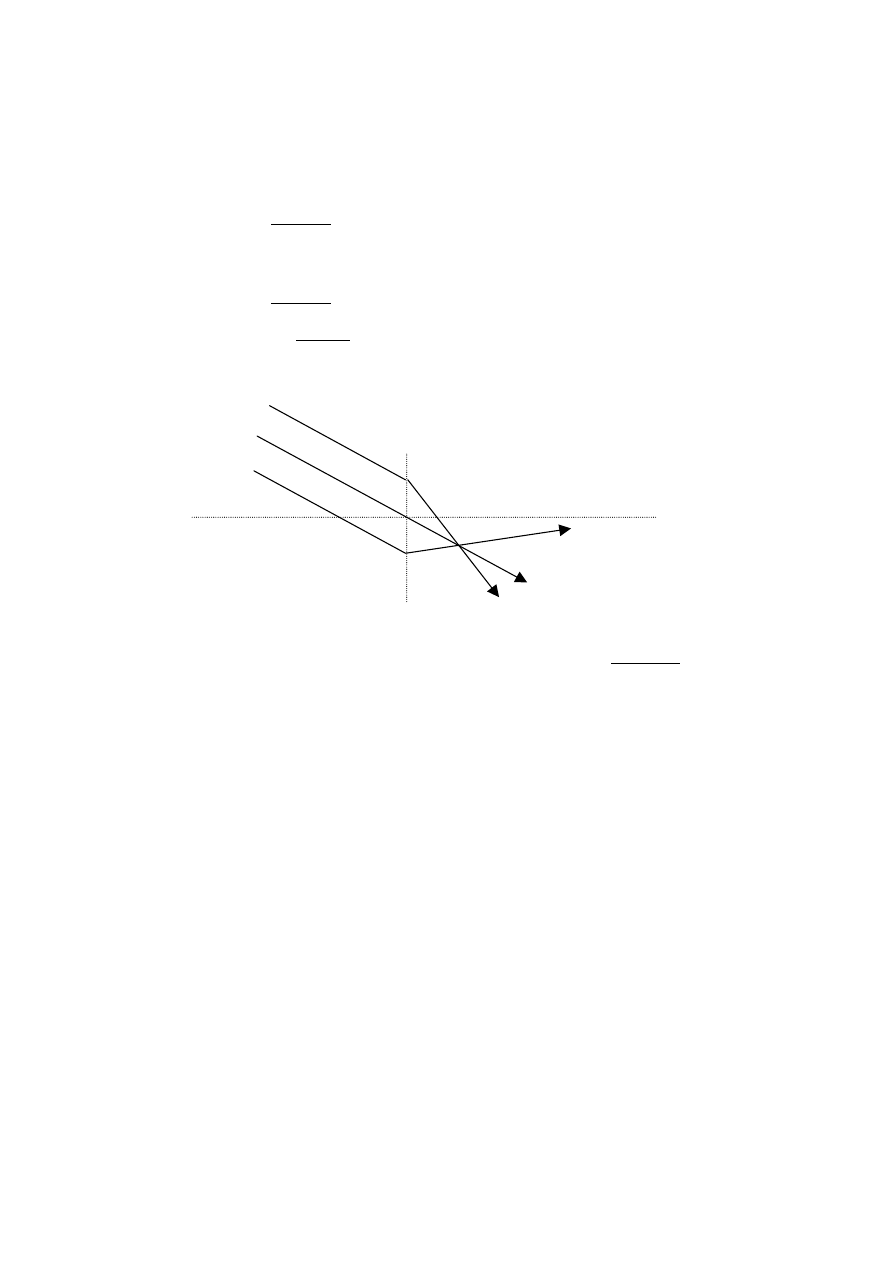
gravitational lensing is the bending of light around a massive astronomical object;
to produce multiple images or magnified images of a region of space that is
further away / OWTTE;
[4]
The
final
[2] marks can be awarded for a clearly drawn and fully labelled
diagram.
– 15 –
N04/4/PHYSI/HP3/ENG/TZ0/XX/M+
Option H — Optics
H1. (a) (i) the position of the closest object that can be brought into focus by the
unaided eye / OWTTE;
[1]
Accept the distance to the closest object etc.
(ii) the position of the furthest object that can be brought into focus by the
unaided eye / OWTTE;
[1]
Accept the distance to the furthest object etc.
(b) (i)
two (or more) parallel rays into lens;
which all converge after refraction at the lens;
correctly off axis;
[3]
Award benefit of the doubt if no arrows on rays.
lens
Award [2 max] for a correct ray diagram showing rays diverging from an
object at twice the focal length (or more) from the lens.
(ii) about 1.7 cm;
[1]
(c) (i)
use of the lens equation with
50cm,
1.7 cm
u
v
=
=
;
to
get
1.64 1.6 cm
f
=
≈
;
[2]
Award
[1 max] for a scale diagram since accuracy is inappropriate.
(ii)
lens
gets
fatter
/
OWTTE;
since focal length goes down;
[2]
(d) (i)
ratio of speed of EM waves;
in vacuum to their speed in medium;
Award
[0] for quoting from the data booklet without additional information.
or
definition as ratio of sin (angle of incidence) to sin (angle of refraction);
explanation of how these angles are measured;
[2]
(ii) normally the refraction is from air to cornea and the difference in refractive
index is large;
if under water refraction is from water to cornea and the difference in
refractive index is negligible so no image is formed / OWTTE;
or
rays crossing the water-eye boundary will undergo little refraction since the
n’s are nearly equal;
hence, rays cannot be brought to a focus (focussed);
[2]
– 16 –
N04/4/PHYSI/HP3/ENG/TZ0/XX/M+
H2. (a) (i)
single frequency / single colour / OWTTE;
[1 max]
(ii) waves with a constant / predictable phase / OWTTE;
[1 max]
Be generous as it is hard to describe in a few words. Look for understanding.
(b)
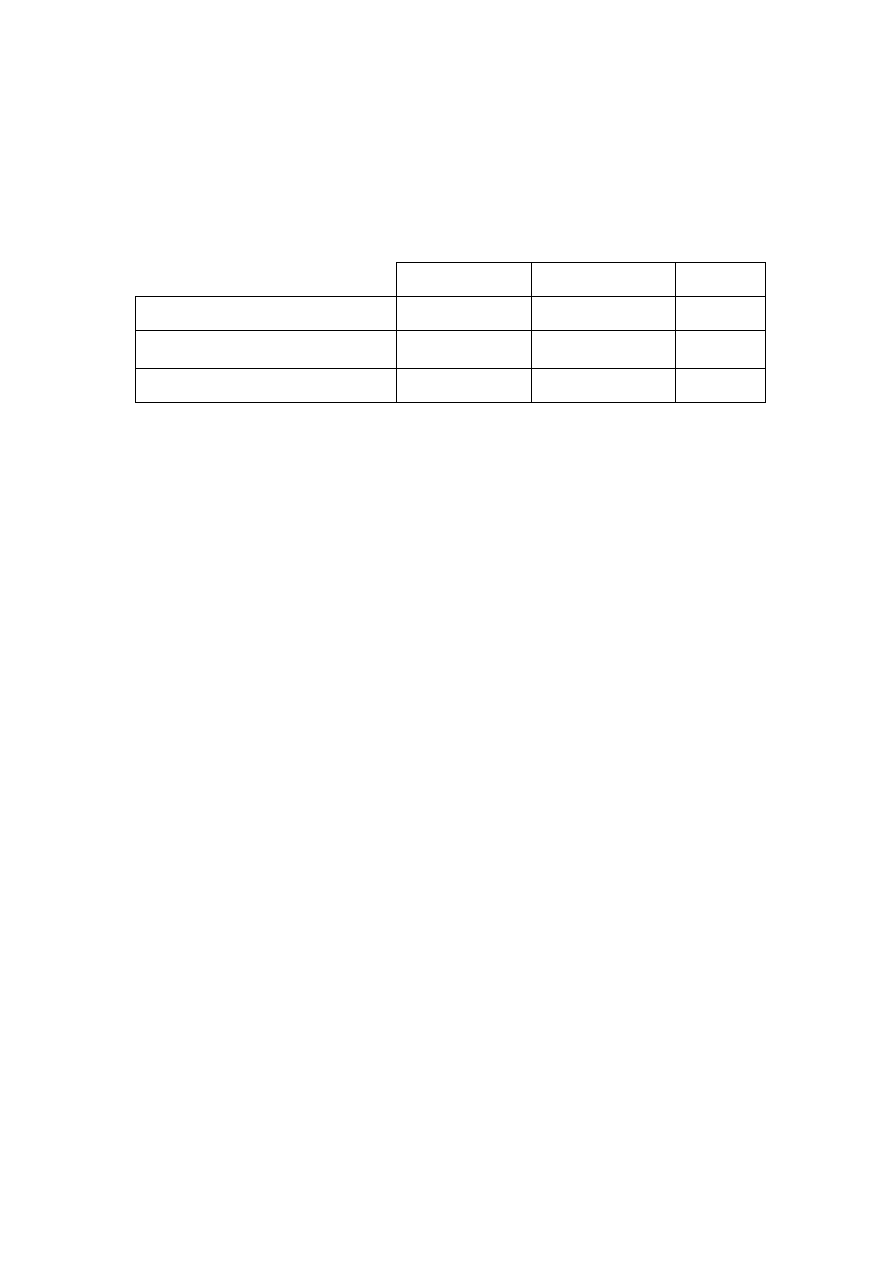
Award [1] for each correct row or column, up to [3 max].
Electromagnetic
Monochromatic
Coherent
light from a filament lamp
Yes No
No
γ
-rays from a radioactive source
Yes
Yes / No
No
infra-red rays from the Sun
Yes No
No
[3 max]
(c) any general application of laser light;
[1]
To
achieve
[1] it must be a situation where the use of laser light is appropriate
and there is sufficient outline detail to understand the situation. Accept any use
(so long as not ambiguous) without description.

– 17 –
N04/4/PHYSI/HP3/ENG/TZ0/XX/M+
H3. (a) identification of path length differences from slit to slit;
to give constructive interference at a particular angle for a particular wavelength;
thus different wavelengths will constructively interfere at different angles i.e. light
will be separated in component wavelengths;
[3 max]
Award full marks for other explanations not of this format but the response must
explain the creation of the spectrum.
(b) correct substitution into
sin
n
d
λ
θ
=
;
to
give
7
sin
5.896 10
600000 0.35376 so
20.7
21
θ
θ
−
=
×
×
=
=
≈
D
D
;
[2]
H4. (a) the diffraction pattern of one point source has its central maximum on the first
minimum of the diffraction pattern of the other point source / OWTTE;
[2]
Full marks can be awarded for a clearly drawn and fully labelled diagram.
Partial credit is for answers that have some idea but lack precision.
(b)
3
(! 2) mm;
[1]
(c) correct calculation of Rayleigh criteria angle;
e.g.
/
9
4
1.22
1.22 590 10
0.003 2.4 10
d
λ
θ
−
−
=
=
×
×
=
×
radians.
Accept answers that miss the factor of 1.2 to get
4
2.0 10
−
×
radians.
correct
comparison
and
answer;
[2 max]
e.g. this will be resolved as minimum angle is less than the separation of the point
sources.
Watch for ECF – this angle may or may not be resolved depending on the
estimation of the diameter of the aperture.
Wyszukiwarka
Podobne podstrony:
PhysHL P3 N04 TZ0
PhysHL P2 N04 TZ0 M
PhysHL P3 N06 TZ0 MS
PhysHL P1 N04 TZ0
PhysHL P2 N04 TZ0
PhysHL P1 N04 TZ0 M
PhysHL P3 M01 MS
PhysHL P3 M05 TZ1 M
PhysHL P3 M06 TZ2
PhysHL P2 N06 TZ0 MS
PhysHL P3 M01
PhysHL P3 M04 TZ2
PhysHL P3 M06 TZ1
PhysHL P3 M04 TZ2 M
PhysHL P3 N01
PhysHL P3 M04 TZ1
PhysHL P3 M02
PhysHL P1 N06 TZ0
PhysHL P2 N06 TZ0
więcej podobnych podstron