http://www.eimodule.com
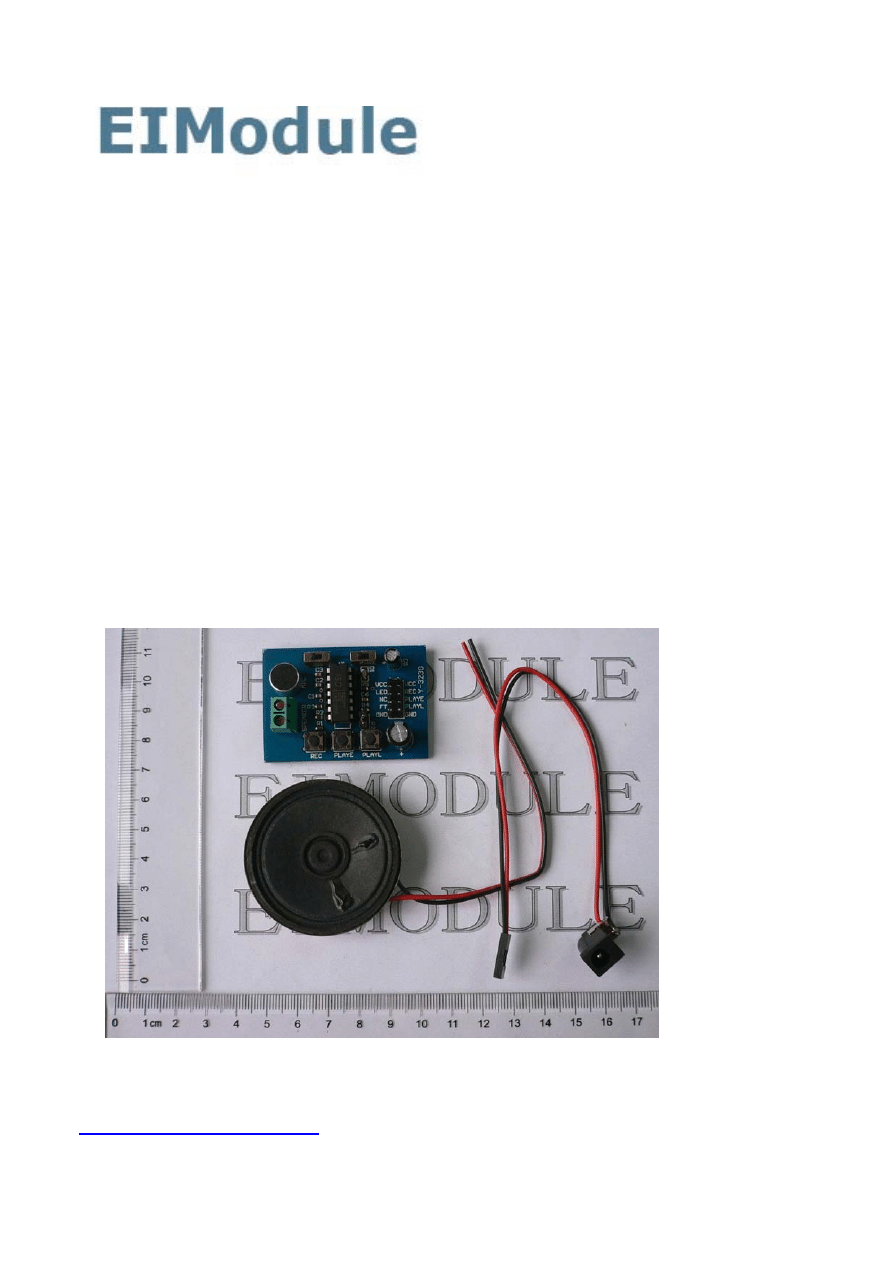
ISD1820 voice recording and playback module
1. Introduction
This module board is based on ISD18B20, which is a single-chip single-message
record/playback device. Recordings are stored into on-chip non-volatile memory, providing
zero-power message storage. With the embedded Flash memory employed, data retention
up to 100 years and typical 100,000 erase/record cycles can be reached. Time for
recording is 8-20 seconds
Features
:
1. Power input: DC 2.4-5.5V
2. With internal audio amplifier, this board can drive 8 Ohm 0.5W speaker directly.
3. Microphone is on board
4. Board dimension: 54mm x 38mm
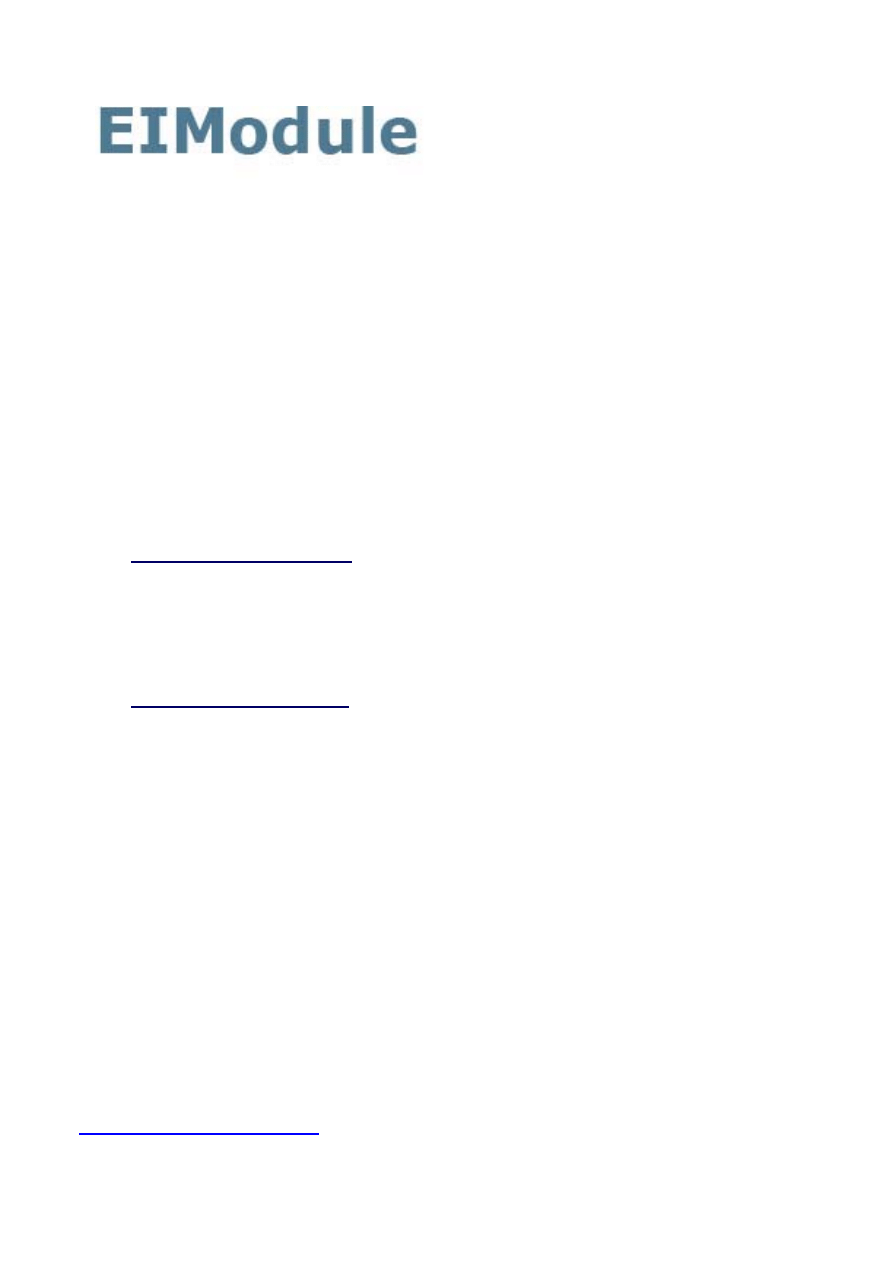
5. All the pins of ISD1820 are extended out with an connector, which can powered and
controlled by microprocessor directly
http://www.eimodule.com
2. Functions
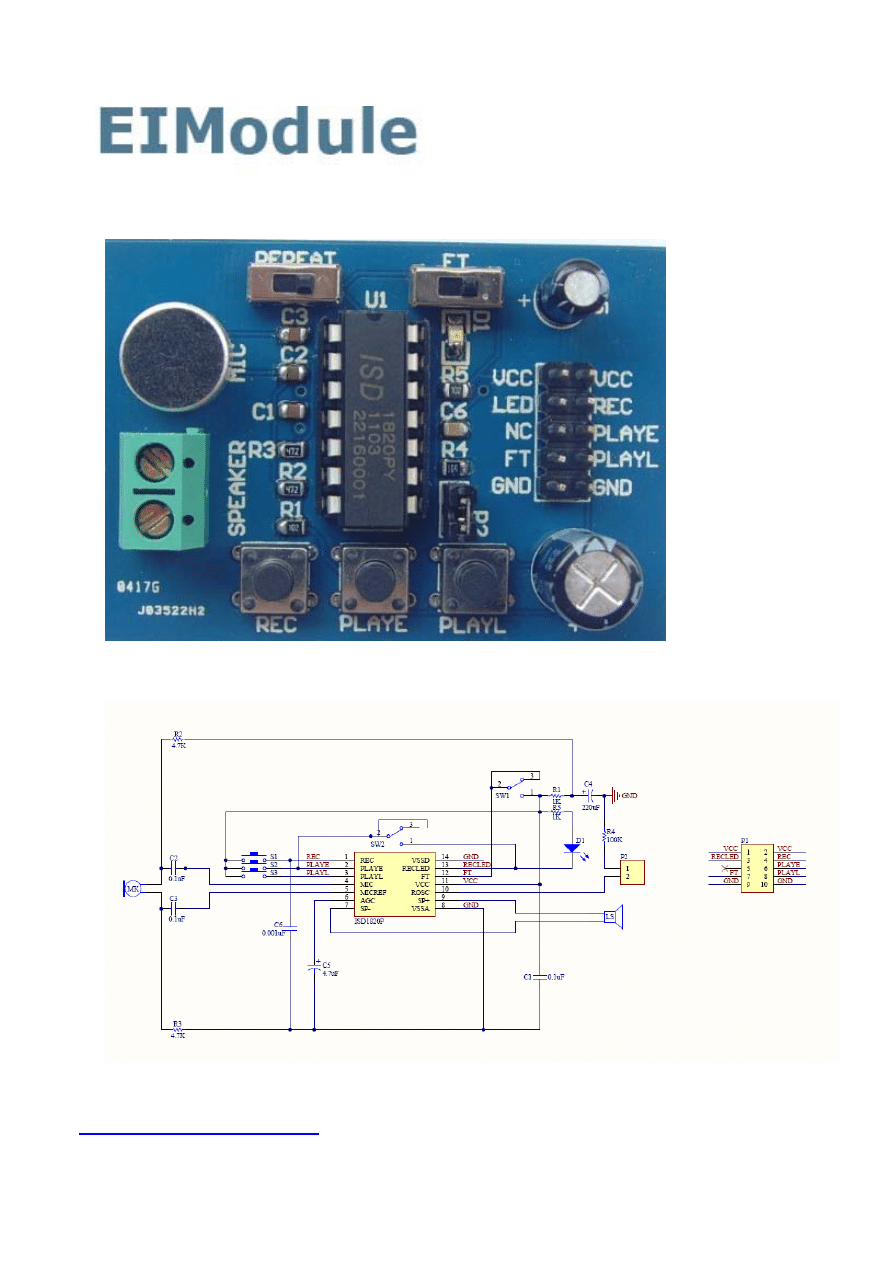
The following is the board picture.
The following is the schematic.
http://www.eimodule.com
There are 3 keys on the board: REC, PLAYE and PLAYL
1) REC
The REC input is an active-HIGH record signal. The device records whenever REC is
HIGH. This pin must remain HIGH for the duration of the recording. REC takes precedence
over either playback (PLAYL or PLAYE) signal. If REC is pulled HIGH during a playback
cycle, the playback immediately ceases and recording begins. A record cycle is completed
when REC is pulled LOW. An End-of-Message (EOM) marker is internally recorded,
enabling a subsequent playback cycle to terminate appropriately. The device automatically
powers down to standby mode when REC goes LOW. This pin has an internal pull-down
device. Holding this pin HIGH will increase standby current consumption.
2) PLAY
There are two modes to play the voice in the voice chip: edge activated mode controlled by
PLAYE pin and level activated mode controlled by PLAYL pin.
(1) Playback, Edge-activated: When a HIGH-going transition is detected on this input pin,
a playback cycle begins. Playback continues until an End-of-Message (EOM) marker is
encountered or the end of the memory space is reached. Upon completion of the
playback cycle, the device automatically powers down into standby mode. Taking
PLAYE LOW during a playback cycle will not terminate the current cycle. This pin has
an internal pull-down device. Holding this pin HIGH will increase standby current
consumption.
(2) Playback, Level-activated: When this input pin level transits from LOW to HIGH, a
playback cycle is initiated. Playback continues until PLAYL is pulled LOW or an End-of-
Message (EOM) marker is detected, or the end of the memory space is reached. The
device automatically powers down to standby mode upon completion of the playback
cycle. This pin has an internal pull-down device. Holding this pin HIGH will increase
standby current consumption. FWD (forward)
On the board there are two switches for Feed Through function and REPEAT.
(1) Feed Through: This mode allows use of the speaker drivers for external signals. The
signal between the MIC and MIC_REF pins will pass through the AGC, the filter and
the speaker drivers to the speaker outputs SP+ and SP-. The input FT controls the feed
through mode. To operate this mode, the control pins REC, PLAYE and PLAYL are
held LOW at Vss. The pin FT is held HIGH to Vcc. For normal operation of record, play
and power down, the FT pin is held at Vss. The FT pin has a weak pull-down to Vss
(2) REPEAT. If this switch is on, the current voice clip will be played back repeatly.
Wyszukiwarka
Podobne podstrony:
NMS KD 0017 en V01 03 N3000 IMC and ISC User Manual
Epidural Anesthesia Manual (A Self Directed Learning Module)
GE MT96 Series Final Manual EN v01
PANsound manual
als manual RZ5IUSXZX237ENPGWFIN Nieznany
hplj 5p 6p service manual vhnlwmi5rxab6ao6bivsrdhllvztpnnomgxi2ma vhnlwmi5rxab6ao6bivsrdhllvztpnnomg
BSAVA Manual of Rabbit Surgery Dentistry and Imaging
Okidata Okipage 14e Parts Manual
Bmw 01 94 Business Mid Radio Owners Manual
Manual Acer TravelMate 2430 US EN
manual mechanika 2 2 id 279133 Nieznany
4 Steyr Operation and Maintenance Manual 8th edition Feb 08
Oberheim Prommer Service Manual
cas test platform user manual
Kyocera FS 1010 Parts Manual
więcej podobnych podstron