
An Introduction to
Cryptography

Copyright © 1990-1998 Network Associates, Inc. and its Affiliated Companies. All Rights
Reserved.
PGP*, Version 6.0
8-98. Printed in the United States of America.
PGP, Pretty Good, and Pretty Good Privacy are registered trademarks of Network Associates,
Inc. and/or its Affiliated Companies in the US and other countires. All other registered and
unregistered trademarks in this document are the sole property of their respective owners.
Portions of this software may use public key algorithms described in U.S. Patent numbers
4,200,770, 4,218,582, 4,405,829, and 4,424,414, licensed exclusively by Public Key Partners; the
IDEA(tm) cryptographic cipher described in U.S. patent number 5,214,703, licensed from
Ascom Tech AG; and the Northern Telecom Ltd., CAST Encryption Algorithm, licensed from
Northern Telecom, Ltd. IDEA is a trademark of Ascom Tech AG. Network Associates Inc. may
have patents and/or pending patent applications covering subject matter in this software or its
documentation; the furnishing of this software or documentation does not give you any license
to these patents. The compression code in PGP is by Mark Adler and Jean-Loup Gailly, used
with permission from the free Info-ZIP implementation. LDAP software provided courtesy
University of Michigan at Ann Arbor, Copyright © 1992-1996 Regents of the University of
Michigan. All rights reserved. This product includes software developed by the Apache Group
for use in the Apache HTTP server project (http://www.apache.org/). Copyright © 1995-1997
The Apache Group. All rights reserved. See text files included with the software or the PGP
web site for further information.
The software provided with this documentation is licensed to you for your individual use
under the terms of the End User License Agreement and Limited Warranty provided with the
software. The information in this document is subject to change without notice. Network
Associates Inc. does not warrant that the information meets your requirements or that the
information is free of errors. The information may include technical inaccuracies or
typographical errors. Changes may be made to the information and incorporated in new
editions of this document, if and when made available by Network Associates Inc.
Export of this software and documentation may be subject to compliance with the rules and
regulations promulgated from time to time by the Bureau of Export Administration, United
States Department of Commerce, which restrict the export and re-export of certain products
and technical data.
Network Associates, Inc. (408) 988-3832 main
3965 Freedom Circle
Santa Clara, CA 95054
http://www.nai.com
info@nai.com
*
is sometimes used instead of the
®
for registered trademarks to protect marks registered
outside of the U.S.

LIMITED WARRANTY
Limited Warranty. Network Associates warrants that for sixty (60) days from the date of
original purchase the media (for example diskettes) on which the Software is contained will be
free from defects in materials and workmanship.
Customer Remedies. Network Associates’ and its suppliers’ entire liability and your exclusive
remedy shall be, at Network Associates’ option, either (i) return of the purchase price paid for
the license, if any, or (ii) replacement of the defective media in which the Software is contained
with a copy on nondefective media. You must return the defective media to Network
Associates at your expense with a copy of your receipt. This limited warranty is void if the
defect has resulted from accident, abuse, or misapplication. Any replacement media will be
warranted for the remainder of the original warranty period. Outside the United States, this
remedy is not available to the extent Network Associates is subject to restrictions under United
States export control laws and regulations.
Warranty Disclaimer. To the maximum extent permitted by applicable law, and except for the
limited warranty set forth herein, THE SOFTWARE IS PROVIDED ON AN "AS IS" BASIS
WITHOUT WARRANTY OF ANY KIND, EXPRESS OR IMPLIED. WITHOUT LIMITING THE
FOREGOING PROVISIONS, YOU ASSUME RESPONSIBILITY FOR SELECTING THE
SOFTWARE TO ACHIEVE YOUR INTENDED RESULTS, AND FOR THE INSTALLATION
OF, USE OF, AND RESULTS OBTAINED FROM THE SOFTWARE. WITHOUT LIMITING
THE FOREGOING PROVISIONS, NETWORK ASSOCIATES MAKES NO WARRANTY
THAT THE SOFTWARE WILL BE ERROR-FREE OR FREE FROM INTERRUPTIONS OR
OTHER FAILURES OR THAT THE SOFTWARE WILL MEET YOUR REQUIREMENTS. TO
THE MAXIMUM EXTENT PERMITTED BY APPLICABLE LAW, NETWORK ASSOCIATES
DISCLAIMS ALL WARRANTIES, EITHER EXPRESS OR IMPLIED, INCLUDING BUT NOT
LIMITED TO IMPLIED WARRANTIES OF MERCHANTABILITY, FITNESS FOR A
PARTICULAR PURPOSE, AND NONINFRINGEMENT WITH RESPECT TO THE
SOFTWARE AND THE ACCOMPANYING DOCUMENTATION. SOME STATES AND
JURISDICTIONS DO NOT ALLOW LIMITATIONS ON IMPLIED WARRANTIES, SO THE
ABOVE LIMITATION MAY NOT APPLY TO YOU. The foregoing provisions shall be
enforceable to the maximum extent permitted by applicable law.


An Introduction to Cryptography
v
Preface
Cryptography is the stuff of spy novels and action comics. Kids once saved up
bubble-gum wrappers and sent away for Captain Midnight’s Secret Decoder
Ring. Almost everyone has seen a television show or movie involving a
nondescript suit-clad gentleman with a briefcase handcuffed to his wrist. The
word “espionage” conjures images of James Bond, car chases, and flying
bullets.
And here you are, sitting in your office, faced with the rather mundane task of
sending a sales report to a coworker in such a way that no one else can read it.
You just want to be sure that your colleague was the actual and only recipient
of the email and you want him or her to know that you were unmistakably the
sender. It’s not national security at stake, but if your company’s competitor got
a hold of it, it could cost you. How can you accomplish this?
You can use cryptography. You may find it lacks some of the drama of code
phrases whispered in dark alleys, but the result is the same: information
revealed only to those for whom it was intended.
Who should read this guide
This guide is useful to anyone who is interested in knowing the basics of
cryptography, and explains the terminology and technology you will
encounter as you use PGP products. You will find it useful to read before you
begin working with cryptography.
How to use this guide
This guide describes how to use PGP to securely manage your organization’s
messages and data storage.
Chapter 1, “The Basics of Cryptography,”
terminology and concepts you will encounter as you use PGP products.
Chapter 2, “Phil Zimmermann on PGP,”
written by PGP’s creator, contains
discussions of security, privacy, and the vulnerabilities inherent in any
security system, even PGP.

Preface
vi
An Introduction to Cryptography
For more information
There are several ways to find out more about Network Associates and its
products.
Customer service
To order products or obtain product information, contact the Network
Associates Customer Care department.
You can contact Customer Care at one of the following numbers Monday
through Friday between 6:00
A
.
M
. and 6:00
P
.
M
. Pacific time.
Or write to:
Network Associates, Inc.
3965 Freedom Circle
Santa Clara, CA 95054
U.S.A.
Technical support
Network Associates is famous for its dedication to customer satisfaction. We
have continued this tradition by making our site on the World Wide Web a
valuable resource for answers to technical support issues. We encourage you
to make this your first stop for answers to frequently asked questions, for
updates to Network Associates software, and for access to Network Associates
news and encryption information
.
Technical Support for your PGP product is also available through these
channels:
Phone
(408) 988-3832
Fax
(408) 970-9727
World Wide Web
http://www.nai.com
Phone
(970) 522-2952
Fax
(408) 970-9727
PGPSupport@pgp.com

An Introduction to Cryptography
vii
Preface
To provide the answers you need quickly and efficiently, the Network
Associates technical support staff needs some information about your
computer and your software. Please have this information ready before you
call:
• PGP product name
• PGP product version
• Computer platform and CPU type
• Amount of available memory (RAM)
• Operating system and version and type of network
• Content of any status or error message displayed on screen, or appearing
in a log file (not all products produce log files)
• Email application and version (if the problem involves using PGP with an
email product, for example, the Eudora plug-in)
Related reading
Here are some documents that you may find helpful in understanding
cryptography:
Non-Technical and beginning technical books
• “Cryptography for the Internet,” by Philip R. Zimmermann. Scientific
American, October 1998. This article, written by PGP’s creator, is a tutorial
on various cryptographic protocols and algorithms, many of which happen
to be used by PGP.
• “Privacy on the Line,” by Whitfield Diffie and Susan Eva Landau. MIT Press;
ISBN: 0262041677. This book is a discussion of the history and policy
surrounding cryptography and communications security. It is an excellent
read, even for beginners and non-technical people, and contains
information that even a lot of experts don't know.
• “The Codebreakers,” by David Kahn. Scribner; ISBN: 0684831309. This book
is a history of codes and code breakers from the time of the Egyptians to the
end of WWII. Kahn first wrote it in the sixties, and published a revised
edition in 1996. This book won't teach you anything about how
cryptography is accomplished, but it has been the inspiration of the whole
modern generation of cryptographers.

Preface
viii
An Introduction to Cryptography
• “Network Security: Private Communication in a Public World,” by Charlie
Kaufman, Radia Perlman, and Mike Spencer. Prentice Hall; ISBN:
0-13-061466-1. This is a good description of network security systems and
protocols, including descriptions of what works, what doesn’t work, and
why. Published in 1995, it doesn’t have many of the latest technological
advances, but is still a good book. It also contains one of the most clear
descriptions of how DES works of any book written.
Intermediate books
• “Applied Cryptography: Protocols, Algorithms, and Source Code in C,” by Bruce
Schneier, John Wiley & Sons; ISBN: 0-471-12845-7. This is a good beginning
technical book on how a lot of cryptography works. If you want to become
an expert, this is the place to start.
• “Handbook of Applied Cryptography,” by Alfred J. Menezes, Paul C. van
Oorschot, and Scott Vanstone. CRC Press; ISBN: 0-8493-8523-7. This is the
technical book you should read after Schneier’s book. There is a lot of
heavy-duty math in this book, but it is nonetheless usable for those who do
not understand the math.
• “Internet Cryptography,” by Richard E. Smith. Addison-Wesley Pub Co;
ISBN: 0201924803. This book describes how many Internet security
protocols work. Most importantly, it describes how systems that are
designed well nonetheless end up with flaws through careless operation.
This book is light on math, and heavy on practical information.
• “Firewalls and Internet Security: Repelling the Wily Hacker,” by William R.
Cheswick and Steven M. Bellovin. Addison-Wesley Pub Co; ISBN:
0201633574. This book is written by two senior researchers at AT&T Bell
Labs and is about their experiences maintaining and redesigning AT&T's
Internet connection. Very readable.
Advanced books
• “A Course in Number Theory and Cryptography,” by Neal Koblitz.
Springer-Verlag; ISBN: 0-387-94293-9. An excellent graduate-level
mathematics textbook on number theory and cryptography.
• “Differential Cryptanalysis of the Data Encryption Standard,” by Eli Biham and
Adi Shamir. Springer-Verlag; ISBN: 0-387-97930-1. This book describes the
technique of differential cryptanalysis as applied to DES. It is an excellent
book for learning about this technique.

An Introduction to Cryptography
ix
Table of Contents
Chapter 1. The Basics of Cryptography . . . . . . . . . . . . . . . . . . . . . . . . . 11
Key management and conventional encryption . . . . . . . . . . . . . . . . . . . . . . . 14
Meta and trusted introducers . . . . . . . . . . . . . . . . . . . . . . . . . . . . . . . . . . 24

Table of Contents
x
An Introduction to Cryptography
Chapter 2. Phil Zimmermann on PGP . . . . . . . . . . . . . . . . . . . . . . . . . . . 29
About PGP data compression routines . . . . . . . . . . . . . . . . . . . . . . . . . . . . . . . 35
About the random numbers used as session keys . . . . . . . . . . . . . . . . . . . . . 35
How to protect public keys from tampering . . . . . . . . . . . . . . . . . . . . . . . . . . 37
How does PGP keep track of which keys are valid? . . . . . . . . . . . . . . . . . . . 40
How to protect private keys from disclosure . . . . . . . . . . . . . . . . . . . . . . . . . . 42
What if you lose your private key? . . . . . . . . . . . . . . . . . . . . . . . . . . . . . 43
Compromised passphrase and private key . . . . . . . . . . . . . . . . . . . . . . . . . . . 48
Swap files or virtual memory . . . . . . . . . . . . . . . . . . . . . . . . . . . . . . . . . . 51
1
An Introduction to Cryptography
11
1
The Basics of Cryptography
When Julius Caesar sent messages to his generals, he didn’t trust his
messengers. So he replaced every A in his messages with a D, every B with an
E, and so on through the alphabet. Only someone who knew the “shift by 3”
rule could decipher his messages.
And so we begin.
Encryption and decryption
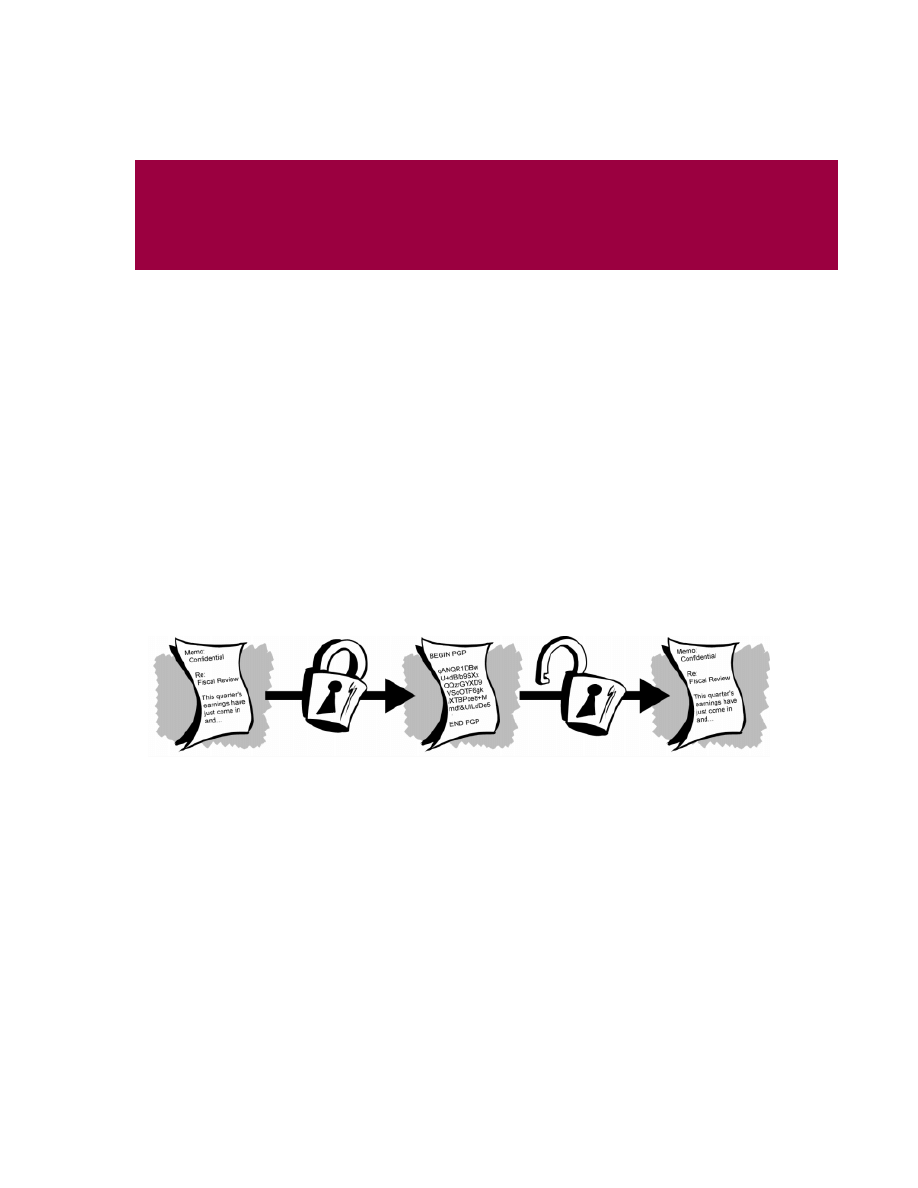
Data that can be read and understood without any special measures is called
plaintext or cleartext. The method of disguising plaintext in such a way as to
hide its substance is called encryption. Encrypting plaintext results in
unreadable gibberish called ciphertext. You use encryption to ensure that
information is hidden from anyone for whom it is not intended, even those
who can see the encrypted data. The process of reverting ciphertext to its
original plaintext is called decryption.
illustrates this process.
Figure 1-1. Encryption and decryption
What is cryptography?
Cryptography is the science of using mathematics to encrypt and decrypt data.
Cryptography enables you to store sensitive information or transmit it across
insecure networks (like the Internet) so that it cannot be read by anyone except
the intended recipient.
plaintext
ciphertext
plaintext
decryption
encryption

The Basics of Cryptography
12
An Introduction to Cryptography
While cryptography is the science of securing data, cryptanalysis is the science
of analyzing and breaking secure communication. Classical cryptanalysis
involves an interesting combination of analytical reasoning, application of
mathematical tools, pattern finding, patience, determination, and luck.
Cryptanalysts are also called attackers.
Cryptology embraces both cryptography and cryptanalysis.
Strong cryptography
“There are two kinds of cryptography in this world: cryptography that will stop your
kid sister from reading your files, and cryptography that will stop major governments
from reading your files. This book is about the latter.”
--Bruce Schneier, Applied Cryptography: Protocols, Algorithms, and Source
Code in C.
PGP is also about the latter sort of cryptography.
Cryptography can be strong or weak, as explained above. Cryptographic
strength is measured in the time and resources it would require to recover the
plaintext. The result of strong cryptography is ciphertext that is very difficult to
decipher without possession of the appropriate decoding tool. How difficult?
Given all of today’s computing power and available time—even a billion
computers doing a billion checks a second—it is not possible to decipher the
result of strong cryptography before the end of the universe.
One would think, then, that strong cryptography would hold up rather well
against even an extremely determined cryptanalyst. Who’s really to say? No
one has proven that the strongest encryption obtainable today will hold up
under tomorrow’s computing power. However, the strong cryptography
employed by PGP is the best available today. Vigilance and conservatism will
protect you better, however, than claims of impenetrability.
How does cryptography work?
A cryptographic algorithm, or cipher, is a mathematical function used in the
encryption and decryption process. A cryptographic algorithm works in
combination with a key—a word, number, or phrase—to encrypt the plaintext.
The same plaintext encrypts to different ciphertext with different keys. The
security of encrypted data is entirely dependent on two things: the strength of
the cryptographic algorithm and the secrecy of the key.
A cryptographic algorithm, plus all possible keys and all the protocols that
make it work comprise a cryptosystem. PGP is a cryptosystem.
An Introduction to Cryptography
13
The Basics of Cryptography
Conventional cryptography
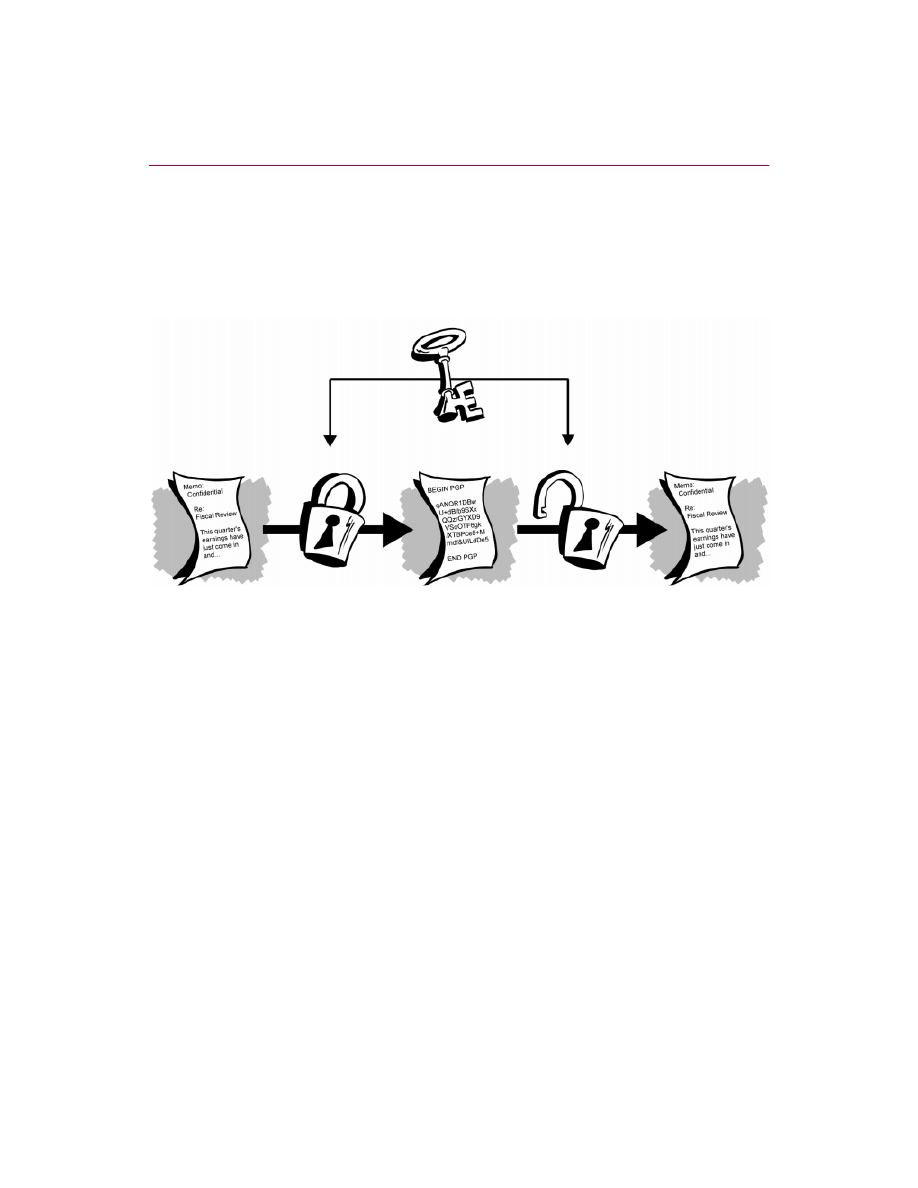
In conventional cryptography, also called secret-key or symmetric-key
encryption, one key is used both for encryption and decryption. The Data
Encryption Standard (DES) is an example of a conventional cryptosystem that
is widely employed by the Federal Government.
is an illustration of
the conventional encryption process.
Figure 1-2. Conventional encryption
Caesar’s Cipher
An extremely simple example of conventional cryptography is a substitution
cipher. A substitution cipher substitutes one piece of information for another.
This is most frequently done by offsetting letters of the alphabet. Two examples
are Captain Midnight’s Secret Decoder Ring, which you may have owned when
you were a kid, and Julius Caesar’s cipher. In both cases, the algorithm is to
offset the alphabet and the key is the number of characters to offset it.
For example, if we encode the word “SECRET” using Caesar’s key value of 3,
we offset the alphabet so that the 3rd letter down (D) begins the alphabet.
So starting with
ABCDEFGHIJKLMNOPQRSTUVWXYZ
and sliding everything up by 3, you get
DEFGHIJKLMNOPQRSTUVWXYZABC
where D=A, E=B, F=C, and so on.
plaintext
ciphertext
plaintext
decryption
encryption

The Basics of Cryptography
14
An Introduction to Cryptography
Using this scheme, the plaintext, “SECRET” encrypts as “VHFUHW.” To
allow someone else to read the ciphertext, you tell them that the key is 3.
Obviously, this is exceedingly weak cryptography by today’s standards, but
hey, it worked for Caesar, and it also illustrates how conventional
cryptography works.
Key management and conventional encryption
Conventional encryption has benefits. It is very fast. It is especially useful for
encrypting data that is not going anywhere. However, conventional
encryption alone as a means for transmitting secure data can be quite
expensive simply due to the difficulty of secure key distribution.
Recall a character from your favorite spy movie: the person with a locked
briefcase handcuffed to his or her wrist. What is in the briefcase, anyway? It’s
probably not the missile launch code/biotoxin formula/invasion plan itself.
It’s the key that will decrypt the secret data.
For a sender and recipient to communicate securely using conventional
encryption, they must agree upon a key and keep it secret between
themselves. If they are in different physical locations, they must trust a courier,
the Bat Phone, or some other secure communication medium to prevent the
disclosure of the secret key during transmission. Anyone who overhears or
intercepts the key in transit can later read, modify, and forge all information
encrypted or authenticated with that key. From DES to Captain Midnight’s
Secret Decoder Ring, the persistent problem with conventional encryption is
key distribution: how do you get the key to the recipient without someone
intercepting it?
Public key cryptography
The problems of key distribution are solved by public key cryptography, the
concept of which was introduced by Whitfield Diffie and Martin Hellman in
1975. (There is now evidence that the British Secret Service invented it a few
years before Diffie and Hellman, but kept it a military secret—and did nothing
with it.)
1
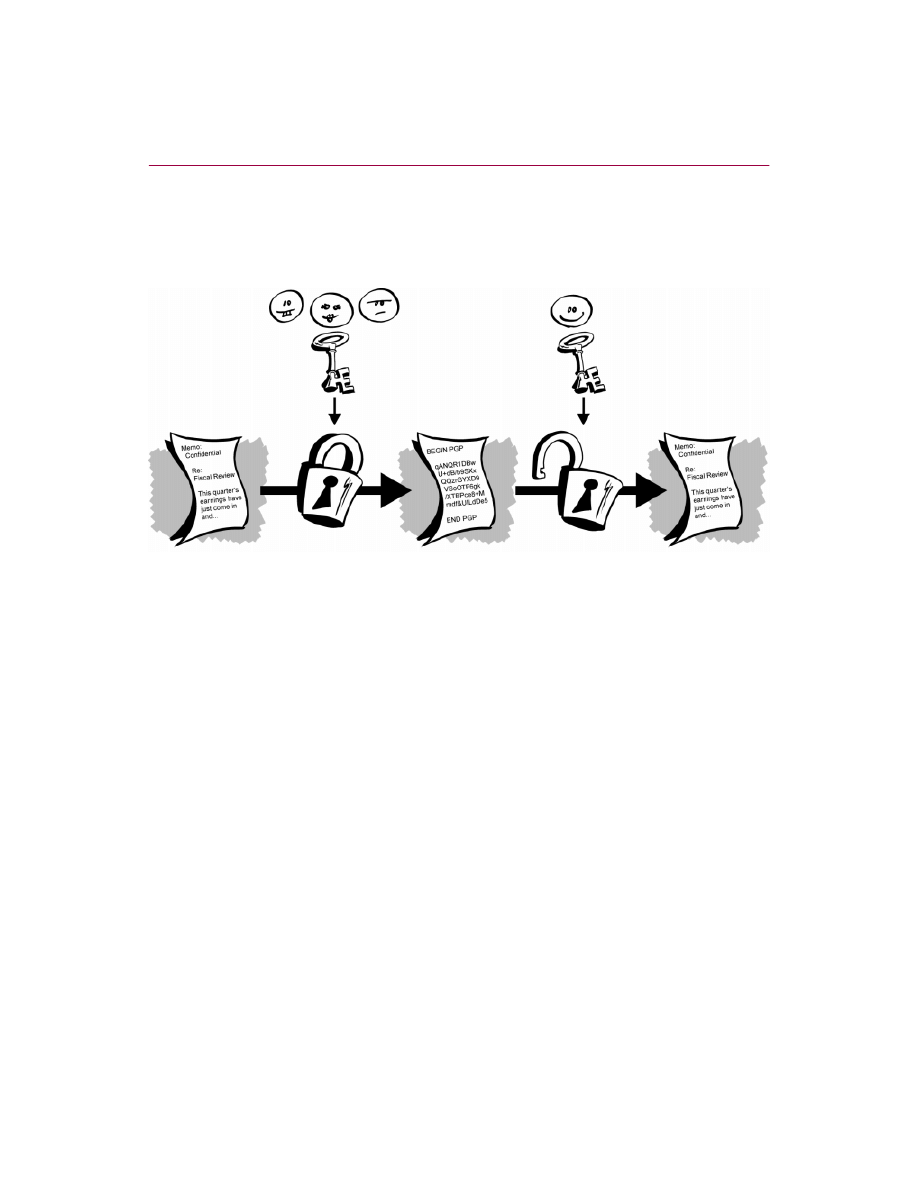
Public key cryptography is an asymmetric scheme that uses a pair of keys for
encryption: a public key, which encrypts data, and a corresponding private, or
secret key for decryption. You publish your public key to the world while
keeping your private key secret. Anyone with a copy of your public key can then
encrypt information that only you can read. Even people you have never met.
1. J H Ellis, The Possibility of Secure Non-Secret Digital Encryption, CESG Report, January 1970.
[CESG is the UK’s National Authority for the official use of cryptography.]
An Introduction to Cryptography
15
The Basics of Cryptography
It is computationally infeasible to deduce the private key from the public key.
Anyone who has a public key can encrypt information but cannot decrypt it.
Only the person who has the corresponding private key can decrypt the
information.
Figure 1-3. Public key encryption
The primary benefit of public key cryptography is that it allows people who
have no preexisting security arrangement to exchange messages securely
.
The
need for sender and receiver to share secret keys via some secure channel is
eliminated; all communications involve only public keys, and no private key
is ever transmitted or shared. Some examples of public-key cryptosystems are
Elgamal (named for its inventor, Taher Elgamal), RSA (named for its
inventors, Ron Rivest, Adi Shamir, and Leonard Adleman), Diffie-Hellman
(named, you guessed it, for its inventors), and DSA, the Digital Signature
Algorithm (invented by David Kravitz).
Because conventional cryptography was once the only available means for
relaying secret information, the expense of secure channels and key
distribution relegated its use only to those who could afford it, such as
governments and large banks (or small children with secret decoder rings).
Public key encryption is the technological revolution that provides strong
cryptography to the adult masses. Remember the courier with the locked
briefcase handcuffed to his wrist? Public-key encryption puts him out of
business (probably to his relief).
public key
private key
plaintext
ciphertext
plaintext
decryption
encryption
The Basics of Cryptography
16
An Introduction to Cryptography
How PGP works
PGP combines some of the best features of both conventional and public key
cryptography. PGP is a hybrid cryptosystem.
When a user encrypts plaintext with PGP, PGP first compresses the plaintext.
Data compression saves modem transmission time and disk space and, more
importantly, strengthens cryptographic security. Most cryptanalysis
techniques exploit patterns found in the plaintext to crack the cipher.
Compression reduces these patterns in the plaintext, thereby greatly
enhancing resistance to cryptanalysis. (Files that are too short to compress or
which don’t compress well aren’t compressed.)
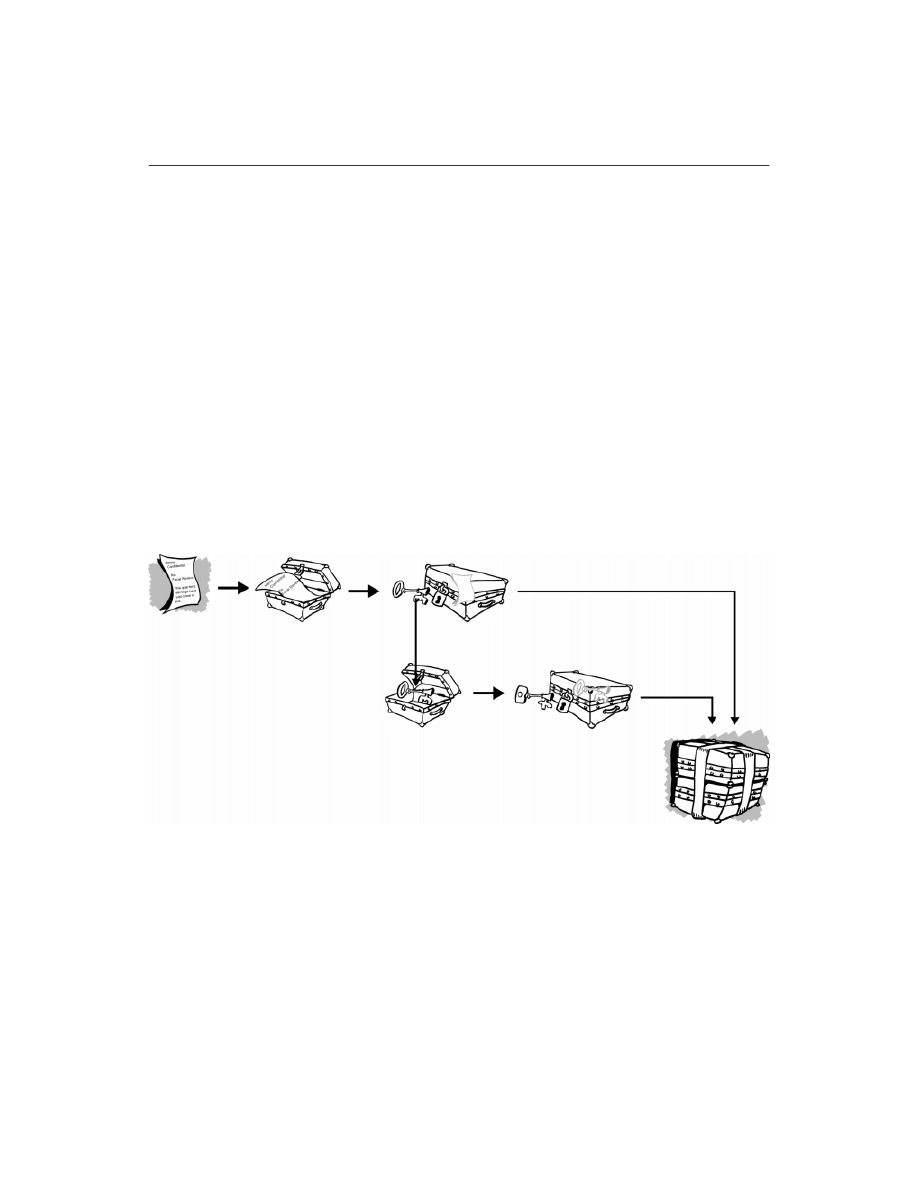
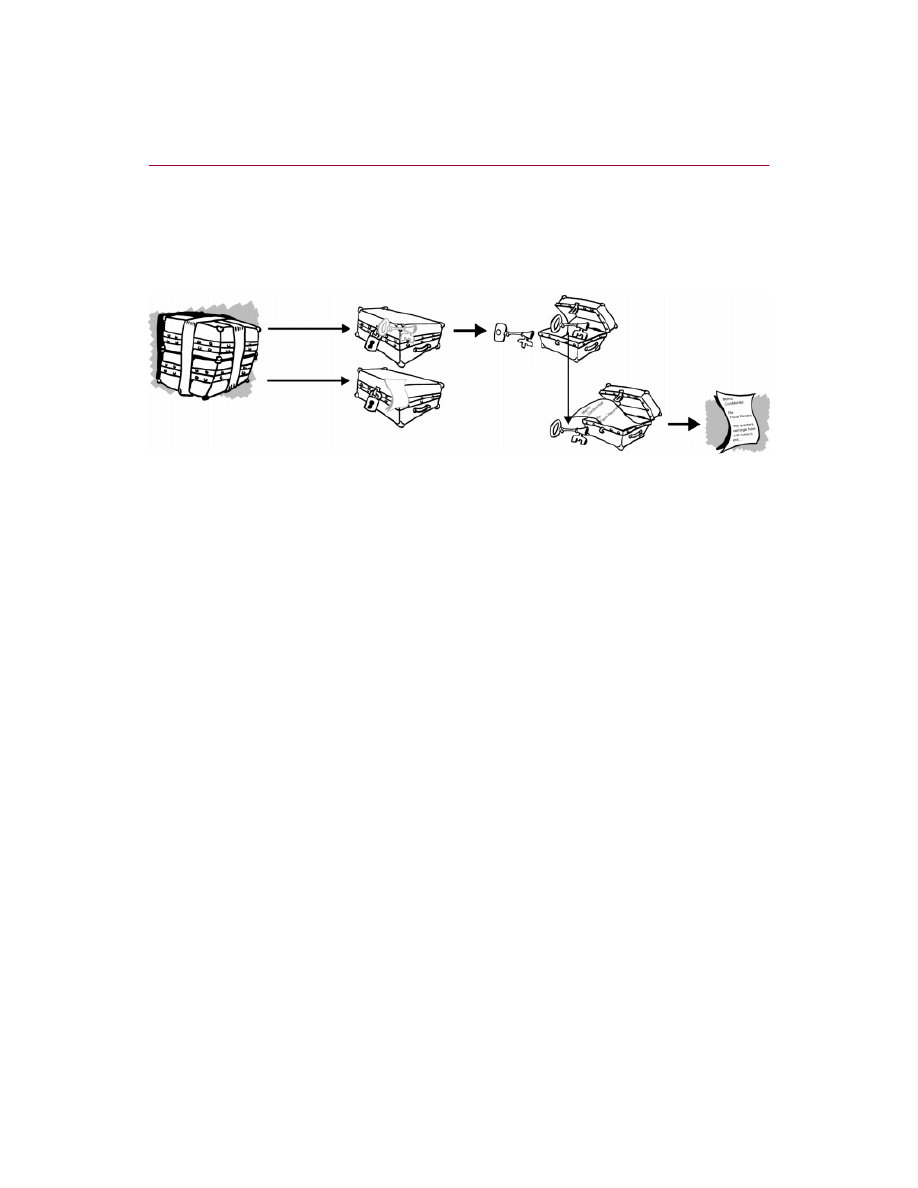
PGP then creates a session key, which is a one-time-only secret key. This key is
a random number generated from the random movements of your mouse and
the keystrokes you type. This session key works with a very secure, fast
conventional encryption algorithm to encrypt the plaintext; the result is
ciphertext. Once the data is encrypted, the session key is then encrypted to the
recipient’s public key. This public key-encrypted session key is transmitted
along with the ciphertext to the recipient.
Figure 1-4. How PGP encryption works
plaintext is encrypted
ciphertext +
encrypted session key
session key is encrypted
with session key
with public key
An Introduction to Cryptography
17
The Basics of Cryptography
Decryption works in the reverse. The recipient’s copy of PGP uses his or her
private key to recover the temporary session key, which PGP then uses to
decrypt the conventionally-encrypted ciphertext.
Figure 1-5. How PGP decryption works
The combination of the two encryption methods combines the convenience of
public key encryption with the speed of conventional encryption.
Conventional encryption is about 1,000 times faster than public key
encryption. Public key encryption in turn provides a solution to key
distribution and data transmission issues. Used together, performance and
key distribution are improved without any sacrifice in security.
Keys
A key is a value that works with a cryptographic algorithm to produce a
specific ciphertext. Keys are basically really, really, really big numbers. Key
size is measured in bits; the number representing a 1024-bit key is darn huge.
In public key cryptography, the bigger the key, the more secure the ciphertext.
However, public key size and conventional cryptography’s secret key size are
totally unrelated. A conventional 80-bit key has the equivalent strength of a
1024-bit public key. A conventional 128-bit key is equivalent to a 3000-bit
public key. Again, the bigger the key, the more secure, but the algorithms used
for each type of cryptography are very different and thus comparison is like
that of apples to oranges.
encrypted
ciphertext
encrypted message
session key
recipient’s private key used
to decrypt session key
session key used
to decrypt ciphertext
original
plaintext

The Basics of Cryptography
18
An Introduction to Cryptography
While the public and private keys are related, it’s very difficult to derive the
private key given only the public key; however, deriving the private key is
always possible given enough time and computing power. This makes it very
important to pick keys of the right size; large enough to be secure, but small
enough to be applied fairly quickly. Additionally, you need to consider who
might be trying to read your files, how determined they are, how much time
they have, and what their resources might be.
Larger keys will be cryptographically secure for a longer period of time. If
what you want to encrypt needs to be hidden for many years, you might want
to use a very large key. Of course, who knows how long it will take to
determine your key using tomorrow’s faster, more efficient computers? There
was a time when a 56-bit symmetric key was considered extremely safe.
Keys are stored in encrypted form. PGP stores the keys in two files on your
hard disk; one for public keys and one for private keys. These files are called
keyrings. As you use PGP, you will typically add the public keys of your
recipients to your public keyring. Your private keys are stored on your private
keyring. If you lose your private keyring, you will be unable to decrypt any
information encrypted to keys on that ring.
Digital signatures
A major benefit of public key cryptography is that it provides a method for
employing digital signatures. Digital signatures enable the recipient of
information to verify the authenticity of the information’s origin, and also
verify that the information is intact. Thus, public key digital signatures
provide authentication and data integrity. A digital signature also provides
non-repudiation, which means that it prevents the sender from claiming that he
or she did not actually send the information. These features are every bit as
fundamental to cryptography as privacy, if not more.
A digital signature serves the same purpose as a handwritten signature.
However, a handwritten signature is easy to counterfeit. A digital signature is
superior to a handwritten signature in that it is nearly impossible to
counterfeit, plus it attests to the contents of the information as well as to the
identity of the signer.
Some people tend to use signatures more than they use encryption. For
example, you may not care if anyone knows that you just deposited $1000 in
your account, but you do want to be darn sure it was the bank teller you were
dealing with.
An Introduction to Cryptography
19
The Basics of Cryptography
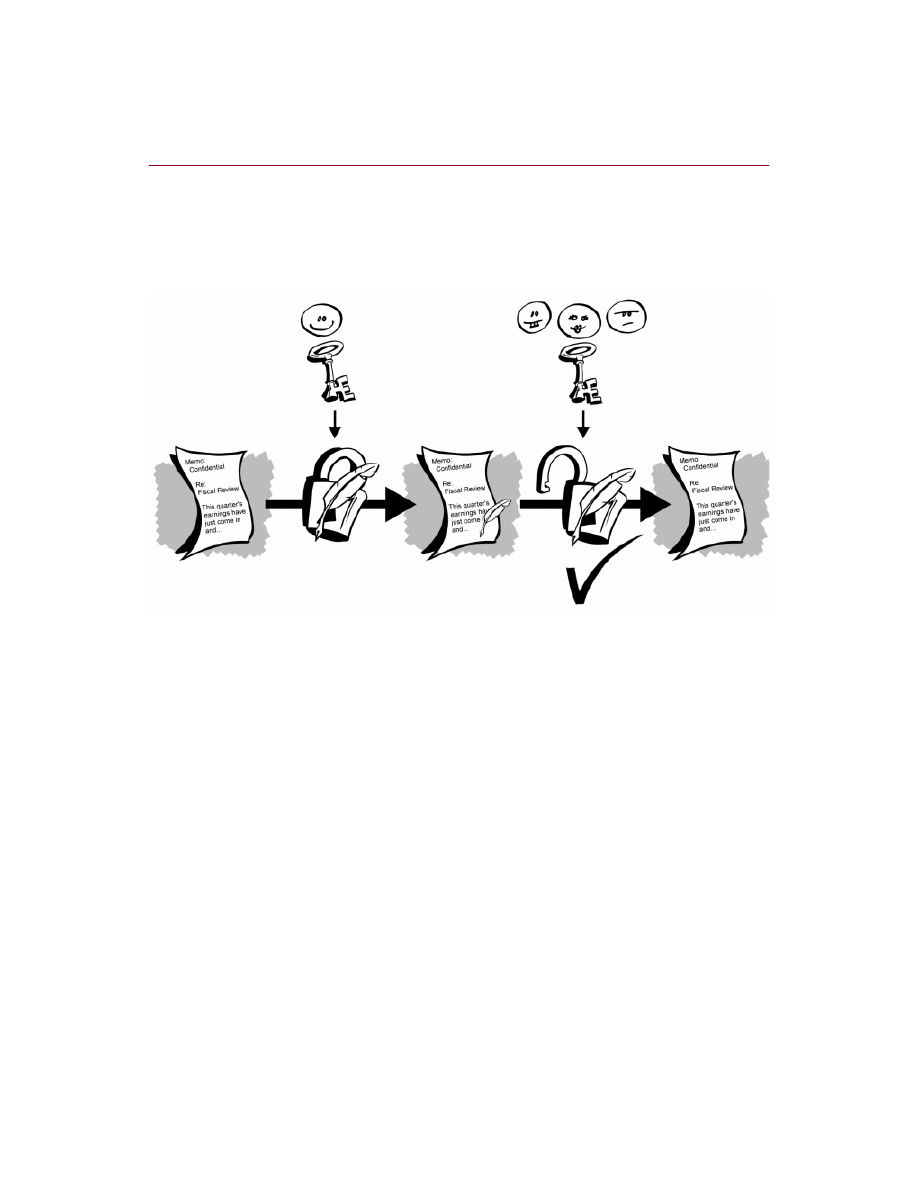
The basic manner in which digital signatures are created is illustrated in
. Instead of encrypting information using someone else’s public key, you
encrypt it with your private key. If the information can be decrypted with your
public key, then it must have originated with you.
Figure 1-6. Simple digital signatures
Hash functions
The system described above has some problems. It is slow, and it produces an
enormous volume of data—at least double the size of the original information.
An improvement on the above scheme is the addition of a one-way hash
function in the process. A one-way hash function takes variable-length
input—in this case, a message of any length, even thousands or millions of
bits—and produces a fixed-length output; say, 160-bits. The hash function
ensures that, if the information is changed in any way—even by just one
bit—an entirely different output value is produced.
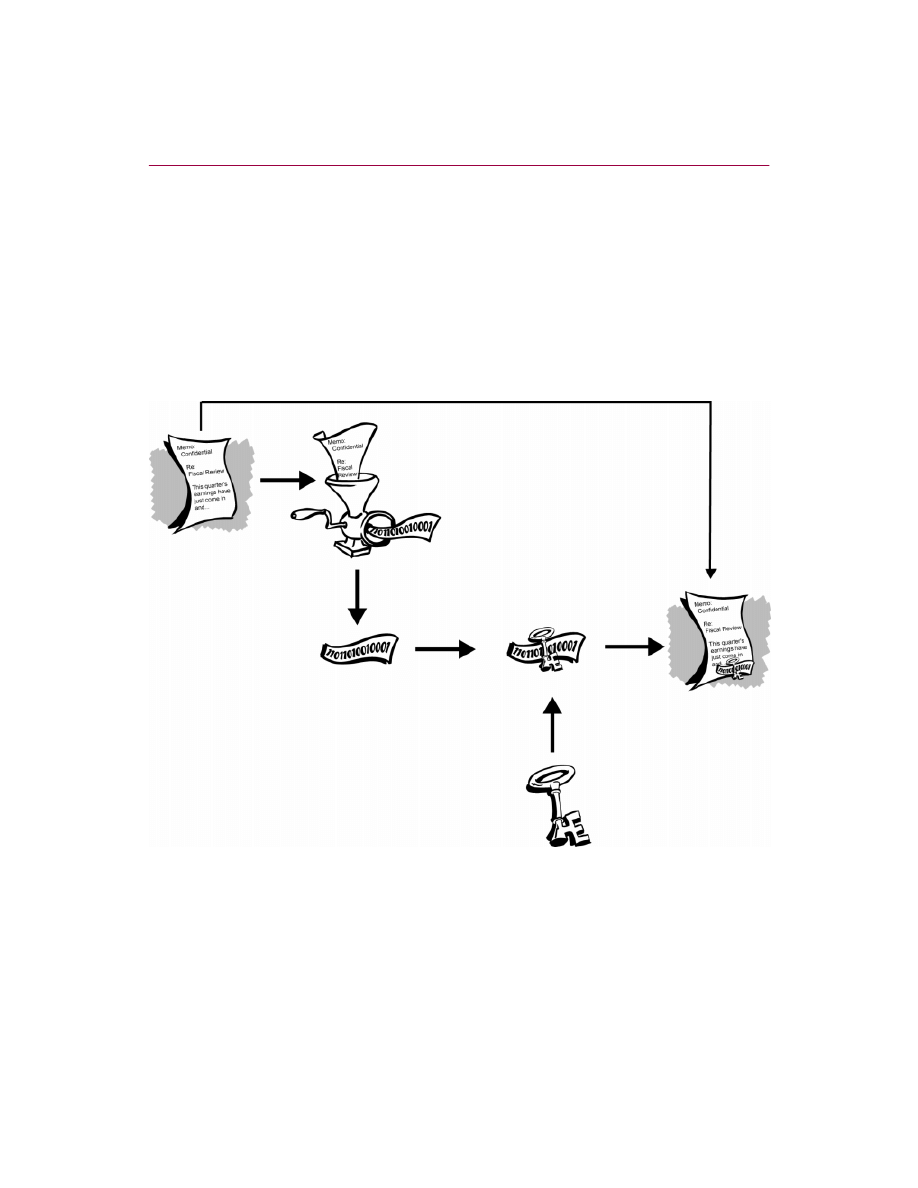
PGP uses a cryptographically strong hash function on the plaintext the user is
signing. This generates a fixed-length data item known as a message digest.
(Again, any change to the information results in a totally different digest.)
original text
signed text
verified text
verifying
signing
private key
public key
The Basics of Cryptography
20
An Introduction to Cryptography
Then PGP uses the digest and the private key to create the “signature.” PGP
transmits the signature and the plaintext together. Upon receipt of the
message, the recipient uses PGP to recompute the digest, thus verifying the
signature. PGP can encrypt the plaintext or not; signing plaintext is useful if
some of the recipients are not interested in or capable of verifying the
signature.
As long as a secure hash function is used, there is no way to take someone's
signature from one document and attach it to another, or to alter a signed
message in any way. The slightest change in a signed document will cause the
digital signature verification process to fail.
Figure 1-7. Secure digital signatures
Digital signatures play a major role in authenticating and validating other PGP
users’ keys.
plaintext
private key
hash function
message digest
plaintext
+
signature
digest signed
with private key
used for signing

An Introduction to Cryptography
21
The Basics of Cryptography
Digital certificates
One issue with public key cryptosystems is that users must be constantly
vigilant to ensure that they are encrypting to the correct person’s key. In an
environment where it is safe to freely exchange keys via public servers,
man-in-the-middle attacks are a potential threat. In this type of attack, someone
posts a phony key with the name and user ID of the user’s intended recipient.
Data encrypted to— and intercepted by—the true owner of this bogus key is
now in the wrong hands.
In a public key environment, it is vital that you are assured that the public key
to which you are encrypting data is in fact the public key of the intended
recipient and not a forgery. You could simply encrypt only to those keys which
have been physically handed to you. But suppose you need to exchange
information with people you have never met; how can you tell that you have
the correct key?
Digital certificates, or certs, simplify the task of establishing whether a key truly
belongs to the purported owner.
Webster’s dictionary defines certificate as “a document containing a certified
statement, especially as to the truth of something.” A certificate is a form of
credential. Examples might be your passport, your social security card, or
your birth certificate. Each of these has some information on it identifying you
and some authorization stating that someone else has confirmed your identity.
Some certificates, such as your driver’s license, are important enough
confirmation of your identity that you would not want to lose them, lest
someone use them to impersonate you.
A digital certificate is data that functions much like a physical certificate. A
digital certificate is information included with a person’s public key that helps
others verify that a key is genuine or valid. Digital certificates are used to
thwart attempts to substitute one person’s key for another.
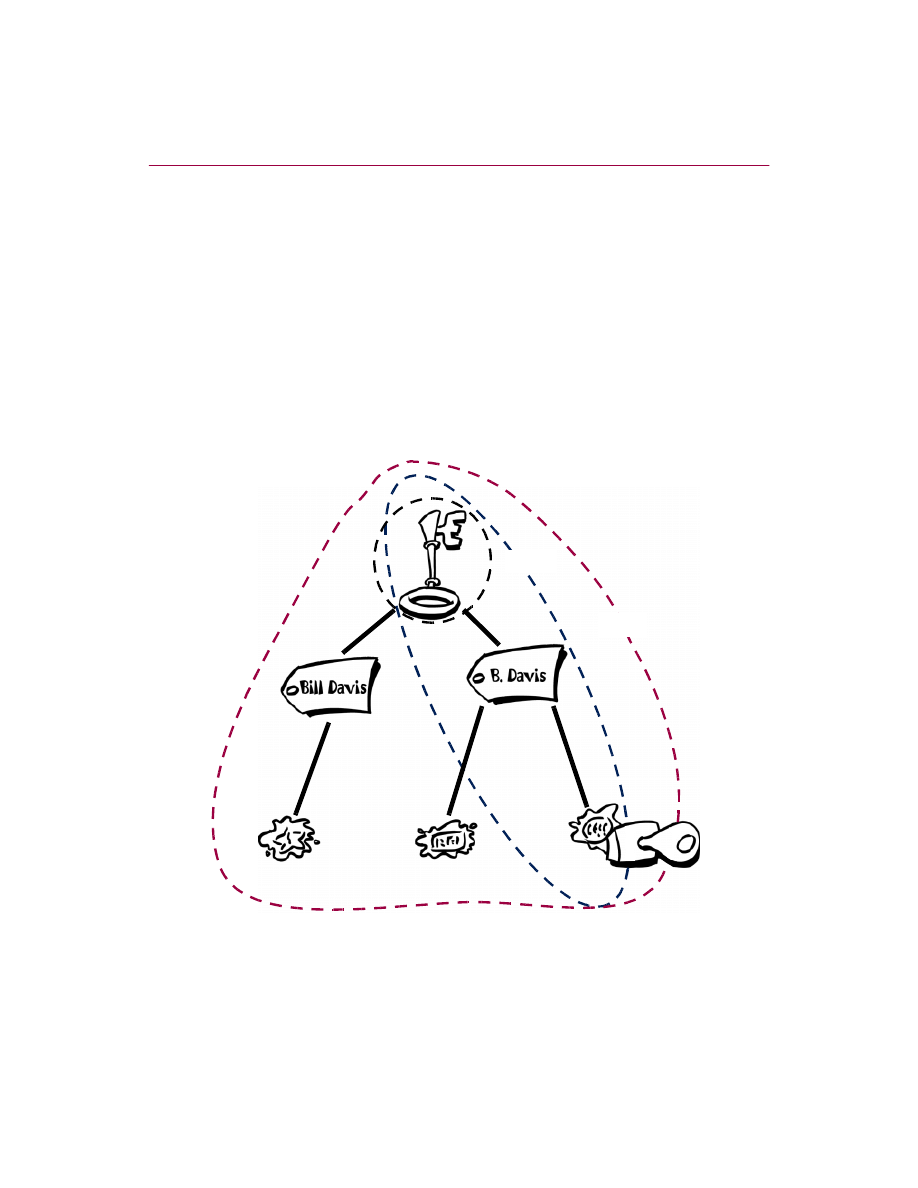
A digital certificate consists of three things:
• A public key.
• Certificate information. (“Identity” information about the user, such as
name, user ID, and so on.)
• One or more digital signatures.
The purpose of the digital signature on a certificate is to state that the
certificate information has been attested to by some other person or entity. The
digital signature does not attest to the authenticity of the certificate as a whole;
it vouches only that the signed identity information goes along with, or is
bound to, the public key.
The Basics of Cryptography
22
An Introduction to Cryptography
While some security experts believe it is not a good practice to mix
professional and personal identity information on one key, but rather have
separate keys for each, you will come across certificates containing a public
key with several associated identities (for example, the user’s name and
corporate email account, the user’s nickname and home email account, the
user’s maiden name and college email account—all in one certificate). The list
of signatures of each of those identities may differ; signatures usually attest to
the authenticity of one of the identities, not that all three are authentic.
For example, suppose your coworker, Alice, asks you to sign her certificate.
You look it up on the server and see that Alice has two pieces of identity
information associated with the certificate. The first one reads “Alice Petucci,
alice@securecompany.com.” The second reads “Cleopatra, cleo@cheops.org.”
Depending on how well you know Alice, you might want to choose to sign
only the one that relates to the Alice you know at work.
Figure 1-8. Anatomy of a certificate
signature
signature signature
userid userid
certificate
certification
key

An Introduction to Cryptography
23
The Basics of Cryptography
Validity and trust
Every user in a public key system is vulnerable to mistaking a phony key
(certificate) for a real one. Validity is confidence that a public key certificate
belongs to its purported owner. Validity is essential in a public key
environment where you must constantly establish whether or not a particular
certificate is authentic.
When you’ve assured yourself that a certificate belonging to someone else is
valid, you can sign the copy on your keyring to attest to the fact that you’ve
checked the certificate and that it’s a good one. If you want others to know that
you gave the certificate your stamp of approval, you can export the signature
to a certificate server so that others can see it.
Some companies designate one or more Certification Authorities (CA), whose
job it is to go around and check the validity of all the certificates in the
organization and then sign the good ones. The CA is the Grand Pooh-bah of
validation in an organization, whom everyone trusts, and in some public key
environments, no certificate is considered valid unless it has been attested to
by a CA.
Checking validity
One way to establish validity is to go through some manual process. There are
several ways to accomplish this. You could require your intended recipient to
physically hand you a copy of his or her public key. But this is often
inconvenient and inefficient.
Another way is to manually check the certificate’s fingerprint. Just as every
human’s fingerprints are unique, every PGP certificate’s fingerprint is unique.
The fingerprint is a hash of the user’s certificate and appears as one of the
certificate’s properties. You can check that a certificate is valid by calling the
key’s owner (so that you originate the transaction) and asking the owner to
read his or her key’s fingerprint to you and verifying that fingerprint against
the one you believe to be the real one. This works if you know the owner’s
voice, but, how do you manually verify the identity of someone you don’t
know? Some people put the fingerprint of their key on their business cards for
this very reason.
Another way to establish validity of someone’s certificate is to trust that a third
individual has gone through the process of validating it.
A CA, for example, is responsible for ensuring that prior to assigning validity
to a certificate, he or she carefully checks it to be sure it belongs to the
purported owner. Anyone who trusts the CA will automatically consider any
certificates validated by the CA to be valid.

The Basics of Cryptography
24
An Introduction to Cryptography
Establishing trust
You validate keys. You trust people. More specifically, you trust people to
validate other people’ keys. Typically, unless the owner hands you the
certificate, you have to go by someone else’s word that it is valid.
Meta and trusted introducers
In most situations, people completely trust the CA to establish certificates’
validity. This means that everyone else relies upon the CA to go through the
whole manual validation process for them. This is fine up to a certain number
of users or number of work sites, and then it may not be possible for the CA to
maintain the same level of quality validation. In that case, adding other
validators to the system is necessary.
A CA can also be a meta-introducer. A meta-introducer bestows not only
validity on keys, but bestows the ability to trust keys upon others. Similar to the
king who hands his seal to his trusted advisors so they can act on his authority,
the meta-introducer enables others to act as trusted introducers. These trusted
introducers can validate keys to the same effect as that of the meta-introducer.
They cannot, however, create new trusted introducers.
Trust models
In relatively closed systems, such as within a company, it is easy to trace a path
of trust back to the root CA. However, in the real world, users must often
communicate with people outside of their corporate environment, including
some whom they have never met, such as vendors, customers, clients,
associates, and so on. Establishing a line of trust to those who have not been
explicitly trusted by a CA is difficult.
Companies follow one or another trust model, which dictates how users will go
about establishing key validity. There are three different models:
• Direct Trust
• Hierarchical Trust
• A Web of Trust
An Introduction to Cryptography
25
The Basics of Cryptography
Direct Trust
Direct trust is the simplest trust model. In this model, a user trusts that a key
is valid because he or she knows where it came from. All cryptosystems use
this form of trust in some way. For example, in web browsers, the root
Certification Authority keys are directly trusted because they were shipped by
the manufacturer. If there is any form of hierarchy, it extends from these
directly trusted certificates.
In PGP, a user who validates keys herself and never sets another certificate to
be a trusted introducer is using direct trust.
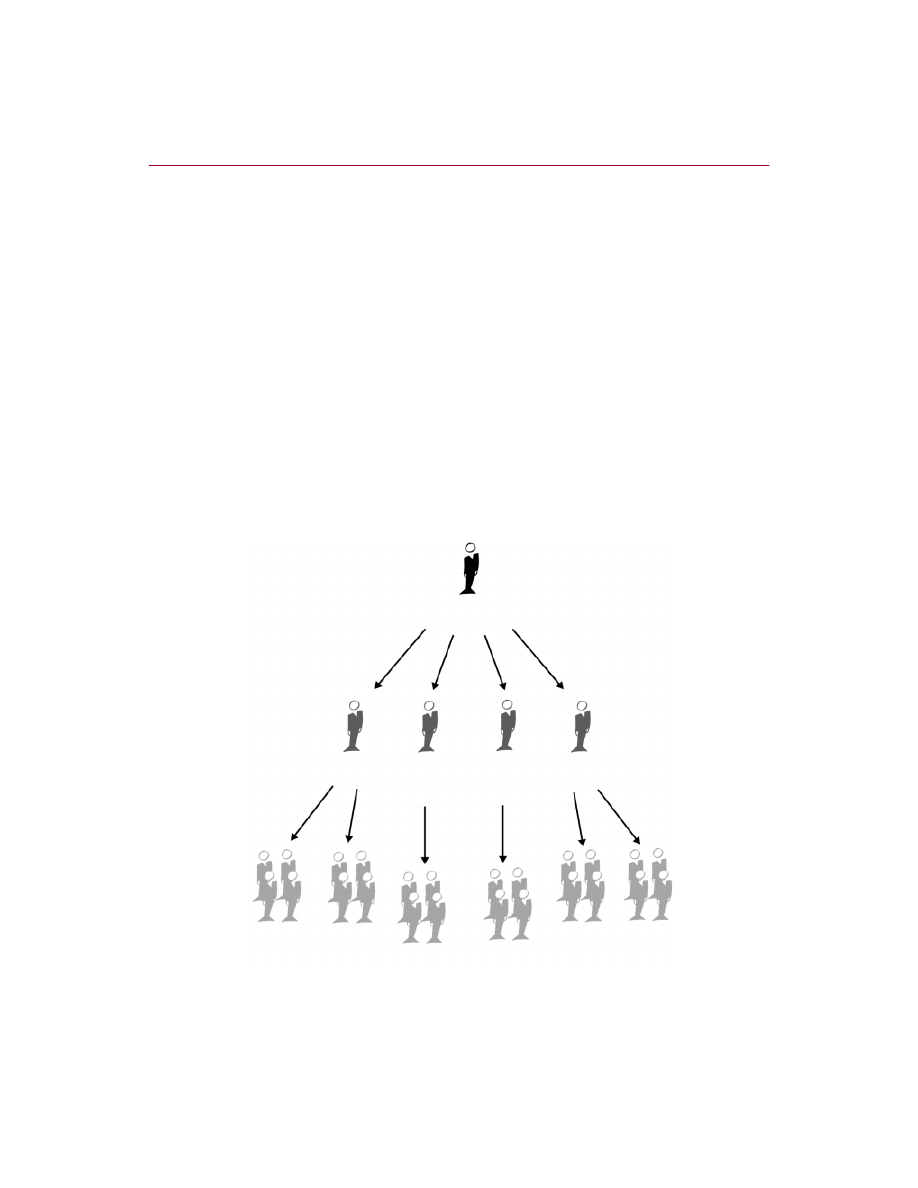
Hierarchical Trust
In a hierarchical system, there are a number of “root” certificates from which
trust extends. These certificates may certify certificates themselves, or they
may certify certificates that certify still other certificates down some chain.
Consider it as a big trust “tree.” The “leaf” certificate's validity is verified by
tracing backward from its certifier, to other certifiers, until a directly trusted
root certificate is found.
Figure 1-9. Hierarchical trust
meta-introducer (or CA)
trusted introducers
users

The Basics of Cryptography
26
An Introduction to Cryptography
Web of Trust
A web of trust encompasses both of the other models, but also adds the notion
that trust is in the eye of the beholder (which is the real-world view) and the
idea that more information is better. It is thus a cumulative trust model. A
certificate might be trusted directly, or trusted in some chain going back to a
directly trusted root certificate (the meta-introducer), or by some group of
introducers.
Perhaps you’ve heard of the term six degrees of separation, which suggests that
any person in the world can determine some link to any other person in the
world using six or fewer other people as intermediaries. This is a web of
introducers.
It is also the PGP view of trust. PGP uses digital signatures as its form of
introduction. When any user signs another’s key, he or she becomes an
introducer of that key. As this process goes on, it establishes a web of trust.
In a PGP environment, any user can act as a certifying authority. Any PGP user
can validate another PGP user’s public key certificate. However, such a
certificate is only valid to another user if the relying party recognizes the
validator as a trusted introducer. (That is, you trust my opinion that others’
keys are valid only if you consider me to be a trusted introducer. Otherwise,
my opinion on other keys’ validity is moot.)
Stored on each user’s public keyring are indicators of
• whether or not the user considers a particular key to be valid
• the level of trust the user places on the key that the key’s owner can serve
as certifier of others’ keys
You indicate, on your copy of my key, whether you think my judgement
counts. It’s really a reputation system: certain people are reputed to give good
signatures, and people trust them to attest to other keys’ validity.
Levels of trust in PGP
The highest level of trust in a key, implicit trust, is trust in your own key pair.
PGP assumes that if you own the private key, you must trust the actions of its
related public key. Any keys signed by your implicitly trusted key are valid.
There are three levels of trust you can assign to someone else’s public key:
• Complete trust
• Marginal trust
• No trust (or Untrusted)

An Introduction to Cryptography
27
The Basics of Cryptography
To make things confusing, there are also three levels of validity:
• Valid
• Marginally valid
• Invalid
To define another’s key as a trusted introducer, you
1. Start with a valid key, one that is either
•
signed by you or
•
signed by another trusted introducer
and then
2. Set the level of trust you feel the key’s owner is entitled.
For example, suppose your key ring contains Alice’s key. You have validated
Alice’s key and you indicate this by signing it. You know that Alice is a real
stickler for validating others’ keys. You therefore assign her key with
Complete trust. This makes Alice a Certification Authority. If Alice signs
another’s key, it appears as Valid on your keyring.
PGP requires one Completely trusted signature or two Marginally trusted
signatures to establish a key as valid. PGP’s method of considering two
Marginals equal to one Complete is similar to a merchant asking for two forms
of ID. You might consider Alice fairly trustworthy and also consider Bob fairly
trustworthy. Either one alone runs the risk of accidentally signing a counterfeit
key, so you might not place complete trust in either one. However, the odds
that both individuals signed the same phony key are probably small.
What is a passphrase?
Most people are familiar with restricting access to computer systems via a
password, which is a unique string of characters that a user types in as an
identification code.
A passphrase is a longer version of a password, and in theory, a more secure
one. Typically composed of multiple words, a passphrase is more secure
against standard dictionary attacks, wherein the attacker tries all the words in
the dictionary in an attempt to determine your password. The best
passphrases are relatively long and complex and contain a combination of
upper and lowercase letters, numeric and punctuation characters.

The Basics of Cryptography
28
An Introduction to Cryptography
PGP uses a passphrase to encrypt your private key on your machine. Your
private key is encrypted on your disk using a hash of your passphrase as the
secret key. You use the passphrase to decrypt and use your private key. A
passphrase should be hard for you to forget and difficult for others to guess. It
should be something already firmly embedded in your long-term memory,
rather than something you make up from scratch. Why? Because if you forget
your passphrase, you are out of luck
. Your private key is totally and
absolutely useless without your passphrase and nothing can be done about it.
Remember the quote earlier in this chapter? PGP is cryptography that will
keep major governments out of your files. It will certainly keep you out of your
files, too. Keep that in mind when you decide to change your passphrase to the
punchline of that joke you can never quite remember.
Key splitting
They say that a secret is not a secret if it is known to more than one person.
Sharing a private key pair poses such a problem. While it is not a
recommended practice, sharing a private key pair is necessary at times.
Corporate Signing Keys, for example, are private keys used by a company to
sign—for example—legal documents, sensitive personnel information, or
press releases to authenticate their origin. In such a case, it is worthwhile for
multiple members of the company to have access to the private key. However,
this means that any single individual can act fully on behalf of the company.
In such a case it is wise to split the key among multiple people in such a way
that more than one or two people must present a piece of the key in order to
reconstitute it to a usable condition. If too few pieces of the key are available,
then the key is unusable.
Some examples are to split a key into three pieces and require two of them to
reconstitute the key, or split it into two pieces and require both pieces. If a
secure network connection is used during the reconstitution process, the key’s
shareholders need not be physically present in order to rejoin the key.
Technical details
This chapter provided a high-level introduction to cryptographic concepts and
terminology. In
, Phil Zimmermann, the creator of PGP, provides a
more in-depth discussion of privacy, the technical details of how PGP works,
including the various algorithms it uses, as well as various attacks and how to
protect yourself against them.
For more information on cryptography, please refer to some of the books listed
in the
section of the Preface.

2
An Introduction to Cryptography
29
2
Phil Zimmermann on PGP
This chapter contains introductory and background information about
cryptography and PGP as written by Phil Zimmermann.
Why I wrote PGP
“Whatever you do will be insignificant, but it is very important that you do it.”
—Mahatma Gandhi.
It’s personal. It’s private. And it’s no one’s business but yours. You may be
planning a political campaign, discussing your taxes, or having a secret
romance. Or you may be communicating with a political dissident in a
repressive country. Whatever it is, you don’t want your private electronic mail
(email) or confidential documents read by anyone else. There’s nothing wrong
with asserting your privacy. Privacy is as apple-pie as the Constitution.
The right to privacy is spread implicitly throughout the Bill of Rights. But
when the United States Constitution was framed, the Founding Fathers saw
no need to explicitly spell out the right to a private conversation. That would
have been silly. Two hundred years ago, all conversations were private. If
someone else was within earshot, you could just go out behind the barn and
have your conversation there. No one could listen in without your knowledge.
The right to a private conversation was a natural right, not just in a
philosophical sense, but in a law-of-physics sense, given the technology of the
time.
But with the coming of the information age, starting with the invention of the
telephone, all that has changed. Now most of our conversations are conducted
electronically. This allows our most intimate conversations to be exposed
without our knowledge. Cellular phone calls may be monitored by anyone
with a radio. Electronic mail, sent across the Internet, is no more secure than
cellular phone calls. Email is rapidly replacing postal mail, becoming the norm
for everyone, not the novelty it was in the past. And email can be routinely and
automatically scanned for interesting keywords, on a large scale, without
detection. This is like driftnet fishing.

Phil Zimmermann on PGP
30
An Introduction to Cryptography
Perhaps you think your email is legitimate enough that encryption is
unwarranted. If you really are a law-abiding citizen with nothing to hide, then
why don’t you always send your paper mail on postcards? Why not submit to
drug testing on demand? Why require a warrant for police searches of your
house? Are you trying to hide something? If you hide your mail inside
envelopes, does that mean you must be a subversive or a drug dealer, or
maybe a paranoid nut? Do law-abiding citizens have any need to encrypt their
email?
What if everyone believed that law-abiding citizens should use postcards for
their mail? If a nonconformist tried to assert his privacy by using an envelope
for his mail, it would draw suspicion. Perhaps the authorities would open his
mail to see what he’s hiding. Fortunately, we don’t live in that kind of world,
because everyone protects most of their mail with envelopes. So no one draws
suspicion by asserting their privacy with an envelope. There’s safety in
numbers. Analogously, it would be nice if everyone routinely used encryption
for all their email, innocent or not, so that no one drew suspicion by asserting
their email privacy with encryption. Think of it as a form of solidarity.
Until now, if the government wanted to violate the privacy of ordinary
citizens, they had to expend a certain amount of expense and labor to intercept
and steam open and read paper mail. Or they had to listen to and possibly
transcribe spoken telephone conversation, at least before automatic voice
recognition technology became available. This kind of labor-intensive
monitoring was not practical on a large scale. It was only done in important
cases when it seemed worthwhile.
Senate Bill 266, a 1991 omnibus anticrime bill, had an unsettling measure
buried in it. If this non-binding resolution had become real law, it would have
forced manufacturers of secure communications equipment to insert special
“trap doors” in their products, so that the government could read anyone’s
encrypted messages. It reads, “It is the sense of Congress that providers of
electronic communications services and manufacturers of electronic
communications service equipment shall ensure that communications systems
permit the government to obtain the plain text contents of voice, data, and
other communications when appropriately authorized by law.” It was this bill
that led me to publish PGP electronically for free that year, shortly before the
measure was defeated after vigorous protest by civil libertarians and industry
groups.
The 1994 Digital Telephony bill mandated that phone companies install
remote wiretapping ports into their central office digital switches, creating a
new technology infrastructure for “point-and-click” wiretapping, so that
federal agents no longer have to go out and attach alligator clips to phone
lines. Now they will be able to sit in their headquarters in Washington and
listen in on your phone calls. Of course, the law still requires a court order for
a wiretap. But while technology infrastructures can persist for generations,

An Introduction to Cryptography
31
Phil Zimmermann on PGP
laws and policies can change overnight. Once a communications
infrastructure optimized for surveillance becomes entrenched, a shift in
political conditions may lead to abuse of this new-found power. Political
conditions may shift with the election of a new government, or perhaps more
abruptly from the bombing of a federal building.
A year after the 1994 Digital Telephony bill passed, the FBI disclosed plans to
require the phone companies to build into their infrastructure the capacity to
simultaneously wiretap 1 percent of all phone calls in all major U.S. cities. This
would represent more than a thousandfold increase over previous levels in the
number of phones that could be wiretapped. In previous years, there were
only about a thousand court-ordered wiretaps in the United States per year, at
the federal, state, and local levels combined. It’s hard to see how the
government could even employ enough judges to sign enough wiretap orders
to wiretap 1 percent of all our phone calls, much less hire enough federal
agents to sit and listen to all that traffic in real time. The only plausible way of
processing that amount of traffic is a massive Orwellian application of
automated voice recognition technology to sift through it all, searching for
interesting keywords or searching for a particular speaker’s voice. If the
government doesn’t find the target in the first 1 percent sample, the wiretaps
can be shifted over to a different 1 percent until the target is found, or until
everyone’s phone line has been checked for subversive traffic. The FBI says
they need this capacity to plan for the future. This plan sparked such outrage
that it was defeated in Congress, at least this time around, in 1995. But the
mere fact that the FBI even asked for these broad powers is revealing of their
agenda. And the defeat of this plan isn’t so reassuring when you consider that
the 1994 Digital Telephony bill was also defeated the first time it was
introduced, in 1993.
Advances in technology will not permit the maintenance of the status quo, as
far as privacy is concerned. The status quo is unstable. If we do nothing, new
technologies will give the government new automatic surveillance capabilities
that Stalin could never have dreamed of. The only way to hold the line on
privacy in the information age is strong cryptography.
You don’t have to distrust the government to want to use cryptography. Your
business can be wiretapped by business rivals, organized crime, or foreign
governments. Several foreign governments, for example, admit to using their
signals intelligence against companies from other countries to give their own
corporations a competitive edge. Ironically, the United States government’s
restrictions on cryptography have weakened U.S. corporate defenses against
foreign intelligence and organized crime.

Phil Zimmermann on PGP
32
An Introduction to Cryptography
The government knows what a pivotal role cryptography is destined to play
in the power relationship with its people. In April 1993, the Clinton
administration unveiled a bold new encryption policy initiative, which had
been under development at the National Security Agency (NSA) since the start
of the Bush administration. The centerpiece of this initiative was a
government-built encryption device, called the Clipper chip, containing a new
classified NSA encryption algorithm. The government tried to encourage
private industry to design it into all their secure communication products,
such as secure phones, secure faxes, and so on. AT&T put Clipper into its
secure voice products. The catch: At the time of manufacture, each Clipper
chip is loaded with its own unique key, and the government gets to keep a
copy, placed in escrow. Not to worry, though—the government promises that
they will use these keys to read your traffic only “when duly authorized by
law.” Of course, to make Clipper completely effective, the next logical step
would be to outlaw other forms of cryptography.
The government initially claimed that using Clipper would be voluntary, that
no one would be forced to use it instead of other types of cryptography. But
the public reaction against the Clipper chip has been strong, stronger than the
government anticipated. The computer industry has monolithically
proclaimed its opposition to using Clipper. FBI director Louis Freeh
responded to a question in a press conference in 1994 by saying that if Clipper
failed to gain public support, and FBI wiretaps were shut out by
non-government-controlled cryptography, his office would have no choice
but to seek legislative relief. Later, in the aftermath of the Oklahoma City
tragedy, Mr. Freeh testified before the Senate Judiciary Committee that public
availability of strong cryptography must be curtailed by the government
(although no one had suggested that cryptography was used by the bombers).
The Electronic Privacy Information Center (EPIC) obtained some revealing
documents under the Freedom of Information Act. In a briefing document
titled “Encryption: The Threat, Applications and Potential Solutions,” and
sent to the National Security Council in February 1993, the FBI, NSA, and
Department of Justice (DOJ) concluded that “Technical solutions, such as they
are, will only work if they are incorporated into all encryption products. To
ensure that this occurs, legislation mandating the use of
Government-approved encryption products or adherence to Government
encryption criteria is required.”

An Introduction to Cryptography
33
Phil Zimmermann on PGP
The government has a track record that does not inspire confidence that they
will never abuse our civil liberties. The FBI’s COINTELPRO program targeted
groups that opposed government policies. They spied on the antiwar
movement and the civil rights movement. They wiretapped the phone of
Martin Luther King Jr. Nixon had his enemies list. And then there was the
Watergate mess. Congress now seems intent on passing laws curtailing our
civil liberties on the Internet. At no time in the past century has public distrust
of the government been so broadly distributed across the political spectrum,
as it is today.
If we want to resist this unsettling trend in the government to outlaw
cryptography, one measure we can apply is to use cryptography as much as
we can now while it’s still legal. When use of strong cryptography becomes
popular, it’s harder for the government to criminalize it. Therefore, using PGP
is good for preserving democracy.
If privacy is outlawed, only outlaws will have privacy. Intelligence agencies
have access to good cryptographic technology. So do the big arms and drug
traffickers. But ordinary people and grassroots political organizations mostly
have not had access to affordable “military grade” public-key cryptographic
technology. Until now.
PGP empowers people to take their privacy into their own hands. There’s a
growing social need for it. That’s why I created it.
The PGP symmetric algorithms
PGP offers a selection of different secret key algorithms to encrypt the actual
message. By secret key algorithm, we mean a conventional, or symmetric,
block cipher that uses the same key to both encrypt and decrypt. The three
symmetric block ciphers offered by PGP are CAST, Triple-DES, and IDEA.
They are not “home-grown” algorithms. They were all developed by teams of
cryptographers with distinguished reputations.
For the cryptographically curious, all three ciphers operate on 64-bit blocks of
plaintext and ciphertext. CAST and IDEA have key sizes of 128 bits, while
Triple-DES uses a 168-bit key. Like Data Encryption Standard (DES), any of
these ciphers can be used in cipher feedback (CFB) and cipher block chaining
(CBC) modes. PGP uses them in 64-bit CFB mode.
I included the CAST encryption algorithm in PGP because it shows promise as
a good block cipher with a 128-bit key size, it’s very fast, and it’s free. Its name
is derived from the initials of its designers, Carlisle Adams and Stafford
Tavares of Northern Telecom (Nortel). Nortel has applied for a patent for
CAST, but they have made a commitment in writing to make CAST available
to anyone on a royalty-free basis. CAST appears to be exceptionally well
designed, by people with good reputations in the field. The design is based on

Phil Zimmermann on PGP
34
An Introduction to Cryptography
a very formal approach, with a number of formally provable assertions that
give good reasons to believe that it probably requires key exhaustion to break
its 128-bit key. CAST has no weak or semiweak keys. There are strong
arguments that CAST is completely immune to both linear and differential
cryptanalysis, the two most powerful forms of cryptanalysis in the published
literature, both of which have been effective in cracking DES. CAST is too new
to have developed a long track record, but its formal design and the good
reputations of its designers will undoubtedly attract the attentions and
attempted cryptanalytic attacks of the rest of the academic cryptographic
community. I’m getting nearly the same preliminary gut feeling of confidence
from CAST that I got years ago from IDEA, the cipher I selected for use in
earlier versions of PGP. At that time, IDEA was also too new to have a track
record, but it has held up well.
The IDEA (International Data Encryption Algorithm) block cipher is based on
the design concept of “mixing operations from different algebraic groups.” It
was developed at ETH in Zurich by James L. Massey and Xuejia Lai, and
published in 1990. Early published papers on the algorithm called it IPES
(Improved Proposed Encryption Standard), but they later changed the name
to IDEA. So far, IDEA has resisted attack much better than other ciphers such
as FEAL, REDOC-II, LOKI, Snefru and Khafre. And IDEA is more resistant
than DES to Biham and Shamir’s highly successful differential cryptanalysis
attack, as well as attacks from linear cryptanalysis. As this cipher continues to
attract attack efforts from the most formidable quarters of the cryptanalytic
world, confidence in IDEA is growing with the passage of time. Sadly, the
biggest obstacle to IDEA’s acceptance as a standard has been the fact that
Ascom Systec holds a patent on its design, and unlike DES and CAST, IDEA
has not been made available to everyone on a royalty-free basis.
As a hedge, PGP includes three-key Triple-DES in its repertoire of available
block ciphers. The DES was developed by IBM in the mid-1970s. While it has
a good design, its 56-bit key size is too small by today’s standards. Triple-DES
is very strong, and has been well studied for many years, so it might be a safer
bet than the newer ciphers such as CAST and IDEA. Triple-DES is the DES
applied three times to the same block of data, using three different keys, except
that the second DES operation is run backwards, in decrypt mode. While
Triple-DES is much slower than either CAST or IDEA, speed is usually not
critical for email applications. Although Triple-DES uses a key size of 168 bits,
it appears to have an effective key strength of at least 112 bits against an
attacker with impossibly immense data storage capacity to use in the attack.
According to a paper presented by Michael Weiner at Crypto96, any remotely
plausible amount of data storage available to the attacker would enable an
attack that would require about as much work as breaking a 129-bit key.
Triple-DES is not encumbered by any patents.

An Introduction to Cryptography
35
Phil Zimmermann on PGP
PGP public keys that were generated by PGP Version 5.0 or later have
information embedded in them that tells a sender what block ciphers are
understood by the recipient’s software, so that the sender’s software knows
which ciphers can be used to encrypt. Diffie-Hellman/DSS public keys accept
CAST, IDEA, or Triple-DES as the block cipher, with CAST as the default
selection. At present, for compatibility reasons, RSA keys do not provide this
feature. Only the IDEA cipher is used by PGP to send messages to RSA keys,
because older versions of PGP only supported RSA and IDEA.
About PGP data compression routines
PGP normally compresses the plaintext before encrypting it, because it’s too
late to compress the plaintext after it has been encrypted; encrypted data is not
compressible. Data compression saves modem transmission time and disk
space and, more importantly, strengthens cryptographic security. Most
cryptanalysis techniques exploit redundancies found in the plaintext to crack
the cipher. Data compression reduces this redundancy in the plaintext,
thereby greatly enhancing resistance to cryptanalysis. It takes extra time to
compress the plaintext, but from a security point of view it’s worth it.
Files that are too short to compress, or that just don’t compress well, are not
compressed by PGP. In addition, the program recognizes files produced by
most popular compression programs, such as PKZIP, and does not try to
compress a file that has already been compressed.
For the technically curious, the program uses the freeware ZIP compression
routines written by Jean-Loup Gailly, Mark Adler, and Richard B. Wales. This
ZIP software uses compression algorithms that are functionally equivalent to
those used by PKWare’s PKZIP 2.x. This ZIP compression software was
selected for PGP mainly because it has a really good compression ratio and
because it’s fast.
About the random numbers used as session keys
PGP uses a cryptographically strong pseudo-random-number generator for
creating temporary session keys. If this random seed file does not exist, it is
automatically created and seeded with truly random numbers derived from
your random events gathered by the PGP program from the timing of your
keystroke and mouse movements.
This generator reseeds the seed file each time it is used, by mixing in new
material partially derived from the time of day and other truly random
sources. It uses the conventional encryption algorithm as an engine for the
random number generator. The seed file contains both random seed material
and random key material used to key the conventional encryption engine for
the random generator.

Phil Zimmermann on PGP
36
An Introduction to Cryptography
This random seed file should be protected from disclosure, to reduce the risk
of an attacker deriving your next or previous session keys. The attacker would
have a very hard time getting anything useful from capturing this random
seed file, because the file is cryptographically laundered before and after each
use. Nonetheless, it seems prudent to try to keep it from falling into the wrong
hands. If possible, make the file readable only by you. If this is not possible,
don’t let other people indiscriminately copy disks from your computer.
About the message digest
The message digest is a compact (160-bit or 128-bit) “distillate” of your
message or file checksum. You can also think of it as a “fingerprint” of the
message or file. The message digest “represents” your message, in such a way
that if the message were altered in any way, a different message digest would
be computed from it. This makes it possible to detect any changes made to the
message by a forger. A message digest is computed using a cryptographically
strong one-way hash function of the message. It should be computationally
infeasible for an attacker to devise a substitute message that would produce an
identical message digest. In that respect, a message digest is much better than
a checksum, because it is easy to devise a different message that would
produce the same checksum. But like a checksum, you can’t derive the original
message from its message digest.
The message digest algorithm now used in PGP (Version 5.0 and later) is
called SHA, which stands for Secure Hash Algorithm, designed by the NSA
for the National Institute of Standards and Technology (NIST). SHA is a
160-bit hash algorithm. Some people might regard anything from the NSA
with suspicion, because the NSA is in charge of intercepting communications
and breaking codes. But keep in mind that the NSA has no interest in forging
signatures, and the government would benefit from a good unforgeable
digital signature standard that would preclude anyone from repudiating their
signatures. That has distinct benefits for law enforcement and intelligence
gathering. Also, SHA has been published in the open literature and has been
extensively peer-reviewed by most of the best cryptographers in the world
who specialize in hash functions, and the unanimous opinion is that SHA is
extremely well designed. It has some design innovations that overcome all the
observed weaknesses in message digest algorithms previously published by
academic cryptographers. All new versions of PGP use SHA as the message
digest algorithm for creating signatures with the new DSS keys that comply
with the NIST Digital Signature Standard. For compatibility reasons, new
versions of PGP still use MD5 for RSA signatures, because older versions of
PGP used MD5 for RSA signatures.

An Introduction to Cryptography
37
Phil Zimmermann on PGP
The message digest algorithm used by older versions of PGP is the MD5
Message Digest Algorithm, placed in the public domain by RSA Data Security,
Inc. MD5 is a 128-bit hash algorithm. In 1996, MD5 was all but broken by a
German cryptographer, Hans Dobbertin. Although MD5 was not completely
broken at that time, it was discovered to have such serious weaknesses that no
one should keep using it to generate signatures. Further work in this area
might completely break it, allowing signatures to be forged. If you don’t want
to someday find your PGP digital signature on a forged confession, you might
be well advised to migrate to the new PGP DSS keys as your preferred method
for making digital signatures, because DSS uses SHA as its secure hash
algorithm.
How to protect public keys from tampering
In a public key cryptosystem, you don’t have to protect public keys from
exposure. In fact, it’s better if they are widely disseminated. But it’s important
to protect public keys from tampering, to make sure that a public key really
belongs to the person to whom it appears to belong. This may be the most
important vulnerability of a public key cryptosystem. Let’s first look at a
potential disaster, then describe how to safely avoid it with PGP.
Suppose you want to send a private message to Alice. You download Alice’s
public key certificate from an electronic bulletin board system (BBS). You
encrypt your letter to Alice with this public key and send it to her through the
BBS’s email facility.
Unfortunately, unbeknownst to you or Alice, another user named Charlie has
infiltrated the BBS and generated a public key of his own with Alice’s user ID
attached to it. He covertly substitutes his bogus key in place of Alice’s real
public key. You unwittingly use this bogus key belonging to Charlie instead of
Alice’s public key. All looks normal because this bogus key has Alice’s user ID.
Now Charlie can decipher the message intended for Alice because he has the
matching private key. He may even reencrypt the deciphered message with
Alice’s real public key and send it on to her so that no one suspects any
wrongdoing. Furthermore, he can even make apparently good signatures
from Alice with this private key because everyone will use the bogus public
key to check Alice’s signatures.
The only way to prevent this disaster is to prevent anyone from tampering
with public keys. If you got Alice’s public key directly from Alice, this is no
problem. But that may be difficult if Alice is a thousand miles away or is
currently unreachable.
Perhaps you could get Alice’s public key from a mutually trusted friend,
David, who knows he has a good copy of Alice’s public key. David could sign
Alice’s public key, vouching for the integrity of Alice’s public key. David
would create this signature with his own private key.

Phil Zimmermann on PGP
38
An Introduction to Cryptography
This would create a signed public key certificate, and would show that Alice’s
key had not been tampered with. This requires that you have a known good
copy of David’s public key to check his signature. Perhaps David could
provide Alice with a signed copy of your public key also. David is thus serving
as an “Introducer” between you and Alice.
This signed public key certificate for Alice could be uploaded by David or
Alice to the BBS, and you could download it later. You could then check the
signature via David’s public key and thus be assured that this is really Alice’s
public key. No impostor can fool you into accepting his own bogus key as
Alice’s because no one else can forge signatures made by David.
A widely trusted person could even specialize in providing this service of
“introducing” users to each other by providing signatures for their public key
certificates. This trusted person could be regarded as a “Certifying Authority.”
Any public key certificates bearing the Certifying Authority’s signature could
be trusted as truly belonging to the person to whom they appear to belong to.
All users who wanted to participate would need a known good copy of just the
Certifying Authority’s public key, so that the Certifying Authority’s
signatures could be verified. In some cases, the Certifying Authority may also
act as a key server, allowing users on a network to look up public keys by
asking the key server, but there is no reason why a key server must also certify
keys.
A trusted centralized Certifying Authority is especially appropriate for large
impersonal centrally-controlled corporate or government institutions. Some
institutional environments use hierarchies of Certifying Authorities.
For more decentralized environments, allowing all users to act as trusted
introducers for their friends would probably work better than a centralized
key certification authority.
One of the attractive features of PGP is that it can operate equally well in a
centralized environment with a Certifying Authority or in a more
decentralized environment where individuals exchange personal keys.
This whole business of protecting public keys from tampering is the single
most difficult problem in practical public key applications. It is the “Achilles
heel” of public key cryptography, and a lot of software complexity is tied up
in solving this one problem.
You should use a public key only after you are sure that it is a good public key
that has not been tampered with, and that it actually belongs to the person
with whom it purports to be associated. You can be sure of this if you got this
public key certificate directly from its owner, or if it bears the signature of
someone else that you trust, from whom you already have a good public key.
Also, the user ID should have the full name of the key’s owner, not just her first
name.

An Introduction to Cryptography
39
Phil Zimmermann on PGP
No matter how tempted you are, you should never give in to expediency and
trust a public key you downloaded from a bulletin board, unless it is signed
by someone you trust. That uncertified public key could have been tampered
with by anyone, maybe even by the system administrator of the bulletin board.
If you are asked to sign someone else’s public key certificate, make certain that
it really belongs to the person named in the user ID of that public key
certificate. This is because your signature on her public key certificate is a
promise by you that this public key really belongs to her. Other people who
trust you will accept her public key because it bears your signature. It can be
ill-advised to rely on hearsay—don’t sign her public key unless you have
independent first-hand knowledge that it really belongs to her. Preferably you
should sign it only if you got it directly from her.
In order to sign a public key, you must be far more certain of that key’s
ownership than if you merely want to use that key to encrypt a message. To be
convinced of a key’s validity enough to use it, certifying signatures from
trusted introducers should suffice. But to sign a key yourself, you should
require your own independent first-hand knowledge of who owns that key.
Perhaps you could call the key’s owner on the phone and read the key
fingerprint to her, to confirm that the key you have is really her key—and
make sure you really are talking to the right person.
Bear in mind that your signature on a public key certificate does not vouch for
the integrity of that person, but only vouches for the integrity (the ownership)
of that person’s public key. You aren’t risking your credibility by signing the
public key of a sociopath, if you are completely confident that the key really
belongs to him. Other people would accept that key as belonging to him
because you signed it (assuming they trust you), but they wouldn’t trust that
key’s owner. Trusting a key is not the same as trusting the key’s owner.
It would be a good idea to keep your own public key on hand with a collection
of certifying signatures attached from a variety of “introducers,” in the hope
that most people will trust at least one of the introducers who vouch for the
validity of your public key. You could post your key with its attached
collection of certifying signatures on various electronic bulletin boards. If you
sign someone else’s public key, return it to them with your signature so that
they can add it to their own collection of credentials for their own public key.
Make sure that no one else can tamper with your own public keyring.
Checking a newly signed public key certificate must ultimately depend on the
integrity of the trusted public keys that are already on your own public
keyring. Maintain physical control of your public keyring, preferably on your
own personal computer rather than on a remote time-sharing system, just as
you would do for your private key. This is to protect it from tampering, not
from disclosure. Keep a trusted backup copy of your public keyring and your
private key on write-protected media.

Phil Zimmermann on PGP
40
An Introduction to Cryptography
Since your own trusted public key is used as a final authority to directly or
indirectly certify all the other keys on your keyring, it is the most important
key to protect from tampering. You may want to keep a backup copy on a
write-protected floppy disk.
PGP generally assumes that you will maintain physical security over your
system and your keyrings, as well as your copy of PGP itself. If an intruder can
tamper with your disk, then in theory he can tamper with the program itself,
rendering moot the safeguards the program may have to detect tampering
with keys.
One somewhat complicated way to protect your own whole public keyring
from tampering is to sign the whole ring with your own private key. You could
do this by making a detached signature certificate of the public keyring.
How does PGP keep track of which keys are valid?
Before you read this section, you should read the previous section,
protect public keys from tampering.”
PGP keeps track of which keys on your public keyring are properly certified
with signatures from introducers that you trust. All you have to do is tell PGP
which people you trust as introducers, and certify their keys yourself with
your own ultimately trusted key. PGP can take it from there, automatically
validating any other keys that have been signed by your designated
introducers. And of course you can directly sign more keys yourself.
There are two entirely separate criteria that PGP uses to judge a public key’s
usefulness—don’t get them confused:
1. Does the key actually belong to the person to whom it appears to belong?
In other words, has it been certified with a trusted signature?
2. Does it belong to someone you can trust to certify other keys?
PGP can calculate the answer to the first question. To answer the second
question, you must tell PGP explicitly. When you supply the answer to
question 2, PGP can then calculate the answer to question 1 for other keys
signed by the introducer you designated as trusted.
Keys that have been certified by a trusted introducer are deemed valid by PGP.
The keys belonging to trusted introducers must themselves be certified either
by you or by other trusted introducers.
PGP also allows for the possibility of your having several shades of trust for
people to act as introducers. Your trust for a key’s owner to act as an
introducer does not just reflect your estimation of their personal integrity—it
should also reflect how competent you think they are at understanding key
management and using good judgment in signing keys. You can designate a

An Introduction to Cryptography
41
Phil Zimmermann on PGP
person as untrusted, marginally trusted, or completely trusted to certify other
public keys. This trust information is stored on your keyring with their key,
but when you tell PGP to copy a key off your keyring, PGP does not copy the
trust information along with the key, because your private opinions on trust
are regarded as confidential.
When PGP is calculating the validity of a public key, it examines the trust level
of all the attached certifying signatures. It computes a weighted score of
validity—for example, two marginally trusted signatures are deemed to be as
credible as one fully trusted signature. The program’s skepticism is
adjustable—for example, you can tune PGP to require two fully trusted
signatures or three marginally trusted signatures to judge a key as valid.
Your own key is “axiomatically” valid to PGP, needing no introducer’s
signature to prove its validity. PGP knows which public keys are yours by
looking for the corresponding private keys on the private key. PGP also
assumes that you completely trust yourself to certify other keys.
As time goes on, you will accumulate keys from other people whom you may
want to designate as trusted introducers. Everyone else will choose their own
trusted introducers. And everyone will gradually accumulate and distribute
with their key a collection of certifying signatures from other people, with the
expectation that anyone receiving it will trust at least one or two of the
signatures. This will cause the emergence of a decentralized fault-tolerant web
of confidence for all public keys.
This unique grass-roots approach contrasts sharply with standard public key
management schemes developed by government and other monolithic
institutions, such as Internet Privacy Enhanced Mail (PEM), which are based
on centralized control and mandatory centralized trust. The standard schemes
rely on a hierarchy of Certifying Authorities who dictate who you must trust.
The program’s decentralized probabilistic method for determining public key
legitimacy is the centerpiece of its key management architecture. PGP lets you
alone choose who you trust, putting you at the top of your own private
certification pyramid. PGP is for people who prefer to pack their own
parachutes.
Note that while this decentralized, grass-roots approach is emphasized here,
it does not mean that PGP does not perform equally well in the more
hierarchical, centralized public key management schemes. Large corporate
users, for example, will probably want a central figure or person who signs all
the employees’ keys. PGP handles that centralized scenario as a special
degenerate case of PGP’s more generalized trust model.

Phil Zimmermann on PGP
42
An Introduction to Cryptography
How to protect private keys from disclosure
Protect your own private key and your passphrase very carefully. If your
private key is ever compromised, you’d better get the word out quickly to all
interested parties before someone else uses it to make signatures in your name.
For example, someone could use it to sign bogus public key certificates, which
could create problems for many people, especially if your signature is widely
trusted. And of course, a compromise of your own private key could expose
all messages sent to you.
To protect your private key, you can start by always keeping physical control
of it. Keeping it on your personal computer at home is OK, or keep it in your
notebook computer that you can carry with you. If you must use an office
computer that you don’t always have physical control of, then keep your
public and private keyrings on a write-protected removable floppy disk, and
don’t leave it behind when you leave the office. It wouldn’t be a good idea to
allow your private key to reside on a remote timesharing computer, such as a
remote dial-in UNIX system. Someone could eavesdrop on your modem line
and capture your passphrase and then obtain your actual private key from the
remote system. You should only use your private key on a machine that is
under your physical control.
Don’t store your passphrase anywhere on the computer that has your private
key file. Storing both the private key and the passphrase on the same computer
is as dangerous as keeping your PIN in the same wallet as your Automatic
Teller Machine bank card. You don’t want somebody to get their hands on
your disk containing both the passphrase and the private key file. It would be
most secure if you just memorize your passphrase and don’t store it anywhere
but your brain. If you feel you must write down your passphrase, keep it well
protected, perhaps even better protected than the private key file.
And keep backup copies of your private key—remember, you have the only
copy of your private key, and losing it will render useless all the copies of your
public key that you have spread throughout the world.
The decentralized noninstitutional approach that PGP supports for
management of public keys has its benefits, but unfortunately it also means
that you can’t rely on a single centralized list of which keys have been
compromised. This makes it a bit harder to contain the damage of a private key
compromise. You just have to spread the word and hope that everyone hears
about it.
If the worst case happens—your private key and passphrase are both
compromised (hopefully you will find this out somehow)—you will have to
issue a “key revocation” certificate. This kind of certificate is used to warn
other people to stop using your public key. You can use PGP to create such a
certificate by using the Revoke command from the PGPkeys menu or by
having your Designated Revoker do it for you. Then you must send this to a

An Introduction to Cryptography
43
Phil Zimmermann on PGP
certificate server so others can find it. Their own PGP software installs this key
revocation certificate on their public keyrings and automatically prevents
them from accidentally using your public key ever again. You can then
generate a new private/public key pair and publish the new public key. You
could send out one package containing both your new public key and the key
revocation certificate for your old key.
What if you lose your private key?
Normally, if you want to revoke your own private key, you can use the Revoke
command from the PGPkeys menu to issue a revocation certificate, signed
with your own private key.
But what can you do if you lose your private key, or if your private key is
destroyed? You can’t revoke it yourself, because you must use your own
private key to revoke it, and you don’t have it anymore. If you do not have a
Designated Revoker for your key, someone specified in PGP who can revoke
the key on your behalf, you must ask each person who signed your key to
retire his or her certification. Then anyone attempting to use your key based
on the trust of one of your introducers will know not to trust your public key.
For more information on Designated Revokers, see the PGP Desktop Security
User’s Guide.
Beware of snake oil
When examining a cryptographic software package, the question always
remains, why should you trust this product? Even if you examined the source
code yourself, not everyone has the cryptographic experience to judge the
security. Even if you are an experienced cryptographer, subtle weaknesses in
the algorithms could still elude you.
When I was in college in the early seventies, I devised what I believed was a
brilliant encryption scheme. A simple pseudorandom number stream was
added to the plaintext stream to create ciphertext. This would seemingly
thwart any frequency analysis of the ciphertext, and would be uncrackable
even to the most resourceful government intelligence agencies. I felt so smug
about my achievement.
Years later, I discovered this same scheme in several introductory
cryptography texts and tutorial papers. How nice. Other cryptographers had
thought of the same scheme. Unfortunately, the scheme was presented as a
simple homework assignment on how to use elementary cryptanalytic
techniques to trivially crack it. So much for my brilliant scheme.

Phil Zimmermann on PGP
44
An Introduction to Cryptography
From this humbling experience I learned how easy it is to fall into a false sense
of security when devising an encryption algorithm. Most people don’t realize
how fiendishly difficult it is to devise an encryption algorithm that can
withstand a prolonged and determined attack by a resourceful opponent.
Many mainstream software engineers have developed equally naive
encryption schemes (often even the very same encryption scheme), and some
of them have been incorporated into commercial encryption software
packages and sold for good money to thousands of unsuspecting users.
This is like selling automotive seat belts that look good and feel good, but snap
open in the slowest crash test. Depending on them may be worse than not
wearing seat belts at all. No one suspects they are bad until a real crash.
Depending on weak cryptographic software may cause you to unknowingly
place sensitive information at risk when you might not otherwise have done
so if you had no cryptographic software at all. Perhaps you may never even
discover that your data has been compromised.
Sometimes commercial packages use the Federal Data Encryption Standard
(DES), a fairly good conventional algorithm recommended by the government
for commercial use (but not for classified information, oddly
enough—Hmmm). There are several “modes of operation” that DES can use,
some of them better than others. The government specifically recommends not
using the weakest simplest mode for messages, the Electronic Codebook
(ECB) mode. But they do recommend the stronger and more complex Cipher
Feedback (CFB) and Cipher Block Chaining (CBC) modes.
Unfortunately, most of the commercial encryption packages I’ve looked at use
ECB mode. When I’ve talked to the authors of a number of these
implementations, they say they’ve never heard of CBC or CFB modes, and
don’t know anything about the weaknesses of ECB mode. The very fact that
they haven’t even learned enough cryptography to know these elementary
concepts is not reassuring. And they sometimes manage their DES keys in
inappropriate or insecure ways. Also, these same software packages often
include a second faster encryption algorithm that can be used instead of the
slower DES. The author of the package often thinks his proprietary faster
algorithm is as secure as DES, but after questioning him I usually discover that
it’s just a variation of my own brilliant scheme from college days. Or maybe he
won’t even reveal how his proprietary encryption scheme works, but assures
me it’s a brilliant scheme and I should trust it. I’m sure he believes that his
algorithm is brilliant, but how can I know that without seeing it?
In fairness I must point out that in most cases these terribly weak products do
not come from companies that specialize in cryptographic technology.

An Introduction to Cryptography
45
Phil Zimmermann on PGP
Even the really good software packages, that use DES in the correct modes of
operation, still have problems. Standard DES uses a 56-bit key, which is too
small by today’s standards, and can now be easily broken by exhaustive key
searches on special high-speed machines. The DES has reached the end of its
useful life, and so has any software package that relies on it.
There is a company called AccessData (http://www.accessdata.com) that
sells a very low-cost package that cracks the built-in encryption schemes used
by WordPerfect, Lotus 1-2-3, MS Excel, Symphony, Quattro Pro, Paradox, MS
Word, and PKZIP. It doesn’t simply guess passwords—it does real
cryptanalysis. Some people buy it when they forget their password for their
own files. Law enforcement agencies buy it too, so they can read files they
seize. I talked to Eric Thompson, the author, and he said his program only
takes a split second to crack them, but he put in some delay loops to slow it
down so it doesn’t look so easy to the customer.
In the secure telephone arena, your choices look bleak. The leading contender
is the STU-III (Secure Telephone Unit), made by Motorola and AT&T for
$2,000 to $3,000, and used by the government for classified applications. It has
strong cryptography, but requires some sort of special license from the
government to buy this strong version. A commercial version of the STU-III is
available that is watered down for NSA’s convenience, and an export version
is available that is even more severely weakened. Then there is the $1,200
AT&T Surity 3600, which uses the government’s famous Clipper chip for
encryption, with keys escrowed with the government for the convenience of
wiretappers. Then, of course, there are the analog (nondigital) voice
scramblers that you can buy from the spy-wannabe catalogs, that are really
useless toys as far as cryptography is concerned, but are sold as “secure”
communications products to customers who just don’t know any better.
In some ways, cryptography is like pharmaceuticals. Its integrity may be
absolutely crucial. Bad penicillin looks the same as good penicillin. You can
tell if your spreadsheet software is wrong, but how do you tell if your
cryptography package is weak? The ciphertext produced by a weak
encryption algorithm looks as good as ciphertext produced by a strong
encryption algorithm. There’s a lot of snake oil out there. A lot of quack cures.
Unlike the patent medicine hucksters of old, these software implementors
usually don’t even know their stuff is snake oil. They may be good software
engineers, but they usually haven’t even read any of the academic literature in
cryptography. But they think they can write good cryptographic software.
And why not? After all, it seems intuitively easy to do so. And their software
seems to work OK.

Phil Zimmermann on PGP
46
An Introduction to Cryptography
Anyone who thinks they have devised an unbreakable encryption scheme
either is an incredibly rare genius or is naive and inexperienced.
Unfortunately, I sometimes have to deal with would-be cryptographers who
want to make “improvements” to PGP by adding encryption algorithms of
their own design.
I remember a conversation with Brian Snow, a highly placed senior
cryptographer with the NSA. He said he would never trust an encryption
algorithm designed by someone who had not “earned their bones” by first
spending a lot of time cracking codes. That made a lot of sense. I observed that
practically no one in the commercial world of cryptography qualifies under
this criterion. “Yes,” he said with a self-assured smile, “And that makes our job
at NSA so much easier.” A chilling thought. I didn’t qualify either.
The government has peddled snake oil too. After World War II, the United
States sold German Enigma ciphering machines to third-world governments.
But they didn’t tell them that the Allies cracked the Enigma code during the
war, a fact that remained classified for many years. Even today many UNIX
systems worldwide use the Enigma cipher for file encryption, in part because
the government has created legal obstacles against using better algorithms.
They even tried to prevent the initial publication of the RSA algorithm in 1977.
And they have for many years squashed essentially all commercial efforts to
develop effective secure telephones for the general public.
The principal job of the United States government’s National Security Agency
is to gather intelligence, principally by covertly tapping into people’s private
communications (see James Bamford’s book, The Puzzle Palace). The NSA has
amassed considerable skill and resources for cracking codes. When people
can’t get good cryptography to protect themselves, it makes NSA’s job much
easier. NSA also has the responsibility of approving and recommending
encryption algorithms. Some critics charge that this is a conflict of interest, like
putting the fox in charge of guarding the hen house. In the 1980s, NSA had
been pushing a conventional encryption algorithm that they designed (the
COMSEC Endorsement Program), and they won’t tell anybody how it works
because that’s classified. They wanted others to trust it and use it. But any
cryptographer can tell you that a well-designed encryption algorithm does not
have to be classified to remain secure. Only the keys should need protection.
How does anyone else really know if NSA’s classified algorithm is secure? It’s
not that hard for NSA to design an encryption algorithm that only they can
crack, if no one else can review the algorithm.

An Introduction to Cryptography
47
Phil Zimmermann on PGP
There are three main factors that have undermined the quality of commercial
cryptographic software in the United States.
• The first is the virtually universal lack of competence of implementors of
commercial encryption software (although this is starting to change since
the publication of PGP). Every software engineer fancies himself a
cryptographer, which has led to the proliferation of really bad crypto
software.
• The second is the NSA deliberately and systematically suppressing all the
good commercial encryption technology, by legal intimidation and
economic pressure. Part of this pressure is brought to bear by stringent
export controls on encryption software which, by the economics of
software marketing, has the net effect of suppressing domestic encryption
software.
• The third principle method of suppression comes from the granting of all
the software patents for all the public key encryption algorithms to a single
company, affording a single choke point to suppress the spread of this
technology (although this crypto patent cartel broke up in the fall of 1995).
The net effect of all this is that before PGP was published, there was almost no
highly secure general purpose encryption software available in the United
States.
I’m not as certain about the security of PGP as I once was about my brilliant
encryption software from college. If I were, that would be a bad sign. But I
don’t think PGP contains any glaring weaknesses (although I’m pretty sure it
contains bugs). I have selected the best algorithms from the published
literature of civilian cryptologic academia. For the most part, these algorithms
have been individually subject to extensive peer review. I know many of the
world’s leading cryptographers, and have discussed with some of them many
of the cryptographic algorithms and protocols used in PGP. It’s well
researched, and has been years in the making. And I don’t work for the NSA.
But you don’t have to trust my word on the cryptographic integrity of PGP,
because source code is available to facilitate peer review.
One more point about my commitment to cryptographic quality in PGP: Since
I first developed and released PGP for free in 1991, I spent three years under
criminal investigation by U.S. Customs for PGP’s spread overseas, with risk of
criminal prosecution and years of imprisonment. By the way, you didn’t see
the government getting upset about other cryptographic software—it’s PGP
that really set them off. What does that tell you about the strength of PGP? I
have earned my reputation on the cryptographic integrity of my products. I
will not betray my commitment to our right to privacy, for which I have risked
my freedom. I’m not about to allow a product with my name on it to have any
secret back doors.

Phil Zimmermann on PGP
48
An Introduction to Cryptography
Vulnerabilities
“If all the personal computers in the world—260 million—were put to work on a
single PGP-encrypted message, it would still take an estimated 12 million times the
age of the universe, on average, to break a single message.”
--William Crowell, Deputy Director, National Security Agency, March 20,
1997.
No data security system is impenetrable. PGP can be circumvented in a variety
of ways. In any data security system, you have to ask yourself if the
information you are trying to protect is more valuable to your attacker than the
cost of the attack. This should lead you to protect yourself from the cheapest
attacks, while not worrying about the more expensive attacks.
Some of the discussion that follows may seem unduly paranoid, but such an
attitude is appropriate for a reasonable discussion of vulnerability issues.
Compromised passphrase and private key
Probably the simplest attack comes if you leave the passphrase for your
private key written down somewhere. If someone gets it and also gets your
private key file, they can read your messages and make signatures in your
name.
Here are some recommendations for protecting your passphrase:
1. Don’t use obvious passphrases that can be easily guessed, such as the
names of your kids or spouse.
2. Use spaces and a combination of numbers and letters in your passphrase.
If you make your passphrase a single word, it can be easily guessed by
having a computer try all the words in the dictionary until it finds your
password. That’s why a passphrase is so much better than a password. A
more sophisticated attacker may have his computer scan a book of
famous quotations to find your passphrase.
3. Be creative. Use an easy to remember but hard to guess passphrase; you
can easily construct one by using some creatively nonsensical sayings or
obscure literary quotes.

An Introduction to Cryptography
49
Phil Zimmermann on PGP
Public key tampering
A major vulnerability exists if public keys are tampered with. This may be the
most crucially important vulnerability of a public key cryptosystem, in part
because most novices don’t immediately recognize it.
To summarize: When you use someone’s public key, make certain it has not
been tampered with. A new public key from someone else should be trusted
only if you got it directly from its owner, or if it has been signed by someone
you trust. Make sure no one else can tamper with your own public keyring.
Maintain physical control of both your public keyring and your private key,
preferably on your own personal computer rather than on a remote
timesharing system. Keep a backup copy of both keyrings.
Not Quite Deleted Files
Another potential security problem is caused by how most operating systems
delete files. When you encrypt a file and then delete the original plaintext file,
the operating system doesn’t actually physically erase the data. It merely
marks those disk blocks as deleted, allowing the space to be reused later. It’s
sort of like discarding sensitive paper documents in the paper recycling bin
instead of the paper shredder. The disk blocks still contain the original
sensitive data you wanted to erase, and will probably be overwritten by new
data at some point in the future. If an attacker reads these deleted disk blocks
soon after they have been deallocated, he could recover your plaintext.
In fact, this could even happen accidentally, if something went wrong with the
disk and some files were accidentally deleted or corrupted. A disk recovery
program may be run to recover the damaged files, but this often means that
some previously deleted files are resurrected along with everything else. Your
confidential files that you thought were gone forever could then reappear and
be inspected by whoever is attempting to recover your damaged disk. Even
while you are creating the original message with a word processor or text
editor, the editor may be creating multiple temporary copies of your text on
the disk, just because of its internal workings. These temporary copies of your
text are deleted by the word processor when it’s done, but these sensitive
fragments are still on your disk somewhere.
The only way to prevent the plaintext from reappearing is to somehow cause
the deleted plaintext files to be overwritten. Unless you know for sure that all
the deleted disk blocks will soon be reused, you must take positive steps to
overwrite the plaintext file, and also any fragments of it on the disk left by your
word processor. You can take care of any fragments of the plaintext left on the
disk by using PGP’s Secure Wipe and Freespace Wipe features.

Phil Zimmermann on PGP
50
An Introduction to Cryptography
Viruses and Trojan horses
Another attack could involve a specially tailored hostile computer virus or
worm that might infect PGP or your operating system. This hypothetical virus
could be designed to capture your passphrase or private key or deciphered
messages and to covertly write the captured information to a file or send it
through a network to the virus’s owner. Or it might alter PGP’s behavior so
that signatures are not properly checked. This attack is cheaper than
cryptanalytic attacks.
Defending against this kind of attack falls into the category of defending
against viral infection generally. There are some moderately capable antiviral
products commercially available, and there are hygienic procedures to follow
that can greatly reduce the chances of viral infection. A complete treatment of
antiviral and antiworm countermeasures is beyond the scope of this
document. PGP has no defenses against viruses, and assumes that your own
personal computer is a trustworthy execution environment. If such a virus or
worm actually appeared, hopefully word would soon get around warning
everyone.
A similar attack involves someone creating a clever imitation of PGP that
behaves like PGP in most respects, but that doesn’t work the way it’s supposed
to. For example, it might be deliberately crippled to not check signatures
properly, allowing bogus key certificates to be accepted. This Trojan horse
version of PGP is not hard for an attacker to create, because PGP source code
is widely available, so anyone could modify the source code and produce a
lobotomized zombie imitation PGP that looks real but does the bidding of its
diabolical master. This Trojan horse version of PGP could then be widely
circulated, claiming to be from a legitimate source. How insidious.
You should make an effort to get your copy of PGP directly from Network
Associates, Inc.
There are other ways to check PGP for tampering, using digital signatures.
You could use another trusted version of PGP to check the signature on a
suspect version of PGP. But this won’t help at all if your operating system is
infected, nor will it detect if your original copy of pgp.exe has been maliciously
altered in such a way as to compromise its own ability to check signatures.
This test also assumes that you have a good trusted copy of the public key that
you use to check the signature on the PGP executable.

An Introduction to Cryptography
51
Phil Zimmermann on PGP
Swap files or virtual memory
PGP was originally developed for MS-DOS, a primitive operating system by
today’s standards. But as it was ported to other more complex operating
systems, such as Microsoft Windows and the Macintosh OS, a new
vulnerability emerged. This vulnerability stems from the fact that these fancier
operating systems use a technique called virtual memory.
Virtual memory allows you to run huge programs on your computer that are
bigger than the space available in your computer’s semiconductor memory
chips. This is handy because software has become more and more bloated
since graphical user interfaces became the norm and users started running
several large applications at the same time. The operating system uses the hard
disk to store portions of your software that aren’t being used at the moment.
This means that the operating system might, without your knowledge, write
out to disk some things that you thought were kept only in main
memory—-things like keys, passphrases, and decrypted plaintext. PGP does
not keep that kind of sensitive data lying around in memory for longer than
necessary, but there is some chance that the operating system could write it
out to disk anyway.
The data is written out to some scratchpad area of the disk, known as a swap
file. Data is read back in from the swap file as needed, so that only part of your
program or data is in physical memory at any one time. All this activity is
invisible to the user, who just sees the disk chattering away. Microsoft
Windows swaps chunks of memory, called pages, using a Least Recently Used
(LRU) page-replacement algorithm. This means pages that have not been
accessed for the longest period of time are the first ones to be swapped to the
disk. This approach suggests that in most cases the risk is fairly low that
sensitive data will be swapped out to disk, because PGP doesn’t leave it in
memory for very long. But we don’t make any guarantees.
This swap file can be accessed by anyone who can get physical access to your
computer. If you are concerned about this problem, you may be able to solve
it by obtaining special software that overwrites your swap file. Another
possible cure is to turn off your operating system’s virtual memory feature.
Microsoft Windows allows this, and so does the Mac OS. Turning off virtual
memory may mean that you need to have more physical RAM chips installed
in order to fit everything in RAM.

Phil Zimmermann on PGP
52
An Introduction to Cryptography
Physical security breach
A physical security breach may allow someone to physically acquire your
plaintext files or printed messages. A determined opponent might accomplish
this through burglary, trash-picking, unreasonable search and seizure, or
bribery, blackmail, or infiltration of your staff. Some of these attacks may be
especially feasible against grass-roots political organizations that depend on a
largely volunteer staff.
Don’t be lulled into a false sense of security just because you have a
cryptographic tool. Cryptographic techniques protect data only while it’s
encrypted—direct physical security violations can still compromise plaintext
data or written or spoken information.
This kind of attack is cheaper than cryptanalytic attacks on PGP.
Tempest attacks
Another kind of attack that has been used by well-equipped opponents
involves the remote detection of the electromagnetic signals from your
computer. This expensive and somewhat labor-intensive attack is probably
still cheaper than direct cryptanalytic attacks. An appropriately instrumented
van can park near your office and remotely pick up all of your keystrokes and
messages displayed on your computer video screen. This would compromise
all of your passwords, messages, and so on. This attack can be thwarted by
properly shielding all of your computer equipment and network cabling so
that it does not emit these signals. This shielding technology, known as
“Tempest,” is used by some government agencies and defense contractors.
There are hardware vendors who supply Tempest shielding commercially.
Protecting against bogus timestamps
A somewhat obscure vulnerability of PGP involves dishonest users creating
bogus timestamps on their own public key certificates and signatures. You can
skip over this section if you are a casual user and aren’t deeply into obscure
public-key protocols.
There’s nothing to stop a dishonest user from altering the date and time setting
of his own system’s clock, and generating his own public key certificates and
signatures that appear to have been created at a different time. He can make it
appear that he signed something earlier or later than he actually did, or that
his public/private key pair was created earlier or later. This may have some
legal or financial benefit to him, for example by creating some kind of loophole
that might allow him to repudiate a signature.

An Introduction to Cryptography
53
Phil Zimmermann on PGP
I think this problem of falsified timestamps in digital signatures is no worse
than it is already in handwritten signatures. Anyone can write any date next
to their handwritten signature on a contract, but no one seems to be alarmed
about this state of affairs. In some cases, an “incorrect” date on a handwritten
signature might not be associated with actual fraud. The timestamp might be
when the signator asserts that he signed a document, or maybe when he wants
the signature to go into effect.
In situations where it is critical that a signature be trusted to have the actual
correct date, people can simply use notaries to witness and date a handwritten
signature. The analog to this in digital signatures is to get a trusted third party
to sign a signature certificate, applying a trusted timestamp. No exotic or
overly formal protocols are needed for this. Witnessed signatures have long
been recognized as a legitimate way of determining when a document was
signed.
A trustworthy Certifying Authority or notary could create notarized
signatures with a trustworthy timestamp. This would not necessarily require
a centralized authority. Perhaps any trusted introducer or disinterested party
could serve this function, the same way real notary publics do now. When a
notary signs other people’s signatures, it creates a signature certificate of a
signature certificate. This would serve as a witness to the signature in the same
way that real notaries now witness handwritten signatures. The notary could
enter the detached signature certificate (without the actual whole document
that was signed) into a special log controlled by the notary. Anyone could read
this log. The notary’s signature would have a trusted timestamp, which might
have greater credibility or more legal significance than the timestamp in the
original signature.
There is a good treatment of this topic in Denning’s 1983 article in IEEE
Computer. Future enhancements to PGP might have features to easily manage
notarized signatures of signatures, with trusted timestamps.
Exposure on multi-user systems
PGP was originally designed for a single-user PC under your direct physical
control. If you run PGP at home on your own PC, your encrypted files are
generally safe, unless someone breaks into your house, steals your PC and
persuades you to give them your passphrase (or your passphrase is simple
enough to guess).

Phil Zimmermann on PGP
54
An Introduction to Cryptography
PGP is not designed to protect your data while it is in plaintext form on a
compromised system. Nor can it prevent an intruder from using sophisticated
measures to read your private key while it is being used. You will just have to
recognize these risks on multiuser systems, and adjust your expectations and
behavior accordingly. Perhaps your situation is such that you should consider
only running PGP on an isolated single-user system under your direct
physical control.
Traffic analysis
Even if the attacker cannot read the contents of your encrypted messages, he
may be able to infer at least some useful information by observing where the
messages come from and where they are going, the size of the messages, and
the time of day the messages are sent. This is analogous to the attacker looking
at your long-distance phone bill to see who you called and when and for how
long, even though the actual content of your calls is unknown to the attacker.
This is called traffic analysis. PGP alone does not protect against traffic
analysis. Solving this problem would require specialized communication
protocols designed to reduce exposure to traffic analysis in your
communication environment, possibly with some cryptographic assistance.
Cryptanalysis
An expensive and formidable cryptanalytic attack could possibly be mounted
by someone with vast supercomputer resources, such as a government
intelligence agency. They might crack your public key by using some new
secret mathematical breakthrough. But civilian academia has been intensively
attacking public key cryptography without success since 1978.
Perhaps the government has some classified methods of cracking the
conventional encryption algorithms used in PGP. This is every
cryptographer’s worst nightmare. There can be no absolute security
guarantees in practical cryptographic implementations.
Still, some optimism seems justified. The public key algorithms, message
digest algorithms, and block ciphers used in PGP were designed by some of
the best cryptographers in the world. PGP’s algorithms has had extensive
security analysis and peer review from some of the best cryptanalysts in the
unclassified world.
Besides, even if the block ciphers used in PGP have some subtle unknown
weaknesses, PGP compresses the plaintext before encryption, which should
greatly reduce those weaknesses. The computational workload to crack it is
likely to be much more expensive than the value of the message.

An Introduction to Cryptography
55
Phil Zimmermann on PGP
If your situation justifies worrying about very formidable attacks of this
caliber, then perhaps you should contact a data security consultant for some
customized data security approaches tailored to your special needs.
In summary, without good cryptographic protection of your data
communications, it may be practically effortless and perhaps even routine for
an opponent to intercept your messages, especially those sent through a
modem or email system. If you use PGP and follow reasonable precautions,
the attacker will have to expend far more effort and expense to violate your
privacy.
If you protect yourself against the simplest attacks, and you feel confident that
your privacy is not going to be violated by a determined and highly
resourceful attacker, then you’ll probably be safe using PGP. PGP gives you
Pretty Good Privacy.

Phil Zimmermann on PGP
56
An Introduction to Cryptography

An Introduction to Cryptography
57
Glossary
A5
a trade-secret cryptographic algorithm used in
European cellular telephones.
Access control
a method of restricting access to resources, allowing
only privileged entities access.
Additional recipient
request key
a special key whose presence indicates that all messages
encrypted to its associated base key should also be
automatically encrypted to it. Sometimes referred to by
its marketing term, additional decryption key.
AES (Advanced
Encryption Standard)
NIST approved standards, usually used for the next 20 -
30 years.
AKEP (Authentication
Key Exchange Protocol)
key transport based on symmetric encryption allowing
two parties to exchange a shared secret key, secure
against passive adversaries.
Algorithm (encryption)
a set of mathematical rules (logic) used in the processes
of encryption and decryption.
Algorithm (hash)
a set of mathematical rules (logic) used in the processes
of message digest creation and key/signature
generation.
Anonymity
of unknown or undeclared origin or authorship,
concealing an entity’s identification.
ANSI (American National
Standards Institute)
develops standards through various Accredited
Standards Committees (ASC). The X9 committee
focuses on security standards for the financial services
industry.
API (Application
Programming Interface)
provides the means to take advantage of software
features, allowing dissimilar software products to
interact upon one another.

Glossary
58
An Introduction to Cryptography
ASN.1 (Abstract Syntax
Notation One)
ISO/IEC standard for encoding rules used in ANSI
X.509 certificates, two types exist - DER (Distinguished
Encoding Rules) and BER (Basic Encoding Rules).
Asymmetric keys
a separate but integrated user key-pair, comprised of
one public key and one private key. Each key is one way,
meaning that a key used to encrypt information can not
be used to decrypt the same data.
Authentication
to prove genuine by corroboration of the identity of an
entity.
Authorization certificate
an electronic document to prove one’s access or
privilege rights, also to prove one is who they say they
are.
Authorization
to convey official sanction, access or legal power to an
entity.
Blind signature
ability to sign documents without knowledge of
content, similar to a notary public.
Block cipher
a symmetric cipher operating on blocks of plain text
and cipher text, usually 64 bits.
Blowfish
a 64-bit block symmetric cipher consisting of key
expansion and data encryption. A fast, simple, and
compact algorithm in the public domain written by
Bruce Schneier.
CA (Certificate Authority)
a trusted third party (TTP) who creates certificates that
consist of assertions on various attributes and binds
them to an entity and/or to their public key.
CAPI (Crypto API)
Microsoft’s crypto API for Windows-based operating
systems and applications.
Capstone
an NSA-developed cryptographic chip that implements
a US government Key Escrow capability.
CAST
a 64-bit block cipher using 64-bit key, six S-boxes with
8-bit input and 32-bit output, developed in Canada by
Carlisle Adams and Stafford Tavares.

An Introduction to Cryptography
59
Glossary
CBC (Cipher Block
Chaining)
the process of having plain text XORed with the
previous cipher text block before it is encrypted, thus
adding a feedback mechanism to a block cipher.
CDK (Crypto Developer
Kit)
a documented environment, including an API for third
parties to write secure applications using a specific
vendor’s cryptographic library.
CERT (Computer
Emergency Response
Team)
security clearinghouse that promotes security
awareness. CERT provides 24-hour technical assistance
for computer and network security incidents. CERT is
located at the Software Engineering Institute at
Carnegie Mellon University in Pittsburgh, PA.
Certificate (digital
certificate)
an electronic document attached to a public key by a
trusted third party, which provides proof that the public
key belongs to a legitimate owner and has not been
compromised.
CFM (Cipher Feedback
Mode)
a block cipher that has been implemented as a
self-synchronizing stream cipher.
CDSA (Common Data
Security Architecture)
Intel Architecture Labs (IAL) developed this framework
to address the data security problems inherent to
Internet and Intranet for use in Intel and others’ Internet
products.
Certification
endorsement of information by a trusted entity.
CHAP (Challenge
Authentication Protocol)
a session-based, two-way password authentication
scheme.
Cipher text
the result of manipulating either characters or bits via
substitution, transposition, or both.
Clear text
characters in a human readable form or bits in a
machine-readable form (also called plain text).
Confidentiality
the act of keeping something private and secret from all
but those who are authorized to see it.

Glossary
60
An Introduction to Cryptography
Cookie
Persistent Client State HTTP Cookie - a file or token of
sorts, that is passed from the web server to the web
client (your browser) that is used to identify you and
could record personal information such as ID and
password, mailing address, credit card number, and
other information.
CRAB
a 1024-byte block cipher (similar to MD5), using
techniques from a one-way hash function, developed by
Burt Kaliski and Matt Robshaw at RSA Laboratories.
Credentials
something that provides a basis for credit or confidence.
CRL (Certificate
Revocation List)
an online, up-to-date list of previously issued
certificates that are no longer valid.
Cross-certification
two or more organizations or Certificate Authorities
that share some level of trust.
Cryptanalysis
the art or science of transferring cipher text into plain
text without initial knowledge of the key used to
encrypt the plain text.
CRYPTOKI
same as PKCS #11.
Cryptography
the art and science of creating messages that have some
combination of being private, signed, unmodified with
non-repudiation.
Cryptosystem
a system comprised of cryptographic algorithms, all
possible plain text, cipher text, and keys.
Data integrity
a method of ensuring information has not been altered
by unauthorized or unknown means.
Decryption
the process of turning cipher text back into plain text.
DES (Data Encryption
Standard)
a 64-bit block cipher, symmetric algorithm also known
as Data Encryption Algorithm (DEA) by ANSI and
DEA-1 by ISO. Widely used for over 20 years, adopted
in 1976 as FIPS 46.

An Introduction to Cryptography
61
Glossary
Dictionary attack
a calculated brute force attack to reveal a password by
trying obvious and logical combinations of words.
Diffie-Hellman
the first public key algorithm, invented in 1976, using
discrete logarithms in a finite field.
Digital cash
electronic money that is stored and transferred through
a variety of complex protocols.
Direct trust
an establishment of peer-to-peer confidence.
Discrete logarithm
the underlying mathematical problem used in/by
asymmetric algorithms, like Diffie-Hellman and Elliptic
Curve. It is the inverse problem of modular
exponentiation, which is a one-way function.
DMS (Defense Messaging
System)
standards designed by the U.S. Department of Defense
to provide a secure and reliable enterprise-wide
messaging infrastructure for government and military
agencies.
DNSSEC (Domain Name
System Security Working
Group)
a proposed IETF draft that will specify enhancements to
the DNS protocol to protect the DNS against
unauthorized modification of data and against
masquerading of data origin. It will add data integrity
and authentication capabilities to the DNS via digital
signatures.
DSA (Digital Signature
Algorithm)
a public key digital signature algorithm proposed by
NIST for use in DSS.
Digital signature
an electronic identification of a person or thing created
by using a public key algorithm. Intended to verify to a
recipient the integrity of data and identity of the sender
of the data.
DSS (Digital Signature
Standard)
a NIST proposed standard (FIPS) for digital signatures
using DSA.
ECC (Elliptic Curve
Cryptosystem)
a unique method for creating public key algorithms
based on mathematical curves over finite fields or with
large prime numbers.

Glossary
62
An Introduction to Cryptography
EDI (Electronic Data
Interchange)
the direct, standardized computer-to-computer
exchange of business documents (purchase orders,
invoices, payments, inventory analyses, and others)
between your organization and your suppliers and
customers.
EES (Escrowed Encryption
Standard)
a proposed U.S. government standard for escrowing
private keys.
Elgamal scheme
used for both digital signatures and encryption based
on discrete logarithms in a finite field; can be used with
the DSA function.
Encryption
the process of disguising a message in such a way as to
hide its substance.
Entropy
a mathematical measurement of the amount of
uncertainty or randomness.
FEAL
a block cipher using 64-bit block and 64-bit key, design
by A. Shimizu and S. Miyaguchi at NTT Japan.
Filter
a function, set of functions, or combination of functions
that applies some number of transforms to its input set,
yielding an output set containing only those members
of the input set that satisfy the transform criteria. The
selected members may or may not be further
transformed in the resultant output set. An example
would be a search function that accepts multiple strings
having a boolean relationship
(( like
a
or like
b
) but not containing
c
)
, and optionally forces
the case of the found strings in the resultant output.
Fingerprint
a unique identifier for a key that is obtained by hashing
specific portions of the key data.
FIPS (Federal Information
Processing Standard)
a U.S. government standard published by NIST.
Firewall
a combination of hardware and software that protects
the perimeter of the public/private network against
certain attacks to ensure some degree of security.

An Introduction to Cryptography
63
Glossary
GAK (Government Access
to Keys)
a method for the government to escrow individual’s
private key.
Gost
a 64-bit symmetric block cipher using a 256-bit key,
developed in the former Soviet Union.
GSS-API (Generic
Security Services API)
a high-level security API based upon IETF RFC 1508,
which isolates session-oriented application code from
implementation details.
Hash function
a one-way hash function - a function that produces a
message digest that cannot be reversed to produced the
original.
HMAC
a key-dependent one-way hash function specifically
intended for use with MAC (Message Authentication
Code), and based upon IETF RFC 2104.
Hierarchical trust
a graded series of entities that distribute trust in an
organized fashion, commonly used in ANSI X.509
issuing certifying authorities.
HTTP (HyperText Transfer
Protocol)
a common protocol used to transfer documents between
servers or from a server to a client.
IDEA (International Data
Encryption Standard)
a 64-bit block symmetric cipher using 128-bit keys
based on mixing operations from different algebraic
groups. Considered one of the strongest algorithms.
IETF (Internet
Engineering Task Force)
a large open international community of network
designers, operators, vendors, and researchers
concerned with the evolution of the Internet
architecture and the smooth operation of the Internet. It
is open to any interested individual.
Identity certificate
a signed statement that binds a key to the name of an
individual and has the intended meaning of delegating
authority from that named individual to the public key.
Initialization vector (IV)
a block of arbitrary data that serves as the starting point
for a block cipher using a chaining feedback mode (see
cipher block chaining).

Glossary
64
An Introduction to Cryptography
Integrity
assurance that data is not modified (by unauthorized
persons) during storage or transmittal.
IPSec
a TCP/IP layer encryption scheme under consideration
within the IETF.
ISA/KMP (Internet
Security Association, Key
Mgt. Protocol)
defines the procedures for authenticating a
communicating peer, creation and management of
Security Associations, key generation techniques, and
threat mitigation, for example, denial of service and
replay attacks.
ISO (International
Organization for
Standardization)
responsible for a wide range of standards, like the OSI
model and international relationship with ANSI on
X.509.
ITU-T
(International
Telecommunication
Union-Telecommunication)
formally the CCITT (Consultative Committee for
International Telegraph and Telephone), a worldwide
telecommunications technology standards
organization.
Kerberos
a trusted third-party authentication protocol developed
at MIT.
Key
a means of gaining or preventing access, possession, or
control represented by any one of a large number of
values.
Key escrow/recovery
a mechanism that allows a third party to retrieve the
cryptographic keys used for data confidentiality, with
the ultimate goal of recovery of encrypted data.
Key exchange
a scheme for two or more nodes to transfer a secret
session key across an unsecured channel.
Key length
the number of bits representing the key size; the longer
the key, the stronger it is.
Key management
the process and procedure for safely storing and
distributing accurate cryptographic keys; the overall
process of generating and distributing cryptographic
key to authorized recipients in a secure manner.

An Introduction to Cryptography
65
Glossary
Key splitting
a process for dividing portions of a single key between
multiple parties, none having the ability to reconstruct
the whole key.
LDAP (Lightweight
Directory Access Protocol)
a simple protocol that supports access and search
operations on directories containing information such
as names, phone numbers, and addresses across
otherwise incompatible systems over the Internet.
Lexical section
a distinct portion of a message that contains a specific
class of data, for example, clear-signed data, encrypted
data, and key data.
MAA (Message
Authenticator Algorithm)
an ISO standard that produces a 32-bit hash, designed
for IBM mainframes.
MAC (Message
Authentication Code)
a key-dependent one-way hash function, requiring the
use of the identical key to verify the hash.
MD2 (Message Digest 2)
128-bit one-way hash function designed by Ron Rivest,
dependent on a random permutation of bytes.
MD4 (Message Digest 4)
128-bit one-way hash function designed by Ron Rivest,
using a simple set of bit manipulations on 32-bit
operands.
MD5 (Message Digest 5)
improved, more complex version of MD4, but still a
128-bit one-way hash function.
Message digest
a number that is derived from a message. Change a
single character in the message and the message will
have a different message digest.
MIC (Message Integrity
Check)
originally defined in PEM for authentication using MD2
or MD5. Micalg (message integrity calculation) is used
in secure MIME implementations.
MIME (Multipurpose
Internet Mail Extensions)
a freely available set of specifications that offers a way
to interchange text in languages with different character
sets, and multimedia email among many different
computer systems that use Internet mail standards.

Glossary
66
An Introduction to Cryptography
MMB (Modular
Multiplication-based
Block)
based on IDEA, Joan Daemen developed this 128-bit
key /128-bit block size symmetric algorithm, not used
because of its susceptibility to linear cryptanalysis.
MOSS (MIME Object
Security Service)
defined in RFC 1848, it facilitates encryption and
signature services for MIME, including key
management based on asymmetric techniques (not
widely used).
MSP (Message Security
Protocol)
the military equivalent of PEM, an X.400-compatible
application level protocol for securing e-mail,
developed by the NSA in late 1980.
MTI
a one-pass key agreement protocol by Matsumoto,
Takashima, and Imai that provides mutual key
authentication without key confirmation or entity
authentication.
NAT (Network Address
Translator)
RFC 1631, a router connecting two networks together;
one designated as inside, is addressed with either
private or obsolete addresses that need to be converted
into legal addresses before packets are forwarded onto
the other network (designated as outside).
NIST (National Institute
for Standards and
Technology)
a division of the U.S. Dept. of Commerce that publishes
open, interoperability standards called FIPS.
Non-repudiation
preventing the denial of previous commitments or
actions.
Oakely
the “Oakley Session Key Exchange” provides a hybrid
Diffie-Hellman session key exchange for use within the
ISA/KMP framework. Oakley provides the important
property of “Perfect Forward Secrecy.”
One-time pad
a large non-repeating set of truly random key letters
used for encryption, considered the only perfect
encryption scheme, invented by Major J. Mauborgne
and G. Vernam in 1917.

An Introduction to Cryptography
67
Glossary
One-way hash
a function of a variable string to create a fixed length
value representing the original pre-image, also called
message digest, fingerprint, message integrity check
(MIC).
Orange Book
the National Computer Security Center book entitled
Department of Defense Trusted Computer Systems
Evaluation Criteria that defines security requirements.
PAP (Password
Authentication Protocol)
an authentication protocol that allows PPP peers to
authenticate one another, does not prevent
unauthorized access but merely identifies the remote
end.
Passphrase
an easy-to-remember phrase used for better security
than a single password; key crunching converts it into a
random key.
Password
a sequence of characters or a word that a subject
submits to a system for purposes of authentication,
validation, or verification.
PCT (Private
Communication
Technology)
a protocol developed by Microsoft and Visa for secure
communications on the Internet.
PEM (Privacy Enhanced
Mail)
a protocol to provide secure internet mail, (RFC
1421-1424) including services for encryption,
authentication, message integrity, and key
management. PEM uses ANSI X.509 certificates.
Perfect forward secrecy
a cryptosystem in which the cipher text yields no
possible information about the plain text, except
possibly the length.
Primitive filter
a function that applies a single transform to its input set,
yielding an output set containing only those members
of the input set that satisfy the transform criteria. An
example would be a search function that accepts only a
single string and outputs a list of line numbers where
the string was found.

Glossary
68
An Introduction to Cryptography
Pretty Good Privacy (PGP)
an application and protocol (RFC 1991) for secure e-mail
and file encryption developed by Phil R. Zimmermann.
Originally published as Freeware, the source code has
always been available for public scrutiny. PGP uses a
variety of algorithms, like IDEA, RSA, DSA, MD5,
SHA-1 for providing encryption, authentication,
message integrity, and key management. PGP is based
on the “Web-of-Trust” model and has worldwide
deployment.
PGP/MIME
an IETF standard (RFC 2015) that provides privacy and
authentication using the Multipurpose Internet Mail
Extensions (MIME) security content types described in
RFC1847, currently deployed in PGP 5.0 and later
versions.
PKCS (Public Key Crypto
Standards)
a set of de facto standards for public key cryptography
developed in cooperation with an informal consortium
(Apple, DEC, Lotus, Microsoft, MIT, RSA, and Sun) that
includes algorithm-specific and algorithm-independent
implementation standards. Specifications defining
message syntax and other protocols controlled by RSA
Data Security Inc.
PKI (Public Key
Infrastructure)
a widely available and accessible certificate system for
obtaining an entity’s public key with some degree of
certainty that you have the “right” key and that it has
not been revoked.
Plain text (or clear text)
the human readable data or message before it is
encrypted.
Pseudo-random number
a number that results from applying randomizing
algorithms to input derived from the computing
environment, for example, mouse coordinates. See
random number.
Private key
the privately held “secret” component of an integrated
asymmetric key pair, often referred to as the decryption
key.

An Introduction to Cryptography
69
Glossary
Public key
the publicly available component of an integrated
asymmetric key pair often referred to as the encryption
key.
RADIUS (Remote
Authentication Dial-In
User Service)
an IETF protocol (developed by Livingston, Enterprise),
for distributed security that secures remote access to
networks and network services against unauthorized
access. RADIUS consists of two pieces - authentication
server code and client protocols.
Random number
an important aspect to many cryptosystems, and a
necessary element in generating a unique key(s) that are
unpredictable to an adversary. True random numbers
are usually derived from analog sources, and usually
involve the use of special hardware.
RC2 (Rivest Cipher 2)
variable key size, 64-bit block symmetric cipher, a trade
secret held by RSA, SDI.
RC4 (Rivest Cipher 4)
variable key size stream cipher, once a proprietary
algorithm of RSA Data Security, Inc.
RC5 (Rivest Cipher 5)
a block cipher with a variety of arguments, block size,
key size, and number of rounds.
RIPE-MD
an algorithm developed for the European Community’s
RIPE project, designed to resist known cryptanalysis
attacks and produce a 128-bit hash value, a variation of
MD4.
REDOC
a U.S.-patented block cipher algorithm developed by M.
Wood, using a 160-bit key and an 80-bit block.
Revocation
retraction of certification or authorization.
RFC (Request for
Comment)
an IETF document, either FYI (For Your Information)
RFC sub-series that are overviews and introductory or
STD RFC sub-series that identify specify Internet
standards. Each RFC has an RFC number by which it is
indexed and by which it can be retrieved
(www.ietf.org).

Glossary
70
An Introduction to Cryptography
ROT-13 (Rotation Cipher)
a simple substitution (Caesar) cipher, rotating each 26
letters 13 places.
RSA
short for RSA Data Security, Inc.; or referring to the
principals - Ron Rivest, Adi Shamir, and Len Adleman;
or referring to the algorithm they invented. The RSA
algorithm is used in public key cryptography and is
based on the fact that it is easy to multiply two large
prime numbers together, but hard to factor them out of
the product.
SAFER (Secure And Fast
Encryption Routine)
a non-proprietary block cipher 64-bit key encryption
algorithm. It is not patented, is available license free,
and was developed by Massey, who also developed
IDEA.
Salt
a random string that is concatenated with passwords
(or random numbers) before being operated on by a
one-way function. This concatenation effectively
lengthens and obscures the password, making the
cipher text less susceptible to dictionary attacks.
SDSI (Simple Distributed
Security Infrastructure)
a new PKI proposal from Ronald L. Rivest (MIT), and
Butler Lampson (Microsoft). It provides a means of
defining groups and issuing group-membership,
access-control lists, and security policies. SDSI’s design
emphasizes linked local name spaces rather than a
hierarchical global name space.
SEAL
(Software-optimized
Encryption ALgorithm)
a fast stream cipher for 32-bit machines designed by
Rogaway and Coppersmith.
Secret key
either the “private key” in public key (asymmetric)
algorithms or the “session key” in symmetric
algorithms.
Secure channel
a means of conveying information from one entity to
another such that an adversary does not have the ability
to reorder, delete, insert, or read (SSL, IPSec, whispering
in someone’s ear).

An Introduction to Cryptography
71
Glossary
Self-signed key
a public key that has been signed by the corresponding
private key for proof of ownership.
SEPP (Secure Electronic
Payment Protocol)
an open specification for secure bankcard transactions
over the Internet. Developed by IBM, Netscape, GTE,
Cybercash, and MasterCard.
SESAME (Secure
European System for
Applications in a
Multi-vendor
Environment)
European research and development project that
extended Kerbros by adding authorization and access
services.
Session key
the secret (symmetric) key used to encrypt each set of
data on a transaction basis. A different session key is
used for each communication session.
SET (Secure Electronic
Transaction)
provides for secure exchange of credit card numbers
over the Internet.
SHA-1 (Secure Hash
Algorithm)
the 1994 revision to SHA, developed by NIST, (FIPS
180-1) used with DSS produces a 160-bit hash, similar to
MD4, which is very popular and is widely
implemented.
Single sign-on
one log-on provides access to all resources of the
network.
SKIP (Simple Key for IP)
simple key-management for Internet protocols,
developed by Sun Microsystems, Inc.
Skipjack
the 80-bit key encryption algorithm contained in NSA’s
Clipper chip.
SKMP (Secure key
Management Protocol)
an IBM proposed key-recovery architecture that uses a
key encapsulation technique to provide the key and
message recovery to a trusted third-party escrow agent.

Glossary
72
An Introduction to Cryptography
S/MIME (Secure
Multipurpose Mail
Extension)
a proposed standard developed by Deming software
and RSA Data Security for encrypting and/or
authenticating MIME data. S/MIME defines a format
for the MIME data, the algorithms that must be used for
interoperability (RSA, RC2, SHA-1), and the additional
operational concerns such as ANSI X.509 certificates
and transport over the Internet.
SNAPI (Secure Network
API)
a Netscape driven API for security services that provide
ways for resources to be protected against unauthorized
users, for communication to be encrypted and
authenticated, and for the integrity of information to be
verified.
SPKI (Simple Public Key
Infrastructure)
an IETF proposed draft standard, (by Ellison, Frantz,
and Thomas) public key certificate format, associated
signature and other formats, and key acquisition
protocol. Recently merged with Ron Rivest’s SDSI
proposal.
SSH (Secure Shell)
an IETF proposed protocol for securing the transport
layer by providing encryption, cryptographic host
authentication, and integrity protection.
SSH (Site Security
Handbook)
the Working Group (WG) of the Internet Engineering
Task Force has been working since 1994 to produce a
pair of documents designed to educate the Internet
community in the area of security. The first document is
a complete reworking of RFC 1244, and is targeted at
system and network administrators, as well as decision
makers (middle management).
SSL (Secure Socket Layer)
developed by Netscape to provide security and privacy
over the Internet. Supports server and client
authentication and maintains the security and integrity
of the transmission channel. Operates at the transport
layer and mimics the “sockets library,” allowing it to be
application independent. Encrypts the entire
communication channel and does not support digital
signatures at the message level.
SST (Secure Transaction
Technology)
a secure payment protocol developed by Microsoft and
Visa as a companion to the PCT protocol.

An Introduction to Cryptography
73
Glossary
Stream cipher
a class of symmetric key encryption where
transformation can be changed for each symbol of plain
text being encrypted, useful for equipment with little
memory to buffer data.
STU-III (Secure
Telephone Unit)
NSA designed telephone for secure voice and
low-speed data communications for use by the U.S.
Dept. of Defense and their contractors.
Substitution cipher
the characters of the plain text are substituted with
other characters to form the cipher text.
S/WAN (Secure Wide Area
Network)
RSA Data Security, Inc. driven specifications for
implementing IPSec to ensure interoperability among
firewall and TCP/IP products. S/WAN’s goal is to use
IPSec to allow companies to mix-and-match firewall
and TCP/IP stack products to build Internet-based
Virtual Private Networks (VPNs).
Symmetric algorithm
a.k.a., conventional, secret key, and single key
algorithms; the encryption and decryption key are
either the same or can be calculated from one another.
Two sub-categories exist - Block and Stream.
TACACS+ (Terminal
Access Controller Access
Control System)
a protocol that provides remote access authentication,
authorization, and related accounting and logging
services, used by Cisco Systems.
Timestamping
recording the time of creation or existence of
information.
TLS (Transport Layer
Security)
an IETF draft, version 1 is based on the Secure Sockets
Layer (SSL) version 3.0 protocol, and provides
communications privacy over the Internet.
TLSP (Transport Layer
Security Protocol)
ISO 10736, draft international standard.
Transposition cipher
the plain text remains the same but the order of the
characters is transposed.
Triple DES
an encryption configuration in which the DES
algorithm is used three times with three different keys.

Glossary
74
An Introduction to Cryptography
Trust
a firm belief or confidence in the honesty, integrity,
justice, and/or reliability of a person, company, or other
entity.
TTP (Trust Third-Party)
a responsible party in which all participants involved
agree upon in advance, to provide a service or function,
such as certification, by binding a public key to an
entity, time-stamping, or key-escrow.
UEPS (Universal
Electronic Payment
System)
a smart-card (secure debit card) -based banking
application developed for South Africa where poor
telephones make on-line verification impossible.
Validation
a means to provide timeliness of authorization to use or
manipulate information or resources.
Verification
to authenticate, confirm, or establish accuracy.
VPN (Virtual Private
Network)
allows private networks to span from the end-user,
across a public network (Internet) directly to the Home
Gateway of choice, such as your company’s Intranet.
WAKE (Word Auto Key
Encryption)
produces a stream of 32-bit words, which can be XORed
with plain text stream to produce cipher text, invented
by David Wheeler.

An Introduction to Cryptography
75
Glossary
Web of Trust
a distributed trust model used by PGP to validate the
ownership of a public key where the level of trust is
cumulative based on the individual’s knowledge of the
“introducers.”
W3C (World Wide Web
Consortium)
an international industry consortium founded in 1994 to
develop common protocols for the evolution of the
World Wide Web.
XOR
exclusive-or operation; a mathematical way to represent
differences.
X.509v3
an ITU-T digital certificate that is an internationally
recognized electronic document used to prove identity
and public key ownership over a communication
network. It contains the issuer’s name, the user’s
identifying information, and the issuer’s digital
signature, as well as other possible extensions in version
3.
X9.17
an ANSI specification that details the methodology for
generating random and pseudo-random numbers.

Glossary
76
An Introduction to Cryptography

An Introduction to Cryptography
77
Index
A
attackers
protecting against
attacks
cryptanalysis
on swap files
on virtual memory
physical security breach
tempest
traffic analysis
trojan horses
viruses
authentication
B
block ciphers
C
CA
Caesar’s Cipher
CAST
key size
CBC
cert
Certification Authority
description
certifying
public keys
CFB
checking validity
checksum
cipher
cipher block chaining
cipher feedback
ciphertext
cleartext
Clipper chip
complete trust
conventional encryption
and key management
Crowell, William
cryptanalysis
cryptographic algorithm
cryptography
types of
cryptology
cryptosystem
D
data compression
in PGP
routines
data integrity
decryption
DES
dictionary attacks
Diffie-Hellman
digital certificates
digital signatures
Digital Telephony bill
direct trust
disclosure
protecting private keys against
DSA
E
eavesdroppers
Elgamal

Index
78
An Introduction to Cryptography
encryption
types of
Enigma
establishing trust
F
fingerprints
description
H
hash function
hash function, description
hierarchical trust
hybrid cryptosystem
I
IDEA
key size
implicit trust
integrity
introducers
and digital signatures
description
trusted
K
key compromise certificate
issuing
key distribution
and conventional encryption
key pair
key rings
key size
key splitting
keys
,
protecting
M
man-in-the-middle attacks
marginal trust
marginally
trusted
valid
message digest
description
meta-introducers
and trust
N
Network Associates
contacting
Customer Care
non-repudiation
NSA
P
passphrases
compromised
password
description
versus passphrase
PGP
how it works
symmetric algorithms
vulnerabilities
Phil Zimmermann
PKZIP
plaintext
Privacy Enhanced Mail
private keys
compromised
protecting against
protecting
against bogus timestamps
public key tampering

Index
An Introduction to Cryptography
79
public keys
certifying
protecting against tampering
signing
R
random numbers
their use as session keys
random seed file
related reading
residual data
RSA
S
Schneier, Bruce
secret keys
secret-key cryptography
security breach
description
session keys
signing
public keys
snake oil
strong cryptography
substitution cipher
symmetric-key cryptography
T
tampering
protecting your keys against
technical support
email address
information needed from user
online
tempest attacks
traffic analysis
as an attack
Triple-DES
key size
trojan horses
trust
and meta-introducers
establishing
marginal
trust models
trusted introducers
description
U
untrusted
user ID
checking a public key’s
V
validity
,
checking
virus
as attacker
vulnerabilities
W
web of trust
worm
as attacker
Z
Zimmermann, Phil

Index
80
An Introduction to Cryptography
Document Outline
- An Introduction to Cryptography
- Preface
- Table of Contents
- Chapter 1: The Basics of Cryptography
- Chapter 2: Phil Zimmermann on PGP
- Glossary
- Index
- A
- B
- C
- CA 23
- Caesar’s Cipher 13
- CAST 33
- CBC 33
- cert 21
- Certification Authority 23
- certifying
- CFB 33
- checking validity 23
- checksum 36
- cipher 12
- cipher block chaining 33
- cipher feedback 33
- ciphertext 11
- cleartext 11
- Clipper chip 32
- complete trust 26 to 27
- conventional encryption
- Crowell, William 48
- cryptanalysis 12
- cryptographic algorithm 12
- cryptography 11
- cryptology 12
- cryptosystem 12
- D
- E
- F
- H
- I
- K
- M
- N
- P
- R
- S
- T
- U
- V
- W
- Z
Wyszukiwarka
Podobne podstrony:
Zizek, Slavoj Looking Awry An Introduction to Jacques Lacan through Popular Culture
An Introduction to the Kabalah
(ebook pdf) Mathematics Statistical Signal Processing WLBIFTIJHHO6AMO5Z3SDWWHJDIBJQVMSGHGBTHI
An Introduction to USA 6 ?ucation
An Introduction to Database Systems, 8th Edition, C J Date
An Introduction to Extreme Programming
Adler M An Introduction to Complex Analysis for Engineers
An Introduction to American Lit Nieznany (2)
An Introduction to USA 1 The Land and People
An Introduction to USA 4 The?onomy and Welfare
An Introduction to USA 7 American Culture and Arts
An Introduction To Olap In Sql Server 2005
(ebook pdf) Mathematics Bayesian Methods, A General Intr PVL7A2PAHPNMYQDCY56JC5QFHCB2WS5QY2PB4FQ P
An Introduction to Yang Mills Theory
An Introduction to Linux Systems?ministration
An introduction to the Analytical Writing Section of the GRE
An Introduction to USA 5 Science and Technology
Geiss An Introduction to Probability Theory
Poisonous and Edible Mushrooms An Introduction to Mushrooms in Norway (2012)
więcej podobnych podstron