
Spanish
securitisation
NEW REGS CHANGE
LANDSCAPE
PLUS:
€
Bond Liquidity Survey
THE BIG INTERVIEW
Pimco’s Peter Bentley
on credit valuations
SPECIAL FOCUS:
Korea
TRADE
PROCESSING
Which STP vendors
are right for YOU?
MOODY'S
INVESTORS SERVICE
Turning the ratings
game upside down

www.creditmag.com
E
nron’s spectacular descent into the biggest corporate
bankruptcy ever seen in the US surprised everyone. Not
least the rating agencies that were still tipping the energy
firm as an investment-grade credit four days before it filed for
bankruptcy protection on December 2, 2001.
Their collective failure to rate Enron’s creditworthiness
adequately in the weeks leading up to its collapse earned the
rating agencies the lasting enmity of US lawmakers, who have
been dying to get their hands on the right to regulate them
ever since. “The credit raters – despite their unique position to
obtain information unavailable to other analysts – were no more
astute and no quicker to act than others,” said US senator Joe
Lieberman, who chaired the governmental committee looking
into Enron’s collapse.
Yet the signs of the energy firm’s imminent demise were there
to be seen clearly in the markets several weeks before Enron’s
Chapter 11 filing, which left creditors holding some $16 billion
of defaulted debt.
On October 22 that year, Enron’s stock price dropped 20%
to $20.65 per share, and five-year credit default swap (CDS)
spreads jumped 20% to 48 basis points, after the Securities &
Exchange Commission announced it was looking into the firm’s
accounting practices. When Enron announced it had overstated
profits by nearly $600m over five years on November 8, the stock
was at $8.41 and CDS spreads were at 133bp. By the time Moody’s
and S&P finally downgraded Enron to junk status on November
28, its stock was worth little more than a dollar per share.
The moral of the story, ‘don’t ignore the market’, was a hard
lesson for the rating agencies to learn. Five years on, one agency,
Moody’s, has something to show for it.
Moody’s, the oldest rating agency, and alongside Standard &
Poor’s one of the two largest agencies by market share, has devel-
oped a set of ratings indicators derived from market signals. These
may be used as a counterpart to Moody’s ‘normal’ ratings, which
are based on analysts’ views of an issuer’s creditworthiness.
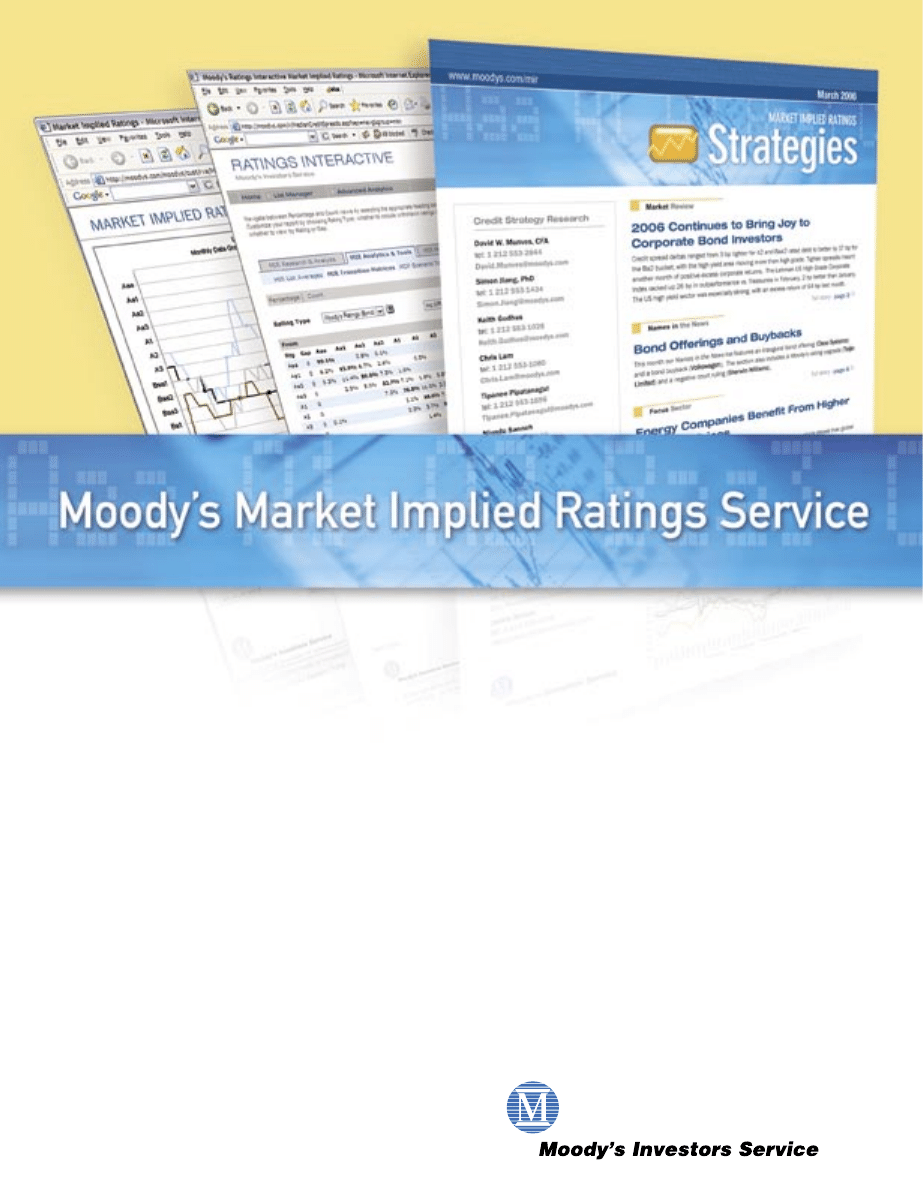
The indicators, dubbed ‘market implied ratings’ (MIR), high-
light discrepancies between an issuer’s credit rating – in essence,
the rating agency’s assessment of a company’s financial situation
and future outlook – and the market’s view of that issuer – which
is in effect the sum total of the expression of all bond, credit
derivatives and equity investors’ views on that company.
The concept is quite simple. Using data derived from all the
issuers it rates, Moody’s has worked out an average bond spread
for certain ratings categories. The MIR team then analyses a
given issuer’s bond spreads to give it a bond implied rating. For
example, the median credit spread for five-year B2 rated bonds
might be 377 basis points over Treasuries. If Acme Inc, a B2
rated credit, is trading at 168 basis points – the median spread
of five-year Ba1 rated bonds – its bond implied rating would be
Ba1. As this is four notches above its actual rating, it is said to
have a ratings gap of +4.
Ford Motor Company is a good example of an issuer’s bonds
trading below its Moody’s rating: as of September 1, Ford’s rat-
ing was B2, while its bond implied rating was Caa1, giving it a
ratings gap of -2. In other words, Ford was then trading two
notches below – or cheap to – its rating.
Synthetic feature
To add extra dimensions to the implied ratings, Moody’s applies
the same analysis to an issuer’s credit default swaps, using median
five-year CDS spreads, and also examines equity implied ratings.
Determining these is more complex, and is based on Moody’s
KMV EDF model, extracting credit risk information from an
issuer’s equity price by assessing expected default frequency.
By highlighting differences between an issuer’s implied rating
and its actual rating, the MIR team is able to flag up different
types of credit risk. They identify default candidates: the agen-
cy’s research shows that default rates are significantly higher for
issuers whose securities are trading with negative gaps compared
with their Moody’s rating. It might seem like something of a no-
brainer that securities the market takes a dim view of are more
likely to default; but what is surprising is the degree to which it
is true.
Using a data set of 2,900 issuers, with 180,000 observations
gathered between January 1, 1999 and February 28, 2006, the
one-year default rate for B2 rated issuers trading two notches
below their Moody’s rating was a massive 17.82%. That com-
pares with a default rate of 3.61% for issuers trading flat to their
Moody’s rating; or 0.59% for those trading two notches rich. In
other words, if you held a portfolio of bonds that were trading
two notches cheaper than the Moody’s rating, you should expect
nearly a fifth of them to default within a year.
MIR can also be used to predict potential ratings changes. An
issuer trading three notches below its Moody’s rating is looking
at about a 25% chance of downgrade over a one-year horizon,
according to MIR data from the same data set. And when you
drill down further into specific ratings categories, the probability
of downgrade can increase further. The most extreme example
As the debate rages over the usefulness of credit ratings, Moody’s unveils
a set of credit risk indicators derived from market movements. Will ‘market
implied ratings’ silence the agencies’ critics?
Nikki Marmery
investigates
rating process
Upgrading
the
P R O F I L E
1
credit
OCTOBER 2006
P R O F I L E
credit
OCTOBER 2006
2
PHOTOGRAPHY
: AMY FLETCHER
Moody’s MIR team: (from left) Simon Jiang, Chris Lam, Dan Russell, Robert Eckerstrom, David Munves, Njundu Sanneh and Tipanee Pipatanagul

www.creditmag.com
Moody’s rolled out a form of the product to its analysts in
2001. From the start, the agency used implied ratings as a guide
to the companies they rated, rather than factoring them in to
their ratings judgments. “As one of the analysts said to me,”
reports Munves, “it makes sure they ask the right questions in
the right way at the right time.”
Three years later, Moody’s rolled out MIR to customers. At
that point it became clear that MIR needed further research on
its uses to help customers interpret the data, and the agency
turned to David Munves, a credit strategist with more than two
decades of experience in the fi xed-income groups of Lehman
Brothers and Standard & Poor’s, to lead the team.
“I joined in December 2004, some months after it was rolled
out to customers,” says Munves. “They wanted to know, ‘what’s
the signifi cance of this? Is it something I should act upon? Is that
a high level of default risk?’ Without the research, no one really
had the answers.”
Team-building
Munves was joined by quant specialist Simon Jiang from another
part of Moody’s research team, and in November 2005 by assist-
ant vice-president Keith Gudhus and research associate Chris
Lam. Gudhus’s background was in trading, having worked in
BNP Paribas’ loan syndication and trading department, and
before that at the Gelber Group, where he traded corporate
debt. Lam researches the MIR database and contributes to the
monthly comments; he was previously at private equity fi rm CAI
Managers in New York where he specialised in buyouts, restruc-
turings and acquisitions.
Vice-president Robert Eckerstrom, who with Gudhus writes
market-orientated research and researches long-term projects,
joined in July. He previously worked for the Government of Sin-
gapore Investment Corporation, where he was an interest rate
portfolio manager and co-managed a credit portfolio.
Moody’s also hired two emerging markets specialists earlier this
year: economists Tipanee Pipatanagul, who monitors Asian and
emerging European economies, and Njundu Sanneh, who looks
at MIR-related credit market trends in regional markets. Pipatan-
agul previously worked as an economist at the US Treasury, and
Sanneh transferred from Moody’s Credit Trends service, where he
provided emerging markets commentary.
The newly formed team each saw the potential for the product
from the perspective of their diverse backgrounds. “Putting my
trading hat on,” says Gudhus, “I thought, ‘this would really help
me with my trading ideas.’”
Still, all this leads to a clear conundrum. If credit risk infor-
mation derived from market movements is more accurate
than Moody’s analysts’ assessments, then what’s the point of
analysts’ assessments of credit risk? Shouldn’t the price of a
security be a function of its creditworthiness – not the other
way round? Isn’t MIR an admission that the naysayers are right
– and Moody’s ratings, along with those of the other agencies,
are untimely and inaccurate?
“They are different signals,” affi rms Russell. “They both serve
a role and the market has spoken that it wants to continue to use
our ratings in a broad manner.”
Serving as a benchmark for the implied ratings, ‘traditional’
ratings are useful, because it’s the discrepancy between the two
that delivers the signals. “We see them
as complementary,” says Russell. “We
think we can play a unique role in
doing rigorous research into mar-
ket signals relative to ratings so we
can move from instinct-based dis-
cussions and conclusions to more
empirically based discussions of
how credit ratings behave.”
But is it necessary for market
implied ratings to function rela-
tive to Moody’s ratings? Could not
default probability be derived from
absolute price move-
ments, irrespective
of rating gaps?
One
credit
analyst at an
investment
bank in
“A lot of the time people have intuition, but
empirical data doesn’t back it up. MIR
helps investors avoid opportunities to buy
expensive paper”
David Munves, Moody’s
P R O F I L E
is B rated issuers, for whom there is a higher than 50% chance of
downgrade over the next year for all issuers trading three notches
or more below their Moody’s rating.
A third application of the tool is relative value analysis. By
comparing relative implied ratings moves, the data can signal
which bonds are likely to rise or fall against the broad market
in the coming year – effectively delivering buy and sell signals
for investors benchmarked against indices. The data shows, for
example, that bonds trading with a ratings gap of -3 are more
than 50% likely to see their bond implied rating rise over the
next 12 months – indicating an outperformance of the broad
market. Conversely 65% of bonds trading three gaps rich to their
Moody’s rating should expect to see their bond implied rating
decrease over the coming year, indicating underperformance
versus the market.
That’s a refl ection of the typical cycle of the market, says David
Munves, the managing director of credit strategy research at
Moody’s in New York, who leads the MIR team. “Fund manag-
ers will rotate out of expensive names and into cheap names; it’s
the traditional pattern of issues being oversold, stabilising and
coming back.”
Bonds with the positive ratings gaps are the ones investors
want to avoid in order to outperform the index. “Holding a
portfolio of bonds here, you’ll have a lot that will lose value
against the benchmark,” he says.
It’s in this relative value analysis that MIR is at its most useful.
It means a trader is able to back up his intuition with cold, hard
facts as to whether a credit really is as cheap as it ‘feels’. “A lot of
the time people have intuition, but empirical data doesn’t back it
up. How many notches exactly is it cheap? It looks like it’s trad-
ing cheaply, but has it become more expensive over time relative
to the market? MIR helps investors avoid opportunities to buy
expensive paper,” says Munves.
It also helps traders pick out the ‘biggest’ trading signals from
a mass of information. Autos traders for example might know
the ins and outs of Ford and GM spread movements; but with
75 rated names in the sector, they are likely to have less intuitive
expertise on the less liquid names. This makes the tool particu-
larly valuable for supervisors and risk managers.
“How well does a boss know what’s going on?” asks Munves.
“They need all the help they can get to stay on top of 300–400
names. With MIR, it’s very easy to get those names uploaded,
look at ratings gaps and get email alerts when ratings gaps appear.
It helps managers keep an eye on large number situations, which
is how Moody’s analysts use it. Information overload is killing
people. MIR picks out what’s important.”
Gestation period
The roots of Moody’s market implied ratings were growing long
before accounting scandals such as Enron’s so clearly demon-
strated their value. “Since time immemorial, Moody’s has gotten
calls from customers saying, ‘you’ve got this thing rated like a B3,
but it’s trading like a B1. What’s going on?’” says Dan Russell,
the managing director responsible for new business initiatives at
Moody’s in New York.
Towards the beginning of this decade, various factors conspired
to make the idea of extracting credit risk from price information
more viable: the wider use of the Merton approach to analys-
ing default risk from equity market information; the emergence
of CDS data, enabling the use of risk signals from this market;
and the availability of traded levels for corporate bonds from the
Trace reporting engine.
“We use it to look for credits that may be
deteriorating so we can make our credit
risk offi cers aware of them,” says one user
of Moody’s market implied ratings who
works in the internal credit risk depart-
ment of a major investment bank in New
York. “We’ve built our own system linking
in all our exposures that alerts us of big
ratings gaps developing.”
Watching ratings gaps evolve helps the
bank act faster in dumping bad credits,
explains this user. “If you look at some of
the auto names in particular – say [auto parts provider] Dana Corp,
with a ratings gap of six – you can see the ultimate crash landing of
that credit developing.”
Dana Corp declared bankruptcy on March 3 this year.
“It’s like the canary in the coalmine: a sign that it’s time to get out
of the credit,” he says.
But credit risk offi cers are looking for
potential upgrades as well as downgrades,
he adds. If market implied ratings signal a
credit is heading for an upgrade, the risk
offi cer could free up the economic capital
set aside against it for another area.
These types of clients – as opposed to
investment managers looking for trad-
ing ideas – might also be using a similar
tool developed by Riskmetrics Group,
a risk management software fi rm spun
out of JPMorgan in 1998. CreditGrades is
an equity-based model for assessing the credit quality of publicly
traded companies. The model is used by Deutsche Bank, Goldman
Sachs and JPMorgan. It diff ers from Moody’s market implied ratings
in that it assesses default probabilities unrelated to credit ratings.
It also focuses purely on credit risk information derived from the
equity markets.
3
credit
OCTOBER 2006
P R O F I L E
The canary in the coalmine: How MIR acts as an early warning system
CORBIS

www.creditmag.com
have happened had an investor bought and sold bonds based
on patterns of behaviour revealed by MIR data in the context
of the market environment of the time. For example, the paper
demonstrates that in 2000 – a “horrific” year for the corporate
bond markets, says Munves – you were better off buying expen-
sive bonds (those trading rich to their Moody’s rating): the ‘+2’
portfolio returned 6.64%. In every year after that, buying rich
bonds proved to be a losing strategy. And in the best year for
corporate bonds – 2003 – “it was a real losing proposition”: the
‘+2’ portfolio returned -19.68%.
‘Super implied ratings’
The team is also looking into what gives more accurate indica-
tors: implied ratings derived from bond spreads, CDS spreads
or equities. Early indications are that the CDS market is the
most efficient, probably because it’s a liquid two-way market,
says Munves. Once the analysis is complete, the team hopes to
determine a ‘super implied rating’ derived from an optimum
weighting of all three indicators.
Other long-term research studies include a project looking at
past leveraged buyouts and working out whether bond and equity
implied ratings can be used to identify risky LBO situations.
As such, MIR is looking at significant expansion. It’s tripled
the number of firms using MIR to “north of 500” over the past
year, says Russell. “We’ll probably double staff size before the
year is over, and expand in London. We expect rapid growth.”
Which leads us to one extreme scenario: what happens if
everyone started to buy into Moody’s market implied ratings?
Would the market end up trading off highly leveraged market
signals? Bonds trading cheap to their Moody’s rating being sold
off, sending the spreads wider, and making them even cheaper
to their Moody’s rating – thus heightening the signal to sell?
Bonds trading rich being bought, thus tightening their spreads
and exacerbating their positive ratings gap to Moody’s rating?
Russell, however, isn’t concerned about this nightmare vision
of the future. “The good news about markets is it’s hard to find
10 people who agree on anything,” he says. “Even if everyone
did [use market implied ratings], they would interpret the out-
put differently.”
A credit risk manager, for example, focuses on the default rate
of entities, which for a portfolio of 100 B2 bonds with -2 rat-
ings gaps would be 17.42%. As a result he would likely buy
protection in the CDS market against these names. However
an active portfolio manager would take a different view: “He
would assume he is a superior name-picker,” explains Munves,
“so would be able to hold a portfolio of cheap bonds and have
a default rate much lower than the market average. He would
likely sell CDS protection.” Thus the names for which protec-
tion would be bought or sold would vary according to the views
of the participants.
This underlines the point that Munves and Russell keep com-
ing back to: “What we are saying is that MIR data is an initial
screening tool,” says Munves. “People then have to make their
investment or risk decisions, as always.”
Case study: MIR raises alarm on Philippine debt
Emerging markets is one of the new project areas Moody’s MIR
is looking into, after the addition of economists Tipanee Pipatan-
agul and Njundu Sanneh earlier this year. One early example of
the team’s work in this area is a recent study on the Philippines.
Financial markets in the country enjoyed a strong rally over the
summer on the back of the government’s improving fiscal situ-
ation, expectations of an end to US and local rate hikes and the
return of foreign inflows to the country.
Against such a backdrop, the Philippines Composite Equity
index rose 13.4% between June 14 and August 16, after a sell-off
in spring brought it crashing down 20.2% from its record high of
2,589 on May 8. The Philippine peso rallied 4% against the dollar
over the same period.
Credit investors looking for opportunities in emerging mar-
kets might be buoyed by such market optimism and see solid
investment potential in the country. But a warning signal from
Moody’s MIR prompted the agency to advise investors to “curb
their enthusiasm” on the sovereign.
It noted on August 18 that bond implied ratings for Philippine
issuers rose by one notch between the end of June and August
15 to a rating of Ba2, taking them to two notches above the sov-
ereign’s actual Moody’s rating of B1. As issuers with bond implied
ratings gaps of two notches tend to underperform over a 12-
month view, Moody’s cautioned investors on Philippine debt.
Qualitative factors back up that cautious view, says Pipatanagul.
In particular the government’s exceptionally high public-sector
debt makes the country highly vulnerable to shocks. “Although
Moody’s recognises that the country’s strengthened external
payments position provides a buffer to transitory shocks or
policy mis-steps, this is not enough to significantly reduce the
country’s debt ratios,” she says. “Even assuming a best-case sce-
nario for fiscal reform this year, the ratio of national government
and non-financial public sector debt to revenue will likely stand
at around 400% at the end of 2006, a level that is well above that
of similarly rated countries.”
Political risk ahead of congressional elections in May 2007 is
also an issue, she notes.
credit
OCTOBER 2006
6
CORBIS
P R O F I L E
London thinks so: “To say the market is implying a particular
rating is egocentric: it breaks everything down as though the rat-
ing was the common language of the credit. What the market is
doing is implying a default probability.”
But there’s another, more compelling argument in favour of
Moody’s market implied ratings: stability. Precisely because they
don’t change with every news-related market movement, they
serve as a more stable indication of longer-term risk, making
them just as valuable to investors, argue Munves and Russell.
Market-based metrics give you “more refined signals”, says
Munves, “but there’s an offset, and the offset here is volatility.
Markets move faster, they’re more volatile, and they’re wrong
on occasion.”
Around 90% of Moody’s market implied ratings, for example,
change in the course of one year, and some 76% reverse that
move during the next 12 months. By comparison around 20% of
Moody’s ratings change throughout a year, with a reversal rate
of just 1%.
Delphi is an example of why an investor would want to keep
both sets of ratings in mind. Earlier in this decade, bond implied
ratings of the then Baa2 rated US auto parts manufacturer were
regularly trading two notches higher – at the level of an A3
credit. By February 2002, the bond implied rating sank a notch
below its Moody’s rating to Baa3, before swinging back to the
Moody’s rating and below again later that year. The Moody’s
rating had remained unchanged throughout. “Markets often
overshoot and come back to the Moody’s rating,” says Russell.
“The question is: how do you use the two together to maximise
the value of both?”
That, of course, was before Delphi’s default in October 2005.
As it stumbled headlong down the path to default, the Moody’s
rating lagged the market indicators – but only just.
Now the MIR team is focusing on new projects. A portfolio
paper is in the pipeline, the result of a back-testing exercise to
examine what happened to portfolios of bonds grouped by their
ratings gap over the past five years. The results reveal what would
Issuer
Sector
Market implied rating
Probability of default
Probability of downgrade
1
HCA
Healthcare
Caa1
(Ba2)
21.5%
(1.8%)
48.4%
(16.1%)
2
Ford Motor Company
Autos
Caa1
(B2)
17.4%
(5.5%)
35.4%
(15.7%)
3
Abitibi-Consolidated
Pulp & paper
Caa1
(B1)
10.6%
(2.7%)
35.9%
(18.8%)
4
Beazer Homes USA
Construction
B3
(Ba1)
7.1%
(0.8%)
47.6%
(17.5%)
5
Fairfax Financial Holdings
Financial services
Caa2
(Ba3)
2.9%
(1.3%)
42.6%
(18.7%)
N.B. Figures in
RED
are ‘market implied’; figures in BLACK
are according to Moody’s actual rating
Beware of the dog: next year’s likely defaults and downgrades
P R O F I L E
5
credit
OCTOBER 2006
��������
���������������������������
��
�
����������������������������������������������������������������
�������������������������������������������������
�����������������������������������������������������������
�
� ��������������������������������������������������������������������������������������������������������
� �������������������������������������������
�
� ������������������������������������������������������������������������������������������������������
� ����������������������������������������������
�
� ��������������������������������������������������������������������������������������������
�
� �����������������������������������������������������������������������������������������������������
�
� ��������������������������������������������������
�������������������������������������������������� �����������
�
����������������
�
����������������������
�
�����������������
�
�����������������
�
����������������������������
�
�
�
��
��
��
���
�
�����������������������������������������������������
Wyszukiwarka
Podobne podstrony:
ARTICLE SUSPENSION STRUT FRONT REPLACE INSTALL
252550982 GFI Submission Re Credit Suisse QPAM Waiver Hearing
articles ćw
Ziba Mir Hosseini Towards Gender Equality, Muslim Family Laws and the Sharia
Articles et prepositions ex
pa volume 1 issue 2 article 534
article CoaltoLiquids Hydrocarb Nieznany
KasparovChess PDF Articles, Sergey Shipov The Stars of the Orient Are the Brightest Ones!
article
ARTICLE MAINT INSPECTION ENGINE
klucz articles, 2008-2011 (Graduates), Gramatyka opisowa
ARTICLE BRAKES PEDAL ASSEMBLY SERVICE
KasparovChess PDF Articles, Sergey Shipov Polanica Zdroj 2000 A Tournament of Surprises
Jung, C G 1932 Article on Picasso
ARTICLE TRANNY AUTO REASSEMBLE PART1
On The Manipulation of Money and Credit
rossijskoe oruzhie vojna i mir
vonnno polevoj obman v chechne nastupil mir konca kotoromu ne
zaterjannyj mir ili maloizvestnye stranicy belorusskoj istorii
więcej podobnych podstron