ALUMINA
1
Alumina
1
Al
2
O
3
[1344-28-1]
Al
2
O
3
(MW 101.96)
InChI = 1/2Al.3O/rAl2O3/c3-1-5-2-4
InChIKey = TWNQGVIAIRXVLR-XYRCZMGDAJ
(a mildly acidic, basic, or neutral support for chromatographic
separations; a reagent for catalyzing dehydration, elimination, ad-
dition, condensation, epoxide opening, oxidation, and reduction
reactions)
Alternate Name: γ
-alumina.
Physical Data:
mp 2015
◦
C; bp 2980
◦
C; d 3.97 g cm
−3
.
Solubility:
slightly sol acid and alkaline solution.
Form Supplied in:
fine white powder, widely available in varying
particle size (50–200 m; 70–290 mesh), in acidic (pH 4), basic
(pH 10), and neutral (pH 7) forms.
Drying:
the activity of alumina has been classified by the Brock-
mann scale into five grades. The most active form, grade I, is
obtained by heating alumina to 200
◦
C while passing an inert
gas through the system, or heating to ∼400
◦
C in an open vessel,
followed by cooling in a dessicator. Addition of 3–4% (w/w)
water and mixing for several hours converts grade I alumina to
grade II. Other grades are similarly obtained (grade III, 5–7%;
grade IV, 9–11%; grade V, 15–19% water).
2,3
Handling, Storage, and Precautions:
inhalation of fine mesh alu-
mina can cause respiratory difficulties. Alumina is best handled
under a fume hood and stored under dry, inert conditions.
Introduction. Alumina is one of the most widely used packing
materials for adsorption chromatography and is available in acidic,
basic, and neutral forms. Use of the correct type is important to
avoid unwanted reactions of the substrate being purified.
1,3
Pos-
sessing both Lewis acidic and basic sites, alumina has been found
to catalyze a wide range of reactions, generally under conditions
that are milder and more selective than comparable homogeneous
reactions.
1
Dehydration and Eliminations. One of the earliest uses of
alumina as a catalyst was for the dehydration of alcohols.
4,5
These
reactions generally require high temperature and yield primarily
non-Saytzeff products. Complex terpenes have been dehydrated
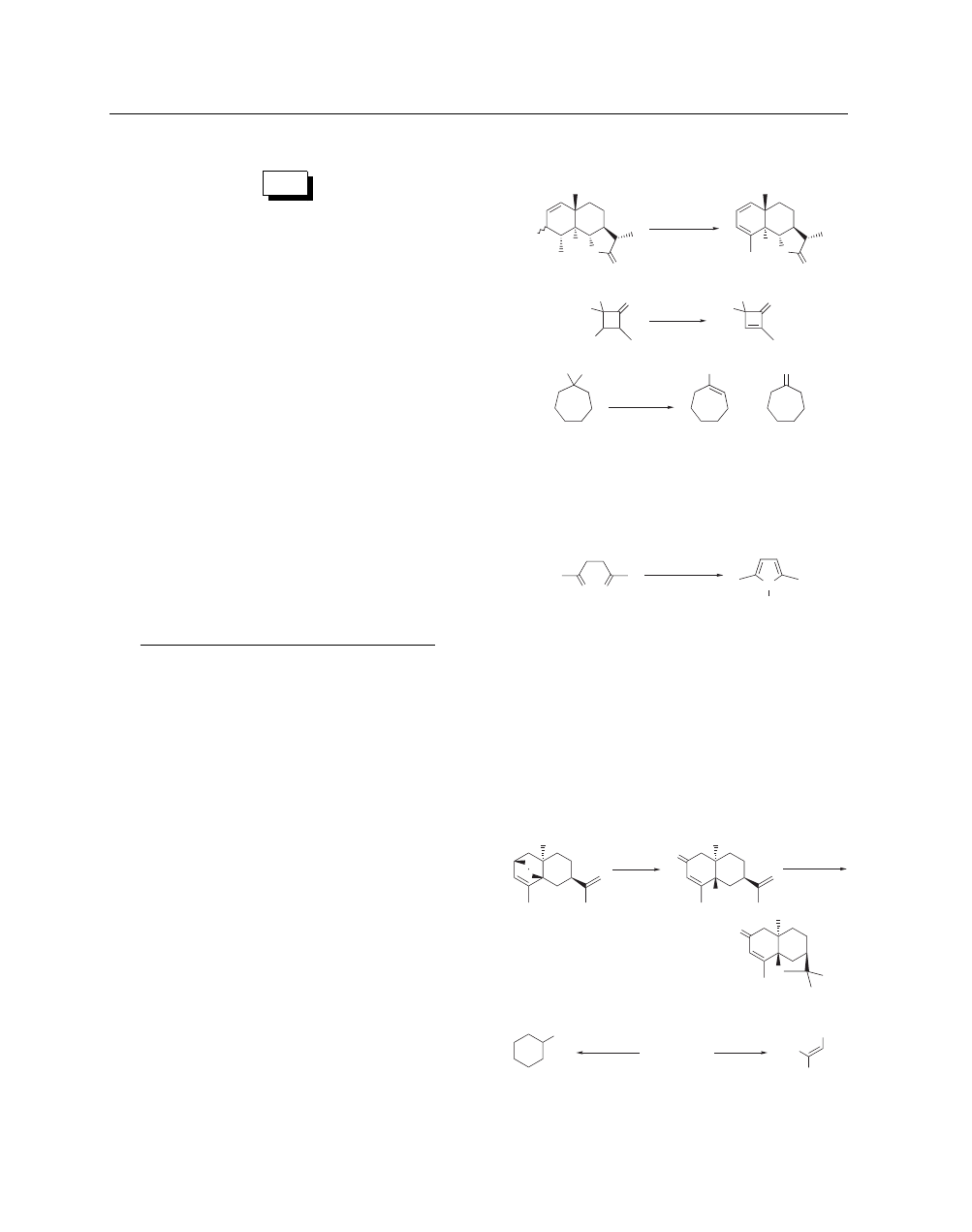
with Pyridine or Quinoline doped alumina (eq 1).
6b
Numerous
other groups can be eliminated in the presence of alumina, in-
cluding OR, OAc, O
3
SR, O
2
SR, and halides.
1,7
Some of these
eliminations proceed under mild conditions,
1
often during chro-
matographic purification (eq 2).
7d
Sulfonates can be eliminated
in the presence of acid and base sensitive groups, without skele-
tal rearrangements. However, a large excess of properly acti-
vated alumina is required, and poor stereo- and regiocontrol are
observed.
7e
Dehydrohalogenations, particularly dehydrofluorina-
tions, occur readily over alumina (eq 3).
8
Stereoselective syn-
theses of vinyl halides have been developed that take advantage
of desilicohalogenation
9
or deborohalogenation
10
of vinylsilane
or vinylboronic acid derived dihalides. Benzol[c]thiophene has
been synthesized by dehydration of a sulfoxide precursor.
11
The
oxidation of selenides to selenoxides and their elimination to
alkenes can be accomplished in one step using basic alumina and
tert-Butyl Hydroperoxide in THF.
12
O
HO
H
(1)
O
O
H
O
alumina
pyridine
220–230 °C
44%
(2)
O
EtO
alumina
activity I
65–80%
O
Ph
Ph
Ph
Ph
(3)
alumina
CCl
4
, 25 °C
24 h
O
F
F
F
+
60%
<4%
Alumina has been used for various dehydration reactions,
including those leading to piperidines,
13
pyrroles (eq 4) and
pyrazoles,
14
and other heterocycles.
15
It is also an effective cat-
alyst for the selective protection of aldehydes in the presence of
ketones.
16
(4)
EtNH
2
, alumina
0 to 20 °C
96%
O O
N
Et
Addition and Condensation Reactions.
Alumina pro-
motes the addition of various heteroatom species, whether by
electrophilic or nucleophilic processes. In contrast to the elimi-
nation reactions described earlier, alumina also promotes the in-
tramolecular addition of OH and OR groups to isolated (eq 5)
6c
and carbonyl-activated alkenes.
17
It is also reported to catalyze
the conjugate addition of other nucleophiles, such as amines.
18
In
the presence of alumina, Iodine can be used to iodinate aromat-
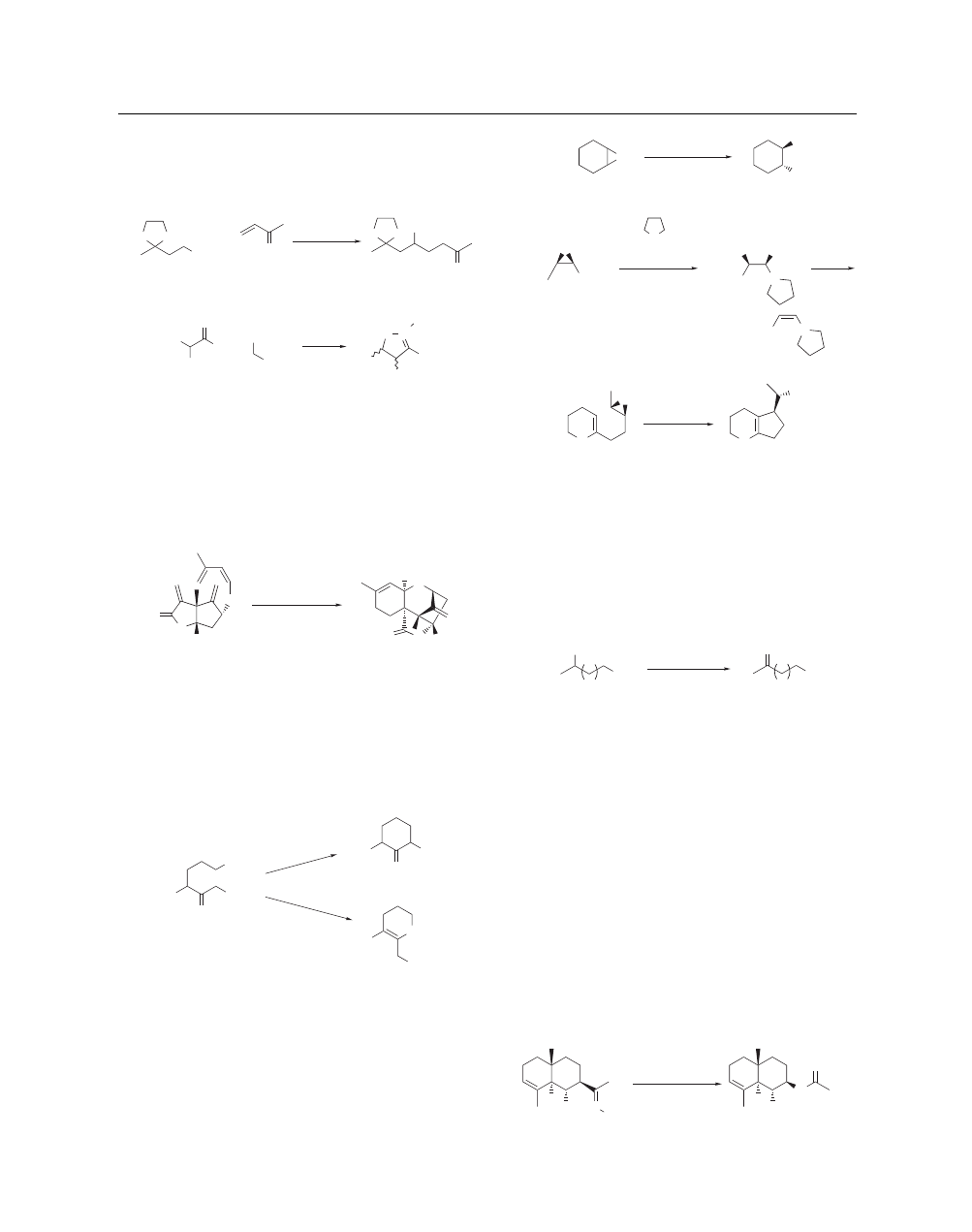
ics, hydroiodinate alkenes, and diiodinate alkynes (eq 6).
19
Hy-
drochlorinations and hydrobrominations of alkenes and alkynes
give the Markovnikov products, with good stereoselectivity.
20
O
O
(5)
O
OH
O
O
basic
alumina
84%
acidic
alumina
PhH, 75 °C
72%
(6)
I
2
activated
alumina
cyclohexene
pet ether
35 °C, 2 h
85%
1-hexyne
pet ether
rt, 4 h
92%
I
Bu
I
I
Aldol-type condensations between aldehydes and various ac-
tive methylene compounds,
21
Michael reactions (eq 7),
22
as well
Avoid Skin Contact with All Reagents
2
ALUMINA
as Wittig-type reactions
23
can be carried out on alumina under
mild conditions, often without a solvent. An interesting nitroaldol
reaction–cyclization sequence gives 2-isoxazoline 2-oxides with
good diastereoselectivity (eq 8).
24
NO
2
O
O
O
O
O
NO
2
O
(7)
+
basic alumina
rt, 5–8 h
88%
(8)
H
O
Br
Ph
NO
2
CO
2
Et
O N
+
O
–
OH
Ph
CO
2
Et
+
Al
2
O
3
24 h
62%
trans
:cis = 9:1
Orbital symmetry controlled reactions that have been promoted
by alumina include the Diels–Alder,
25
the ene,
26
and the Carroll
rearrangement.
27
These reactions proceeded under milder condi-
tions and with greater stereoselectivity. In a spectacular exam-
ple, chromatographic purification promoted a diastereoselective
intramolecular Diels–Alder that produced the verrucarol skeleton
(eq 9).
25b
O
O
H
O
O
H
O
O
H
(9)
neutral alumina (I)
column, rt
83%
Alkylation reactions that have been induced by alumina in-
clude per-C-methylation of phenol,
28
intramolecular alkylation
to yield a spiro-fused cyclopropane,
29
and S-
30
and O-alkylations
(eq 10).
31
The activation of Diazomethane by alumina has pro-
vided methods for the conversion of ketones to epoxides
32
and
for the selective monomethylation of dicarboxylic acids.
33
Basic
alumina has been used for the generation and trapping of
dichlorocarbene.
34
SO
2
Ph
Br
Ph
O
O
Ph
SO
2
Ph
Ph
O
SO
2
Ph
(10)
LDA
glyme
90%
neutral alumina
toluene
rt
95%
Epoxides.
Epoxides can be opened under mild, selective
conditions using alumina impregnated with a variety of nucle-
ophiles, such as alcohols, thiols, selenols, amines, carboxylic acids
(eq 11),
35
and peroxides.
36
Use is made of this process in a route to
(Z)-enamines (eq 12).
37
Formation of C–C bonds by intramolec-
ular opening of epoxides has been reported (eq 13),
38
as have
alumina catalyzed epoxide formations
23,39
and rearrangements.
40
(11)
O
OH
XR
4% RXH
neutral alumina
Et
2
O, 25 °C, 1 h
RX = MeO, 66%; PhS, 70%, PhSe, 95%; n-BuNH, 73%
n
-Hex
SiMe
3
O
N
N
n
-Hex
n
-Hex
SiMe
3
HO
(12)
neutral alumina
85 °C, 4 d
63%
N
H
KH
THF, rt
(13)
O
O
O
1. basic
alumina (I)
hexanes
rt, 24 h
2. Ac
2
O, py
90–100%
OAc
Oxidations and Reductions. Posner has shown that Oppe-
nauer oxidations, with Cl
3
CCHO or PhCHO as the hydrogen
acceptors, are greatly accelerated in the presence of activated
alumina.
41
Secondary alcohols are oxidized selectively over pri-
mary alcohols (eq 14) and groups susceptible to other oxidants
(sulfides, selenides, and alkenes) are unaffected. Even cyclobu-
tanol, which is prone to fragmentation with one-electron oxidants,
can be oxidized to cyclobutanone in 92% yield.
8
OH
OH
OH
O
(14)
8
2 equiv PhCHO
alumina
25 °C, 24 h
65%
The
complementary
reduction
reaction
(Meerwein–
Ponndorf–Verley), using isopropanol as the hydride donor,
is also facilitated by alumina and allows the selective reduction
of aldehydes over ketones.
42
Functional groups that survive these
conditions include alkene, nitro, ester, amide, nitrile, primary and
secondary iodides, and benzylic bromide.
Air oxidation of a fluoren-9-ol to the fluoren-9-one and thiols
to disulfides are accelerated on the alumina surface.
43
Alumina
has also been used as a solid support for a variety of inorganic
reagents,
44
and for immobilizing chiral catalysts.
45
Miscellaneous Reactions.
Many rearrangements are cat-
alyzed by alumina.
1
The Beckmann rearrangement
46
of the O-
sulfonyloxime shown gives the expected amide with activated
alumina, and the corresponding oxazoline with basic alumina
(eq 15).
46d
Alumina has long been used for isomerization of β,γ-
unsaturated ketones to the conjugated ketones.
47
Isomerizations
of alkynes to allenes,
48
and allenes to conjugated dienoates
49
have
also been reported (eq 16).
N
H
OH
N
H
H
OH
O
(15)
OSO
2
Ar
activated alumina
80%
A list of General Abbreviations appears on the front Endpapers

ALUMINA
3
CO
2
Me
Et
•
(16)
alumina
PhH, reflux, 5 h
82%
Et
CO
2
Me
Alumina promotes the hydrolysis of acetates of primary
alcohols,
50
the deacylation of imides,
51
the hydrolysis of
sulfonylimines,
52
and the decarbalkoxylation of β-keto esters and
carbamates.
53
It can also be used for acylations and esterifica-
tions, with high selectivity for primary alcohols over secondary
alcohols.
54
1.
Posner, G. H. , Angew. Chem., Int. Ed. Engl. 1978, 17, 487.
2.
Perrin, D. D.; Armarego, W. L. F. Purification of Laboratory Chemicals;
Pergamon: New York, 1988; pp 20, 310.
3.
(a) Furniss, B. S.; Hannaford, A. J.; Smith, P. W. G.; Tatchell, A. R.
Vogel’s Textbook of Practical Organic Chemistry
; Longman-Wiley:New
York, 1989; p 212. (b) Fieser & Fieser 1967, 1, 19.
4.
Knözingery, H., Angew. Chem., Int. Ed. Engl. 1968, 7, 791.
5.
(a) Hershberg, E. B.; Ruhoff, J. R., Org. Synth. 1937, 17, 25. (b) Newton,
L. W.; Coburn, E. R., Org. Synth., Coll. Vol. 1955, 3, 312. (c) Sawyer,
R. L.; Andrus, D. W., Org. Synth., Coll. Vol. 1955, 3, 276.
6.
(a) von Rudloff, E., Can. J. Chem. 1961, 39, 1860. (b) Corey, E. J.;
Hortmann, A. G., J. Am. Chem. Soc. 1965, 87, 5736. (c) Barrett, H. C.;
Büchi, G., J. Am. Chem. Soc. 1967, 89, 5665.
7.
(a) Kobayashi, S.; Shinya, M.; Taniguchi, H. , Tetrahedron 1971, 71.
(b) Ishii, H.; Tozyo, T.; Nakamura, M.; Funke, E., Chem. Pharm. Bull.
1972, 20, 203. (c) Gotthardt, H.; Hammond, G. S., Chem. Ber. 1974,
107
, 3922. (d) Mayr, H.; Huisgen, R., Angew. Chem., Int. Ed. Engl.
1975, 14, 499. (e) Posner, G. H.; Gurria, G. M.; Babiak, K. A., J. Org.
Chem. 1977
, 42, 3173. (f) Vidal, J.; Huet, F., Tetrahedron 1986, 27,
3733.
8.
(a) Strobach, D. R.; Boswell, G. A., Jr., J. Org. Chem. 1971, 36, 818. (b)
Boswell, G. A., Jr., J. Org. Chem. 1966, 31, 991.
9.
(a) Miller, R. B.; McGarvey, G., J. Org. Chem. 1978, 43, 4424. (b) Miller,
R. B.; McGarvey, G., Synth. Commun. 1977, 7, 475.
10.
Sponholtz, W. R., III; Pagni, R. M.; Kabalka, G. W.; Green, J. F.; Tan,
L. C., J. Org. Chem. 1991, 56, 5700.
11.
Cava, M. P.; Pollack, N. M.; Mamer, O. A.; Mitchell, M. J., J. Org. Chem.
1971, 36, 3932.
12.
Labar, D.; Hevesi, L.; Dumont, W.; Krief, A., Tetrahedron 1978, 1141.
13.
(a) Bourns, A. N.; Embleton, H. W.; Hansuld, M. K., Org. Synth., Coll.
Vol. 1963
, 4, 795. (b) Glacet, C.; Adrian, G., C.R. Hebd. Seances Acad.
Sci., Ser. C 1969
, 269, 1322.
14.
(a) Texier-Boullet, F.; Klein, B.; Hamelin, J., Synthesis 1986, 409.
(b) Tolstikov, G. A.; Galin, F. Z.; Makaev, F. Z., Zh. Org. Khim. 1989,
25
, 875.
15.
(a) LeBlanc, R. J.; Vaughan, K., Can. J. Chem. 1972, 50, 2544.
(b) Higashino, T.; Suzuki, K.; Hayashi, E., Chem. Pharm. Bull. 1978,
26
, 3485. (c) Bladé-Font, A., Tetrahedron 1980, 21, 2443. (d) Hooper,
D. L.; Manning, H. W.; LaFrance, R. J.; Vaughan, K., Can. J. Chem.
1986, 65, 250. (e) Hull, J. W., Jr.; Otterson, K.; Rhubright, D., J. Org.
Chem. 1993
, 58, 520.
16.
Kamitori, Y.; Hojo, M.; Masuda, R.; Yoshida, T., Tetrahedron 1985, 26,
4767.
17.
McPhail, A. T.; Onan, K. D., Tetrahedron 1973, 4641.
18.
(a) Pelletier, S. W.; Venkov, A. P.; Finer-Moore, J.; Mody, N. V.,
Tetrahedron 1980
, 21, 809. (b) Pelletier, S. W.; Gebeyehu, G.; Mody, N.
V., Heterocycles 1982, 19, 235. (c) Dzurilla, M.; Kutschy, P.; Kristian,
P., Synthesis 1985, 933.
19.
Pagni, R.; Kabalka, G. W.; Boothe, R.; Gaetano, K.; Stewart, L. J.;
Conaway, R.; Dial, C.; Gray, D.; Larson, S.; Luidhardt, T., J. Org. Chem.
1988, 53, 4477.
20.
Kropp, P. J.; Daus, K. A.; Tubergen, M. W.; Kepler, K. D.; Wilson,
V. P.; Craig, S. L.; Baillargeon, M. M.; Breton, G. W., J. Am. Chem. Soc.
1993, 115, 3071, and references cited therein.Addition of HN
3
:Breton,
G. W.; Daus, K. A.; Kropp, P. J., J. Org. Chem. 1992, 57, 6646.
21.
(a) Rosan, A.; Rosenblum, M., J. Org. Chem. 1975, 40, 3621. (b) Texier-
Boullet, F.; Foucaud, A., Tetrahedron 1982, 23, 4927. (c) Rosini, G.;
Ballini, R.; Sorrenti, P., Synthesis 1983, 1014. (d) Varma, R. S.; Kabalka,
G. W.; Evans, L. T.; Pagni, R. M., Synth. Commun. 1985, 15, 279. (e)
Nesi, R.; Stefano, C.; Piero, S.-F., Heterocycles 1985, 23, 1465. (f)
Rosini, G.; Ballini, R.; Petrini, M.; Sorrenti, P., Synthesis 1985, 515.
(g) Foucaud, A.; Bakouetila, M., Synthesis 1987, 854. (h) Moison, H.;
Texier-Boullet, F.; Foucaud, A., Tetrahedron 1987, 43, 537.
22.
(a) Rosini, G.; Marotta, E.; Ballini, R.; Petrini, M., Synthesis 1986, 237.
(b) Ballini, R.; Petrini, M.; Marcantoni, E.; Rosini, G., Synthesis 1988,
231.
23.
Texier-Boullet, F.; Villemin, D.; Ricard, M.; Moison, H.; Foucaud, A.,
Tetrahedron 1985
, 41, 1259.
24.
Isoxazoline:Rosini, G.; Galarini, R.; Marotta, E.; Righi, P., J. Org. Chem.
1990, 55, 781.Rosini, G.; Marotta, E.; Righi, E.; Seerden, J. P., J. Org.
Chem. 1991
, 56, 6258.
25.
(a) Parlar, H.; Baumann, R., Angew. Chem., Int. Ed. Engl. 1981, 20, 1014
(b) Koreeda, M.; Ricca, D. J.; Luengo, J. I., J. Org. Chem. 1988, 53,
5586.
26.
(a) Tietze, L. F.; Beifuss, U.; Ruther, M., J. Org. Chem. 1989, 54, 3120.
(b) Tietze, L. F.; Beifuss, U., Synthesis 1988, 359.
27.
Pogrebnoi, S. I.; Kalyan, Y. B.; Krimer, M. Z.; Smit, W. A., Tetrahedron
1987, 28, 4893.
28.
Cullinane, N. M.; Chard, S. J.; Dawkins, C. W. C., Org. Synth., Coll. Vol
1963, 4, 520.
29.
Baird, R.; Winstein, S., J. Am. Chem. Soc. 1963, 85, 567.
30.
Villemin, D., J. Chem. Soc., Chem. Commun. 1985, 870.
31.
(a) Ogawa, H.; Chihara, T.; Teratani, S.; Taya, K., Bull. Chem. Soc.
Jpn. 1986
, 59, 2481. (b) Cooke, F.; Magnus, P., J. Chem. Soc., Chem.
Commun. 1976
, 519.
32.
Hart, P. A.; Sandmann, R. A., Tetrahedron 1969, 305.
33.
Ogawa, H.; Chihara, T.; Taya, K., J. Am. Chem. Soc. 1985, 107, 1365.
34.
Sarratosa, F., J. Chem. Educ. 1964, 41, 564.
35.
(a) Posner, G. H.; Rogers, D. Z., J. Am. Chem. Soc. 1977, 99, 8208.
(b) Posner, G. H.; Rogers, D. Z., J. Am. Chem. Soc. 1977, 99, 8214. (c)
Evans, D. A.; Golob, A. M.; Mandel, N. S.; Mandel, G. S., J. Am. Chem.
Soc. 1978
, 100, 8170.
36.
Kropf, H.; Amirabadi, H. M.; Mosebach, M.; Torkler, A.; von Wallis,
H., Synthesis 1983, 587.
37.
Hudrlik, P. F.; Hudrlik, A. M.; Kulkarni, A. K., Tetrahedron 1985, 26,
139.
38.
(a) Boeckman, R. K., Jr.; Bruza, K. J.; Heinrich, G. R., J. Am. Chem. Soc.
1978, 100, 7101. (b) Niwa, M.; Iguchi, M.; Yamamura, S., Tetrahedron
1979, 4291.
39.
(a) Dhillon, R. S.; Chhabra, B. R.; Wadia, M. S.; Kalsi, P. S., Tetrahedron
1974, 401. (b) Antonioletti, R.; D’Auria, M.; De Mico, A.; Piancatelli,
G.; Scettri, A., Tetrahedron 1983, 39, 1765.
40.
(a) Tsuboi, S.; Furutani, H.; Takeda, A., Synthesis 1987, 292. (b)
Harigaya, Y.; Yotsumoto, K.; Takamatsu, S.; Yamaguchi, H.; Onda, M.,
Chem. Pharm. Bull. 1981
, 29, 2557.
41.
(a) Posner, G. H.; Perfetti, R. B.; Runquist, A. W., Tetrahedron 1976,
3499. (b) Posner, G. H.; Chapdelaine, M. J., Synthesis 1977, 555. (c)
Posner, G. H.; Chapdelaine, M. J., Tetrahedron 1977, 3227.
42.
Posner, G. H.; Runquist, A. W.; Chapdelaine, M. J., J. Org. Chem.
1977, 42, 1202.Also see:Suginome, H.; Kato, K., Tetrahedron 1973,
4143.
43.
(a) Pan, H.-L.; Cole, C.-A.; Fletcher, T. L., Synthesis 1975, 716. (b) Liu,
K.-T.; Tong, Y.-C., Synthesis 1978, 669.
44.
Review:Laszlo, P., Comprehensive Organic Synthesis 1991, 7, 839.
Recent examples: (a) Singh, S.; Dev, S., Tetrahedron 1993, 49, 10959.
Avoid Skin Contact with All Reagents

4
ALUMINA
(b) Lee, D. G.; Chen, T.; Wang, Z., J. Org. Chem. 1993, 58, 2918.
(c) Morimoto, T.; Hirano, M.; Iwasaki, K.; Ishikawa, T., Chem. Lett.
1994, 53. (d) Santaniello, E.; Ponti, F.; Manzocchi, A., Synthesis 1978,
891.
45.
Soai, K.; Watanabe, M.; Yamamoto, A., J. Org. Chem. 1990, 55, 4832.
46.
(a) Craig, J. C.; Naik, A. R., J. Am. Chem. Soc. 1962, 84, 3410. (b)
Gonzalez, A.; Galvez, C., Synthesis 1982, 946. (c) Luh, T.-Y.; Chow,
H.-F.; Leung, W. Y.; Tam, S. W., Tetrahedron 1985, 41, 519. (d) Nagano,
H.; Masunaga, Y.; Matsuo, Y.; Shiota, M., Bull. Chem. Soc. Jpn. 1987,
60
, 707.See also: (e) Métayer, A.; Barbier, M., Bull. Soc. Chem. Fr. 1972,
3625.
47.
(a) Marshall, J. A.; Roebke, H., J. Org. Chem. 1966, 31, 3109. (b)
Hudlicky, T.; Srnak, T., Tetrahedron 1981, 22, 3351. (c) Reetz, M. T.;
Wenderoth, B.; Urz, R., Chem. Ber. 1985, 118, 348. (d) Hatzigrigoriou,
E.; Schmitt, M.-C.; Wartski, L., Tetrahedron 1988, 44, 4457. Also see: (e)
Scettri, A.; Piancatelli, G.; D’Auria, M.; David, G., Tetrahedron 1979,
35
, 135.
48.
(a) Larock, R. C.; Chow, M.-S.; Smith, S. J., J. Org. Chem. 1986, 51,
2623. (b) Manning, D. T.; Coleman, H. A. J., J. Org. Chem. 1969, 34,
3248.
49.
Tsuboi, S.; Matsuda, T.; Mimura, S.; Takeda, A., Org. Synth., Coll. Vol
1993, 8, 251.
50.
Johns, W. F.; Jerina, D. M., J. Org. Chem. 1963, 28, 2922.
51.
Boar, R. B.; McGhie, J. F.; Robinson, M.; Barton, D. H. R.; Horwell,
D. C.; Stick, R. V., J. Chem. Soc., Perkin Trans. 1 1975, 1237.
52.
Coutts, I. G. C.; Culbert, N. J.; Edward, M.; Hadfield, J. A.; Musto,
D. R.; Pavlidis, V. H.; Richards, D. J., J. Chem. Soc., Perkin Trans. 1
1985, 1829.
53.
(a) Greene, A. E.; Cruz, A.; Crabbé, P. , Tetrahedron 1976, 2707.
(b) van Leusen, A. M.; Strating, J., Org. Synth., Coll. Vol 1988, 6,
981.
54.
(a) Posner, G. H.; Oda, M., Tetrahedron 1981, 22, 5003. (b) Rana,
S. S.; Barlow, J. J.; Matta, K. L., Tetrahedron 1981, 22, 5007. (c) Posner,
G. A.; Okada, S. S.; Babiak, K. A.; Miura, K.; Rose, R. K., Synthesis
1981, 789. (d) Nagasawa, K.; Yoshitake, S.; Amiya, T.; Ito, K., Synth.
Commun. 1990
, 20, 2033.
Viresh H. Rawal, Seiji Iwasa, Alan S. Florjancic, & Agnes Fabre
The Ohio State University, Columbus, OH, USA
A list of General Abbreviations appears on the front Endpapers
Wyszukiwarka
Podobne podstrony:
aluminum eros ra075
potassium on alumina eros rp192
aluminum chloride eros ra079
aluminium ethoxide eros ra081
aluminium amalgam eros ra076
aluminium isopropoxide eros ra084
Aluminum i miedź Mateusz Bednarski
benzyl chloride eros rb050
hydrobromic acid eros rh031
chloroform eros rc105
magnesium eros rm001
więcej podobnych podstron