82
CWB-2/2008
François Sorrentino
Mineral Research Processing Company, France
Nowe spojrzenie na moduł nasycenia wapnem
Lime saturation factor: new insight
1. Introduction
It may be surprising and somewhat pretentious to discuss again the
design of Portland cement clinker raw meal after two centuries of
existence of this cement and a huge world production, still growing.
Nevertheless, it seems that there still exist in the literature, areas
of shadow that should be clarifi ed.
The main target of the cement producer is to obtain a good quality
product (mechanical performance, durability,...) with a high perfor-
mance of manufacturing (burning, grinding).
The most useful parameters for this purpose are:
a) the lime saturation factor to control the ratio C
3
S /C
2
S. Many
methods have been proposed to calculate the maximum lime
content (1, 2, 3). We have selected the widely used LSF (lime
saturation factor).
LSF = 100 x (%CaO)/[(2,8 x (%SiO
2
) + 1,65 x (% Al
2
O
3
) +
0,35 x (%Fe
2
O
3
)]
if Al
2
O
3
/Fe
2
O
3
>0,65 and
LSF = 100 x (%CaO)/[(2,8 x (%SiO
2
) + 1,18 x (%Al
2
O
3
) +
0,65 x (%Fe
2
O
3
)]
if Al
2
O
3
/Fe
2
O
3
< 0,65
The use of an other type of relations would not change the princi-
ples of calculation that follows.
b) the silica ratio SR = SiO
2
/( Al
2
O
3
+ Fe
2
O
3
) to control the burna-
bility,
c) the alumina modulus AM = Al
2
O
3
/Fe
2
O
3
to fi x the ratio C
3
A/C
4
AF
and impact on the burnability of the fi nal cement and the dura-
bility of concrete.
Quantitative relation between chemical control parameter and four
phases of clinker (C
3
S, C
2
S, C
3
A, C
4
AF) have been determined
(4) and setting up LSF, SR and AM allows the calculation of these
four phases content. Unfortunately, the reactivity of the clinker and
cement is mainly based on the quantity of C
3
S and alite and not
1. Wprowadzenie
Może być zaskakujące i w pewnym stopniu pretensjonalne, aby
podjąć znowu dyskusję na temat zestawu surowcowego do pro-
dukcji klinkieru portlandzkiego po dwóch wiekach istnienia i wobec
dzisiejszego ogromnego wzrostu jego produkcji, stale się powięk-
szającej. Niemniej jednak wydaje się, że są jeszcze w literaturze
niejasne obszary, które powinny być wyjaśnione.
Głównym celem producenta cementu jest wytwarzanie produktu
dobrej jakości (fi zycznej, a także obejmującej użyteczność i trwa-
łość) i równocześnie z dużym profesjonalizmem produkcyjnym
(wypalanie, przemiał).
Najważniejszymi parametrami prowadzącymi do tego celu są
następujące:
a) moduł nasycenia wapnem określający stosunek C
3
S/C
2
S.
Proponowano wiele metod pozwalających na obliczenie
maksymalnej zawartości wapna (1–3). Wybraliśmy szeroko
stosowany moduł nasycenia wapnem LSF.
LSF = 100 x (%CaO)/[(2,8 x (%SiO
2
) + 1,65 x (% Al
2
O
3
) +
0,35 x (%Fe
2
O
3
)]
gdy Al
2
O
3
/Fe
2
O
3
>0,65 i
LSF = 100 x (%CaO)/[(2,8 x (%SiO
2
) + 1,18 x (%Al
2
O
3
) +
0,65 x (%Fe
2
O
3
)]
gdy Al
2
O
3
/Fe
2
O
3
< 0,65
Zastosowanie innego równania nie zmieni zasad przyjętych
w obliczeniach, które zostaną przeprowadzone w dalszej części.
b) moduł krzemowy SR = SiO
2
/(Al
2
O
3
+ Fe
2
O
3
) decydujący
o zdolności do klinkieryzacji,
c) moduł glinowy AM = Al
2
O
3
/Fe
2
O
3
określający stosunek C
3
A/
C
4
AF i mający wpływ na zdolność do klinkieryzacji i trwałość
otrzymanego cementu oraz betonu.
Ilościowe zależności pomiędzy tymi parametrami kontrolnymi
i czterema fazami klinkierowymi (C
3
S, C
2
S, C
3
A i C
4
AF) zostały

CWB-2/2008
83
ustalone (4) i przyjęcie LSF, SR i AM pozwala na obliczenie
zawartości tych czterech faz. Niestety reaktywność klinkieru
i cementu zależy głównie od zawartości alitu, a nie od LSF. Jest
możliwe otrzymanie różnej zawartości C
3
S dla tej samej wartości
LSF i odwrotnie można zachować tę samą zawartość alitu przy
zmiennej LSF (zmienne AM i SR). W tablicy 1 pokazano przykła-
dowo zmiany C
3
S przy stałym LSF.
Z kolei w tablicy 2 pokazano przykładowo zmiany LSF przy stałym
C
3
S.
Zestaw surowcowy do produkcji klinkieru zawiera dwa rodzaje
składników: surowiec wprowadzający wapno (głównie wapień) oraz
wprowadzające krzemionkę tlenek glinu i żelaza (głównie glina).
Przed dodaniem wapienia znamy tylko moduł krzemowy, to jest
stosunek krzemionki do sumy tlenków glinu i żelaza oraz moduł
glinowy, a więc stosunek Al
2
O
3
/Fe
2
O
3
. Te parametry są stałe w celu
zapewnienia dobrej klinkieryzacji i trwałości cementu (C
3
A).
LSF daje stosunek tych dwóch składników (wapienia i gliny)
i określa skład chemiczny zestawu surowcowego. Kiedy ustalimy
już skład chemiczny mamy możliwość obliczenia składu mine-
ralnego (na przykład wzorami Bogue’a) i mamy wstępną ocenę
reaktywności cementu (% C
3
S).
Zwykle stosujemy taką metodę, że najpierw ustalamy LSF, AM
i SR i obliczamy skład chemiczny oraz mineralny. W niniejszym
podejściu sugerujemy; najpierw ustalić zawartość C
3
S czyli alitu,
a następnie określić skład chemiczny i LSF. Wymaga to ustalenia
zależności pomiędzy LSF i C
3
S. Trzy parametry, a mianowicie:
C
3
S, AM i SR defi niują układ zamiast LSF, AM i SR. W tym artykule
omawiamy wspólny wpływ tych trzech parametrów na reaktywność
klinkieru (% C
3
S) wyłączając wpływ domieszek. Rozważamy na-
stępujące zależności:
a) LSF w zależności od % C
3
S,
b) LSF w zależności od SR przy stałym % C
3
S i AM,
c) LSF w zależności od AM przy stałym % C
3
S i SR,
d) % C
3
S w zależności od LSF przy stałym AM i SR,
e) % C
3
S w zależności od SR przy stałym LSF i AM,
f) %
C
3
S w zależności od AM przy stałym LSF i SR,
g) Czyste składniki czy roztwory stałe?
2. Wyniki i dyskusja
a) LSF w zależności od % C
3
S
Z literatury (materiały z ICMA, ICCC i innych konferencji) znamy
skład chemiczny klinkierów (laboratoryjnych i przemysłowych).
Z analizy chemicznej obliczamy LSF i % C
3
S stosując równania
Bogue’a. Jeżeli wykreślimy zmiany LSF w zależności od % C
3
S
otrzymujemy krzywą pokazaną na rysunku 1. Można znaleźć w li-
teraturze (5) zależność pomiędzy LSF i składem mineralogicznym
obliczonym metodą Bogue’a. Liniową zależność można wyrazić
jako Y= 0,3764 X+69,197 ze współczynnikiem R
2
= 0,933.
on LSF. It is possible to obtain different % C
3
S with the same LSF
and vice versa, to keep the same C
3
S with different LSF value
(modifi cation of AM and SR). The Table 1 shows an example of
variation of C
3
S at constant LSF.
Tablica 1 / Table 1
ZMIENNE ZAWARTOŚĆ C
3
S PRZY STAŁYM LSF
VARIATION OF % C
3
S FOR A CONSTANT LSF
LSF
95
95
95
95
95
95
95
95
AM
1,6
1,6
1,6
1,6
2,2
2,2
2,2
2,2
SR
2,2
2,5
2,8
3,0
2,2
2,5
2,8
3,0
C
3
S
67,7
69,6
71,2
72,2
66,7
68,8
70,5
71,5
The Table 2 shows an example of variation of LSF at constant
C
3
S.
Tablica 2 / Table 2
ZMIANY LSF DLA DANEJ ZAWARTOŚCI C
3
S
VARIATION OF LSF FOR A GIVEN % C
3
S
C
3
S
65,0
65,0
65,0
65,0
65,0
65,0
65,0
65,0
AM
1,6
1,6
1,6
1,6
2,2
2,2
2,2
2,2
SR
2,2
2,5
2,8
3,0
2,2
2,5
2,8
3,0
LSF
94,0
93,1
92,5
92,1
94,3
93,4
92,7
92,4
The raw meal for clinker making, basically contains two types of
compounds: calcium bearing compounds (mainly limestone), and
alumina, silica, iron oxide bearing compounds (mainly clay). Before
the addition of limestone, we only know the ratio of silica, over
alumina and iron oxides (silica ratio) and the ratio alumina over iron
oxide (alumina modulus). These parameters are fi xed to insure the
quality of the burning, and the durability of the cement (C
3
A).
LSF gives the proportion of these two compounds (limestone and
clay) and defi nes the chemical composition of the raw meal. Once
the chemical composition is defi ned, it is possible to calculate the
mineralogical composition (Bogue formula for example) and to
have an idea of the reactivity of cement (% C
3
S).
In an usual approach, LSF is fi rst fi xed with AM and SR and che-
mistry and mineralogy are calculated. In the present approach, we
suggest to fi x at fi rst the proportion of C
3
S or alite and to determine
chemical composition and LSF. This involves a relation between
LSF and C
3
S. Three parameters i.e. C
3
S, AM and SR control the
system instead of LSF, AM and SR. In this paper, we discuss the
reciprocal infl uence of these three parameters on the reactivity of
the clinker ( % C
3
S) excluding the infl uence of minor elements.
We study:
a) LSF versus % C
3
S,
b) LSF versus SR at constant %C
3
S and AM,
c) LSF versus AM at constant %C
3
S and SR,
d) % C
3
S versus LSF at constant AM and SR,
84
CWB-2/2008
Niezależnie od dobrej zgodności tego wzoru jest za duży zakres
zmienności C
3
S dla danego LSF, który uniemożliwia dobre przewi-
dywanie reaktywności cementu. Bardzo łatwo możemy wyznaczyć
numerycznie tę krzywą jeżeli znamy skład chemiczny zestawu
surowcowego, jednak ten przypadek nie zachodzi gdy zaczynamy
projektować zestaw surowcowy, gdyż wówczas znamy tylko AM
i SR, a nie pełny skład chemiczny. Można wyprowadzić dokładny
wzór opisujący zależność LSF od zawartości C
3
S. Wykorzystując
równania Bogue’a i wzory dla LSF, AM oraz SR otrzymujemy
następującą zależność LSF od C
3
S:
LSF = 100 x [(A + B x C
3
S)/(C + D x C
3
S)]
[1]
Współczynniki wynoszą:
A = 7,602 x SR x (AM + 1) + 6,718 x AM + 1,429
B = (AM + 1) x (SR + 1) x 0,01
C = [2,8 x (AM + 1) x SR+1,65 x AM + 0,35] x 4,071
D = - [2,8 x (AM + 1) x SR+1,65 x AM + 0,35]x 0,01
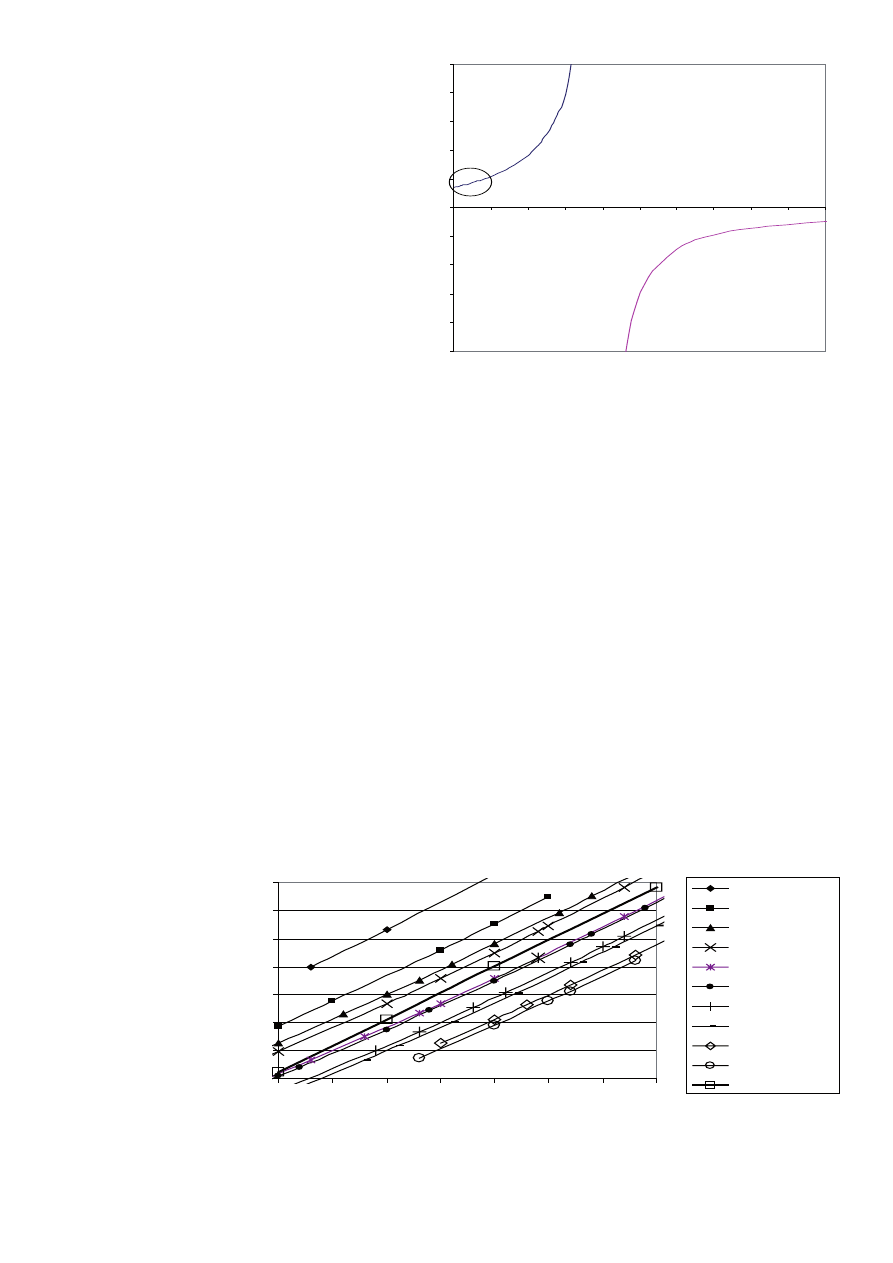
Rysunek 2 przedstawia całą krzywą:
Y = 100 x [(A + B x X)/(C + D x X)]
Zależność ma kształt hiperboli, lecz jeżeli zmniejszamy zakres X
i Y od 0 do 100% (w środku koła) może ona być przedstawiona
w postaci linii prostej. Jest to powód liniowości tej krzywej na
rysunku 1.
Wykorzystując wzór 1 możemy zdefi niować wszystkie punkty.
Każdy z nich przedstawia specyfi czny klinkier w formie części
krzywej, wyznaczonej przez zbiór wartości SR i AM. Na rysunku
3 pokazano krzywą z rysunku 1, jednak linia prosta (wartość śred-
nia) została podzielona na szereg krzywych posiadających pewną
wartość stosunku SR/AM. Aby rysunek 1 był bardziej zrozumiały
pokazaliśmy go w powiększeniu na rysunku 3.
b) Zależność LSF od SR przy stałej zawartości C
3
S
i AM
Ustalono zależność tego samego rodzaju co poprzednia
LSF = (A
sr
+ B
sr
SR )/(C
sr
+ D
sr
SR)
[2]
A
sr
= 6,718 x AM + (AM + 1) x 0,01
x C
3
S + 1,429
B
sr
= (AM + 1) (7,602 + 0,01 x
C
3
S)
C
sr
= (1,65 x AM + 0,35) x (4,071
- C
3
S x 0,01)
D
sr
= (AM + 1) 2,8[4,071 - C
3
S x
0,01]
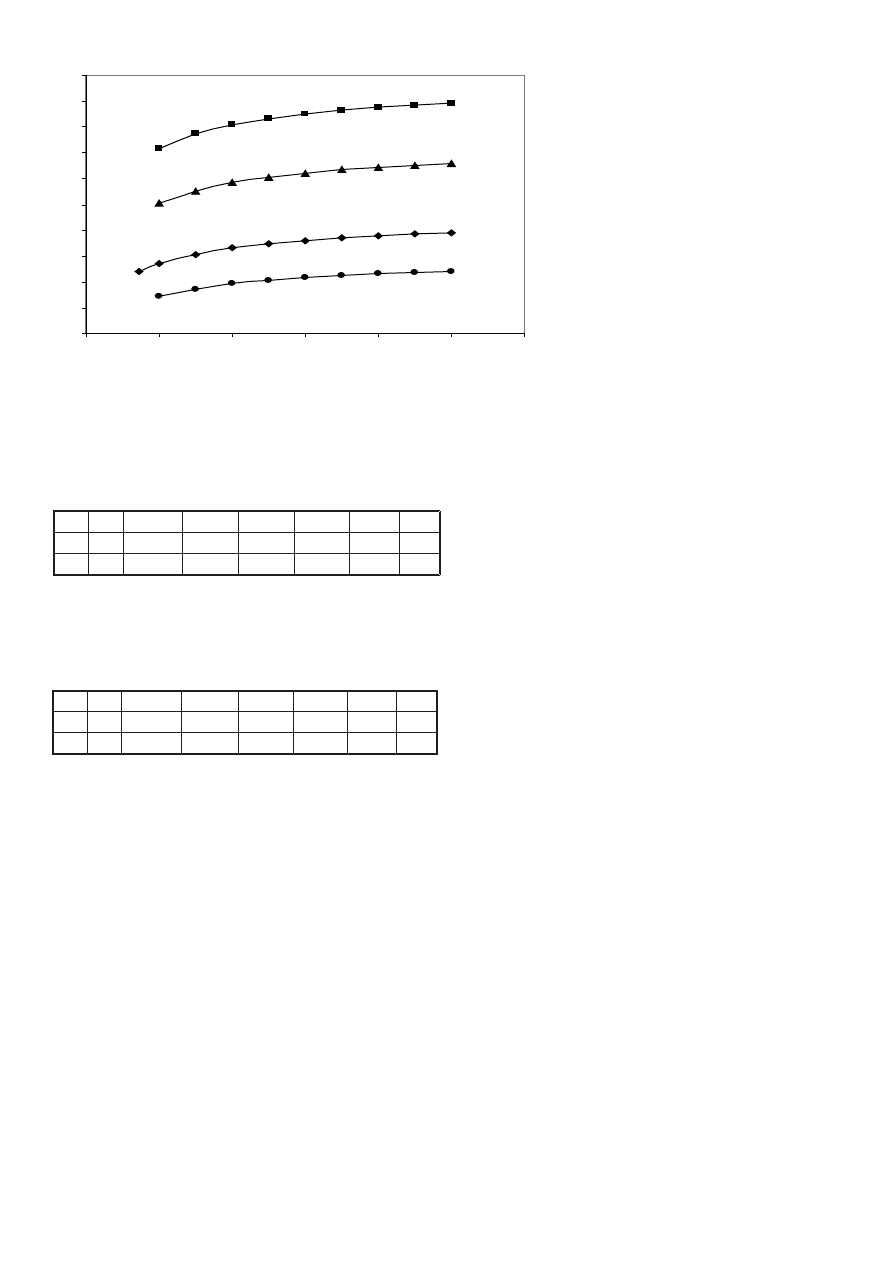
Na rysunku 4 pokazano zależność
LSF od modułu krzemowego przy
stałych udziałach C
3
S i zmiennego
AM.
Ten rodzaj krzywych można zna-
leźć w literaturze (6). Wynika nich,
e) % C
3
S versus SR at constant LSF and AM,
f) % C
3
S versus AM at constant LSF and SR,
g) Pure compounds or solid solutions?
2. Results and discussion
a) LSF versus % C
3
S
We have collected from literature (proceedings of ICMA, ICCC
conferences..) chemical analysis of clinkers. (laboratory and in-
dustrials). From the chemical analysis, LSF and % C
3
S according
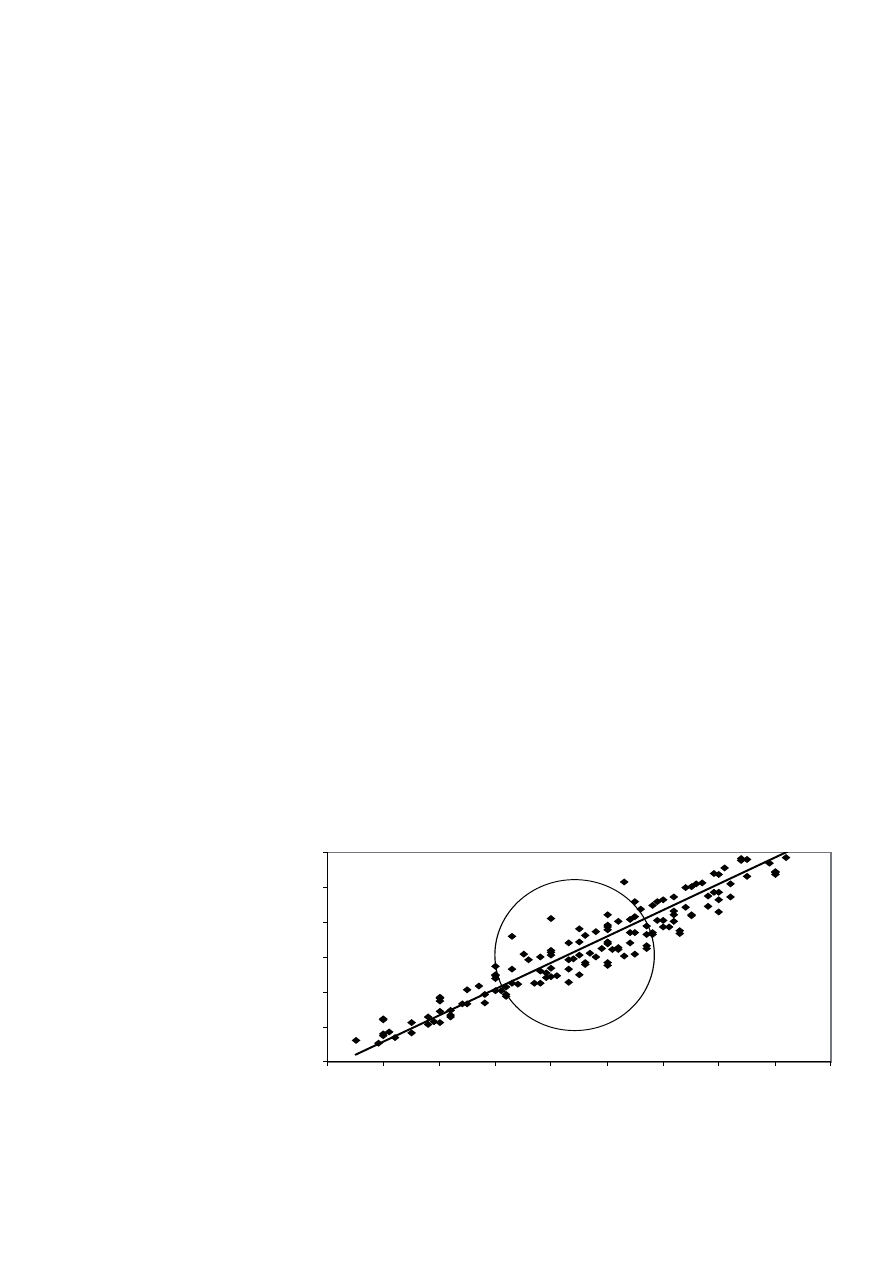
to Bogue’s equations have been calculated. If we plot LSF versus
% C
3
S, we obtain the curve shown in Figure 1. It is possible to
fi nd, in the literature ( 5) such a relation between LSF and the
mineralogical composition calculated by Bogue’s equations. The
linear relation is given as:
Y= 0,3764 X + 69,197 with a coeffi cient R
2
= 0,933.
In spite of the good quality of the correlation we see that the range
of variation of C
3
S for a given LSF is too wide to predict correctly
the reactivity of the cement. It is quite easy to calculate numerically
this curve if we know the chemical composition of the raw meal, but
this is not the case when we begin to design the raw meal because
we only know AM and SR and not the chemical composition. It is
possible to assess a literal formula giving LSF versus % of C
3
S.
By using Bogue’s equations and the defi nition of LSF, AM and SR,
we obtain the following relation giving LSF versus C
3
S.
LSF = 100 x [(A + B x C
3
S)/(C+ D x C
3
S)] [1]
With the coeffi cients:
A = 7,602 x SR x (AM+1) + 6,718 x AM +1,429
B = (AM+1) x (SR+1) x 0,01
C = [2,8 x (AM+1) x SR+1,65 x AM+ 0,35] x 4,071
D = - [2,8 x (AM+1) x SR+1,65 x AM+ 0,35] x 0,01
Figure 2 represents the total curve:
Y = 100 x [(A + B x X)/(C+ D x X)]
70,00
75,00
80,00
85,00
90,00
95,00
100,00
0
10
20
30
40
50
60
70
80
90
LS F
% C 3S
Rys. 1. Zależność LSf od % C
3
S obliczona ze wzorów Bogue’a. Zmiana skali jest pokazana na rysunku 3
Fig. 1. Relation between LSF and % C
3
S calculated by Bogue’s equation zoom inside the circle is shown
Figure 3
CWB-2/2008
85
że duże wartości LSF i modułu krzemowego nie są korzystne
dla zdolności do klinkieryzacji, a odwrotny wpływ mają małe
LSF i SR.
W uzupełnieniu do wcześniejszych publikacji widać tutaj:
a) wpływ AM i SR przy stałym % C
3
S,
b) że każdy punkt przedstawiający zestaw surowcowy lub
klinkier należy do charakterystycznego zbioru AM/SR i LSF.
c) zależność LSF od AM przy stałych C
3
S i SR
Ustalono zależność tego samego rodzaju co [1] i [2]. Różne
są tylko współczynniki.
LSF = (A
AM
+B
AM
x AM )/(C
AM
+ D
AM
x AM)
[3]
A
AM
= 7,602 x SR + 1,429 + (SR + 1) x 0,01 x C
3
S
B
AM
= [7,602 x SR + 6,718 + (SR + 1) x 0,01 x C
3
S]
C
AM
=(2,8 x SR + 0,35) x (4,071 - C
3
S x 0,01)
D
AM
= (2,8 x SR + 1,65) x (4,071 - C
3
S x 0,01)
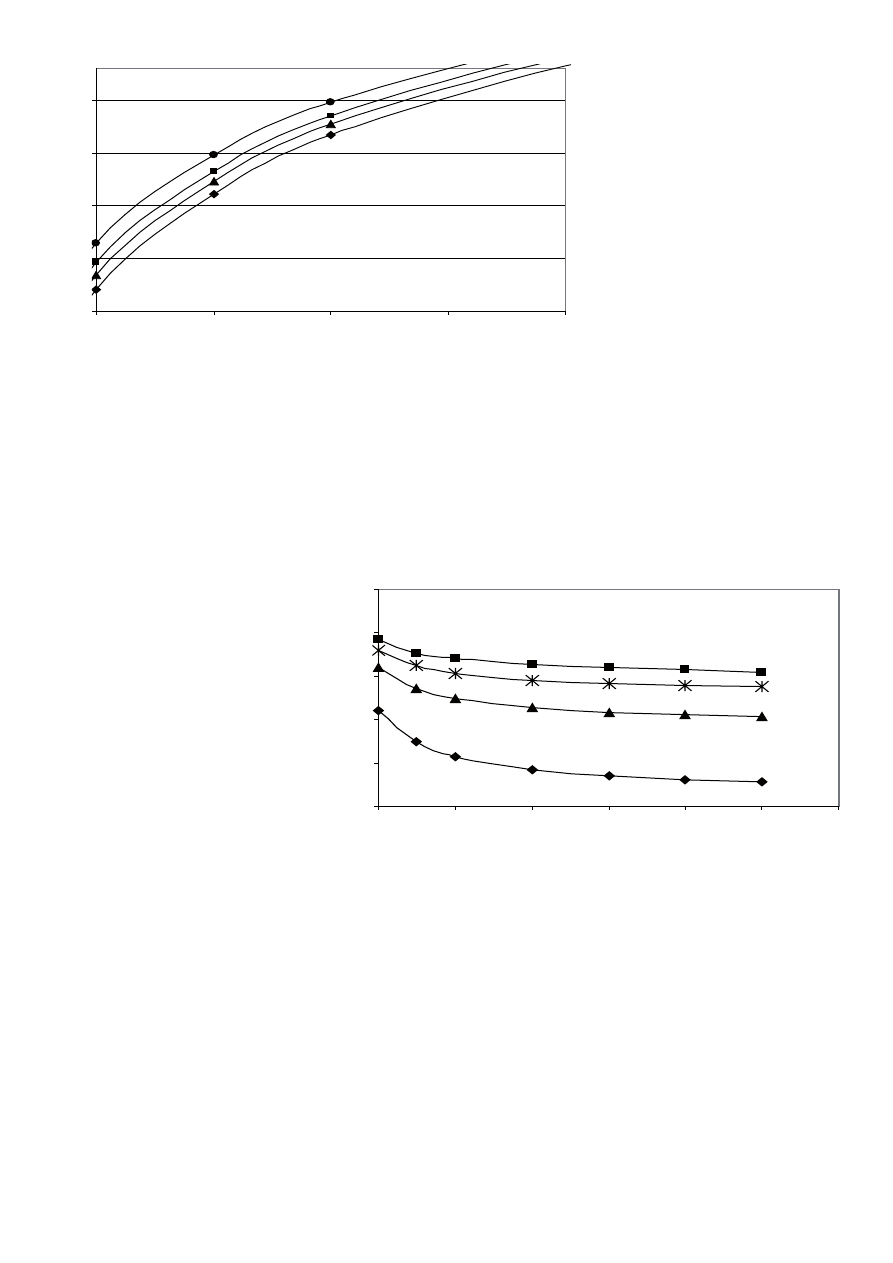
Na rysunku 5 pokazano zależność pomiędzy LSF a modułem
glinowym przy różnych SR
d) zależność zawartości C
3
S od LSF przy stałych AM
i SR
W tym przypadku rodzaj zależności i współczynniki A, B, C, D są
takie same jak w równaniu 1.
C
3
S = -A+ C x (LSF/100) /(B - Dx(LSF/100 )
[4]
e) zawartość C
3
S w zależności od SR przy stałych
LSF i AM
Rodzaj równania jest taki sam jak w poprzednim punkcie.
C
3
S = 100 x (E
SR
+ F
SR
x SR)/(G
SR
+ H
SR
x SR)
[5]
F
SR
= (AM + 1) x [11,398 x LSF -7,602]
E
SR
= (6,7187 x AM +1,4297) x (LSF-1)
H
SR
= (AM + 1) (1 + 2,8 x LSF)
G
SR
= (AM + 1) + LSF x (1,65 x AM + 0,35)
W tym przypadku utrzymujemy stałą wartość LSF, tak jak prze-
ważnie postępuje się w trakcie obliczeń i analizujemy zmiany
zawartości C
3
S od SR (rysunek
6). Wiadomo (7), że wzrost SR
wymaga zwiększenia zawarto-
ści SiO
2
, co powoduje spadek
zawartości C
3
S.
Na rysunku 6 widzimy odwrot-
ny wpływ, to znaczy zawartość
C
3
S wzrasta ze wzrostem SR.
Można to łatwo wyjaśnić zmia-
nami LSF. W tablicy 3 LSF
zmienia się od 95 do 90 pod-
czas, gdy jest on stały w przy-
padku wszystkich krzywych.
The relation is hyperbolic, but if we reduce the range of X and
Y from 0 to 100% b (inside the circle), it can be assimilated to
a straight line. It is the reason of the linearity of the curve shown
in the Figure 1.
By using the formula 1, we are able to classify all the points. Each
one represents a specifi ed clinker into a part of curve, defi ned by
a set of SR and AM. Figure 3 represents the curve shown in the
Figure 1, but the straight line (average) has been splitted into many
curves having a given couple SR/AM. For the clarity of the fi gure,
we have represented a zoom of the Figure 1 on the Figure 3.
b) LSF versus SR at constant % C
3
S and AM
A relation of the same type as the preceding has been establis-
hed.
LSF = (A
sr
+B
sr
SR)/(C
sr
+ D
sr
SR)
[2]
A
sr
= 6,718 x AM + (AM + 1) x 0,01 x C
3
S + 1,429
B
sr
= (AM + 1) (7,602 + 0,01 x C
3
S)
C
sr
= (1,65 x AM + 0,35) x (4,071 - C
3
S x 0,01)
- 5 0 0
- 4 0 0
- 3 0 0
- 2 0 0
- 1 0 0
0
1 0 0
2 0 0
3 0 0
4 0 0
5 0 0
0
1 0 0
2 0 0
3 0 0
4 0 0
5 0 0
6 0 0
7 0 0
8 0 0
9 0 0
1 0 0 0
X
Y
Rys. 2. Y = 100 x (A + B x X ) / (C+ D x X). Wewnątrz koła LSF w zależności od
% C
3
S
Fig. 2. Y = 100 x (A + B x X) / (C+ D x X). Inside the circle LSF versus % C
3
S
80
82
84
86
88
90
92
94
30
35
40
45
50
55
60
65
S R = 1 A M = 2
S R = 1,5 A M = 2
S R = 2 A M = 4
S R = 2 A M = 2
S R = 3 A M = 4
S R = 3 A M = 3
S R = 4 A M = 4
S R = 4 A M = 2
S R = 6 A M = 3
S R = 7 A M = 3
A verage
LS F
% C 3S
Rys. 3. Rysunek 1 w większej skali
Fig. 3. Zoom of the Figure 1
86
CWB-2/2008
Jeżeli utrzymujemy stałą wartość LSF
(tablica 4), to otrzymujemy wzrost
zawartości C
3
S.
Ten wzrost zawartości C
3
S jest mały i
powinien być umiarkowany ze względu
na pogorszenie zdolności do klin-
kieryzacji zestawu surowcowego ze
zwiększeniem SR. Trzeba znaleźć
kompromis pomiędzy zwiększeniem
reaktywności, a zmniejszeniem zdol-
ności do klinkieryzacji. Rysunek 6
pokazany dla LSF = 90% może być
wykonany dla dowolnej innej wartości
LSF.
f) Zależność zawartości C
3
S
od AM przy stałych LSF i SR
Zależność zawartości C
3
S od AM jest dana następującym równa-
niem, takim samym jak poprzednie:
C
3
S = 100 x (E
AM
+ F
AM
AM)/(G
AM
+ H
AM
AM)
[6]
E
AM
= LSF x 4,071 (2,8 x SR + 0,35) - 7,602 x SR -1,4297
F
AM
= [LSF x 4,071 (2,8 x SR + 1,65) - 7,602 x SR- 6,7187]
G
AM
= (SR + 1) + LSF x (2,8 x SR + 0,35) x 0,01
H
AM
= [(SR+1) + LSF x (2,8 x SR + 1,65)] x 0,01
Widzimy spadek zawartości C
3
S ze wzrostem AM (% C
3
A wzra-
sta).
g) Czyste związki czy roztwory stałe?
Poprzednie obliczenia przeprowadzono dla czystych związków:
Ca
3
SiO
5
, Ca
2
SiO
4
, Ca
3
Al
2
O
6
, Ca
4
Al
2
Fe
2
O
10
, z zastosowaniem
wzorów Bogue’a. Te same obliczenia można przeprowadzić dla
roztworów stałych alitu, belitu, glinianu i ferrytu. Jako przykład
bierzemy roztwory stałe czterech związków uproszczonego układu
CaO-SiO
2
-Al
2
O
3
-Fe
2
O
3
.
Te związki można napisać następująco (uproszczenie wzorów
podanych w (10)):
alit Ca
3
Si
0,98
Al
0,01
Fe
0,01
O
5
belit
Ca
2
Si
0,93
Al
0,035
Fe
0,035
O
4
glinian
Ca
3
Si
0,93
Al
0,035
Fe
0,035
O
5
ferryt Ca
2
Si
0,2
Al
1
Fe
0,8
O
7
W tym przypadku wzory Bogue’a przyjmą postać:
Alit = 4,358 x CaO – 8,509 x SiO
2
– 7,815 x Al
2
O
3
+ 0,197 x
Fe
2
O
3
Belit = -3,493 x CaO + 9,935 x SiO
2
+ 5,973 x Al
2
O
3
– 0,513 x
Fe
2
O
3
Glinian = -0,025 x CaO +0,082 x SiO
2
+ 3,952 x Al
2
O
3
– 3,139 x
Fe
2
O
3
D
sr
= (AM + 1) 2,8[4,071 - C
3
S x 0,01]
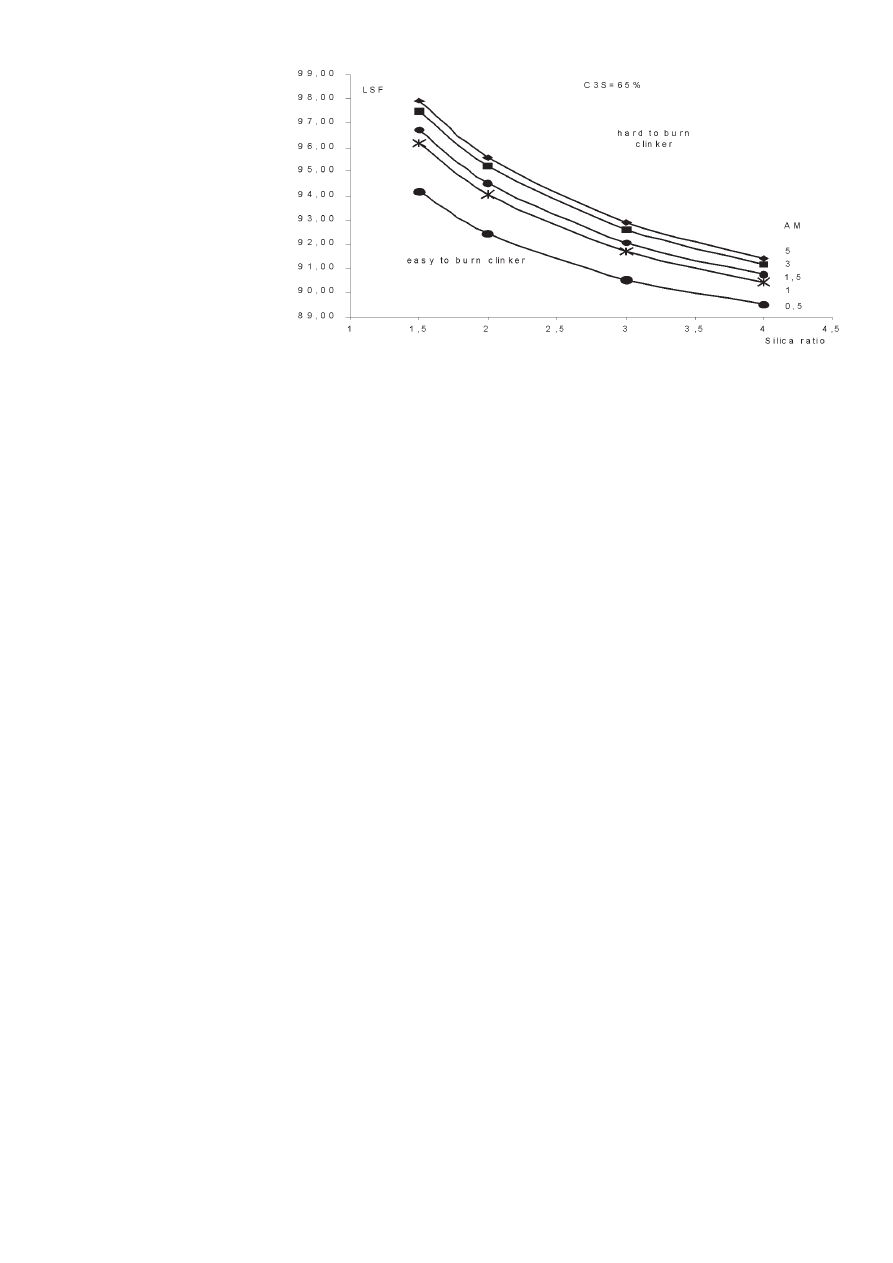
Figure 4 gives the relation between LSF and the silica ratio for
a fi xed % C
3
S and different AM.
This type of curve can be found in the literature (6). It shows that
a high LSF and silica ratio are not favourable to the burnability as
opposite as a low LSF and silica ratio.
In addition to the previous publications, we see here:
a) the respective infl uence of AM and SR at constant % C
3
S,
b) that each point representing a raw meal or a clinker belongs
to a specifi c set of AM/SR and LSF.
c) LSF versus AM at constant % C
3
S and SR
A relation of the same type as [1] and [2] has been established.
Only the coeffi cients are modifi ed.
LSF = (A
AM
+B
AM
x AM )/(C
AM
+ D
AM
x AM)
[3]
A
AM
= 7,602 x SR+1,429 + (SR+1) x 0,01 x C
3
S
B
AM
= [7,602 x SR+ 6,718 + (SR+1) x 0,01 x C
3
S]
C
AM
=(2,8 x SR+0,35) x (4,071- C
3
S x 0,01)
D
AM
= (2,8 x SR+1,65) x (4,071- C
3
S x 0,01)
Figure 5 gives the relation between LSF and the alumina ratio for
a fi xed % C
3
S and different SR.
d) % C
3
S versus LSF at constant AM and SR
In this case the type of relation and the coeffi cients A, B, C, D are
the same as in the relation 1.
C
3
S = -A+ C x (LSF/100) /(B - Dx(LSF/100)
[4]
e) % C
3
S versus SR at constant LSF and AM
The type of equation is the same as in the previous paragraphs.
C
3
S = 100x (E
SR
+F
SR
x SR)/(G
SR
+H
SR
x SR)
[5]
F
SR
= (AM+1) x [ 11,398 x LSF -7,602]
Rys. 4. Zależność LSF od SR przy 65% C
3
S
Fig. 4. LSF versus SR for % C
3
S=65%
CWB-2/2008
87
Ferryt = 0,160 x CaO – 0,508 x SiO
2
– 1,110 x Al
2
O
3
+ 4,455 x
Fe
2
O
3
Ten rodzaj wzorów można znaleźć w literaturze z różnymi współ-
czynnikami (8, 9, 10).
Stąd LSF można zapisać następująco:
LSF= 100x(%CaO) / (2,846x (%SiO
2
) +1,711x(%Al
2
O
3
)-
0,146x(%Fe
2
O
3
)
Można także dojść do tego samego rodzaju równań jak [1]
LSF = 100 x [(A
ss
+ B
ss
x C
3
S )/(C
ss
+ D
ss
x C
3
S)] [7]
Ze współczynnikami:
A
ss
= 8,509 x SR x (AM + 1) + 7,875 x AM +1,429
B
ss
= (AM + 1) x (SR + 1) x 0,01
C
ss
= [2,846 x (AM + 1) x SR + 1,711 x AM-0,146] x 4,358
D
ss
= - [2,846 x (AM + 1) x SR + 1,711 x AM-0,146] x 0,01
Ten sam rodzaj zależności pozostaje dla a, b, c, d, e, f. Jest także
możliwe ekstrapolować te wyniki w przypadku bardziej złożonych
E
SR
= (6,7187 x AM +1,4297) x (LSF-1)
H
SR
= (AM+1) (1 + 2,8 x LSF)
G
SR
= (AM+1)+ LSF x (1,65 x AM+0,35)
In this case, we fi x LSF, as it is done in the usual
calculation and we study the variation of the %
C
3
S versus SR (Figure 6). It is known (7) that an
increase of SR leads to an increase of % SiO
2
and
a decrease of % C
3
S.
In the Figure 6, we see the opposite behaviour i.e.
the % of C
3
S increases when SR increases.
It can be easily explained by the variation of LSF. In
the Table 3, LSF changes from 95% to 90%, while
LSF is constant in the Figure 6. If we keep constant
LSF (Table 4) we obtain an increase of the % C
3
S.
This gain in % C
3
S is small and must be moderated
by the decreases of the burnability of the raw meal
that decreases when SR increases. An equilibrium must be found
between a gain of reactivity and a loss of burnability. The Figure 6
drawn for LSF = 90% could be drawn for any other LSF.
f) % C
3
S versus AM at constant LSF and constant SR
The relation between % C
3
S and AM is given by the following
equation (same as in the previous paragraphs).
C
3
S = 100 x (E
AM
+F
AM
AM )/(G
AM
+ H
AM
AM)
[6]
E
AM
= LSF x 4,071 (2,8 x SR + 0,35) - 7,602 x SR -1,4297
F
AM
= [LSF x 4,071 (2,8 x SR + 1,65)- 7,602 x SR- 6,7187]
G
AM
= (SR + 1) + LSF x (2,8 x SR + 0,35) x 0,01
H
AM
= [(SR + 1) + LSF x (2,8 x SR + 1,65)] x 0,01
We see a decrease of the % of C
3
S when AM increases (% C
3
A
increases).
g) Pure compounds or solid solutions?
The previous calculations have been done with pure compounds.
Ca
3
SiO
5
, Ca
2
SiO
4
, Ca
3
Al
2
O
6
, Ca
4
Al
2
Fe
2
O
10
and the application of
Bogue’s equation
.
The same calculation can be done with solid
solution, alite, belite, aluminate, and ferrite. As an example we take
the solid solution of the four compounds in the simplifi ed system
CaO-SiO
2
-Al
2
O
3
-Fe
2
O
3
.
The compounds can be written (simplifi cation of the composition
given in (10)):
alite
Ca
3
Si
0,98
Al
0,01
Fe
0,01
O
5
belite
Ca
2
Si
0,93
Al
0,035
Fe
0,035
O
4
aluminate
Ca
3
Si
0,93
Al
0,035
Fe
0,035
O
5
ferrite
Ca
2
Si
0,2
Al
1
Fe
0,8
O
7
In this case, Bogue ‘s equations become:
Alite = 4,358 x CaO – 8,509 x SiO
2
– 7,815 x Al
2
O
3
+
0,197 x Fe
2
O
3
89
90
91
92
93
94
95
96
97
98
99
0
1
2
3
4
5
6
A M
LSF
SR
4
3
2
1,5
C3S=65%
Rys. 5. Zależność LSF od AM przy stałej zawartości C
3
S = 65%
Fig. 5. LSF versus AM for % C
3
S = 65%
Tablica 3 / Table 3
Zmiany zawartości C
3
S w zależności od SR
Variation of % C
3
S versus SR
AM
SR
% Fe
2
O
3
% Al
2
O
3
% SiO
2
% CaO
% C
3
S
LSF
2
3
2,55
5,09
22,91
69,46
70,89
95
2
4
2,06
4,12
24,73
69,09
62,71
90
Tablica 4 / Table 4
ZMIANY ZAWARTOŚCI C
3
S W ZALEŻNOŚCI OD SR PRZY STAŁYM
LSF
VARIATION OF % C
3
S VERSUS SR AT CONSTANT LSF
AM
SR
% Fe
2
O
3
% Al
2
O
3
% SiO
2
% CaO
% C
3
S
LSF
2
3
2,63
5,27
23,71
68,39
59,13
90
2
4
2,06
4,12
24,73
69,09
62,71
90
88
CWB-2/2008
układów zawierających inne tlenki jak na przykład MgO, Na
2
O,
K
2
O, P
2
O
5
, SO
3
, Cr
2
O
3
, Mn
2
O
3
…..
3. Wnioski
Opierając się na znanych, uproszczonych układach (czyste związ-
ki i 4 składniki), wykazaliśmy możliwość projektowania zestawu
surowcowego uwzględniającą zdolność do klinkieryzacji (SR),
reaktywność klinkieru (% C
3
S) i trwałość betonu (AM). Główną
zaletą takiej strategii projektowania jest możli-
wość jej ekstrapolacji na układy bardziej złożone,
obejmujące roztwory stałe.
Literatura / References
1. W. H. Duda “Cement data book 2ed Bauverlag GmbH,
Wiesbaden and Berlin, p. 14, (1977).
2. L. Forsen 2d ICCC Stockholm, p. 132 (1938).
3. Z. Pucar “ Calculations of raw mixes in the manu-
facture of Portland cement” Rock Products 56, 12, pp.
126-32, (1953).
4. C. W. Moore “Chemical control of Portland cement
clinker’” J.A.C.S vol. 61, N°4, pp. 511-514, (1982).
5. G. Jeon et al “Quantitative analysis of quality control
factors related with compressive strength and cement
fi neness” from Cement technology edt by E. Gartner
and H. Uchikawa pp. 43-51, (1994).
6. A. K. Chatterjee “Burnability and clinkerisation of cement raw mix “Advan-
ces in cement technology S. N. Gosh, Pergamon Press, p. 52, (1982).
7. S. P. Gosh “Raw material-Geological characteristics” Advances in cement
technology S. N Gosh Pergamon Press, p. 27, (1982).
8. K. E. Fletcher “The composition of the C3A and ferrite phases in P.C.
Clinker by use of an electron probe micro analysis “ Magazine of Concrete
Research, 21, 66, pp. 3-4, (1969).
9. H. F. W. Taylor “Modifi cation of the Bogue calculation”, Advances in
Cement Research, 2, 3, pp. 73-77 (1989).
10. H. F. W. Taylor “Cement Chemistry”, Academic Press ltd, p.10,
(1990).
Belite = -3,493 x CaO + 9,935 x SiO
2
+
5,973 x Al
2
O
3
– 0,513 x Fe
2
O
3
Aluminate = -0,025 x CaO +0,082 x SiO
2
+
3,952 x Al
2
O
3
– 3,139 x Fe
2
O
3
Ferrite = 0,160 x CaO – 0,508 x SiO
2
– 1,110 x Al
2
O
3
+ 4,455 x Fe
2
O
3
This type of equation can be found in the lite-
rature, with different coeffi cients (8, 9,10).
And LSF can be written:
LSF= 100x(%CaO) / (2,846x (%SiO
2
)
+1,711x(%Al
2
O
3
)- 0,146x(%Fe
2
O
3
)
It is possible to asses the same type of
equations as [1]
LSF = 100 x [(A
ss
+ B
ss
x C
3
S)/(C
ss
+ D
ss
x
C
3
S)] [7]
With the coeffi cients:
A
ss
= 8,509 x SR x (AM+1) + 7,875 x AM +1,429
B
ss
= (AM+1) x (SR+1) x 0,01
C
ss
= [2,846 x (AM+1) x SR+1,711 x AM-0,146] x 4,358
D
ss
= - [2,846 x (AM+1) x SR+1,711 x AM-0,146] x 0,01
The same results remain as in a, b, c, d, e, f . It is also possible to
extrapolate these results to more complicated system containing
other oxides such as MgO, Na
2
O, K
2
O, P
2
O
5
, SO
3
, Cr
2
O
3
, Mn
2
O
3
.
3. Conclusions
Based on an understanding of a simplifi ed system (pure compounds
and 4 constituents), we have shown the possibility to design a raw
meal to take into account the conditions of burning (SR), the reactivity
of the clinker (%C
3
S) and the durability of concrete (AM). The main
advantage of this strategy of design is the possibility of extrapolation
to more complex system covering also solid solution.
35,00
40,00
45,00
50,00
55,00
1,00
1,50
2,00
2,50
3,00
SR
% C3S
A M
1
2
3
LSF 90
1,5
Rys. 6. Wpływ SR na zawartość C
3
S przy stałym LSF = 90%
Fig. 6. % C
3
S versus SR for at constant LSF = 90%
30
40
50
60
70
80
0
1
2
3
4
5
6
A M
% C3S
SR
4
3
2
1
LSF=90%
Rys. 7. Zawartość C
3
S w zależności od AM przy LSF = 90%
Fig. 7. % C
3
S versus AM for LSF = 90%
Wyszukiwarka
Podobne podstrony:
nowe spojrzenie na przywodztwo (2 str), Zarządzanie(1)
Nowe spojrzenie na problem grawitacji, naukowe
Nowe spojrzenie na inwestycje(1), Elektrotechnika-materiały do szkoły, Gospodarka Sowiński
02 DiMaggio, Nowe spojrzenie na żelazną klatkę
Nowe spojrzenie na wentylację, Domy i ARCHITEKTURA, wentylacja
Nowe spojrzenie na beta-blokery w schorzeniach układu krążenia, Farmakologia, Kardiologiczne
Nowe spojrzenie na błąd medyczny
nowe spojrzenie na przywodztwo
Nowe spojrzenie na lojalność wobec marki
Nowe spojrzenie na obiektywizm fotografii
więcej podobnych podstron