
Understanding Planes and Axes of Movement
Terminology
When describing the relative positions of the body parts or relationship
between those parts it is advisable to all use the same standard terminology.
Anterior
:
Toward or on the front of the bod
y: in front of
The pectorals are on the anterior aspect of the body
Posterior
:
Towards or on the back of the body: behind
The rhomboids are on the posterior aspect of the body
Superior:
Toward the head or upper part of a structure: above
The humerus is
superior to the radius
Inferior
:
Toward the lower part of a structure: below
The tibia is inferior to the femur
Medial:
Toward or at the midline of the body: inner side
The adductors are on medial to the abductors
Lateral
:
Away form the midline of the b
ody: outer side
The abductors are on the lateral aspect of the leg
Proximal:
Closer to the origin of a point of reference
The elbow is proximal to the wrist
Distal:
Further from the origin or point of reference
The foot is distal to the knee
Planes an
d Axis
Human movements are described in three dimensions based on a series of
planes and axis. There are three planes of motion that pass through the
human body.
The sagital plane
The frontal plane
The transverse (horizontal) plane
The sagital plane lie
s vertically and divides the body into right and left parts.
The frontal plane also lies vertically however divides the body into anterior
and posterior parts.
The transverse plane lies horizontally and divides the body into superior and
inferior parts.
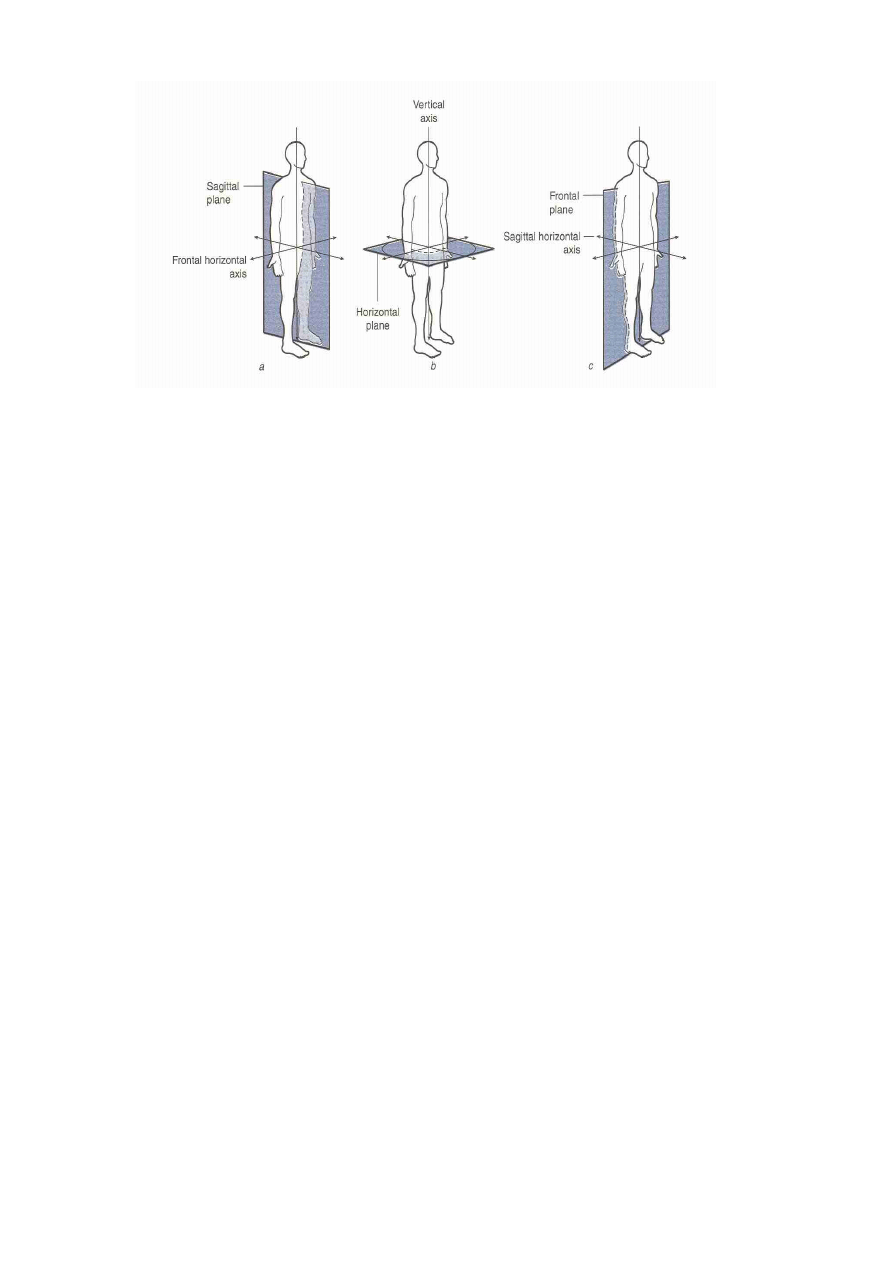
Behnke 2000
Axis
An axis is a straight line around which an object rotates. Movement at the
joint take place in a plane about an axis. There are three axis of rotation.
Sagital axis
Frontal axis
Vertical axis
The sagital axis passes horizontal
ly from posterior to anterior and is formed
by the intersection of the sagital and transverse planes.
The frontal axis passes horizontally from left to right and is formed by the
intersection of the frontal and transverse planes.
The vertical axis passes
vertically from inferior to superior and is formed by
the intersection of the sagital and frontal planes.
Planes of motion and function
There is a tendency when describing a movement for it to be referred to in
the particular plane that it is dominated
by. An example of this would be a
description of walking as a sagital plane movement.
In reality this is really only a description of the gross direction of
movement. At individual joint level, movement will be occurring in several
planes not solely i
n the sagital plane. For example during walking, the hip
will be flexing/extending in the sagital plane, adducting/abducting in the
frontal plane and internally/externally rotating in the transverse plane.
The same concept applies to all the individual j
oints in the lower limb
This simultaneous movement can be seen as one motion with three
components……
tri
-
planar motion
It is essential that the exercise professional is comfortable with the
concepts of
tri
-planar
motion
and
the
fact
that
all
functional
mo
vements
are
three dimensional, however it is biomechanically understood that
description in single plane terms is most useful when generalising about
gross movement patterns.
Examples of dominant planes, motions and axis in gross movements
Plane
Motio
n
Axis
Example
Sagital
Flexion/extension
Frontal
Walking
Squatting
Overhead press
Frontal
Abduction/abduction
Side flexion
Inversion/eversion
Sagital
Star jump
Lateral arm raise
Side bending
Transverse
Int rotationn/ext rotation
Horizontal flexion/exten
sion
Supination/pronation
Vertical
Throwing
Baseball swing
Golf swing
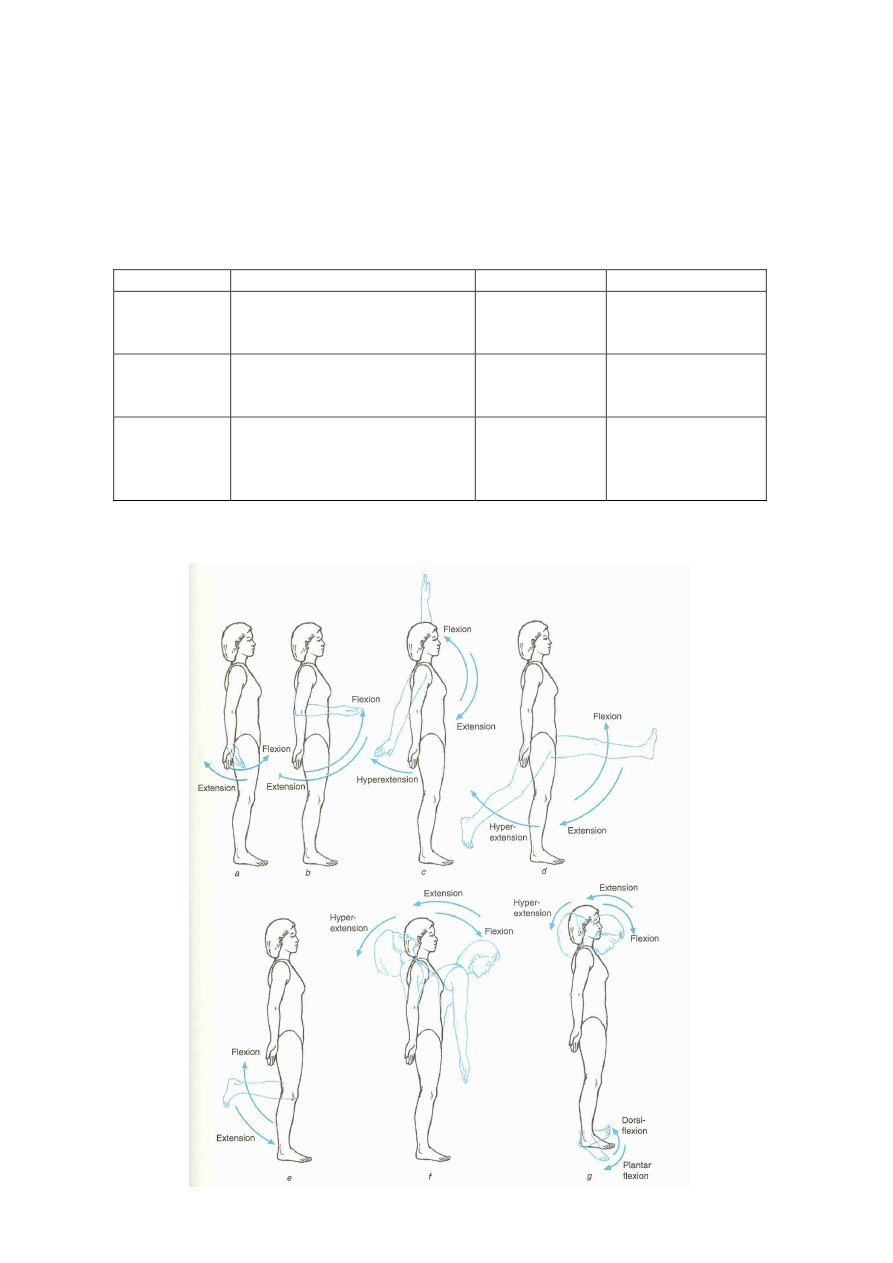
Movement in the sagital plane about the frontal axis
McGinnis, (1999)
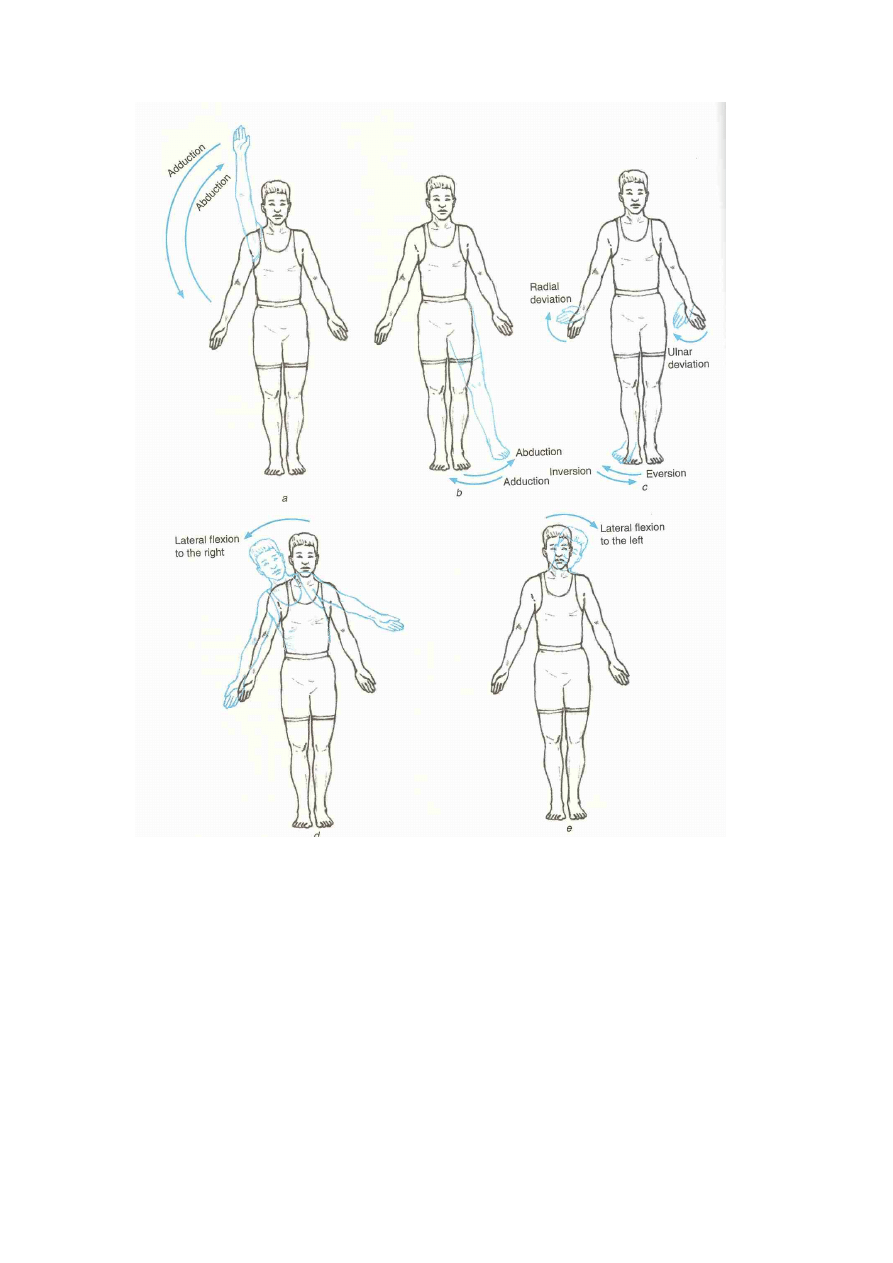
Movement in the frontal plane about the sagital axis
McGinnis, (1999)
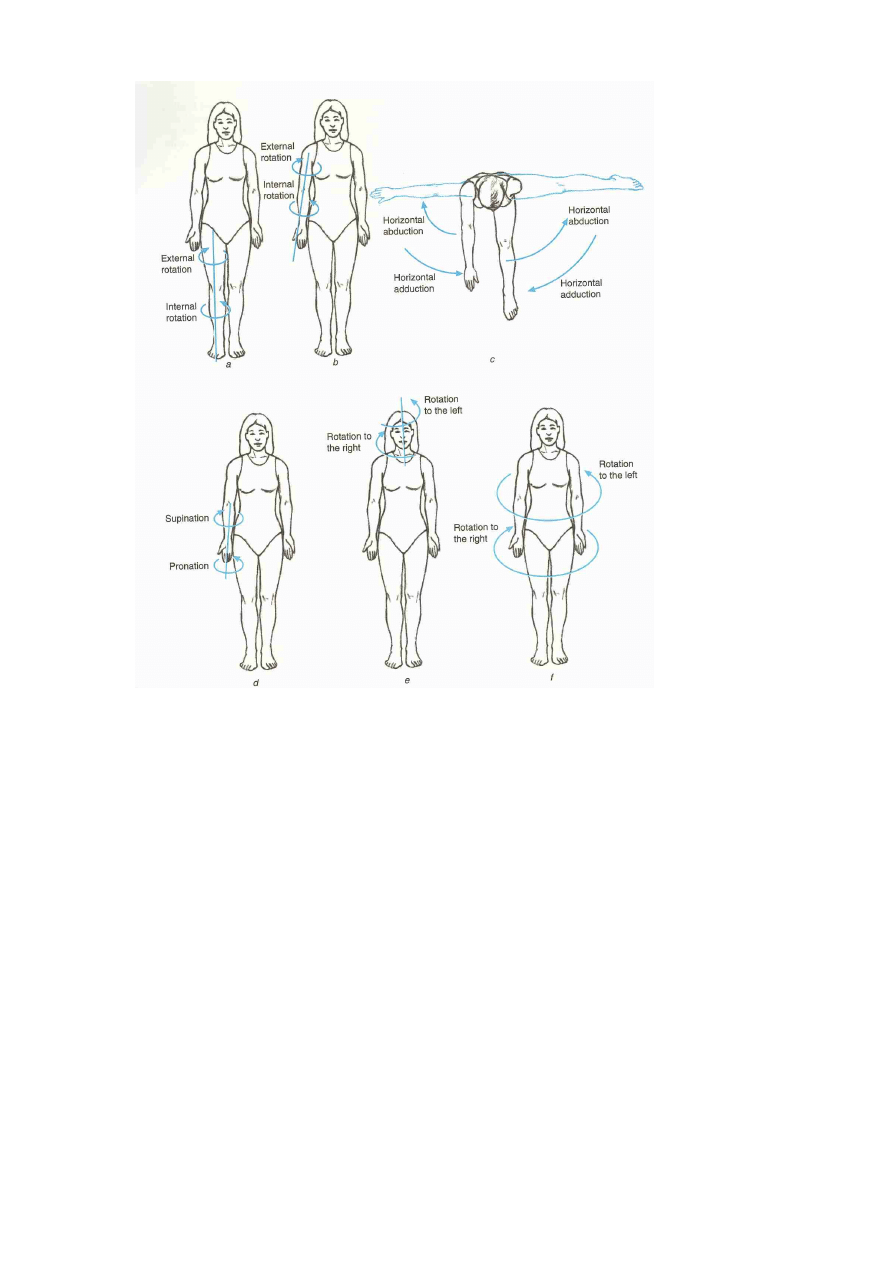
Movement in the transverse (horizon
tal) plane about the vertical axis
McGinnis, (1999)
As well as missing many other components of functional training, our current
popular methods involve machine
-based exercises that do everything
possible to ensure movement is strictly limited to one
plane. E.g
Quads bench, bicep curl, hip abduction, hamstring curl, calf raise, tricep
press!
These examples show how movement is dominated in the sagital plane
closely followed by the frontal plane. Even when machines are temporarily
neglected and, for
example, a dumbbell is selected, the planes that the
dumbbell exercises are often biased toward still remain sagital and frontal.
E.g.
Bicep curl, lateral arm raise, overhead press, tricep extension.
This training approach has brainwashed the average gym
member into
believing all exercises must be performed in strict planes of movement, which
usually tend to be the sagital and frontal planes.
Now look at the functional activities of life and sport. eg.

Rolling, walking, skipping, twisting, running, jump
ing, hopping,
Catching, throwing, kicking, climbing, squatting, pushing, pulling
All of these component movements will combine to achieve a backhand at
tennis, or a golf swing, a header in football, a spike in volleyball, paddling in
kayaking.
They are all activities that require motion in all three planes simultaneously.
Multi-plane movement dominates activities of life and sport. Current popular
training methods take no account of this with exercises that dominate in the
sagital plane and often ne
glect the transverse plane entirely.
How many machines can you think of in the average gym that utilise the
transverse
plane.
Multi-plane movement is an essential component of functional training and
furthermore the transverse plane as a ‘functional c
ornerstone’. This plane has
been neglected but must be recognised in order for an exercise to be
deemed
truly functional.
How can one expect
carryover
from training to sport if training methods
continue to be dominated by single plane exercises in a propr
ioceptively
sparse environment.
We function in a 3 dimensional environment
Traditional training methods tend to emphasise movement in one plane
The transverse plane is often neglected in training programmes
Key Points
Wyszukiwarka
Podobne podstrony:
PŁASZCZYZNY I OSIE CIAŁA
Ruchy w stawach
Ruchy w stawach, Fizjoterapia Zak
Płaszczyzny i osie ciała - anatomia, dokumenty, anatomia
Ruchy w stawach obręczy kończyny górnej
płaszczyzny i osie - wydrukowane, Fizjoterapia, Kinezyterapia
ruchy w stawach i mięśnie odpowiadajace, metody diagnostyki funkcjonalnej
4 Płaszczyuzny, osie, kierunki
Ruchy w stawach kończyn dolnych i górnych
Płaszczyzny i osie ciała1(1), Masaż, terapie itp
Płaszczyzny i osie ciała, Fizjoterapia
Ruchy W STAWACH, BIOLOGIA
płaszczyzny i osie ciała
Płaszczyzny, osie[1]
PŁASZCZYZNY I OSIE CIAŁA, Fizjoterapia Zak
Ruchy w stawach i miesnie je powodujace konczyna gorna
więcej podobnych podstron