Production of Energy from Biomass Residues
(Nuts and Fruit Processing Waste)
1. Aim of the Project
The aim of the project was to construct a combined heat and power demonstration plant
fuelled by agro-food industry residues, in particular: hazelnut shells, olive kernels, fruit
stones, pine cone seed wastes, other fruit processing wastes and wood chips.
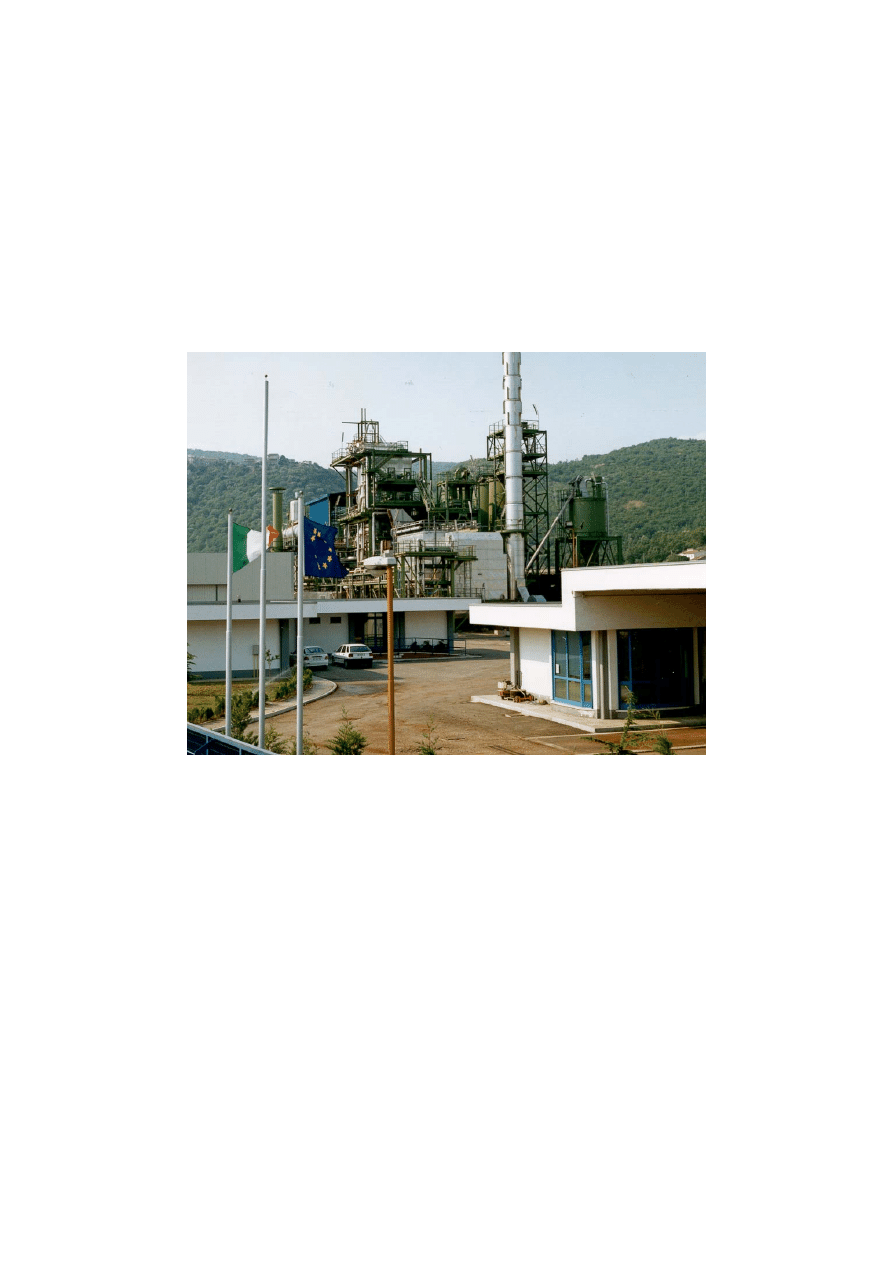
Photo 1: General view of the plant
2. Introduction
The company Energonut srl in Naples has built in the industrial area of Pozzilli this
cogeneration plant. The plant construction was completed by the end of 1996 and is operating
since early 1997. The fuel material is biomass derived from agro-forestry and agro-industrial
activities, such as olive husk, pine cones, hazelnut shells, fruit stones, wood residue etc.,
gathered inside an area in a range of about 300 km from the power station. The typology of
the various fuels, their physical characteristics (calorific value, moisture and ash content etc.)
and the seasonal properties of the products required the development of a specific and
thorough strategy for purchase and use, specially as every single product needs an individual
storage care and mixing conditions. This influences considerably the management of the
feedstock supply to the boiler in order to obtain the best fuel mix while at the same time
trying to meet very diverging fuel specifications.
Italian laws n.9 and 10 of 1991 govern the production and sale of electricity from renewable
resources (like biomass) from private operations. The ENERGONUT plant fully complies
with the requirements of the above laws and will therefore benefit by the price per kWh for
the electric energy produced by it and sold to ENEL. The electric energy price actually paid
covers the production costs of the plant after the significant modifications introduced as
suggested by experience.
3. Technical description
The project included the design, engineering, construction and commissioning of the
complete power station, consisting of the biomass storage yard and handling facilities; the
grate steam boiler and flue gas treatment; the turbo-generator and steam condenser, the
transformers, switchboards and power connection system to the national electrical network
(ENEL); the condenser water cooling system; the ashes recovery and shipping unit; ancillary
plants; and the waste heat supply for third party's utilisation (greenhouses, etc.).
The steam boiler is equipped with a moving grate specially designed for proper regulation of
the combustion rate and a design value for unburned carbon of less than 0.5 %. The ashes
(about 200-300 kg/h depending on the fuel mix) are conveyed to an ash silo for storage of 30
m
3
. The silo is periodically emptied into trucks and the ash is sent to an authorised landfill
nearby. ENERGONUT is investigating the possibility to sell the ash as a soil conditioner due
to its high potassium content, compost component or cement additive.
Natural gas is used as auxiliary fuel for start up and transient phases.
4. Performance of the Plant
One of the main objectives was to demonstrate the multi-fuel operation of the boiler since this
will give great operational flexibility for this and future plants. Table 1 gives a typical blend
of the biomass fuel based on the various types of residues available. The net calorific value,
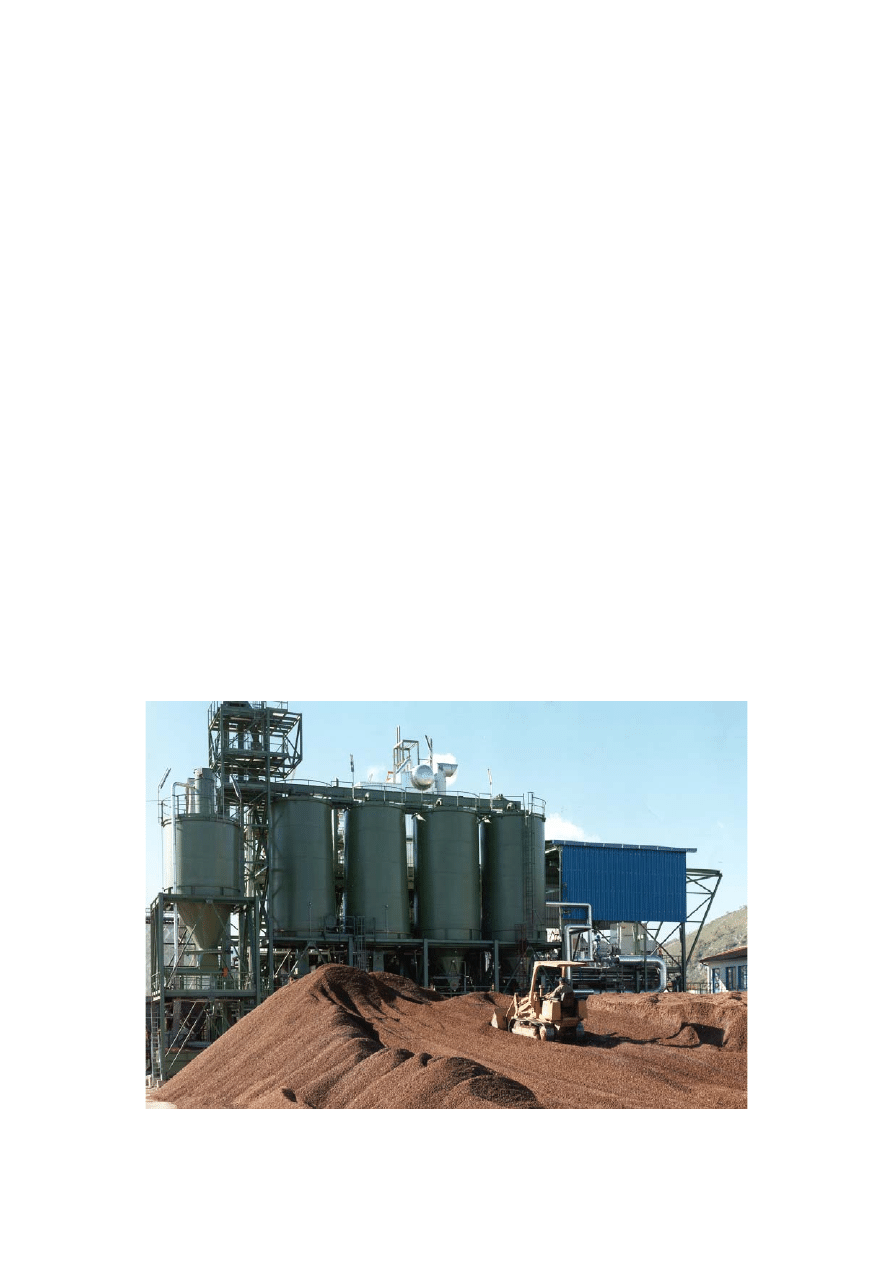
on dry basis, of the fuel fed to the boiler is in the range of 19 - 21 MJ/kg. Photo 2 shows the
biomass storage area.
Photo 2: The biomass storage silos
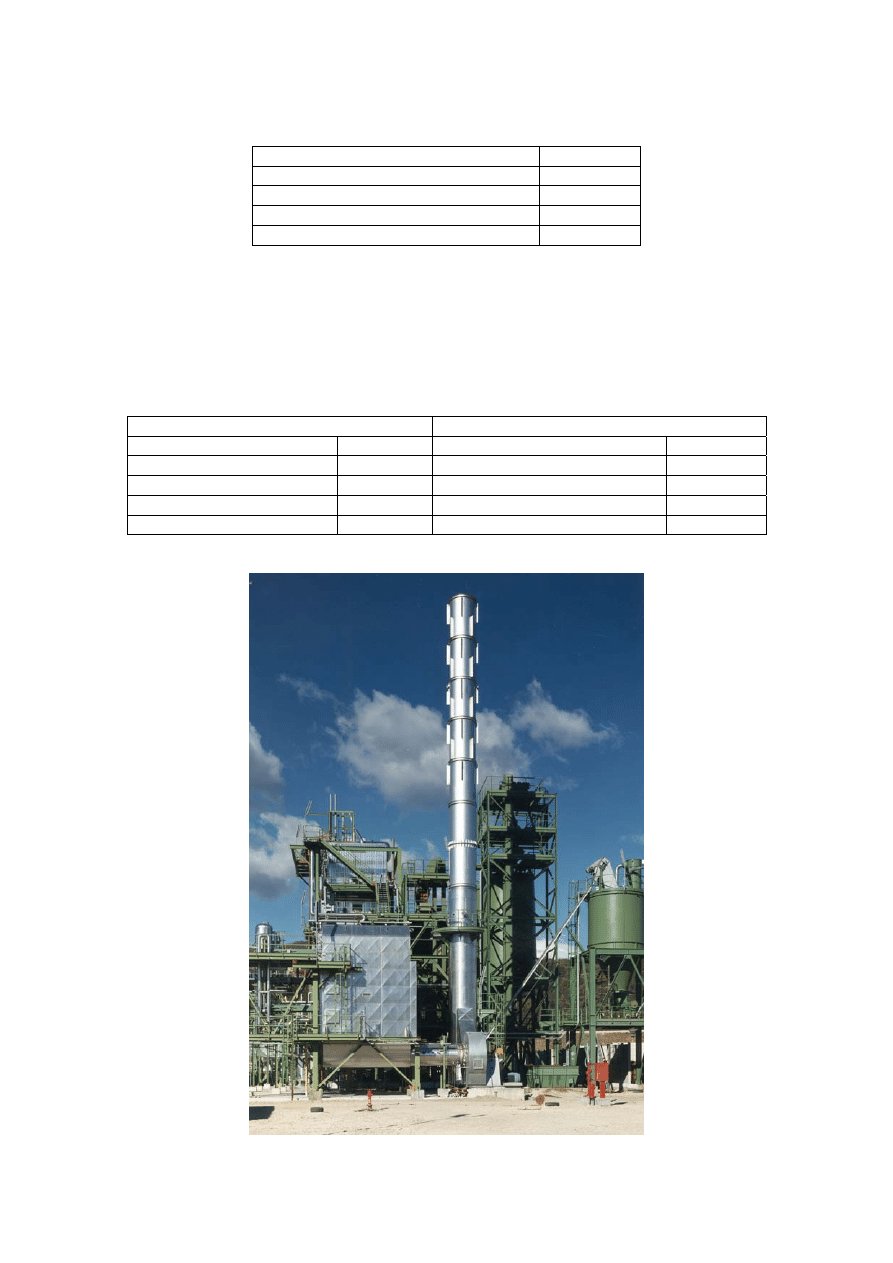
Table 1: Typical blend of the biomass
Type of biomass residue
Weight %
Olive oil residues
10-20
Almond, walnut shells & apricot stones
10-20
Pine seeds shells and cones
10-30
Other wood residues
50-60
The steam data are summarised in table 2. The electricity production, 70,000 MWh/y, is
totally sold to ENEL. The waste heat is available for the customers in the form of warm water
at 40 °C. The plant has an annual consumption of 80,000 t/y of biomass fuels corresponding
to 36,000 Toe saving. The net rated power output is 9.8 MWe. Figure 3 shows a general view
of the plant.
Table 2: Steam data and steam turbine performance
Steam data
Steam turbine
Steam output
43 t/h Steam generation
43 t/h
Steam temperature
505 °C Exhaust steam rate to condenser
38 t/h
Steam pressure
67 Bar a Nominal output power
11,000 kW
Primary fuel consumption
8-10 t/h Total plant efficiency
28-29 %
Boiler efficiency
94.3 % Net power delivery
9,800 MW
Photo 3 : General view of the installation

During the commissioning of the plant several tests were made with various feedstock
mixtures in terms of their quality and of the moisture content. A significant data basis has
been established on operating performance with several feedstocks, their characteristics, the
transport properties as well as their combustion efficiency. This data basis has been used to
improve and optimise the operational status of the plant and to introduce specific and
necessary experience based modifications.
It has been necessary to make equipment modifications and operational adjustments for the
fuel preparation and feeding system, the combustion system and the cooling towers. Before
these modifications the plant was operating at significantly reduced availability of about 50
%. After the modifications were completed the availability was improved to 90 % of the rated
value. The operators plan to reach the 100 % operational capacity by optimisation in several
areas of the plant with emphasis on the feedstock handling, preparation and feeding.
Considering the complicated nature of the feedstocks, these problems are understandable.
This concept can be disseminated in several countries with similar biomass and agricultural
residues especially in the Mediterranean area such as Spain, Portugal, France and Greece.
5. Economic Performance
As the plant has reached its full operational capacity only since 1999, it is not possible to have
sufficient data concerning its economic performance. However, the total amortisation of the
investment is estimated to be completed over the first 8 years of the operation of the plant
during which ENEL will buy the exported electricity at subsidized prices.
In the same period possible additional income may be gained from the sale of waste heat and
the high potassium content ashes which will significantly improve the economic viability of
the plant.
The useful life time of the plant is estimated to 25 years.
6. Project Identifiers
Project: BM/496/93
Owner: ENERGONUT
Srl
Via
Privata
D.
Giustino
3/A
80125 Napoli
Italy
Tel: +39-0865-911028
Fax: + 39-0865-911777
Contractors: SITICEM Spa of Pisa &
BABCOCK ENTERPRISE, Group CNIM-Paris.
Technology: BABCOCK ENTERPRISE
Total Cost: 21,340,000 ECU
EC Support: 2,118,135 ECU
Wyszukiwarka
Podobne podstrony:
Economics of Producing Fuel Pellets From Biomass
SMeyer WO8901464A3 Controlled Process for the Production of Thermal Energy from Gases and Apparatus
Fuel and chemical products from biomass syngas A comparison of gas fermentation to thermochemical co
Techniques to extract bioactive compounds from food by products of plant origin
An analysis of the energy efficiency of winter rapeseed biomass under
Potential applications of renewable energy sources, biomass
An analysis of energy efficiency in the production of oilseed crops
Production of xylan degrading enzymes from Amazon forest fungal
Extracting electrical energy from vacuum by cohesion of charged foliated conductors
Biomass upgrading by torrefaction for the production of biofuels, a review Holandia 2011
Organic pollutants profiling of wood ashes from biomass power plants
~$Production Of Speech Part 2
Morimoto, Iida, Sakagami The role of refections from behind the listener in spatial reflection
Idea of God from Prehistory to the Middle Ages
78 1101 1109 Industrial Production of Tool Steels Using Spray Forming Technology
Manovich, Lev The Engineering of Vision from Constructivism to Computers
GB1008594A process for the production of amines tryptophan tryptamine
Isolation of trimyristin from nutmeg (NMR)
więcej podobnych podstron