
MIND AND MEMORY
TRAINING
BY
ERNEST E. WOOD
FORMER PRINCIPAL OF THE D. G. SIND NATIONAL
COLLEGE, HYDERABAD, SIND
THE THEOSOPHICAL PUBLISHING HOUSE, LTD.,
68 Great Russell Street, W.C.1
ADYAR - MADRAS - INDIA WHEATON - ILL. - U.S.A.

First Edition .
Second Edition .
Reprinted . .
Revised Reprint .
Reprinted . .
Reprinted . .
Reprinted . .
7229 5126 4
1936
1939
1945
1947
1956
1961
1974
PRINTED IN GREAT BRITAIN BY
FLETCHER AND SON LTD, NORWICH

CONTENTS
PAGE
PREFACE V
SECTION I
THE MIND AND ITS MANAGEMENT
CHAP.
I. THE MAGIC BOX 3
II. THE ROADS O F THOUGHT
. . . . 6
III. CONCENTRATION OF MIND . . . .11
IV. AIDS TO CONCENTRATION . . . . 16
SECTION II
IMAGINATION AND ITS USES
V. MENTAL IMAGES 23
VI. FAMILIARIZATION 29
VII. FAMILIARIZATION OF FORMS . . . - 3
9
VIII. FAMILIARIZATION OF WORDS . . . - 5
0
IX. PROJECTION OF THE MEMORY . . . - 5
7
X. SIMPLIFICATION AND SYMBOLIZATION . . 65
SECTION III
THE ART OF THINKING
XI. MODES OF COMPARISON 73
XII. A LOGICAL SERIES. . . . . . 8l
XIII. FOOTSTEPS OF THOUGHT. . . . 89
XIV. THE POWER OF A MOOD . . . . 94
XV. EXPANSION OF IDEAS 1 0
0

viii CONTENTS
SECTION IV
A BAG OF TRICKS
PAGE
X V I . NUMBER ARGUMENTS A N
D DIAGRAMS . . 1 0
5
XVII . NUMBER-WORD
S 11
1
XVIII . PLACING THE MEMORY
.
.
.
.
. 1 2
0
X I X . MEMORY-MEN O
F INDI
A 1 2
8
SECTION V
THE MIND AT WORK
XX. READING AND STUDY
1
37
XXI. WRITING AND SPEECH-MAKING . . . 148
XXII. MORE CONCENTRATION 151
XXIII. MEDITATION 158
SECTION VI
SOME PARTING ADVICE
XXIV. USES OF THE WILL 171
XXV. BODILY AIDS l80
INDEX 187

MIND AND MEMORY
TRAINING
CHAPTER I
THE MAGIC BOX
IMAGINE
yourself to be standing with a party of friends in
some Oriental market-place, or in a palace garden. Enter, a
conjurer with a magic box. The strange man spreads a
square of cloth upon the ground, then reverently places upon
it a coloured box of basket-work, perhaps eight inches
square. He gazes at it steadily, mutters a little, removes the
lid, and takes out of it, one by one, with exquisite care, nine
more boxes, which seem to be of the same size as the original
one, but are of different colours.
You think that the trick is now finished. But no; he opens
one of the new boxes and takes out nine more; he opens the
other eight and takes nine more out of each—all with
Oriental deliberation. And still he has not done; he begins to
open up what we may call the third generation of boxes,
until before long the ground is strewn with piles of them as
far as he can reach. The nine boxes of the first generation
and the eighty-one boxes of the second generation have
disappeared from sight beneath the heaps. You begin to
think that this conjurer is perhaps able to go on for ever—
and then you call a halt, and open your purse right liberally.
I am taking this imaginary conjuring entertainment as a
simile to show what happens in our own minds. Something
in us which is able to observe what goes on in the mind is the
spectator. The field of imagination in the mind itself may
be compared to the spread cloth. Each idea that rises in the
3

4 MIND AND MEMORY TRAINING
mind is like a magic box. Something else in us which is able
to direct the ideas in the mind is the conjurer. Really the
spectator and the conjurer are one "something" which we
are, but I will not now attempt to define that something
because our present object is not to penetrate the deep
mysteries of psychology, but to see what we can do to make
ourselves better conjurers, able to produce our boxes quickly
—more boxes, better boxes, boxes which are exactly of the
kind needed for the business of thinking which at any given
time we may wish to do.
Although all minds work under the same laws, they do so
in different degrees of power and plenty. Some work quickly,
others slowly; some have much to offer, others little. Several
students may be called upon to write an essay on the subject
of cats. Some of them will find their thoughts coming
plentifully forward from the recesses of the mind, while
others will sit chewing the ends of their pens for a long time
before their thoughts begin to flow.
Some minds are brighter than others, and you want yours
to be bright and strong. You want to think of many ideas
and to think them well. You want to think all round any
subject of your consideration, not only on one side of it, as
prejudiced or timid thinkers do.
While you are making the mind bright, however, care
must be taken to avoid the danger that besets brilliant
minds everywhere. The quick thinker who is about to write
upon some social subject, such as that of prison reform or
education, will find thoughts rapidly rising in his mind, and
very often he will be carried away by some of the first that
come, and he will follow them up and write brilliantly along
the lines of thought to which they lead. But probably he
will miss something of great importance to the understanding
of the matter, because he has left the central subject of
thought before he has considered it from every point of view.
As an example of this, a chess player, captivated by some

5
THE MAGIC BOX
daring plan of his own, will sometimes forget to look to his
defences, and will find himself the subject of sudden disaster.
Sometimes a duller mind, or at any rate a slower one, will
be more balanced and will at last come nearer to the truth.
So, while you do want a quick mind, not one that is hard
to warm up like a cheap motor-car engine on a cold winter's
morning, you do not want one that will start with a leap
and run away with you, but one that will dwell long enough
on a chosen subject to see it from every point of view, before
it begins the varied explorations of thought in connexion
with it that it should make upon different lines.
If I follow up the analogy of an engine, we require three
things for the good working of our mental machinery—
cleaning, lubrication, and control.

CHAPTER II
THE ROADS OF THOUGHT
Control of the subject-matter and the direction of move
ment of our thought is often called concentration. Let us
try a preliminary experiment to see exactly what this
means.
Sit down in some quiet place by yourself, and set before
the mind an idea of some common object. Watch it carefully
and you will soon find that it contains many other ideas,
which can be taken out and made to stand around it—or
perhaps you will find that they leap out incontinently and
begin to play about.
Let us suppose that I think of a silver coin. What do I
find on looking into this box? I see an Indian rupee, a
British shilling, an American "quarter." I see coins round
and square, fluted and filleted, small and large, thick and thin.
I see a silver mine in Bolivia and a shop in Shanghai where I
changed some silver dollars. I see the mint in Bombay
(which I once visited) where coins of India are made; I see
the strips of metal going through the machines, the discs
punched out, the holes remaining.
Enough, I must call a halt, lest this fascinating conjurer
go on for ever. That he could not do, however, but if I permit
him he will open many thousands of boxes before he exhausts
his powers. He will soon come to the end of the possibilities
of the first box, but then he can open the others which he has
taken from it.
It is the peculiarity to some minds—of the wandering and
unsteady kind—to open another box before they have taken
everything out of the first. That is not concentration, but
mind-wandering. Concentration on an idea means that you
will completely empty one box before you turn away from
6

7
THE ROADS OF THOUGHT
it to open another. The value of such practice is that it
brightens up the mind and makes it bring forth ideas on a
chosen subject quickly and in abundance.
There is a reason why a given box should become ex
hausted. It is that the ideas which come out of it do not do
so at random but according to definite laws; they are chained
to it, as it were, and only certain kinds can come out of a
certain kind of box.
Suppose, for example, someone mentions the word
"elephant" in your hearing. You may think of particular
parts of the animal, such as its large ears or its peculiar
trunk. You may think of its intelligence and its philosophical
temperament, or of particular elephants that you have seen
or read about. You may think of similar animals, such as
the hippopotamus or the rhinoceros, or of the countries
from which elephants come. But there are certain things
you are not likely to think of, such as a house-fly, or a paper-
knife, or a motor-boat.
There are certain definite laws which hold ideas together
in the mind, just as gravitation, magnetism, cohesion and
similar laws hold together material objects in the physical
world.
For the purpose of this prelim nary experiment I will give
a list of the four main Roads of Thought. Notice, first, that
among your thoughts about an elephant there will be images
of things that resemble it very closely, that is, of other
animals, such as a cow, a horse, or a camel. The first law,
of attraction between ideas is to be seen in this. "Ideas of
similar things cling closely together, and easily suggest one
another. We will call this first principle the law of Class. It
includes the relations between an object and the class to
which it belongs, and also that between objects of the same
class.
The second is the law of Parts. When you think of an
elephant you will probably form special mental pictures of

8 MIND AND MEMORY TRAINING
its trunk, or ears, or feet, or when you think of its ears you
may also think of other parts of it, such as the eyes.
The third law may be called Quality. It expresses the
relation between an object and its quality, and also between
objects having the same quality. Thus one may think of
the cat as an artist, of the moon as spherical, etc., or if one
thinks of the moon, one may also think of a large silver coin,
because they have the quality of white, disc-like appearance
in common.
The fourth law involves no such observation of the resem
blances and differences of things, or an object and the class
to which it belongs, or a whole and its parts, or an object
and its prominent qualities. It is concerned with striking
and familiar experiences of our own, and has more to do
with imagination than logical observation.
If 1 have seen or thought of two things strongly or fre
quently together, the force of their joint impact on my con
sciousness will tend to give them permanent association in
my mind. I therefore entitle the fourth principle the law of
Proximity. "
Thus, for example, if I think of a pen I shall probably
think also of an inkpot, not of a tin of axle-grease. If I
think of a bed I shall think of sleep, not of dancing. If I
think of Brazil, I shall think of coffee and the marvellous
river Amazon, not of rice and the Himalaya mountains.
Each one of us has an independent fund of experience
made up of memories of such relationships seen, or heard of,
or thought about, either vividly or repeatedly.
Within this law comes also familiar sequence, or con
tiguous succession, often popularly called cause and effect,
as in exercise and health, over-eating and indigestion, war
and poverty. It is proximity in time.
In connexion with Road I, I must mention a case which is
often misunderstood—namely contrast. If two things con
trast they must belong to the same class. You cannot

9
THE ROADS OF THOUGHT
contrast a cow with blotting paper, or a walking stick with
the square root of two. But you can contrast an elephant
and a mouse, blotting paper and glazed paper, the sun and
the moon, and other such pairs. So contrasts belong to
Road I.
The four Roads of Thought mentioned above are given
in a general way for our present purpose. For greater pre
cision of statement the four laws must be subdivided; I will
do this in a later chapter.
I wish the student particularly to notice that some ideas
arise through the mind's capacity for comparison, that is
through a logical faculty, while others arise simply in
imagination, without any reason other than that they have
been impressed upon it at some previous time. Comparison
covers the first three laws, imagination the fourth only.
To convince the student that these mental bonds between
ideas really exist, let me ask him to try another small pre
liminary experiment, this time not upon his own mind, but
upon that of a friend. Repeat to your friend two or three
times slowly the following list of sixteen words. Ask him to
pay particular attention to them, in order—
Moon, dairy, head, paper, roof, milk, fame, eyes, white,
reading, shed, glory, cat, top, sun, book.
You will find that he is not able to repeat them to you from
memory.
Then take the following series and read them to him
equally carefully.
Cat, milk, dairy, shed, roof, top, head, eyes, reading, book,
paper, white, moon, sun, glory, fame.
Now ask your friend to repeat the list, and you will find
that he has a most agreeable feeling of surprise at the ease
with which he can perform this little feat.
Now the question is: why in the first place was he not able
to recall the series of ideas, while in the second case he could
easily remember them, the words being exactly the same in

10
MIND AND MEMORY TRAINING
both the sets ? The reason is that in the second series the
ideas are in rational order, that is, each idea is connected
with that which preceded it by one of the four Roads of
Thought which I have mentioned. In the first series they were
not so connected.
I must remark that the deliberate use of these Roads of
Thought involves nothing forced or unnatural. It is usual
for our attention to go along them, as I have already indi
cated. For instance, I knew a lady in New York named
Mrs. Welton. One day when I was thinking of her, I found
myself humming the tune of "Annie Laurie." Somewhat
surprised, I asked myself why, and brought to light the first
line of the song, which goes: "Maxwellton's braes are
bonny. . . ."

CHAPTER III
CONCENTRATION OF MIND
MANY
years ago I invented another simple experiment to
help some of my students to gain that control of mind which
is called concentration. This has proved itself, I think, to be
the very best means to that end. Let me ask the reader or
student now to try this experiment for himself in the
following form—
Select a quiet place, where you can be undisturbed for
about fifteen minutes. Sit down quietly and turn your
thought to some simple and agreeable subject, such as a coin,
a cup of tea, or a flower. Try to keep this object before the
mind's eye.
After a few minutes, if not sooner, you will, as it were,
suddenly awake to the realization that you are thinking
about something quite different. The reasons for this are
two: the mind is restless, and it responds very readily to
every slight disturbance from outside or in the body, so that
it leaves the subject of concentration and gives its attention
to something else.
Now, the way which is usually recommended for the
gaining of greater concentration of mind, so that one can
keep one's attention on one thing for a considerable time, is
to sit down and repeatedly force the mind back to the
original subject whenever it wanders away. That is not,
however, the best way to attain concentration, but is, in
fact, harmful rather than beneficial to the mind.
The proper way is to decide upon the thing on which your
attention is to be fixed, and then think about everything else you
can without actually losing sight of it. This will form a habit of
recall in the mind itself, so that its tendency will be to return
to the chosen object whenever it is for a moment diverted.

12 MIND AND MEMORY TRAINING
Still, it will be best of all if, in trying to think of other
things while you keep the chosen object in the centre of
your field of attention, you do so with the help of the four
Roads of Thought, in the following manner—
Suppose you decide to concentrate upon a cow. You must
think of everything else that you can without losing sight of
the cow. That is, you must think of everything that you
can that is connected with the idea of a cow by any of the
four lines of thought which have been already explained.
So, close your eyes and imagine a cow, and say: "Law I
—Class," and think: "A cow is an animal, a quadruped, a
mammal"—there may be other classes as well—"and other
members of its classes are sheep, horse, dog, cat— " and so
on, until you have brought out all the thoughts you can from
within your own mind in this connexion. Do not be satisfied
until you have brought out every possible thought.
We know things by comparing them with others, by
noting, however briefly, their resemblances and differences.
When we define a thing we mention its class, and then the
characters in which it differs from other members of the
same class. Thus a chair is a table with a difference, and a
table is a chair with a difference; both are articles of
furniture; both are supports.
The more things we compare a given object with in this
way the better we know it; so, when you have worked
through this exercise with the first law and looked at all the
other creatures for a moment each without losing sight of
the cow, you have made brief comparisons which have im
proved your observation of the cow. You will then know
what a cow is as you never did before.
Then go on to the second Road of Thought—that of
Parts—and think distinctly of the parts of the cow—its eyes,
nose, ears, knees, hoofs, and the rest, and its inner parts as
well if you are at all acquainted with animal anatomy and
physiology.

13
CONCENTRATION OF MIND
Thirdly comes the law of Quality. You think of the
physical qualities of the cow—its size, weight, colour, form,
motion, habits—and also of its mental and emotional
qualities, as far as those can be discerned. And you think of
other objects having the same prominent qualities.
Lastly comes the fourth division, that of Proximity, in
which you will review "Cows I have known," experiences
you have had with cows which may have impressed them
selves particularly on your imagination. In this class also
will come things commonly connected with cows, such as
milk, butter, cheese, farms, meadows, and even knife
handles made of horn and bone, and shoes made of
leather.
Then you will have brought forth every thought of which
you are capable which is directly connected in your own mind
with the idea of a cow. And this should not have been done
in any careless or desultory fashion; you should be able to
feel at the end of the exercise that you have thoroughly
searched for every possible idea on each line, while all the
time the cow stood there and attention was not taken away
from it.
A hundred times the mind will have been tempted to
follow up some interesting thought with reference to the
ideas which you have been bringing out, but every time it
has been turned back to the central object, the cow.
If this practice is thoroughly carried out it produces a
habit of recall which replaces the old habit of wandering, so
that it becomes the inclination of the mind to return to the
central thought, and you acquire the power to keep your
attention upon one thing for a long time.
You will soon find that this practice has not only given
you power of concentration, but has brought benefit to the
mind in a variety of other ways as well. You will have
trained it to some extent in correct and consecutive think
ing, and in observation, and you will have organized some

14 MIND AND MEMORY TRAINING
of that accumulation of knowledge which perhaps you have
for years been pitching pell-mell into the mind, as most
people do. This exercise, practised for a little time every day
for a few weeks, exactly according to instructions, will tidy
or clean up the mind, and also lubricate it, so as to make it
far brighter than it was before, and give it strength and
quality evident not only at the time of exercise, but at all
times, whatever may be the business of thought on which
you are engaged during the day.
One of the most fruitful results will be found in the
development of keen observation. Most people's ideas about
anything are exceedingly imperfect. In their mental pic
tures of things some points are clear, others are vague, and
others lacking altogether, to such an extent that sometimes
a fragment of a thing stands in the mind as a kind of symbol
for the whole.
A gentleman was once asked about a lady whom he had
known very well for many years. The question was as to
whether her hair was fair or dark, and he could not say. In
thinking of her his mind had pictured certain parts only,
or certain part vaguely and others clearly. Perhaps he knew
the shape of her nose, her general build and the carriage of
her body; but his mental picture certainly had no colour in
the hair.
The same truth may be brought out by the familiar
question about the figures on the dial of your friend's watch,
or about the shape and colour of its hands. One day I tested
a friend with this question: "Can you tell me whether the
numerals on your watch are the old-fashioned Roman ones
which are so much used, or the common or Arabic numerals
which have come into vogue more recently ?"
"Why!" he replied, without hesitation. "They are the
Roman numerals, of course."
Then he took out his watch, not to confirm his statement,
but just in an automatic sort of way, as people do when

15
CONCENTRATION OF MIND
thinking of such a thing, and as he glanced at it a look of
astonishment spread over his face.
"By Jove," he exclaimed, "they are the Arabic figures.
And do you know, I have been using this watch for seven
years, and I have never noticed that before !"
He thought he knew his watch, but he was thinking of
part of it, and the part was standing in his mind for the whole.
Then I put another question to him: "I suppose you know
how to walk, and how to run ?"
"Yes," said he, "I certainly do."
"And you can imagine yourself doing those things ?"
"Yes."
"Well, then," said I, "please tell me what is the difference
between running and walking."
He puzzled over this question for a long time, for he saw
that it was not merely a difference of speed. He walked up
and down the room, and then ran round it, observing him
self closely. At last he sat down, laughing, and said: " I have
it. When you walk you always have at least one foot on the
ground, but when you run both feet are in the air at the
same time."
His answer was right, but he had never known it before.
Life is full of inaccuracies due to defective observation,
like that of the schoolboy who, confronted with a question
about the Vatican, wrote: "The Vatican is a place with no
air in it, where the Pope lives."

CHAPTER IV
AIDS TO CONCENTRATION
LET me now give some hints which will make a great
improvement in the practice of concentration.
Many people fail in concentration because they make the
mistake of trying to grasp the mental image firmly. Do not
do that. Place the chosen idea before your attention and
look at it calmly, as you would look at your watch to see the
time. Such gentle looking reveals the details of a thing quite
as well as any intense effort could possibly do—perhaps even
better.
Try it now, for five minutes, for when once you have
realized how to look a thing over and see it completely—in
whole and in part, without staring, peering, frowning, holding
the breath, clenching the fists, or any such action, you can
apply your power to the mental practice of concentration.
Pick up any common object—a watch, a pen, a book, a leaf,
a fruit, and look at it calmly for five minutes. Observe every
detail that you can about it, as to the colour, weight, size,
texture, form, composition, construction, ornamentation,
and the rest, without any tension whatever. Attention
without tension is what you want.
After you have felt how to do this, you will understand
how concentration can be carried on in perfect quietude. If
you wanted to hold out a small object at arm's length for as
long a time as possible, you would hold it with a minimum
of energy, letting it rest in the hand, not gripping it tightly.
Do not imagine that the idea that you have chosen for
your concentration has some life and will of its own, and that
it wants to jump about or to run away from you. It is not
the object that is fickle, but the mind. Trust the object to
remain where you have put it, before the mind's eye, and
16

17
AIDS TO CONCENTRATION
keep your attention poised upon it. No grasping is necessary;
indeed, that tends to destroy the concentration.
People usually employ their mental energy only in the
service of the body, and in thinking in connexion with it.
They find that the mental flow is unobstructed and that
thinking is easy when there is a physical object to hold the
attention, as, for example, in reading a book. Argumenta
tion is easy when each step is fixed in print or writing, or the
thought is stimulated by conversation. Similarly, a game of
chess is easy to play when we see the board; but to play it
blindfold is a more difficult matter.
The habit of thinking only in association with bodily
activity and stimulus is generally so great that a special
effort of thought is usually accompanied by wrinkling of the
brows, tightening of the lips, and various muscular, nervous
and functional disorders. The dyspepsia of scientific men and
philosophers is almost proverbial. A child when learning
anything displays the most astonishing contortions. When
trying to write it often follows the movements of its hands
with its tongue, grasps its pencil very tightly, twists its feet
round the legs of its chair, and so makes itself tired in a
very short time.
All such things must be stopped in the practice of con
centration. A high degree of mental effort is positively in
jurious to the body unless this stoppage is at least partially
accomplished. Muscular and nervous tension have nothing
to do with concentration, and success in the exercise is not
to be measured by any bodily sensation or feeling whatever.
Some people think that they are concentrating when they
feel a tightness between and behind the eyebrows; but
they are only producing headaches and other troubles for
themselves by encouraging the feeling. It is almost a
proverb in India that the sage or great thinker has a
smooth brow. To screw the face out of shape, and cover
the forehead with lines, is usually a sign that the man is

l8 MIND AND MEMORY TRAINING
trying to think beyond his strength, or when he is not
accustomed to it.
Attention without tension is what is required. Concentra
tion must be practised always without the slightest strain.
Control of mind is not brought about by fervid effort of any
kind, any more than a handful of water can be held by a
violent grasp, but it is brought about by constant, quiet,
calm practice and avoidance of all agitation and excitement.
Constant, quiet, calm practice means regular periodical
practice continued for sufficient time to be effective. The
results of this practice are cumulative. Little appears at the
beginning, but much later on. The time given at any one
sitting need not be great, for the quality of the work is more
important than the quantity. Little and frequently is better
than much and rarely. The sittings may be once or twice a
day, or even three times if they are short. Once, done well,
will bring about rapid progress; three times, done indiffer
ently, will not. Sometimes the people who have the most
time to spare succeed the least, because they feel that they
have plenty of time and therefore they are not compelled
to do their very best immediately; but the man who has only
a short time available for his practice feels the need of doing
it to perfection.
The exercise should be done at least once every day, and
always before relaxation and pleasure, not afterwards. It
should be done as early in the day as is practicable, not
postponed until easier and more pleasurable duties have
been fulfilled. Some strictness of rule is necessary, and this
is best imposed by ourselves upon ourselves.
Confidence in oneself is also a great help to success in
concentration, especially when it is allied to some knowledge
of the way in which thoughts work, and of the fact that they
often exist even when they are out of sight. Just as the
working of the hands and feet and eyes, and every other part
of the physical body, depends upon inner organs of the body

AIDS TO CONCENTRATION
19
upon whose functioning we may completely rely, so do all the
activities of thought that are visible to our consciousness
depend upon unseen mental workings which are utterly
dependable.
Every part of the mind's activity is improved by confi
dence. A good memory, for example, rests almost entirely
upon it; the least uncertainty can shake it very much indeed.
I remember as a small boy having been sent by my mother,
on some emergency occasion, to purchase some little thing
from a small country grocery about half a mile away from
our house. She gave me a coin and told me the name of the
article which she wanted. I had no confidence in the tailor's
art, and certainly would not trust that coin to my pocket.
I could not believe, in such an important matter, that the
object would still be in the pocket at the end of the journey,
so I held the coin very tightly in my hand so as to feel it all
the time. 1 also went along the road repeating the name of
the article, feeling that if it slipped out of my consciousness
for a moment it would be entirely lost. I had less confidence
in the pockets of my mind than the little which I had in
those made by my tailor. Yet despite my efforts, or more
probably on account of them, on entering the little shop and
seeing the big shopman looming up above me in a great mass,
I did have a paralytic moment in which I could not remember
what it was that I had to get.
This is not an uncommon thing, even among adults. I
have known many students who seriously jeopardized their
success in examinations by exactly the same sort of anxiety.
But if one wants to remember it is best to make the fact or
idea quite clear mentally, then look at it with calm con
centration for a few seconds, and then let it sink out of sight
into the depths of the mind, without fear of losing it. You
may then be quite sure that you can recall it with perfect
ease when you wish to do so.
This confidence, together with the method of calm looking,

20 MIND AND MEMORY TRAINING
will bring about a mood of concentration which can be
likened to that which you gain when you learn to swim. It
may be that one has entered the water many times, that one
has grasped it fiercely with the hands and sometimes also
with the mouth, only to sink again and again; but there
comes an unexpected moment when you suddenly find your
self at home in the water. Thenceforward, whenever you
are about to enter the water you almost unconsciously put
on a kind of mood for swimming, and that acts upon the
body so as to give it the right poise and whatever else may be
required for swimming and floating. So in the matter of
concentration a day will come, if it has not already done so,
when you will find that you have acquired the mood of it,
and after that you can dwell on a chosen object of thought
for as long as you please.

NOTES

CHAPTER V
MENTAL IMAGES
IMAGINATION
is that operation of the mind which makes
mental images or pictures. Sometimes these are called also
"thoughts," or again, "ideas." But thought is, properly
understood, a process, that is, a movement of the mind.
Thought is dynamic, but a thought or idea is static, like a
picture.
In order that the process of thinking may take place, there
must be thoughts or ideas or mental images for it to work
with, and it is at its best when these are clear and strong.
So we take up as the second part of our study the means by
which our imagination may be improved. We are all apt to
live in a colourless mental world, in which we allow words to
replace ideas. This must be remedied if our minds are to
work really well and give us a colourful existence.
But first let us examine our thinking. In it our attention
moves on from one thought to another—or rather from one
group of thoughts to another group of thoughts, since most
of our images are complex. The dynamic thinking makes
use of the static thoughts, just as in walking there are spots
of firm ground on which the feet alternately come to rest.
You cannot walk in mid-air. In both cases the dynamic
needs the static. In walking you put a foot down and rest
it on the ground. Then you swing your body along, with that
foot as a point of application for the forces of the body against
the earth. At the end of the movement you bring down the
other foot to a new spot on the ground. In the next move
ment you relieve the first foot and poise the body on the
other as a new pivot, and so on. Thus transition and poise"
alternate in walking, and they do the same in thought.
Suppose I think: "The cat chases the mouse, and the
23

24 MIND AND MEMORY TRAINING
mouse is fond of cheese, and cheese is obtained from the
dairy, and the dairy stands among the trees." There is no
connexion between the cat and the trees, but I have moved
in thought from the cat to the trees by the stepping stones
of mouse, cheese and dairy.
Now that we see clearly the distinction between ideas and
thinking, let us turn, in this second part of our study, to the
business of developing the power of imagination.
We shall begin our course by a series of exercises intended
to train the mind to form, with ease and rapidity, full and
vivid mental pictures, or idea-images.
When a concrete object is known, it is reproduced within
the mind, which is the instrument of knowledge; and the
more nearly the image approximates to the object, the truer
is the knowledge that it presents. In practice, such an image
is generally rather vague and often somewhat distorted.
For our purpose we will divide idea-images into four
varieties; simple concrete, complex concrete, simple abstract,
and complex abstract.
Simple concrete ideas are mental reproductions of the
ordinary small objects of life, such as an orange, a pen, a cow,
a book, a hat, a chair, and all the simple sensations of sound,
form, colour, weight, temperature, taste, smell, and feeling.
Complex concrete ideas are largely multiples of simple
ones, or associations of a variety of them such as a town, a
family, a garden, ants, sand, provisions, furniture, clothing,
Australasia.
Simple abstract ideas are those which belong to a variety
of concrete ideas, but do not denote any one of them in
particular, such as colour, weight, mass, temperature, health,
position, magnitude, number.
Complex abstract ideas are combinations of simple ones,
such as majesty, splendour, benevolence, fate.
The difference between simple and complex ideas is one
of degree, not of kind. What is simple to one person may

25
MENTAL IMAGES
appear complex to another. A man with a strong imagina
tion is able to grip a complex idea as easily as another may
hold a simpler one.
A good exercise in this connexion is to practise repro
ducing simple concrete objects in the mind. This should be
done with each sense in turn. If a student has been observing
flowers, for example, he should practise until he can, in
imagination, seem to see and smell a flower with his eyes
closed and the object absent, or at least until he has an
idea of the flower sufficiently real and complete to carry with
it the consciousness of its odour as well as its colour and form.
He may close his eyes, fix his attention on the olfactory organ,
and reproduce the odour of the flower by an effort of will.
Simply to name an object and remember it by its name does
not develop the faculty of imagination.
I will now give a few specific exercises along these lines—
EXERCISE 1.
Obtain a number of prints or drawings of
simple geometrical figures. Take one of these—say a five-
pointed star—look at it carefully, close the eyes, and imagine
its form and size. When the image is clear, proportionate
and steady in the imagination, look at the drawing again
and note any differences between it and the original. Once
more close the eyes and make the image, and repeat the
process until you are satisfied that you can imagine the form
accurately and strongly. Repeat the practice with other
forms, gradually increasing in complexity.
EXERCISE
2. Repeat the foregoing practice, but use
simple objects, such as a coin, a key, or a pen. Try to
imagine them also from both sides at once.
EXERCISE
3. Obtain a number of coloured surfaces; the
covers of books will do. Observe a colour attentively; then
try to imagine it. Repeat the process with different colours
and shades.
EXERCISE
4. Listen intently to a particular sound. Re
produce it within the mind. Repeat the experiment with

26 MIND AND MEMORY TRAINING
different sounds and notes, until you can call them up faith
fully in imagination. Try to hear them in your ears.
EXERCISE
5. Touch various objects, rough, smooth,
metallic, etc., with the hands, forehead, cheek and other
parts of the body. Observe the sensations carefully and re
produce them exactly. Repeat this with hot and cold things,
and also with the sensations of weight derived from objects
held in the hands.
EXERCISE
6. Close your eyes and imagine yourself to be
in a small theatre, sitting in the auditorium and facing the
proscenium, which should be like a room, barely furnished
with perhaps a clock and a picture on the wall, and a table
in the centre. Now select some simple and familiar object,
such as a vase of flowers. Picture it in imagination as stand
ing on the table. Note particularly its size, shape, and colour.
Then imagine that you are moving forward, walking to the
proscenium, mounting the steps, approaching the table,
feeling the surface of the vase, lifting it, smelling the flowers,
listening to the ticking of the clock, etc.
Get every possible sensation out of the process, and try
not to think in words, nor to name the things or the sensa
tions. Each thing is a bundle of sensations, and imagination
will enable the mind to realize it as such.
It may be necessary for some students at first to prompt
their thought by words. In this case, questions about the
objects may be asked, in words, but should be answered in
images. Each point should be dealt with deliberately, with
out hurry, but not lazily, and quite decisively. The thought
should not be lumpy ore but pure metal, clean-cut to shape.
A table of questions may be drawn up by the experimenter
somewhat on the following plan: As regards sight, what is
the outline, form, shape, colour, size, quantity, position, and
motion of the object ? As regards sound, is it soft or loud,
high or low in pitch, and what is its timbre? As regards
feeling, is it rough, smooth, hard, soft, hot, cold, heavy,

27
MENTAL IMAGES
light? As regards taste and smell, is it salty, sweet, sour,
pungent, acid? And finally, among these qualities of the
object, which are the most prominent ?
The value of the proscenium is that it enables you to get
the object by itself, isolated from many other things, and the
simple pretext of stepping into the proscenium is a wonderful
aid to the concentration necessary for successful imagination.
After this practice has been followed it will be found to be
an easy matter, when reading or thinking about things, or
learning them, to tick them off mentally by definite images,
or, in other words, to arrest the attention upon each thing in
turn and only one at a time. If you are reading a story, you
should seem to see the lady or gentleman emerge from the
door, walk down the steps, cross the pavement, enter the
motor car, etc., as in a moving picture. The process may seem
to be a slow one when a description of it is read, but it be
comes quite rapid after a little practice.
It will always help in the practice of concentration or
imagination if you take care to make your mental images
natural and to put them in natural situations.
Do not take an object such as a statuette and imagine it
as poised in the air before you. In that position there will
be a subconscious tendency for you to feel the necessity of
holding it in place. Rather imagine that it is standing on a
table in front of you, and that the table is in its natural
position in the room (as in the experiment with flowers in a
vase on the table in the proscenium already mentioned).
Launch yourself gently into your concentration by first
imagining all the portion of the room which would be
normally within range of your vision in front of you; then
pay less attention to the outermost things and close in upon
the table bearing the statuette. Finally close in still more
until only the little image on the table is left and you have
forgotten the rest of the room.
Even then, if the other things should come back into your

28 MIND AND MEMORY TRAINING
thought do not be troubled about them. You cannot cut
off an image in your imagination as with a knife. There will
always be a fringe of other things around it, but they will be
faint and out of focus.
Just as when you focus your eye on a physical object the
other things in the room are visible in a vague way, so when
you focus your mental eye upon the statuette other pictures
may arise in its vicinity. But as long as the statuette occu
pies the centre of your attention and enjoys the full focus
of your mental vision, you need not trouble about the other
thoughts that come in. With regard to them you will do
best to employ the simple formula: " I don't care."
If you permit yourself to be troubled by them, they will
displace the statuette in the centre of the stage, because you
will give attention to them; but if you see them casually,
and without moving your eyes from the statuette say: " Oh,
are you there ? All right, stay there if you like, go if you like;
I don't care," they will quietly disappear when you are not
looking. Do not try to watch their departure. You cannot
have the satisfaction of seeing them go, any more than you
can have the pleasure of watching yourself go to sleep. But
why should you want it ?
Make your object of imagination fully natural by invest
ing it with all its usual qualities. If it is a solid thing, make
it solid in your imagination, not flat like a picture. If it is
coloured, let the colour shine. Be sensible of its weight as
you would if you were actually looking at a physical object.
Things that are naturally still should appear positively still
in your image, and moving things definitely moving—such
as trees whose leaves and branches may be shaking and
rustling in the wind, or as fishes swimming, or birds flying,
or persons walking and talking, or a river running along with
pleasant tinkling sounds and glancing lights.
CHAPTER VI
FAMILIARIZATION
So far we have contented ourselves with simple exercises
of the imagination. Let us now see what part imagination
plays and can play in the grasping and remembering of ideas
which are new to us.
Suppose that we have to learn the letters of a foreign
alphabet, the appearances and names of plants, minerals or
persons, the outlines or forms of countries, or other such
things, which are new to us. It is exceedingly difficult to
remember these unfamiliar things, unless we first make them
familiar with the aid of imagination.
In this part of my subject I will follow the excellent
teaching of a certain Major Beniowski, who expounded
the art of familiarization a century ago. He pointed out
that to himself the notion "table" was very familiar,
meaning that it had been well or frequently impressed
upon his mind and he knew a great many properties and
circumstances relating to a table. The notion "elephant,"
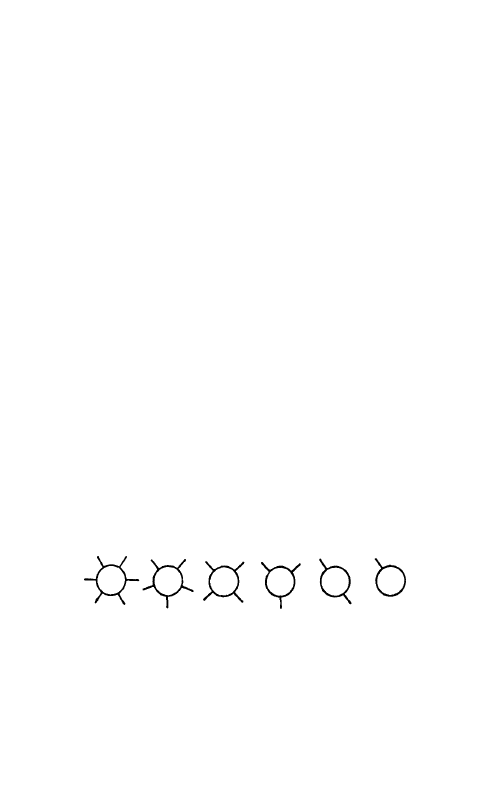
he said, was less familiar. He indicated the familiarity of
different things in six degrees, according to the following
symbols—
The idea or mental image is represented by the circle, and
its degree of familiarity, which will, of course, vary with
different persons, according to their various experience, is
indicated by the number of radiating lines
Major Beniowski proceeded to give examples from his
own mind, conveying the idea of the comparative degree of
29
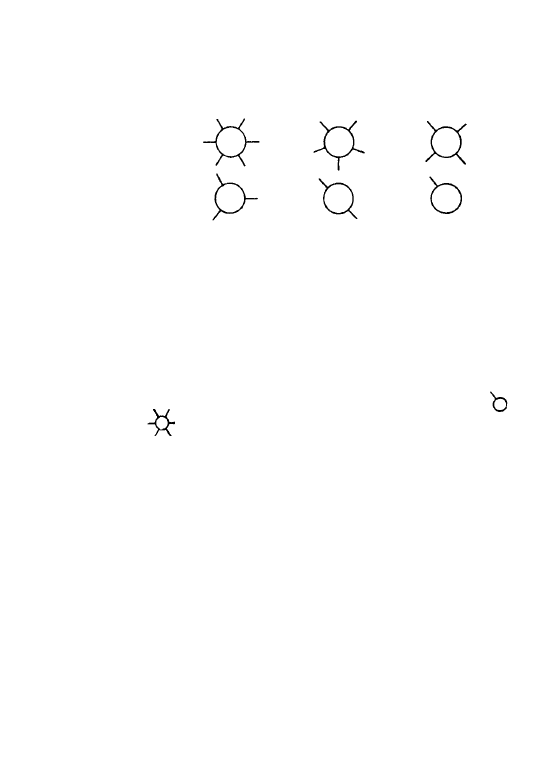
30 MIND AND MEMORY TRAINING
his familiarity with table, ink, lion, zodiac, elephant, and
chicholo as follows—
Table:
Ink:
Lion:
Elephant:
Chicholo:
.Zodiac:
The diagram indicated that a table was to him an object of
the highest familiarity, ink an object of less familiarity, and so
on through the examples of a lion, the zodiac and an elephant,
to a chicholo, which was an object of the greatest un
familiarity.
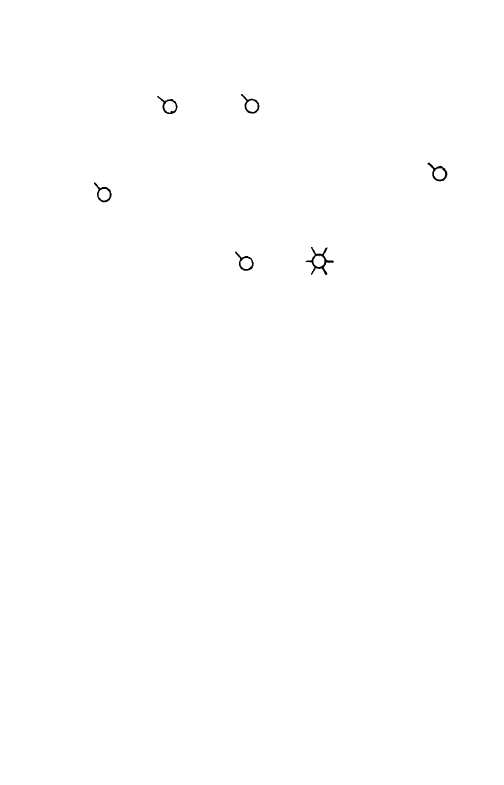
Though we may note these degrees of familiarity, for
practical purposes of learning and remembering it will be
sufficient to employ two. Our aim in learning something—
and our first step in remembering it—will be to convert a
into a . I
n practice we generally find that two things
have to be remembered together. There is no adding of
something to nothing in the mind; the newly acquired
notion has to be put beside or added to something already
known.
The learning of foreign alphabets or the names of plants,
or other such things, involves the association of two things
in the mind so that they will recur together in memory.
Thus, if I am learning the Greek alphabet and I come across
the sign π and am told that it represents the sound "pi, "
my learning of this fact consists in my remembering together
the unfamiliar form π and the familiar sound "pi. " I have to
associate an unfamiliar with a familiar. Really all learning
consists in associating something previously unknown with
something previously known.
From these considerations Major Beniowski formulated
what he called the three phrenotypic problems, namely—

31
FAMILIARIZATION
(1) To associate a familiar with a familiar, as, for example,
lamp with dog, or man with river.
(2) To associate a familiar with an unfamiliar, as, cow
with obelus, or green leaf with chlorophyll.
(3) To associate an unfamiliar with an unfamiliar, as,
pomelo with amra, or scutage with perianth.
Let me here quote Major Beniowski's excellent illus
tration—
"Suppose a London publisher, who being for many years
a constant reader of the newspapers, cannot fail of becoming
familiar with the names of the leading members of the House
of Commons. He knows about the biography, literary pro
ductions, and political principles of Dr. Bowring, Sir Robert
Peel, Lord Melbourne, etc., as much as any man living.
"Suppose also, that having on many occasions seen these
personages themselves, as at chapel, the opera, museum,
etc., he has their physiognomies, their gait, etc., perfectly
impressed upon his brain.
"Suppose moreover that they are his occasional cus
tomers, although he never knew who these customers were;
he never in the least suspected that these customers are the
very individuals whose speeches he was just anatomizing, and
whose political conduct he was just praising or deprecating.
" He knows well their names; he knows a host of circum
stances connected with these names; he knows well the
personages themselves; he saw them, he conversed with them,
he dealt with them; still he had never an opportunity of
learning that such names had anything to do with such
personages.
"A visit to the gallery of the House of Commons during
the debate on the (say) libel question, is the occasion on
which those names and their owners are for the first time to
come into contact with each other in his brain. The Speaker,
one of his customers, takes the chair, and immediately our
publisher bursts into an ' Is it possible!'

32 MIND AND MEMORY TRAINING
"He can scarcely believe it, that the gentleman whom he
had seen so often before was the very Speaker of the House
of Commons, whose name and person he knew separately
for so many years.
"His surprise increases by seeing Dr. Bowring, Sir Robert
Peel, Lord Melbourne, etc., addressing the House.
"He knew them all—he had seen all three in his own shop
—he had conversed with them—nay, had made serious
allusions to their names when present.
" He is now determined to commit to memory the names
of all those personages; in other words, he is determined to
stick together the names with their respective personages.
"Next to him sat a Colonial publisher just arrived say,
from Quebec. This colonial gentleman is perfectly familiar
with the names of the above M.P.'s; but he indeed never
saw any of them.
"He also attempts to commit to memory the names of
various speakers on the occasion.
" I n another corner of the same House sat a Chinese,
just arrived in London, who also wishes to commit to
memory the names, shapes, gait, dresses, etc., of the Bar
barians that spoke and legislated in his presence.
"The Londoner, the colonial gentleman, and the Chinese
have evidently the same piece of knowledge to heave into
their brain; but for the Londoner it is the first phrenotypic
problem; he has to stick together a name which is to him a
familiar notion with a personage which is for him a familiar
notion also—thus, a with a
"For the colonial gentleman it is the second phrenotypic
problem; he has to stick together a name which is for him
a familiar notion, with a personage which is for him a not-
familiar notion—thus, a with a
"For the Chinese it is the third phrenotypic problem; he
has to stick together a name which is for him a not-familiar
33
FAMILIARIZATION
notion, with a personage which is for him a not-familiar
notion—thus, a with a ."
1
The task for the Chinese is an exceedingly difficult one,
yet students have often to face it. Imagine the distress of a
student of botany who has hundreds of times to link a
with a , the appearance of an unfamiliar plant with an
unfamiliar name. There is only one way of getting out of the
difficulty, and that is in every case to make the unfamiliar
thing familiar, to make the into a , either by think
ing about it, and studying it, or by seeing in it a resemblance
to something already familiar.
In no case is it desirable to try to remember things which
are not familiar. So, first recognize whether your problem
is of the first, second or third order, and if it is of the second
or third, convert the unfamiliar into a familiar.
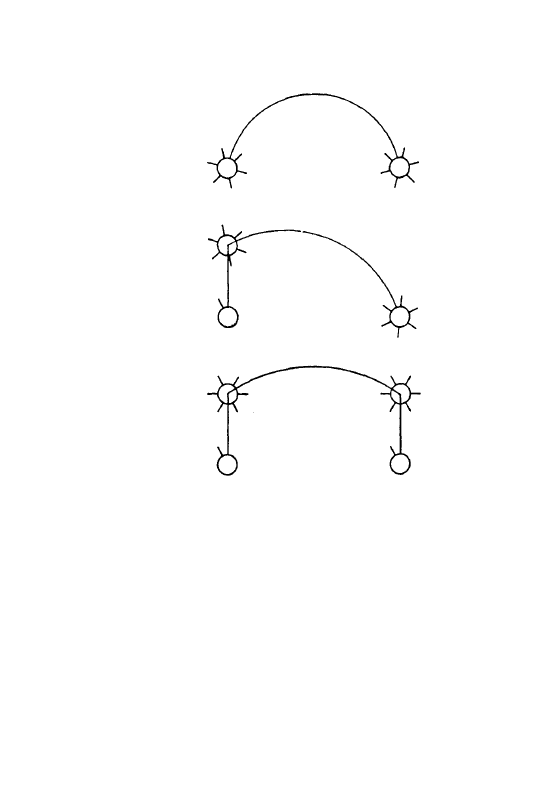
The diagrams on page 34 show the process.
Let me now give an example, from the Major, of the pro
cess of making the unfamiliar familiar—
"In my early infancy, my father, a physician and an
extraordinary linguist, initiated me in the mysteries of
several mnemonic contrivances. In the study of languages I
invariably employed the association of ideas. I succeeded
so far that, when at the age of not full thirteen, my father
sent me to study medicine at the University of Vilna, in
Poland, relying upon my extraordinary memory, as it was
called, I attended several courses of lectures, besides those
usually prescribed for students in medicine.
"I succeeded perfectly everywhere during several months,
until spring came, and with it the study of botany. Here,
far from outstripping my fellow-students, I actually re
mained behind even those whom I was accustomed to look
upon as poor, flat mediocrities.
1
Handbook of Phrenotypics, by Major Beniowski, 1845.
34
MIND AND MEMORY TRAINING
First Problem: familiar with familiar:
Second Problem: Unfamiliar with familiar:
Third Problem: Unfamiliar with Unfamiliar:
"The matter stood thus: Besides attending the lectures
on botany, the students are admitted twice a week to the
botanic garden; there they find a metallic label with a number
upon it; that number refers them to a catalogue where they
find the respective names; these names they write out into
a copy-book thus—
No. 1778 . . Valeriana officinalis,
No. 9789 . . Nepeta Cataria, etc.
"And having thus found out the names of a dozen of
plants they endeavour to commit them to memory in the
best manner they can. Anyone finds it tiresome, awkward,
and annoying to look to the huge numbers upon the label,
then to the catalogue, then to the spelling of the names, then

35
FAMILIARIZATION
to the copy-book, and after all to be allowed to remain there
only about an hour twice a week, when the taking away with
you a single leaf may exclude you for ever from entering the
garden at all.
" But I was peculiarly vexed and broken-hearted. I came
to the garden tired out by other studies; I had a full dozen
of copy-books under my arm, a very old catalogue with many
loose leaves; to which if you add an umbrella in my left, a
pen in my right, an ink-bottle dangling from my waistcoat-
button, and, above all, the heart of a spoiled child in my
breast, you will have a tolerable idea of my embarrassment.
"Week after week elapsed before I mastered a few plants.
When I looked at home into my copy-book, the scribbled
names did not make rise the respective plants before my
imagination; when I came to the garden, the plants did not
make rise their respective names.
"My fellow-students made, in the meantime, great pro
gress in this, for me, so unmanageable study;—for a good
reason—they went every morning at five into the fields,
gathered plants, determined their names, put them between
blotting-paper, etc.—in a word, they gave to botany about
six hours per day. I could not possibly afford such an ex
penditure of time; and besides, I could not bear the idea of
studying simply as others did.
"The advantages I derived from mnemonic contrivances
in other departments, induced me to hunt after some scheme
in botany also.
"My landlady and her two daughters happened to be
very inquisitive about the students passing by their parlour
window, which was close to the gates of the university; they
scarcely ever allowed me to sit down before I satisfied their
inquiries respecting the names, respectability, pursuits, etc.,
of at least half a dozen pupils.
"I was never very affable, but on the days of my mis
chievous botanic garden they could hardly get from me a

36 MIND AND MEMORY TRAINING
single syllable; I could not, however, refuse, when they once
urged their earnest request thus—' Do tell us, pray, the name
of that fish, do!' pointing most pathetically to a pupil just
hurrying by close to the window.
"When I answered,'His name is Fisher' (I translate from
the Polish, Ryba Rybski), they broke into an almost spas
modic chatter. 'We guessed his name! Oh, he could not have
another name. Look only,' continued they, 'how his cocked
hat sits upon his head, pointing from behind forward, exactly
in the same direction with his nose! Look to the number of
papers and copy-books fluttering about on each side between
his ribs and elbows! Look how he walks—he is actually
swimming! Oh, the name Fisher becomes him exceed
ingly well.'
"I could not but agree with the justness of their remarks.
I complimented them. I became more attentive to their
conversation when at table, which happened to run thus—
'Mother, what has become of the Long Cloak? I saw him
yesterday with the Old Boot. Do they reside together?'
'Oh, no; the Long Cloak looks often through yon garret
window, where the Big Nose lived some time ago, etc., e t c '
They perfectly understood one another by these nicknames
—Long Cloak, Old Boot, Big Nose, etc.
"This conversation suggested to me at once the means of
dispensing with my old anarchical catalogue when in the
garden—and in fact the whole plan of proceeding in the
study of botany stood before my view. I felt confident I
should soon leave all the young, jealous, triumphant,
and sneering botanic geniuses at a respectable distance
behind.
" I t happened to be the time of admission; I proceeded
immediately to that corner of the garden where the medical
plants were, leaving the catalogue at home. I began christen
ing these plants just in the same manner as my landlady
and her ingenious daughters christened the students of the

37
FAMILIARIZATION
university, viz. I gave them those names which spontaneously
were suggested to me by the sight, touch, etc., of them.
"The first plant suggested imperatively the name of Roof
covered with snow, from the smallness, whiteness and peculiar
disposition of its flowers, and so I wrote down in my copy
book 'No. 978, Roof covered with snow.'
"Next I found No. 735, Red, big-headed, cock-nosed plant;
and so on to about twenty plants in a few minutes.
"Then I tried whether I had committed to memory these
plants—YES. In looking to the plants, their nicknames im
mediately jumped up before my imagination; in looking to
these nicknames in my copy-book the plants themselves
jumped up.
"My joy was extreme. In a quarter of an hour I left the
garden, convinced that I had carried away twenty plants
which I could cherish, repeat, meditate upon at my own
leisure.
"The only thing that remained to be done was to know
how people, how learned people, call them. This business I
settled in a few minutes, thus: I put comfortably my cata
logue upon the table, looked for No. 978, and found Achiloea
Millefolium; this made rise before my imagination an eagle
with a thousand feathers (on account of aquila in Latin, eagle;
mille, thousand; and folium, leaf).
" I put simultaneously before my mind, Roof covered with
snow, and eagle; and high mountain rose immediately before
my imagination, thus—ROOFS covered with snow are to be
found in high mountains, and so are EAGLES."
I have quoted the Major's experience fully, as it indicates
so well the average student's feelings, and so graphically
explains the manner of relieving them.
It must be noted that when Major Beniowski had famili
arized a plant in the garden, and afterwards the name of
the plant at home, by likening them to something that he
knew well, and had come to the business of joining the two

38 MIND AND MEMORY TRAINING
permanently in his mind, he used his imagination in a natural
way. He did not invent a story to connect them; he simply
put the two things simultaneously before his mind's eye, and
waited, and the connexion came of itself.
The probability of such a common idea springing up
quickly is dependent upon the degree of familiarity of both
the ideas which are to be connected. Hence the importance
of familiarization first.
By this means the Major found that he could at once carry
away from the garden a clear memory of at least twenty
plants within the hour, and as his faculty grew by exercise
he memorized some hundreds of medical plants in a few
visits to the garden.
Every student who uses this method to learn names of
objects, or the meaning of words of a foreign language, or
in fact anything of the kind, will find that his faculty rapidly
grows. But let him be warned, for the benefit of his memory
and mind, to use the imagination only naturally in finding
the common or connecting idea. Do not create a fanciful
picture, for if you do you will have made something extra,
and what is more, unnatural, which will be a burden to the
mind.
Let me summarize this process of learning and remember
ing by imagination:
First, it must be settled which two notions you want to
connect.
Secondly, the notions must be familiarized, if necessary.
Thirdly, the notions must be stuck together by simul
taneous contemplation, resulting in natural imagination, and
Then, when one of the notions is given the other will rise
before the mind's eye.

CHAPTER VII
FAMILIARIZATION OF FORMS
LET me now apply the method of familiarization to learning
and remembering forms.
We will consider first the forms of foreign alphabets. When
learning these, do not try to remember them by simply
staring at them. Look quietly at each form until you find
in it a resemblance to some other form which is already
familiar to you.
Sometimes you will say to yourself that the form has no
comparison with anything that you know. But that is never
the case, as the following conversation between Major
Beniowski and one of his pupils will show. The pupil was
about to commit to memory the Hebrew alphabet—
. alef
. baiss
. guimmel
. dalet
. hay, etc., etc.
" Beniowski. What name would you give to the first
Hebrew letter ? or rather, What is the phantom that rises
before your imagination, in consequence of your contem
plating the first Hebrew letter ?
" Pupil. I think it is like an invalid's chair.
" B. Therefore call it an invalid's chair. What name
would you give to the second letter ?
" P. It is exactly like the iron handle of a box.
"B. Call it so. What of the third ?
" P. Nothing—it is like nothing—I can think of nothing.
" B. I cannot easily believe you—try. I infer from your
looks that you think it would be useless to express your
strange imaginings—they would laugh at you.
39
40 MIND AND MEMORY TRAINING
"P. All that this third letter reminds me of is a poor
Spanish-legion man, whom I saw sitting on the pavement
with swollen legs and no arms.
" B. And this you call nothing! this is valuable property
of your own; you did not acquire it without a certain ex
penditure of life; you can turn it to good account; call this
letter the Spanish-legion man. What of the fourth ?
" P. I understand you now—this fourth letter is evidently
like the weathercock upon yon chimney opposite your win
dow ; the fifth is like a stable with a small window near the
roof, etc., etc."
As a second example (merely for illustration, as I do not
expect the reader of this book to learn Sanskrit) I will take
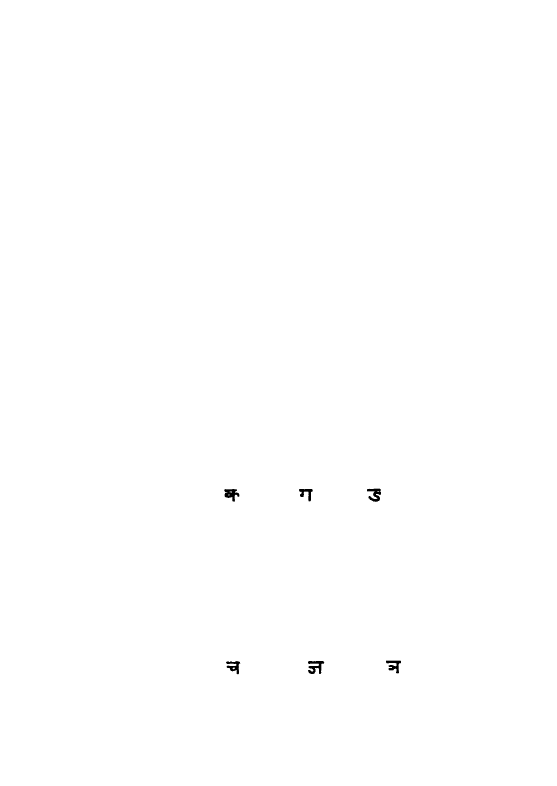
up some of the unaspirated consonants of the Devanagari
alphabet, which is used in Sanskrit and some of its derivative
languages. We may as well make use of the principle of
sense-proximity, as well as that of association or mind-
proximity. Therefore I first give a Devanagari letter, and
then the Roman letter (which, I' assume, will be familiar to
the reader) close beside it.
The gutturals are—
ka ga nga
We have now to find familiar forms to name the forms
which are strange to us. K looks to me rather like a knot,
g like a gallows, and ng like a rearing snake. I find no great
difficulty in associating these with ka, ga, and nga, respec
tively, for k and g are the first letters of the words knot
and gallows, and a rearing cobra is a very picture of anger.
The palatals are—
cha ja na
Here ch looks like a pointing finger—chiding. J resembles
a footballer kicking—scrimmage. N reminds me of a lobster's
nipper.
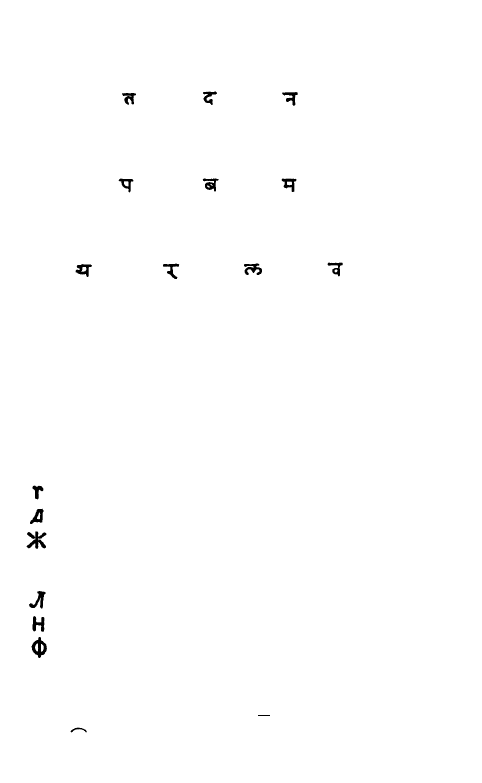
41
FAMILIARIZATION OF FORMS
The dentals are—
ta da na
In this case t appears to me like a fail, d like a hunchback
sitting down—dwarf, and n like a nose.
The labials are—
pa ba ma
P is like a P turned round: b like a button; m is quite
square—mathematical.
I will conclude with the semi-vowels—
ya ra la va
These will serve to illustrate the principle of comparison
with the forms already learned, since y resembles p and v is
much like b. R reminds me of an old-style razor, partially
opened in use, and 1 seems like a pair of crab's legs. I have
said enough to enable the student of Sanskrit or Hindi
or Mahratti to learn the rest of the alphabet by himself
within an hour or two—a process which usually takes
days.
Next, as further illustration, let me give some items from
the Russian alphabet—
g, very much like a little r—rag.
d, like a delta..
zh, rather like a jumping jack with a string through
the middle which when pulled causes the arms
and legs to fly outwards—plaything—jeunesse.
1, something like a step-ladder.
n, like H—hen.
i, an arrow going through a target—-flight or fight.
We can do the same with any other alphabet. The follow
ing are some suggestions for learning Pitman's shorthand out
lines : | t is like a T without a t
o p
; k is like a coward, lying
down: m is like a little wound. Among the Greek letters

42 MIND AND MEMORY TRAINING
gamma is like a catapult—game; pi is like an archway—
pylon; lambda is leaning; phi is like an arrow piercing a
target—battle—fight. The Persian characters require a little
more imagination than most of our alphabets do, yet when I
look at them I find boats, waves, commas, eyes, wings,
snakes, and funny little men, standing, crouching, and
running.
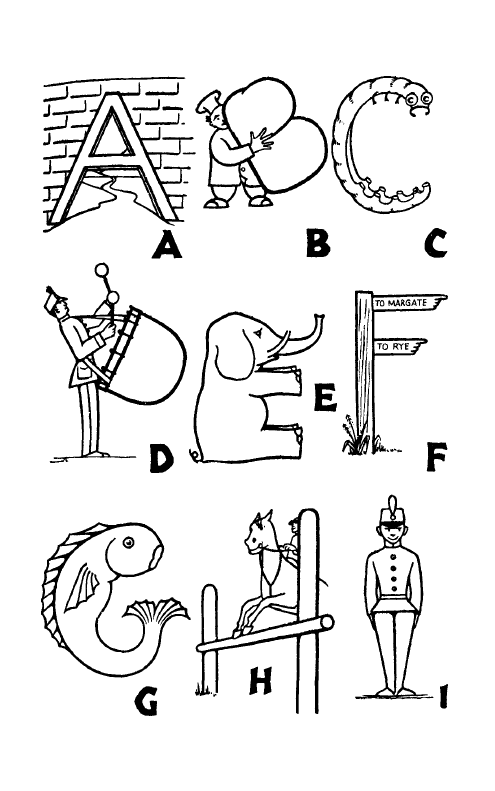
I will now give the Roman alphabet in a form in which it can
be taught in English to young children in a very short time:
A stands for an arch; B for a bundle; C for a coiled cater
pillar ; D for a drum; E for an elephant sitting up in a circus ;
F for a finger-post; G for a goldfish curled round in the
Japanese style; H for a hurdle; I for an icicle or a little imp
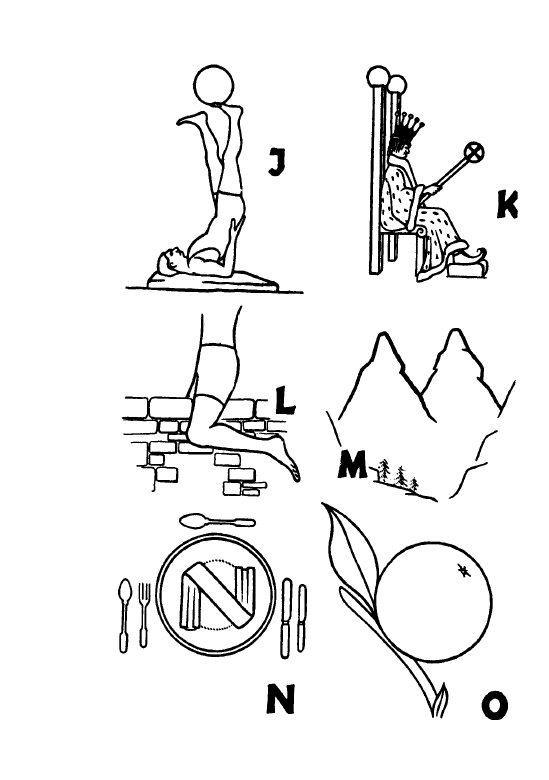
standing stock-still; J for a juggler lying on his back, balanc
ing a ball on his feet; K for a king, sitting on a throne and
holding out his sceptre in a sloping direction; L for a leg;
M for mountains; N for a napkin on the table; O for an
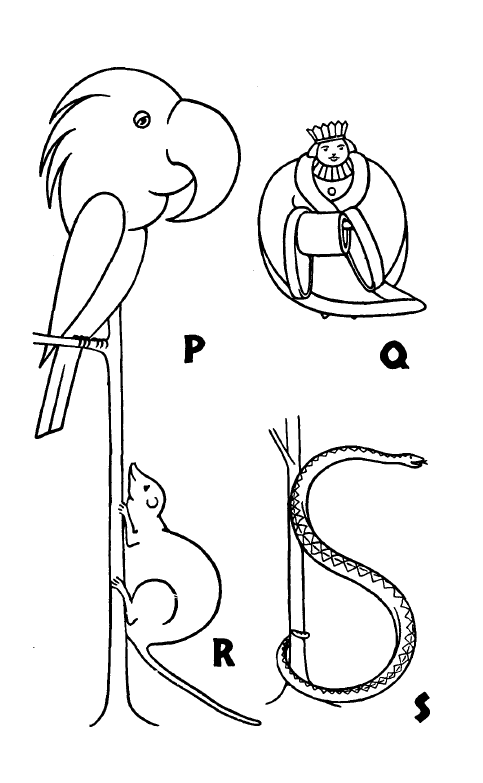
orange; P for a parrot with a large head; Q for a queen, very
fat and round, with a little tail of her gown sticking out near
her feet; R for a rat climbing a wall, with its tail touching
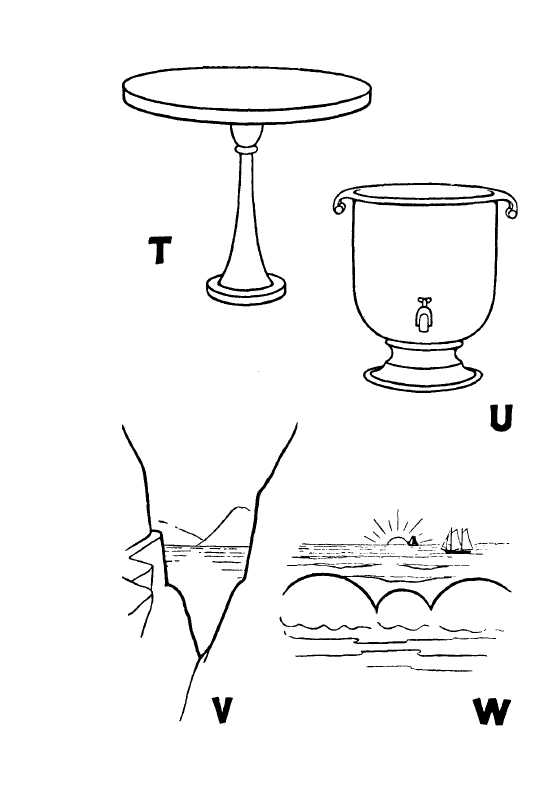
the floor; S for a snake; T for a small table, with one central
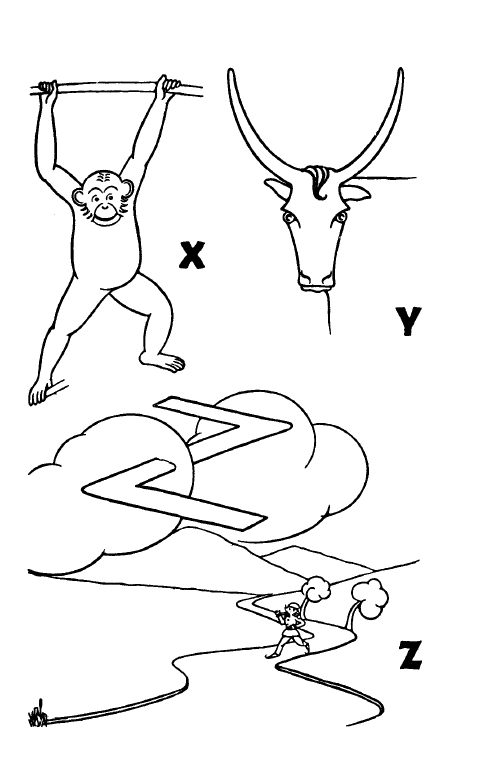
leg; U for an urn; V for a valley; W for waves; X for Mr. X
—a monkey stretching out its arms and legs to hold the
branches of a tree; Y for yarn, frayed at the end, or a yak's
head, with large horns; Z for a zigzag—a flash of lightning.
For each of the objects the teacher should draw a picture
bearing a strong resemblance to the letter that is to be taught
(somewhat as in our illustrations) and the letters should at
first be represented by the full words, arch, bundle, cater
pillar, drum, etc.
1
Turning now to geographical outlines, the best-known
example of comparison is the outline of Italy, which every
schoolboy remembers much better than he does that of any
other country, for the simple reason that he has noticed that
1
This method of representing the alphabet is copyright.
43
FAMILIARIZATION OF FORMS
44
MIND AND MEMORY TRAINING
45
FAMILIARIZATION OF FORMS
46
MIND AND MEMORY TRAINING
47
FAMILIARIZATION OF FORMS

48
MIND AND MEMORY TRAINING
it resembles a big boot kicking at an irregular ball, which we
call the island of Sicily. Africa is like a ham; South America
resembles a peg-top; Mexico is like a sleeve; Newfoundland
resembles a distorted lobster; France appears like a shirt
without sleeves; Norway and Sweden are like an elephant's
trunk; India is like Shri Krishna dancing and playing his
flute; the river Severn is like a smiling mouth.
The student of botany has to remember the general appear
ance of a large number of plants and flowers. We have
already seen that the best plan to follow in remembering
these is not to go into the garden or the field with textbook
in hand, but to go among the flowers and plants and give
them names of your own invention. When the forms are
thus made familiar to the mind they can easily be recalled
by remembering the new names, and afterwards the ortho
dox names can be learned, just as we should learn a number
of foreign words.
The popular names of many plants are already based on
simple comparisons. Among these one thinks at once of the
sunflower, the buttercup and the bluebell, and the cam
panula is obviously a cluster of most exquisite bells. But
when the student comes to narcissus, calceolaria, chrysanthe
mum and eschscholtzia and many other scientific names he
must have recourse to his own familiarization for remember
ing their forms in the beginning.
In private life, living in the country, we often see and wish
to remember flowers, without ever hearing what people have
named them. Then it is well to give them our own names for
the time being.
Near one of my dwellings there was a hedge full of jolly
little old men with occasional purple-grey hair, and they
seemed to bob their funny round heads in the breeze in
response to my nod. I did not in the least know their names,
but we were not worse friends on that account. The allegory
of Narcissus is reflected in the flower of that name; the way

49
FAMILIARIZATION OF FORMS
in which the gentle flower bends its lovely head is remindful
of the fall of the spirit enamoured of its image reflected in
the waters of existence; yet for most of us it remains a
beautiful star. The crinkled white champaka reminds me
always of a swastika; and the clover, so like a fluffy ball, Is
in India often called the rudraksha flower, because it is
thought to resemble the crinkled berry beads which yogis
wear, these in turn being held sacred because their markings
are thought to be strange letters (aksha) written by the God
Rudra or Shiva. We may think of the drooping bag-like lip
of the calceolaria, of the large velvet face of the pansy, of
the curious lips and curly strings of the sweet pea, and of the
exfoliated heart of the rose, and we may know these little
ones much better by these happy names than if our brains are
fagged beforehand by the crabbed terminology of the books.
Major Beniowski's experience has already suggested to us
the way to remember persons—a method which, in fact, led
him to his system of familiarization of the forms of plants.
I may relate in this connexion one experience of my own.
Once, when I was travelling on a boat, I made the acquain
tance of a studious and learned university professor who
won my esteem. His name was Dittmer. Now, I was very
familiar in India with the various kinds of oil lamps which
were imported in large quantity from a manufacturing firm
named Dittmar. I had seen the name on lamps in many
places, so the connexion of Dittmar and lamps was strong
in my mind. Well, when I first met Prof. Dittmer he was
wearing a huge pair of round tortoise-shell reading glasses.
They reminded me irresistibly of a pair of motor-car lamps.
Hence I had no difficulty in remembering his name. Another
reminder also occurred to me. He looked somewhat like the
immortal Mr. Pickwick—wick—lamp- -Dittmer. I am sure
that, if this happens to catch the eye of the professor, he will
not be offended at the liberty with his person which I have
taken, for it is in the interests of science.

CHAPTER VIII
FAMILIARIZATION OF WORDS
THE principle of familiarization is especially useful in learn
ing the words of a foreign language. In this connexion
let me enunciate again two important points. Do not try
to put an unfamiliar thing into the mind, and do not try to
do two things at once, namely, to remember an unfamiliar
word and also its meaning. To learn foreign words always
reduce them to familiar sounds; then associate them with
their meanings.
First take the foreign word which you have to learn, and
repeat it to yourself without thinking of any meaning until
you are able to find its resemblance to some other word that
is quite familiar to you.
Suppose I have to learn the French word "maison." As
I turn it over in my mind there comes up the similar English
word "mason." I am told that the word "maison" means
house. Well, a mason builds a house. I have just asked my
wife to give me another French word at random. Her reply
is "livre," which means a book. Pondering for a moment
on the sound "livre" I find that the English word "leaf"
comes up in my mind, and I think, "A book is composed of
leaves."
Very often when we are learning a foreign language there
are many words which are similar to words having the same
meaning in our own language. So, first of all, if you are free
to choose your words, look over your vocabulary, and learn
all the words that clearly resemble English words, such as,
for example, in German—
Wunder (wonder), Vater (father), Nord (north), Sohn
(son), Schuh (shoe), Ebbe (ebb), Ende (end), Ochs (ox),
Dank (thank), Eis (ice), Wasser (water), Donner (thunder),
50

51
FAMILIARIZATION OF WORDS
Ohr (ear), Krone (crown), Dorn (thorn), Schulter (shoulder),
Seele (soul), Kuh (cow), Strom (stream), Garten (garden),
and hundreds of others.
If, however, the student is compelled to follow a course
of study in the order of a prescribed textbook, he will have
to take the words as they come, and will at once find many
which do not appear to resemble English words. He takes
the first word, Saal, room, and repeats: "Saal, room, Saal,
room . . ." until his head buzzes; then he goes on to
"Schutz, protection, Schutz, protection, Schutz, protection
. . ." until his brain throbs; and then "Schön, beautiful,
Schön, beautiful, Schön, beautiful . . ." until his mind
whirls; and then "Trennung, separation, Trennung, separa
tion, Trennung, separation . . . " until he nearly drops from
his seat, and yawns and rubs his eyes and wishes—oh, how
longingly—that it was time to go out and play cricket; and
he looks up at the clock and sees there is still twenty minutes
to playtime—oh, endless and unrelenting time—and then
he tries to fix his burning eyes upon his book again, once
more to grind out " Fürchterlich, terrible, Fürchterlich,
terrible, Fürchterlich, terrible . . .", once more to swoon,
once more to look at the clock—oh, mercy, nineteen minutes
more!
Do not grind like that, dear boys! Take the word Saal ;
look at it; shut your eyes; repeat it audibly and visually
three times without thinking of the meaning. You have
already noticed that it means a room, but do not dwell on
that. Dwell on the mere sound of Saal, and look out for
familiar words that sound something like it. You may think
of sale, salt, and saloon—ah, that is the best word, Saal is
like saloon, which is a kind of room. Then repeat Saal three
times while thinking of the room. Do not think merely of
the word room, but think of a room known to you. Then
take Schutz, meaning protection; repeat it three times,
thinking only of the sound. Think of some words that sound

52 MIND AND MEMORY TRAINING
like Schutz, say shut or shoot. Do you not protect a thing
by shutting it up ? Do not the soldiers, who shoot, protect
us ? Once more repeat the word three times, thinking of the
idea.
Schön is like shining—beautiful; and for Trennung you
might think of a trench or chasm which separates, separa
tion ; and for Fürchterlich, fear-like. Always repeat three
times, and always think of the connexion, such as: the sol
dier, who shoots, protects us from aggression.
Now I will give a few words from the Spanish—
Mesa, a table—mess; libro, a book—library; ventana, a
window—ventilation; verde, green—verdure; tiene, he has
—tenant; levantar, to raise—lever; escribir, to write—scribe,
and so on.
As another example, a few words from the Russian—
Koleso, a wheel—kaleidoscope; komar, a mosquito—no
comrade; derevo, a tree—a country drive among trees;
bratstvo, brotherhood—fraternity; palatko, a tent—not a
palace; skala, a rock—scale it; osel, a donkey—O slow one;
reka, a river—yes, if rocky and rapid it may be a wrecker;
lozhka, a spoon—food lodges in it, temporarily; molot, a
hammer—moulds hot iron to shape; nasos, a pump—noses
are air pumps; and so on.
The words that must be learned are not always quite so
easy as these, but if you practise this like a puzzle-game for
some time, you will be able to find something for every word.
Preferably take the accented syllable of the word that you
art going to make. Let us take some difficult words from
Sanskrit, as an illustration. They are difficult because they
are very unfamiliar, and because they sound somewhat
different from English words.
Kama which means passionate desire, sounds like "calm,"
and you might think in the form of a contrast, "When a
man gives way to passionate desire he is not calm." Karma,
which means work, sounds somewhat like " cream." Cream is

53
FAMILIARIZATION OF WORDS
made into butter by constant motion—or work. Sharira,
which means body, sounds like " sharing ": we can share with
others in bodily work and the produce thereof. Or again, it
sounds like "shear": wool is sheared from the body of the
sheep- Manas means mind—man has a mind. Prana means
vitality; you may think of a high-spirited horse, prancing
along, full of vitality. Surya means the sun; it sounds some
thing like "sower." The sun stirs up the life of all the seeds
that are sown in the ground.
But really, these are too easy; let us try something more
difficult. Indriya, which means sense-organ, sounds like
india-rubber, which has no sense! Jagat, the universe. The
universe is jogging along all right. Raja, a king. A king is
nearly always rich. Bhakti, devotion. The devotee bends
his back when worshipping. Saundarya, beautiful and grace
ful. A sound and healthy body is beautiful and graceful.
Naga, a snake. Always catch a snake by the neck. Kshira,
milk. The wool that is sheared from sheep is as white as
milk. Kshattriya, a warrior. A warrior shatters his enemies.
Expressing the connexions in briefer form we may use our
four roads of thought. It is an additional aid to memory to
discover and name the roads when associating two ideas—
not that the roads are to be remembered, but the two things
are automatically held in close proximity while you are
trying to identify the road. Thus—
Harmya, a palace—harm, (Road I), luxury, (Road II),
palace. Pada, a foot—pedal, (Road IV), foot. Kama, an ear
—cornea, (Road II), eye, (Road I), ear. Grama, a village—
gram, (Road IV), agriculture, (Road II or IV), village. Kama,
passion—calm, (Road I, contrast implying similarity), ex
citement, (Road I), passion. Pushpa, flower—bush, (Road II),
flower. Madhu, sweet—mad, (Road IV), intoxicated bear,
(Road IV), honey, (Road III), sweet.
I have looked through my Sanskrit dictionary for half an
hour, and have failed to find one word that could not soon

54
MIND AND MEMORY TRAINING
be resolved in this way. We might take the most difficult
words from Latin or Greek, or, I think, any European
language, and we should find them much easier than the
Sanskrit.
You will discover that by this method you can happily
and easily remember quite a large number of foreign words in
the course of an hour, and your memory will not be burdened
afterwards by all the fancies in which you have indulged;
yet you will remember the words better than if you had
learned them by rote. As a matter of fact, you really get
to know the words as usable things when you read a number
of books in the language or practise conversation in it. The
real difficulty which you will have to encounter at the
beginning is that of introducing the unfamiliar words to
your mind.
To show how even the most difficult words can be dealt
with, we may form uncouth words, such as the following, at
random. Let labagart be synonymous with tametac,
emattle with revilog, ebpetag with thodge, nadard with
smecia. We might associate them thus: Labagart—lovely
cart—market—fruit—tomato—tametac; emattle—metal—
rifle—revilog; ebpetag—potato—cottager—cottage—thatch
— thodge; nadard — adder — field — labourer — smock —
smecia.
If for the sake of exercise, or for amusement, you wish to
remember a long, uncouth word, such as hturtnahtrehgih
noigileronsiereht, you can easily do so by forming a series
of words such as the following: hat; upper; ten; ah; tower;
eh, gari (cart); hen; obi (magic); gai (cow); love; rao (king);
ness (nose); isle; rope; height. It will be noticed that each
word of ours represents two letter:, of the long uncouth word
—the first and last letters only being taken into account,
Thus one can do a thing that most people would think well-
nigh impossible for an ordinary brain; though, like many
things generally regarded as more dignified and respectable,

55
FAMILIARIZATION OF WORDS
it has no particular value beyond the exercise that it
provides.
In some languages we have the additional trouble of genders
in the nouns. There are several ways to assist the memory of
these. The student may keep lists of masculine nouns in
red ink, feminine in green, and neuter in black.
Dr. Pick, a famous mnemotechnist who wrote about
seventy years ago, recommended the student to learn the
exceptions. For this, however, one must have a teacher or
expert who will be accommodating enough to make a list.
When teaching the French language Dr. Pick wrote that
except for the following words all nouns having these endings
are masculine.
Amitié (friendship), moitié (half), pitié (pity), forêt (forest),
paix (peace), fourmi (ant), merci (mercy), brebis (sheep),
souris (mouse), vis (screw), perdrix (partridge), eau (water),
peau (skin), chaux (chalk), faux (scythe), glu (glue), tribu
(tribe), vertu (virtue), toux (cough), syllabe (syllable), clef
(key), nef(nave), soif (thirst), cage (cage), image (image), nage
(swimming), page (page—of paper, not a page-boy), plage
(plain), rage (rabies or violent passion), tige (stem), voltige
(leap), part (part), mort (death), foi (faith), loi (law), paroi
(partition-wall), dent (tooth), jument (mare), gent (race),
faim (hunger), main (hand), fin (end).
I have given this list only as an illustration. Similar lists
may be formed in other languages. If, however, you have
no such list, and no expert available to make one for you, the
following method will help. The genders of many words will
impress themselves upon your mind without special atten
tion, as in the case of a child who is naturally picking up the
language, but there will be a residue which may give you
trouble. The items in this residue may be associated with
qualities or objects familiarly regarded as masculine, femi
nine or neuter.
Thus, in Sanskrit, padma, a lotus, is neuter; ghata, a jar.

56 MIND AND MEMORY TRAINING
is masculine; mukti, liberation, is feminine. We may then,
perhaps, think that the lotus is both bold in pushing its way
up through the mud and water to the air, and gentle in
resting its soft leaves upon the surface of the water; so it
may be considered neither one nor the other—hence neuter.
As to pot—where do you find pot-bellies but in men?—a
masculine shape, surely. To avoid earthliness and to seek
retirement are feminine virtues, so mukti may be remem
bered as a word of feminine gender.

CHAPTER IX
PROJECTION OF THE MEMORY
WE have considered and perhaps practised some simple
experiments intended to make the imagination vivid and
accurate. We have also applied the imagination to learning
various things which may be new to us. Let us now con
sider how to use imagination to help us to remember various
things when we want to remember them.
There are plenty of memories in the world which remember
a vast number of things, yet are of little use to their owners
because they do not deliver rust what is needed or wanted
it a given time.
An instance of this was very cleverly depicted by Charles
Dickens in his novel Nicholas Nickleby. The following are
the words of Mrs. Nickleby when Stratford-on-Avon, the
birthplace of Shakespeare, happened to be the subject of
conversation:
"I think there must be something in the place, for, soon
after I was married, I went to Stratford with my poor dear
Mr. Nickleby, in a post-chaise from Birmingham—was it a
post-chaise though ? Yes, it must have been a post-chaise,
because I recollect remarking at the time that the driver had
a green shade over his left eye;—in a post-chaise from Bir
mingham, and after we had seen Shakespeare's tomb and
birthplace we went back to the inn there, where we slept
that night, and I recollect that all night long I dreamt of
nothing but a black gentleman, at full length, in plaster-of-
Paris, with a laydown collar tied with two tassels, leaning
against a post and thinking; and when I woke in the morn
ing and described him to Mr. Nickleby, he said it was
Shakespeare just as he had been when he was alive, which
was very curious indeed. Stratford—Stratford. Yes, I am
57

58 MIND AND MEMORY TRAINING
positive about that, because I recollect I was in the family
way with my son Nicholas at the time, and I had been very
much frightened by an Italian image boy that very morning.
In fact, it was quite a mercy, ma'am, that my son didn't
turn out to be a Shakespeare, and what a dreadful thing
that would have been !"
And this was one of her memories about dining:
" It's very odd now, what can have put that in my head !
I recollect dining once at Mrs. Bevan's, in that broad street
round the corner by the coachmaker's where the tipsy man
fell through the cellar flap of an empty house nearly a week
before the quarter-day, and wasn't found till the new tenant
went in—and we had roast pig there. It must be that, I
think, that reminds me of it, especially as there was a little
bird in the room that would keep on singing all the time of
dinner—at least, not a little bird, for it was a parrot, and he
didn't sing exactly, for he talked and swore dreadfully; but
I think it must be that. Indeed I am sure it must."
But suppose we have a person of good memory, whose
mind has not been allowed to drift, as presumably that of
Mrs. Nickleby had done throughout her life, and the conver
sation turns to the subject of elephants. Then perhaps that
mind in an instant will say to itself, without words: " The
elephant is a large, vegetarian, mammalian, quadruped
animal, inhabiting Ceylon, India and Africa." And in a
moment more that mind will slide its fingers along each word
of that definition, and at once a great deal of information
will become available on each point.
Such a memory is like a dictionary having more cross-
references than it would be possible ever to obtain in a
printed book; furthermore, a dictionary which will always
open at the word or idea which you want.
It sometimes happens in practice that a student has to
remember a number of things which he may put in any order
he chooses, as, for example, lists of foreign words. But more

59
PROJECTION OF THE MEMORY
frequently a certain predetermined order is required, as in
learning historical series of events, or in committing to
memory heads of a lecture or book. This occurs often in
practical life, where one may require in the morning to re
member a number of things to be attended to during the
day.
In this case it is obvious that the subjects will not fall into
an order serially connected in the way which we have already
illustrated, so we must devise some means whereby the
items will suggest each other in their order. Generally these
things have no immediate or direct association. If, then, an
effort is made to remember them together, it usually fails—
for there can be no leap in consciousness; each idea must
follow another directly connected with it by one of the roads
I have described.
I will take as an example a gentleman of long ago who was
going into town and wanted to carry out the following items
of business—
(1) To purchase some barley at the market;
(2) To hire a labourer for some building alterations;
(3) To keep in mind the proverb that a bird in the hand
is worth two in the bush (since former experience had taught
him the value of that maxim);
(4) To buy some aromatic spices at a grocer's;
(5) To call to see a lawyer about a friend's suit in
Chancery;
(6) To buy some velvet;
(7) To collect some money due.
Many people would write these items down, but it is far
better that we should remember our own business, as we all
know that notebooks weaken the memory.
In this case, we have to remember the following ideas in
succession; barley, labourer, bird, spices, Chancery, velvet,
debt. The best method for this purpose is to insert one or
two intermediaries where there is no direct association.

I
6o
MIND AND MEMORY TRAINING
(1) Barley—harvest—
(2) Labourer—gamekeeper—
(3) Bird—bird-seed—groceries—
(4) Spices—red pepper—red-tape—
(5) Chancery suit—chancellor—robe—
(6) Velvet—smooth—slippery—debtor—
(7) Debt.
I have not troubled to print the associations or Roads of
Thought, as the reader or student will easily see them if he
wishes to do so.
must mention that this process is not artificial. It
actually occurs in the mind—though generally sub-con-
sciously—when two unrelated things are remembered in
sequence.
In practice, the extremes, say barley and labourer, are
considered; an effort is made to work forwards from barley
and, as it were, backwards from labourer, until the two meet.
It is then found that there is rarely any necessity for more
than two intermediaries.
Having formed our connexions, we may repeat the series
a few times, and presently the intermediaries can be dropped
out of mind and the series will be remembered without them,
as they are only a temporary aid to bring the pairs of ideas
together.
The recall of such a series is made easier when the mood
in which they were originally associated is revived, so when
trying to revive an impression go back in imagination and
put yourself into the mood in which you originally received
it. You may have been to a lecture, which you now wish to
remember. First recall the mood, the whole attitude of the
attention, as it was at the time given to the lecturer, to the
subject of the lecture and to its different parts in turn. It
will be quite impossible for you to recall the succession of the
ideas of the lecture if you are at the same time thinking of
what you will have for dinner, what so-and-so has been

PROJECTION OF THE MEMORY 6l
saying about you, how you will carry out such-and-such a
plan, what a cold day it is, or what a noise the people round
about are making. A certain kind of indifference is essential
for success in this practice.
The student practising the repetition of a series of ideas
such as has been described is recommended to notice with
the greatest care exactly what takes place in his mind when
he comes to an obstacle in the process, and finds himself
unable to remember the next link of the chain. At once the
attention darts off in a new direction, taking up another line
of ideas of its own. This indicates not so much lack of
memory as a change of mood. If the new mood is overcome
and the mind is forced by the will into the original one, the
attention is bound to go in its original direction, for the
mood determines the path of least resistance for it.
This device of intermediaries is excellent for remembering
the sequence of ideas in a speech or lecture which you may
propose to deliver.
So far I have written about associating two ideas together
in the mind. It is also practical to associate an idea with an
actual thing instead of with another idea. This is particu
larly useful with reference to the future, when you wish to
do something in some place or at some time.
Sometimes a business man is asked to purchase some little
thing in town for his wife, and bring it home in the evening.
Very often, it must be confessed, he forgets. One device by
which he may remind himself that there is something to be
done is to tie a knot in his handkerchief, so that it will remind
him of his commission when he pulls it out of his pocket.
But it would be a better plan for him to associate the idea
of the thing to be done with some object which he is sure to
see during the day.
In practice, we are all being reminded all the time of many
things by the objects which surround us. It is as if they
were plastered all over with thoughts and those thoughts

62 MIND AND MEMORY TRAINING
leapt out at us when we see the objects. To illustrate this
fact, take out your watch and look at it for a few minutes,
keeping y6ur thoughts still and attentive, and observe the
little pictures that arise involuntarily in the mind. You will
probably find an image of the person who gave you the
watch or of the shop where you bought it, and pictures of
any special incidents in which it has played a part. The
numbers on the dial will remind you of the different duties
and appointments of the hours throughout the day; while
the qualities of the watch, the substances of which it is made
and the accessories which are associated with it, radiate
ideas in all directions, as do the ideas which we have
mentioned in earlier chapters.
All the articles that we possess are similarly full of thoughts
—the rooms, the houses, the streets that we enter, are
saturated with them. There is thus a process, going on for
the most part unconsciously, by which the mind of man,
except at moments when it is under the active control of the
will, is constantly influenced by his surroundings.
This process can be employed for remembering things that
are to be done, so that at the right moment they will enter
the mind, without our being put to the trouble of recalling
them again and again before the appointed time. The
memory may thus be cast forward, as it were, by our
linking the idea we want with an object that we are sure
to come across and notice, and in the process we shall be
free of the waste of mental energy necessitated when the
idea is kept half consciously in the mind throughout the
interval.
Suppose, for example, you wish to remember to send a
letter to Mr. Blank, when you arrive at the office. There is
no need to worry the mind by continually thinking about the
matter, nor to weaken it by taking a note. Simply make a
clear picture of your office, project your thought there, as
it were, with Mr. Blank sitting there conversing with you,

63
PROJECTION OF THE MEMORY
and when you arrive at the spot the image will naturally
rise up in your mind.
If during your journey by railway into town, you wish to
consider some problem in electricity or in finance, fix your
idea on the lighting apparatus or on the costly upholstery of
the compartment; when you step into the train, these things
will catch your eye and remind you of the problem.
It is possible thus to hang images on prominent signs,
shop and house fronts, monuments and other noticeable
things you are likely to pass, and to fix ideas on the books,
pictures, furniture and clothing you are likely to use. There
remains in the mind a kind of latent or subconscious ex
pectancy which will notify you on the slightest signal from
the determined object. When the memory is discharged this
latent expectancy ceases, the association is broken, and the
object is left free for future associations.
Various special ways of fixing ideas on objects will
naturally occur to the student. If I need to remember, for
example, that I want to send a clerk out to buy a new pair
of compasses, I can associate the idea by making a picture
of myself writing a letter A at my desk and noticing that that
letter resembles a pair of compasses. As soon as I sit down
to write I shall be reminded of the intention. This purpose
must be forthwith discharged if the method is to be em
ployed again, for unless we are faithful to our memory it
will not long be faithful to us.
Or again, suppose I want to look up a certain question in
chemistry. I know that when I go to my room for the
morning's work, which consists chiefly in writing, I shall
use my fountain pen, which is lying there. I picture myself
picking up the pen and noticing the gold nib, which reminds
me of alchemy, and that in turn revives the idea of chemistry.
I know that when the time comes my memory will present
me with the idea I want, because we have much confidence
in each other—my memory and I.

64 MIND AND MEMORY TRAINING
This principle may be allied to the instinct by which one
awakens oneself from sleep in the morning at a time pre
determined before retiring for the night. I have had to do
that frequently when travelling in India, and have found
that confidence is justified. But I have noticed several times
that when my watch was wrong the instinct awoke me by
the wrong time of the watch, not at the proper time.

CHAPTER X
SIMPLIFICATION AND SYMBOLIZATION
WHEN
memorizing lists of things of any kind it is often an
advantage to simplify very complex ideas and to symbolize
abstract ideas.
A good example of symbolization is related with reference
to the Greek poet Simonides, who was one of the earliest
known exponents of aids to memory. He invented, among
other things, a simple device for committing to memory
ideas which do not represent objects of sense, and are there
fore difficult to remember. For example, in preparing a dis
course concerning government, financial matters, naval
affairs, and the necessity for wisdom in the policy of the
times, he would not try to memorize those topics or para
graphs of his discourse in these general terms, but would
represent each by a symbol—a crown or sceptre, a current
coin, the image of a ship, and the figure of Minerva
respectively.
When preparing such images or symbols we should always
take account of their qualities, as already explained, to make
them as natural and lively as possible. I take an extract on
this point from a work written by John Willis, B.D., of
Magdalen College, Oxford, which was published in 1618 in
Latin and translated into English in 1661.
"Ideas are to be vested with their proper circumstances,
according as their natures require; for as writings the fairer
they are, are more facilely read; so ideas, the more aptly
they are conceived, according to the exigency of their natures,
are more speedily recalled to mind; and also consequently
the things by them signified.
"Motion is to be attributed to ideas of movable things;
quiet to ideas of quiet things and good and evil savours to
65

66
MIND AND MEMORY TRAINING
ideas representing things so qualified. Examples of movable
ideas are: artificers at work in their shops, women dancing,
trees shaken by the wind, water running from taps, and such
like. Ideas of quiet things are: hens laying in their nests,
thieves lurking under bushes, etc.
"Ideas to which sound is ascribed are: a lion roaring, a
bell ringing, whistling, the rustling of trees, a chorister sing
ing, etc. If incense burning be used for an idea, a sweet and
pleasant odour must be attributed thereto; but, on the con
trary, to vaults underground, a dank unwholesome smell is
to be assigned. So also, ideas of merry men require cheerful
ness of countenance, of sick men paleness and sadness.
"After this manner ideas of edifices, machines, and all
artificial things whatsoever, ought to be signalized; propor
tion of form and splendour of colour must be attributed to
pictures, grace and liveliness of letters to writing, glory and
excellence of workmanship to engravings. Finally, every idea
must have such illustration as may render it most notable
and conspicuous and seem principally coherent to its
nature."
The quantity and position of ideas should also be observed.
In imagining small things, such as an ant, a grain of rice or
of sand, or a drop of water, it is well to picture an army of
ants, a bagful of rice, a sandy shore, or a flowing river,
respectively. On the other hand, to represent highly com
plex pictures, such as a battle, or a large block of buildings,
it is well to reduce them in quantity or in size, and represent
a battle by a few men fighting, a block of buildings by some
small erections, a church or a mountain as diminutive, as
though seen through the wrong end of a telescope.
As to position, things which are usually hung upon walls,
such as pictures and looking-glasses, should be imagined as
hanging there; books upon shelves; crockery in cupboards;
clothes in wardrobes, in drawers or on the person; tables,
chairs, chests and the like standing on the ground; and

67
SIMPLIFICATION AND SYMBOLIZATION
graves, wells, wine-cellars, mines and other such things,
under the ground.
"The mind of man doth naturally and immediately
present direct ideas of all visible things," wrote Mr. Willis,
"so that it is vain to excogitate any, but rather use those
that offer themselves. If a man hears the account of a naval
battle, doth he not presently seem to behold the sea, ships,
smoke of great ordnance, and other things obvious in such
matters ? If speech be made of mustering an army, doth not
the hearer form in his mind the effigies of a field, replenished
with soldiers marching in military postures? "
To this standard of direct imagination we may easily
reduce complex or abstract ideas. The landing of Julius
Caesar may be represented by a few ships approaching the
shore, their owners being repulsed by rough Britons. Ath
letics may be represented by a ball; education by a black
board ; art by a statue or a picture; music by a violin; the
theatre by a mask; horse-racing by a jockey's cap. Cold may
be represented by a piece of ice; heat by a fire; light by a
lamp; love by a heart; pride by a peacock; gluttony by an
ostrich; melancholy by a sad man; the spring time by green
meadows and flowering trees; winter by a picture of houses,
trees, and the earth white with snow and rigid with frost.
We are all familiar with the figure of Justice, the veiled
virgin with her sword and balance, and old man Time with
his scythe and forelock, and his merciless wings.
To conclude these remarks let me give some complex
examples to show how ideas relating to incidents or stories
should be made in concrete form, not in mere words. This
point should be especially important to students of history—
"Milo of Croton, a famous wrestler, first crowned in the
Olympic games, when through age he had left off his youth
ful exercise and was travelling through some woodlands of
Italy, espied an oak near the way rifted in the middle.
Willing to try whether any of his ancient vigour remained.

68 MIND AND MEMORY TRAINING
he thrust his hands into the cleft of the tree, to rend down the
middle part. But as soon as his violence ceased, the oak,
thus forcibly writhed, returned to its pristine estate and,
closing fast upon his hands, detained him a prey for wild
beasts.
"Fancy a cleft oak, full of green leaves and acorns, in the
cleft of which a strong great-limbed man, crowned with
laurel, is fast held by the hands. Bending back his head and
body he cries out so loudly that you really seem not only to
see his wretched body and the beasts preying about him,
but also to hear his outcries and lamentations."
" I n the year 1530, in the time of Charles V, Emperor,
the German Princes exhibited their Confession of Faith
at Augsburgh, with a solemn protestation because of that
perilous time—whence afterwards they, and all such as
embraced the same Confession were called Protestants.
"Suppose an Imperial throne, adorned with badges of the
Empire, glittering with gold and gems, upon which sits the
Emperor, crowned with a golden diadem, while to him his
nobles, bare-headed, present their Confession fairly engrossed
on paper."
M. Gregor von Feinaigle—a memory expert, whose New
Art of Memory was published in London in 1812—carried
the process of symbolization to a new point when he recom
mended students to make outline-and-symbol sketches
instead of writing notes, in many cases. The diagram on
page 69 is an example.
The explanation of this was as follows—
"A convention was entered into in Egypt, between General
Kleber, on the part of the French, and the Grand Vizier, on
the part of the Sublime Porte, which was approved by the
Cabinet of London. The straight line with the crescent on
its top denotes the Grand Vizier, by its superior height to
the perpendicular line which is to represent General Kleber;
the line drawn through the centre of this line, forming acute
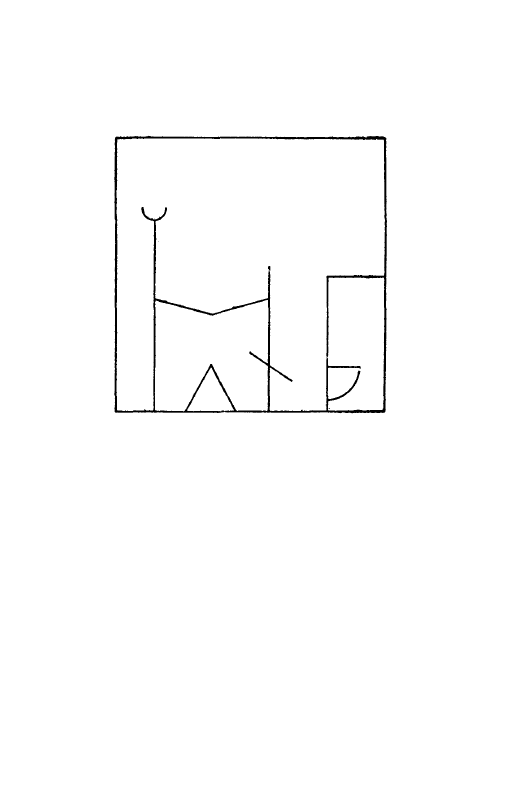
69
SIMPLIFICATION AND SYMBOLIZATION
angles, is intended for the General's sword. To denote the
convention two lines are drawn, which meet together in the
centre, and represent the shaking of hands, or a meeting.
The convention was formed in Egypt, which is signified by a
pyramid. The Cabinet of London is typified by the outline
of a cabinet on the right of the diagram; the head of a ship
placed in the oblong denotes London, as it is frequented
more than any other port by ships."

CHAPTER XI
MODES OF COMPARISON
IN studying imagination we have seen that one thought or
idea arises in connexion with another as a result of previous
experience in which those two things have been closely
connected. For example, an elephant might remind us of a
zoological garden that we have known, or of the teak-wood
forests of Burma. When this happens, however, there is no
mental act of comparison between the elephant and the zoo
or between the elephant and the teak forest. Their relation
ship is a case of proximity in the world of sense-objects.
They simply happened to come together, just as a tree may
grow on a mountain. The connexion is a matter of chance.
But when comparison between two things occurs, you
have something more than experience and imagination.
Then reason has arisen.
Because of the logical constitution of our minds we are
capable of comparing any two things that exist. This com
parison consists of two parts—we take note of the particulars
in which the two objects resemble each other, and also of
those in which the two differ from each other.
If we did not note the difference as well as the resemblance,
there would be no comparison. The two things would be
exactly the same. Suppose we compare a horse and an
ordinary table—to take a rather far-fetched example. Well,
you may laugh, but both are quadrupeds. Among the
differences, which are many, the most striking is that one
can move by itself and the other cannot.
It is not usual for us to need to compare such unconnected
things. In practical life a carpenter might receive an order
to make a chair and a stool. To do this he must be able to
compare them; they are both articles of furniture to sit
73

74 MIND AND MEMORY TRAINING
upon, but generally they differ in that one has a back and
the other has not.
Another common comparison would be between a tree
and a bush. I am not an expert botanist, so I can suggest
only a very ordinary comparison—that while both are
growing and woody plants, one has a long stem raising its
foliage some distance from the ground, and the other has not.
Another element of reason is the perception of causes and
effects. Very often, however, what people call causality is
simply an example of contiguity in time. For instance, it
may be said that gluttony is the cause of indigestion, and that
fatigue is the cause of sleep. What we really mean is that we
have observed that gluttony is generally followed by indi
gestion and fatigue by sleep. But really the cause is the
peculiar physiological constitution of the animal or man;
some creatures can stuff themselves with food to the limit,
with no ill effects, and some of our muscles—for example
the heart—never sleep. In common talk we say that if a
lamp is brought into a dark room the light in the room is
the effect of the lamp. It is not in a logical sense, but only
in a popular sense, that the lamp can thus be called the cause.
A very ignorant person observing that day is always
followed by night, and night by day, might think that day
is the cause of night, and night again the cause of day. But
the real cause is something which holds both the elements of
the sequence in its grasp—the rotation of the earth in rela
tion to the sun. If I say that the rotation of the earth is the
cause of day and night, I have performed a rational act, in
the department of causality.
The present section of our study will deal chiefly with the
rational connexions between successive ideas in the mind.
We will not separate them entirely from the imaginative
connexions already considered, because, as the mind moves
on from one idea to another, sometimes it proceeds by a
rational road and sometimes by one directed by imagination.

75
MODES OF COMPARISON
I have already presented the student with an outline of
the four Roads of Thought, and explained that three of them
involve rational acts of comparison while the fourth relates
to strong impressions on the imagination through the senses.
Objects coming together in the mind are thus connected
either by comparison or contiguity. To avoid any possible
confusion of these two, I will now give more examples of
contiguity; the student will then be in a position to ignore
all cases of contiguity while studying the three roads of
comparison, with their subdivisions.
Contiguity. When I think of a banyan tree, at once I also
think of the huge tree outside the window of a room where
I used to write, and of the squirrels and crows which thronged
its branches. A banyan tree is not necessary to the idea of
squirrels, nor are they any part or connexion of a banyan
tree; nevertheless, these have been so closely associated—
quite accidentally—in my experience that the thought of
either now evokes a picture containing both. There are
probably few of us who can think of the Duke of Wellington
without some vision or idea of the battle of Waterloo; or
again of Napoleon without some thought of Corsica or of the
island of Saint Helena, because these are always pictured
together in history; yet they are not necessary associates.
A thought of William the Conqueror is almost inseparable
from another of the village of Hastings, not because these
are necessarily connected, but because they are vividly,
though accidentally, presented together in experience.
Another case is that of George Washington and the cherry
tree.
Similarly we all remember incidents connected with the
places where we have lived, the countries, towns, houses,
rooms, furniture, people, accidents of every kind—an im
mense collection of incidents. For me, many events of
childhood can be recalled and placed in their proper relation
and sequence by their connexion with the houses in which I

76 MIND AND MEMORY TRAINING
lived at different times. It is a personal matter, in which the
contents of my mind are bound to differ from those of others.
Again the idea of elephants is for me particularly associated
with the city of Baroda, because when I was there for the
first time I was each night awakened by an imposing pro
cession of them passing the balcony on which I lay. For
many people it is, no doubt, more closely linked with pictures
of the zoo, of great wooden bars and the ringing of bells for
pennies and biscuits.
More familiarly, pen is associated with hand, boots with
feet, carriage with horse, ship with sea, sleep with bed, spade
with garden, letter with post office, cow with grass, and so
on to an unlimited extent. Yet all these pairs of ideas have
purely accidental connexions, the members of each pair
having no comparative relationship with each other. They
are contiguous, having a relation for sense or imagination,
but not for reason.
It is different, however, with banyan tree and hanging
roots, squirrel and bushy tail, crow and black colour,
Wellington and Napoleon, cherry tree and blossom, cow and
horse, possibility and impossibility, house and room, elephant
and trunk, Bombay and Baroda. All these have a relation
ship of comparison of some kind. A banyan without its
roots, or an elephant without its trunk, would be incomplete
ideas, while cows and horses, Wellington and Napoleon,
Bombay and Baroda, obviously resemble each other in their
respective pairs.
Let us now examine more in detail the first three Roads of
Thought—those concerned with comparison; the first Road
can be conveniently subdivided into three, and the second
and third into two each—
I. Class
A. This occurs when one idea includes another because
of a principal characteristic which one has in part and the
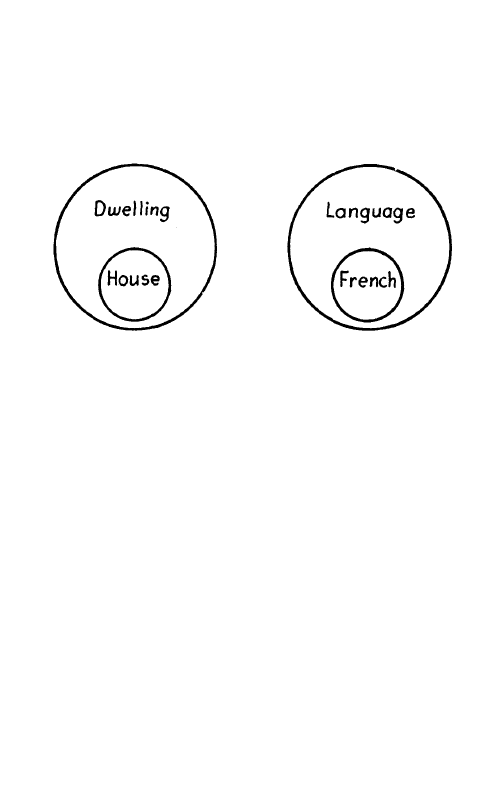
77
MODES OF COMPARISON
other in whole. It may be otherwise expressed as the con
nexion between an object and the class to which it belongs.
Examples are: animal and cow; Englishman and man;
dwelling and house; drink and tea. We may symbolize the
relationship by one circle within another, thus—
B. This occurs when two ideas or objects have a prin
cipal characteristic in common, that is, when two objects
belong to the same class. Examples are: cow and horse
(both animals); chair and table (both articles of furniture);
red and blue (both colours); daisy and buttercup (both
flowers); train and ship (both means of transport); box and
bag; snow and ice; father and son; beech and oak. We may
symbolize the relationship by two circles overlapping, as
shown in Fig. B page 78.
C. This occurs when two ideas or objects have a principal
characteristic in common, but express opposite degrees in
regard to it. Examples are: hot and cold (both temperatures,
but opposite); up and down (opposite directions); animate
and inanimate; curvilinear and rectilinear; fire and water;
light and darkness; sage and fool; king and peasant. We
may symbolize the relationship as shown in Fig. C page 78.
2. Part
A. This occurs when two things or ideas are respectively
whole and part of some natural object or idea. Examples
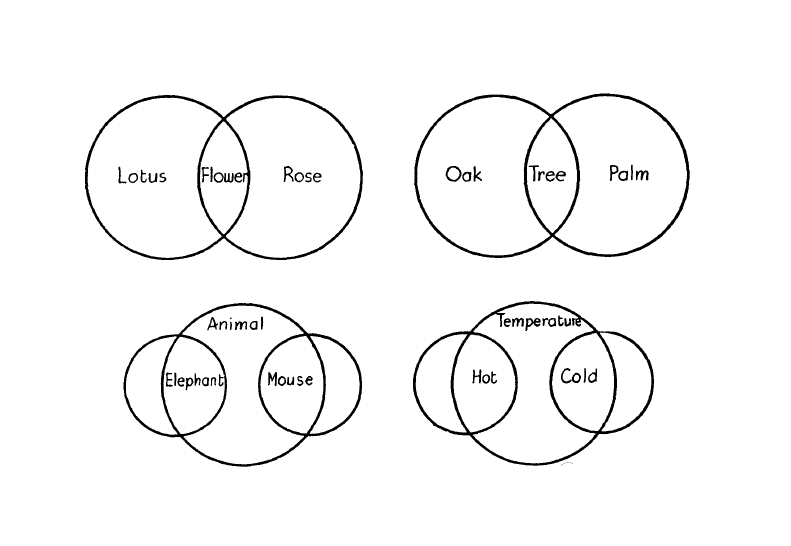
FIG.
B
FIG.
C
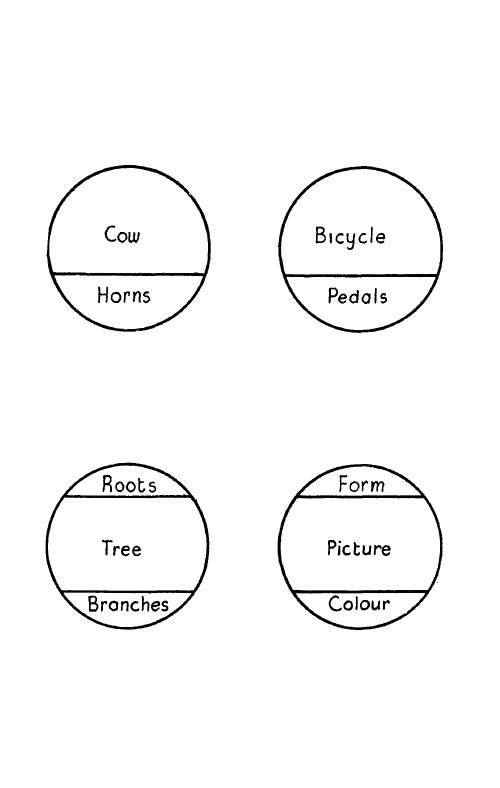
79
MODES OF COMPARISON
are: tree and branch; whale and blubber; Bengal and India;
sea and waves; book and page; box and lid; cow and horns;
bird and wings; ten and five; river and water. We may
symbolize the relationship thus—
B. This occurs when two ideas or objects are different
parts of the same whole. Examples are: hull and sails (of a
ship); thumb and finger (of a hand), root and branch (of a
tree); nerves and muscles; stairs and door. We may sym
bolize the relationship thus—
3. Quality
A. This occurs when two objects or ideas are related as
object to quality, or substantive to adjective. Examples
are: lead and heaviness; snow and whiteness; fire and
heat; ball and round; bottle and glass; coin and gold;
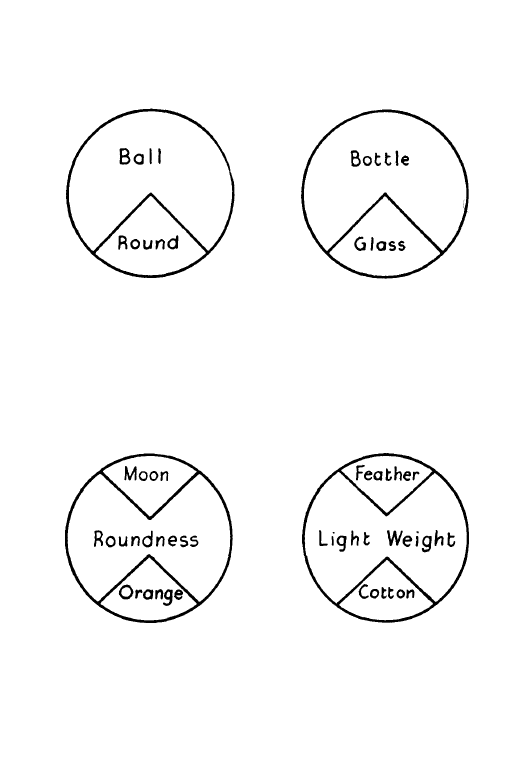
8o
MIND AND MEMORY TRAINING
bag and leather. We may symbolize the relationship
thus—
B. This occurs when objects having the same prominent
quality are linked together by some striking feature possessed
by both, the feature not being their class, but a quality of
each of them. Examples are: moon and orange (both round);
paper and snow (both white); ink and negro (both black);
feathers and cotton (both light); church spire and factory
chimney (both high). We may symbolize the relationship
thus—
This completes our seven logical connexions, which, with
Contiguity or Proximity subdivided into Co-existence and
Succession, make a total of nine. In practice, however, it
will nearly always be sufficient to classify a connexion as
belonging to one or other of the four Roads of Thought:
Class, Part, Quality, or Proximity.

CHAPTER XII
A LOGICAL SERIES
IT often happens that a student requires to remember a
series of things. The days are gone, I hope, in which children
are expected to reel off the names of all the kings and queens
of Israel or of England, or of the capes on the coasts of
Europe, Asia, Africa, or America. But it does often happen
to anyone to be a convenience to be able to memorize a series
of foreign words. Thus we might put together in suitable
order the exceptions given by Dr. Pick as a mnemonic for
the genders of French nouns, referred to in Chapter VIII.
The reader will readily see why I have said "in suitable
order" if he remembers our experiment with a series of ideas
in Chapter II. In that case he or she must have found that
it was easy to remember cat—milk—dairy—shed—roof—top
—head — eyes — reading — book — paper — white — moon
—sun—glory—fame, but almost impossible to remember
moon — dairy — head — paper — roof — milk — fame —
eyes — white — reading — shed — glory — cat — top — sun
—book, although the words are the same in both the series.
Let us then run over the easily remembered series, taking
two at a time in order, and notice the Roads of Thought
which made the remembering easy—
Cat and milk (Proximity);
milk and dairy (Proximity);
dairy and shed (Part);
shed and roof (Part);
roof and top (Class);
top and head (Class);
head and eyes (Part);
eyes and reading (Proximity);
reading and book (Proximity);
book and paper (Quality or Part);
paper and white (Quality);
81

82 MIND AND MEMORY TRAINING
white and moon (Quality) ;
moon and sun (Class);
sun and glory (Quality);
glory and fame (Class).
All these links could be expressed in a more familiar way
by simply making sentences to connect each pair of words.
That might be more convenient for a mind quite unaccus
tomed to scientific methods and formulae. Nevertheless, the
method is not as good as that of naming the Road between
each pair, because the act of pausing with the two ideas
before the mind while finding the name of the Road connect
ing them creates a momentary concentration on the two ideas
together, which is the chief cause of their being afterwards
remembered together.
However, for those who wish simply to make sentences I
will lay down the following two rules—
1. When you link two ideas together, always give a clear
reason for their association.
2. Never invent any unnatural reason.
I will now illustrate these rules by the following series:
Yellow — gold — iron — rails — railway — steam — water
— ice — snow — soft — fur — skin — hand — pen — paper.
Yellow and gold; because gold is of yellow colour.
Gold and metal, because gold is a metal.
Metal and iron; because iron is a metal.
Iron and rails; because rails are made of iron.
Rails and railway; because rails are part of a railway.
Railway and steam; because there is steam traction on most
railways.
Steam and water; because these are two forms of the same
thing.
Water and ice; because these also are two forms of one thing.
Ice and snow; because they are forms of the same thing, and
are often found together in winter.
Snow and soft; because snow is very soft.
Soft and fur; because fur is very soft.
Fur and skin; because the fur is attached to the skin of the
animal.

83
A LOGICAL SERIES
Skin and hand; because the skin is part of the hand.
Hand and pen; because we hold a pen in the hand when we
write with it.
Pen and paper; because with a pen we usually write on paper.
Putting some of these in a different order we could make
a more difficult example: water—paper—railway—gold—
steam—fur—pen—snow—metal—skin. The connexions by
sentences might be somewhat as follows—
A sheet of paper is smooth like the surface of calm water.
Or, water is used in making paper pulp. What is the con
nexion between paper and railway ? Sometimes carriage
wheels are made of compressed paper-pulp; also everybody
must be familiar with the forms of the book-stall boys run
ning about in the big railway stations, selling their bundles
of papers. Next come railway and gold. Here it would be
rather unnatural to think of railway trucks heaped up with
gold; it would be better to observe that the railway com
panies are immensely rich and that much gold passes through
their hands. How is gold related to steam ? The use of steam
power has increased the wealth of humanity enormously,
and wealth is represented by gold. The next pair is steam
and fur. Furs conserve the warmth of the body; warmth
produces steam from water, or let us say, steam issues from
a hot place, such as a volcano, while the most valuable furs
are obtained from the cold latitudes, there being a contrast
between the two ideas in this respect. We come to fur and
pen. The hair of animals is used (among other things) for
making artists' brushes, or "pencils," and the brush and the
pen are akin, since both are used for the same purpose, that
of writing and drawing. We might associate these two in
another way. Fur and feathers are the coverings of animals
and birds, respectively, and a quill pen is made from the
feathers of a goose. As for pen and snow, let us say the
feather of a quill is as white as snow. In deference to rule
2 we must, of course, avoid making an idea such as "I find

84 MIND AND MEMORY TRAINING
a pen in the snow," or " I see a snow man eating a fountain-
pen." Such ridiculosities have no part in the true art of
memory. Snow can be connected with metal because one is
soft, the other hard. Metal can be connected with skin on
the ground that knights of old used to wear metal armour
and though as a rule it did not touch the skin, it was, as it
were, a metal skin to the body. A good alternative is the
idea that the skin of a ship is nowadays made of metal.
As an illustration of the use of the Roads in remembering
a number of words I will take the collection of French nouns
given in Chapter VIII. Dr. Pick put them in the following
order, which he considered the most convenient that
could be made with these specific words. I will, however,
give my own Roads of Thought, as I consider them an
improvement upon the various associations of thought put
forward by many teachers of mnemonics during the last
few centuries.
I give the English words, in order to present the meanings
so plainly that he who runs may read, but let the student of
French repeat the series to himself only in that language.
To emphasize the importance of isolating each pair of ideas
and thinking of only two at a time I will show the series in
tabular form.
Conjoin tooth with rabies (Proximity);
,, rabies with pity (Proximity);
,, pity with mercy (Class);
„ mercy with end (Proximity) ;
,, end with peace (Proximity);
„ peace with law (Proximity);
„ law with faith (Class);
„ faith with virtue (Class);
„ virtue with friendship (Class);
„ friendship with nation (Proximity);
,, nation with tribe (Class);
tribe with ant (Class);
,, ant with mouse (Class);
„ mouse with sheep (Class);
„ sheep with leap (Proximity or Quality);

85
A LOGICAL SERIES
Conjoin leap with mare (Proximity or Quality);
,, marc with partridge (Class);
,, partridge with forest (Proximity);
„ forest with stern (Part);
,, stem with part (Class);
,, part with half (Class);
,, half with page (Class—half a leaf) ;
,, page with syllable (Part or Proximity);
,, syllable with image (Class—all words are symbols).
For the remainder of the series I will leave the student to
find the Roads for himself or herself, as an exercise.
Conjoin image with water;
„ water with swimming;
,, swimming with cough;
,, cough with thirst;
„ thirst with hunger;
,, hunger with death;
„ death with scythe;
„ scythe with hand;
„ hand with skin;
,, skin with plain;
„ plain with nave;
„ nave with partition-wall;
„ partition-wall with chalk;
,, chalk with glue;
„ glue with cage;
„ cage with screw;
„ screw with key.
The reader may wonder why I have so much insisted that
only two ideas be taken together. The answer is: Because
the ability to forget or put things out of mind is essential to
a good memory. If you want to remember something new
to you you must, at least for a moment, concentrate upon it
in relation with something which is already familiar. It is
impossible to obtain that concentration while you are trying
not to forget something else. To emphasize still further this
necessity for forgetting, I will give one more exercise showing
the process—
Animal and cow (Class), forget animal;
cow and horns (Part), forget cow;

86
MIND AND MEMORY TRAINING
horns and knife (Class or Proximity), forget horns;
knife and spoon (Class), forget knife;
spoon and tea (Proximity), forget spoon ;
tea and wakefulness (Proximity), forget tea;
wakefulness and sleep (Class), forget wakefulness;
sleep and vigour (Proximity), forget sleep;
vigour and Hercules (Quality), forget vigour;
Hercules and Greece (Proximity), forget Hercules ;
Greece and Italy (Class), forget Greece;
Italy and top-boot (Quality), forget Italy;
top-boot and highwayman (Proximity), forget top-boot;
highwayman and horse (Proximity), forget highwayman;
horse and swiff (Quality), forget horse;
swift and eagle (Quality), forget swift;
eagle and peak (Proximity), forget eagle;
peak and snow (Proximity), forget peak;
snow and cotton-wool (Quality), forget snow;
cotton-wool and gas (Quality), forget cotton-wool;
gas and liquid (Class), forget gas;
liquid and sap (Class), forget liquid ;
sap and bark (Part), forget sap;
bark and skin (Class), forget bark.
After studying these relationships, close the book and
repeat the whole series slowly forwards and backwards. If
you have any difficulty in remembering any of them, try
every possible device before you consent to look up the list
in the book. If in going forward you come to a stop, start
from the end and work backward until you meet the
difficulty in the rear. If that does not avail, take the word
next to the missing one, and ask yourself whether the con
nexion was one of Class, Part, Quality, or Proximity. The
recovery of the last idea is sure by this method. One should
not submit to the ignominy of looking up the list, either as
an admission of failure, or worse still as a capitulation to
mental indolence. The mind should be firmly made to render
complete obedience. When repeating the words you need
not recall the relationships or linkages, except when a
breakdown occurs.
To complete my emphasis upon the placing together of
two ideas, let me explain further:

87
A LOGICAL SERIES
It must be observed that two separate or dissociated ideas
will not co-exist in the mind without blending. A new idea
can come forward in thought only by linking itself with
another already in the mind. If two ideas are brought to
gether, cither they will blend into a larger unit, or the
stronger will push out the weaker, which will then slip out
of attention. Link two such ideas by a third, which is com
mon to both, and at once they will remain together com
fortably before the attention.
Picture, for example, in your imagination a pen and a
hand separately. Now try to hold these separate ideas at
once before the mind. You will find that the attention runs
rapidly to and fro from one object to the other, and each is
lost in turn; but if you picture the pen in the hand in the act
of writing it becomes easy to hold them together without
any variation of attention, because they are then really one
idea, the two objects having a unity of purpose and action.
The sequences of ideas which we have studied in this
chapter may seem somewhat artificial, but really all our life
is such a sequence. There has been a continuous succession
and if we wish to remember something that has occurred
within it we can often do so with the aid of outstanding land
marks by the roadside. The ways of memory are not unlike
those of outer experience.
In finding our way about the outer world from one place
to another we have three particular guides. We may reach
our goal by fixing our eyes on a distant spire or mountain
peak, and gradually working towards it, overcoming or cir
cumventing such obstacles as we may find in our path. We
may follow out a well-marked road, trusting that it will take
us to the place we wish to reach. We may take note of a
succession of landmarks, and proceed from point to point
with their aid. In a well laid out country these are amply
provided. There is no road without landmarks—at this
turning an inn, at that a stout and ancient oak tree, at"

88
MIND AND MEMORY TRAINING
another a tinkling rivulet, at the next, a farm-house with a
barking dog, and children playing in the yard.
In the sequence of memories, also, the roads have their
landmarks—ideas each of which leads on to the next and
suggests it. With their aid the train of thought can almost
always find its way with certainty along the roads and paths
which it has trodden before. At the age of six I had a severe
illness, at twelve my father removed his home to a new house,
at sixteen I went to college—such are the pronounced mem
ories from which most persons would be able to trace out
details of the past.
The man of orderly and well-appointed mind finds himself
living as in a pleasant, prosperous country with well-kept
roads, well-stocked lands and smiling gardens, whether his
range be small or large. Another may live in a barren
wilderness or jungle twenty times as large, but to move from
point to point must cross the arid, thirsty wastes of useless
knowledge, scramble over the broken ground of mental
rubbish, wade through the pestiferous marshes of ill-
associated thoughts, or force his painful way through the
tangled undergrowth of confused purposes and ideas. It is,
of course, largely these ill-associations that are responsible
for bad memories, for when they are numerous the roads and
tracks are almost obliterated.
In the following chapter I will try to show how the mind
travels, and we may then consider the means to guide its
future movement.

CHAPTER XIII
FOOTSTEPS OF THOUGHT
I
MUST
now remind the student that the mind is dynamic
and that it walks as though on two feet. This I have already
explained. Sometimes thinking is called a flow of thought.
Very good, but I prefer the simile of walking, as that reminds
me of the static elements—the ideas or mental images on
which the feet of the mind may be thought to step.
This is an important point. Therefore, even at the risk
of repetition let me give another example, from my own
experience. I start by thinking about a cat. A few moments
later I find myself thinking about a very strikingly designed
iron bridge that spans the river Indus between the towns of
Sukkur and Rohri. I might imagine, if I did not know the
laws governing the process of thought, that my mind had
leaped from the idea of the cat to the idea of the bridge, that
it had merely casually forgotten the first thing and merely
casually thought of the other. But if I take the trouble to
recall what has happened and to study the matter I shall
find that there was an unbroken chain of images leading
from the first to the last, that it was on a definite series of
stepping stones that I crossed between the two.
I thought of a cat, then of a cat lying upon a hearth-rug
before a fire (a very common thing in Europe), then of the
hearth-rug without the cat, then of the hearth-rug being
made in a factory, then of a particular factory that I knew
very well, which was near the river Indus, and then of the
scene further up the river where the great bridge already
mentioned rises into the air.
As I have said before, the process is just like walking; one
mental foot comes down on the idea of the cat, the other
moves forward and rests on the idea of the hearth-rug; the
89

90 MIND AND MEMORY TRAINING
first foot is lifted from the cat and moves forward to the
factory. When it is settled there the second foot is lifted
from the idea of the hearth-rug and brought down upon the
river Indus. Next the first foot is removed from the idea of
the factory and settled upon the Sukkur bridge and so on.
The process is also like the beating of the heart. There
is first a thought, then it is enlarged by the addition of
another; then it is contracted by the elimination of the first.
Expansion and contraption of thought thus alternate as
regularly as in the beating of the heart. When the expansion
takes place consciousness becomes vaguer, for the light of
attention is more diffused, because it covers a larger field;
but when the contraction takes place the object is vividly
illumined and consciousness is at its best in point of quality.
The contraction is concentration; the expansion is medita
tion. The movement is thought.
Now, two things may happen in this process of thought.
The attention may simply drift from one image to another
with no settled purpose or direction, taking at each step the
easiest path, following old habits of thought, keeping to the
beaten track, or going the easiest way, like a stream of water
finding its way down hill. Or it may be set to the work of
exploration and discovery in a certain definite direction
decided upon before the process begins.
The first of these alternatives is mind-wandering; the
second is thinking. Some minds scarcely do anything but
wander; others are capable of thought.
Knowing this, we are in a position to practise thinking,
just as definitely as we can undertake muscular development
with or without physical apparatus. We may convert our
thought-activities from streams of mud and sand into chains
of gold.
Let us define some of our words and see where we stand.
(1) The attention is what is commonly called the will, which
is ourself awake, expanding and contracting like a heart.

91
FOOTSTEPS OF THOUGHT
spanning portions of what we may call the mental world,
as with two feet. (2) The mental world is a subjective region
full of ideas. As the attention poises itself on one of these,
whether simple or complex (a larger or smaller portion of
that world) it can look around and see some of the mental
scenery, the ideas connected with that upon which it
rests. (3) Thought is the process of moving from one foot
to the other. Ideas are mental objects; thought is mental
travel; the will is the traveller. Let us examine these
more fully.
There is a sense in which we are all very much aloof from
the world. Our life is really in our minds; there we see the
reflections of the objects around us; there we feel our
pleasures and pains. Sitting in this mind I am at the
moment somewhat aloof from my surroundings, and intent
only on my writing.
Suppose I stop writing for a moment and look round. In
front of me are the table and chairs, on and against the walls
are book-shelves, cabinets, a clock, a calendar, pictures, and
numerous other things. I look through the windows and
there are the tops of the palm and mango trees, the white
March clouds of Madras, and beyond them the ethereal blue.
I attend to my ears instead of my eyes—a crow squawks
over on the left; the clock ticks on the wall; footsteps shuffle
along the corridor; there is a murmur of distant voices; a
squirrel chirrups near at hand; some pandits are droning in
the Sanskrit library near by; a typewriter rattles somewhere
else; and behind all these is the roar of the breakers of the
Bay of Bengal on the beach half a mile away. I attend more
closely, and hear the blood rumbling in my ears and the
long-drawn whistle of some obscure physiological process.,,
I turn my attention to my skin, and now I feel the pen
upon which my fingers gently press, the clothes upon my
back, the chair on which I sit (I might say "in which" if it
were more comfortable), the floor upon which my feet are

92
MIND AND MEMORY TRAINING
placed; the warm soft wind pressing upon and wafting my
hands and face.
I wish to emphasize this point: at any moment I am aware
of only a tiny fragment of the world. I have travelled about
in this body for a number of years, seen, heard and felt many
things in different parts of the world, but how little of that
experience of mine can exist in my consciousness at any
moment, and how inexpressibly small even the whole of it
has been in comparison with all that exists which I have
not seen or known!
I must accept my natural limitations, but fortunately I
am not a mere mirror in which the objects of the world
reflect themselves. I have the power of attention. I can
ignore some things, and pay attention to others. This
applies to both sense-objects and ideas.
This being so, let us understand the value of control of
the mind, so that what we do we do intentionally. Let us
train the mind (1) to move in the direction we have chosen,
and (2) to extend and improve its range of vision, its ability
to see clearly and rightly the events which it meets on the
road of life.
Before we consider (1) let us look again at (2), which is
concerned with the static elements, or stepping-stones, in
the process of thought.
When the foot of thought comes down upon an idea it
does so like that of an elephant, which spreads when it
settles, and covers a certain amount of space. Therefore
when you turn your attention to an idea you do not find a
solitary, clear-cut thing, but one thing associated with many
others.
Materially that is the case also; you cannot find anything
by itself—books without eyes to read them, pens without
paper to write on, shoes without feet to be covered, cups
without mouths to be poured into, houses without people to
live in them, are unthinkable things.

93
FOOTSTEPS OF THOUGHT
But every idea has a centre where the vision is clear, from
which it gradually shades away. Just as when I fix my eyes
upon the ink-bottle before me I see also vaguely other things
on the table, the articles of furniture to left and right, the
trees in the garden outside, a multitude of details; so also
when I fix my attention on a particular thought I find a
mass of thoughts around it, gradually shading off, becoming
more indefinite as more remote, and finally losing themselves
at no definite limit. So our stepping-stones may be large or
small, on account of various factors, especially our famili
arity with the subject and our degree of concentration at
the moment.

CHAPTER XIV
THE POWER OF A MOOD
WE have already seen that when I thought of a cat I thought
of a hearth-rug (which is one of the ideas that can come out
of that magic box), but I might apparently equally well have
thought of whiskers, milk, claws, or mice. One of such ideas
was sure to form the next stepping-stone in my chain of
ideas or flow of thought. This chain of thoughts presents an
unbroken succession. Each idea is succeeded by another,
like the links in a chain. As in time things follow one after
another, only two moments with their contents being linked
directly together, so in the flow of mental activity images
follow one after another, only two being directly connected.
There is some kind of a choice at every step in the process
of thought, and it is instructive to observe to what widely
seperate goals every parting of the ways may lead, since
every idea calls up such a great variety of associations.
When I used to look at the banyan tree outside my win
dow I saw and heard the throngs of crows and squirrels; and
now any thought of a banyan tree will at once bring within
its circle a vision of this particular tree, with its spreading
branches and hanging roots, the fern-pots beneath it, the
audacious crows and the chattering, shrieking, striped brown
squirrels. But at once thoughts of other kinds of trees also
enter into the circle of attention, though further from the
centre; the tall, straight palm, the wrinkled oak, the slender
poplar, the sad, shorn willow of central England, the trim
pine among the northern snows.
Then again, as I view the spreading branches of the ban
yan tree and its many trunks, bearing the weight of giant
arms ten centuries old, my mind runs back to the history
which it might tell—of the floods of the river running near,
94

95
THE POWER OF A MOOD
of the building of houses and the making of roads, and, far
back in the past, of the breezy jungle growth, the jackals
and the tigers, the birds and the monkeys and the countless
ants and scorpions and snakes which have nestled in its
hollows and lived among its branches in the centuries past.
If my mood changes again I might notice its vast extent—
a mountain of wood—and think how an army might shelter
beneath it, how it would give timber to build ten houses
or make a thousand roaring fires. Thus the banyan tree
calls up different kinds of thoughts according to my mood.
The manner in which anyone's thought will turn at the
parting of the ways which occurs at every step in thought
depends upon his mood. Consider this idea of the tree. It
has many thoughts attached to it, such as those mentioned
above, or those represented in the following diagram—
1. Garden, field, etc.
2. Banyan, pine, etc.
3. Age, size, value, etc.
TREE
4. Bush, hedge, plant, etc.
5. Leaves, branch, bark, etc.
6. Crows, squirrels, insects, etc.
7. Seed, blossom, fruit, etc., and so on.
If I were a farmer my thought might pass along line 7 to
an idea of fruit. Fruit would then become the centre of
another circle of ideas, those belonging to lines 1 to 6 having
been passed by, almost or entirely unnoticed. The mind
might then pass on to the idea of market, a thought which
has no direct connexion with the tree, and the tree is now
forgotten as the moving attention pursues its course.
If I were a merchant my thought might find itself some
where on line 3, interested in lumber, which is directly
connected with the thought of the tree, and from that it
might pass on to the current prices of timber, and on to
financial and banking questions and other matters still more
remote.
A naturalist might pass along line 6; a huntsman or a
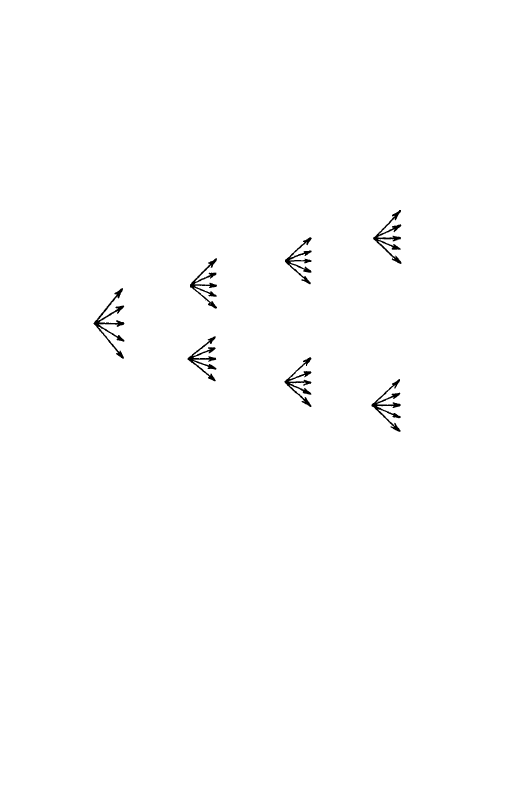
96 MIND AND MEMORY TRAINING
pleasure-seeker along line 1. Almost all would lose sight of
the tree at the third step of thought.
It is marvellous to what an extent the future depends
upon the choice I make at every moment as to my next step
in thought. The following diagram illustrates how slight is
the parting of the ways of thought, but how wide asunder
the paths soon go—
Bridge, etc.
Indus
Factory
Ganges
Hearth- rug
Wheel
Wool
C a t
Dairy
Milk
Cradle
Baby
Celluloid
Rattle
Thunder, etc.
It is a choice between many ways that is being offered to
us at every moment. Our attention is being called from a
great number of directions at once. There is an endless com
petition among the objects of the senses for our notice; there
is likewise an endless competition among the ideas within the
world of the mind for our attention. The attention finds itself
surrounded with various alluring baits. Which will he take at
any given time ? Will he prefer the hearth-rug or the milk ?
In the succession of ideas, what is the nature of that
internal mood which determines that one idea rather than
another shall be appropriated, shall be raised to the throne
in our minds, in the succession that takes place there ? Why
should it not be some other idea, which is quite as closely
associated with the original one?
Let me put the problem in another way. Suppose I am

97
THE POWER OF A MOOD
sitting at my desk in the centre of my room when suddenly
all the four doors open at once, and with the precision of the
cuckoo from an old cottage clock my friends Smith, Brown,
Jones and Robinson enter and exclaim with one voice: "Ah,
Wood, I want to consult you about something !"
Which will first claim my surprised attention ? This will
certainly depend upon something. It will depend upon the
mood of my mind. The only other thing which could deter
mine it would be some unusual peculiarity in attire or gesture,
which we are not supposing to be present. If Brown were
dressed as a Turk he would claim first attention; but in the
absence of any such startling or abnormal thing, nothing
but the mood of the mind at the moment could determine
which selection the attention would make.
Again, suppose that I am engaged in the work of putting
a book through the press, and someone comes to the door
and calls out: "Proofs!" I have visions of printed sheets
and the drudgery of correcting them. If I am engaged in
studying a scientific problem, the same sound will immedi
ately awaken a totally different set of ideas. Here it is clear
that the difference which determines the sequence lies in the
mind, not in the outside world.
Similarly, if Mr. Lincoln Inn, the eminent barrister, is in
London, and someone utters in his hearing the word "bag,"
he at once thinks of briefs and all the paraphernalia of his
profession; but if it is the vacation and he is engaged in his
favourite sport of shooting upon the Scottish moors, the
word at once brings before him gratifying visions of forlorn-
looking birds tied by the legs, and pleasant recollections of
his skill and prowess and past triumphs on the field of sport.
At different times different moods—purposes, habits, and
interests—dominate our minds, and it is the mood which is
the cause that one idea rather than another should be
selected from the many that surround every thought and
object. As a powerful magnet polarizes soft iron within a

98 MIND AND MEMORY TRAINING
considerable area, not only in immediate proximity, so does
the temporary or permanent mood polarize each incoming
idea as soon as it approaches the outermost sphere of the
field of attention.
Most of us are familiar with the schoolboy experiment
with a test-tube loosely filled with iron filings. We corked it
and laid it flat upon the table, and as we passed a magnet
slowly over it we watched the filings rise and turn over and
lay themselves all in the same direction, so that they became
a lot of little magnets all acting together. And we then found
by experiment that the tube of filings had become a magnet.
At first the filings lay higgledy-piggledy; even if they had
then been magnets the influence of one would have neutral
ized that of its neighbour, because of their different direc
tions ; but now that they lie in line they act together as a
magnet, influencing all soft iron that is brought near to them.
So also if your thoughts lie higgledy-piggledy in the mind,
pointing in all directions, their effects will destroy one an
other. If you want to know the present condition of your
mind, observe the nature of your thoughts when you are
not deliberately thinking of something definite—they form
the background of the mind, and it is possible that they may
be a confused and sorry crowd. If we desire success in any
particular pursuit, we had better polarize those thoughts.
We can now understand that success in the pursuit of any
aim may be promoted by our establishing a permanent
mood in its direction. When this is done, even the most
trifling or the most adverse events will fall into line and
prove of service to us in the gaining of our end. The will
controls thought. It can form a mood covering a period of
time or a specific enterprise.
If you would like to undertake a little experiment in keep
ing a mood through a series of ideas try the following—
Open a book at random, and note the first noun that
catches your eye; this idea will be your starting-point. Next

THE POWER OF A MOOD 99
open it at a different page, and again take the first noun;
this will be your goal. You are interested in reaching that
goal. It determines your mood for the time being. Then
think consecutively from the starting-point to the goal.
For example, I have turned up "law," then "portal"; I
must think away from "law," keeping "portal" in view
until I reach it. This proves to be an easy matter, for I
think of a certain law court that I know, which has a
strikingly gloomy entrance.
A second case: "cloak" and "bottle." Again it is easy
because my wife has a bottle-green rain-coat.
A third case: "turmoil" and "wall"; I might think of
many things in connexion with turmoil, but under the present
conditions I find myself thinking of a medieval battle
against the wall of an old fort near which is a college where
I served as Principal for some years.
These exercises will help you to realize how a mood im
posed by the will actually works, and will assist you to impose
one permanently or temporarily on the mind at any time, so
that your life may be concentrated on a definite purpose. In
addition to its general purpose in life, you will find the
power to impose moods very useful as enabling you to turn
rapidly and effectively from one piece of work to another.

CHAPTER XV
EXPANSION OF IDEAS
IN Chapter III we have studied how to develop concentration
by thinking of many things connected with a chosen object,
taking care at the same time not to lose sight of it. For that
purpose we made use of the four Roads of Thought.
Now I propose to the student a very similar experiment
for the purpose of expanding ideas, so that he may be able
to do his best thinking about any object.
Select your object, let us say "house," and proceed to
clothe it with all its directly connected ideas. The result
may be somewhat as follows, but should be much fuller, as
there is not room here for a complete picture.
HOUSE
Road I. A. Abode, dwelling, domicile, residence, habita
tion, address, lodging.
B. Cottage, mansion, cabin, shed, hut, hovel, tent,
shanty, barrack, palace, castle, kennel, sty, pen, nest, hive,
wigwam, hutch, villa, lodge, hotel, inn, bungalow.
C. Prison.
Road II. A. Room, hearth, floor, wall, door, roof,
foundation, brick, mortar, tile.
Village, town, farm, camp, park, block, row, square, street,
road, terrace.
B. Warehouse, shop, factory, field, orchard, garden,
barn.
Road III. A. Large, small, comfortable, ugly, beautiful,
new, old, Elizabethan, Georgian, Colonial, modern, stone,
brick, wood, concrete, country, town.
B. Museum, school, factory, workshop, store, church,
temple.

101
EXPANSION OF IDEAS
Road IV. A. Furniture, crockery, fire, water, electricity,
gas, bath, architect, builder. Also houses you have known or
particularly noticed.
B. Comfort, safety, health, companionship, cleaning.
As another example I will take an abstract subject—
PEACE
Road I. A. Virtue.
B. Harmony, concord, friendship, calm, agreement, sym
pathy.
C. War, enmity.
Road II. A. Good citizenship, worthiness, holiness.
B. Industry, devotion, perseverance, altruism.
Road III. A. Fraternity, friendliness, tranquillity.
B. Sympathy, game, agreement, arbitration, good-
humour, co-operation.
Road IV. A. Pipe, treaty, League of Nations, plough
share, pastoral scene, pacifism.
B. Safety, commerce, progress, armistice, truce.
It will be noticed that some of the above lines of
thought have two subdivisions. In IV B, for example, we
have to consider what peace leads to, and what leads to
peace.
In actual experiment along these lines the student will
find that he has to do much thinking. He will ponder a
moment to consider how peace is a virtue. He will consider
whether a factory is part of the same whole along with a
house, or is another object having the same quality as a
house; he will probably finally agree with me that it is
both—for they are often co-parts of a town or village,
and they also have an outstanding quality in common,
the character of being shelters from the sun, wind or rain.
Some may consider that I am wrong in putting prison
in contrast to house, and that I should have put "the
out-of-doors," and that I am wrong in including such

102
MIND AND MEMORY TRAINING
things as hive, nest and kennel in objects belonging to
the same class. Perhaps I am wrong in those cases, but
the student must agree that this exercise gives a good
training in the art of thinking. To do it you are compelled
to think.

CHAPTER XVI
NUMBER ARGUMENTS AND DIAGRAMS
NEARLY
all persons find it difficult to remember numbers,
because these do not in themselves represent objects evident
to the senses and therefore material for imagination. We
can easily imagine two gate posts, three sides of a triangle,
six surfaces of a cube, but when we go beyond this it becomes
increasingly difficult to imagine the quantities of even quite
definite things. It is still more difficult to picture the num
bers representing quantities of units of measure.
A teacher may "feel" that there are thirty-five or forty
boys in his class by seeing them in complete or broken
groups, but of things such as the number of feet in a mile, or
the square root of a number, only a specially constituted mind
could form the slightest image. Numbers in themselves are
meaningless in the imagination.
Notwithstanding this abstract character of numbers, they
have some distinguishable features in their relationships to
one another. It is therefore possible to develop a greatly
improved memory of numbers by studying these features,
so as to acquire familiarity with their distinctions.
To a very little child a cat and a dog are not at first clearly
different kinds of things, but later it observes their points
of difference and recognizes them easily—no longer as in
distinguishable twins. When non-Asiatic persons first go to
Japan or India, they often say that the Japanese or the Hindu
people are all alike. Frequently they find themselves in the
embarrassing position of not being able to distinguish those
to whom they have been introduced a day or two before.
But later on they have no such difficulty. At first the general
colour and formation of face dominated the mind, and only
after it had become quite used to these features did it begin
105

106 MIND AND MEMORY TRAINING
to discriminate the minor differences. In time, indeed, the
new resident forgets the brown colour and does not notice
it at all.
Similarly do we appreciate the facial merits of our loved
relatives, who may be homely or even repulsive to others.
To add another example; it has often been remarked that a
shepherd recognizes by their features the members of his
flock, which look alike to ordinary persons.
Most people have not developed a sense of the relations
between numbers, and have not practised thinking about
them—hence their inability to recognize and remember
them. When this faculty of the mind has been developed
by practice of number arguments, the numbers will become
familiar realities with strong features of their own, and will
be remembered with comparative ease.
Let us suppose that you want to remember your new
telephone number, which is 8715. Write the number down,
look at it, and do all the reasoning that you can about it,
on the following lines: the first number is even and it is the
biggest; the other three are odd, and of those three the
biggest comes first and is one less than the even number;
the middle odd number is the smallest possible; if you add
the last two you have a descending series from 8; the addition
of the two middle numbers equals the first—and so on.
It is a great help in the remembering of long numbers to
divide them into groups, in much the same way as long words
are divided into syllables. The present number conveniently
breaks into 8 and 715.
Looking over the balcony where I am writing this para
graph I see a motor car standing in the road—number
208457. This easily splits into two parts, 2084 and 57. The
first part has only even numbers, if we may consider 0 in
the even series; the last part has two odd numbers, which are
ascending and successive, and follow in order (5 after 4)
from the first part. The first part begins with the smallest
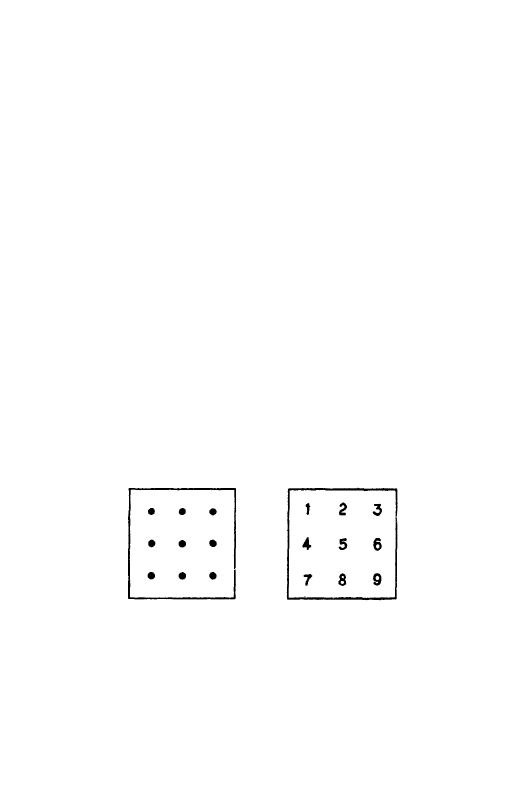
107
NUMBER ARGUMENTS AND DIAGRAMS
positive even number, ascends after o to the highest and
then goes on to half that or double the first—and so on.
The following happens to be the number on a certain
passport: 062246. It presents the peculiarity of being com
posed only of even numbers. It splits comfortably into
three, 06, 22 and 46. The middle pair is easily remembered,
and the other two may be compared. Both end in 6; the
first number of the last pair is the sum of the middle pair,
and the second number follows it successively; the sum of
the last pair is equal to the sum of all the rest—and so on.
There is no group of numbers that cannot be discussed in
this way. After considering for half a minute any telephone
or other number you will find it pleasantly reclining in your
mind whenever you want to remember it. The arguments
will disappear, but the number will remain, and you will
probably soon find also that your observation and memory
for numbers have been greatly improved, so that you can
remember them far better than before, even without special
intention and without resort to these number arguments.
Let us now turn to a method of remembering numbers
Which I have called "Number Diagrams."
Look for a little while at the first diagram above, which is
nothing more than a square containing nine dots in the
centres of the nine equal divisions into which it is easily
broken up in the imagination.
Then look at the second diagram, and imagine that the
divisions of the square have the values of 1 to 9, as shown.
In the first diagram the middle dot can be supposed to
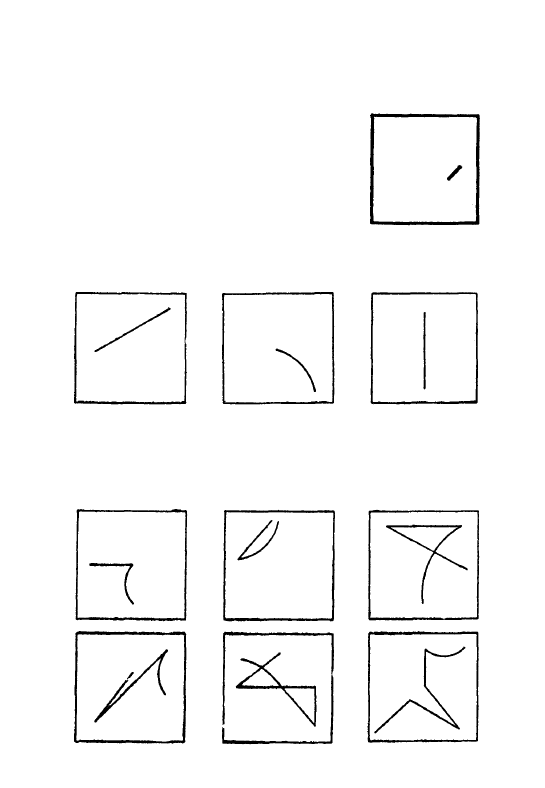
108
MIND AND MEMORY TRAINING
stand for the number 5, the dot in the lower left-hand corner
for the number 7, that in the upper right-hand corner for 3,
and so on. Thus, an imaginary square
containing a dot or a little dash, as
below, will constitute a diagram for the
number 6.
Two Digits. To form a diagram for a
number having two digits, simply draw
a line from the one position to the other,
straight if the smaller comes first, curved if the bigger comes
first, as in the following, representing 34, 95 and 28.
Three Digits. If the number contains three or more digits,
always begin with a straight line and end with a curved one;
thus we may express 458, 242, 6138, 5736, 24691 and
759523 by.
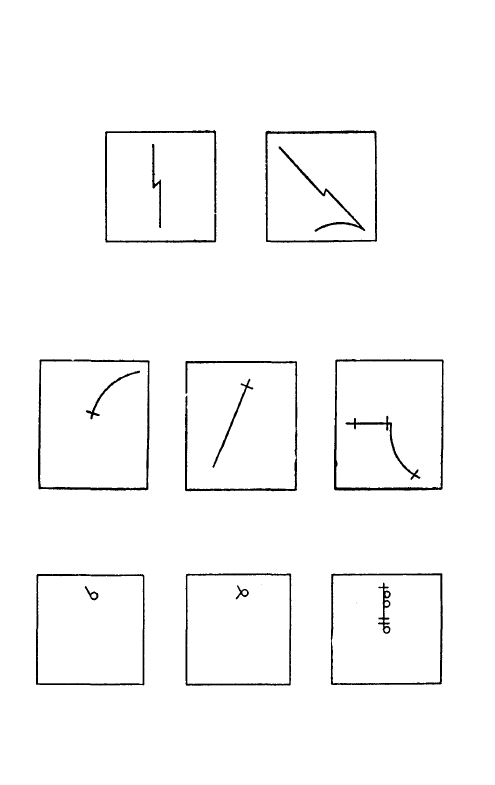
109
NUMBER ARGUMENTS AND DIAGRAMS
If the three numbers happen to lie in a straight line, a
break in the line should be made, as will be seen in the
following diagrams of 258 and 1598:
A little complication is introduced if two similar digits
happen to come together, but the difficulty is overcome by
the device of making a little tick across the line to indicate
the second similar digit; thus, for 553, 227 and 445599 we
form—
A further complication arises in connexion with the
cipher. In this case insert a little circle into the series; thus,
for 20, 202 and 22005550 we have—
If the cipher comes first in the number, detach it
at the beginning if there are only two digits, but attach
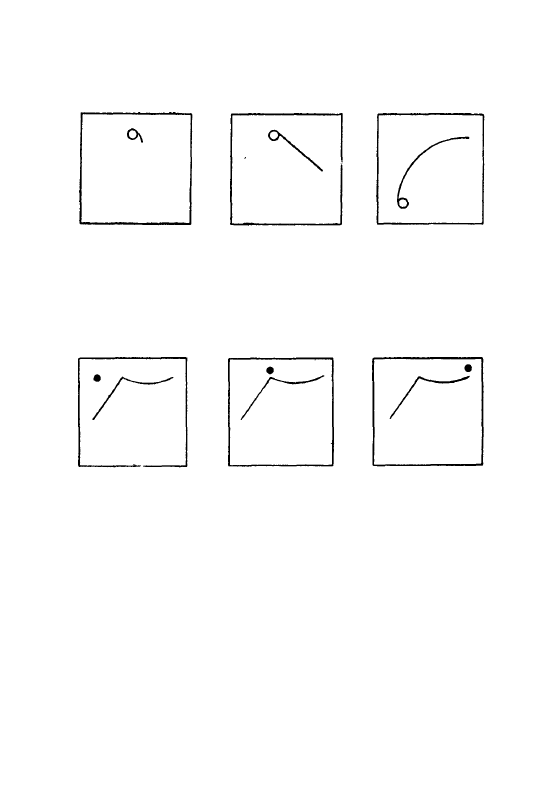
MIND AND MEMORY TRAINING
110
it if there are more, as in the following, representing 02,
026 and 073.
A decimal point may be indicated by a dot placed in that
one of the nine divisions of the square which corresponds to
the position of the number before which it is to be placed.
Thus if the point is to be placed before the first digit, it
will be put in the first division, and so on, as in the
following examples, showing •423, 4•23 and 42•3.
It is a help to make the number diagrams of a generous
size in the imagination—as big as an average picture or even
a window frame.
The two practices in this chapter lend themselves to
immediate employment in practical affairs, so no special
exercises need be prescribed.

CHAPTER XVII
NUMBER-WORDS
IN the year 1648 Stanislaus Mink von Wenusheim wrote
a work entitled Relatio Novissima ex Parnasso de Arte
Meminiscentiae,
1
in the course of which he expounded what
he described as "the most fertile secret." This "secret"
consisted in substituting letters for numbers and then making
words and sentences from the letters.
He appears to have been the first mnemotechnist to employ
this plan in Europe, and his method was quickly taken up
and improved by the famous G. W. Leibnitz, who also called
it a secret—"A secret how numbers, especially those of
chronology, etc., can be conveyed to the memory so as never
to be forgotten."
2
Dr. Richard Grey was the first to expound the idea in
English, in his Memoria Technica, published in 1730. It
cannot be said that Dr. Grey's number letters were very
satisfactory, for it was possible to make from them only
uncouth words, whereas for the benefit of mind and memory
we require words naming familiar objects or ideas.
In Dr. Grey's system 1 could be represented by either a or
b, 2 by either d or e, 3 by either i or t—I need not mention
the rest of the equivalents. To remember (to take only one
example) that the Inquisition was first erected against the
Albigenses in the year 1222, he formed the compound word,
"Inquisded"—the first part to represent the Inquisition,
and the "ded" to represent the number 222, the thousand
being ignored as not being likely to be forgotten.
Gregor von Feinaigle (1812) improved upon that clumsy
system by giving number-values only to consonants, and
1
"Parnassus" was the name of a periodical, published at Marburg.
2
From a MS. in the Library of Hanover.
111

112 MIND AND MEMORY TRAINING
keeping the vowels free, so that they might be inserted be
tween the consonants to form well-known words. His
alphabet was: 1 = t; 2 = n; 3 = m; 4 = r; 5 = 1; 6 = d;
7 = c, k, g, q; 8 = b, h, v, w; 9 = p, f; o = s, x, z. From
these equivalents the number 812 (I take it from the date
of publication of his work, as a random example) could be
represented by words such as "button," "obtain," or
"Wotan."
Other teachers of memory systems—notably Aime Paris,
Francis Fauvel Gouraud, Dr. Edward Pick, and others more
recent, worked further upon this idea of number equivalents,
introducing small improvements—mostly attempts to pro
vide for each number a more or less equal representation.
The lower case of a practical printer shows that certain letters
are used in the English language much more frequently than
others. Those which are comparatively little used should
therefore be grouped in lots, each lot to represent one
number.
I have studied most of these systems, and as a result have
formed my own, which I believe to be a slight improvement
upon even the best of any of the others. It happened that
nearly twenty-five years ago I had a long illness, and during
convalescence I had to lie down quietly for about six weeks.
I took the opportunity during that time to study the com
binations of the letters in all the commonly used words in
the English dictionary.
Before I explain the method, in which I naturally adopted
all that was best in the old systems, I must mention that the
" fertile secret" was known among the Hindus long ago. I
have before me a set of number-equivalents for the Sanskrit
language given in Nilakantha's Commentary on the " Mahab
harata" (Adi Parva, end of Sarga 2). His system was called
" Katapayadi." His number-equivalents were for consonants
only as shown in the table on page 113.
I insert this only as a curiosity for European readers, and
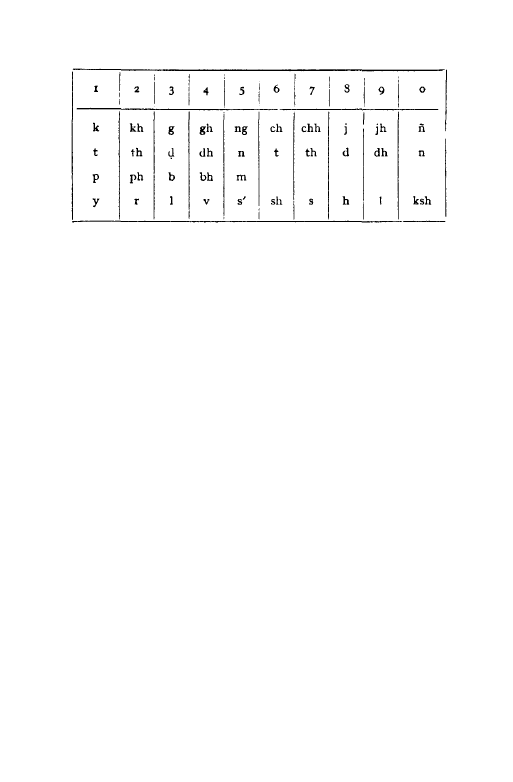
113
NUMBER-WORDS
so refrain from explaining the phonetics of the Sanskrit
alphabet.
One of the uses of this system is found in a commentary
on the " Ramayana," in which the number of verses is given
in mnemonic form at the ends of certain sections. We find
apparently unmeaning words ending in "mana" (a measure),
such as garamana, which would indicate the number 32.
The system is also referred to in other places, such as
Vararuchi's "Kadinava" and the "Laghu Arya Siddhanta."
Now to the system which I advocate. It springs from a
study based upon a recognition that the numbers 1, 2, 3, 4,
5, 6, 7, 8, 9, 0, are probably used equally in human affairs,
but the letters of the alphabet are not, and further, some
letters are rare at the beginnings or the ends of words, while
others are common.
1 is to be represented by t, or d. Thus the following words
may stand for number 1: head, tea, toe, doe, hot, oat, wad,
yacht, youth, thaw, etc.
2 is to be represented by n. Words for number 2: hen,
knee, wain, neigh, etc.,
3 is to be represented by m. Words for number 3: yam,
may, home, ma, aim, etc.
4 is to be represented by r. Words for number 4: oar, row,
ray, arrow, etc.
5 is to be represented by 1. Words for number 5 : hill, hall
lea, yellow, etc.

114 MIND AND MEMORY TRAINING
6 is to be represented by ch, j or sh. Words for number
6: joy, wish, ash, edge, show, chew, etc.
7 is to be represented by k, g, or ng. Words for number 7:
cow, hag, egg, hang, ache, etc.
8 is to be represented by f or v. Words for number 8: foe,
vow, half, wave, fee, etc.
9 is to be represented by p or b. Words for number 9: ape,
bee, hope, web, abbé, hub, etc.
o is to be represented by s or z. Words for number 10:
hose, saw, haze, zoo, ass, etc.
The letters h, w and y, and the vowels, have no number-
values in our method, but may be used for word-making
wherever convenient. Only the sound of words (not the
spelling) is considered, and double letters are always used
as though single, as in "yellow."
It is very easy with these number-letters to find a great
variety of words representing numbers from 1 to 100: in
many cases, such as 10, 14, 15, 41, 50, 51, 57, 70, 85, 90, 91,
94, 95, 97, one can readily write down about forty words for
each number.
When we come to numbers between 100 and 1000, it is a
little more difficult, and the student will find that, while he
can readily write down several words for most of the num
bers there will be over two hundred out of the nine hundred
numbers which will give him pause.
If we choose the number 742 for example, we may readily
form corn, crane, green, carrion, grain, acorn, cairn, etc.
For 945 we easily discover April, pearl, prowl, broil, parole,
peril, parley, barley, barrel, apparel, beryl, brawl, etc. For
114 we readily find daughter, editor, theatre, debtor, auditor,
tutor, tooter, dater, etc.
But the following numbers, among others, present
difficulties: 993, 963, 896, 699, 598, 599, 568, 525,-499,
418, 353, 135
To overcome these difficulties I suggest the following

115
NUMBER-WORDS
plan: use an adjective and a noun together, and count only
the first consonant sound of the adjective. We can then form,
for the above numbers, epic poem, prowling puma (993);
pure jam, precious gem (963); flowery bush, full page (896);
shy baby, cherry-wood pipe (699); lean beef, light puff (598);
lively puppy, lead pipe (599); Highland chief, yellow sheaf
(568); long nail, lower Nile (525); restless baby, ruling pope
(499); running thief, rapid dive (418); meek lamb, mortared
lime (353); daily mail, hot meal (135).
It is necessary in all such cases to make a very lively image
to represent the adjective. Vague and general adjectives,
such as nice, good, bad, pleasant, etc., are to be strictly
avoided.
Students do not nowadays need to remember long lists
of dates in history and of numbers in science and mathe
matics, as was formerly the case, so numbers of more than
three digits are rarely needed. In history, one needs only
three digits for dates, as the thousands may easily be re
membered without any special attention being given to
them.
When we have settled that we do not want more than
three digits in one word, we may, if we wish, employ the
method of counting only the first three consonant sounds in
a long word, or if we use an adjective, the first sound in the
adjective and the first two in the noun.
We may then form number-words such as the following:
flowing river (848); boomerang (934); book-case (977);
wild elephant (558); blue lotus (951); young pigeon
(796).
The number-words, when formed, can be associated
without difficulty in all the ways that I have already
indicated, and from them the numbers can readily be
drawn.
The following will serve as a little exercise for the student.
Convert these numbers into a sentence by first finding as

116 MIND AND MEMORY TRAINING
many words as you can for each: 2, 3175, 174—1, 1953. 2,
651, 51—0, 6415, 1, 9, 214101, 9, 1, 45, 756, 8, 80620, 21, 1,
45. 756, 8, 04620.10, 01956321, 010, 2, 012141,14,17140, 67,
1, 09650, 2, 1, 74, 8, 65142.
The key to the above sentence is: "A new medical degree—
the Diploma in Child Health—is shortly to be introduced
by the Royal College of Physicians and the Royal College of
Surgeons. Its establishment sets, a new standard for doctors
wishing to specialize in the care of children."
In the last chapter I gave a telephone number, 8715, a
motor-car number, 208457, and a passport number, 062246.
If we wish to remember these by the number-word method
we could form "full kettle," "unsafe rowlock," and "such
inane rush" respectively. In this case we must remember
that we are using the adjectives in full in reference to the
two larger numbers.
Now let us suppose that the telephone, the motor car and
the passport belong respectively to a Mr. Smith, a Mr.
Brown and a Mr. Robinson; we can connect the numbers
with those persons by: full kettle—repair to kettle—tin-
smith—Smith; unsafe rowlock—-boat—drown—Brown ;such
inane rush—danger—robbery—Robinson.
If they are your own telephone, motor car and passport
you may remember them by: full kettle—bubbling sound—
ringing sound—telephone; unsafe rowlock—boat—convey-
ance—motor car; such inane rush—travel—passport. The
student may perhaps improve upon these associations; I
have given the first that came into my head.
A man with a good memory for numbers, and thoroughly
familiar with their manipulation, might be able, with some
effort, to remember a dozen or twenty digits once read out
to him; but it would be indeed difficult to find a man who
could remember, say, a thousand numbers in that way,
though the task of doing so by our method of substitution is
simplicity itself.

NUMBER-WORDS 117
There are several ways of arranging the digits in a very
long number. The method I recommend is that of taking
them in groups of three and then finding number-words for
them.
I will take at random—921840365719283605712823701
562394. For this I may form the following series of words:
bind, freeze, marine shell, cool dip, new vim, chisel, cotton,
venom, ghost, legion, empire. These words are almost the
first that occur to me, and are by no means necessarily the
best. I use them to show what can be done off-hand, though
it is better generally to go over the numbers and choose the
words more carefully when there is time.
The next step is to link the words by intermediaries,
where necessary, as, bind (fix) freeze (water) marine shell
(sea) cool dip (nudity) new vim (keen, tool) chisel (shavings,
soft, cotton-wool) cotton (cotton-thread, stringy, snake)
venom (fear) ghost (dead, dead warriors) legion (Roman
legion) empire.
Another method of making number-words was "dis
covered" by M. Gouraud, and expounded in his Phreno-
Mnemotechny, published in New York and London in 1845.
He called it "number metamorphosis."
His metamorphoses were made through similarity of
sound. The name of some object of sense was substituted for
the name of the number, thus: for the figure zero, hero; for
the number one, a wand; for the number two, a tooth; for
three, a tree; for four, a fort; and so on.
These metamorphosed words or "homophones" were used
as "pegs" on which to hang nine or ten numbers each, while
the ten numbers were formed into a sentence on the principle
of number-words.
M. Gouraud showed how to apply this method to keeping
in mind the ratio of the circumference to the diameter of
a circle to the extent of 154 decimals, a feat which he per
formed by learning sixteen simple sentences.

118
MIND AND MEMORY TRAINING
The first nine numbers are 3 1 4 1 5 9 2 6 5 , for which he
formed the ridiculous sentence: "My deary dolly, be no
chilly." This, the first set, is the "hero" set, and was linked
with that word by the supposition that a hero was uttering
the sentence.
The sentences are difficult to make, and the Unking is
decidedly primitive, but apart from these elements, the
scheme of metamorphosed key-numbers proves very useful.
It may, for example, be used as providing starting-points
for a series of our number-words, which may very readily be
linked on to it. We may choose thirty numbers, as before,
9218403657, 1928360571, 2823701562, and remember them
in three sets of ten, each preceded by one of the key-words.
The digits from the first to the tenth will be under the aegis
of '"hero," the eleventh to the twentieth under "wand,"
and so on. Thus for the foregoing numbers we may make
three sets: hero, bone, devour, smash, leg; wand, tap, knife,
images, locket; tooth, hen, fan, hammock, stall, chain. These
could be connected, where it is necessary, by (mighty dead),
(hungry dog), (crunch), (broken leg); (blow), (cut), (gleaming
and mirror), (portrait); (beak), (feather), (swing), (rest),
(rope).
This method facilitates the location of the digits, and
enables one to pick out a number required, without the
trouble of counting along the whole series.
A third plan, which I prefer to M. Gouraud's, is to select
number-words for key-words, instead of homophones; for
example, instead of hero, use ice, sea, saw, ass, sow, sue, ease,
essay, hose, house, or any other zero word; instead of wand
use tea, tie, add, oat, toe, height, youth, or any other word
standing for the number one. In this case it is easy to find
a word suited to the series which it is required to begin.
It will now be seen that the task of remembering dates is
a very easy one. All that needs to be done is to take the last
three digits of the date, form a word from them, and connect

119
NUMBER-WORDS
this in turn with the idea of the event by our link
method.
There are, of course, other devices useful to students, such
as that of making charts of centuries, divided into squares
for each year or ten years, and fixing small symbols in each
square to represent the happenings of the period.
I will content myself with one or two examples of the link
method: Queen Boadicea raised an army against the Romans
and killed 7000 of them, in the year A.D. 67—check. King
Arthur, famous for his powerful resistance and victories over
the Saxons, A.D. 514—leader. Queen Elizabeth ascended
the English throne, 1558—fond of praise—lady-love. Ger
many annexed Austria, 1938, bold move. Transatlantic
air mail began, 1939, air—air-pump—pump.

CHAPTER XVIII
PLACING THE MEMORY
IN a previous chapter I have mentioned that the Greek poet
Simonides had the idea of symbolizing complex or abstract
ideas so as to remember them easily. The examples I took
were from a hypothetical discourse in which government,
financial matters and naval affairs and the necessity for
wisdom in the policy of the time, would be represented
respectively by a crown or sceptre, a current coin, the image
of a ship, and the figure of Minerva.
We are also indebted to him for the idea of using places
or positions in which to put ideas for safe-keeping in the mind,
much as we put papers in pigeon-holes or files.
Suppose that we provide our places in a house which is
quite familiar to us. Then, if we enter our house at the front
door and number all the objects we see in turn—the doormat
I, the brass step 2, a picture 3, a hatrack 4, an umbrella
stand 5, and so on—we have at once a basis for remembering
a large number of things in order.
In the discourse above mentioned we might place the
crown on the doormat, the coin on the brass step, the ship
in the picture, a statue of Minerva on the hatrack, and so on.
Thus the speaker could avoid missing any of them in the
course of his speech or debate.
The incident which led Simonides to this mnemonic device
of places is related as follows by Cicero. I have taken it
from Dr. Pick's History of Mnemonics (1866).
"A man named Skopas, at Kranon, in Thessalia, once gave
a grand dinner in honour of a victorious gladiator. Among
the guests was the poet Simonides, who, during the repast,
recited some verses he had composed in honour of the hero
of the feast. After his recitation, he was called outside, and
1 2 0

121
PLACING THE MEMORY
had scarcely left the room, when the ceiling fell in, crushing
Skopas and all his guests. When the relatives of the killed
came to bury the remains, they found them so smashed and
disfigured, that they could not distinguish one body from
another. It happened, however, that Simonides had ob
served the place which each person had occupied; and on
looking at the several places, he was able to identify all the
bodies. This led him to believe that nothing could better
assist the memory than to retain in the mind certain fixed
places, and therein to deposit, with the assistance of the
imagination, whatever we intend to keep in our memory."
The following extract from Quintilian shows how the idea
was used among the ancients—
"You choose a very spacious and diversely arranged place
—a large house, for instance, divided into several apart
ments. You impress on the mind with care whatever is
remarkable in it; so that the mind may run through all the
parts without hesitation or delay; for the essential is not to
hesitate before the objects, as remembrances destined to
help other remembrances should be more than sure. More
over, for recalling to mind what you have written or simply
meditated, you help yourself with any sign borrowed from
the matter you have to treat of—if the object should be one
of war, navigation, or the like; or with some word, for a
word suffices to refresh the memory, as soon as it begins to
fail. If the object is navigation, the sign will be an anchor;
if it is war, it will be a weapon.
"Then you proceed as follows: you place the first idea in
the hall, the second in the parlour, and so on with the rest,
going over the windows, the chambers, to the statues and
similar objects. This done, if the object is to apply that pro
ceeding to the memory, you look over every apartment,
beginning with the first, and recalling at every picture the
idea which was confided to it; so that, howsoever numerous
the things may be which are to be kept in mind, they are

1 2 2 MIND AND MEMORY TRAINING
put in a row, and form a sort of chain, which prevents the
confusion to which you are exposed when bound to learn by
heart. You can create for yourself imaginary places."
In another place Quintilian said that in place of a house,
which might not contain enough things to act as pegs or
places (quite possible in his day, I suppose, though hardly
likely now), we may assume a public building, the walls of a
city, or a well-known road, to divisions of which we may refer
our symbols.
Metrodorus assumed the circle of the zodiac, divided into
360 compartments of a degree each—but that in my opinion
would not provide a background of sufficiently vivid quality.
The common things of daily life, or the incidents of myth
ology or history are far more vivid and facile for any but
an extraordinary mind.
The process of locating ideas (by means of symbols and
otherwise) in familiar objects underwent numerous changes
in the course of the centuries that followed. I need not detail
these but will content myself with a brief description of the
adaptation made by Gregor von Feinaigle.
In this later development an imaginary house is taken as
having a number of rooms, and each room as having fifty
places, arranged in the following manner: the floor is divided
into nine equal squares, and each wall is divided similarly
into nine, with, however, a tenth in the centre above it upon
the ceiling, while another square in the centre of the ceiling
makes the fiftieth square in the room.
You enter at one side, and find before you nine squares on
the floor; then, on your left hand is a wall with the tenth
square on the ceiling above, and squares 11 to 19 on the wall ;
in front of you a similar set from 20 to 29; on the right an
other, from 30 to 39; beside you another, from 40 to 49;
while number 50 lies above you in the middle of the
ceiling.
Having fixed your walls, it is better to take a walk round
123
PLACING THE MEMORY
the room in imagination, rather than merely to stand at the
side and survey it in the manner described,
It now remains to people the apartment, and this may be
done in a variety of ways.
Von Feinaigle used the method of similarity of form, that
is, he made pictures somewhat resembling the numbers
assigned to the squares or places. On the floor of the first
room he had—
The Tower
of Babel
A Swan
A Mountain,
or Parnassus
A Looking-
Glass
A Throne
The Horn
of Plenty
A Glass
blower
Midas
A Flower,
or Narcissus
In the case of number 4, the form was really symbolical,
the looking-glass having four corners, but the other pictures
were so drawn that they very closely resembled the numbers.
I will supply a set of the first nine squares which I think
give an improvement upon von Feinaigle's selection—for
1 a tower, 2 a swan, 3 a sea-horse, 4 a sailing boat, 5 a snake,
6 a monkey, 7 a trumpeter, 8 an ant, and 9 a flower. The
pictures on page 124 illustrate the idea.
It would be equally practical, at least for the smaller
numbers, to use the homophones, or similar-sound words, of
Gouraud, which I have mentioned in my previous chapter.
Then the first square would be occupied by a wand, the
second by a tooth, the third by a tree, the fourth by a fort
and so on.
A better method, in my opinion, is to form pictures
according to number-words representing the numbers. In
that case we might have in the first square a head, in the
second a hen, in the third a home, in the fourth an oar, in
the fifth a hill, and so on. The advantage of this method is
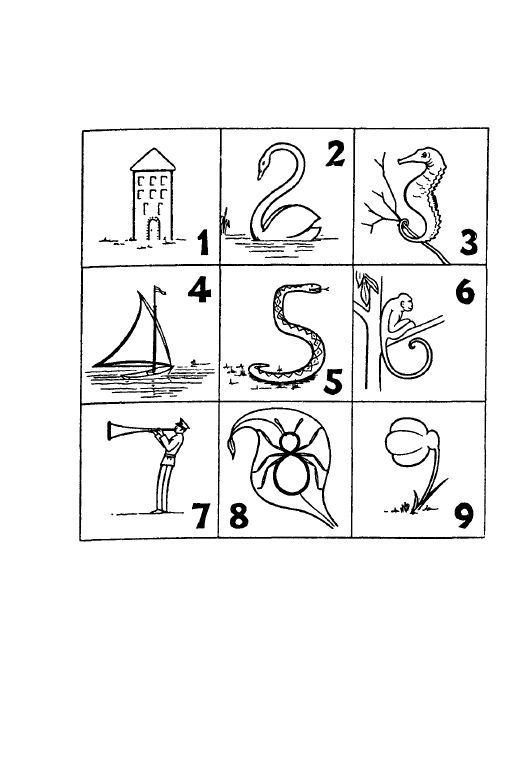
124
MIND AND MEMORY TRAINING
that it gives us a very wide choice of familiar objects from
which to make at least two rooms—that is up to a hundred.
If the student wants at short notice a set of, say, ten
squares or places, I suggest that he may select number-
words relating to some chosen category of things, such as:
Towns; I Tokio, 2 New York, 3 Manchester, 4 Rio de
Janeiro, 5 London, etc. For number 10 a town beginning
with s or z—Stuttgart. Here I use the first consonant only.
Animals; 1 dog, 2 hen, 3 monkey, 4 rabbit, 5 lion, etc.
Materials; 1 wood, 2 enamel, 3 marble, 4 iron, 5 leather,
etc.
Races; 1 Tibetan, 2 Indian, 3 American, 4 Russian,
5 Liberian, etc.

PLACING THE MEMORY 1 2
5
Locomotion; i tram-car, 2 underground railway, 3 motor
car, 4 aeroplane, 5 lorry, etc.
Shops; 1 Thacker's, 2 Wanamaker's, 3 Marshall Field's,
4 Orr's, 5 Liberty's, etc. (I have given the names of shops
well known to me; the student will easily provide substi
tutes of his own.)
Clothing; 1 turban, 2 necktie, 3 umbrella, 4 riding suit,
5 lace, etc.
Foods; 1 toffee, 2 nuts, 3 milk, 4 rice, 5 olive oil, etc.
People; 1 Hitler, 2 Napoleon, 3 Emerson, 4 Rembrandt,
5 Lenin, etc. (I have given historical names, but per-
sonally-known people are even better, as having more
mnemonic detail.)
I now ask the student to notice that I have given, in
"Towns," "Animals," "Materials," etc., number-words for
1, 2, 3, etc. He is thereby provided with 90 squares, which
will serve him well for a long series, since he can use Towns
for places 11 to 20, Animals for places 21 to 30, and so on.
To complete a full" house " of a hundred squares he can make
an extra series of 1 to 10, composed of, say, Sounds: 1
thunder, 2 neighing, 3 music, 4 rattle, 5 laughter etc.
I consider this last method of mine about the best of all
—easiest to commit to memory, and allowing for a selection
of very familiar objects. Let the student make up his own
ten sets of varied familiar objects on these lines, and he will
be well equipped to perform what most people will regard
as wonderful feats of memory.
Whatever he decides upon he will do well to make a set
of little drawings for himself; however rough or crude they
may be they will aid his imagination greatly.
It is necessary to commit the chosen set of places
thoroughly to memory, but the task is an easy one, because
the objects either resemble the numbers they represent or
are number-words.
Another plan for making a set of 25 squares on the spur

12 6 MIND AND MEMORY TRAINING
of the moment is to follow the letters of the alphabet
(omitting x) with reference to some category such as animals,
or countries or occupations. Thus we might form the series:
Architect, Butler, Carpenter, Doctor, Elephant-trainer,
Farmer, Goldsmith, Harbour-master, Ink-maker, Journalist,
Kitchen-maid . . . Veterinary surgeon, Watchman, Yachts
man, Zoologist.
The advantage of the picture-system over that of merely
linking together a long string of things is that you can at
once pick out any one of the things you want from it without
disarranging the series, and without having to repeat the
whole series from the beginning. Its disadvantage is that
more ideas are imposed upon the mind than are neces
sary for understanding the things to be remembered. Yet
that disadvantage is small, and the system does enable one
to do some things that would be impossible by the link
method. With its aid some astonishing memory feats can be
performed.
Some such system as this was almost universally employed
by those who from time to time appeared in Middle Age
Europe performing memory feats consisting of repeating
vast numbers of words and numbers once read out to them.
One of the most striking examples of this use of the art was
a certain Lambert Schenckel, who travelled over the chief
countries in Europe in the sixteenth century, and won honour
and praise everywhere, though in his earlier years he, like
many others, was persecuted for supposed traffic with the
devil. A pupil of his, Sommer, writes in a Latin treatise—
"A lawyer, who has a hundred or more causes to conduct,
by the assistance of my mnemonics may stamp them so
strongly on his memory that he will know in what manner
to answer each client, in any order and at any hour, with as
much precision as if he had but just perused his brief. And
in pleading, he will not only have the evidence and reason
ings of his own party at his finger's ends, but all the grounds

PLACING THE MEMORY I 2
7
and refutations of his antagonist also. Let a man go into a
library, and read one book after another, yet he shall be able
to write down all that he has read, many days after, at
home."
The student will understand, from my previous chapters,
how to associate the objects to be remembered with the places
to which they are assigned. Suppose that in the 17th place
we want to remember an ostrich. Let my 17th place be a town
beginning with k, g, or ng, say Kiel. I do not like the old
idea of making a picture of an ostrich crossing the Kiel canal.
If I make a rational association and concentrate on it for a
moment, I can drop it out of mind with full confidence that
it will come to light again as soon as I think of Kiel. Such
a connexion might be: ostrich—sand—water—canal—Kiel.

CHAPTER XIX
MEMORY-MEN OF INDIA
INDIA
has always been a land of wonders, among which the
memory feats of the Ashtavadhanis have long been con
spicuous. An article in The Theosophist magazine for 1886
reports an occasion on which a memory expert of South India
simultaneously kept in mind and did the following eleven
things and afterwards correctly repeated the whole.
1. Played a game of chess, without seeing the board.
2. Carried on a conversation upon various subjects.
3. Completed a Sanskrit verse from the first line given
him.
4 Multiplied five figures by a multiplier of four figures.
5. Added a sum of three columns, each of eight rows
of figures.
6. Committed to memory a Sanskrit verse of sixteen
words—the words being given to him out of their order,
and at the option of the tester.
7. Completed a "magic square" in which the separate
sums in the several squares added up to a total named,
whether tried horizontally or vertically.
8. Without seeing the chess-board directed the move
ment of a knight so that it should make the circuit of the
board within the outline of a horse traced on it, and
enter no other squares than those.
9. Completed a second "magic square" with a different
number from that in the above named.
10. Kept count of the strokes of a bell rung by a
gentleman present.
11. Committed to memory two sentences of Spanish,
given on the same system as No. 6.
The writer of the article, Colonel H. S. Olcott, went on
128

MEMORY-MEN OF INDIA 129,
to say that he had heard of men who could take in fifty
things in this way, and in one case, when he was living in
Bombay, there was an exhibition in the house of a Hindu
gentleman of high position in which the pandit remembered
no less than one hundred things given to him at the one
sitting. The Colonel believed, however, that twenty-four
was about the maximum of new items that could be retained
and the remainder must have been already known to the
pandit.
This estimate was certainly too low, but the author was
correct when he added, with reference to the method of
memorizing, that the memory-men have acquired the power
of creating in the mind for each of the several things they
do a separate mnemonic point or thought-centre, around
which they force the ideas relating to it to cluster and group
themselves.
The "places" which I have described in the preceding
chapter constitute such mnemonic points.
In an exhibition which I had the pleasure of witnessing in
the State of Morvi in Kathiawar, the expert, Mr. Nathuram
P. Shukla, remembered a hundred items. There was a large
gathering of people, seated on carpets in a big hall. Twenty
people were selected and seated directly in front of the pandit.
He attended to each of the twenty people in turn, and went
along the line five times.
Several gave him sentences composed of five words, each
person using a different language—Gujarati, English,
Sanskrit, Persian, Hindi, Mahratti, French and Latin—and
the words were given out of order. One sitter gave moves in
a game of chess. Two others gave figures to be multiplied
and added together. Another carried on little conversations
with the pandit on various topics. Another struck a little
bell a number of times on each round. There were calcula
tions of dates, completion of short poems and other items.
After the hundred points had been made the pandit

I3 0 MIND AND MEMORY TRAINING
meditated for a little while, then answered questions relating
to the items, and finally repeated the whole.
Later I had the good fortune to meet this expert in the
State of Limbdi. We spent much time together during my
stay there, and he was good enough to explain to me some
of the methods of memory culture in vogue in his profession.
Though I am writing this book for the benefit of students,
and others who want to improve their minds and memories
in general, not for spectacular purposes, the reader who
cares to do so may comparatively easily perform many of
the feats of Ashtavadhana with the aid of the methods
prescribed in this book, and a reasonable amount of practice.
The training should be gradual, and one must be particular
about cleanliness of life and thought, and general calmness
of mind. Otherwise there is real danger of overstrain. I do
not recommend people beyond middle age to attempt these
feats.
I will explain how some of the feats can be done. The
student will easily arrange the others for himself.
First of all have in mind 100 places. I will assume that
you have adopted my system of Sounds, Towns, Animals,
Materials, Races, Locomotion, Shops, Clothing, Foods and
People, as given in the last chapter, and that you know your
"places" thoroughly.
You have twenty people sitting before you, and you will
attend to each of them five times. You first assign five of
your places to each.
Let us suppose that the third man is to give you a sentence
consisting of five words in English. His squares will be the
first five towns: Tokio, New York, Manchester, Rio de
Janeiro and London. He says: " My third word is ' looks'."
You can make a picture of a man looking afar, perhaps
shading his eyes with his hand, or perhaps a picture of a
person looking into a microscope. The connexion of this
with Manchester would be easy for me, for it was in

MEMORY-MEN OF INDIA 13
1
Manchester that I studied geology and examined many
rock-sections and other things under the microscope.
On the next round our third gentleman says, "My
fifth word is ' pretty'." A pretty lady would do for my
picture. London in my experience has been largely
Oxford Street and Regent Street, where the ladies buy
their pretty things. Next, Mr. 3 says, " My second word
is 'garden'." You must associate this with New York.
I would think of the roof gardens on some of the tall
buildings of New York, which are already familiar to me.
On the next round, "My fourth word is 'very'." Now
"very" alone has no sense, so I must think of a similar
word—verre, the French word for glass, jumps up in my
mind. This must be connected with Rio de Janeiro. On one
of my visits to that town I stayed in an hotel which had a
huge plate-glass window. Now the fifth round: "My first
word is 'my'." Again a meaningless word; turn it into
microphone or mica. To join microphone with Tokio, I
would picture myself as I once gave a lecture there—not,
however, using the microphone that time. Your connexions,
and your towns, perhaps, would be quite different from
mine.
At this stage in the proceedings you still have no idea of
the sentence. You have not tried to remember the first
round while going on the second round. Each time that you
have associated an object with your town you have immedi
ately forgotten it and thought no more about it—this is
imperative. Only at the end of the experiment, when you
have received the entire one hundred items, and you are
asked to state them, you will run over your towns, Tokio,
etc., and will easily bring out, " My garden looks very
pretty."
In other languages you will follow the same proce
dure. If it is a language that you do not know, you
will have to treat the words as mere sounds, and find

132 MIND AND MEMORY TRAINING
homophones—known words having similar sounds—for all
the five.
Let us suppose that the ninth man gives you a number, of
fifteen digits, divided into sets of three. His "places" will
be the first five Races: Tibetan, Indian, American, Russian,
Liberian.
On the first round perhaps he says, "My fourth set
is 364." You might at once translate this into 'major,'
and then connect: Russia—Red army—major. On his
second round Mr. 9 may say: "My second set is 589."
Not seeing immediately an English word to my liking
to represent this, I think of 'lavabo,' which is concerned
with washing. I connect this with my memory of the
frequent bathing of the people of South India, which
struck me very forcibly on my first arrival there. And
so on. At the end you will reel off the fifteen numbers
without difficulty.
Now I will suppose that one of the people sets you the task
of multiplying five figures by four, let us say 47352 x 9463.
For the act of multiplication time must be allowed after
wards, because during the giving of the items you will
receive only the figures, in five sets, 47, 3, 52, 94, and 63.
The giver may say, for example, "The last two numbers of
my multiplier are 63," and so on. You will set down perhaps
"gem" in his fifth place.
How will you do the multiplication? There are several
methods. I was taught that of the Hindi "Iluvati," as
follows. First multiply 52 by 63 (52 X 60 = 3120; add
52 X 3 = 156; total 3276). Remember and set aside the 76
(coach, or cash, or cage), and remember 32 (moon) to carry
forward. Next multiply 3 by 63 and add the 32 (189 + 32 =
221). Remember and set aside the 1 (tea) and remember 22
(onion) to carry forward. Thirdly, multiply 47 by 63
(47 x 60 = 2820; add 47 x 3 = 141; total 2961) and add
the 22, making 2983. So now you have 2983176—in words:

MEMORY-MEN OF INDIA 13
3
nap, fume, tea and cash. Remember these four words, and
forget everything else.
Now you may proceed to the second part of your task.
47352 is to be multiplied by 94 in the same way (52 X 90 =
4680; add 52 X 4 = 208; total 4888). Set aside 88 ( v i v a
waving flags, etc.), carry 48 (roof). Secondly, multiply 3 by
94, and add "roof" (282 + 48 = 330). Set aside 0 (sea), and
carry 33 (mamma). Thirdly, multiply 47 by 94 (47 X 90 =
4230; 47 x 4 = 188; total 4418; plus 33 = 4451). In this
second part you have 4451088—in words: roar, foot, sea,
viva. Remember the four words and forget the rest.
Now to add nap—fume—tea—cash to roar, foot, sea,
viva. But cash and roar lie outside, as the second multiplica
tion (94 X 47352) was in hundreds. So you add nap—fume
—tea (29831) to foot—sea—viva (51088) and obtain 80919
—in words: face—bee—tub. So your result is " roar—face—
bee—tub—cash." At the required moment you can trans
late this back into numbers, 448091976. The five words can
be placed in the questioner's five 'places,' as you no longer
need his original numbers.
Some may prefer to follow the ordinary European mode
of multiplication. If so, they had better prepare a special
"room" for this task. I can explain it best by a diagram—
as on page 134—which must have three places across and
five down. I will assume that the fifteen places are made of
Occupations.
On looking through the five "places" of the man who has
given you a multiplication to do you will find, let us say,
rock—home—lion—bear—gem. This tells you that you have
to multiply 47352 by 9463. The working then is given in the
table on page 134.
So the answer is: Furore—tubs—shy cub, the words being
read backwards in this case, because the working is from
right to left.
A third method of multiplication suitable for those who
134
MIND AND MEMORY TRAINING
Architect
Butler
1 4 2
Carpenter
0 5 6
Narada
jewels
Doctor
2
Elephant-trainer
8 4 1
Farmer
1 2
noses
turf
scent
Goldsmith
1 8
foods
Harbour-master
9 4 0
syrup
Ink-maker
8
steel safe
Journalist
Kitchen-maid
Laundress
4 2 6
1 6 8
joiner
full jet
Minister
4 4 8
furore
Nurse
0 9 1
tubs
Ostler
9
7
6
shy cub
can readily visualize the original terms is shown in the
following diagram, which requires nine "places," which I
will make by number-words of games and sports for the
purpose—
47352
x
9463
Tennis
3 x a — 6
shirt
H u n t i n g
3 X 5 = 15 + 6 X 2 = 27
countryside
Marbles
3 x 3 + 2 = 1
1 + 6 x 5 = 4
1 + 4 x 2 = 4 9
bowler
R a c i n g
3 x 7 + 4 = 2
5 + 6 x 3 = 4
3 + 4 x 5 = 6
3 + 9 x 2 = 8 1
tipster
Lacrosse
3 x 4 + 8 = 2 0
+ 6 x 7 = 6 2
+ 4 x 3 - 7 4
+ 9 x 5 = 1 1 9
beat (stick)
Chess
6 x 4 + 1 1 = 3 6
+ 4 x 7 = 6 3 .
+ 3 x 9 = 9
0
sitting
Golf
4 x 4 + 9 = 2
5 + 9 x 7
= 8
8
fairway
Football
9 x 4 + 8 4 4
rugby
Billiards
4
red (ball)
The answer is remembered in the words: red—rugby —
fairway — sitting — beat — tipster — bowler — countryside
— shirt, representing 448091976.
This mental arithmetic is not difficult, but it requires
practice. It is only the real experts who include such multi
plications in their round of ten or twenty people.

CHAPTER XX
READING AND STUDY
READING
can be made into an opportunity for the develop
ment of mental power. Its effect is very often quite the
reverse, for there is scarcely anything more destructive of
mind organization and the power of thought than the habit
of promiscuous reading without purpose and without after
thought or forethought.
If you know any people who cannot read or seldom read,
you may have observed that the condition at their minds is
often superior to tha t of reading people. What they know
they know well; their ideas are vivid, and available when
they want them—but we must offset against this advantage
a great lack of mental content.
There is no reason, however, why we should not have per
fect clearness and vigour of mind along with ample know
ledge ; and indeed this can be brought about by reading in
the right manner. We shall perhaps read a little less than we
did before, but we shall read well.
For this purpose I recommend the advice of Emerson:
" Read for correction, not for information." In other words,
think first and read afterwards. Some few people read first
and think afterwards, which is a good thing, though not the
best; but I am afraid that most people just read and do not
think at all.
The rare people who are really going to profit by their
reading are those who think first and read afterwards.
If you have half an hour for reading, spend ten minutes
in reviewing your own knowledge and thought on the subject
—even if you think you have none, you may engage in
wondering about it—and then read for twenty minutes. Or,
137

13 8 MIND AND MEMORY TRAINING
if you have only a quarter of an hour to spare, think for five
minutes and read for ten.
This means that when you pick up your book to read, let
us say, a chapter on the habits of elephants, you will not
immediately open the book and plunge into the subject.
You will first sit with the book unopened on your knee or on
the table, and say to yourself: "Now, just what do I know
about the habits of elephants ?" It may be much, or little,
or next to nothing, that you know, but whatever it is you
must make yourself review your own knowledge before you
start to add to it. Then you may open your book and begin
to read, and the result will be that you will understand more
than usual; and you will remember more than usual, indeed,
nearly all, of what you read.
Your mind has been awakened to the subject; its own
knowledge has been rearranged in an orderly form, and many
questions, definite and indefinite, have come into view. The
expectancy engendered by thinking before reading provides
the mind with hooks to take up many points which other
wise would scarcely be noticed, and the arrangement of your
old knowledge offers a place into which each piece of new
knowledge will fit.
This practice puts the mental house in order, opens up
and tidies the most unused drawers and boxes, and prepares
the mind for light, as no other kind of reading can. First
of all you have ideas of your own—then you correct, enlarge
and increase them by reading. You gain not only knowledge
and a well-ordered mind, but also exercise that results in
power of mind and will.
Even if you are merely reading a story or a novel, why
not sit for a while musing on the situation that has arisen ?
What would you do if you were in the position indicated,
what would you make the characters do if you were the
author ?
This mode of reading has also another great merit; it

139
READING AND STUDY
prepares one for a fruitful old age. Everyone who wants to
keep his mental powers unimpaired after the decline of the
physical senses should have a mental hobby, and give a little
time to it from three to five days each week—not every day,
for that tends to fatigue.
It is best always to have on hand a good book, on philo
sophy, or history, or travel, or science or any other subject,
to which one can turn several times a week for mental
recreation. There should be no thought of reaching the end of
the book; it is to be lived with, and the method of reading it
should be that in which one thinks first and reads afterwards.
I recommend every young man or woman when leaving
college or high school to keep up one of his subjects of study
as a mental hobby, or to take up some other subject in which
he is interested. It does not matter what the subject is—a
branch of mathematics, history, biology, geology, psychology,
moral philosophy, economics, political science, astronomy,
chemistry, religion, art; any one of these, or any branch of
one of them.
The most important fact in connexion with this study is
that the student will be using his mind under the control of
the will, that is to say, by determination from within, not
merely in response to the stimulus of everyday events and
needs, as is the case when we think about most of the affairs
of life.
If a man has been thinking only in response to external
stimuli, it is almost certain that when the physical powers
of hearing, sight, etc., begin to decline and external things
do not make as strong claims on attention as they did before,
and curiosity begins to disappear, mental activity will also
diminish.
But when a man has used his mind from within, has
accustomed it to work under the impulse of his own will,
there is no reason why his mental powers should not con
tinue to improve even into advanced old age of the body.

14 0 MIND AND MEMORY TRAINING
There are still other benefits resulting from the possession
of a mental hobby. You have sooner or later the satisfaction
of feeling that you are the master of some line of thought or
subject of human knowledge. You know as much as almost
anyone does about it. This gives you confidence, and you
feel also the strength and the indescribable happiness of the
inner sense of will.
For the purpose of these considerations I may divide books
and articles into three classes: (1) novels and stories, in
tended for relaxation and for imaginative enjoyment, (2)
books of travel, biography, history, literature, politics, and
human subjects generally, intended to instruct or elevate,
and (3) textbooks and technical works, intended to give full
and exact information in the minimum of words on the
subjects treated in them.
The last class of books are not for reading, but for study.
In this case there seems to be a difference of opinion: should
they be read quickly, or slowly with meticulous attention to
detail ? My answer to this problem is: both. First read your
current chapter quickly to get the high lights, the main
tendencies, the chief headings or topics. Then go over the
heading or topic again with close attention to the detail.
In our study of any complex subject, we have to deal with
such a vast mass of ideas that it is not practical to learn them
seriatim. The student who tries to give equal attention to
each point as it comes up will soon become a very dull
student indeed. He will resemble a person who in real life
meeting with, let us say, a dog, will first look at its nose, then
eyes, ears, neck, shoulders, back, rump, and tail, and at last
will declare to himself with an imbecile kind of sagacity, "Ah,
that is a dog." An intelligent person will first see that it is
a dog, and then study it in detail if he wants to do so.
So our student should understand the subject and nature of
the chapter or topic he is studying, before studying it closely.
His study will then fall into groups, under definite headings.

READING AND STUDY I 4
I
When the main topics are clear let the student turn to
detail. Then very soon the apparent multiplicity of detail
will disappear, as the ideas connected with a main topic
become consolidated in the mind. To a chemist, for example,
the properties and reactions of, let us say, sodium, become
one unit, just as we think of a book as a unit idea, not of the
paper, ink, cover, binding, etc., as a number of things to be
individually remembered.
At this stage the subject will seem easy; all is simple to
one who knows. I have seen students looking aghast at
examination papers such as they will have to meet in per
haps a year. With white face the student mutters, "I shall
never be able to answer." A year later, the same student
looks at the paper, and remarks loftily: "Very simple;
nothing in it," and when he becomes a teacher later on, he
says: " I do not know what examination papers are coming
1o in these days; in my time they used to set stingers, but
now it is all kindergarten stuff."
In practice, then, when you have sorted out your groups
or headings, or such of them as you immediately need, pick
out the principal fact in a group and make a thorough study
of that, committing it to memory.
Incidentally, it would be well to review it in memory every
day for a week, for new knowledge is like young plants—
they must be watered regularly while young, until they are
strong enough to stand the slings and arrows of outrageous
fortune without outside help.
As to the subsidiary facts in each block—a mere careful
reading of them with reference to the main fact will be suffi
cient to impress them strongly on the mind, and if at any
time you are called upon for an account of these minor
things, you will be able to recall all about them by thinking
first of the main fact which you thoroughly know, and
mentally inquiring their relation to it.
For example, in history, one would study thoroughly the

I 4 2 MIND AND MEMORY TRAINING
most prominent monarch in each dynasty and the principal
fact, event or personage in each reign, and then link the
reigns together in a series or plant them in order in a
"house"; or in chemistry one would study thoroughly
chlorine as one of the halogens, and sodium and calcium, and
such typical elements, thoroughly, and associate other
members of their series with them by an after-reading of a
far less searching kind.
The secret of success in the study of complex subjects is
to take one thing at a time, get hold of it firmly, stow it away
out of sight, and pass on to the next. When the second idea
is quite clear, bring the first out again and add the two
together. Never try to put more than two together at one
time, and never hurry.
Many a student fails because he will not take one thing at
a time and form a clear idea of that before passing on to the
next. I have known students to grab feverishly at a number
of ideas at once, and fail to grasp any of them clearly. Not
feeling sure of one fact which they are supposed to have
learned, they try to keep an eye upon it, so to speak, lest it
should slip away while they are learning the next; and the
result is that the new idea is not properly understood or
learned.
There is a little story of an Irish farm labourer who was
once sent by his master to count the pigs in the yard. After
a time, he came back scratching his head and looking sorely
puzzled: "I counted ten of them," he explained, "but there
was one little fellow who ran about so fast that I could not
count him at all, at all."
It is a fact that unless we make our ideas stand quietly,
and look ever them singly, they run about so much that we
cannot grasp them clearly. It is necessary to get each new
idea into a corner, from which he cannot escape, and then
examine him and watch him very carefully indeed.
If the student will not do this, he is like a person trying

READING AND STUDY I4
3
to run with a big armful of oranges; one falls over; he makes
a desperate clutch at it; another goes over on the other side;
and soon all the oranges are rolling on the ground.
It is best to make the new idea as simple as you can at
first, so that it may easily add itself to knowledge already
existing in your mind. In every case in which you are learn
ing from a book it is a good plan to simplify the sentence you
are studying by taking away all the qualifying words, making
a mental picture of the essential idea, and then adding to
this image one by one all the various qualifying attributes.
For example, you read of the discovery of Lithium—
"In 1817, Arfvedson, working in Berzelius's laboratory
upon a petalite from Uto, Sweden, discovered an alkali
which he found to differ from those already known in the
following particulars: (1) in the low fusing points of the
chloride and sulphate; (2) in the hygroscopic character of
the chloride, and (3) in the insolubility of the carbonate."
Simplify the idea: Arfvedson discovered an alkali. Make
a clear mental picture (not in words) of Arfvedson in the act
of discovering an alkali. Repeat the idea several times until
it becomes familiar. Then add to it the idea that the dis
covery took place in a laboratory. Picture the discovery in
the laboratory; add the idea that it was Berzelius's labora
tory; next give the whole idea the aspect of 1817; the date
may easily be remembered by noting that 18 is followed by
17, which is one less. Get the whole idea clear that, in 1817,
Arfvedson discovered an alkali in Berzelius's laboratory.
How did he make the discovery, and what exactly did he
discover ? He was working in Berzelius's laboratory in 1817
upon a mineral silicate named petalite from Uto, Sweden,
when he discovered the alkali. Be sure that your idea of an
alkali is clear, and recall to mind familiar examples of alkaline
properties, such as those associated with sodium and potas
sium. He found that it differed from the known alkalis —
study them together; compare them carefully, noting the

1 4 4 MIND AND MEMORY TRAINING
resemblances and differences. Finally repeat the whole idea
from memory, and thus slowly work through the textbook.
I have tried to show how each sentence must be worked
upon with thought, not simply read and repeated as a whole;
how the qualifying words, phrases, and sentences must first
be removed and then added again bit by bit. The aim is to
transfer the form of words from the printed page, not into a
form of words in the mind, but into a living mental image
which its owner can express in any words or from any point
of view he may choose.
The image may be an inner visualization, audition, or
other sense imagination of the object, or a simplified or
symbolic picture. Most students of history, I feel sure, will
find it more difficult to remember: " The period of Charles I
was one of continual parliamentary, religious and martial
strife," than to make and keep a small mental picture of the
handsome king, with an excited parliamentary group on one
hand and a body of Bible-carrying Roundheads on the other.
When such picture-ideas have been made they should be
compared with each other, two at a time, in accordance with
the four Roads of Thought. Suppose, for example, that in
English history we have studied the reign of Charles I, and
are familiar with it, and we now wish to study that of
James I. We may make another little picture of that
authoritative monarch sitting upon his throne surrounded
by his favourites in succession, and then go on adding details
to each picture, inquiring in what respect, with reference to
the whole and to each detail, they resemble and differ from
each other.
Let us take a simpler instance from elementary geography.
Suppose you are about to study the geography of India and
you already know quite well that of England. As you come
to each point that is new to you, compare it with a similar
point in the geography of the country that you know well.
For example, the lower part of India is a triangle with the

READING AND STUDY
point to the south; England is also roughly a triangle, but
with the point to the north. India is bounded on the north
by a long range of mighty mountains, whereas England is
bounded on the north by a very short range of small moun
tains. The large rivers of both countries flow into seas on the
east and the west, but in England the rivers, like all the other
natural features, are comparatively small. On the west of
India we have a projecting nose (Kathiawar), just as Wales
sticks out on the west of England.
In this manner you may proceed to compare the numbers,
sizes, shapes and positions of rivers and mountains with
those you already know; and go on to compare the political
divisions of the countries, the natural products, the general
and local governments, etc., with those that are familiar to you.
In all cases it is better not to try to compare two un
familiar things, but to compare the new unfamiliar fact with
an old familiar one. As I have before remarked, all learning
consists in adding something that you did not know to some
thing that you do; nothing can suddenly heave into your
mind a new piece of knowledge which has no relation to
anything that you already know.
Merely as an exercise, one might compare a number of
large complexes in pairs, such as a forest and a park; a park
and a mountain range; mountains and the sea; the sea and
the sky; a house and a factory; an elephant and a whale; a
law book and a textbook of science; a poem by Tennyson
and one by Wordsworth.
No doubt it will seem easier and quicker to many students
merely to read over and over again the portions of their
textbooks that they require, in the hope that some of the
ideas they thus gain will stick in the mind. There is some
excuse for the student, who in these days is terribly harried
by a vast and varied host of teachers—each with his own
coagulation of indigestible mental bread—if he finds him
self too tired to think. Yet the fact remains that the only

14 6 MIND AND MEMORY TRAINING
knowledge that is really retained for long is that which has
been acquired with some effort—a sudden and incisive
effort of perception, or a long, slow and deliberate pondering
of the facts or ideas.
Before closing these hints on study, I must impress again
upon the student the great importance of concentration,
especially in preparing for examinations, for just as an artist
surrounds his picture with a frame or stands his statue on a
pedestal so that its beauty may be isolated and thus more
perfectly seen, so must the thinker concentrate upon his idea
to see it clearly. As that idea is a mental thing it cannot be
surrounded by a frame. There is this distinction between
outside objects and things of the mind, that the former are
defined by their boundaries or outlines and the latter by their
centres. Let the student stick to his centres.
Let us suppose that a student is going to read several
pages of a textbook by himself. There are perhaps five ideas
which he must understand and make perfectly clear to him
self. He begins on the first page with idea number 1, gives
to it the full power of his attention, and obtains a clear im
pression of it. Then he goes on to the next page, to study his
second idea. But he is a little anxious about idea number 1.
He feels that he must keep half an eye upon it lest it escape
from his mind and be lost. He is not quite sure that he
possesses that idea unless he can see it or feel it. The con
sequence is that he cannot give full attention to idea number
2. Therefore he does not grasp it as well as he did the first
idea. It is less definite to him, and his anxiety is therefore
greater than before when he has to turn to idea number 3.
Still less power of attention can he give to idea number 4,
since he is anxious about number 1, very anxious about
number 2, and very, very anxious about number 3. His know
ledge of idea number 5 is likely to be vague in the extreme.
When he has finished his whole course of study his
Knowledge of the entire subject will prove to be very unequal

1
47
READING AND STUDY
and mottled. Some few things are clear to him, others are
hazy, others are invisible, and his success in the examin
ation depends upon his luck with the questions. Further, his
knowledge is not going to be of great use to him for deeper
or more advanced studies, when in its elementary parts it
is so unequal.
This unfortunate student reminds me of another story of
an Irishman who was working on a farm, and (like him whom
I have already mentioned) was one day sent out into a yard—
to catch some little pigs. He ran after them and caught one
by the tail. Holding on to that with his left hand, he ran
after another and caught it. Now holding on to two of them,
he ran after a third. It is not recorded how he finished the
task. He ought, of course, to have caught one and locked it
up, then another, and so on.
That is what the student ought to do with his ideas. Let
him fully understand idea number 1, and then lock it up by
an act of concentration. When he has made the idea clear
to himself, let him lean back and look at it calmly and
steadily for a quarter of a minute. He can now drop the
subject while he turns to idea number 2, confident that num
ber 1 will come up in his mind when he wants it. Thus he will
be able to give the same full attention to number 2 that he
first gave to number 1, and so on to number 5.
Using this method of concentration, his knowledge will
be equal, and he will not forget. There is nothing like
anxiety to produce both forgetfulness and feeble-mindedness;
but the experience of the value of concentration in study
soon produces confidence in its power, and grants a new lease
of life to the fatigued and worried student.
It is also a great merit of concentration that it enables a
student not only to take up and retain a new idea, but also
to drop one thing and turn to another. This ability to forget,
to leave things alone mentally when it is not the proper time
to think about them, is of great value.

CHAPTER XXI
WRITING AND SPEECH-MAKING
I
PRESUME
that no one will venture to write an article or
deliver a lecture who has not studied the subject of which
he intends to treat. It is, however, well known that even
when that has been done, a writer or speaker often forgets,
at the moment when he needs them, several points and
illustrations which he had intended to present in connexion
with his subject. This can be avoided by the following
means.
Supposing that a speaker has considered the occasion of
his article or speech, and the matter at his command, he
will have selected four or five main branches of his subject to
be expounded in a predetermined order. These branches he
can summarize each in a word or two, and then "place" the
symbols of his ideas in the parts of the hall in which he
intends to speak. If he does not know the hall, he may place
his headings in a familiar "house" such as I have already
described in Chapter XVIII.
The next thing for him to do is to consider those main
headings or items one by one and extract from each idea all
the detail that he can, by the process of expansion of ideas
given in Chapter XV. This will prevent possible oversight
of important details and also provide suggestions for illus
trations and similes of all kinds.
When this is done, two or three selected sub-headings and
illustrations may be placed under each head, each summed
up in a word or picture or symbol and these associated with
the places in the "house."
In memorizing the points of a speech it is far better to use
the ancient system of "places" or "houses," than to form
the sub-headings into a list or series connected by the Roads
148

WRITING AND SPEECH-MAKING I49
of Thought. The Roads of Thought, however, should be
used jointly with the imagination for fixing the required
points in their respective places, so that when the speaker
is approaching the end of one of his topics, he has only
to turn his attention for a moment to the next "place," and
all that he wished to recall will spring up before his mind.
In the course of a debate one may desire to remember the
points of an opponent's speech, with a view to referring to
them, perhaps in order, when one's own turn to speak
arrives. One method is to write these on a piece of paper
and then turn to the notes one by one; but this generally has
rather an enfeebling effect. Merely to memorize them is not
very satisfactory either, for it nearly always involves a
certain amount of mental preparation of the second point
while one is still speaking about the first.
A good plan is to fix your points as they occur, in your
"house," or, if you like, upon the different parts of the per
son with whom you are debating. Each point can thus be
fixed and left to take care of itself, while the mind is kept
free to consider other matters as they come up. It also gives
one the advantage of being able to keep one's eyes on one's
opponent throughout the whole of the debate.
What I have written with regard to speeches applies also
to a large extent to writing articles. I consider it a very good
plan to ruminate before making any notes for a forthcoming
article. Sit quietly; turn your attention to the subject;
expand it with the aid of the Roads of Thought. While you
are expanding it certain items will impress you as of special
interest. Remember those. Next consider your readers—
what they already know, their point of view and their
interests. You should now be ready to decide in what order
to discuss the various points of your subject. Write these
down if you like, or better, keep them in a "house" until
you are ready to settle down and write the article.
I would strongly recommend speakers and writers to go

150 MIND AND MEMORY TRAINING
over the subject mentally several times on a number of suc
cessive days, before proceeding to speak or write. In such
rumination the mind often finds ideas, points of view, and
similes which may otherwise remain for ever unknown.
Before closing this chapter I may say a few words about
learning poetry. When you take up a verse, first understand
it. Then, in order to remember the words, it is a good plan
to impress upon your mind the first word, the principal word,
and the last word of each line in turn. Learn the first line.
Repeat it to yourself. Forget it. Learn the second line.
Repeat it. Recall the first line and repeat both together.
And so on.
While learning, ask questions, and answer the questions
in the words of the poem. As an example, I will take from
Shakespeare's "Hamlet, Prince of Denmark" a portion of
the advice of Polonius to his son Laertes, at the moment of
his departure to a foreign country—
Neither a borrower nor a lender be;
For loan oft loses both itself and friend,
And borrowing dulls the edge of husbandry.
This above all: to thine own self be true;
And it must follow, as the night the day,
Thou canst not then be false to any man.
Let us consider the last line. The principal word is "false."
The subject is falsity. To get the feel of the line, notice that
the first word is "thou," the last "man."
Now to questions. Whose falsity is referred to? Thou
canst not then be false. Is it a matter of choice ? No. Thou
canst not then be false. When ? As mentioned before, when
following the advice, "To thine own self be true." False in
what way ? False to any man. Not to a particular man ?
No. Thou canst not then be false to any man.
But do not be content with mere learning of the words.
Poetry, by reason of its beauty, tells more than its words; it
calls up new life in us, to witness truth felt as well as known.

CHAPTER XXII
MORE CONCENTRATION
IN view of the great value of concentration of mind, I will
now give some exercises—not by any means to be imposed
on the student, but useful perhaps as playthings for him at
odd times.
1. Sit down in your room and look round carefully, noting
all the little things which it contains. Now close your eyes
and make all those things go before your mind in imagina
tion, until the entire procession has passed by. If you know
an alphabet of foreign forms, such as the Devanagari, the
Arabic, or the Russian, make the letters pass one by one in
procession before your imagination until the whole series is
complete. If a break occurs in the series, begin again.
2. Take a walk in imagination, along a familiar road or
street, noticing all the details that you can remember as you
slowly pass them by; return by the same route. If the
attention wanders from the path that you have chosen for
your walk, make it come back and begin the walk over
again from the beginning.
3. Pass in imagination through some previous experience
of your own. Suppose, for example, you have risen in the
morning, taken breakfast, gone to college, listened to a
lecture, worked in the library, returned to lunch, and so
forth, through all the general incidents of the daily round.
4. Select some particular sight or sound that is present,
say the ticking of the clock. Ask yourself what is the cause
of that. It is due to the swinging of the pendulum and the
movements of the spring and wheels. But what causes all
these ? Try to run back along a" series of images, following
the clock back in its wanderings; see how it was placed in
position, how it travelled to where it is, where it came from,
151

1 5 2 MIND AND MEMORY TRAINING
how its parts were put together and made, where and by
whom, how its materials were procured. Imagine all that
has contributed to make it what it is. It does not matter
very much whether your imaginings in this practice are right
or wrong; the exercise will train the mind to run through a
series of coherent imaginings without missing the point.
5. Go out for a walk in imagination, as you did before,
along some familiar way, but on coming to a selected build
ing or scene, stop and examine it. Try to picture it in detail.
If you find that the mind begins to tug in its efforts to get
away, move about into different positions every few moments
and try to picture the scene from these different points of
view. You will probably find that you know very little of
the details of the buildings or the scenes with which you
thought yourself quite familiar.
In this exercise dwell with perfect gentleness upon the
scene you are trying to recall, as though you were trying to
remember a fading dream. It is not success in recalling that
is the important thing in these exercises, but the development
of mind that comes from trying. Stop when you are tired.
6. Look carefully at the wall of the room in which you
sit; notice everything about it, the objects that are fixed
upon it or are standing against it, the form, size and propor
tions of everything connected with it. Now shut your eyes
and try to picture the whole at once. You will find the image
hazy and indefinite. Imagine then various small parts of
it in turn, and you will see how much clearer these are.
Again, picture to yourself the figure of a man. You
1
will
probably find it indefinite, but when you look at one small
portion of the image that part will become clear while the
rest will tend to disappear. If you make a hand or foot
clear, the head will vanish; if you make the head clear the
lower part of the body will have gone. Whatever may be
the image that you examine in this manner, some part of
it will elude you, and when you look at one portion the

MORE CONCENTRATION I53
others will grow faint or even disappear. Practise, therefore,
the following method of mind-painting.
Take a picture of a human face. Place it before you and
examine a small portion of it, say an eye. Close your eyes
and think of that portion. Repeat this several times, until
you can form it clearly. Now take another part near to the
first—say the other eye—and concentrate upon it in the
same manner. Next recall the first eye and make an image
of the two together. Now deal with the nose in the same
way, separately, and then picture together the two eyes and
the nose.
Compare your image with the original every time, and go
on adding part after part until you can imagine the whole
face without great effort. In one sitting you may succeed in
reproducing only one or two features; it will take time to
complete the portrait. If you thus do even one picture per
fectly, you will find a great increase in grasp of imagination.
You will find it a great help in making such a mental
picture, to see that all the details within it are congruous
with one another. For example, you might picture a cart
drawn by two horses, but if you attempt to imagine it as
being drawn by two kangaroos you will find the matter much
more difficult. It is not possible to hold two disconnected
images or ideas before the mind at the same time, but it is
possible to grasp them at once if the main idea includes both
at the same time, or something common to both.
I can picture a kangaroo and a horse together by centring
my attention on their common characteristics and thinking
of both as animals. I can picture a horse and cart together
because they occur together in common experience as a unit
having a single purpose. But it would be comparatively
difficult to hold together the ideas of a kangaroo and a cart.
The mind would tend to run from one to the other, losing
sight of each alternately. If, however, some common rela
tionship were discovered and made the centre of attention,

1 5 4 MIND AND MEMORY TRAINING
the two ideas would readily cling together, instead of repel
ling each other by their incongruity. It is useful therefore
to find the idea which makes the group really a unit, and
make that the centre of your attention.
7. Select a picture of any pleasant scene. For example, a
Hindu might choose the well-known picture of Shri Krishna
in the form of a boy seated on a rock, playing a flute, while
in the background happy cows graze on the bank of a peace
ful river, beyond which a range of tree-clad hills protectively
encloses the gentle scene.
Take such a picture; examine it carefully; close your eyes
and reproduce it in imagination. Now begin to narrow down
the view, and observe how much clearer the scene becomes
as you diminish its extent. First drop the clouds and the
mountains in the background, then the trees and the river
and the cows which are grazing by it, and so on little by
little until you have nothing left but the form of the boy.
Go on slowly in the same way, making the image clearer and
clearer as it grows smaller, until you have lost the rock and
have only left the upper part of the body, the head and the
face.
Hold that image for a moment, and then begin to expand
it again, trying to keep the whole as clear as the small piece
to which you had contracted it, and as you build up the entire
picture again, point by point, make every effort to retain for
the complex unit the clearness which you were able to
secure in one small portion of it.
8. Place some pleasant and familiar object, such as a
small statue in front of you, at a little distance, preferably
in the middle of the room. After examining it, close your
eyes and imagine it clearly from the position where you are,
as you would look at it.
Next imagine it from the back, not by turning it round in
your imagination, but by transferring your idea of yourself
to a point on the opposite wall. Imagine yourself not to be

MORE CONCENTRATION 1 5
5
sitting where you are, but against the opposite wall, looking
at the object from the opposite side.
When you have both images well made—from the front
and the back—try to imagine them both at once, as though
you were looking at the object from both sides at once. To
do this effectively you will need to get rid of the idea that
you are facing the object from one point of view, and imagine
yourself as on both sides of it, regarding it from both
directions at once.
This exercise can be extended to the above and the below,
if desired. It teaches us at least to remember that usually
we have a very limited point of view. Even an artist—
a good observer—rarely thinks of the roots of a tree or the
shape of its top, as seen from above.
9. Take up now a simple object, such as a flower or a box
of matches. Examine it; look into the interior. Close your
eyes and imagine it. Imagine that your consciousness is at
the centre of the article and that you are looking at it from
within. Next, expand your consciousness gradually until
you are no longer a point in the middle of the object, but
have become a large ball with the object in the middle of
yourself.
10. Select an object which you have already used in your
exercises in concentration. This time, instead of building
the picture up little by little, call it up complete. Command
it to appear. If you have used the picture of Shri Krishna,
now, with your eyes closed, look into empty space and men
tally call out the name of Shri Krishna, trying to discern the
form. Suddenly the complete picture will spring up before
your mental vision, in idea or in form.
11. Make an effort to think in images, without the use of
words. Very often we feel that we do not know a thing until
we have succeeded in recalling its name or verbal descrip
tion, though its appearance and qualities may be quite
familiar. Thinking in words is thinking in symbols, and in that

MIND AND MEMORY TRAINING
156
there is much danger of missing the truth, for it is easily
possible to manipulate and rearrange the symbols in a
manner to which the facts would not conform.
As an exercise one might let the following ideas form a
succession of thought forms, without words: horse, cow,
milk, moonlight, moon, sun. Picture a horse, trying not to
think of the name of it. If you now drop the picture and
then call up the image of a cow, you will ordinarily have to
think the word "cow" between the two. This is the usual
process in the chain of thought, name (horse), form (horse),
name (horse), name (cow), form (cow), name (cow), name
(milk), form (milk), name (milk), and so on. In this practice
however, try to leave out the names, and let the picture
undergo a continuous gradual change.
Having pictured the horse clearly, begin to modify it. Let
the contour of the back, the slope of the neck, the shape of
the body, the form of the legs and hoofs, the tail, the setting
of the head, and other details gradually change from those
of a horse to those of a cow, until the transition is complete.
Then proceed to concentrate the attention on the milk
which comes from the cow, and gradually lose sight of the
parts of the cow until only the stream of milk is seen. Make
this undergo a gradual change. Thin out the liquid stream,
letting it lose its definite outline and opacity, but retaining
the colour though making it paler, and to this nebulous
stream add outline and surroundings until you have a stream
of moonlight. Next trace the moonlight to the moon in the
dark sky, adding this to the picture. Pass away from the
moonlight and let your attention centre on the moon itself.
Gradually change this form. Let its outline remain but ex
pand, and its colour change, until you have the great golden-
red ball of the rising or the setting sun.
Many may think that these practices of concentration
involve great effort, but little result. It is not really so.
Think of the efforts that you made as a child when learning

MORE CONCENTRATION I 5
7
to write, how long it took you to gain control of your hand
and pen. That was a greater effort than this, for, however
much the mind may seem to plunge about, it is made of far
more yielding and plastic stuff than is your arm or hand, and
is therefore easier to control. Indeed it is easier to learn to
control the mind than it is to learn to write. Think, again,
of the vast number of exercises a violinist will practise to
render his fingers supple, obedient, and expert. Give the
same, or far less, effort to mental training, and you will
surely be delighted with the result. But there should be no
physical strain in all this—that is imperative.

CHAPTER XXIII
MEDITATION
ALTHOUGH
it does not come within the purview of the average
student, it will not be out of place for me to describe here
the process of meditation, and explain how it can be done.
The best preliminary exercise is what has been called the
daily life ledger. Spare a little time in the morning or evening
to review the experiences and doings of the day and think
about them in a gentle manner. Quite apart from the mental
exercise which it gives, this greatly rests the mind and emo
tions, as it combs out the tangled threads of daily life. It
also ploughs and harrows the field, so to speak, in prepara
tion for experience to come.
It is well to form a habit of voluntary reflection also with
reference to any matter of current interest to you. For want
of this habit the rich variety of our modern life leaves little
or no knowledge behind it in the mind, and fails to awaken
thought. Very often when subjects such as chemistry,
history, and economics are being studied, or when languages
are being learnt, the student makes very little progress. An
hour's work makes little impression upon the mind, if
twenty-three hours are allowed to elapse before the subject
is revised. But in a school or college where the jargon of the
students contains frequent reference to the salient points of
their studies, a kind of familiarity results, which gives the
subject a footing in the mind. The same principle applies
in the case of young people who desire to model themselves
upon someone whom they admire. Girls attend the moving
pictures and sometimes fix upon one of the Stars as their
ideal. They are full of enthusiasm while the picture lasts
and for an hour or two afterwards, but they lose the point
and fail to stamp it on their lives for want of reflection.
158

MEDITATION 159
Voluntary reflection not only impresses the mind in this
way, it starts the process of thought. The collection and
review of ideas or mental pictures is one thing. Thinking is
another. But after a little time thoughts will begin to come.
Then the beginner may do well to cherish them and note
them down for future reflection, since they easily evade the
memory.
Further, this meditation or voluntary reflection will pre
pare the way for intuition. It need not be frequent and
should not be strenuous. When others snatch up a novel or
a newspaper or seek a conversation with some one else to
fill an odd quarter of an hour, you may quietly reflect.
I do not think systematic meditation can be well done
unless it is first understood. One must therefore consider
the theory of meditation.
Meditation begins where concentration ends. The purpose
of concentration is to focus the attention upon a small field
of mental vision, so that the light of consciousness may be
as brilliant as possible; it is analogous to the fixing of a re
flector round a light, as, for example, in a searchlight.
During such concentration our awareness is at its best.
Concentration involves contraction of the field of mental
vision, but meditation involves its expansion. In concentra
tion you gain clear vision; in meditation you try to keep that
clear vision but extend it over a larger field and into depths
and heights of thought which you have not been able to
reach clearly before.
Even a small mind can often do one thing well; even the
animal mind can bring one narrow virtue to a high degree
of perfection, as in the case of the faithfulness of the dog.
What we require to develop is a large mind which can
grasp a great deal at once and still deal decisively with
the whole.
Yet concentration must precede expansion, lest there be
diffusion and indefiniteness, instead of increase of mental

l60 MIND AND MEMORY TRAINING
power. Consider this by the simile of a camera. If you take
a square box, take out the bottom and replace it with ground
glass, or unglazed paper, and make a very small hole in the
lid, then stand it on its side and look at the paper, you .will
see upon it an image of the object that lies before the camera.
That is because the same picture always appears at both
ends of a ray of light. Have you noticed in summer the sun
shining upon the ground through the many shaped but small
interstices of thick foliage? The spots are elliptical or
round, because they are each an image of the sun.
If you made the hole bigger and bigger, gradually your
picture would become blurred and then disappear, because
from every point of the object rays of light go in every
direction, and when you make the hole larger the spots of
light overlap and so obscure one another.
The body of man is like the camera box, and the senses
are like pin-holes or lenses which let into his mind pictures
of the objects around him. There is one great difference,
however, between the plate of the camera and the mind of
man—man has memory, by which he continues the images,
and reflection, by which he considers them in relation to one
another, and forms his own plans.
This limitation of the senses is not an injury to man, but
a benefit, for senses and mind are adapted to each other. If
we could suddenly increase the input of the senses a hundred
fold, men would become gibbering idiots, unable to cope
with such a volume of fact. As it is, the limitation of material
that the senses provide is beneficial, as conducive to clarity
of impression in the mind, just as the smallness of the hole
in the camera provides a clear picture on the plate.
All the same, clear impressions clearly observed by the
concentrated mind can become the material for that mind
to work upon by meditation, which involves expansion, and
increases the power of the mind to grasp clearly more things
at once.

MEDITATION l 6
l
Success in meditation therefore implies success in con
centration, and in those things which are necessary to that,
namely, relaxation of the body, indifference for the time
being to what is happening near at hand or far away,
emotional calm, and gentleness of vision.
A man concentrating is almost asleep bodily, but his
consciousness in the brain is more than ever wide awake. In
meditation that wide awake consciousness applies itself to
the subject of thought. Meditation is the very opposite of
going to sleep. It is a regular flow of thought about an object
with regard to which one has no difficulty in concentration.
It is not like mind-wandering, in which the chain of thought
leads over the hills and far away, and it is not like worry, in
which one arrives again and again at the same point, having
travelled in a circle.
Meditation is a great act of self-creation. The vivid
consciousness obtained in concentration, carried by medita
tion into the yet unirrigated and finer fields of the mind, is
like an open channel for more life. No man has life as full as
that which could be his. All men have a hunger for more
sense of life. Sometimes ignorant people seek its satisfaction
in outward excitement, not realizing that to be a surrender
of real life, and an acknowledgment of dependence upon
outside things—not upon what is inside the mind itself—
for real happiness and life.
In meditation a man may reach conceptions of beauty, or
duty, or truth or the grandeur of noble character, loftier than
any he has obtained before. As he dwells upon them, they
work into him in a creative way, so that afterwards he will
be able to reach and hold the higher level with comparative
ease.
The object of meditation is not to bring something down,
as it were, for the satisfaction of our old personality. It is to
take something up, to reach in our thought or feeling some
thing that we have not touched before, and yet to carry up

l 6 2 MIND AND MEMORY TRAINING
there the clearness of vision that was ours at the lower levels.
We must take ourselves up. The self that seeks only con
solation for the troubles in life, or a pleasant emotional
sensation of confidence in something higher than itself, may
possess and enjoy its own meagre delights in an inferior sort
of meditation that is hardly worthy of the name.
Grateful and comfortable, he of this meditation is like a
cat purring in a person's arms, enjoying the luxury of atten
tion from a superior being. But meditation proper is for him
who would humanize himself to a higher degree, expand his
heart and intelligence, and increase his practical capacity—
things which contain the happiness of true life, positive and
active, far above the comforts and consolations and hopings
which are the resort of many who seek in the mind what they
have failed to secure in life.
I hope that my exposition of the theory of meditation has
shown that it is not different from thinking, when that is
properly done. Suppose that a student has before him a
theorem in geometry. To prove it he must think. First—if
he knows how to think, or meditate—he will dwell for a
while on his data. This is the preliminary concentration—
to review the material provided for his thinking. He must
be in a position to remember the properties of the lines,
angles, triangles, and circles, or whatever they may be.
Then, and only then, should he begin the expansion process
of considering their relation to one another under the given
conditions. I have known many students much troubled by
geometry, and I have noticed that in most cases it is because
they do not know how to think, and so do not first review
the data and only afterwards try to solve the problem or
prove the theorem.
At the end of a process of thinking, the conclusion ought
to be as clear and certain as the terms from which it is
derived. Later that conclusion should be available as simple
and self-evident material for further and deeper study. All

MEDITATION 163
the time the thinker or the student is really engaged in
making platforms for himself, and then climbing on to them
and using them for the building of still higher platforms.
In thinking, we often proceed from the concrete to the
abstract. To know beauty we must dwell on objects of
beauty.
This principle is very evident in the use of meditation for
the development of character. There would be little use in
sitting down, closing the eyes and saying over and over
again: "Courage, courage, courage" or "Kindness, kindness,
kindness." If people do not know what the dials of thei-r
watches look like, still less do they know what ideals or
virtues really are They must begin the meditation with
concrete examples.
Having chosen the virtue that you want to build into your
character, first of all make mental pictures of the virtue in
action. If it is courage, make several pictures representing
that quality—perhaps a soldier rescuing a wounded comrade
under fire; an invalid in pain and wretchedness, but making
little of his or her misery, so as not to convey it to others; a
person bound to some duty that is drudgery, but carrying
it through cheerfully; an artist or a poet who will not give
up his love, regardless of the unkind face of fortune; a re
former, whose talents might make him a shining light in
politics were he to compromise, but he will not.
With the aid of these concrete examples, improve your
conception of the abstract virtue. In the process, make your
pictures clear and living, concrete and detailed, solid as a
drama on a stage, not flat like a picture on a wall.
Next build the quality into your own character by step
ping up on to the stage, as it were, entering the body of the
hero, acting and feeling and realizing the scene as a living
incident in your own life, and resolving to be that character
henceforth.
There is a more passive kind of meditation in which one

16 4 MIND AND MEMORY TRAINING
does not think directly of the building of character, but
simply dwells in thought—expanding it to the full—upon
some person looked upon as ideal, or upon some symbolic
form. This method is carried to great perfection among the
Hindus, who meditate upon the 1008 names—really qualities
—of Shiva or of Vishnu, or upon images with many symbols
—numerous heads and arms bearing weapons and other
objects and making significant gestures, all symbolical of
powers and virtues and benevolent intentions.
The idea is that one becomes like that upon which the
mind dwells, and so absorbs into one's own character the
good qualities represented by the symbols or words.
This method is suitable for consolidating in character
qualities already known, not for advancing to new heights.
The image is really a mnemonic device, a "house" or set of
pegs for remembering a collection of powers and virtues. It
cannot show anything new, for the imagination cannot
portray what is not known. It is quite possible to picture a
gesture as indicating benevolence, but the idea of benevo
lence may remain very imperfect unless one considers it
practically in actual expression in varying circumstances in
human life. To have virtue we need to keep very near to our
fellow-men, with all their faults.
Sometimes there is meditation upon superior beings, sup
posed real—heroes, angels, saints, masters, and divine in
carnations. In this case there are several dangers to be
carefully avoided. In great admiration for the qualities of
these, pictured as exceptional beings there is often the
feeling that such perfection can hardly be expected in us
ordinary people. This reduces the character-building effect,
and also tends to a harsh judgment of our fellow-men, since
they, too, are ordinary people, and to them therefore we do
not easily attribute the virtues predicated of our beloved
ideal.
There is also a tendency to slacken effort and be content

MEDITATION 165
with relatively negative virtues in ourselves—a feeling that
since the object of devotion has the virtues and the power
we may be content with a lower grade.
There may also be something of the attitude of the football
or cricket enthusiasts who go by the hundreds of thousands
to see the matches and admire the players, without any
serious intention to become such players themselves.
It is, however, in ordinary life that we develop our
qualities, and our meditation as a science is best kept very
close to that.
Let us now pass on to the art of contemplation.
The fulfilment of meditation is contemplation. As con
centration leads on to meditation, so does meditation lead
on to contemplation, which may be defined as concentration
at the top end of one's line of thought.
Just as it is not well to begin meditation suddenly, but
it is best to sit down and quietly bring the attention to the
chosen subject—first of all thinking of a large scene and then
narrowing down gradually to the special object, and then
meditating upon it—so it is not well to end a meditation
abruptly.
At a certain point one must stop the flow of thought and
dwell for a short time with clear-sighted and calm vision
upon the best thing that one has been able to reach. It may
be that you have reached a height or depth of thought beyond
which you cannot go on to any advantage. At this point
your attention begins to waver, your mind begins to lose its
hold. Do not then try to go further; do not desperately try
to clutch or grasp that splendid conception or vision that is
flickering just beyond your reach. Stop where you are and
gaze contentedly at the highest you have been able clearly
to attain. That is contemplation.
It will often happen that this highest conception has not
been the consecutive outcome of your meditative process,
but while you were going on with that a new idea burst upon

16 6 MIND AND MEMORY TRAINING
you in a flash of inspiration. Then you may stop the medita
tion and give your whole attention to the contemplation of
that greatest thing. Such contemplation creates new plat
forms on which consciousness can stand, so that when you
come round again to deal with that deepest thought you
will find that it is easier to hold, and that your meditation
can be carried further still.
It often happens in daily life that those who are given to
meditation catch sudden glimpses of great truths, or splendid
ideas, which carry with them some inexplicable evidence of
their own accuracy, and one thinks them wonderfully simple,
and says to oneself: "Now why on earth did I never think
of that or hear about it before ?" But beware; if you do not
keep your attention on that idea, simple as it is, it will be
gone from you very soon and you will be unable to recover
its message. It is, alas, true that you must imprison it in a
form of words. A great truth put into words is like a bird
kept in a cage; some like its song, but it has not quite the
note of liberty, the quality of life. Still, write it down, and
make it the subject of future meditation.
Even in dealing with scientific subjects, which have not a
quality of appeal to high emotion, the same operation
appears. Many of the greatest discoveries in science have
come in moments of inspiration, when their authors have
thought long and deeply on the subject and then given up
the effort as a failure, at least for the time being.
In any systematic attempt at contemplation three stages
should be followed—
(1) the attention must be centred on the object;
(2) thought must be active with reference to that
object alone;
(3) the mind must remain actively centred on the
object while its ordinary activities cease.
In the last stage we stop all comparing and reasoning and
remain with the attention fixed actively upon the object,

MEDITATION 167
trying to penetrate the indefiniteness which for us then
appears to surround it.
It will be seen that in contemplation there is nothing in
the nature of sleep or mental inactivity, but an intense
search; you make an effort to see in the indefiniteness some
thing definite, and refuse for the time being to descend to the
ordinary regions of conscious activity in which your sight is
normally clear and precise. You concentrate again, but this
time at the top end of your line of thought.

CHAPTER XXIV
USES OF THE WILL
Voluntary Decision. It is a common thing among human
beings to wait for the guidance of events. To some extent
this is inevitable. It would be folly for a sailing-ship to set
out from harbour in the midst of a terrible storm, or for a
motor car to undertake a long journey on roads deep in snow.
But often it must be confessed that we are not resourceful,
so that, one thing being barred by circumstances, we do not
make use of the conditions that exist.
One effect of this weakness of waiting on events is that when
a choice does offer, decision is difficult. Suppose that we need
a month's change of air in the summer, and we have the
money to pay for it. The question arises: shall we go to the
mountains or to the seaside ? Sometimes people wear them
selves out in deciding such a small matter. I knew a lady
who used frequently to tire herself by trying to decide what
dress she would wear, and sometimes she would array herself
for going out, and then suddenly at the last moment rush
back and change her stockings or even her entire dress.
Once, when she was going on a voyage of several weeks, a
friend advised her to make a time-table of dresses, and they
sat together and made an engagement book of her wearing
apparel; the dates were written down, with morning, after
noon and evening in the horizontal columns, and in the
vertical columns dress, shoes, stockings, and even under
clothing, were set forth. The lady kept to her programme,
and afterwards declared that she had never before felt so
free and happy; she seemed to have four times the nervous
energy which had been hers before.
There are few things more fatiguing and devitalizing than
the habit of indecision in small things. Truly, students
171

17 2 MIND AND MEMORY TRAINING
generally have their plan of life laid out for them very fully
by others, but even so they sometimes find it difficult to get
to grips with their programme. It is so tempting to take up
the easy or favourite subject first, and neglect that which is
troublesome or dull. But the student who wants to develop
the powers of his mind will act by voluntary decision as to
what is best.
Sometimes a person will say: " I really cannot decide what
to do; I cannot see what is best." Assuming then, that you
have fully considered the pros and cons, and cannot decide
because they are evenly balanced, or because they do not pre
sent sufficient data on which to base a definite judgment,
and yet some action is desirable, toss a coin and have done
with the matter. The idea is not that the coin will tell you
what is best, but that it will put an end to your worry. Be
sufficiently decisive, however, not to wish that the coin had
fallen on the other side, or to wonder whether to toss it again
to decide whether you will obey the previous toss or not!
Voluntary decision is a great help to practical success, as
well as to strength and clearness of mind. I remember an
account, written by a distinguished man, of the causes to
which he attributed his phenomenal success in life. Among
these was one which he seemed to prize above all the rest—the
habit of making a list early each morning of the things which
he had to do during the day. He said that with the aid of
this practice he was able to do ten times as much as he could
before he adopted it; not because he really worked very
much harder, but because he had ceased to waste time in idle
and irritating speculations as to what he should do next,
and whether he should do it now or leave it until after lunch
or until to-morrow. He discovered that these troublesome
questions, utterly unimportant as they were, had the power
to sap his strength and resolution, so as to leave him unfit
to enjoy his work. Their effect was such that he found him
self constantly turning aside to some trifling dissipation that

173
USES OF THE WILL
would for the moment divert his mind, such as that of pick
ing up a casual magazine to fill in an odd half hour.
Elements of Success. If you would have success in your
life, take each thing that comes and decide how you will use
it. No man can do everything, so choose some definite form
of activity. Do not be one of those people who follow no
definite road, and drift hither and thither towards an old
age filled chiefly with disappointments and regrets. Dwell
frequently upon the idea of your chosen purpose, so that it
becomes a permanent mood. When that is established, many
things will serve you which would otherwise be passed by
without notice or use. If an architect travels, does he not
notice the forms of the buildings in various places, as his
fellow-travellers do not ? And do not those things then help
him in his chosen profession ?
Some definiteness of personality and character is necessary
for healthy physical existence in the fullest sense of the term.
Full health is not merely harmony in our own bodily func
tions, but harmony also in relation to other people. We must
fit into the larger body.
What is usually called greatness is not sufficient for real
success in life, unless there is also goodwill for humanity, and
real love for some few people. Without love, no happiness,
so do not sacrifice people to greatness. For real success, body,
emotions and mind must all be well occupied, and in
agreement.
If body, emotions and mind are well occupied, character
will follow. Character is inward success. Its possessor can
make a mark on the world, but he will allow the world to
make a mark on him only as he chooses. He will not drift.
Nor will he be dependent upon circumstances for his happi
ness or strength. He will be like the Stoic of old times, who
did not bother his head about things outside his power, but
took good care to occupy himself with the things within his
power So, before you let anything worry you, ask yourself

MIND AND MEMORY TRAINING
174
if the thing is in your power, and if it is not, turn your
attention to something else.
I once knew a family of five brothers who well illustrated
the fact that there can be no real outward success without
inward success. While comparatively young two of those
brothers became successful in business. But unfortunately
they had not the inward strength to profit by their outward
prosperity and their success proved a curse instead of a
blessing. They ate and drank more than was desirable; they
did not take any exercise. They indulged their bodies, know
ing quite well the danger of it all. At the age of about thirty-
five they were both fat and ailing; at forty they were per
manently in the doctor's hands; at about forty-five they
were both dead, after ten years of utterly miserable life. The
other three brothers remained hale and hearty, surrounded
by happy families at an advanced old age.
Yet strange to say the friends of the family still allude to
the two who died as the successful brothers, and say sadly
what a pity it is that the best die young. But really, outward
success without inward success leads to failure; and inward
success ultimately leads to outward success as well.
Give your body a square deal. Let it have rest, recrea
tion, variety—a reasonable amount of enjoyment of the
senses. But exact obedience. When you know what is best
insist upon it, in eating and drinking, in sleeping and rising,
in working and playing. The body is almost like an animal,
and you will find that it is happy when well treated without
over-indulgence, which it may at times desire.
Avoid fear. Reason it out of your life. How can it help
you? Do what you can, and be content with that. Avoid
anger. If others wrongly obstruct you, defeat their plans if
you can; if not, do what you can, and be content with that.
But thank your enemies at least a little for drawing out your
faculties and strength. Avoid pride; it will blind you to
excellence which otherwise you might attain. Try to do well

175
USES OF THE WILL
what you want or have to do, and be content with that. Do
it well, if it is only putting your foot to the ground. If you
must swear, swear well, and even that will become admirable.
" How much must I do ?" asked a student, of his teacher.
"Oh," replied the professor drily, "Just a little more than
you can."
Wishing and Willing. Don't wish. For you cannot both
wish and will. Wishing and willing are incompatible.
This can be shown by a very simple argument. Suppose I
consider whether I will or will not pick up my pen. I cannot
wish in this matter. I must decide either to pick it up or to
leave it where it is. I know quite well that it weighs only an
ounce or two and that I am free and strong enough to pick
it up. Therefore I may say; "I will pick it up," or "I will
not pick it up." But if I knew or thought that the pen
weighed half a ton I might find myself saying: "Oh, I do
wish that I could pick up that pen!"
Wishing is an acknowledgment of inability. It is a declara
tion of dependence upon external events. It is waiting, not
working, and wasting time and energy while you wait, and
opening the door to every sort of weakness that will spoil
you for your opportunities when they come. Wise men do
not wish for opportunity, but they wish to be prepared for it.
Willing is the use of your own power; the man of will has
no use for wishes, which would waste his time and sap his
moral strength. Therefore he does not complain against his
environment, does not grumble about the things fortune
brings to him through no apparent actions of his own. He is
content to make the fullest possible use of what so comes.
It is worth while to meditate upon this matter of not wish
ing, but willing, until you have made the mood, until you
instinctively say, every time that you find yourself wishing:
"Stop that; I will not have it! " Dwell a little in thought
upon what this change of policy would mean in your life.
What would it mean to you when you rise in the morning,

176 MIND AND MEMORY TRAINING
when you eat, when you lie down to sleep ? What when you
meet your companions, your friends, your so-called enemies ?
What when you lose your appointment or money, or meet
with an accident or fall ill, and your family suffers. Sit down
and think over all the disagreeable things that may happen
within the next week, and see in each case, what it would
mean to you.
You would not wish them to be otherwise. You would say
to each of them: "What are you for; what use can I make
of you ?" You would not sink down and say " I am sorry
," or "I wish " You would get up and say: "I
will " or "I will not "
While I am on this subject, let me give a warning against
idle thought, which is akin to wishing. It is a great weakness
of some to dally in imagination with things which they would
hesitate to express in act if opportunity came. Avoid the
habit of lying awake in bed and thinking things over before
going to sleep, and of lying in a semi-dream state on awaken
ing. Thinking should be done in a positive position and with
intention, not in a semi-sleep.
Do not dwell again and again on the same thought or
argument. If anything requires to be thought over, bring
forward and consider all the facts bearing upon it, arrive at
a conclusion, and then dismiss the matter from your mind ;
and never consider it again unless you can bring some new
facts to bear upon it.
If a difficulty arises, do not procrastinate; deal with it
completely there and then, and dismiss its further con
sideration, or appoint a special time for settling it. Do not
let anxiety, fear and distress ramble about the mind,
poisoning and enfeebling it.
Do not think about what others say about you, except to
extract from it the element of truth which is often there.
On no account make the imperfections of others a subject of
your meditations. You need your energy and time for your

USES OF THE WILL
own work, and besides, dwelling on others' defects tends to
develop the same weaknesses in ourselves.
If the brain is torpid do not eat after dark or sleep after
dawn, and take mild exercise and fresh air.
Work and Play. The strong attitude towards life which I
have advocated may seem somewhat hard, as filling the day
too much with work. But I would say, "Unify work and
play." Work need not be toil and drudgery; in fact, its true
character is play. Drudgery is merely action; it does not
create the man who does it. But the least bit of work done
well, done heartily, done better than ever before, feels good,
is good, and leads to good. If, in writing a letter, one is at
pains to do it neatly, even beautifully, and to express oneself
briefly, clearly and gracefully, one has developed hand, eye
and brain, thought-power, love-power, and will-power, and
that means more life for the future. But if you do it with your
eye on the future and not because you like it in the doing,
you will lose much of the savour and the benefit.
Also, if you can help it, do not work too much. There is
no sense in overwork. The man who does it achieves less
than he who knows how to measure his strength. All our
work ought to create new strength in us so that to-morrow
will be better than to-day. Work that is so hard or pro
longed that it leaves us weaker to-morrow is no true work
at all, but waste.
In the ideal, all work would be play. "Consider the lilies
of the field; they toil not, neither do they spin."
Some people go to the extreme and convert play into work.
If you practise, let the practice also be play, or the thought
of the future may spoil the present, and that in turn spoil
the hoped-for future, causing you to fall short of full success.
It is related of Paderewski that when he had already made
some appearances in public at the piano, an expert approached
him and said: " If you will obey me for two years I will make
you the greatest of pianists." He obeyed and practised

I 7 8 MIND AND MEMORY TRAINING
exercises constantly without giving himself the pleasure of
appearing in public for two years. But I think that during
that time he must have delighted in the feeling of growing
strength and suppleness in his fingers, and not fixed his gaze
too closely on the end of the two years.
No doubt we have to whip ourselves up a bit sometimes, but
that is only at the beginning of the journey, when the engine
is cold. I knew a lady who used to get out of bed at two in
the morning to feed young pups. It was a pull, no doubt, but
I believe a bright spot in her life, though probably she never
analysed it as such.
There are many occasions of pleasure as well as profit lost
to the man who keeps his eye glued too closely on the future.
To him a long journey, for example, may be a misery, as he
is thinking only of what he will do or receive at the end of it.
Another finds a thousand things of interest on the way—the
scenery, the people, the train itself; for him the journey is a
happy holiday. And in the end he has accomplished much
more than the other man.
I have long admired the Hindus for their capacity to
enjoy the journey of life. The Hindu villager lives very near
to nature, and shows us a sample of man growing as the flower
grows. A man will set out from his village to collect the mail
from the post office or to dispatch some letters there, perhaps
many miles away. He does not tramp along stolidly and
painfully, jarring his nerves with the graceless movements
that spring from a discontented or impatient mind. The
vision of his mail is not a mania that shuts out all other
interests, and makes him curse the length of the track. No,
there are insects, birds, flowers, trees, streams, clouds in
the sky, fields, houses, animals and people, and lastly the
blessed earth itself, to lie on which for a while is to be in
paradise.
On the other hand, do not be always seeking novelty as
such. People seek novelty because their own shallow powers

179
USES OF THE WILL
of thought soon exhaust the surface possibilities of familiar
things. It is a step beyond that to have a prevailing purpose
and mood. It is a step farther still to be full of a purpose and
yet awake to the value of all things by the way.
In conclusion, remember the Hindu proverbs—
If you want a light, what is the good of merely talking
about a lamp ?
If you are sick, can you cure your disease simply by calling
out the names of medicines ?
Hidden treasure does not reveal itself by your simply
commanding: "Come out!" You must find the place,
remove the stones, and dig.

CHAPTER XXV
BODILY AIDS
THERE
are many very excellent exercises for the purpose of
keeping the body fit. Some of them are positively necessary
for the student who is inclined to be sedentary. The effect
of the mind on the bodily functions cannot safely be ignored
by anyone who takes up mental training. In concentration
of mind, for example, there is a tendency to halt the breath
outside the body; I know one student who was occasionally
recalled to the fact that he had forgotten to breathe in by
suddenly choking. So a few suitable breathing exercises
will not be out of place in this book.
On the other hand, the restlessness of the body sometimes
spoils our mental work. So for the successful practice of
concentration it is desirable to train the body to remain
quiet.
People who are mentally disposed are often inclined to be
somewhat nervous. Therefore a little attention in this con
nexion may also be in place here. And finally, control of the
senses, so that you can curb their restlessness and turn your
attention away from their messages at will, is also a useful
accomplishment.
I will therefore offer the student a few exercises along these
lines.
Stillness. Perhaps you have never sat for a few minutes
without moving. Try it now. Try to sit quite still for five
or ten minutes, without supporting the back above the
waist, with the eyes closed, without feeling either restless or
sleepy.
You will probably be surprised to find in what a variety
of ways your body will rebel, and in how many parts of it
there will be strange creeping and twitching feelings. As
180

BODILY AIDS l 8
l
a remedy for this I recommend the following standing
exercise:
Go into a room where you will not be disturbed, and stand
erect, preferably before a long mirror, with a clock or watch
in sight. Stand perfectly still for five minutes. The eyes may
blink; no attention need be paid to them. The body must
not be allowed to sway, nor the fingers to twitch; and no
notice must be taken of any slight sensations. The mind
may occupy itself in thinking in turn of the different parts
of the body, and seeing that they are still. Probably the
little fingers, or the shoulders, or some other part of the body
will ache, but no attention need be paid to them. Practise
this for about five minutes daily.
Relaxation. That exercise should be supplemented by the
practice of relaxation, intended to relieve tension in the body.
To get the feeling of relaxation try the following experiment:
With the right hand hold a book firmly in front of the
chest. Raise the left elbow almost as high as the shoulder,
and let the left hand and wrist rest on the book, so that the
left forearm is about horizontal. By imagination or thought
slowly withdraw the energy of the left arm till you feel that
there is no life in it, that it is quite relaxed. Then suddenly
drop the book. If the left arm falls as though lifeless, you
have succeeded in relaxing. This experiment will be better
done if someone else holds the book for you, and removes
it without warning.
Another way of performing this experiment is to stand close
to a chest of drawers or other similar object on which you can
comfortably rest your arm and hand, from elbow to finger
tips. Relax the arm and then step back smartly. If you have
relaxed properly the arm will fall inert, by its own weight.
Having thus learned what relaxation feels like, you need
not repeat the experiment, but proceed as follows: Lie down
flat on your back on the floor or on a board (not on a bed or
conch) and try to sink into it, as if it were soft. This will give

18 2 MIND AND MEMORY TRAINING
you a luxurious feeling of relaxation of the whole body. It
is a good plan to stretch the body, then the neck, then let it
go loose and relax the body part by part, beginning at the
feet and going up to the head. To relax the eyes—an impor
tant matter—imagine black. It is good to relax in this
manner at night, before going to sleep.
As an extreme measure, if necessary, one may learn re
laxation by sleeping for a few nights on a table, with only
a sheet between the body and the board, that is, with nothing
to soften the surface. It is possible to go to sleep in a soft
bed without being relaxed, but it is not so easy to do so on
a board. On the hard surface you must relax in order to be
comfortable. Then, when you know what the mood of
relaxation is like, and you can do it at will, it will be per
missible to revert to the soft bed.
Stretching and Bending Exercises. To the standing and
relaxing exercises the following stretching and bending exer
cises may be added, for general health—
Stand with the heels together; raise the hands above the
head; bend forward to touch the toes without bending the
knees; return to the upright position, reaching as high as
possible, standing on the toes.
Stand with the hands at the sides, palms inwards; lean
over slowly to one side until the hand sinks below the knee,
while the other hand is curled up under the armpit; slowly
swing back to the opposite side, stretching the body all the
time.
Perform these exercises with an even movement and con
centrated thought, for about one minute each. Finally
stand, raise one foot from the floor by bending the knee; now
raise the other and lower the first, and thus run for one
minute, without moving along.
Nerve Exercises. Let us now turn to the nerve exercises.
These are done either by holding a part of the body still and
preventing it from trembling or by moving it very slowly and

BODILY AIDS 18
3
evenly. Hold out the hand with the fingers a little apart and
watch them intently. They move a little, and you begin to
feel a kind of creaking inside the joints. Try to keep them
perfectly still by an effort of the will. After a few minutes
they begin to tingle, and you may feel a leakage at the ends,
as though something were going off. Send this back up the
arm and into the body by the will.
Next, stand before a large mirror, and move the arm by
imperceptible degrees from the side into a horizontal posi
tion in front. It should move without any jerking and so
slowly that you can scarcely see it moving.
Again, sit with your back to the light, facing a large object,
such as a bookcase. Without moving your head, start at
one corner of the object and let your eyes move, without
jumping, very slowly round the outline of it and along its
prominent lines, back to the original point. These three
exercises may take about five minutes each, and should be
done on successive days.
Breathing Exercises. I do not recommend elaborate breath
ing exercises, such as that of breathing in at one nostril and
out at the other. Our object is only to learn regular breath
ing with the full use of the lungs, so that there may be a good
habit during study or concentration. So I suggest only the
following simple practices:
Draw the breath in slowly and evenly, through both
nostrils, while mentally counting eight, or for five seconds;
hold it in while counting eight; and breathe out slowly and
evenly while counting eight. Repeat this eight times.
While the breath is in the body it should not be held with
the throat muscles, but by holding the chest muscles out
and the diaphragm down by an act of will. To cork the
breath in at the throat is injurious. The whole process should
be easy, pleasant and natural.
Gently draw the lungs full of air, and then, holding the
breath as before, press the breath down as low as possible

1 8 4 MIND AND MEMORY TRAINING
in the body by sinking the diaphragm. Then press the air
up into the chest (without raising or moving the shoulders)
so that the abdomen goes in. Thus press the air up and down,
slowly and deliberately, five or six times, and then slowly
and gently breathe out.
Inhale the breath as before, press it down as low as possible,
and draw in more air, so that both the lower and the upper
parts of the lungs are filled tight. Then suck in and swallow
more air through the mouth until you feel slight muscular
discomfort. Release the air slowly, from the chest first.
These breathing exercises help to make the body bright
and cheerful, and to counteract the natural suspension of
breath outside the body which often occurs during strong
concentration of mind, as distinguished from the suspension
of breath inside the body which accompanies physical effort.
If carried on for too long at one time they tend to inhibit
its sensibility.
Pratyahara. I will conclude these exercises by mention of
the practice of inattention, known among Indian yogis as
pratyahara. It is well known that often when we are reading
a book, or listening to music, or looking at a beautiful object,
we become inattentive to all but that in which we are inter
ested. In all such cases many things are battering on the
senses, a person may enter the room and go out again, a
tram-car may go howling and screeching and thundering
past, but you have not seen or heard. Vibrations from these
things entered the eye and ear, and the messages travelled
along the nerves to the appropriate centres in the brain, but
you did not see or hear because your attention was turned
away.
How vibrations of matter in the brain are converted into
sense-perceptions in consciousness has always been a mystery
to the psychologist, but the theory of knowledge does not
concern us at present.
The practical point is that the translation of vibrations

BODILY AIDS 185
into perceptions is within the power of our will. We can
practise deliberate inattention to objects before our eyes. I
am writing these words on a bit of paper on a blue writing
pad. I find it quite possible to lose sight of the pad as well
as my pen, by particular attention to what I am thinking,
without turning my eyes away. Similarly it is possible to
listen to the ticking of a clock or the sound of the wind in the
trees, and then forget them while concentrating on some idea.
I knew a man who used frequently to lecture on platforms
on which he was preceded by musical items. If, while wait
ing for his turn, he wished to reflect upon some point of his
lecture, he could turn his attention to it while the music was
going on, and deliberately turn it away from the music. The
result was that after a moment or two he heard the sounds
no more, and was able to examine his ideas as though he had
been alone in his room or in the depths of a forest.
And now, reader or student, permit me to wish you full
success in the use of this art of mind and memory, and all
the good that may follow therefrom.

INDEX
AIMÉ Paris, 112
Alphabets, foreign, method of learn
ing. 39
Ashtavadhanis, the, memory feats
of, 128
Associations, 60
, ill-, 88
Attention, 18, 90, 92, 93, 96, 166
BENIOWSKI, Major, 29
Bodily aids, 180-85
Botany, 48
CAUSALITY, 74
Character, 173
Chemistry, 63
Chess, 4, 17, 128
Class, law of, 7, 76
Co-existence and succession, 80
Comparison, 9, 75
, modes of, 73-80
Complex abstract ideas, 24
concrete ideas, 24
Concentration, 6, 11-20, 90, 146,
151-57. 159. 180
Confidence, 18
Contemplation, 165
Contiguity, 75, 80
Contrast, 8
Control of the mind, 92
DICKENS, Charles, 57
EMERSON and reading, 137
Exercises, 25, 98, 100, 115, 151-57
, breathing, 183
, nerve, 182
, relaxation, 181
, stillness, 180
, stretching and bending, 182
Expectancy, subconscious, 63
FAMILIARIZATION, method of, 29-38
of forms, 39-49
of words, 50—56
Fear, 174
Feinaigle, Gregor von, 68, 111, 122
Forget, ability to, 85
French words, learning, 50, 84
Foreign alphabets, 39
words, 50-56
187
GENDERS, remembering, 55
German words, learning, 50
Gouraud, Francis Fauvel, 112, 117,
118, 123
Greek, 41
Grey, Dr. Richard, 111
HEBREW alphabet, 39
Hindu proverbs, 179
History of Mnemonics, 120
Hobbies, mental, 139
IDEAS, 24, 91
, associating, 61
, dissociated, 87
, expansion of, 100-102
, linking, 82
——, quantity and position of, 66
, radiation of, 62
, sequences of, 87
, succession of, 96
Ill-associations, 88
Images, 63
Imagination, 23—28
Impressions, reviving, 60
Indecision in small things, 171
India, memory-men of, 128-34
Intermediaries, 59
LEIBNITZ, G. W., HI
Lithium, discovery of, 143
MEDITATION, 90, 158-67
Memoria Technica, 111
Memory, 141
, feats of the A shtavadhanis, 128
, placing the, 120-27
, projection of, 57-64
Mind control, 92
Mind-wandering, 6, 90
Mink, Stanislaus, 111
Mood, 94-9
, establishing a permanent, 98
, reviving a, 60
New Art of Memory, 68
Nicholas Nickleby, 57
Notebooks, 59
Number arguments, 105-10
diagrams, 107-10
words, 111-19
Numbers, remembering, 105
MIND AND MEMORY TRAINING
i88
OBSERVATION, 14
Olcott, Colonel H. S., 128
PADEREWSKI, 177
Parts, law of, 7, 77
Phreno-Mnemotechny, 117
Pick, Dr., 55, 112, 120
Pitman's shorthand, 41
Poetry, the learning of, 150
Pratyahara, 184
Proximity, law of, 8, 80
QUALITY, law of, 8, 79
Quintilian, 121
READING and study, 137-47
Reason, 73
Reflection, voluntary, 158
Roads of Thought, the, 7, 9, 53, 76,
100, 149
Roman alphabet, 42
SANSKRIT, 91, 112, 128
alphabet, 41, 113
Schenckel, Lambert, 126
Simple abstract ideas, 24
concrete ideas, 24
Simplification and symbolization,
65-9
Simonides, 65, 120
Sommer, 126
Speech-making and writing, 148-50
Stillness exercises, 180
Study and reading, 137-47
Success, elements of, 173
THINKING, 23, 90, 162
Thought and walking, 89
process of, 90, 94
Roads of, the four, 7,9, 53, 76,
100, 149
Thoughts, chain of, 94
VOLUNTARY decision, 171
reflection, 158
WILL, the, 00
, uses of, 171-79
Willing and wishing, 175
WillU, John, 65
Wishing and willing, 175
Work and play, 177
Writing and speech-making, 148-50

SUGGESTED READING
THOUGHT POWER, ITS CONTROL AND CULTURE
Annie Besant
CONCENTRATION, A PRACTICAL COURSE
With Supplement on Meditation
Ernest Wood
MEDITATION, A PRACTICAL STUDY
With Exercises
ADELAIDE GARDNER
MEDITATION FOR BEGINNERS
J. I. Wedgwood
MEDITATION, ITS PRACTICE AND RESULTS
Clara M. Codd
THOUGHT FORMS
Besant and
(The effects of sound, feeling and thought
Leadbeater
in the invisible realms of Nature.
Illus. coloured plates).
THE MENTAL BODY (A Compilation)
A. E. Powell
THE ASTRAL BODY (A Compilation)
A. E. Powell
AN INTRODUCTION TO YOGA
Annie Besant
Obtainable from
The Theosophical Publishing House London, Ltd.
68, Great Russell Street, London, W.C.I
Wyszukiwarka
Podobne podstrony:
więcej podobnych podstron