Practical Action, The Schumacher Centre, Bourton on Dunsmore, Rugby, Warwickshire, CV23 9QZ, UK
T +44 (0)1926 634400 | F +44 (0)1926 634401 | E infoserv@practicalaction.org.uk | W
www.practicalaction.org
______________________________________________________________________________________________
Practical Action is a registered charity and company limited by guarantee.
Company Reg. No. 871954, England | Reg. Charity No.247257 | VAT No. 880 9924 76 |
Patron HRH The Prince of Wales, KG, KT, GCB
HUMAN & ANIMAL
POWERED
WATER-LIFTING
DEVICES FOR IRRIGATION
Introduction
This technical brief outlines the
main types of human and animal
water-lifting devices used for
irrigation. A separate technical brief
is available on human powered water
lifting for domestic and community
water supply.
Human and animal powered water
lifting devices have been
traditionally used in irrigation in a
number of places around the world.
Many of the technologies applied
today have been used for thousands
of years. Recent developments have
concentrated on increasing the
efficiency of water lifting by
combining ease of use with higher
water delivery.
Human physical power output is between 0.08 – 0.10 horsepower (hp) or 0.06 - 0.075 kW
whereas traction animals have a physical power output of between five and ten times this
amount. For example, a pair of bullocks has a physical power output of around 0.8 hp or 0.6
kW and can lift water from depths of 30 metres or more. Hence, animals can pump more
water in a shorter time, making irrigation more efficient and more productive.
This technical brief provides guidance on the key criteria that needs to be taken into account
when selecting a human or animal powered water lifter and discusses the applicability of the
different types of water lifter to specific local conditions.
Selection Criteria for Human- or Animal- Powered Water Lifters for Irrigation
Table 1 provides a summary of the technical, financial, economic, institutional and social
questions that need to be answered when selecting a human or animal powered lifting device
for irrigation:
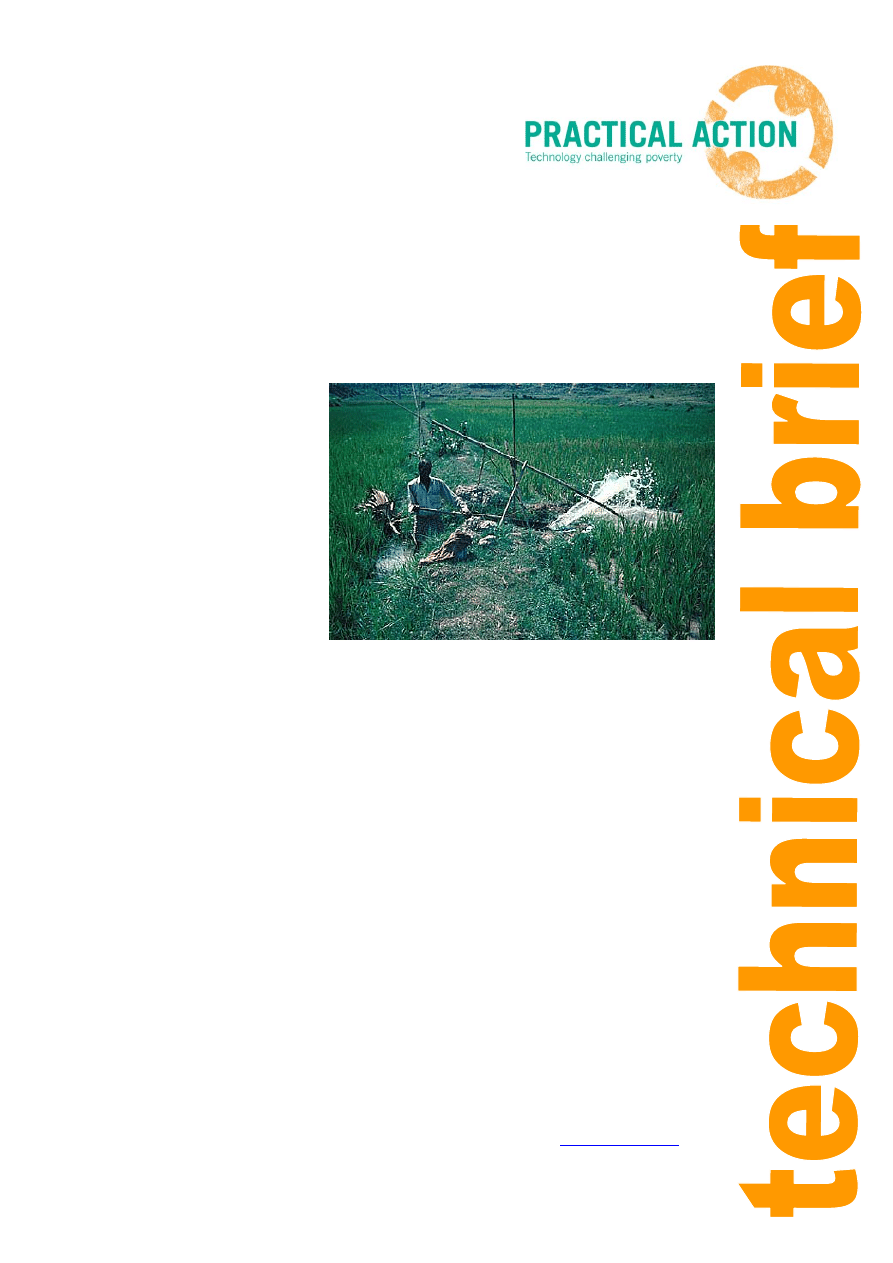
Figure 1: Traditional surface water lifter in Bangladesh
Photo: Practical Action.

Human and animal powered water lifting devices
Practical Action
2
Criteria
Key Questions
Important Points to Note
Technical Aspects :
Lift height and
yield
How much water is required for irrigation
purposes?
How high does the lifter have to raise the
water?
Water lifting requirements depends amongst
other things upon the climate, the crop and
the area to be irrigated.
The capacity of water lifter varies from around
0.5 m to more than 100 m.
Soil Conditions
What are the local soil conditions?
Can you access water the water easily i.e.
surface water or hand-dug well or is
drilling required?
Where there is very rocky soil a borehole will
usually need to be drilled to reach the
groundwater.
Operators
Is the lifter suitable and acceptable to the
people who will operate it?
Is the operation ergonomic (comfortable to
use) and realistic for the group responsible
for irrigation?
Are there health and safety considerations,
such as dangerous machinery?
The choice of water lifter should take into
account which group of people are tasked with
water lifting for irrigation.
It is important to determine if average and
maximum handle forces required are realistic
for the proposed user.
Financial and Economic Aspects :
Capital Cost
What is the initial cost of the water lifter?
Does the village have sufficient funds or is a
loan required?
How soon will the community be able to
pay back the loan/ recover this investment?
Using a water lifter for irrigation increases
efficiency and productivity and can ensure the
generation of additional income. For instance
families that introduced a treadle pump for
irrigation were able to generate between
US$100 and 500 additional income each
year.
Material and
Manufacturing
Costs
Can the lifter be manufactured using local
skills and materials?
Operating Costs
What is the operating cost of the lifter?
Does the village have sufficient
manpower/animal power to operate the
lifter for all the time it is needed?
It should be noted that although it may only
be necessary to irrigate crops for some of the
year, traction animals will need to be
maintained all year round. It is therefore
important to determine other tasks that will be
undertaken by the animal and ensure that the
timing of these task do not conflict.
Maintenance
Costs
What is the cost of maintaining/ repairing
the lifter?
Are the skills to maintain/ repair the water
lifter available locally?
Are spare parts available and affordable?
How often is the lifter likely to need
maintenance and/or repair?
How long will repairs take and what will
the villagers do in the meantime?
Maintenance is an integral part of lifter
management. For more complicated designs, it
is important to carry out preventative
maintenance. Serious problems can be
avoided by undertaking regular inspections
and servicing of the mechanical parts. Wear
and tear will be less severe this way and any
problems will be solved before they cause
major damage.
Life expectancy
How long is the lifter expected to last before
it has to be replaced?
How resistant is the lifter to vandalism or
abuse?
Institutional and Social Aspects :
Household/
Community
Is there a community organisation capable
of overseeing operation, maintenance and
management of the device and the water?
Will the users be instructed how to use and
look after the device?
The lifter should be suitable for Village Level
Operation and Maintenance (VLOM) or
Management of Maintenance (VLOMM). This
reduces the reliance of villagers upon large
institutions to sustain the water supply.
Table 1: Checklist for Water Lifting Device Selection
Human and animal powered water lifting devices
Practical Action
3
Types of Human- and Animal-Powered Water Lifters
Human and Animal Powered Water Lifters can be split into two categories: those designed to
lift surface water and those designed to raise groundwater.
Surface Water is present in depressions, lakes, rivers, reservoirs, and oceans.
Groundwater flows or seeps downward through the earth filling up the spaces
between soil, sand and rock to form a saturated zone. The upper surface of this
saturated
zone is called the “water table.” The “water table” may be just below the
surface like a spring or oasis or it may be over 100 metres down. The only way to get
access to this water is by digging and/or drilling.
Surface Water Lifters
Surface water lifters are generally the simplest form of human and animal water lifters
because the water is readily accessible and does not need to be raised more than a few
metres.
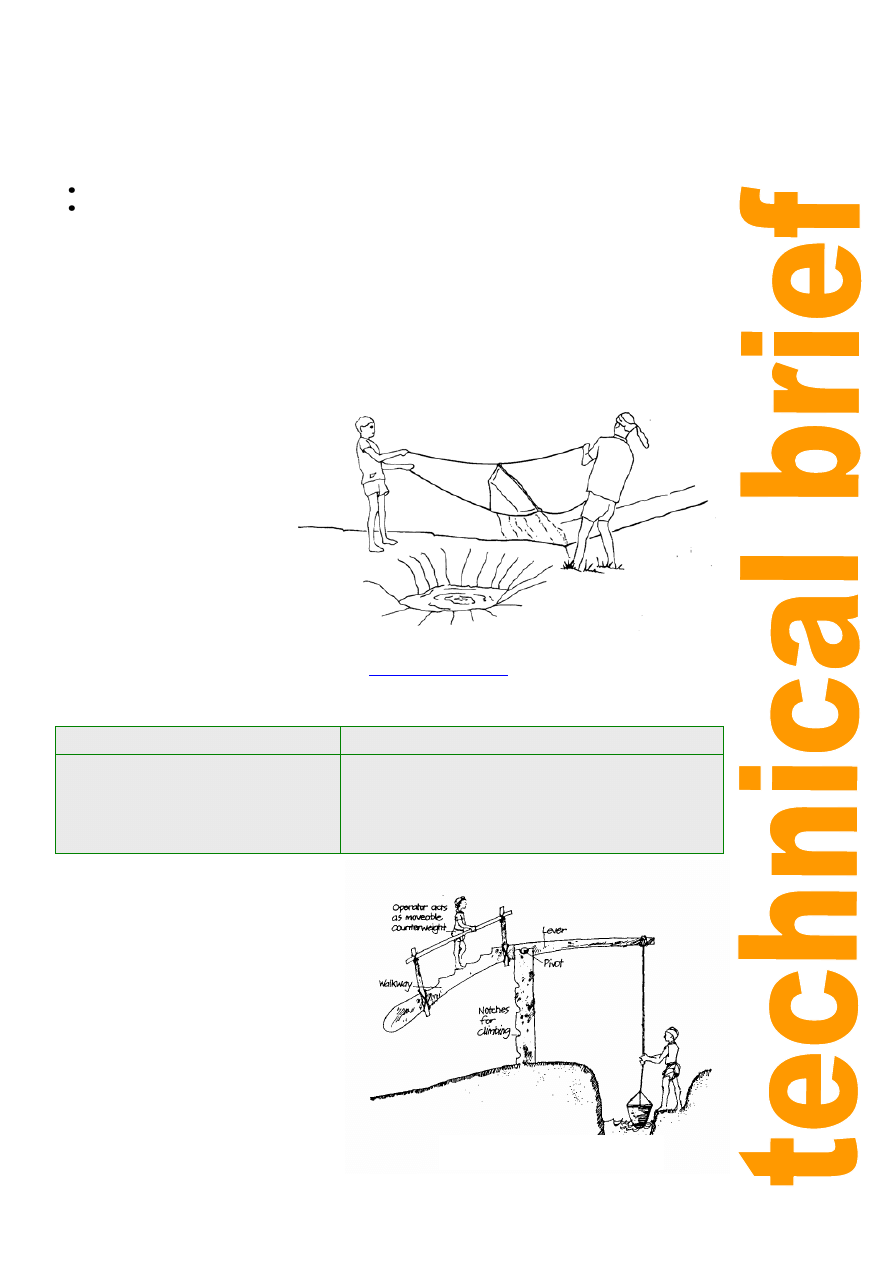
Swing basket
The swing basket is made from
cheap materials like woven
bamboo strips, leather, or iron
sheet to which four ropes are
attached. Two people hold the
basket facing each other, they dip
the basket into the surface water
and the basket is lifted by
swinging it and emptied into an
irrigation channel from which
point the water flows to the
fields. This lifter can be used at
depths of up to 1.2 m. Typical flow
rates of 60 to 80 l/min are
obtained at depths of 0.75 m.
Advantages
Disadvantages
Simple, inexpensive technology which can
be locally made and maintained.
Easy to operate by both adults and
children
Limited to lifts of less than 1.2 m
Limited water yield 60-80 l/min suitable for small fields
Low efficiency (10-15%) big human effort with significant
water spillage
Shadouf (Picottah)
The basic shadouf consists of a rope,
pole, bucket and counterweight and is
capable of lifting water up to 4 metres.
The counterweight can be just a heavy
rock, but in the more advanced picottah
design, one person guides the bucket
while the other acts as a moving
counterweight (Figure 3). It is generally
used for lifting water from unlined wells,
streams or ponds for irrigating small
fields. Approximately 60 litres/ min can
be lifted from a depth of 2 to 3 metres.
Figure 2: Swing Basket Irrigation
Source:
Figure 3: Shadouf (Picottah)
Human and animal powered water lifting devices
Practical Action
4
Advantages
Disadvantages
A relatively inexpensive traditional technology
which can be locally made and maintained.
Easy to operate
Relatively efficient (30-60%)
Limited to lifts of less than 4 m
Limited water yield, 60 l/min suitable for small
fields
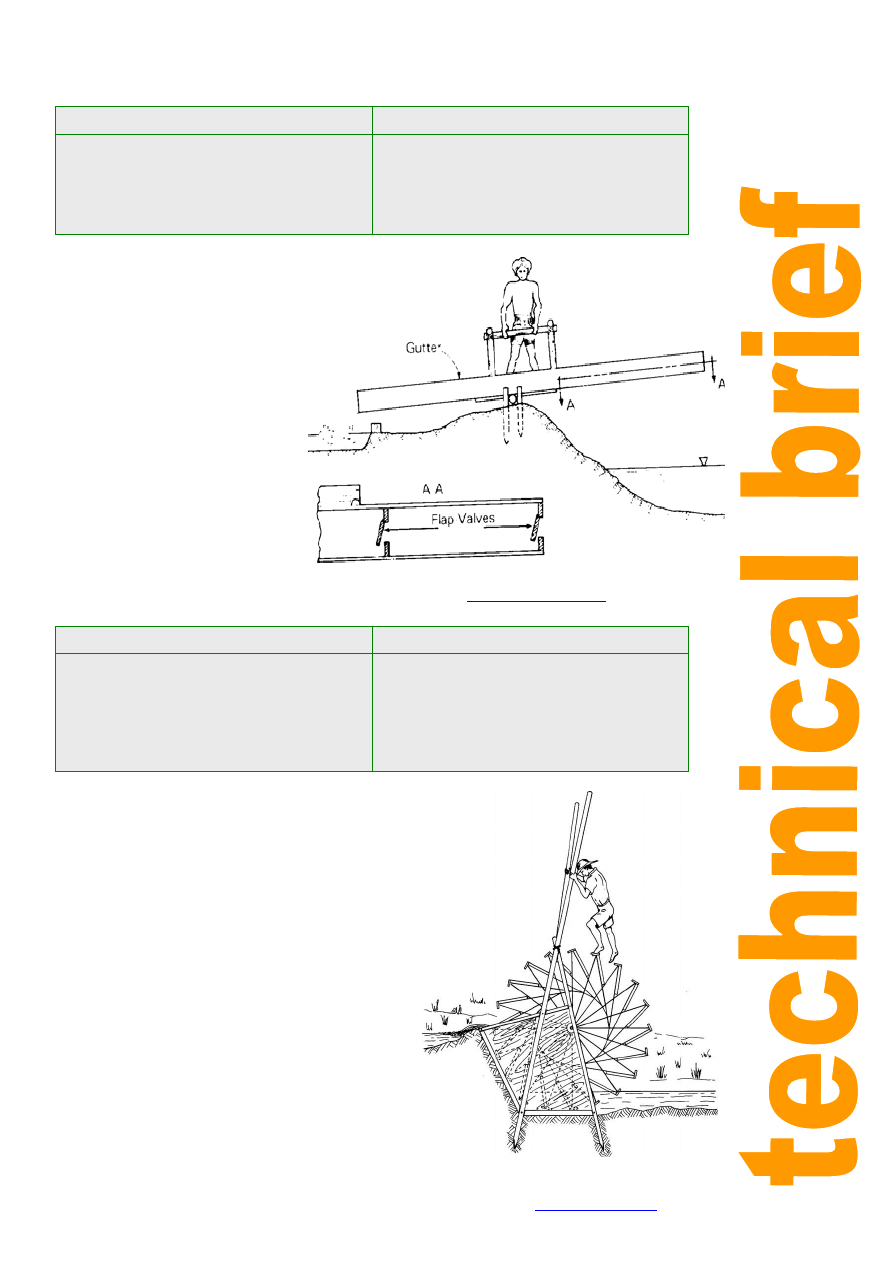
Dhone
The dhone consists of a trough
made from a wooden log or iron
sheet; closed at one end and open
at the other. The trough is
mounted on a suspended pivoted
lever to produce a see-sawing
gutter or dhone which operates at
relatively low lifts of up to 1.5 m.
The trough is lowered into the
water by exerting pressure using a
rope or the foot of the operator
until the closed end is submerged
in water. Upon releasing pressure
the trough comes to its original
position and the water is delivered
to the irrigation channel. Typical
yields of 80-160 l/min can be
obtained from the dhone between 0.3-1.0 m.
Paddle wheel (Chakram)
The paddle wheel is only suitable for low water lifts
of up to 0.5 metres and it is mostly used in coastal
regions to irrigate paddy fields.
Small paddles are mounted on a horizontal shaft,
which rotates in a close fitting concave trough,
pushing water upwards. The operator walks directly
on the rim of the paddle wheel, turning it so that it
continuously and steadily scoops up water and
deposits it into the irrigation channel.
The paddle wheel is not particularly efficient
because a lot of water lifted flows back around the
edges of the blades and hence it is not used
extensively. However it is simple to build and install
in situations where a lot of water needs to be lifted
through a small height. A paddle wheel with 12
blades can lift 300 litres/ min at depths of 0.5
metres.
Advantages
Disadvantages
A relatively inexpensive traditional technology
which can be locally made and maintained.
Easy to operate
Water yields of approximately 160 l/min for
lifts of less than 1 m
Limited to lifts of less than 1.5 m
Low to medium efficiency (20-50%)
Figure 4: Dhone
Source:
Figure 5: Paddle Wheel
Source:
Human and animal powered water lifting devices
Practical Action
5
Advantages
Disadvantages
Traditional technology which can be locally
made and maintained.
Water yields of approximately 300 l/min for
lifts of 0.5 m
Limited to lifts of less than 0.5m
Not very efficient (20-50%), lots of backflow
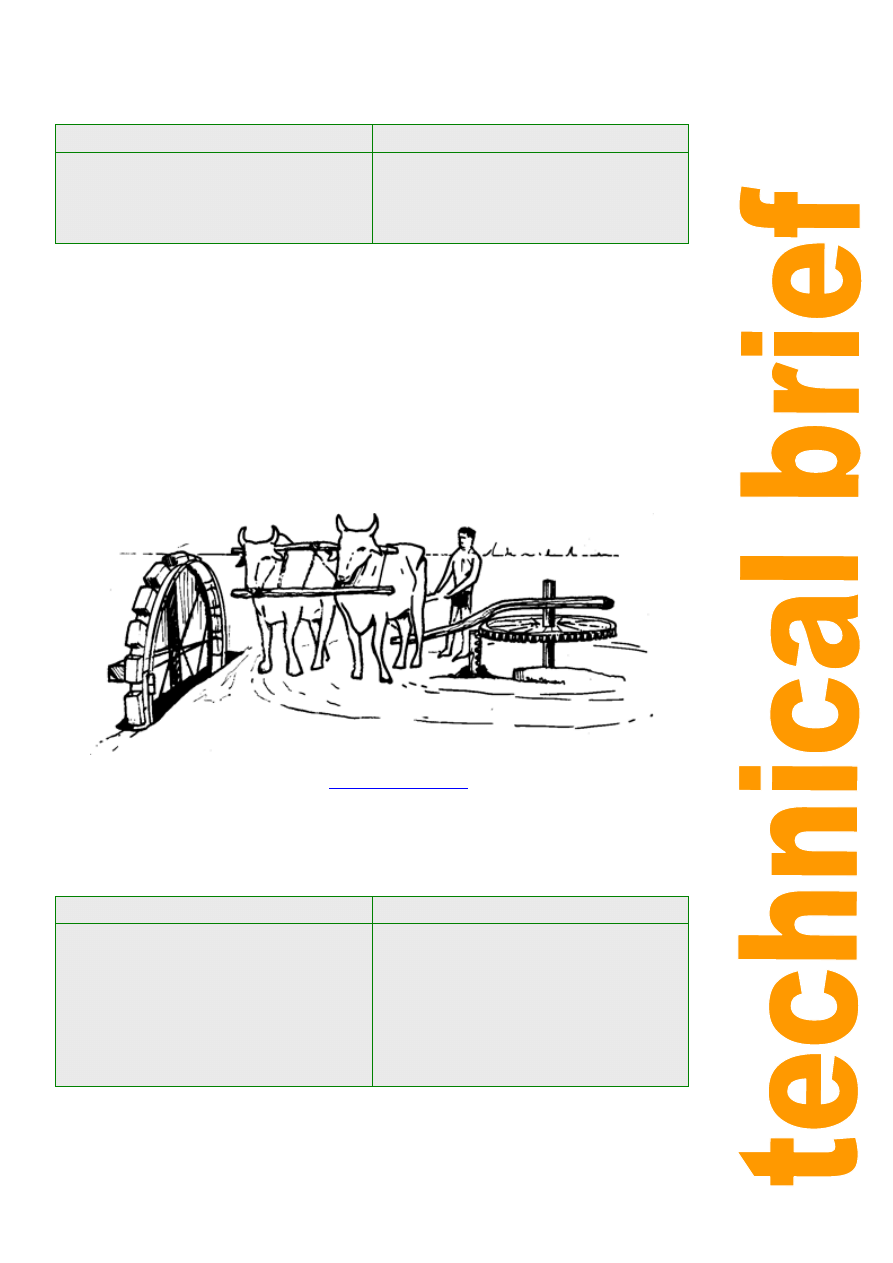
Persian Wheel (Raha)
This device consists of an endless chain of buckets typically with an individual capacity of 8-
15 litres mounted upon a drum and submerged in water to the required depth. The drum is
connected to a toothed wheel held in a vertical plane by a long shaft usually kept below ground
level. The vertical toothed wheel is geared with a large toothed horizontal wheel connected to a
horizontal beam. This beam is yoked to a pair of animals. The animals move in a circle to turn
the drum and raise the water. Water is released when the bucket reaches the top.
The average discharge rate from a Persian wheel is about 160-170 litres/min from a depth of 9m
with one pair of bullocks. The Persian wheel can be used to raise water from a depth of up to 20
m but its efficiency is reduced at depths below 7.5 metres.
Figure 6: Animal Driven Persian Wheel
Source:
A variety of all-metal improved Persian wheels have been built. Their smaller diameter reduces the
extra height the water needs to be lifted before it is tipped out of the containers, and also reduces
the well diameter that is necessary.
Advantages
Disadvantages
A relatively inexpensive traditional technology
which can be locally made and maintained.
Easy to operate
Lifts water up to 20 m but most efficient at
depths of less than 7.5 m. Water yields of
approximately 160-170 l/min for lifts of 9 m
Medium efficiency (40-70%)
The design means that water is raised above
the point of discharge before falling into the
collection channel.
Animals need to be maintained all year even
when irrigation is not necessary.
Human and animal powered water lifting devices
Practical Action
6
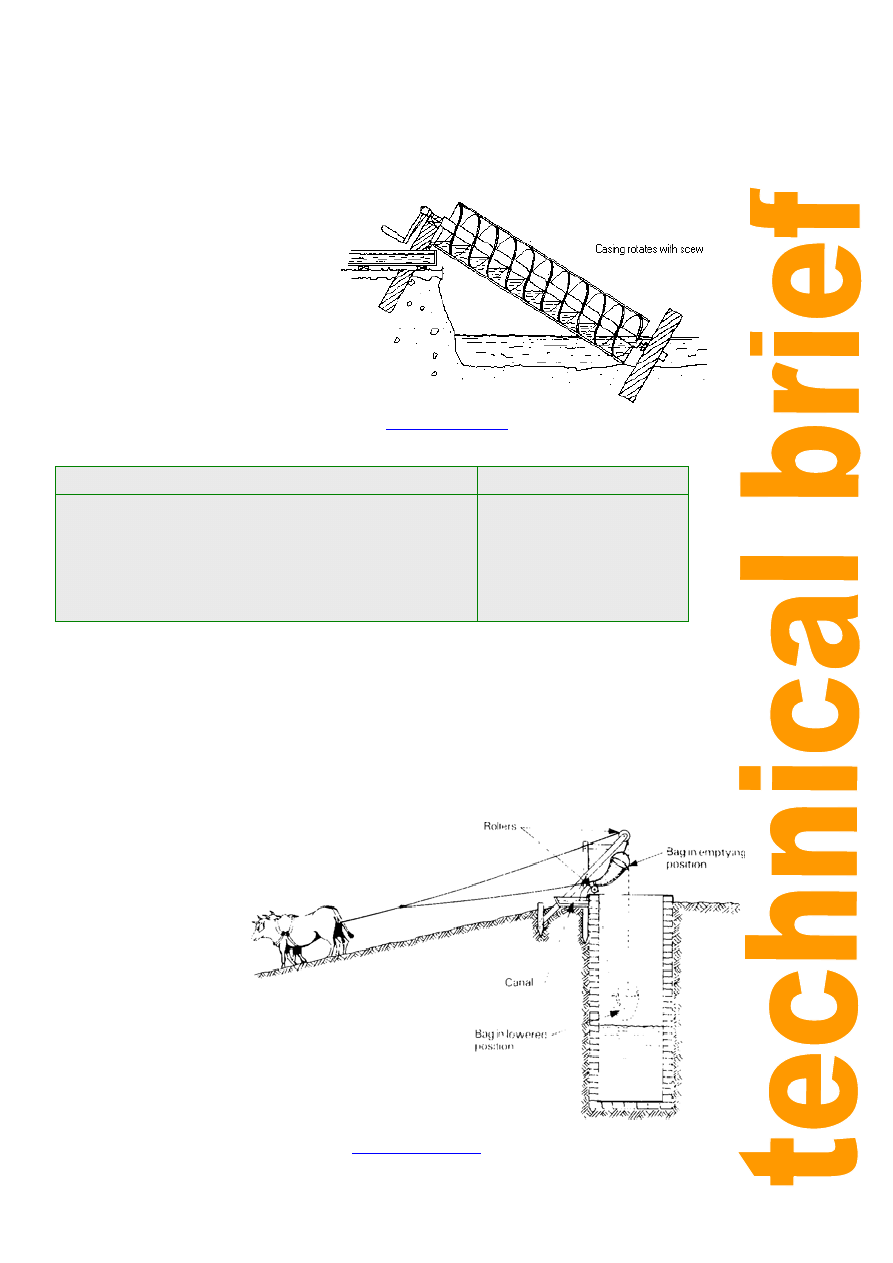
Archimedean screw
The Archimedean screw consists of a helical screw mounted on a spindle which is rotated
inside a wooden or metallic cylinder. One end of the cylinder is placed at an angle of 30
degrees and submerged in the surface
water source. When the handle is
turned water is trapped in the cavities
and raised to the level of the irrigation
channel as shown in Figure 7
.
Although this design looks quite
complicated, it is fairly easy to build
using local materials and is readily
transportable. It can also be adapted
to be driven by animals as shown in
Figure 8. The Archimedean screw
typically raises water from depths of
0.2 - 1.0 metres at a rate of 250-500
litres/ min.
Advantages
Disadvantages
A relatively inexpensive traditional technology which can be
locally made and maintained.
Transportable and easy to operate
Low to Medium efficiency (30-60%)
Water Delivery of 250-500 l/min for lifts of 0.2-1.0 m
Limited to lifts of up to 1.2 m.
Groundwater Lifters
The following section presents the main types of human and animal powered devices used for
lifting water from shallow and deep wells for irrigation purposes.
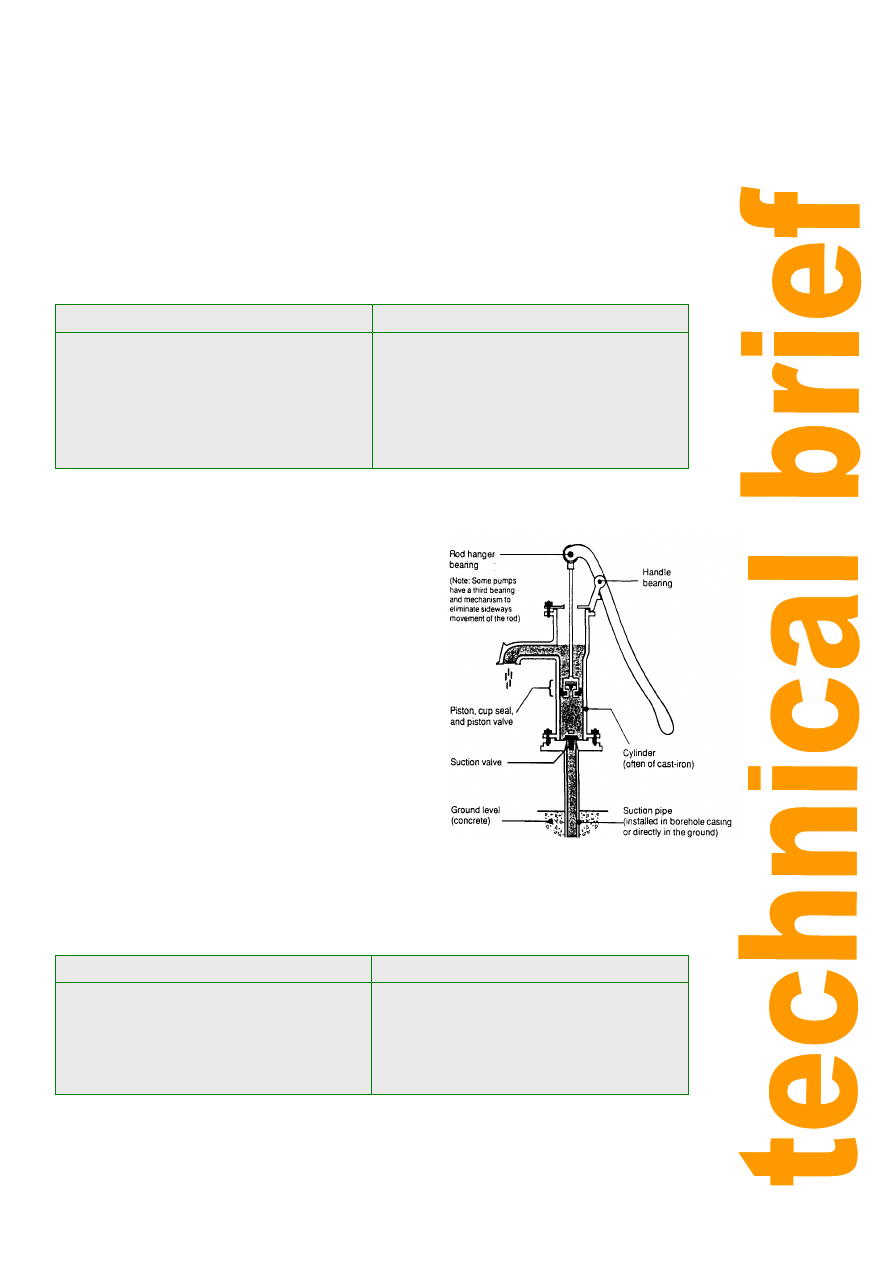
Rope and Bucket (Mohte, Charsa, Pur)
The simplest and cheapest method of lifting groundwater remains a rope and bucket in a wide,
shallow well. This type of well can operate up to a depth of 100 metres, although they rarely
exceed 45 metres. The rope and bucket lifter can be operated by humans or animals. Human
operated rope and bucket lifters typically raise 10-15 litres/min from depths of 10-15 metres
whereas an animal water
lifter can raise 150 litres/
min from 15 metres. In
the animal driven rope
and bucket lifter, the rope
attached to the bucket is
passed over a pulley and
fixed to the animal. The
animal is driven down on
an earthen ramp sloped at
an angle of 5-10 degrees
in order to lift the water.
A self-emptying container
or mohte can be used in
place of the bucket as
shown in Figure 8
.
The
system consists of a leather
container, shaped like a funnel.
The container can typically hold
Figure 8: Mohte.
Figure 7: Archimedean Screw
Source:
Human and animal powered water lifting devices
Practical Action
7
Figure 9: Shallow-Well Piston Pump
between 100 to 150 litres. This arrangement can discharge about 130 litres/ min at depths of
up to 9 metres.
The rope and bucket lifter can also be adapted to include two buckets which are raised and
lowered alternately. In this case the pulling animal moves in a circular path and with the help
of central rotating lever, rope and pulley arrangement the buckets move up and down. Each
bucket has a carrying capacity of up to 70 litres. The buckets have a hinged flap at the
bottom, which acts as a valve. Guide rods are provided in the well to control the movement of
the buckets. The buckets are automatically filled and emptied during operation. This device
can lift about 230 litres /min from depths of up to 5 metres.
Advantages
Disadvantages
Simple technology which is inexpensive to build
and maintain.
Can be operated at depths of up to 100 m.
Water Delivery from Animal Operated Rope and
Bucket Water Lifter of over 200 l/min for
double bucket system
Water Delivery from Human Operated Rope and
Bucket Water Lifter is limited to 15 l/min.
Animals need to be maintained all year even
when irrigation is not necessary.
Relatively low efficiency for traditional human
and animal operated designs (10-40%)
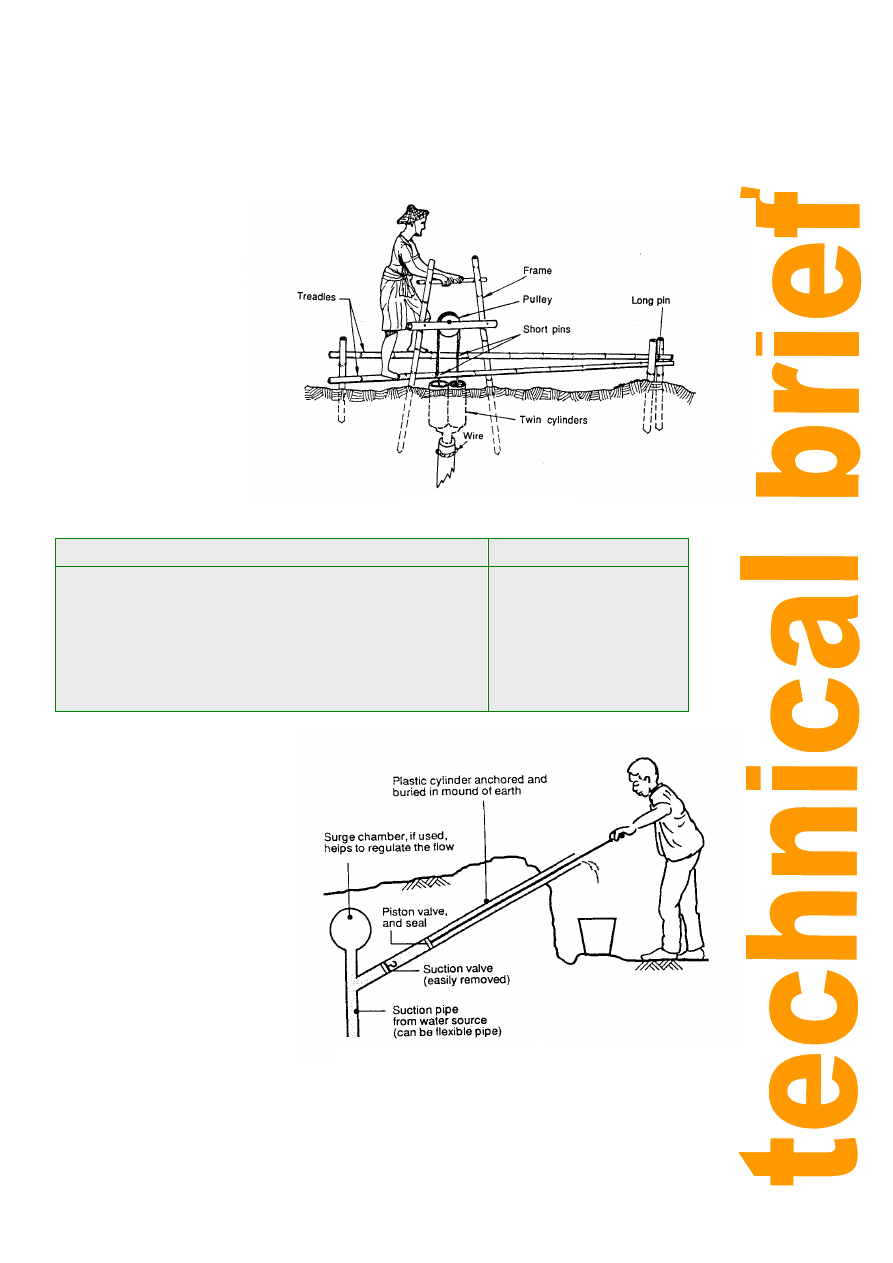
Shallow-Well Piston Pump
A reciprocating suction pump has a plunger or piston
which moves up and down in a two-valve closed
cylinder. As the plunger moves upward it forces water
out through the outlet valve and at the same time draws
water into the cylinder through the inlet valve. Moving
the plunger down brings it back to its starting position.
The reciprocating suction pump has the pump cylinder
situated above ground or near the surface. Pulling up
the plunger lowers the atmospheric pressure in the
cylinder (creates suction) causing the atmospheric
pressure outside the cylinder to push the water
upwards. The main limitation of this pumping method
is that the atmospheric pressure difference between the
inside and outside of the cylinder is only large enough
to raise water up to a maximum of 7m from the water
table.
A large piston diameter will give water delivery of 24-
36 litres/min at a depth of 7 metres. Most designs
have a maximum usage of around 50 people/day, which makes them less appropriate for irrigation
purposes than for household water supply.
Advantages
Disadvantages
Relatively simple maintenance (main pump
components positioned above ground)
Large piston diameter gives water delivery of
24-36 litres/min at 7 m depth
Medium to high efficiency (60-85%)
More expensive than most basic/traditional
irrigation methods.
Limited to wells of less than 7 metres in
depth
Treadle pump
A type of suction pump designed to lift water from a depth of 7 metres or less. The treadle
Human and animal powered water lifting devices
Practical Action
8
Figure 11: Rower Pump
Figure 10: Treadle Pump
pump has a lever pushed by the foot to drive the pump. Because leg muscles are stronger than
arm muscles, this design is less tiring to use than other human powered water lifters. Most of
the parts can be manufactured locally hence the treadle pump is relatively simple and
inexpensive to build.
The treadle pump can lift up to 100 litres/ min at depths of around 4 m.
The introduction of the
treadle pump for
irrigation has been shown
to have a positive impact
on household income. In
Bangladesh, a simple
treadle pump costs
around US$20 but this
investment allows
families to generate
US$100 additional
income annually. In
Africa where treadle
pumps cost between
US$50-80 additional
income rises to between
US$200 – 500 each
year.
Advantages
Disadvantages
Simple and inexpensive construction
Less intensive operation (foot operated)
Maintenance uses local skills and materials
Water delivery of up to 100 litres/min at 4 metres depth
Use leads to generation of US$100-500 additional income per
year for rural households in Africa and Asia
Limited to wells of less than
7 metres in depth
Rower
The rower pump is a simpler and
cheaper version of the traditional
reciprocating suction pump. The
pump is set at an angle of 30˚
and water is lifted through a
rowing action. The long piston
stroke ensures fast water delivery
of up to 90 litres/min at 4 m
depth.
Its simple design means it can
be easily manufactured and
maintained using locally
available skills and materials.
Human and animal powered water lifting devices
Practical Action
9
Advantages
Disadvantages
Cheaper construction than most reciprocating
suction and lift pumps
Maintenance using local skills and materials
Long piston stroke gives water delivery of up
to 90 litres/min at 4 metres depth
Limited to wells of less than 7 metres in
depth
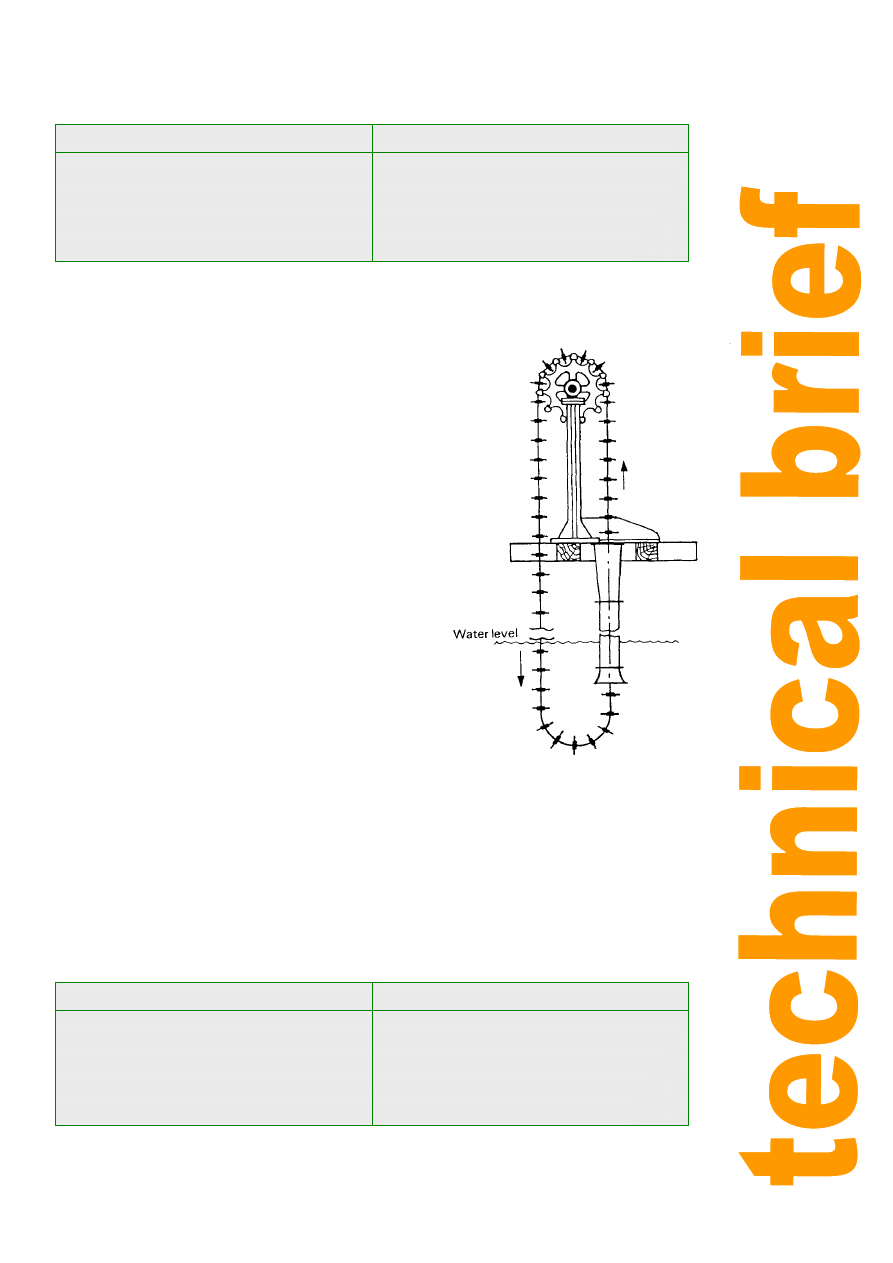
Chain / Rope and Washer Pump
(‘Pater noster’)
These pumps have been used in China and Europe for
many centuries. The pump consists of an endless
chain or rope on which washers are mounted at
intervals. The endless chain usually passes over two
drums. The upper drum is above the top of well to
which axle and handle is attached for operation. The
chain with disc passes through a pipe which extends
downward from the top of well to about 0.6 to 0.9m
below the surface of water. As the chain rotates the
discs trap the water in the pipe and carry it to the
surface where it is discharged in a trough.
Although in theory it is possible to construct a vertical
chain and washer pump to raise water to any height,
most do not exceed 35 metres. At this depth the
average yield is calculated as 10 litres/ min. However,
rope pumps more commonly operate at depths of up to
10 m with a water yield of 40 litres/ min. The rope
pump can be adapted to be operated by a horse and
will raise 60 litres/min from a 20 m well.
Chain/Rope and washer pumps require less
maintenance than other equivalent pumps. Their
simple design means that repairs can often be done by
users and require few spare parts. Models can use parts
that incorporate commonly available materials such as PVC
pipe, rope, and old car parts.
The main disadvantage of this type of pump for irrigation is that since this is not a pressurised
system it may take time to receive water from the well with the water falling back to the level
of the bottom of the well when not in use.
A variation of this design is called the "dragon-spine" pump, which lies at a shallow angle to
the horizontal. In this case, lifting height is rarely more than 6 metres. However, the design is
very flexible and can easily be adapted to circumstances.
Advantages
Disadvantages
Relatively cheap, and easy to manufacture
(for wells down to 35 m rope pumps are five
times cheaper than piston lift pumps.)
Maintenance uses local skills and materials
Operation limited to depths of up to 35 m.
Initial water delivery is relatively slow at
greater depths.
Frequent simple maintenance required
Medium to high efficiency (50-80%)
Figure 12: Chain and Washer Pump
Human and animal powered water lifting devices
Practical Action
10
Comparison of human- and animal- surface water and groundwater lifting
devices
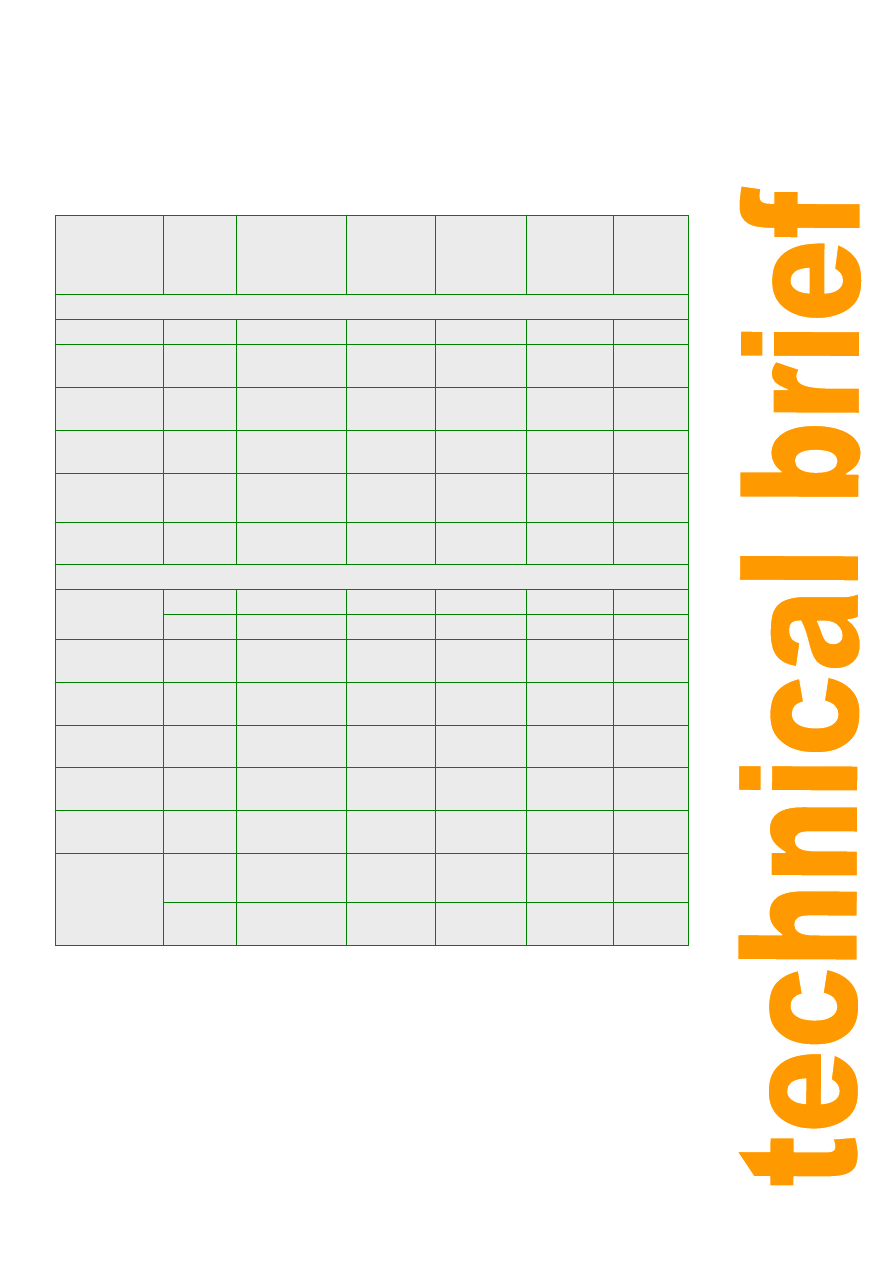
Table 2 provides an assessment of the different technologies considered in this technical brief.
Type
Power
Source
Manufacture
Investment
Cost
Maximum
Lift (m)
Typical
Flow Rate
(litres/min
)
Typical
Lift (m)
SURFACE WATER
Swing Basket
Human
Basic
Low
1.20
60-80
0.75
Shadouf /
Picottah
Human
Basic/
Traditional
Low-
Medium
4.00
60
2-3
Dhone
Human
Basic/
Traditional
Low-
Medium
1.50
80-60
0.30-
1.00
Paddle
Wheel
Human
Basic/
Traditional
Low-
Medium
0.50
300
0.50
Persian
Wheel
Animal
Traditional
Low-
Medium
20
250-280
160-170
3
9
Archimedean
Screw
Human
Traditional/
Industrial
Medium-
High
1.5
250-500
0.2-1.0
SURFACE WATER AND GROUNDWATER
Rope and
Bucket
Human
Basic
Low
100
15
10
Animal
Basic
Low
100
150
15
Mohte
Animal
Basic/
Traditional
Low -
Medium
100
130
9
Double
Bucket
Animal
Basic/
Traditional
Low -
Medium
100
230
5
Suction
piston
Human
Industrial
Low -
Medium
7
24-36
7
Treadle
Human
Basic/
Traditional
Low -
Medium
7
100
4
Rower
Human
Traditional
Low -
Medium
7
50
4
Chain &
Washer
Pump
Human
Basic/
Traditional
Low to
Medium
35
40
10
10
35
Animal
Basic/
Traditional
Low to
Medium
35
60
20
Table 2: Comparison of Different Types of Human- & Animal- Powered Water Lifting Devices

Human and animal powered water lifting devices
Practical Action
11
References and resources
Human-Powered Handpumps for Water Lifting
Technical Brief Practical Action
Technical Brief Practical Action
Technical Brief
WEDC
Technical Brief
WEDC
Technology Note WaterAid
Technical Brief
WEDC
How To Make and Use The Treadle Irrigation Pump
by Carl Bielenberg and Hugh Allen, Practical Action Publishing, 1995.
How to Make a Rope-and-Washer Pump
by Robert Lambert, Practical Action Publishing,
1990.
Human and Animal-powered Water-lifting Devices
by W. K. Kennedy & T. A. Rolgers. Practical Action Publishing, 1985.
Smart Water Solutions: Examples of innovative low cost technologies for wells, pumps,
storage, irrigation and water treatment
Netherlands Water Partnership, 2006
The Treadle Pump: Manual Irrigation for Small Farmers in Bangladesh
by Alastair Orr, A.
S. M. Nazrul Islam, & Gunner Barnes, Rangpur Dinajpur Rural Service – RDRS
Tools for Agriculture - a buyer's guide to appropriate equipment
Introduction by Iab Carruthers & Marc Rodriguez, Practical Action Publishing, 1992.
, FAO Irrigation and Drainage Paper 43, PL Fraenkel, 1986
Water Pumping Devices - A Handbook 3
by Peter Fraenkel & Jeremy Thake, Practical Action Publishing, 2006.
Organisations
IRC International Water and Sanitation Centre
P. O. Box 93190
2509 AD
The Hague
Netherlands
Tel: +31 70 3314133
Fax: +31 70 3814034
E-mail:
The IRC International Water and Sanitation Centre (IRC) facilitates the sharing, promotion and
use of knowledge so that governments, professionals and organisations can better support poor
men, women and children in developing countries to obtain water and sanitation services they
will use and maintain.
Netherlands Water Partnership (NWP)
Postbus 82327
2508 EH Den Haag
Tel: 070 304 3700
Fax: 070 304 3737
Tel: +31 (0)15 215 17 28
Fax: +31 (0)15 215 17 59
E-mail:
The Netherlands Water Partnership (NWP) is an independent body set up by the Dutch private
and public sectors. They nationally coordinate water activities overseas and provide relevant
information regarding these activities.

Human and animal powered water lifting devices
Practical Action
12
Practica Foundation
Oosteind 47
3356 AB Papendrecht
The Netherlands
Tel: +31-786150125
Website:
http://www.practicafoundation.nl/
The Practica Foundation aims to facilitate research, development and commercial application
of technology in the field of water and energy in developing countries. Technologies include:
SKAT
Vadianstrasse 42, CH-9000 St.Gallen, Switzerland
Tel: +41 71 228 54 54
Fax: +41 71 228 54 55
E-mail:
info@skat.ch
SKAT is an independent resource centre and consulting company. It is committed to
sustainable development in developing countries and countries in transition.
WELL
London School of Hygiene & Tropical Medicine
Keppel Street, London, WC1E 7HT, United Kingdom
Tel: +44(0)20 7927 2214
Fax: +44(0)20 7636 7843
E-mail:
WELL is a resource centre which aims to promote environmental health and well being in
developing and transitional countries. It is managed by the London School of Hygiene and
Tropical Medicine (LSHTM) and the Water, Engineering and Development Centre (WEDC),
Loughborough University for British & Southern NGOs working in water & sanitation.
WaterAid
Prince Consort House, 27-29 Albert Embankment, London, SE1 7UB, United Kingdom
Tel: +44 (0)20 7793 4500
Fax: +44 (0)20 7793 4545
E-mail:
technicalenquiryservice@wateraid.org.uk
The World Health Organization
Headquarters Office in Geneva (HQ)
Avenue Appia 20
1211 Geneva 27
Switzerland
Tel: +41 22 791 21 11
Fax: +41 22 791 3111
Website:

Human and animal powered water lifting devices
Practical Action
13
Manufacturers
(This is a selective list, not implying endorsement by Practical Action.)
Bombas de Mecate S.A.
Technology Transfer Division,
P.O.Box 3352, Managua, Nicaragua.
Telefax: 00-505-8566692
E-mail:
Manufacture different types of rope pump.
Consallen Group of Companies
P.O. Box 2993, Sundury, Suffolk, CO10 0TY,
United Kingdom
Tel/Fax: +44 (0)1787 881115
E-mail:
Specialists in Rural Water Supply & VLOM
Handpumps
H.J.Godwin Ltd.
Quenington, Cirencester, Glos, GL7 5BX,
United Kingdom
Tel +44 (0)1285 750271
Fax +44 (0)1285 750352
Deep-well and shallow-well pumps
Monoflo Incorporated
16503 Park Row, Houston, Texas 77084,
U.S.A.
Tel: +1 281 599 4700
Fax: +1 281 599 4733
E-mail:
Mono Pumps Limited
Martin Street, Audenshaw, Manchester M34
5DQ, England, United Kingdom
Tel: +44 (0)161 339 9000
Fax: +44 (0)161 344 0727
E-mail:
Website:
Producers of helical rotor and piston lift
device
Prodorite (Pvt) Ltd
21 Leyland Road, Arbennie Industrial Sites,
PO Box 2887, Harare
Zimbabwe
Tel: +263 4 663691/4
Fax: +263 4 663696
Products include hand pumps for wells,
water storage tanks, Blair vent pipes and
sanitary pans
Steelman Industries
Shanti Dham, Kankarbagh Main Road, Patna
(Bihar) - 800 020,
India
Tel: +91-612-352530
Fax: +91-612-352872
E-mail:
Produce the following handpumps: India Mark
II, India Mark III, India Mark IV, Rawman
shallow & force handpump, Rawman special
Lift & force VLOM handpump
SWS Filtration Ltd.
The Bakers Chest, Hartburn, Morpeth,
Northumberland NE61 4JB,
United Kingdom
Tel +44 (0)1670 772214
Fax +44 (0)1670 772363
E-mail:
Manufactures of Rower and other
low-technology pumps
Van Reekum Materials bv
P. O. Box 98, 7300 AB Apeldoorn,
The Netherlands
Tel: +31 55 533 54 66
Fax: +31 55 533 54 88
E-mail:
Producers of a range of pumping equipment
Human and animal powered water lifting devices
Practical Action
14
This technical brief was produced by Jane Olley for Practical Action, November 2008.
Practical Action
The Schumacher Centre
Bourton-on-Dunsmore
Rugby, Warwickshire, CV23 9QZ
United Kingdom
Tel: +44 (0)1926 634400
Fax: +44 (0)1926 634401
E-mail:
inforserv@practicalaction.org.uk
http://practicalaction.org/practicalanswers/
Practical Action is a development charity with a difference. We know the simplest ideas can have the most
profound, life-changing effect on poor people across the world. For over 40 years, we have been working
closely with some of the world’s poorest people - using simple technology to fight poverty and transform their
lives for the better. We currently work in 15 countries in Africa, South Asia and Latin America.
Wyszukiwarka
Podobne podstrony:
Human & Animal Powered Water Lifters for Irrigation
Solar Thermal Water Heater For Less Than Five Doll
Solar Thermal Water Heater For Less Than Five Doll
Garret Water Carburator Plans For Water Powered Vehicles
Garret Water Carburator Plans For Water Powered Vehicles
Guidelines for coordinated human and animal brucellosis surveillance
Comparison of Human Language and Animal Communication
THE UNIQUENESS OF HUMAN LANGUAGE ANIMAL VS
dokument Strengthening respect for human rights, strengthening INTERPOL
Anatomical evidence for the antiquity of human footwear use
English for CE EE and water id Nieznany
European standards for drinking water
4 animals for woman
Contrasting Human Language With Animal Communication
How To Build an Acid Alkaline Water Charger health healing search for [!B!]
ANIMAL MODELS FOR IMPLANT BIOMA Nieznany (2)
Mark Alders A Human for Christmas
więcej podobnych podstron