
Reading Mission Control Data out of Predator Drone video feeds
By Kingcope
Introduction
There have been recent reports [1] of insurgents intercepting unencrypted U.S. Predator drone
video feeds in Iraq and Afghanistan. The predator drone video feeds were sent in some cases
from the predator drones without any encryption technology so the insurgents were in a rather
simple situation to intercept the video feeds and save them to hard disks and share them
among each other. WSJ [1] states that a software called “SkyGrabber” was used to read the
video feeds. The intention of this software is to read images and videos off the air by using
satellite antennas.
After doing some research on the issue we found that in the predator video feeds aside from
image data there is also mission control data carried inside the satellite signal to the ground
control stations. It is theoretically possible to read off this mission control data both in the
intercepted video feed and saved video data on harddisks.
Technology used by the drones
There is a control and command link to communicate from a control station to the drone.
Further there is a data link that sends mission control data and video feeds back to the ground
control station. Here one has to distinguish between line-of-sight communication paths and
beyond line-of-sight communication paths. The operation of the line-of-sight link is limited to
approx. 81-138 miles. This operating range can be extended by for example using mobile
ground control stations, which are locally deployed. Line-of-sight links are critical for
takeoffs and landings of the drone. These links utilize a C-Band communication path.
Beyond line-of-sight communication links operate in the Ku-Band satellite frequency. This
allows the UAV (Unmanned Arial Vehicle) to cover approx. 1500 miles of communication
capability.
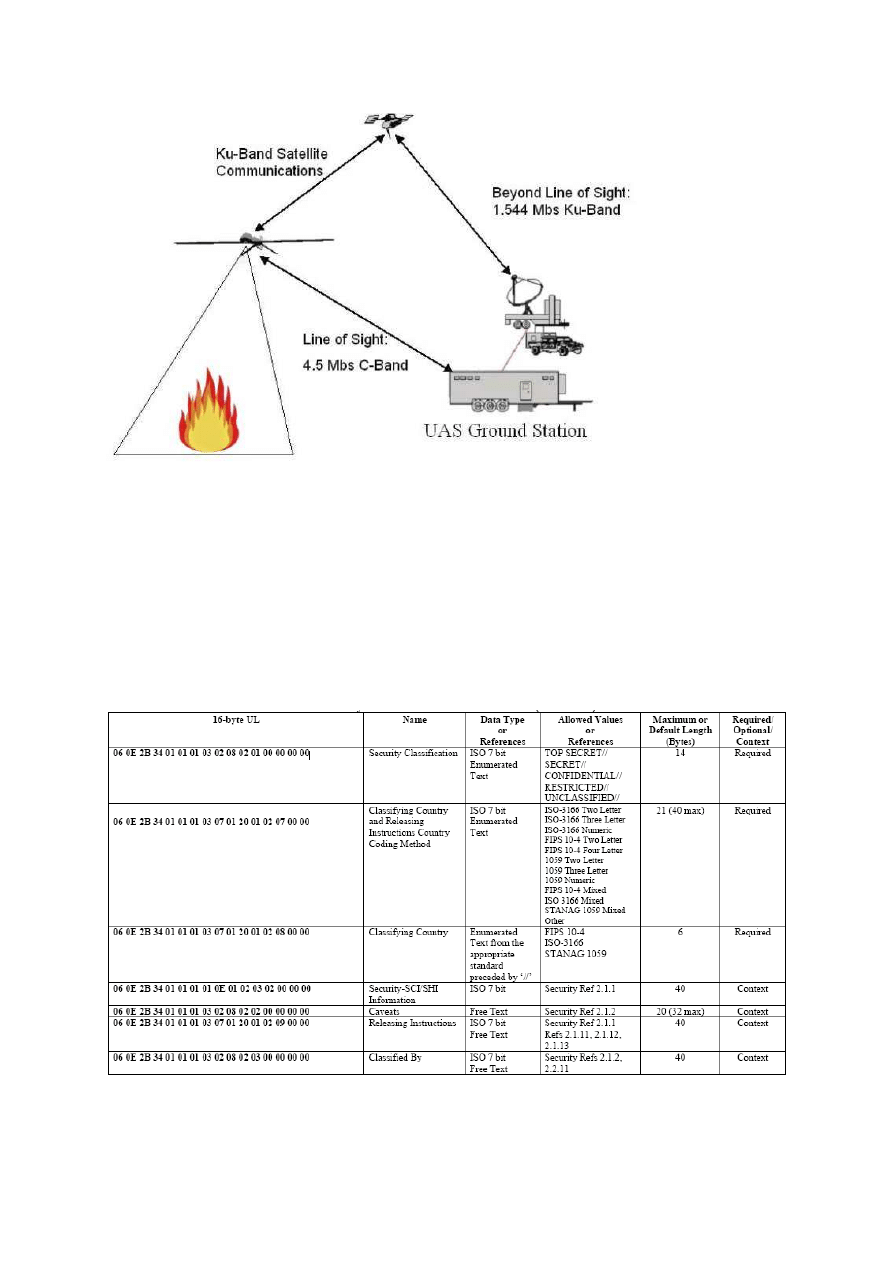
Figure: C-Band and Ku-Band Communication
So this explains somewhat why the insurgents were able to intercept the Predator video feeds
when they were sent unencrypted to the ground station. The only thing needed is a C-Band or
Ku-Band antenna which can read traffic. Sending traffic to a satellite for example is not
needed in this case.
The drones normally use MPEG-TS (MPEG Transport Stream) to send video and data to the
ground station. Motions Imagery Standards Board (MISB) [2] has developed several
standards on how to embed the control data into MPEG streams.
Figure: Excerpt of metadata sent with the MPEG Transport Stream taken off a public MISB Standard document
An important note is that our research shows that most if not all metadata inside the MPEG
Stream is for its own not encrypted if the MPEG Stream itself is not encrypted.
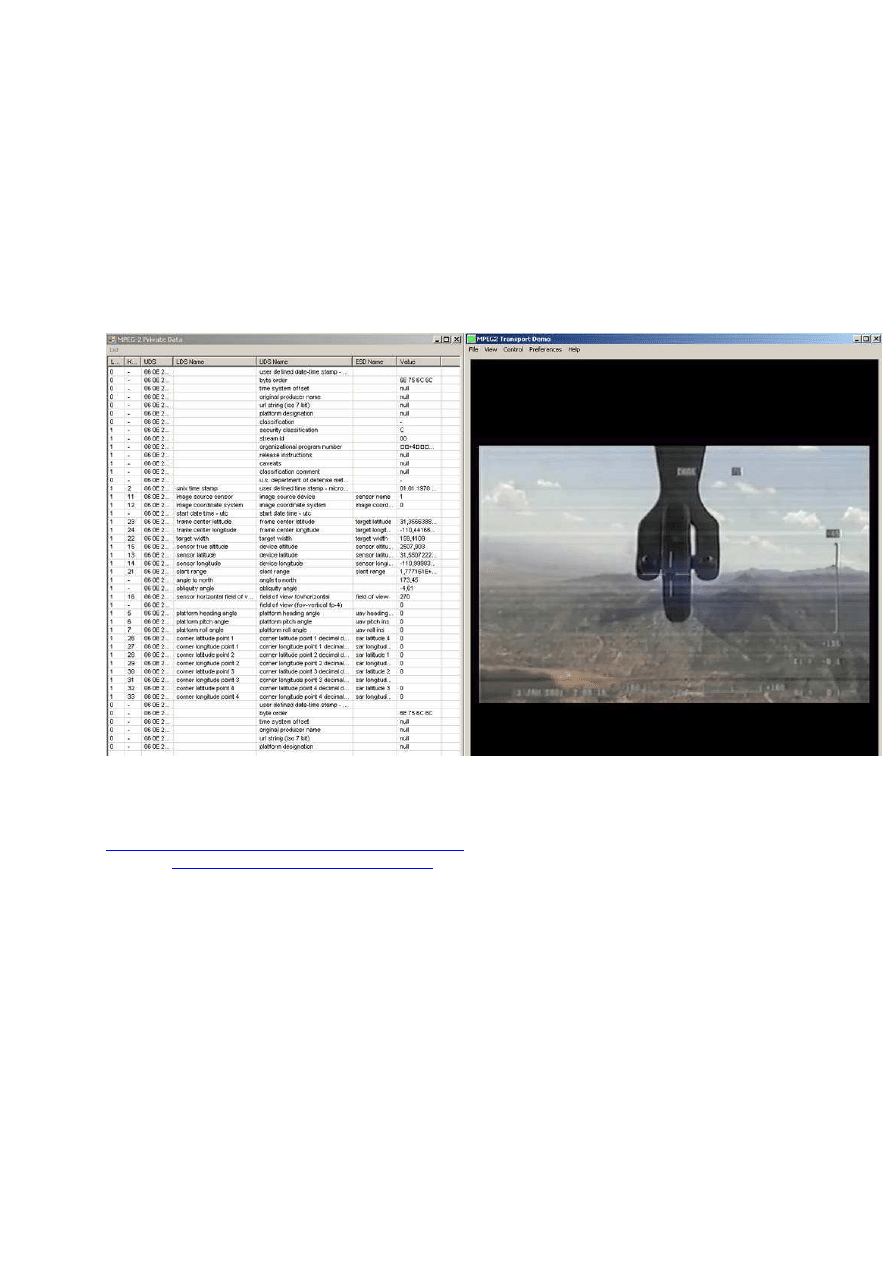
How to read the control data with publicly available tools
During our research we found a suitable tool to read the mission control data off the air video
feeds and also off saved video feeds. The tool is programmed by LEADTOOLS [3] and is
capable of reading KLV metadata out of MPEG-TS. Inside the LEADTOOLS Multimedia
SDK package a programmer finds source code and binaries of the needed tool.
The following screenshot shows the tool in action. The loaded file is a saved MPEG-TS UAV
video with private metadata embedded.
References
[1] Insurgents Hack U.S. Drones, Wall Street Journal
http://online.wsj.com/article/SB126102247889095011.html
[2] MISB,
http://www.gwg.nga.mil/misb/stdpubs.html
[3] LEADTOOLS, http://leadtools.com/SDK/Multimedia/mpeg2-transport-stream.htm
Wyszukiwarka
Podobne podstrony:
71 Predator MkVÇ âóáÓĄĘ´ é«Ó«şá (2009)
72 Predator MVÇ ŹáßÔáóşĘ¬Ę (2009)
73 Predator MkVÇ ĽÓáČ«óşĘ¬Ę 2009
Wykład 6 2009 Użytkowanie obiektu
Przygotowanie PRODUKCJI 2009 w1
Wielkanoc 2009
przepisy zeglarz 2009
Kształtowanie świadomości fonologicznej prezentacja 2009
zapotrzebowanie ustroju na skladniki odzywcze 12 01 2009 kurs dla pielegniarek (2)
perswazja wykład11 2009 Propaganda
Wzorniki cz 3 typy serii 2008 2009
2009 2010 Autorytet
Cw 1 Zdrowie i choroba 2009
download Prawo PrawoAW Prawo A W sem I rok akadem 2008 2009 Prezentacja prawo europejskie, A W ppt
Patologia przewodu pokarmowego CM UMK 2009
Wykład VIp OS 2009
więcej podobnych podstron