1
PB1633
Agricultural Extension Service
The University of Tennessee
Improving Your
Backyard
Wildlife Habitat

2
Table of Contents
Wildlife Needs.......................................................................................................................................... 3
Wildlife Management Concepts ............................................................................................................... 3
Edge, Vertical Structure and Interspersion ............................................................................................... 4
Draw a Map .............................................................................................................................................. 5
Putting It All Together.............................................................................................................................. 6
Benefi ts of Landscaping for Wildlife ....................................................................................................... 6
What Should You Plant?........................................................................................................................... 6
Table 1 - Native trees and shrubs benefi cial to wildlife ........................................................................ 7
Table 2 - Native herbaceous plants that attract hum ming birds and butterfl ies...................................... 8
Providing Shelter ...................................................................................................................................... 8
Feeders and Nest Boxes ........................................................................................................................... 9
Table 3 - Food preferences of birds common to back yard feeders in Tennessee ................................ 10
SPECIAL CASE: The Eastern Bluebird ................................................................................................ 11
Table 4 - Dimensions of nest boxes.................................................................................................... 13
Water....................................................................................................................................................... 14
Conclusion.............................................................................................................................................. 15
3
ildlife viewing is
becoming one of the most
popular forms of outdoor
recreation in Amer i ca. Ob-
serv ing wildlife in one’s own backyard is not only
en joy able, but convenient as well. In some areas (es pe -
cial ly rural settings), excellent wildlife habitat exists
and viewing op por tu ni ties can be abundant. How ev er,
in a growing number of areas (especially suburbia),
wildlife habitat has de te ri o rat ed or been destroyed
entirely. This is particularly true in many subdivisions
where the landscape was bulldozed and leveled-off
prior to home con struc tion. In either case, there are lots
of ways to im prove wildlife habitat around your home.
Wildlife Needs
Wildlife have four basic requirements: food,
cover, water and space. Considering these re quire -
ments, you can see where the area around your
home may be defi cient in one or more of these. In
most cases you can improve defi ciencies; how-
ev er, in some cases, because of physical or spatial
lim i ta tions, you will not. These four basic habitat
re quire ments differ (to some degree) with each
wildlife species. What is good for one species may
W
Improving
Your Back yard
Wild life Habitat
Craig A. Harper, Assistant Professor
Forestry, Wildlife and Fisheries
not be good for another. For example, squirrels will
not get much benefi t from a large lawn or pasture
where bluebirds are thriving on insects. Also, some
mammals (e.g., deer and bears) need a much larger
area to meet their habitat re quire ments than others
(e.g., rabbits or chip munks) do. There is, however,
overlap in many habitat re quire ments. Many wild-
life species benefi t from a fruit-pro duc ing shrub or
bird feeder and a multitude of species will use the
stand ing dead oak at the edge of your yard or fi eld
for nesting, denning, roosting, perching and feeding.
Wildlife Management
Concepts
Before starting a plan to improve wildlife habi-
tat around your home, there are some basic concepts
of wildlife management you should un der stand.
Re al iz ing that not all species have the same habitat
re quire ments, a diversity of habitats and vegetative
types will benefi t more wildlife species than an area
with homogenous vegetative cover. Increased plant
di ver si ty gives rise to in creased animal diversity,
where diversity is the number of species, not the
number of individuals. Food, cover, water and space
4
resources are fi nite
and can be utilized
com plete ly. To this
end, an area can sup-
port only so many
animals, which is
ex pressed as the carry-
ing capacity (Figure
1). In many areas, the
carrying capacity has
been reached, yet no
animals are present!
That is because there
is in suf fi cient habitat
to support any wild-
life. This is where
ac tiv i ties for im prove -
ment are much needed
and results can be as ton ish ing.
Edge, Vertical Structure
and Interspersion
“Edge” is where two or more habitats come
together. For example, an edge exists where your
yard meets the woodlot. Most often, many wild life
species are found here. The reason these species
are associated with edges is because both food
AND cover are in close prox im i ty. Es cap ing a hawk
or house cat is much easier for a rabbit if some
brushy cover is near the clover and grass it’s feed-
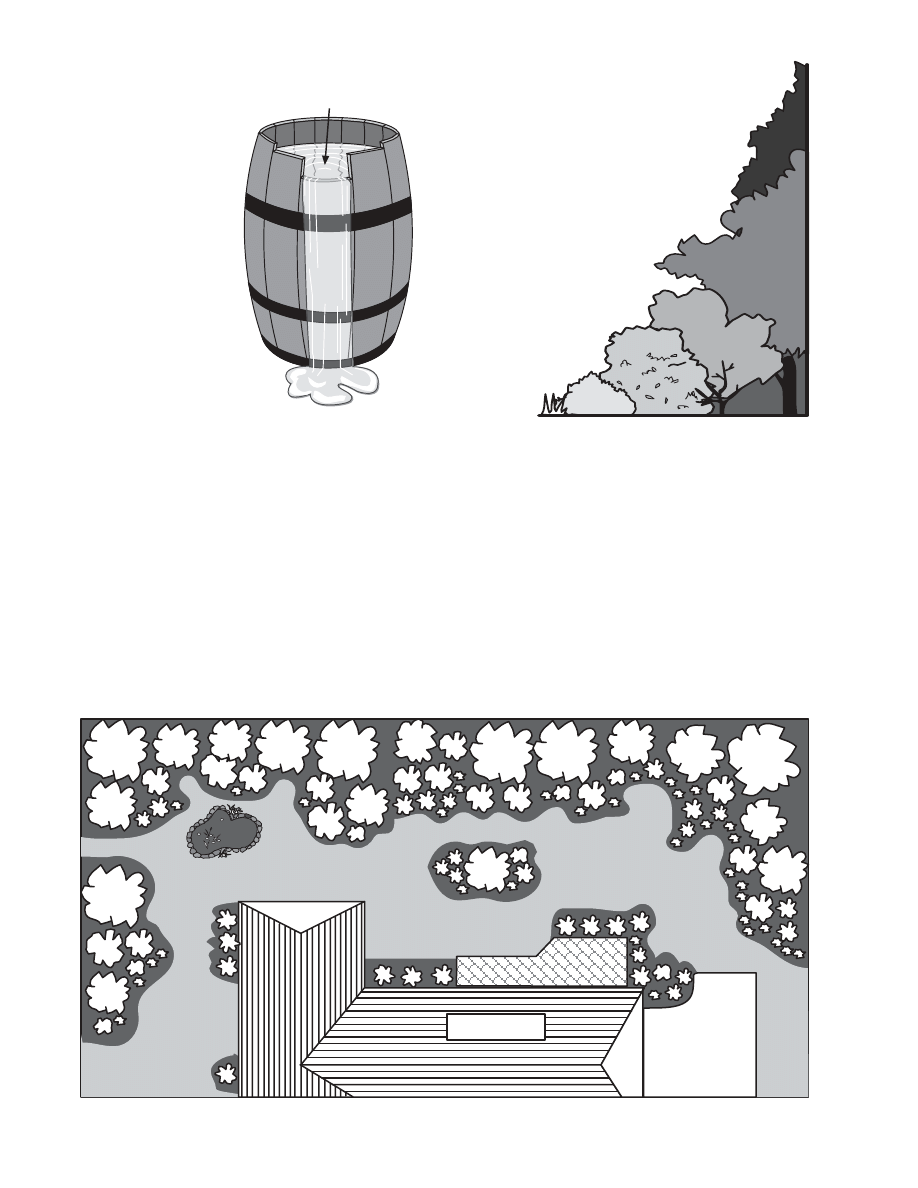
Figure 2. You can increase the amount of edge by creating irregular borders.
ing on. Like wise, a fox is going to hunt most often
where the rabbit is — near the “edge!” Cre at ing an
ir reg u lar border (as op posed to a straight one) with
your yard and or na men tal plantings is the eas i est
way to increase the amount of edge near your home
(Figure 2).
Edge is rep re sent ed on both a hor i zon tal and
vertical plane. Vertical struc ture is rep re sent ed by
dif fer ent layers of veg e ta tion ex tend ing from the
ground up to the tree canopy (Figure 3). Ver ti cal struc-
ture is im por tant for several rea sons. Most im por tant ly,
it rep re sents dif fer ent lay ers of cov er for pro tec tion,
nest ing, roost ing and feeding for all kinds of animals
Figure 3.
Edge is increased vertically
by “stair stepping”
vegetation starting with
low-growing herbaceous
vegetation, then shrubs,
small trees and large trees.
House
W
a
te
r
C
o
v
e
r
Food
Wildlife
Figure 1.
5
and
some
species “spe cial ize” in being
able to exploit a par tic u lar layer.
Many small mam mals and birds (e.g.,
eastern towhees and brown thrash ers) feed on
the ground amongst brush and low vegetation. Caro-
lina wrens, north ern car di nals and north ern mock ing -
birds forage for food in low-grow ing shrubs and trees.
Red-eyed vireos, scarlet tan a gers and yel low-throat ed
war blers for age in the can o py of ma ture stands. Some
spe cies (e.g., wild tur keys) prefer areas where vis i bil i ty
is good and the veg e ta tion is not too dense. Others
(e.g., rabbits) prefer areas with low-growing dense
veg e ta tion and re duced vis i bil i ty.
In ter sper sion is best de scribed as the ar range -
ment of hab i tats. A mixture of hab i tats arranged in
a patch work mosaic pro vides good in ter sper sion.
Make your yard and sur round ing area more at-
trac tive for wild life by ar rang ing dif fer ent habitats
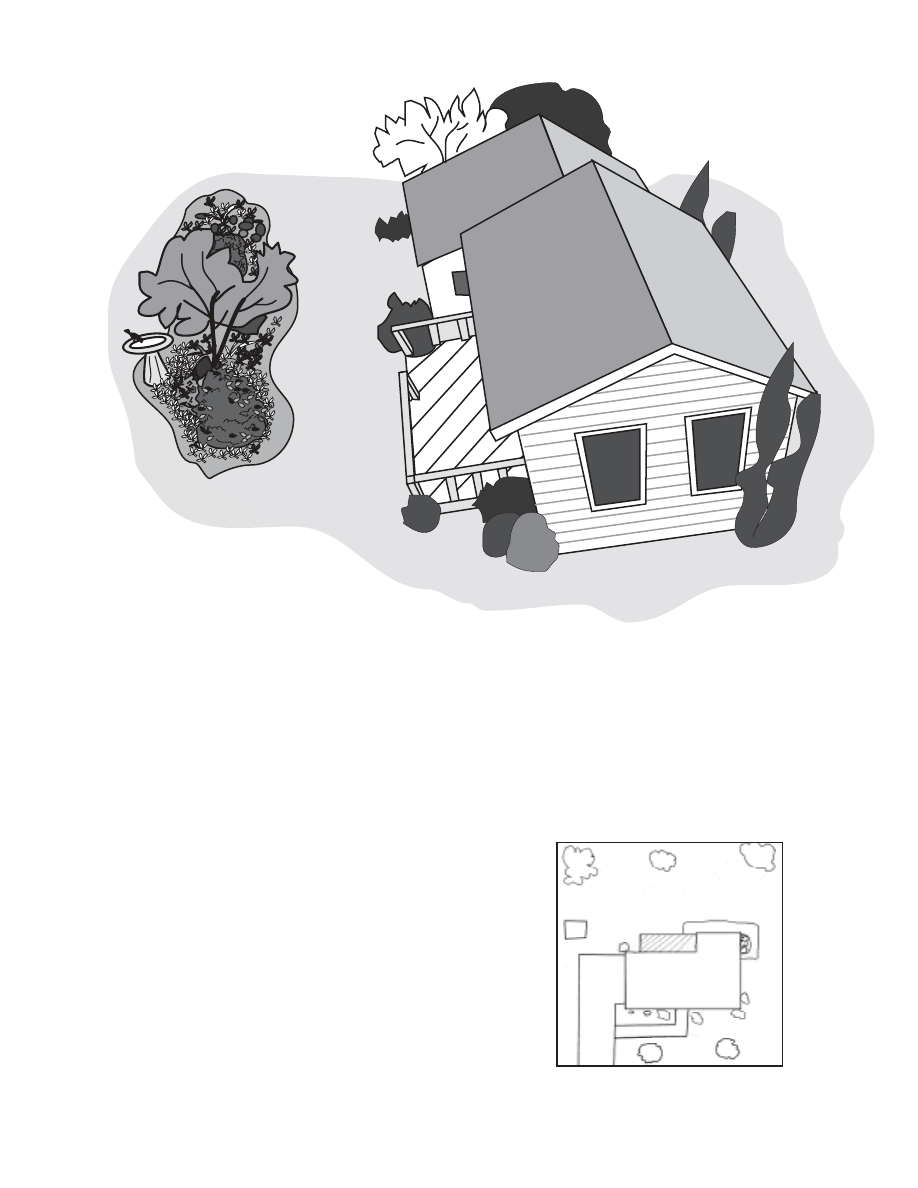
close to one an oth er. An island of wild fl ow ers or
shrub bery in your yard in creas es in ter sper sion while
break ing up large expanses of grass (Figure 4).
Draw a Map
One of the fi rst steps in pro vid ing in creased
hab i tat for wild life in your back yard is to draw a
map of the area sur round ing your home (Figure 5).
As ac cu rate ly as you can, start with your property
bound aries
and draw in your
house, drive way, fence, shed and then your shrub-
bery. Continue by iden ti fy ing the lo ca tion of all
trees, bushes, bird feeders, bird baths, etc. Once
com plet ed, step off distances (e.g., from house to
road, shed to garden, etc.) to get a rough check of
your map and correct any sign of errors re gard ing
scale. Now, what do you have? Look at the habitat
“holes” on your map and study the ar range ment of
vegetation. This will help you see where you should
begin working.
Figure 4. Establishing islands
in your yard is a great way
to increase edge and promote
diversity.
Figure 5. Drawing of a backyard.
6
Putting It All Together
Although every area is unique, most back-
yards need more wild life-friendly plants arranged
to increase interspersion and edge. Plant ing trees,
shrubs and herbaceous plants that are benefi cial to
wildlife usually is the single most im por tant thing
you can do to improve wildlife hab i tat around your
home. Plant ing suitable plants in the appropriate
plac es in the proper ar range ment will benefi t wild-
life through out the year. Food, cov er and, to some
degree, space will be provided au to mat i cal ly.
As you develop a plan to land scape your area
for wildlife, keep edge and in ter sper sion in mind.
If you are start ing from scratch, consider planting
the tallest trees along the outside bor der of your
yard and con tin ue in toward the center of your yard
in a stair-step fashion with smaller trees, then large
shrubs, small shrubs and fi nally herbaceous plants
(see Figure 3) . If woods already surround your
house, con sid er planting smaller trees and shrubs
at the edge of your yard and the woods, creating
what is called a “soft” edge. That is, the transition
between the woods and your yard is gradual, not
sudden. This makes the area attractive to many more
species of wildlife. Remember that a diversity of
vegetation gives rise to a diversity of wildlife.
Benefits of Landscaping
for Wildlife
Many ben e fi ts are re al ized when land scap ing
for wild life. Ob vi ous ly, wild life will benefi t from
habitat en hance ment, but you will ben e fi t as well.
By land scap ing for wild life, you can benefi t by
con serv ing energy and re duc ing your heating and
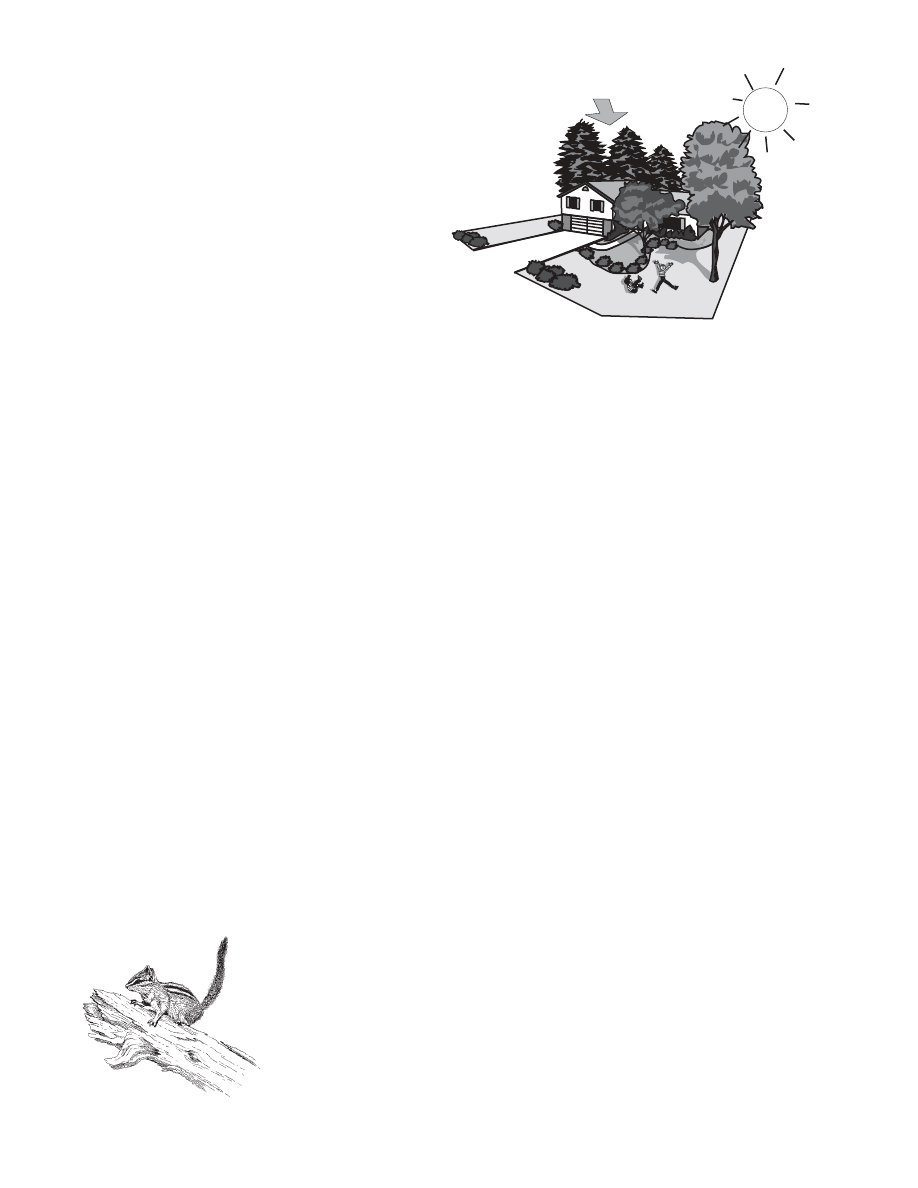
cool ing bill (Figure 6). Plant co ni fers as a wind-
break on the north and west sides of your property
to pro tect from chilling win ter storms. Ev er green
trees and shrubs act as in su la tors for birds and mam-
mals, pro tect ing them from bitter winds and freez-
ing pre cip i ta tion. For ag ing spots of ten can be found
un der ev er greens when snow cov ers the sur round ing
area. On the south side
of your prop er ty, plant
deciduous trees that
produce plenty of shade
for a cooling effect in
the sum mer. During
winter, these trees will
lose their leaves and
allow the sun’s warming rays to reach your home
and help reduce your heating bill. Soil conservation
also is realized by land scap ing for wildlife. Bird-
watching and pho to graph ic op por tu ni ties are greatly
in creased by landscaping in a wildlife-friendly
manner. Further, what better place is there to raise
your children than one in which they can observe
wildlife and learn about the natural world in their
own backyard? In addition, the beauty created by
your land scap ing efforts may increase the value of
your home and property.
What Should You Plant?
First, consider planting trees and shrubs native
to Tennessee because native species are well adapted
to the soils and climate of our area (Table 1). There
is less risk in native plants suc cumb ing to drought
and disease (except for exotic diseases) and they
usually require less cultural at ten tion than exotic
species. Second, be aware of each plant species’
re quire ments for sun light, soil type, mois ture and
pH. Contact your county Extension agent for help
concerning site re quire ments if you are not sure.
When deciding which species to plant, keep in
mind the year-round needs of wildlife. Plants that
benefi t wildlife most in spring and summer may not
benefi t wildlife in fall and winter. Be sure to plant a
variety of species that will benefi t wildlife during all
seasons. Foods most often consumed by birds and
small mammals during spring and summer include
soft mast (i.e., soft fl eshy fruits, e.g., drupes, ber-
ries and pomes), invertebrates (e.g., beetles, bugs,
worms, snails and fl ies), leafy greens and tender
shoots of rapidly growing twigs. These foods are
relatively high in protein and minerals, both of
Figure 6. Planting the correct species in the
proper arrangement can help conserve energy.
Wind
Sun

7
.
1
e
l
b
a
T
t
e
v
i
t
a
N
i
f
e
n
e
b
s
b
u
r
h
s
d
n
a
s
e
e
r
o
t
l
a
i
c
.
e
f
i
l
d
l
i
w
*
s
e
i
c
e
p
S
m
r
o
F
)
e
p
y
t
-
t
i
u
r
f
,
r
e
v
o
c
(
t
i
f
e
n
e
B
e
f
i
l
d
l
i
W
y
r
r
e
b
y
t
u
a
e
b
n
a
c
i
r
e
m
A
)
a
p
r
a
c
il
l
a
C
(
b
u
r
h
s
s
u
o
u
d
i
c
e
d
s
e
p
u
r
d
h
c
e
e
b
n
a
c
i
r
e
m
A
)
s
u
g
a
F
(
e
e
r
t
s
u
o
u
d
i
c
e
d
s
t
u
n
y
ll
o
h
n
a
c
i
r
e
m
A
)
x
e
l
I
(
e
e
r
t
n
e
e
r
g
r
e
v
e
s
e
i
r
r
e
b
,
r
e
v
o
c
r
e
t
n
i
w
h
s
a
n
i
a
t
n
u
o
m
n
a
c
i
r
e
m
A
)
s
u
b
r
o
S
(
e
e
r
t
s
u
o
u
d
i
c
e
d
s
e
m
o
p
e
l
p
p
A
)
s
u
l
a
M
(
e
e
r
t
s
u
o
u
d
i
c
e
d
s
e
m
o
p
y
r
r
e
b
p
s
a
r
d
n
a
y
r
r
e
b
k
c
a
l
B
)
s
u
b
u
R
(
b
u
r
h
s
s
u
o
u
d
i
c
e
d
s
t
e
l
e
p
u
r
d
f
o
s
e
t
a
g
e
r
g
g
a
m
u
g
k
c
a
l
B
)
a
s
s
y
N
(
e
e
r
t
s
u
o
u
d
i
c
e
d
s
e
p
u
r
d
y
r
r
e
b
e
u
l
B
)
m
u
i
n
i
c
c
a
V
(
b
u
r
h
s
s
u
o
u
d
i
c
e
d
s
e
i
r
r
e
b
y
r
r
e
h
C
)
s
u
n
u
r
P
(
e
e
r
t
s
u
o
u
d
i
c
e
d
s
e
p
u
r
d
n
i
p
a
u
q
n
i
h
C
)
a
e
n
a
t
s
a
C
(
e
e
r
t
/
b
u
r
h
s
s
u
o
u
d
i
c
e
d
s
t
u
n
e
l
p
p
a
-
b
a
r
C
)
s
u
l
a
M
(
e
e
r
t
s
u
o
u
d
i
c
e
d
s
e
m
o
p
k
c
i
t
s
g
n
i
k
l
a
w
s
'l
i
v
e
D
)
a
il
a
r
A
(
b
u
r
h
s
s
u
o
u
d
i
c
e
d
s
e
p
u
r
d
d
o
o
w
g
o
D
)
s
u
n
r
o
C
(
e
e
r
t
s
u
o
u
d
i
c
e
d
s
e
p
u
r
d
k
c
o
l
m
e
h
n
r
e
t
s
a
E
)
a
g
u
s
T
(
e
e
r
t
n
e
e
r
g
r
e
v
e
r
e
v
o
c
r
e
t
n
i
w
r
a
d
e
c
d
e
r
n
r
e
t
s
a
E
)
s
u
r
e
p
i
n
u
J
(
e
e
r
t
n
e
e
r
g
r
e
v
e
r
e
v
o
c
r
e
t
n
i
w
y
r
r
e
b
r
e
d
l
E
)
s
u
c
u
b
m
a
S
(
b
u
r
h
s
s
u
o
u
d
i
c
e
d
s
e
p
u
r
d
n
r
o
h
t
e
r
i
F
)
a
h
t
n
a
c
a
r
y
P
(
b
u
r
h
s
n
e
e
r
g
r
e
v
e
r
e
v
o
c
r
e
t
n
i
w
,
s
e
m
o
p
e
e
r
t
-
e
g
n
i
r
F
)
s
u
h
t
n
a
n
o
i
h
C
(
b
u
r
h
s
s
u
o
u
d
i
c
e
d
e
p
u
r
d
y
r
r
e
b
k
c
a
H
)
s
i
t
l
e
C
(
e
e
r
t
s
u
o
u
d
i
c
e
d
s
e
p
u
r
d
n
r
o
h
t
w
a
H
)
s
u
g
e
a
t
a
r
C
(
b
u
r
h
s
s
u
o
u
d
i
c
e
d
s
e
m
o
p
t
u
n
-
l
e
z
a
H
)
s
u
l
y
r
o
C
(
b
u
r
h
s
s
u
o
u
d
i
c
e
d
s
t
u
n
y
r
o
k
c
i
H
)
a
y
r
a
C
(
e
e
r
t
s
u
o
u
d
i
c
e
d
s
t
u
n
t
s
u
c
o
l
y
e
n
o
H
)
a
i
s
t
i
d
e
l
G
(
e
e
r
t
s
u
o
u
d
i
c
e
d
s
e
m
u
g
e
l
s
e
i
r
r
e
b
e
l
k
c
u
H
)
a
i
c
a
s
s
u
l
y
a
G
(
b
u
r
h
s
s
u
o
u
d
i
c
e
d
s
e
i
r
r
e
b
l
e
r
u
a
l
n
i
a
t
n
u
o
M
)
a
i
m
l
a
K
(
b
u
r
h
s
n
e
e
r
g
r
e
v
e
r
e
v
o
c
r
e
t
n
i
w
k
a
O
)
s
u
c
r
e
u
Q
(
e
e
r
t
s
u
o
u
d
i
c
e
d
s
n
r
o
c
a
w
a
p
w
a
P
)
a
n
i
m
i
s
A
(
e
e
r
t
s
u
o
u
d
i
c
e
d
s
e
r
u
t
c
u
r
t
s
e
k
il
-
y
r
r
e
b
f
o
e
t
a
g
e
r
g
g
a
n
o
m
m
i
s
r
e
P
)
s
o
r
y
p
s
o
i
D
(
e
e
r
t
s
u
o
u
d
i
c
e
d
s
e
i
r
r
e
b
e
n
i
P
)
s
u
n
i
P
;
e
n
i
p
e
t
i
h
w
.
p
s
e
(
e
e
r
t
n
e
e
r
g
r
e
v
e
s
d
e
e
s
,
r
e
v
o
c
r
e
t
n
i
w
m
u
l
P
)
s
u
n
u
r
P
(
e
e
r
t
s
u
o
u
d
i
c
e
d
s
e
p
u
r
d
y
r
r
e
b
l
u
m
d
e
R
)
s
u
r
o
M
(
e
e
r
t
s
u
o
u
d
i
c
e
d
s
e
p
u
r
d
n
o
r
d
n
e
d
o
d
o
h
R
)
n
o
r
d
n
e
d
o
d
o
h
R
(
b
u
r
h
s
n
e
e
r
g
r
e
v
e
r
e
v
o
c
r
e
t
n
i
w
y
r
r
e
b
e
c
i
v
r
e
S
)
r
e
i
h
c
n
a
l
e
m
A
(
e
e
r
t
s
u
o
u
d
i
c
e
d
s
e
m
o
p
a
il
o
n
g
a
m
n
r
e
h
t
u
o
S
)
a
il
o
n
g
a
M
(
e
e
r
t
n
e
e
r
g
r
e
v
e
r
e
v
o
c
r
e
t
n
i
w
h
s
u
b
e
c
i
p
S
)
a
r
e
d
n
i
L
(
b
u
r
h
s
s
u
o
u
d
i
c
e
d
s
e
p
u
r
d
c
a
m
u
s
n
r
o
h
g
a
t
S
)
s
u
h
R
(
b
u
r
h
s
s
u
o
u
d
i
c
e
d
s
e
p
u
r
d
h
s
u
b
-
y
r
r
e
b
w
a
r
t
S
)
s
u
m
y
n
o
u
E
(
b
u
r
h
s
s
u
o
u
d
i
c
e
d
s
d
e
e
s
m
u
n
r
u
b
i
V
)
m
u
n
r
u
b
i
V
(
b
u
r
h
s
s
u
o
u
d
i
c
e
d
s
e
p
u
r
d
r
e
p
e
e
r
c
a
i
n
i
g
r
i
V
)
s
u
s
s
i
c
o
n
e
h
t
r
a
P
(
e
n
i
v
s
u
o
u
d
i
c
e
d
s
e
i
r
r
e
b
g
n
i
t
n
a
l
p
d
e
d
n
e
m
m
o
c
e
r
,
a
e
r
a
r
u
o
y
n
i
r
o
g
i
v
s
e
i
c
e
p
s
g
n
i
d
r
a
g
e
r
l
e
n
n
o
s
r
e
p
n
o
i
s
n
e
t
x
E
y
t
n
u
o
c
h
t
i
w
k
c
e
h
C
*
.
)
(
n
i
d
e
d
i
v
o
r
p
s
i
s
u
n
e
G
.
c
t
e
,
s
n
o
i
t
i
d
n
o
c
li
o
s
,
s
e
u
q
i
n
h
c
e
t

8
which are needed during this time of year when
many animals (particularly the young) are growing
rapidly.
As fall and winter arrive, many wildlife
species seen around the house in spring and sum-
mer disappear, either hibernating or mi grat ing to
warm er, more hospitable places. For those that
stay, fall and winter present diffi cult chal leng es,
such as fi nding shelter from harsh weath er and
high-energy food. Foods rel ished during the fall
and winter sea sons include hard mast (i.e., acorns
and nuts), seeds, twigs, bulbs, invertebrates and
cool-season grasses and legumes. Foods high in
car bo hy drates and fat are at a premium during
winter, as an animal’s energy re serves are de plet ed
through cold winter months. Selected trees and
shrubs de serv ing con sid er ation when land scap ing
for wildlife habitat im prove ment around your
home are listed in Table 1.
A wide variety of her ba ceous plants are used
by wildlife. Most of the herbaceous vegetation
around homes, other than lawn grasses, is com-
prised of ornamental plantings, often in clud ing
exotic fl owering species. Many fl ow er ing her ba -
ceous species can be planted specifi cally to attract
hum ming birds and butterfl ies. When planting
or na men tals for cover, keep the concept of vertical
structure in mind. More wildlife species will benefi t
if herbaceous plants are ar ranged to provide a “soft”
edge. Holistically, herbaceous plants around your
yard benefi t wildlife more as a source of cover than
forage, though some species, es pe cial ly white-tailed
deer and rabbits, may browse these plants. Her ba -
ceous species you can use to attract hum ming birds
and butterfl ies are listed in Table 2.
Providing Shelter
In addition to landscaping for food and cover,
there are more possibilities to consider. When you
fi nish limbing and pruning work around the house
or cutting up storm damage, pile the material adja-
.
s
e
i
l
f
r
e
t
t
u
b
d
n
a
s
d
r
i
b
g
n
i
m
m
u
h
t
c
a
r
t
t
a
t
a
h
t
s
t
n
a
l
p
s
u
o
e
c
a
b
r
e
h
e
v
i
t
a
N
.
2
e
l
b
a
T
s
e
i
c
e
p
S
t
i
b
a
H
t
i
f
e
n
e
B
e
f
i
l
d
l
i
W
r
e
t
s
A
)
r
e
t
s
A
(
l
a
u
n
n
a
y
l
f
r
e
t
t
u
b
t
o
m
a
g
r
e
B
)
a
d
r
a
n
o
M
(
l
a
i
n
n
e
r
e
p
d
r
i
b
g
n
i
m
m
u
h
/
y
l
f
r
e
t
t
u
b
n
a
s
u
s
d
e
y
e
-
k
c
a
l
B
)
a
i
k
c
e
b
d
u
R
(
l
a
u
n
n
a
y
l
f
r
e
t
t
u
b
r
a
t
s
g
n
i
z
a
l
B
)
s
i
r
t
a
i
L
(
l
a
i
n
n
e
r
e
p
d
r
i
b
g
n
i
m
m
u
h
/
y
l
f
r
e
t
t
u
b
d
e
e
w
y
l
f
r
e
t
t
u
B
)
s
a
i
p
e
l
c
s
A
(
l
a
i
n
n
e
r
e
p
d
r
i
b
g
n
i
m
m
u
h
/
y
l
f
r
e
t
t
u
b
r
e
w
o
l
f
l
a
n
i
d
r
a
C
)
a
il
e
b
o
L
(
l
a
i
n
n
e
r
e
p
d
r
i
b
g
n
i
m
m
u
h
/
y
l
f
r
e
t
t
u
b
e
n
i
b
m
u
l
o
C
)
a
i
g
e
li
u
q
A
(
l
a
i
n
n
e
r
e
p
d
r
i
b
g
n
i
m
m
u
h
/
y
l
f
r
e
t
t
u
b
r
e
w
o
l
f
e
n
o
C
)
a
e
c
a
n
i
h
c
E
(
l
a
i
n
n
e
r
e
p
y
l
f
r
e
t
t
u
b
e
s
o
r
m
i
r
p
g
n
i
n
e
v
E
)
a
r
e
h
t
o
n
e
O
(
l
a
i
n
n
e
r
e
p
d
r
i
b
g
n
i
m
m
u
h
/
y
l
f
r
e
t
t
u
b
d
o
r
n
e
d
l
o
G
)
o
g
a
d
il
o
S
(
l
a
i
n
n
e
r
e
p
y
l
f
r
e
t
t
u
b
d
e
e
W
e
y
P
-
e
o
J
)
m
u
i
r
o
t
a
p
u
E
(
l
a
i
n
n
e
r
e
p
y
l
f
r
e
t
t
u
b
d
e
e
w
k
li
M
)
s
a
i
p
e
l
c
s
A
(
l
a
i
n
n
e
r
e
p
y
l
f
r
e
t
t
u
b
s
e
g
d
e
S
)
x
e
r
a
C
(
l
a
i
n
n
e
r
e
p
y
l
f
r
e
t
t
u
b
t
o
n
-
e
m
-
h
c
u
o
t
d
e
t
t
o
p
S
;
d
e
e
w
l
e
w
e
j
r
o
(
)
s
n
e
i
t
a
p
m
I
l
a
u
n
n
a
d
r
i
b
g
n
i
m
m
u
h
/
y
l
f
r
e
t
t
u
b
r
e
w
o
l
f
n
u
S
)
s
u
h
t
n
a
il
e
H
(
l
a
i
n
n
e
r
e
p
y
l
f
r
e
t
t
u
b
r
e
w
o
l
f
n
u
s
d
e
e
s
k
c
i
T
)
s
n
e
d
i
B
(
l
a
i
n
n
e
r
e
p
y
l
f
r
e
t
t
u
b
y
li
l
p
a
c
s
'
k
r
u
T
)
m
u
il
i
L
(
l
a
i
n
n
e
r
e
p
d
r
i
b
g
n
i
m
m
u
h
s
t
e
l
o
i
V
)
a
l
o
i
V
(
l
a
i
n
n
e
r
e
p
y
l
f
r
e
t
t
u
b
9
cent to a nearby woodlot. Brushpiles are magnets
for lots of birds (foraging for insects), small mam-
mals (e.g., rabbits and chipmunks) and reptiles (yes,
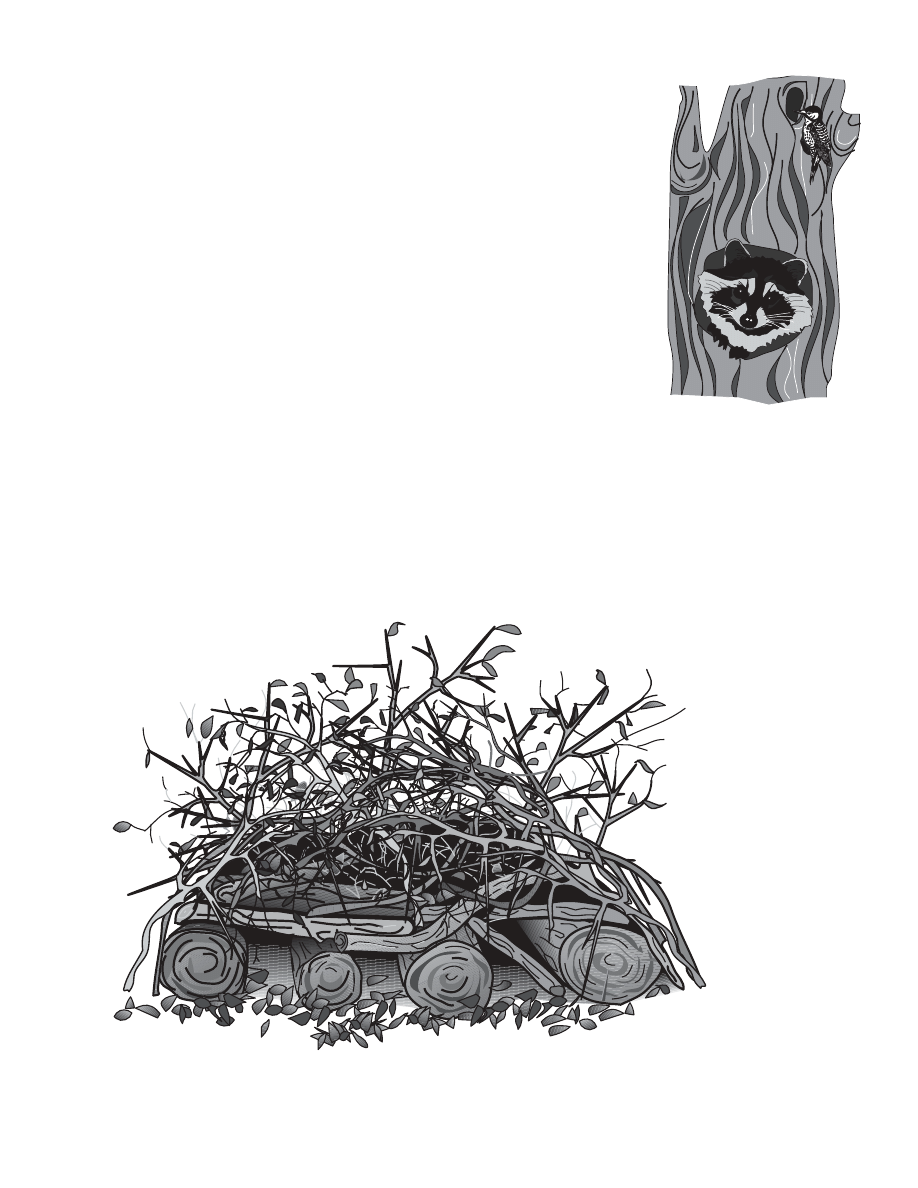
this includes snakes!). To construct a brushpile for
wildlife, place the largest limbs (or logs) on the
bottom and pile the smaller brush on top in a loose
fashion (Figure 7). This provides dens and crevices
for wildlife under the protection of brushy cover.
If you do not have any large limbs or logs, you can
pile smaller brush on top of sec tions of corrugated
pipe. After the holidays, your Christ mas tree makes
a wonderful addition to the top of the brushpile.
As you tend your garden in the spring, instead of
throwing rocks wildly into adjacent brush or woods,
cre ate a rockpile. Many spe cies (e.g., chip munks,
fox es, rabbits, rac coons and snakes) will ben e fi t
from your ef fort.
Ad di tion al hab i tat for many species of birds,
mammals, rep tiles and amphibians is pro vid ed by
cavities in trees, par tic u lar ly dead, stand ing trees
(called snags; Figure 8). These struc tures provide
nest ing, denning and roosting sites for species such
as blue birds, owls, wrens, fl y catch ers, wood ducks,
nuthatch es, chick a dees, swallows, titmice, wood-
peck ers, vultures, black bears, squir rels, rac coons,
bats, black rat snakes and gar ter snakes. Snags also
serve as perch ing sites for ea gles, hawks, owls, vul-
tures, herons and king birds and feeding
sites for brown creep ers, nuthatch es,
king birds, wood-
peck ers, gnat-
catch ers,
lizards, skinks and tree-
frogs. Unless the snag
is a potential hazard
to your home or other
struc tur al prop er ty, let
it stand and watch what
hap pens. You will be
amazed at how many
wildlife res i dents and
visitors it re ceives.
Feeders and
Nest Boxes
In addition to plant ing
trees and shrubs that
produce food and cover
for wild life, feeders
and nest boxes can
be placed through-
out your prop er ty to
further provide for
wild life around your
house. Much has been written con cern ing back yard
feeders and nest boxes, with many designs and
va ri et ies available. For com pre hen sive in for ma tion
on feed ing birds and feeder designs, refer to Wild
about Birds by Carrol Henderson, available
through
the Min ne so ta De part ment of
Natural Re sourc es (800)
657-3757 or (612)
297-3000. Detailed
in for ma tion on
nest boxes and other
nesting struc tures
and how to con struct
them is pro vid ed in
Wood work ing for
Wildlife: Homes for Birds
and Mam mals, also by
Carrol Henderson.
A version adapted
for Ten nes see is
avail able through
the TWRA and
is titled, Wood-
work ing for
Wild life in Ten-
nes see, and is avail able by con-
tact ing the Ten nes see Wild life Re sourc es Agen cy,
(800) 262-6704.
Figure 7. Brushpile designed for wildlife.
Figure 8. Standing dead
trees (snags) attract many
species of wildlife.

10
Which ev er type of feeder(s) you use, there are
some key points to consider. First, there is no best or
worst time to begin feeding; how ev er, if you begin a
feeding program in the fall/winter months, continue
until spring. Wildlife around your house will begin
to depend on the food provided—that is why they are
there! You can con tin ue feeding wildlife through out
the year if desired. Another point to keep in mind is
to beware of house cats! They are ex treme ly pro fi -
cient predators and can se vere ly reduce the number
of birds and small mam mals around your house.
Re search has shown that house cats (both fe ral and
pets) kill hun dreds of thou sands of birds and un told
numbers of mammals each year. In many cas es, the
prey is not con sumed, only killed be cause of the
cat’s in nate sense to hunt. If you have a cat, con sid er
keeping it inside and/or putting a bell on its collar.
All feral cats seen in your area should be reported to
your local animal shelter for immediate capture and
removal. Otherwise, you are doing a disservice to our
native wildlife pop u la tions. House cats (wheth er feral
or not) are NOT natural pred a tors; they are exotic
animals, not native to North Amer i ca.
You can cater to the species you prefer by using
selective feeder designs and seeds. Most birds will
eagerly consume black oil-type sunfl ower seeds and
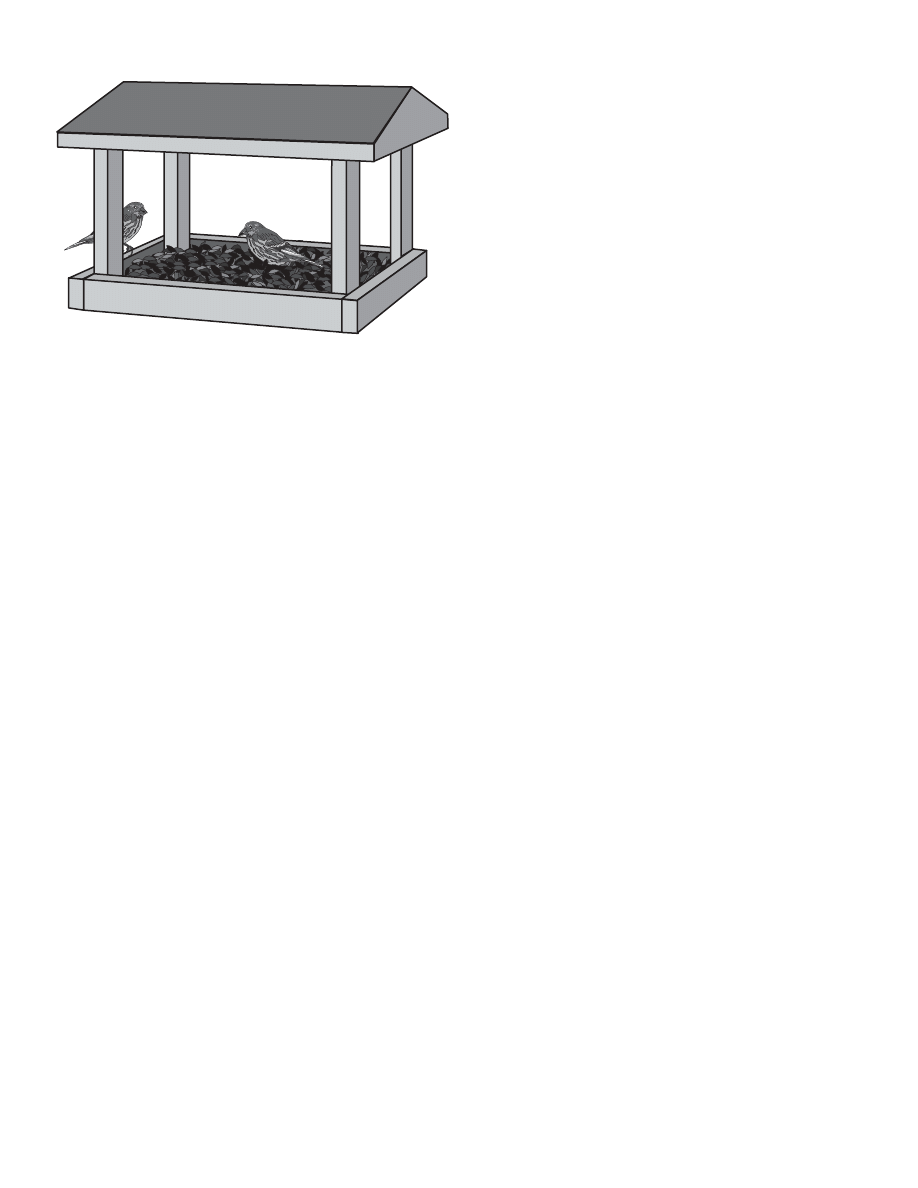
white proso millet and all can feed from plat form
and fl y-through feeders (Figure 9). Put out several
different types of foods — part of the fun is fi nding
out who will eat what! Don’t forget to try suet feed-
ers, thistle, fruit halves nailed to a tree or post, peanut
butter smeared on the side of a tree and old breads
and cakes. This should ensure a diversity of birds
around your home. Feeders should be cleaned period-
ically with hot, soapy water fortifi ed with a capful of
disinfectant (10 percent bleach); rinse well. Bot toms
of feeders should have small holes drilled in (if they
are not screen bottoms) to facilitate moisture evap o -
ra tion and reduce mildew. If you enjoy watch ing
wildlife visiting your feeders, be sure to place them
in view of a window or glass sliding door. However,
remember sites under feeders may be very messy
with spilled seeds and drop pings, which can attract
mice and rats. Hence, your back porch or patio may
not be the best place for a feeder. Listed in Table 3
are foods preferred by birds that frequent backyard
feeders in Tennessee.
European starlings are especially attracted to
peanut hearts, so you may not want to offer them
at your feeders. Also, note that it is legal to kill
exotic bird pests such as starlings and house spar-
rows. If you consider squirrels a problem at bird
.
e
e
s
s
e
n
n
e
T
n
i
s
r
e
d
e
e
f
d
r
a
y
k
c
a
b
o
t
n
o
m
m
o
c
s
d
r
i
b
f
o
s
e
c
n
e
r
e
f
e
r
p
d
o
o
F
.
3
e
l
b
a
T
s
e
i
c
e
p
S
d
o
o
F
d
e
r
r
e
f
e
r
P
s
e
v
o
d
g
n
i
n
r
u
o
m
t
e
ll
i
m
o
s
o
r
p
e
t
i
h
w
,
s
d
e
e
s
r
e
w
o
l
f
n
u
s
e
p
y
t
-
li
o
k
c
a
l
b
,
s
e
e
d
a
k
c
i
h
c
,
s
r
e
k
c
e
p
d
o
o
w
s
e
h
c
t
a
h
t
u
n
,
e
c
i
m
t
i
t
,
s
t
u
n
a
e
p
n
e
k
o
r
b
d
n
a
d
e
ll
e
h
s
,
s
t
u
n
d
e
k
c
a
r
c
,
s
d
e
e
s
r
e
w
o
l
f
n
u
s
e
p
y
t
-
li
o
k
c
a
l
b
t
e
u
s
,
s
b
m
u
r
c
d
a
e
r
b
y
a
j
e
u
l
b
t
e
u
s
,
n
r
o
c
d
n
a
s
t
u
n
d
e
k
c
a
r
c
,
s
t
u
n
a
e
p
,
)
s
e
p
y
t
ll
a
(
s
d
e
e
s
r
e
w
o
l
f
n
u
s
,
s
r
e
h
s
a
r
h
t
n
w
o
r
b
,
s
d
r
i
b
g
n
i
k
c
o
m
s
d
r
i
b
t
a
c
,
s
e
h
s
u
r
h
t
,
s
n
i
b
o
r
s
b
m
u
r
c
d
a
e
r
b
d
n
a
s
n
i
s
i
a
r
,
s
e
g
n
a
r
o
,
s
e
l
p
p
a
t
u
c
s
l
a
n
i
d
r
a
c
s
t
u
n
a
e
p
n
e
k
o
r
b
d
n
a
d
e
ll
e
h
s
,
n
r
o
c
d
e
k
c
a
r
c
,
)
s
e
p
y
t
ll
a
(
s
d
e
e
s
r
e
w
o
l
f
n
u
s
s
e
e
h
w
o
t
n
r
e
t
s
a
E
d
e
ll
e
h
s
d
n
a
,
n
r
o
c
d
e
k
c
a
r
c
,
)
s
e
p
y
t
ll
a
(
s
d
e
e
s
r
e
w
o
l
f
n
u
s
,
t
e
ll
i
m
o
s
o
r
p
e
t
i
h
w
s
t
u
n
a
e
p
n
e
k
o
r
b
d
n
a
k
a
e
b
s
o
r
g
g
n
i
n
e
v
e
s
t
u
n
a
e
p
n
e
k
o
r
b
d
n
a
d
e
ll
e
h
s
d
n
a
,
n
r
o
c
d
e
k
c
a
r
c
,
)
s
e
p
y
t
ll
a
(
s
d
e
e
s
r
e
w
o
l
f
n
u
s
s
e
h
c
n
i
f
d
l
o
g
s
d
e
e
s
r
e
w
o
l
f
n
u
s
e
p
y
t
-
li
o
k
c
a
l
b
,
s
d
e
e
s
r
e
w
o
l
f
n
u
s
d
e
ll
u
h
,
e
l
t
s
i
h
t
r
e
g
i
n
h
c
n
i
f
e
s
u
o
h
e
l
t
s
i
h
t
r
e
g
i
n
,
s
d
e
e
s
r
e
w
o
l
f
n
u
s
e
p
y
t
-
li
o
k
c
a
l
b
h
c
n
i
f
e
l
p
r
u
p
)
s
e
p
y
t
ll
a
(
s
d
e
e
s
r
e
w
o
l
f
n
u
s
s
o
c
n
u
j
,
s
w
o
r
r
a
p
s
s
b
m
u
r
c
d
a
e
r
b
,
t
a
e
h
w
,
s
d
e
e
s
r
e
w
o
l
f
n
u
s
e
p
y
t
-
li
o
k
c
a
l
b
,
t
e
ll
i
m
o
s
o
r
p
e
t
i
h
w
s
e
l
k
c
a
r
g
)
s
e
p
y
t
ll
a
(
s
d
e
e
s
r
e
w
o
l
f
n
u
s
d
e
ll
u
h

11
T
he Eastern Bluebird is a
songbird native to Ten nes see
whose bright coloration and
cheerful song make it a favorite
among most landowners. To attract
bluebirds around your home, it is
necessary to provide them with
nesting cover. Blue birds primarily
are in sec tiv o rous birds and typically
do not feed at bird feeders. Thus, the
best way to attract them is by erect-
ing nest boxes.
Over the past few decades, blue-
birds have ex pe ri enced a decline in
numbers. A primary reason for this
decline is a lack of suitable nesting
sites. Nat u ral ly, bluebirds nest in cavi-
ties of trees or fence posts created by
wood peck ers or decay. In many areas,
suitable nesting cavities can be scarce
or even non-existent. Re pro duc tion in
these areas is pre dict ably low. In addi-
tion, the house sparrow and European
starling (two exotic species from Eur-
asia) now compete with bluebirds for
nesting cavities. As a result, even if
suitable nesting cavities are avail able,
use by bluebirds is limited because of
the aggressive nature of the non-native
birds.
Before you build and erect nest
boxes for blue birds, there are some
important guidelines that should be
followed. To keep competition from
starlings at a minimum, dimensions
of nest boxes should be:
Floor 5 inches x 6 inches
Back 6 inches x 18 inches
(extra length to
allow nailing on
post or tree)
Front 6 inches x 9 inches
Sides 5 inches x 9 inches
in the front and 10
inches in the back
Top 6 inches x 7 inches
(to provide a little
overhang in the front)
Entrance hole 1
1
/
2
inches in
diameter; 6 inches
above the fl oor of
the box
Generally,
3
/
4
-inch lumber is
used to con struct nest boxes. The
dimensions can vary slightly EX-
CEPT for the entrance hole, which
must be 1
1
/
2
inches. If you make
the entrance hole smaller than 1
1
/
2
inches, bluebirds will not be able to
enter. By making the entrance hole
no larger than 1
1
/
2
inches, the box is
somewhat species selective, exclud-
ing larger, un want ed birds, such
as the European starling. House
sparrows still may be a problem;
however, since they are un pro tect ed,
in va sive, non-native birds, you may
shoot them or destroy their nests at
will. Also, nest boxes for bluebirds
should NOT have a perch installed
just below the entrance hole. Blue-
birds do not need perches, which
only serve to attract house sparrows.
It is im por tant to construct nest
boxes so it is possible to get into
them for cleaning and de stroy ing
nests of unwanted birds such as
house sparrows. This is accom-
plished by attaching a hinge to the
top of the front panel of the box. A
small wood-screw inserted half-way
into the bottom of the front panel
can serve as a “handle” to pull the
front of the box up and open so you
can get inside. Install a small clasp
to keep the front panel closed. To
allow for drainage and airfl ow, a few
1
/
8
-inch holes may be drilled into
the bottom of the box and at the top
of the sides. Other struc tures (e.g.,
gourds, cans, etc.) also can serve as
nesting cavities for blue birds. Just
be sure to keep the entrance hole
1
1
/
2
inches in di am e ter.
Bluebirds prefer open spaces,
such as pastures, or chards, road-
sides, yards and parks where insects
are abun dant. Creating open-type
areas around or near your home will
increase the amount of for ag ing
habitat for bluebirds. When nest
boxes are placed in these op ti mal
habitats, bluebird pop u la tions can
increase quite rapidly. Mount nest
boxes on fence posts or tree trunks
4 to 6 feet above the ground facing
open terrain, optimally facing east
to protect the entrance hole from
pre vail ing wind and rain. “Pred a tor
guards” (conical shields) made of
sheet metal can be wrapped around
the tree or post just below the nest
box to minimize predation from
house cats, snakes and raccoons.
To help keep wasps out of bluebird
boxes, try nailing a piece of the
sticky strips com mon ly sold for fl ies
on the inside of the box top. Nest
boxes should be erected in late win-
ter, since nesting may begin as early
as late Feb ru ary or early March.
Because of the territorial nature of
bluebirds, boxes should be at least
100 yards apart.
Bluebirds may produce two to
four broods per year. Females will
lay a clutch of four to six light-blue
eggs and incubate them ap prox i-
mate ly 12 days. Upon hatch ing,
bluebird chicks remain in the nest
for about 15 days before fl edging.
Once the fl edg lings leave the nest,
the male tends to them for several
days while they learn to fl y and
search for grasshoppers, crick ets,
beetles, fl ies and other insects.
Mean while, the female prepares the
nest for a second clutch.
Bluebirds that nest in Ten nes see
typically stay near their nesting
area all year, while bluebirds from
northern states migrate southward
during winter. Over-wintering here
in Tennessee can be a problem for
bluebirds during harsh winters, as
some winter mortality may occur.
On particularly cold nights, several
bluebirds may roost together in a
single nest box to conserve heat.
SPECIAL CASE: The Eastern Bluebird
12
feeders, pro vide them with some food of their own.
Unshelled (left on the cob) corn skewered on a long
nail driven into a tree or post sometimes will keep
their at ten tion away from the bird feeder. If not,
“squirrel-proof” feeders are available commercially
or you can use your imagination in “squirrel-proof-
ing” your bird feeder. (Hint: metal fl ashing or vinyl
siding wrapped around the feeder post usually
works. Good luck matching wits; squirrels are quite
ingenious at get ting to feeders!)
Hummingbirds require a special type of
feeder. Hum ming bird “nec tar” is four parts water to
one part sug ar. It is best to boil water before add-
ing the sugar so it will dissolve well. If you make
relatively large quan ti ties of this solution, store
unused portions in the re frig er a tor. Hum ming bird
“nectar” should not contain honey because of the
risk of fungal dis eas es. You can feed hum ming birds
as long as they visit the feeder. You will NOT keep
hum ming birds from migrating by keeping feed-
ers out past Labor Day. Also, there is no evidence
that putting red food-coloring dye in the solution
harms hum ming birds, however, since the safety of
food-coloring dye is in question, it may be best not
to use it in “nectar.” Most hummingbird feed ers
are colored red to attract the birds so food-col or ing
dye is not needed any way. If your feeder does not
have any color, you can paint a red fl ower or put red
tape around the feeder. CAUTION: sugar water will
ferment when left in the hot sun. Fer ment ed nectar
is dead ly for hum ming birds. Do not put out a hum-
ming bird feeder if you are not willing to clean it
weekly. Wash hum ming bird feeders using hot water
with a little vinegar added to dis cour age mold.
Hummingbird feeders should be scrubbed with a
bottlebrush and rinsed thor ough ly before refi lling
with “nectar.” If insects are attracted to your hum-
ming bird feed er, don’t de spair; in ad di tion to nec tar,
hum ming birds feed upon in sects for pro tein.
Nest boxes are an oth er struc tur al com po nent
im por tant in im prov ing wild life hab i tat around your
home. Al though most peo ple as so ci ate nest boxes
with blue birds, many other wildlife species (in-
clud ing mammals) benefi t also. Species such as gray
squir rels, fl ying squirrels, bats and screech owls will
accept and use nest boxes. In fact, all of the cavity-
nesting species listed pre vi ous ly may be found in
nest boxes if dimensions are appropriate (Table 4).
Nest boxes for birds should be erected in late win-
ter, awaiting ar riv al of spring migrants. Nest box es
should be in spect ed, cleaned out and repaired if nec-
essary before each nesting season. While it is impor-
tant that nest boxes be inspected prior to the nesting
season, you should not inspect the boxes once birds
(or other wild life) have begun using them. By do-
ing so, you risk causing the birds to desert their nest
and/or young. The ex cep tion to this is when unwant-
ed, invasive species (e.g., house sparrows and star-
lings) use your nest boxes—in which case their nests
should be de stroyed. After chicks fl edge, do not try
to catch them, even if they are lying on the ground,
seem ing ly helpless. The adults are nearby, waiting
for you to leave and quit both er ing them. It is best to
leave the animals alone and let nature take its course.
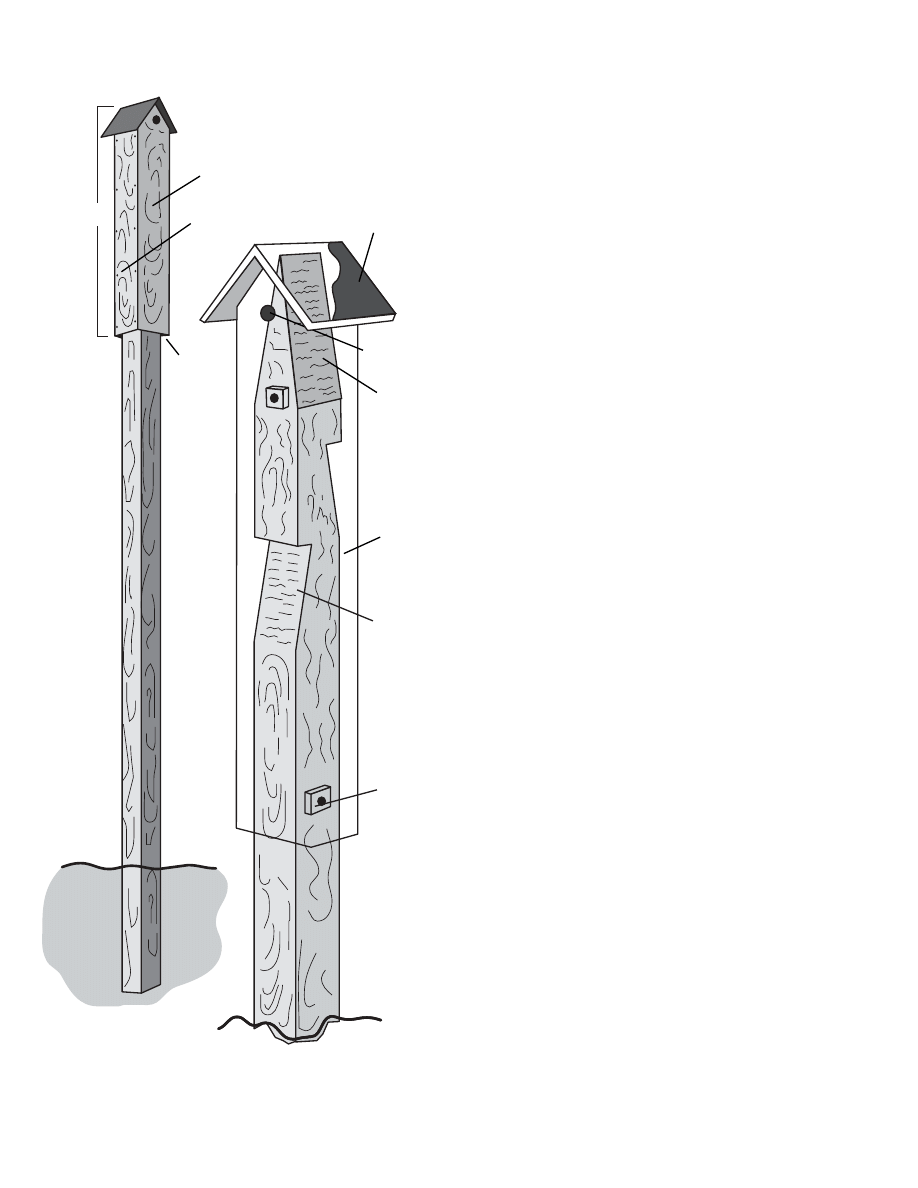
For those interested in providing bats with
suit able roosting sites, a new “bat house” has been
de signed by personnel from the Daniel Boone
Na tion al Forest in Kentucky (Figure 10). These
“post bat houses” re port ed ly are being used at a
much higher rate than previous designs, as they are
more like the bats’ natural summer roost sites. Dan
Dourson and John MacGregor of the Daniel Boone
National Forest recommend placing bat hous es in
the fol low ing habitats: upland for est stands with an
open canopy on slopes fac ing south or southwest;
small open ings along edge-habitat near ponds;
along ri par i an zones (streams and creeks), forest
roads, powerline rights-of-ways; or the edge of
forest clearcuts and small forest gaps. Rel a tive ly
open areas where the bat houses can re ceive more
sun light are pre ferred. Bat houses are less like ly
to be used when placed near homes, barns or other
build ings.
Figure 9. Fly-through feeders are popular with
many people and attract many different bird
species.

13
TABLE 4 - Dimensions of nest boxes for various wildlife species,
height they should be placed above ground and preferred habitat.
Floor of
Cavity
Depth of
Cavity
Entrance
above
Floor
Diameter of
Entrance
Height above
Ground or
Water (W)
Preferred
Habitat
Codes
Species
Inches
Inches
Inches
Inches Feet
House Wren
4x4
6 - 8
4 - 6
1 - 1 1/4
5 - 10
2, 7
Carolina Chickadee
4x4
9
7
1 1/8
5 - 15
2
Bewick’s Wren
4x4
6 - 8
4 - 6
1 1/4
5 - 10
2, 7
Tufted Titmouse
4x4
9
7
1 1/4
5 - 15
2
Downy Woodpecker
4x4
9
7
1 1/4
5 - 15
2
Prothonotary Warbler
4x4
6
4
1 3/8
5 - 12, (W)
3, 5
Nuthatches
4x4
9
7
1 3/8
5 - 15
2
Carolina Wren
4x4
6 - 8
4 - 6
*1 1/2
5 - 10
2, 7
Eastern Bluebird
4x4
8 - 12
6 - 10
*1 1/2
5 - 6
1
Tree Swallow
5x5
6 - 8
4 - 6
*1 1/2
10 - 30
1
Hairy Woodpecker
6x6
12 - 15
9 - 12
1 5/8
12 - 20
2
Great-Crested
Flycatcher
6x6
8 - 10
6 - 8
1 3/4
8 - 10
1, 2
Red-headed
Woodpecker
6x6
12
9
2
10 - 20
2
Purple Martin
6x6
6
1
2 1/4
10 - 20
1
Flicker
7x7
16 - 18
14 - 16
2 1/2
6 - 30
1, 2
Screech Owl (also
gray squirrel and
fl ying squirrel)
8x8
12 - 15
9 - 12
3
10 - 30
2
American Kestrel
8x8
12 - 15
9 - 12
3
10 - 30
1,4
Barn Owl
10x18
15 - 18
0 - 4
6
12 - 18
4
Wood Duck
12x12
22
17
3x4 oval
10 - 20, (W)
3, 5
Eastern Phoebe
6x6
6(
2
)
(
2
)
8 - 12
8 - 20
7, 8
Barn Swallow
6x6
6(
2
)
(
2
)
8 - 12
8 - 20
7, 8
Robin
6x8
8(
2
)
(
2
)
6 - 15
5 - 10
7
*Precise measurement required; if diameter over 1-1/2 inches, starlings may take the box over.
1Brown-headed and Pygmy Nuthatches (1-1/8), Red-breasted Nuthatch (1-1/4) and White-breasted
Nuthatch (1-3/8) will always use the same box. However, the smaller opening sizes where appropriate may discourage
use by House sparrows.
2One or more sides open.
3Preferred habitat codes. The numbers in the last column of Table 4 refers to the habitat types listed here:
1. Open areas in the sun (not shaded permanently by trees), pastures, fi elds or golf courses.
2. Woodland clearings or the edge of woods.
3. Above water, or if on land, the entrance should face water.
4. On trunks of large tree, or high in little-used parts of barns, silos, water towers or church steeples.
5. Moist forest bottomlands, fl ooded river valleys, swamps.
6. Dry open woods and woods edges.
7. Back yards, near buildings.
8. Near water, under bridges, barns.
14
Water
Water sources are provided in a variety of
ways, ranging from a simple birdbath to a small
pond created with wildlife in mind. Regardless of
source, water is an essential component of wild-
life habitat and provides necessities for wildlife in
many ways. Ob vi ous ly water provides re fresh ment
for thirsty animals; however, there are other bene-
fi ts you may not realize. De pend ing on the size and
nature of the water source, some wildlife species
may fi nd food there. Raccoons forage for crawdads
in shallow pools and creeks; herons and king fi sh ers
feed upon small fi sh; and frogs, dragonfl ies, whip-
poor wills, tree swallows, purple martins, night-
hawks and bats forage on the many fl ying insects
found above a small pond. For some species (e.g.,
many frogs, toads and sala manders), water is nec-
es sary for reproduction, providing a place to lay
eggs and for tadpoles to de vel op. In addition, some
wildlife species require water for a substrate to live
in (i.e., fi sh, many turtles, frogs and sala manders).
A pond is a unique ecosystem, providing habitat
for an array of wildlife species that simply would
not be there otherwise and en hanc ing conditions
for many terrestrial species.
Whether you have a birdbath, a small pond 5
feet in diameter or a
1
/
4
-acre pond, there are some
things to consider and keep in mind. It is best if the
water source is located in the shade at least part of
the day. Water will remain cooler and not become
stagnant as quickly as if it were in full sunlight all
day. To make a small pool most at trac tive for wild-
life, make sure there is some cover nearby (within
about 10-20 feet). This will make the animals
using the water source feel more secure and render
it available to more spe cies. Keep birdbaths at least
3 feet above ground level (for protection from cats)
and have a tree or some type of perch nearby for
birds. In addition, the edge and bottom of birdbaths
should be rough to provide secure footing. Water
depth should be shallow, especially around the
edges, so birds can get in and splash about. If the
edge or side of the water source is too steep, many
birds will not use it. If you have a small pond,
make sure part of the bank pe rim e ter is free of tall
veg e ta tion to provide a place for birds to approach
the water. Another important con sid er ation is to
keep the water fl owing or mov ing for aeration.
This can be ac com plished by al low ing the water to
run over rocks or by po si tion ing the water intake so
Figure 10. “Kentucky” bat houses (or "rocket
boxes") reportedly receive more use than previous
designs.
3'
Poplar or pine
Galvanized screws
Bats enter
and exit
4" x 4"
rough-cut
oak.
12 - 16
ft. long.
2 1/2 - 3 ft
in ground
Shingle roofing
Screened vent
1/2" to 3/4"
in diameter
Cut top of
4" x 4" post
Slightly rounded
post corners
Additional cuts
could be made
to increase
roosting area.
3/4" wood spacer
attached with
lug bolts.

15
that it pours into the birdbath or pond. The sound of
moving water attracts many birds and other wildlife
that otherwise would not visit the pool. It is critical
to keep the water in your birdbath as clean and cool
as pos si ble. Allowing water to become stagnant and
fi lled with algae can be harmful to wildlife.
Conclusion
Improving wildlife habitat around your home
can be a very rewarding and invigorating ex pe -
ri ence. While the aesthetic, recreational and bi o -
log i cal benefi ts may be most obvious, the biggest
re ward may be the educational ex pe ri ence gained
by chil dren enjoying wildlife residing in and visit-
ing their own backyards. Many folks are limited in
terms of op por tu ni ties to help conserve our wildlife
re sourc es. By working toward this effort in your
own backyard you can make the area around your
home more interesting and attractive, and ex pe -
ri ence the fruits of your labor through an increased
abun dance and diversity of wildlife around you.
Sources for information regarding back-
yard wildlife management:
Foote, L. E. and S. B. Jones. 1989. Native
shrubs and woody vines of the Southeast. Land-
scap ing uses and identifi cation. Timber Press.
Portland, Oregon.
Gardening with wildlife. Available from the
National Wildlife Federation, 1412 Sixteenth St.,
N. W., Washington, D. C.
Henderson, C. 1987. Landscaping for wildlife.
Minnesota Department of Natural Resources, Non-
game Wildlife Program. St. Paul, Minnesota.
Henderson, C. 1995. Wild about birds. Min-
ne so ta Department of Natural Resources, Nongame
Wildlife Program. St. Paul, Minnesota.
Woodworking for wildlife in Tennessee. Avail-
able from the Tennessee Wildlife Resources Agen-
cy, Ellington Agricultural Center, P. O. Box 40747,
Nashville, TN 37204.

16
PB1633-5M-11/99 E12-2015-00-081-00
The Agricultural Extension Service offers its programs to all eligible persons regardless of race,
religion, color, national origin, sex, age, disability or veteran status and is an Equal Opportunity Employer.
COOPERATIVE EXTENSION WORK IN AGRICULTURE AND HOME ECONOMICS
The University of Tennessee Institute of Agriculture, U.S. Department of Agriculture,
and county governments cooperating in furtherance of Acts of May 8 and June 30, 1914.
Agricultural Extension Service
Charles L. Norman, Dean
PB1633-3M-3/03 E12-4915-00-019-03
Wyszukiwarka
Podobne podstrony:
(Gardening) Backyard Conservation Series Wildlife Habitat
Improve your digital footprint
Improve Your Written English
Improving your concentration
(Gardening) Grow Your Own Beans And Peas
1001 Vocabulary and Spelling Questions Fast Focused Practice that Improves Your Word Knowledge
How to improve your English
3 licks to improve your bends
9 Ways to Instantly Improve Your Dating Skills
improve your band with syncopated fills 2p
Daniel Coyle the little book of talent 52 tips for improving your skills
Improve Your Eyesight EFT by Carol Look
Danny Kopec, Hal Terrie Test, Evaluate and Improve Your Chess U S Chess Press (2003)
The Art of Seeing Your Psychic Intuition, Third Eye, and Clairvoyance A Practical Manual for Learni
Finding Chess Jewels Improve your Imagination and Calculation Krasenkow Michal, 2014
więcej podobnych podstron