WFD POLICY
Education Rights for Deaf Children
A policy statement of the World Federation of the Deaf
Background
The World Federation of the Deaf (WFD)
promotes and safeguards the right of all Deaf
people to quality education, starting at birth and
throughout life. As for all learners, Deaf children
have the same right to education and full access to
quality education.
The right to education is clearly and explicitly
stated in the new Convention on the Rights of
Persons with Disabilities. The Convention states
that states shall take appropriate measures for
facilitating the learning of sign language and the
promotion of the linguistic identity of the deaf
community. Governments shall ensure that
education of deaf and deaf blind persons is
delivered in the most appropriate languages and in
environments which maximize academic and
social development. The governments shall also
take appropriate measures to employ teachers who
are qualified in sign language.
Education is a basic necessity for all people.
Education is recognised as a primary means for
gaining independence, citizenship rights,
appropriate employment, economic power and
self-empowerment. WFD supports the United
Nation's (UN) position that all people, regardless
of origin, gender, age, disability and creed, have
the right to a meaningful education. The UN and
the UN Educational, Scientific and Cultural
Organization (UNESCO) advocate education as a
human right for all people.
Like all children, Deaf children must have access
to equal and quality education. Deaf children have
the right to expect that their needs and human,
linguistic and educational rights are respected and
supported by educational authorities, in full
compliance with international policy statements,
national legislation and national curricula. Deaf
children are born with the same basic capacities
for learning and language as all children; they can
and should reach their full potential with
appropriate, visual, quality educational
programmes and support.
WFD advocates, promotes and safeguards
educational rights for all Deaf people of all ages.
The term ‘Deaf people’ includes a wide spectrum
of people with hearing differences from moderate
to profound, from various backgrounds, races,
ages, creeds, ethnicities, and philosophies and
with different levels of linguistic variables.
WFD emphasizes respect for difference and
acceptance of persons with disabilities as part of
human diversity as humanity as it is stated in the
Convention on the Rights of Persons with
Disabilities. Deaf children are part of human
diversity and they are entitled to respect for their
evolving capacities and respect for their right to
preserve their identities. These principles shall
include in all spheres of education of deaf
children: school legislation, curricular, learning
materials, teacher teaching, school subjects and
school practices.
Regardless of the age of the learner, there are
some common denominators that must be
considered in planning and implementing
successful educational programmes for and with
Deaf students. This specific paper will focus on
the educational needs and rights of Deaf youth.
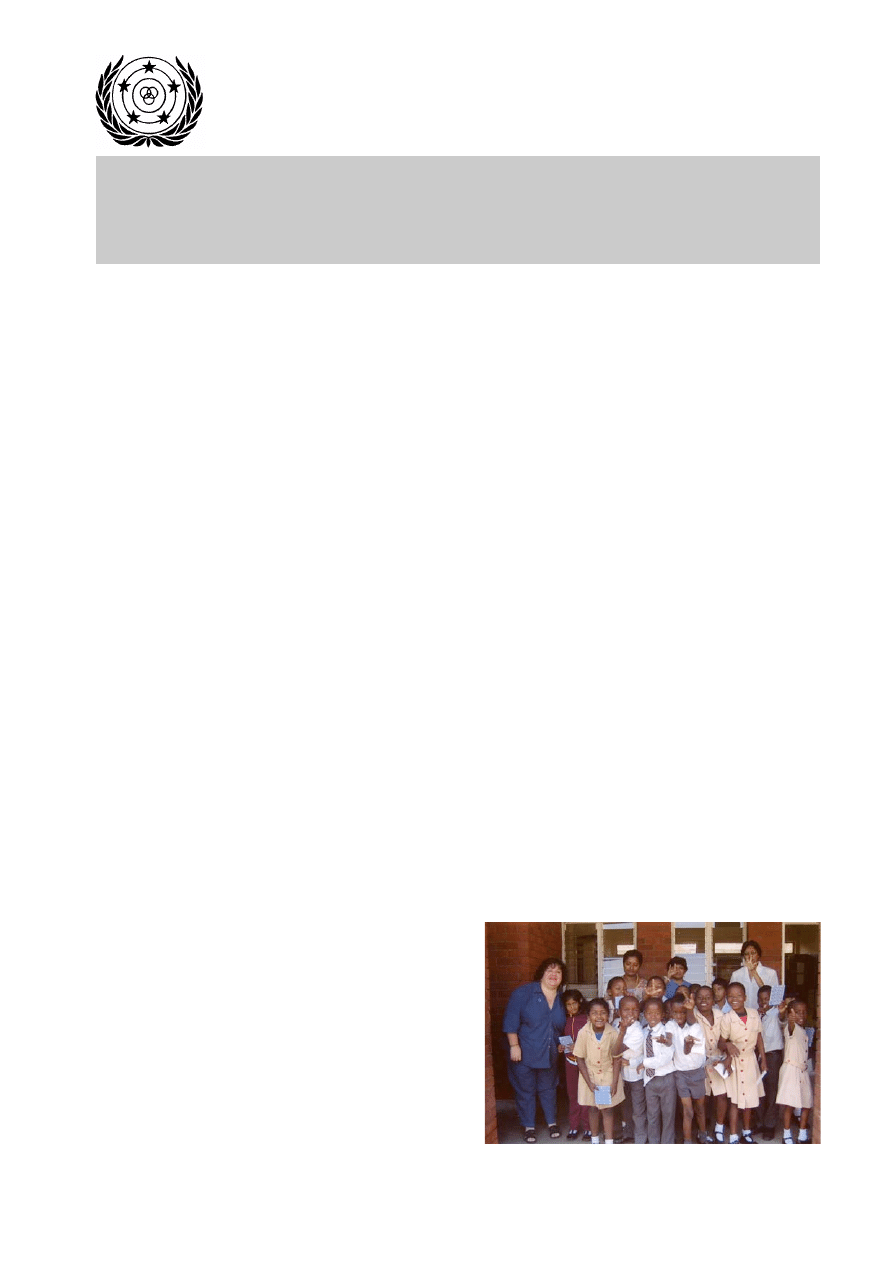
Deaf South African Children

ii
WFD POL ICY
Education Rights for Deaf Children
WFD embraces these following human rights and
educational principles:
Like all people, Deaf people have the right to
full access to quality education.
Deaf people are primarily visual beings,
whose eyes are their portal to the world of
information and knowledge. Thus, sign
language and visual strategies must be made
available to Deaf people as a birthright.
(Deafblind people may predominantly depend
on their tactile sense and have the right to
learn sign language, Braille and mobility
skills.)
Education is in itself not a place or a goal, but
a continuous, life-long process enabling one to
acquire multiple skills needed to become an
independent, educated, employed, self-
actualising, participating and contributing
citizen of one’s community and society.
Furthermore, WFD takes the position that to
deny Deaf children access to
a quality education and their bill of rights are
tantamount to child abuse.
The Current Situation
Studies by the WFD reveal that the enrolment rate and literacy achievement of Deaf children is far below the
average for the population at large. Illiteracy and semi-literacy are serious problems among Deaf people.
Without appropriate education, advancement in society as an independent, employed, contributing citizen
becomes problematic. Without a strong educational and language base, it is difficult to succeed in today’s
communities and marketplaces, and in the world of technology and information.
WFD takes the unequivocal position that there is no excuse for this deplorable situation, since Deaf children
have the same innate intellectual, social and emotional capacities, as do all children.
Moreover, even in industrialised countries, the majority of current Deaf education programmes do not respect
the linguistic human rights of Deaf children. Indeed, most Deaf education programmes fall into the language
deprivation category described in theoretical models of education of linguistic minorities. “Language
deprivation” for Deaf people means ignoring the use of sign language as a basic communication means, as a
language of instruction and as a school subject. Following this, the linguistic human rights of Deaf children
are grossly violated in educational programmes all over the world.
Current Research
There are several salient findings derived from research studies regarding educational development, language
acquisition and Deaf children:
• Deaf students learn best through visual modalities and depend on sign language.
• The brain, without adequate stimulation during the critical learning years, ages 0-3, may atrophy as
much as 30%. Due to insufficient family and community support during this critical time, Deaf
children are needlessly stalled in language acquisition until they commence formal schooling.
• Deaf children of Deaf adults generally have a head start in language acquisition, communication
development and educational prowess, and do well in later life as employees, citizens and leaders.
• Literacy and language does not equal speech and communication. Language development must
precede everything else, speech development can occur later. Conversely, early speech development
alone will not guarantee language and literacy skills.
• Sign language is a valid linguistic means of conveying thoughts, ideas and emotions. Hearing babies
whose parents use sign language have a head start in communicating with their parents. Increasing
numbers of hearing people study and utilise sign language annually.

iii
WFD POL ICY
Education Rights for Deaf Children
• Programmes utilising bilingual or multilingual approaches, and employing qualified professionals,
provide Deaf children with a strong language base, which equips them better for success in the broad
range of educational subjects.
• Deaf children who are in school are often in programmes that do not meet their needs, educationally,
socially or emotionally. These include oral programmes that exclude the Deaf learner’s right to visual
access to education, professionals fluent in the sign language used by the Deaf community, and
supportive, enriching and appropriate environments. Such programmes fail to meet the Deaf child’s
needs and goals, and are detrimental to the Deaf child’s educational development, self-esteem and
overall well-being.
• Early educational intervention, bilingual/multilingual programmes and qualified professionals and
role models enable Deaf learners to achieve full intellectual, social and emotional development, and
enable them to reach their full potential as human beings, in all aspects of life.
Linguistic Human Rights
The UN supports the rights of students from minority cultures, specifically the right to education in their
mother tongue. This includes the right of Deaf children to the sign language of their country. Previously
mentioned new Convention emphasizes that without respecting linguistic rights of the deaf students, their
human right can not be fulfilled.
Linguistic human rights are an essential component of human rights, and central to language acquisition.
Such language acquisition is required for full access to education.
WFD supports the right of Deaf children to acquire full mastery of their sign language as their 'mother
tongue', as well as to learn the language(s) used by their family and community.
Deaf children must also have access to adult role models fluent in sign language.
The realisation of linguistic human rights is linked to the realisation of basic human rights to education,
freedom of thought and expression, enjoyment of an adequate standard of living, protection from all forms of
abuse, neglect and exploitation, and freedom from subjection to torture or other cruel, inhumane or degrading
treatment or punishment. It is the mastery of language(s) that enables a child to express her/his needs and
desires, and gives him/her the tool to protect and to assert him/herself as a human being.
Inclusive Education
Many policy-makers today strongly support full inclusion in education, which they interpret to mean full-
scale mainstreaming of all disabled students with all students in regular schools near their homes.
While such a goal may be generally appropriate for many disabled learners who can hear and interact with
their peers and teachers, WFD has serious differences regarding implementation of this concept for Deaf
learners.
WFD holds that the least restrictive environment for a Deaf learner is whatever is the most enabling
environment for that learner. Full inclusion for a Deaf learner means a totally supportive, signing and student-
centred environment. This permits the learner to develop to his/her full educational, social and emotional
potential. This is stated also in the Convention on the Rights of Persons with Disabilities.
Otherwise, inclusion as a simple placement in a regular school without meaningful interaction with
classmates and professionals at all times is tantamount to exclusion of the Deaf learner from education and
society. In such environments, the Deaf child is physically present but may be mentally and socially absent.

iv
WFD POL ICY
Education Rights for Deaf Children
Statement of Rights and Recommendations
To ensure that the educational rights of Deaf learners are fulfilled, WFD therefore:
Reaffirms its position that all Deaf people, including Deaf children, have the right to full access to
quality education through visual modes, including indigenous sign languages. This position is
supported by several international conventions of the UN.
Supports early identification of Deaf infants and youth, followed promptly with sign language
environments and educational intervention strategies and programmes, in partnerships between
families, Deaf adults and professionals.
Calls upon governments to ensure full and equal access to and educational success for Deaf learners
based on regular education goals, standards and curricula.
States, furthermore, that such curricula should provide the opportunity for students to learn in and
study both their local/national sign language and the local (written) language as academic subjects.
Calls upon national and regional/provincial governments to:
To sign and ratify the Convention on the Rights of Persons with Disabilities and modify their
education legislation to follow this Convention.
Put into practice policies or guidelines regarding early identification of and intervention for Deaf
children that maximise their visual capabilities and sign language.
Legalise sign language and quality education for Deaf people of all ages.
Provide the resources necessary for the development of effective programmes for teaching sign
language and Deaf Studies (history, culture, etc.) to involved people, such as:
• Families of Deaf children
• Teachers of Deaf children, administrators and other professionals
• Professionals, including doctors and therapists, for preschool Deaf children
• Interested parties such as but not limited to community service providers, interpreters, and
other students
Provide support for programmes for Deaf people to receive training and become employed as
teachers, educational professionals and members of educational teams.
Establish high standards for quality education programmes and outcomes, from early childhood
to professional education, for all Deaf people equal to that for all people; implement assessment
and monitoring programmes to ensure that each learner makes appropriate progress.
Ensure that Deaf learners who may be placed in mainstream educational settings have access to
the services of educated, trained and qualified sign language interpreters, other needed support
services, Deaf peers and role models, and full participation in both the educative and co-
curricular processes.
Support further research into:
• The development of strategies and valid instruments for teaching and assessing features in
indigenous sign languages and the development of fluency in sign language.
•
The benefits of acquiring an education using direct communication pedagogies,
versus indirectly through a third-party interpreter.
v
WFD POL ICY
Education Rights for Deaf Children
------------------------------------------------------------------------------------------------------------------------------------
THE WORLD FEDERATION OF THE DEAF (WFD)
WFD is an international, non-governmental central organisation of national associations of Deaf people, with a current
membership of 128 countries.
WFD has consultative status in the United Nations (UN) system, including the Economic and Social Council
(ECOSOC); the UN Educational, Scientific and Cultural Organization (UNESCO); the International Labor Organization
(ILO); and the World Health Organization (WHO). WFD also co-operates closely with the UN High Commissioner for
Human Rights, and has representatives on the Panel of Experts on the UN Standard Rules for the Equalization of
Opportunities for Persons with Disabilities.
World Federation of the Deaf
General Secretariat
PO Box 65
00401 Helsinki
FINLAND
Email:
info@wfdeaf.org
-------------------------------------------------------------------------------------------------------------------------------------------------
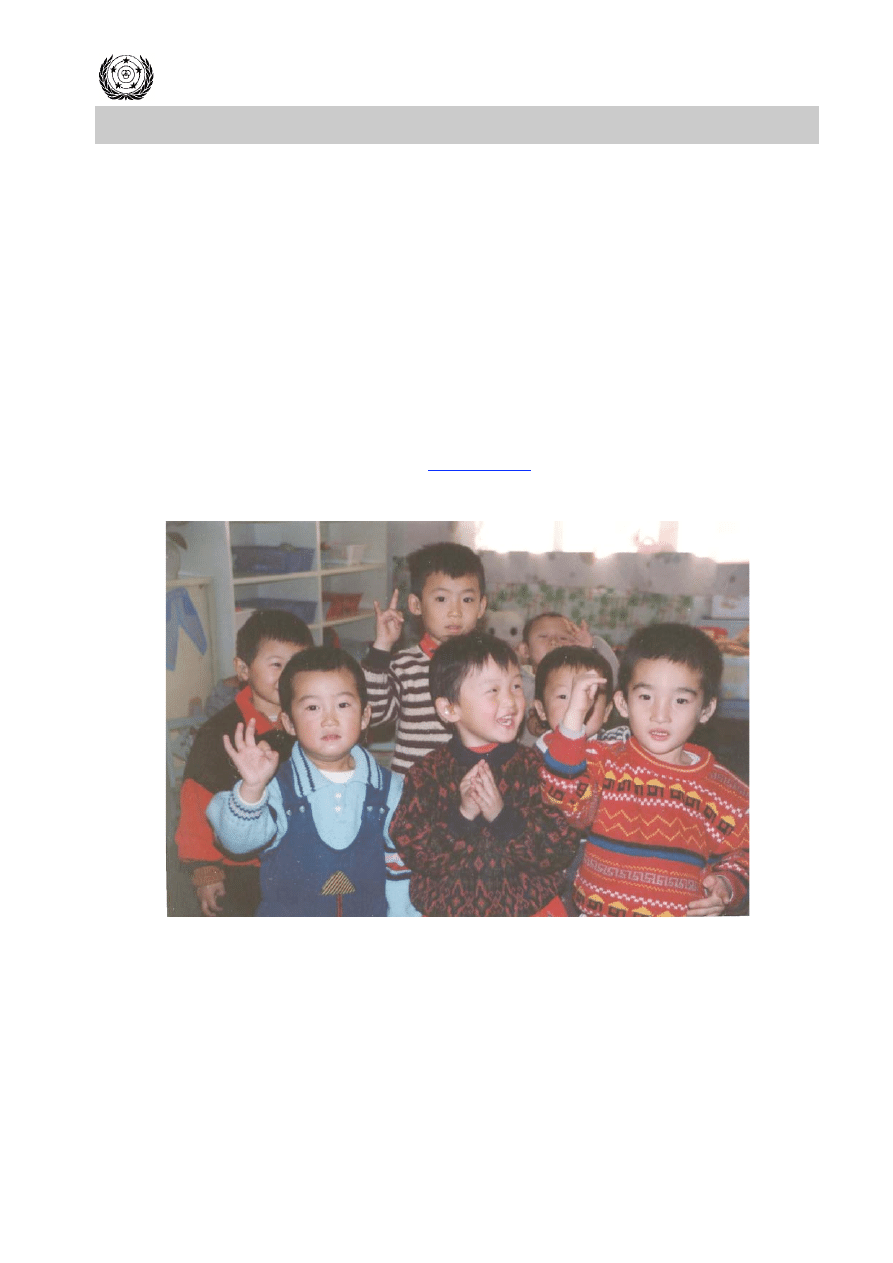
Deaf Chinese Young Children

vi
WFD POL ICY
Education Rights for Deaf Children
REFERENCES:
Joutselainen, Marjo: WFD Survey of Deaf People in the Developing World; World Federation of the Deaf, 1991
Mahshie, Shawn Neal: Educating Deaf Children Bilingually; Pre-College Programmes, Gallaudet University, Washington, DC, 1995
UNESCO: The Salamanca Statement and Framework for Action on Special Needs Education; Adopted by the World Conference on
Special Needs Education: Access and Quality, Salamanca, Spain, June 1994
UNESCO: The Hamburg Declaration on Adult Learning and Agenda for the Future, CONFINTEA V, Hamburg, Germany, July 1997
United Nations: Convention on the Rights of the Child, adopted by the UN General Assembly 1959 and 1989
United Nations: Declaration on the Rights of the Child, adopted by the UN General Assembly 22 February 2001, under the heading of
“Children with Disabilities”
United Nations: Declaration on the Rights of Persons Belonging to National or Ethnic, Religious and Linguistic Minorities, adopted
by the UN General Assembly 18 December 1992
United Nations: The Standard Rules on the Equalization of Opportunities for Persons with Disabilities: adopted by the UN General
Assembly 20 December 1993 (particularly Article 6.1 – 6.9)
United Nations: Universal Declaration of Human Rights, adopted by the UN General Assembly 10 December 1948
United Nations: The Charter of Fundamental Rights, Articles 21, 24 and 26, 28 September 2000
World Federation of the Deaf: Report on the Status of Sign Language; WFD Scientific Commission on Sign Language (Supalla, T.;
Bergmann, R.; Denmark, C.; Jokinen, M.; Schroeder, O-I; and Suwanarat, M), 1993
World Federation of the Deaf: Report from the Commission on Deaf Education (International President M. Jokinen, National
President G. Leigh), XIII World Congress of the WFD, July 1999
UN Convention on the Rights of Persons with Disabilities 2006
July 2007
Wyszukiwarka
Podobne podstrony:
policy adult ed
Ultimate Child Abuse
WSPÓŁCZESNE ID ED
Praca zespolowa z elementami komunikacji interpersonalnej ed wczesn
Fiscal Policy
Wykład II Analiza podstawowych pojęć eksploatacyjnych i użytkowanie obiektów ED
policy work dev
Gately, Ed Cena i Czas zarys metod analizy technicznej
1916 03 29 Rozporządzenie policyjne Prezydenta Galicjiid 18455
2011 08 KGP Ceremonial policyjn projektid 27380
ED 1999 1 41
Program zajęć ED, aaa, studia 22.10.2014, Materiały od Piotra cukrownika, materialy Kamil, Szkoła, L
MANDAT-za-złe-parkowanie, █▬█ █ ▀█▀ RADARY POLICYJNE - instrukcje, Radary- anuluj sobie mandat
07.10.12r. - Wykład -Taktyka i technika interwencji policyjnych i samoobrona, Sudia - Bezpieczeństwo
Policyjna Ankieta, Prezentacje, Prezentacje - żarty
środki przymusu bezpośredniego, Studia licencjat- administracja, Prawo policyjne
więcej podobnych podstron