
Review
Hepatitis C — new developments in the studies of the viral life cycle
Małgorzata Rychłowska
*
and Krystyna Bieńkowska-Szewczyk
Department of Molecular Virology, Intercollegiate Faculty of Biotechnology, University of Gdańsk and Medical
University of Gdańsk, Gdańsk, Poland
Received: 12 February, 2007; revised: 29 May, 2007; accepted: 17 September, 2007
available on-line: 25 October, 2007
Hepatitis C virus (HCV) is a causative agent of chronic liver disease leading to cirrhosis, liver
failure and hepatocellular carcinoma. The prevalence of HCV is estimated as 3% of the world
population and the virus is a major public health problem all over the world. For over 16 years,
since HCV had been discovered, studies of the mechanisms of the viral life cycle and virus-host
interactions have been hampered by the lack of a cell culture system allowing the virus to be
grown in laboratory conditions. However, in recent years some new model systems to study HCV
have been developed. The major breakthrough of the last two years was the cell culture system
for maintaining the virus in an adapted hepatocyte-derived cell line. This review describes the
techniques and applications of most of the in vitro systems and animal models currently used
for working with hepatitis C virus.
Keywords: hepatitis C virus, HCV replicons, HCV pseudoparticles, HCVcc-cell culture-derived
InTroduCTIon
Hepatitis C virus is a single stranded, posi-
tive-sense RNA virus belonging to the genus Hepaci-
virus in the Flaviviridae family. HCV has a very nar-
row host range and infects only humans and chim-
panzees. HCV particle consists of a capsid enclosing
single-stranded RNA genome, surrounded by an
envelope derived from host cell membranes con-
taining spike-like projections of viral glycoproteins.
Naturally occurring HCV particles circulating in the
blood of infected people are highly heterogeneous
(Maillard et al., 2001). According to recent data, the
majority of viral particles are associated with lipo-
proteins (Thomssen et al., 1993; Andre et al., 2002)
and such association correlates with the highest
infectivity of HCV virions. Different forms of lipo-
protein-associated HCV particles have been identi-
fied: simple low density lipoprotein associated HCV
virions, lipo-viro-particles (LVP) (Andre et al., 2002;
2005) and exosomes (Masciopinto et al., 2004).
The genome of HCV contains short untrans-
lated regions (UTRs) at each end of the viral RNA,
which are required for replication and translation,
and carries a long open reading frame encoding a
polyprotein of about 3010 amino acids, which is co-
and post-translationally processed by the host and
viral proteases into 10 viral proteins (Bartenschlager
& Lohmann, 2000). Core protein C and envelope
glycoproteins E1 and E2 belong to the structural
proteins building the viral particle. Downstream of
the structural region there is a small, highly hydro-
phobic, integral membrane protein, p7, most prob-
ably involved in ion channel formation (Griffin et al.,
2003; Pavlovic et al., 2003). The non-structural region
of the polyprotein comprises six intracellular pro-
*
Corresponding author: Małgorzata Rychłowska, Department of Molecular Virology, Intercollegiate Faculty of Biotech-
nology, University of Gdańsk and Medical University of Gdańsk; Kładki 24, 80-822 Gdańsk, Poland; phone: (48) 58 523
6336; fax: (48) 58 305 7312; e-mail: ggordon@biotech.ug.gda.pl
Abbreviations: con-1, consensus genome 1; CMVp, cytomegalovirus promoter; EMCV, encephalomyocarditis virus; GBV-
B, GB virus B; GFP, green fluorescent protein; HCV, hepatitis C virus; HCVpp, HCV pseudoparticles; HCVcc, HCV cell
culture-derived; HIV, human immunodeficiency virus; IFN, interferon; IRES, internal ribosomal entry site; LTR, long ter-
minal repeat; MLV, murine leukemia virus; NS, non-structural; PBMC, peripheral blood mononuclear cells; SCID, severe
combined immunodeficiency; UTR, untranslated region.
Vol. 54 No. 4/2007, 703–715
on-line at: www.actabp.pl

704
2007
M. Rychłowska and K. Bieńkowska-Szewczyk
teins NS2, NS3, NS4A, NS4B, NS5A and NS5B that
are responsible for viral replication and polyprotein
processing and are not included in the viral particle
(Fig. 1). NS5B is the viral RNA polymerase respon-
sible for replication of HCV genome. Apart from
the polyprotein, expression of a novel HCV protein
from an alternative reading frame overlapping the
core gene has been reported (Walewski et al., 2001;
Xu et al., 2001; Boulant et al., 2003). The resulting 17-
kDa protein is called the frameshift (F) or alternative
reading frame (ARF) protein (Varaklioti et al., 2002).
The role of the F protein remains to be defined (Bar-
tenschlager et al., 2004).
Translation of viral polyprotein is dependent
on an internal ribosomal entry site (IRES) localized
in the 5’ UTR, which is an RNA structural element
interacting directly with the 40S ribosomal subunit
during translation initiation (Tsukiyama-Kohara et
al., 1992; Pestova et al., 1998; Spahn et al., 2001; He et
al., 2003; Boni et al., 2005).
Naturally occurring variants of HCV are clas-
sified into six major genotypes, numbered 1 to 6,
and multiple subtypes. Additional variants, known
as quasispecies, develop in infected individuals as a
result of the high error rate of viral RNA polymer-
ase. Despite the sequence diversity between the
genotypes of about 30–35%, all of them share the
same genome organization, replication cycle and
ability to establish persistent infection (Simmonds,
2004). HCV infections are common worldwide. It
is estimated that about 3% of the world population
(170 million people) is infected with the virus and
there are about 4 million carriers in Europe alone.
HCV is the main etiological agent of chronic liver
inflammation leading to cirrhosis and liver cancer.
Probably as many as 70–90% of infected people fail
to clear the virus during acute phase of the
disease
and become chronic carriers.
In most cases (about
80%) acute hepatitis C is asymptomatic and about
20% of chronic carriers develop cirrhosis which,
in up to 25% of cases, progresses into a fatal liver
disease and liver cancer (WHO report, 2003). Dif-
ferent HCV genotypes account for diverse progres-
sion and severity of the disease. Genotype 1 is con-
sidered the most difficult to treat with current HCV
therapy and subtype 1b is associated with the most
severe disease progression and the highest probabil-
ity of developing chronic infection and liver fibrosis.
The genetic variability of hepatitis C virus, emerg-
ing with so many different genotypes, subtypes and
quasispecies, makes it extremely difficult to develop
a universal treatment and a vaccine that will protect
against all HCV strains. Current HCV drug therapy
is based on general antivirals, like interferon and
the nucleoside analogue ribavirin. The best results
are obtained with the combination therapy with
pegylated interferon α (IFN-α) and ribavirin (Bret-
ner, 2005; Pawlowska et al., 2006). Depending on the
viral genotype, the therapy is successful in about
40% of patients, with genotypes 1 and 4 being the
most resistant to IFN treatment. Many infected peo-
ple do not qualify for interferon therapy because of
the serious side effects of the drug. In the developed
countries, patients with HCV-related liver cirrhosis
are qualified for liver transplantation (WHO report,
2003). These data indicate that HCV is a very seri-
ous global health problem and the need for new,
more efficient therapeutic strategies, based on drugs
specifically targeting the virus, is urgent and obvi-
ous. The development of new therapy is inseparably
connected with the understanding of all possible as-
pects of the molecular virology of HCV infection.
MeTHods To sTudy HCV VIrus
The possibilities to study hepatitis C virus
were, until very recently, seriously limited by the
lack of a cell culture system for growing the virus
in laboratory conditions and a small animal model
for in vivo experiments. For a long time the only ap-
proaches to study HCV were experimental infection
of chimpanzees, observation of infected patients and
comparison with other viruses, members of Flaviviri-
dae family. Additionally, some important data about
basic biochemical properties of viral enzymes and
Figure 1. structure of HCV genome and function of HCV proteins.
Vol. 54
705
New developments in hepatitis C virus studies
glycoproteins came from studies based on expres-
sion systems that produce viral proteins in different
types of cells. Recently, many laboratories have been
working on different systems, enabling the replica-
tion and growth of HCV in cell culture conditions.
These attempts have resulted in the establishment
of currently used models to study hepatitis C virus
(Brass et al., 2006):
in vitro models:
•
transient and stable expression systems
•
HCV replicon systems
•
retrovirus based HCV pseudo-particles (HCVpp)
•
infectious HCV virus in cell cultures (HCVcc)
in vivo models:
•
experimentally infected chimpanzees
•
murine models for HCV
•
New World monkeys–marmosets infected with GBV-B
virus.
Some of these model systems allow only
limited studies of some aspects of the complex vi-
ral replication cycle. Nevertheless, while a detailed
analysis of the HCV life cycle was hampered by a
lack of an efficient viral culture, they contributed to
a better understanding of the biology of the virus.
Transient and stable expression systems
Studies based on recombinant HCV envelope
proteins produced in various expression systems had
great influence on the current knowledge about the
sub-cellular localization, folding, glycosylation and
dimerization of E1 and E2 glycoproteins (Dubuis-
son et al., 1994; Debuisson, 2000; Patel et al., 2001
Deleersnyder et al., 1997; Goffard et al., 2005) and
their interaction with major HCV receptors: CD81
and SR-B1 (Pileri et al., 1998; Scarselli et al., 2002).
Recombinant HCV proteins proved to be very use-
ful for both basic and advanced biochemical studies
of protein structure and interactions with other viral
or cellular proteins, and are still used in such type
of studies. However, a recently developed HCV cell
culture system enabled the analysis of HCV proteins
in the natural environment during viral infection.
HCV replicon systems
A very important step forward in HCV re-
search was the development of HCV replicon sys-
tems, designed to study viral RNA replication to-
gether with translation and maturation of viral pro-
teins (Lohmann et al., 1999). HCV replicons are self-
amplifying, genetically engineered HCV genomes.
They contain either complete genomic RNA of HCV
or shorter sub-genomic fragments consisting of the
minimal non-structural region from NS3 to NS5B of
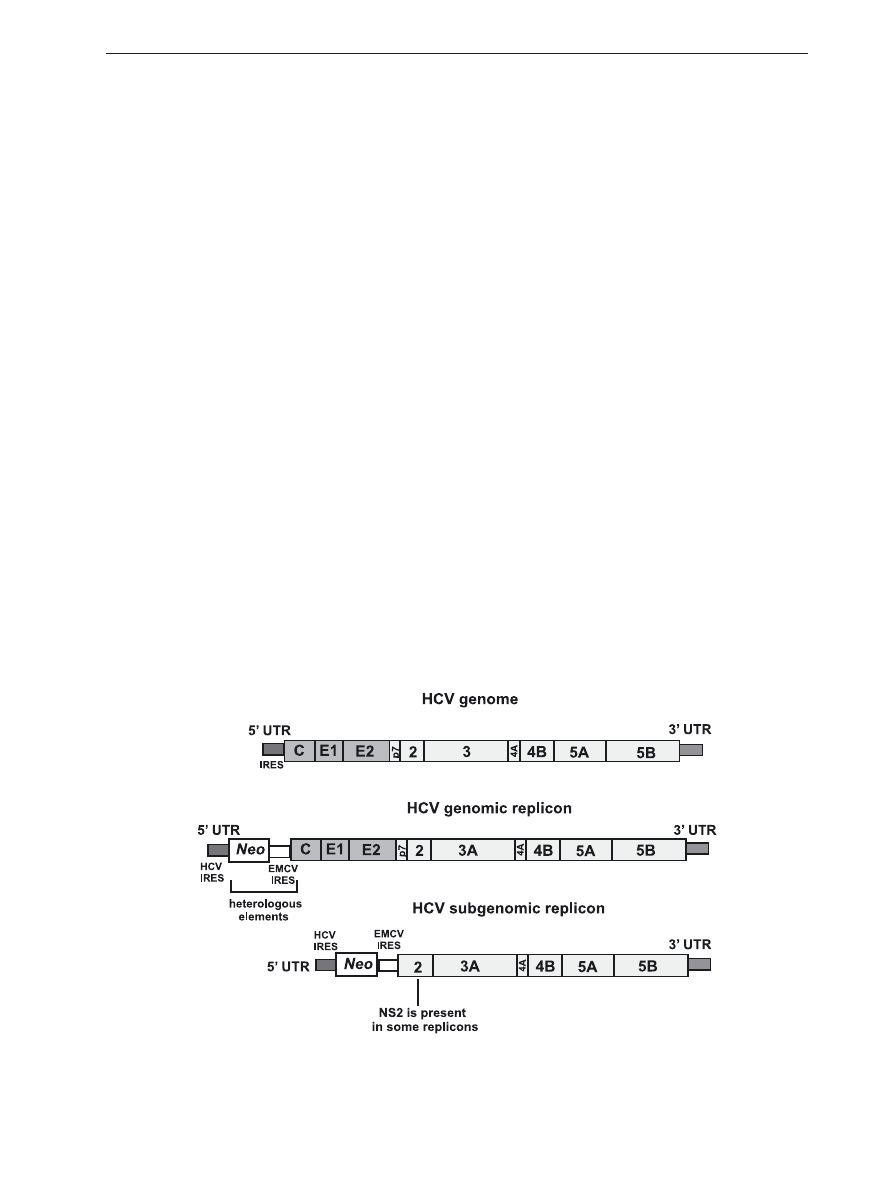
the genome (Fig. 2).
The prototype subgenomic replicon (Lohm-
ann et al., 1999) was based on HCV genotype 1b of
a con-1 clone (consensus genome 1), isolated from
a patient with chronic infection. Since short RNA is
known to replicate more efficiently than long one,
all the structural region of the HCV genome was re-
placed with two heterologous elements, one of them
Figure 2. structure of genomic and subgenomic HCV replicons.
Schematic representation of HCV genome and basic genomic and subgenomic replicons, neo gene allows for stable rep-
lication under antibiotic selection, in transient replicons the neo gene is usually replaced with a reporter gene coding for
GFP or luciferase.

706
2007
M. Rychłowska and K. Bieńkowska-Szewczyk
encoding neomycin phosphotransferase (neo
r
), con-
ferring the antibiotic G418 resistance, and the second
one being the internal ribosome entry site (IRES) of
encephalomyocarditis virus (EMCV). The resulting
construct was a selectable, bi-cistronic RNA replicon,
with the expression of the neo
r
gene directed by HCV
IRES, and the second cistron of HCV non-structural
region translated under the control of EMCV IRES.
Replicon RNA was generated by in vitro transcrip-
tion from cDNA and transfected into Huh-7 cells.
Upon G418 selection, Huh-7 cell clones were select-
ed carrying high numbers of replicating HCV RNA
and viral proteins, with an average of 1000–5000
replicons per single cell. Replicons maintained in
G418-selected Huh-7 cell clones acquire certain sin-
gle amino-acid substitutions, conserved among the
cell clone that allow for efficient replication (Blight
et al., 2000). These substitutions, called cell-culture
adaptive mutations, are found in all non-structural
proteins, but most of them cluster to a central re-
gion of the NS5A gene. The most efficient replicons
usually carry more than one mutation. The most po-
tent substitutions enhance replication even 500-fold
when introduced into the wild type HCV replicons
(Krieger et al., 2001). It is not clear how exactly these
substitutions influence RNA replication, but most of
them lead to modifications of the surface of the par-
ticular protein. It is believed that such modifications
may affect viral interactions with cellular proteins,
components of the replication machinery (Lohmann
et al., 2001; Bartenschlager et al., 2003).
The replicon system made it possible, for the
first time, to study genuine HCV RNA replication in
vitro and to analyze structural aspects of the repli-
cation complex and translation of the viral polypro-
tein.
An important extension of the replicon sys-
tem was the development of full length genomic
HCV replicons as a potential tool to generate viral
particles in cell culture. Although the replication of
genomic replicons was very efficient, and viral pro-
teins were produced, infectious viral particles were
not assembled (Ikeda et al., 2002; Pietschmann et al.,
2002; Bartenschlager et al., 2003; Brass et al., 2006).
The fact that the full length HCV genomic replicons
fail to produce infectious viral particles is caused
most probably by the presence of cell-culture adap-
tive mutations. Moreover, the HCV RNA genomes
containing such mutations are severely attenuated
when transfected into the liver of chimpanzees in in
vivo experiments (Blight et al., 2002; Pietschman et al.,
2002). Despite this limitation, HCV replicons have
successfully been used to study the mechanisms of
replication and viral RNA translation (Bartenschlag-
er et al., 2003; Brass et al., 2006). A large panel of dif-
ferent replicon systems has been generated, mostly
derived from HCV genotypes 1a and 2a (Blight et
al., 2003; Kato et al., 2003). Some of the replicons
have been modified to visualize or quantify viral
replication; these include replicons with green fluo-
rescent protein (GFP) insertions in NS5A protein to
track the replication complexes in living cells (Mo-
radpour et al., 2004), transient replication systems
expressing easily quantifiable reporter genes like lu-
ciferase (Krieger et al., 2001) and selectable replicons
with luciferase (Vrolijk et al., 2003) successfully used
for measuring interferon levels in HCV patients and
screening for anti-HCV compounds (Puerstinger et
al., 2007). Such replicons, containing reporter genes,
are very useful tools in drug screening studies in
respect to their influence on viral replication. The
replicon system has also been used to characterize
the assembly of HCV replication complex and the
so called membranous web as a platform for viral
replication (Gosert et al., 2003; Hardy et al., 2003; Lai
et al., 2003). With the use of cell clones that stably
support high levels of HCV RNA replication, its in-
fluence on cell growth could also be studied. It has
been shown that HCV replication does not have a
cytopathogenic effect and is the most efficient in the
log phase of the cell growth (Pietschman et al., 2001).
The replicon system has become one of the most im-
portant tools to study HCV RNA replication, patho-
genesis and persistence. In the last few years repli-
cons have been used to screen for resistance against
selective antiviral compounds targeting mainly the
viral NS3 protease and the NS5B RNA-dependent
RNA polymerase (Lin et al., 2005; Ma et al., 2005).
retrovirus based HCV pseudo-particles (HCVpp)
For a few years several laboratories have tried
to develop a model to study HCV entry. A major
advance has been achieved by the development of
the HCV pseudo-particles (HCVpp) system (Bar-
tosch et al., 2003b; Drummer et al., 2003; Hsu et al.,
2003b). HCVpp are recombinant viral particles con-
taining a retroviral core surrounded by an envelope,
bearing HCV glycoproteins E1 and E2. Pseudo-par-
ticles mimic the HCV virions in terms of cell entry
pathways, as the early steps of infection like attach-
ment, receptor binding and probably fusion are de-
pendent on functional envelope HCV glycoproteins.
Pseudo-particles are engineered to contain a reporter
gene transcript, such as green fluorescent protein
(GFP) or luciferase, enclosed in the retroviral cap-
sid. Upon infection the reporter gene transcript is
released into the target cell resulting in expression
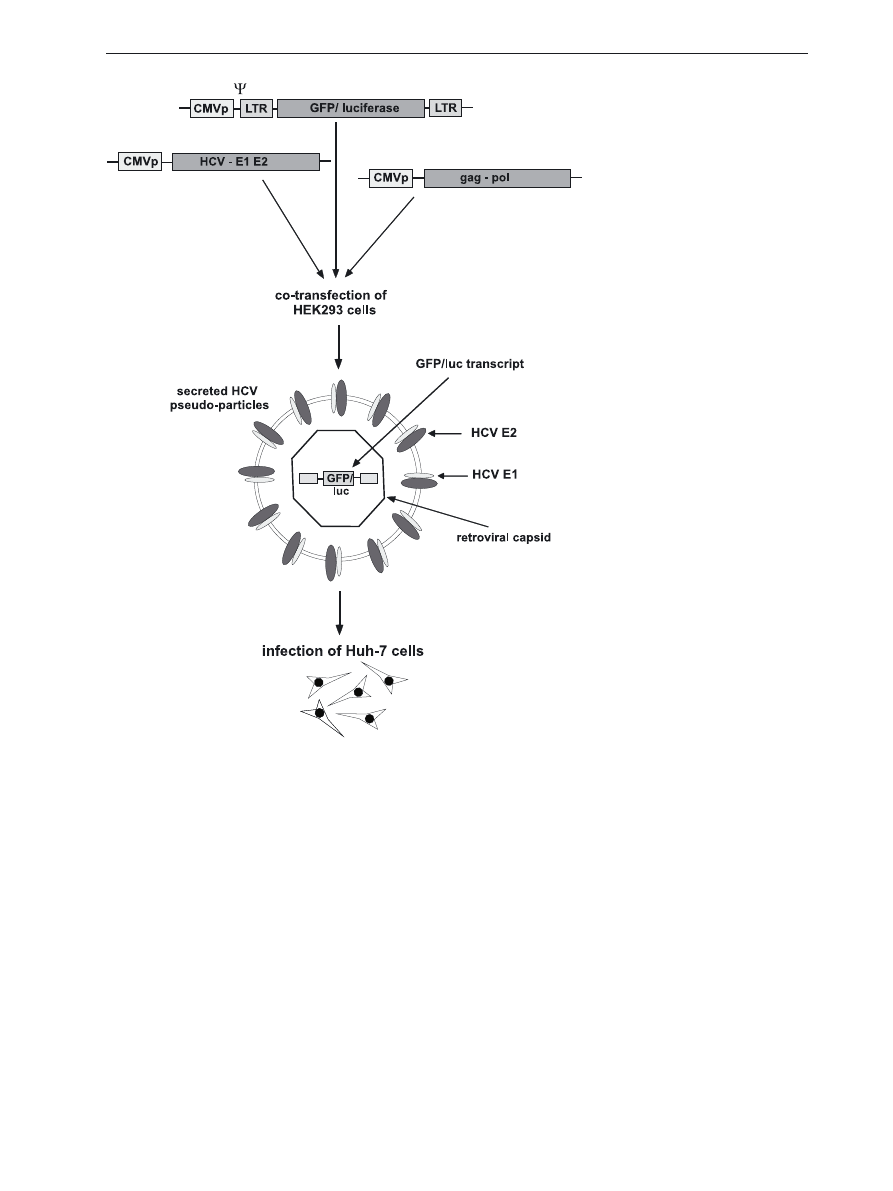
of GFP or luciferase (Fig. 3). Infected cells express-
ing the reporter gene can be detected and quantified
with the use of very sensitive fluorescence methods.
HCV pseudotyped retroviral particles are produced
in HEK293 cells (a human embryonic kidney-de-
rived cell line), typically after transfection of three
Vol. 54
707
New developments in hepatitis C virus studies
independent DNA constructs containing the gag
and pol genes of the retrovirus, a packaging/reporter
gene construct and HCV glycoproteins (Fig. 3). Viral
capsids composed of retroviral proteins and contain-
ing two copies of the retroviral transcripts including
the reporter gene are assembled inside transfected
cells. Such particles are subsequently transported to
the cell surface, where they acquire an envelope by
budding at the cell membrane. The envelope of the
newly formed particles contains HCV glycoproteins
E1 and E2 derived from the host cell membrane
(Bartosch et al., 2003b; Op De Beeck & Dubuisson,
2003; Diedrich, 2006).
Retroviruses are very suitable vectors for the
construction of pseudotyped viruses because they
possess a natural ability to incorporate a number of
cellular proteins into the viral particle, and their ge-
nomes tolerate large insertions of genetic markers.
The viruses used in the HCVpp system are mainly
MLV (murine leukemia virus) and HIV (human im-
munodeficiency virus). These viruses are extensively
studied, well characterized and efficiently assemble
in cell cultures. The retrovirus-based pseudo-particle
system is relatively safe to work with because the de-
fective viral genome canot replicate inside the infected
cell. The only manifestation of infection is expression
of the reporter gene. HEK293 cells were chosen as
the platform for the assembly of HCV pseudotyped
viruses because they are easy to transfect and accept
large amounts of foreign DNA. In the infection assay,
pseudo-particles assembled in HEK293T cells and re-
leased into the culture medium are subsequently used
for infecting hepatocytes of the Huh-7 human hepato-
ma cell line. Upon the infection, retroviral transcripts
Figure 3. Generation of HCVpp for
infection assay.
Hek 293 cells are cotransfected with
three independent expression vectors
coding for: 1. HCV E1 and E2 glyco-
proteins, 2. retroviral gag and pol, 3.
reporter protein (GFP or luciferase)
flanked by the retroviral genome LTR
sequences containing transcript pack-
aging signal − Ψ. Culture supernatant
containing HCV pseudoparticles is
used for infecting Huh-7 cells.

708
2007
M. Rychłowska and K. Bieńkowska-Szewczyk
are released into the target cells and the reporter gene
is expressed. Infectivity mediated by HCV glycopro-
teins is reflected by the number of cells expressing
the reporter gene. HCV pseudo-particles infection is
neutralized by HCV glycoprotein E2-specific mono-
clonal antibodies and serum from chronically infected
patients. HCVpp infectivity is restricted primarily to
human hepatocytes and hepatocyte-derived cell lines,
proving the specificity of the system and the role of
the E1 and E2 glycoproteins in HCV cell entry (Bar-
tosch et al., 2003a; Hsu et al., 2003; Op De Beeck et al.,
2004).
Although the HCV pseudo-particle system
has been developed only recently, it has already
shed some light on the early steps of HCV infection.
Several molecules have been proposed as potential
HCV receptor candidates, such as the tetraspanin
CD81 (Pileri et al., 1998), the scavenger receptor class
B type 1 (SR-B1) (Scarselli et al., 2002; Voisset et al.,
2005; Dreux et al., 2006), the low density lipoprotein
(LDL) receptor (Agnello et al., 1999; Monazahian et
al., 1999; Andre et al., 2002) and nectins L-SIGN and
DC-SIGN (Lozach et al., 2003; 2004). The HCVpp
system has been widely used for characterization of
some candidate receptors for HCV (Cocquerel et al.,
2006; McHutchinson et al., 2006) and their interaction
with the E1E2 glycoproteins. It has been revealed that
none of the putative receptor molecules alone is suf-
ficient to restore infectivity of HCV pseudo-particles
in non-permissive cells and infection with HCVpps
requires a set of co-receptors that include both CD81
and SR-B1 (Bartosch et al., 2003c). Considering the
great heterogeneity of HCV virions, it can be as-
sumed that different particles might infect cells using
different mechanisms and receptors (Diedrich, 2006).
Infection with HCV pseudo-particles differs from the
naturally occurring infection in humans because HCV
pseudotypes do not associate with lipoproteins. Thus,
some aspects of HCV entry, such as the lipoprotein
mediated infectivity or the role of LDL receptor in the
attachment, could not be studied. However, a number
of very interesting findings came recently from the
HCVpp studies. The glycosylation status of HCV E1,
E2 has been shown to be crucial for the infectivity of
pseudo-particles (Goffard et al., 2005) and some con-
served residues involved in CD81 interaction have
been identified (Owsianka et al., 2006). HCV pseudo-
particles have also been used to study the humoral
immune response in humans and chimpanzees (Bar-
tosch et al., 2003a; Meunier et al., 2005).
Infectious HCV virus in cell cultures (HCVcc) — a
breakthrough in HCV research
The development of replicon systems and
generation of HCV pseudo-particles has brought
substantial information about HCV replication and
cell entry. However, in these experimental systems,
the later stages of infection like the spreading of the
virus and release of the viral progeny could not be
analyzed.
In the past years many attempts have been
made to establish a cell culture system support-
ing HCV replication. Many systems were based ei-
ther on the infection of human or chimpanzee pri-
mary hepatocytes (Iakovacci et al., 1993; Lanford et
al., 1994; Fournier et al., 1998; Rumin et al., 1999)
and human hepatocyte-derived cell lines (Dash et
al., 1997; Seipp et al., 1997; Ikeda et al., 1998; Kato
et al., 1996; Song et al., 2001) with HCV particles
from patient’s serum, or on the cultivation of cells
derived from chronically infected individuals. Sev-
eral groups have also shown that HCV is able to
infect a variety of lymphoid cell lines in culture, in-
cluding several T-cell lines (MacParland et al., 2006;
Mizutani et al., 1996a; 1996b; Nakajima et al., 1996;
Shimizu et al., 1992; 1993), B-cell lines (Bertolini et
al., 1993; Sung et al., 2003; Valli et al., 1995) and pe-
ripheral blood mononuclear cells — PBMCs (Cribier
et al., 1995; Laskus et al., 1997; Pham et al., 2005). The
cell-culture-produced virus could be transmitted to
naïve cells by co-cultivation (Shimizu & Yoshikura,
1994) and in vivo infectivity after inoculation of a
chimpanzee with B-cell culture produced virus was
reported (Shimizu et al., 1998). However, the major
drawbacks of those systems were poor reproduc-
ibility and inefficient HCV replication that could be
measured only with very sensitive detection meth-
ods (Bartenschlager & Lohmann 2000). Moreover,
stable long-term virus production could hardly be
achieved. Nevertheless, some important questions
mostly about the genomic variability of HCV and
selection of lymphotropic HCV variants were ad-
dressed by these studies (Sugiyama et al., 1997; Ru-
min et al., 1999; Revie et al., 2006). Lymphoid cell
cultures were also employed in the first neutraliza-
tion assays to test anti-HCV antibodies (Shimizu et
al., 1994; 1996), studies of antiviral activity of α, β
interferons and first HCV antisense nucleotides (Mi-
zutani et al., 1995; 1996b). Studies based on T- and
B-cell lines not only have shed light on many as-
pects of HCV infection but also indicated that these
non-hepatic cells can possibly function as a reservoir
of the virus.
What revolutionized HCV research was the
cell culture HCV virus production system, based
on the transfection of human hepatoma cell line
Huh-7 with genomic RNA derived from a cloned
HCV genome (Lindenbach et al., 2005; Wakita et
al., 2005; Zhong et al., 2005). The starting point of
this new system was the isolation in 2001 by the
group of Takaji Wakita of an HCV genotype 2a
strain JFH-1 from a patient with fulminant hepatitis
(Kato et al., 2001). In the first series of experiments,

Vol. 54
709
New developments in hepatitis C virus studies
the JFH-1 isolate was used for the development of
a new subgenomic replicon which, as it was soon
demonstrated, could efficiently replicate in a vari-
ety of cell lines (Huh-7, Hep-G2, IMY-N9 and non-
hepatic cells) in spite of the lack of adaptive muta-
tions (Kato et al., 2003; 2005; Date et al., 2004). In
the following years Wakita and other researchers
proved that replication of JFH-1 complete genome
in human hepatoma cell line Huh-7 leads to the
secretion of infectious viral particles. Cell-culture-
produced virus was infectious for Huh-7 cells and
the virions were physically similar to natural HCV
isolates. However, attempts to infect cell lines oth-
er than Huh-7 were not successful. The new HCV
cell culture system generates different types of vi-
ral particles that are able to associate with lipopro-
teins. Thus, the lipoprotein-mediated infectivity of
HCV and release of viral particles from infected
cells could be studied (Diaz et al., 2006; Gastaminza
et al., 2006; Lindenbach et al., 2006) which was not
possible in any of the previous in vitro models. In-
fectivity of HCVcc was neutralized by CD81 recep-
tor-specific antibodies and immunoglobulins from
chronically infected patients. Infection was sensi-
tive to interferon treatment and limited to hepato-
ma cell lines, proving specificity and selectivity of
the infection. Moreover, cell-culture-generated HCV
was infectious for chimpanzees, generating disease
symptoms identical to those observed for human-
derived HCV virus (Lindenbach et al., 2005; Wakita
et al., 2005; Zhong et al., 2005). As determined in
studies of J6/JFH-1 chimeric virus a determinant
of the infectivity of JFH-1 clone was localized in
the NS region (NS3–NS5B) of the HCV genome
(Lindenbach et al., 2005). In future it will be very
interesting to find out which particular gene or re-
gion is responsible for the infectivity of JFH-1 in
cell culture.
In the optimized protocol for producing in-
fectious HCV virions in cell culture, the first step
is the transfection of in vitro transcribed JFH-1 or
chimerical (JFH-1 and other clones) HCV RNA into
the Huh-7-derived cells. Transcripts from the cDNA
derived from the viral RNA induce infection when
introduced into a permissive cell (Gale & Beard,
2001). This was based on the observation that in
vitro transcribed HCV RNA is infectious when trans-
fected into the liver of chimpanzees (Kolyhakov et
al., 1997; Yanagi et al., 1997). Infectious viruses are
obtained from cell culture supernatants and infec-
tivity is determined by indirect immunofluorescent
staining of infected cells for the viral NS5A protein
(Fig. 4). This system yields viral titers of 10
4
–10
6
in-
fectious units per ml of culture supernatant. Infec-
tion spreads throughout the culture within a few
days after inoculation at low multiplicity of infection
(moi) and the virus can be serially passaged without
loss of infectivity (Lindenbach et al., 2005; Wakita et
al., 2005; Zhong et al., 2005). The replication of HCV
is the most efficient in the highly permissive Huh-
7.5 cells derived from an HCV replicon-harboring
Huh-7 cell line selected for the highest HCV replica-
tion efficiency (Blight et al., 2002). The new Huh-7.5
cell line with the replicon removed by γ-interferon
treatment is ideal for robust HCV replication and
produces much higher viral titers than the original
Huh-7 cell line (Lindenbach et al., 2005; Zhong et al.,
2005).
Initially the HCV cell culture system was lim-
ited by the dependence on two particular structural
gene sequences (JFH1 and J6), both belonging to the
genotype 2a. This was a major problem in compara-
tive studies including multiple genotypes of HCV.
Further construction of chimeric genomes of differ-
ent genotypes was necessary to obtain cell culture
derived infectious viruses representing, in terms of
the structural genes, genotypes other than 2a. This
has resulted so far in new functional chimeras repre-
senting genotypes 1a (H77 isolate) and 1b (con1 iso-
late) (Pietschman et al., 2006). For these constructs,
an efficient infectious virus production was obtained.
However, the JFH1 virus still appears to be unique
among the strains of HCV in terms of its ability to
cause productive infection in cell culture.
Figure 4. overview of production of
infectious HCV in cell culture.
Upon transfection of Huh-7 cells with
in vitro transcribed HCV RNA and
96 h incubation cell culture superna-
tant containing HCV viral particles
is collected and used for subsequent
infection of naïve Huh-7 cells. HCV
infection is detected by anti-NS5A
staining.

710
2007
M. Rychłowska and K. Bieńkowska-Szewczyk
As an extension and modification of the
HCVcc system, modified HCV genomes expressing
luciferase as a reporter gene were constructed (Wak-
ita et al., 2005; Tscherne et al., 2006). With the urgent
need for the improvement of HCV drug therapies,
this new approach may be useful for testing current
and future antiviral compounds.
experimentally infected chimpanzees
Chimpanzees, as the only animals suscepti-
ble to HCV infection, have commonly been used
in the initial studies on non-A non-B hepatitis and
they are continuing to play an essential role in
many aspects of HCV research. Studies in chim-
panzees included the characterization of infectious
sera, analysis of the course of the disease and viral
transmission, host immune response studies, infec-
tivity studies and testing of anti-HCV compounds
and vaccine candidates (Bassett et al., 1999; Gale &
Beard, 2001; Bukh et al., 2001; Lanford et al., 2001).
The chimpanzee model, however, has some serious
limitations and disadvantages. Most importantly,
the availability of the animals is very limited. They
are on the list of endangered species, very expen-
sive and difficult to handle. Furthermore, chim-
panzees do not respond to HCV infection exactly
in the same way as humans. The major difference
is in the frequency of chronic infection, which oc-
curs in approximately 75% of the cases in humans,
while only 30–50% of infected chimpanzees develop
chronic hepatitis. Human disease can progress to
liver cirrhosis and fibrosis, which does not happen
in chimpanzees. Unlike in humans, high viral clear-
ance (over 60%) is observed in chimpanzees (Bas-
set et al., 1999; Bradley, 2000; Major & Feinstone,
2000; Thomson et al., 2003). These limitations of the
chimpanzee model stimulate the search for alterna-
tive animal models for HCV.
Murine models for HCV
The chimpanzee model, in which the develop-
ment of chronic liver disease is extremely rare, can-
not be used for studies of liver pathology. To exam-
ine the influence of HCV on the liver in an animal
model, two types of mouse HCV models have been
established:
1.
transgenic mice that express HCV proteins in the liver
from tissue-specific promoters,
2.
mice with chimeric human livers (engraftment of human
liver tissue into transgenic, immunocompromised mice).
In the first model, HCV proteins are expressed
individually or collectively from different promot-
ers. This model has been used mostly to characterize
such liver pathology manifestations as hepatocyte in-
jury, steatosis and hepatocellular carcinoma induced
by HCV proteins (reviewed by Gale & Beard, 2001).
The chimeric mice which give a possibility to
study liver pathology directly in the human liver tis-
sue seem to be a more accurate model for HCV-in-
duced liver failure. In this model, SCID (severe com-
bined immunodeficiency disease) mice with induced
liver failure are engrafted with the human liver tis-
sue. In SCID mice the humoral and cellular immune
systems fail to mature, making them one of the best
animal models for tissue transplants (Custer et al.,
1985). Human liver tissue is typically engrafted to
transgenic scid/Alb-uPA mice carrying a tandem of
murine urokinase genes under the liver-specific al-
bumin promoter. Urokinase overproduction causes
liver failure at 2–3 weeks of age and animals are
rescued by the human liver transplant leading to
repopulation of the mouse liver with human hepa-
tocytes. The resulting chimeric mice are effectively
infected with human serum-derived HCV of differ-
ent genotypes and produce virus that is infectious to
other animals (Mercer et al., 2001). As a modification
of the HCV mouse model, a novel non-infectious ef-
ficacy model for evaluating antiviral compounds has
been developed. In this model, Huh-7 cells carrying
an HCV replicon were implanted into the liver of
SCID mice. The replicon contained the luciferase re-
porter gene allowing for monitoring the viral repli-
cation using non-invasive whole body imaging (Zhu
et al., 2006). Those newly developed models are very
useful in in vivo tests of new compounds potentially
inhibiting viral replication and preventing infection,
both in drug evaluation and vaccine development
studies (Ilan et al., 2002; Hsu et al., 2003a; Kneteman
et al., 2006). However, technical difficulty in gener-
ating animals and high costs of the experiments are
serious limiting factors preventing the use of those
models for routine studies.
new World monkeys — marmosets infected with
GBV-B virus
An interesting surrogate model for HCV re-
search is the GB virus B (GBV-B). GBV-B is an en-
veloped, positive-sense RNA virus belonging to the
Flaviviridae family, phylogenetically most closely
related to HCV (Bukh et al., 1999). There is a high
degree of structural and biochemical homology be-
tween the GBV-B and HCV replication processes
(Sbardellati et al., 2001; Hope et al., 2002). GBV-B
causes hepatitis in small New World primates such
as tamarins (genus Saguinus) and marmosets (ge-
nus Callithrix) and replicates efficiently in cultures
of primary hepatocytes of these species (Bukh et al.,
1999). The ability of GBV-B to replicate in cell cul-
ture makes it possible to grow and study the virus
in laboratory conditions. Marmosets are suitable as

Vol. 54
711
New developments in hepatitis C virus studies
model organisms, relatively easy to breed in captiv-
ity and already regularly used for drug metabolism,
pharmacokinetics, and toxicology studies in drug
development, making them an ideal alternative HCV
model (Bright et al., 2004).
suMMAry
The recent technical advances in cell culture
systems, replicon and infection assays, have contrib-
uted to many important discoveries giving insight
into the mechanisms of HCV infection.
New small-animal models (chimeric mice)
have emerged which facilitate studies of liver pa-
thology associated with viral infection and testing of
new potential antiviral drugs.
The establishment of the cell culture sys-
tem for HCV opens a new era in the studies of
this virus. The system based on the JFH-1 clone
has serious limitations: only one strain of HCV
genotype 2a (not the most common genotype) can
be propagated in a very specific type of cells. The
cell-culture grown viral particles are more homog-
enous and less infective than the virus generated
from experimentally infected animals, which may
be due to the
lower association with lipoproteins
(Maillard et al., 2006). However, this is the first
true cell-culture system which allows the applica-
tion of classical virological methods to study many
aspects of the viral life cycle, including viral as-
sembly, egress and spread, which have previously
been unapproachable. Understanding the molecu-
lar virology of hepatitis C virus will be very help-
ful in identifying new specific targets for antiviral
therapy.
All the new methods constitute a solid plat-
form for researchers to study different aspects of
HCV biology, including host-virus interactions,
very important for the development of new antivi-
ral strategies. Hepatitis C virus, since its discovery
in 1989 (Choo et al., 1989), has been a subject of
extensive research. Taking into account how much
was achieved in the past without such suitable and
reliable research tools, it seems highly likely that in
the near future hepatitis C virus will become a well
known pathogen, with an effective treatment per-
spective for infected people. With the advances in
the understanding of HCV virology and the mecha-
nisms of its genetic variability, it will hopefully be-
come possible to design a universal vaccine against
this dangerous human pathogen.
Acknowledgements
Author M.R. is supported by an EU grant
from 6FP LSH-2005-1.2.4-2 HEPACIVAC - 0374435

REFERENCES
Agnello V, Abel G, Elfahal M, Knight GB, Zhang QX (1999) Hepatitis C virus and other Flaviviridae viruses enter cells
via low density lipoprotein receptor. Proc Natl Acad Sci USA 96: 12766-12771.
Andre P, Komurian-Pradel F, Deforges S, Perret M, Berland JL, Sodoyer M, Pol S, Brechot C, Paranhos-Baccala G,
Lotteau V (2002) Characterization of low- and very-low-density hepatitis C virus RNA-containing particles. J Virol 76:
6919-6928.
Andre P, Perlemuter G, Budkowska A, Brechot C, Lotteau V (2005) Hepatitis C virus particles and lipoprotein
metabolism. Semin Liver Dis 25: 93-104.
Bartenschlager R, Lohmann V (2000) Replication of hepatitis C virus. J Gen Virol 81: 1631-1648.
Bartenschlager R, Kaul A, Sparacio S (2003) Replication of the hepatitis C virus in cell culture. Antiviral Res 60: 91-102.
Bartenschlager R, Frese M, Pietschmann T (2004) Novel insights into hepatitis C virus replication and persistence. Adv
Virus Res 63: 71-180.
Bartosch B, Bukh J, Meunier JC, Granier C, Engle RE, Blackwelder WC, Emerson SU, Cosset FL, Purcell RH (2003a) In
vitro assay for neutralizing antibody to hepatitis C Virus: evidence for broadly conserved neutralization epitopes. Proc Natl
Acad Sci USA 100: 14199-14204.
Bartosch B, Dubuisson J, Cosset FL (2003b) Infectious hepatitis C virus pseudo-particles containing functional E1-E2
envelope protein complexes. J Exp Med 197: 633-642.
Bartosch B, Vitelli A, Granier C, Goujon C, Dubuisson J, Pascale S, Scarselli E, Cortese R, Nicosia A, Cosset FL (2003c)
Cell entry of hepatitis C virus requires a set of co-receptors that include the CD81 tetraspanin and the SR-BI scavenger
receptor. J Biol Chem 278: 41624-41630.
Bassett SE, Thomas DL, Brasky KM, Landford RE (1999) Viral persistence, antibody to E1 and E2, and hypervariable
region 1 sequence stability in hepatitis C virus-inoculated chimpanzees. J Virol 73: 1118-1122.
Bertolini L, Iacovacci S, Ponzetto A, Gorini G, Battaglia M, Carloni G (1993) The human bone-marrow-derived B-cell line
CE, susceptible to hepatitis C virus infection. Res Virol 144: 281-285.
Blight KJ, Kolyhakov AA, Rice CM (2000) Efficient initiation of HCV RNA replication in cell culture. Science 290: 1972-
1974.
Blight KJ, McKeating JA, Marcotrigiano J, Rice CM (2003) Efficient replication of hepatitis C virus genotype 1a RNAs in
cell culture. J Virol 77: 3181-3190.
Blight KJ, McKeating JA, Rice CM (2002) Highly permissive cell lines for subgenomic and genomic hepatitis C virus
RNA replication. J Virol 76: 13001-13014.
Boni S, Lavergne JP, Boulant S, Cahour A (2005) Hepatitis C virus core protein acts as a trans-modulating factor on
internal translation initiation of the viral RNA. J Biol Chem 280: 17737-17748.
Boulant S, Becchi M, Penin F, Lavergne JP (2003) Unusual multiple recoding events leading to alternative forms of
hepatitis C virus core protein from genotype 1b. J Biol Chem 278: 45785-45792.

Bradley DW (2000) Studies of non-A, non-B hepatitis and characterization of the hepatitis C virus in chimpanzees. Curr
Top Microbiol Immunol 242: 1-23.
Brass V, Moradpour D, Blum HE (2006) Molecular virology of hepatitis C virus (HCV): 2006 update Int J Med Sci 3: 29-
34.
Bright H, Carroll AR, Watts PA, Fenton RJ (2004) Development of a GB virus B marmoset model and its validation with a
novel series of hepatitis C virus NS3 protease inhibitors. J Virol 78: 2062-2071.
Bretner M (2005) Existing and future therapeutic options for hepatitis C virus infection. Acta Biochim Polon 52: 57-70.
Bukh J, Apgar CL, Yanagi M (1999) Toward a surrogate model for hepatitis C virus: an infectious molecular clone of the
GB virus-B hepatitis agent. Virology 262: 470-478.
Bukh J, Forns X, Emerson SU, Purcell RH (2001) Studies of hepatitis C virus in chimpanzees and their importance for
vaccine development. Intervirology 44: 132-142.
Choo QL, Kuo G, Weiner AJ, Overby LR, Bradley DW, Houghton M (1989) Isolation of a cDNA clone derived from a
blood-borne non-A, non-B viral hepatitis genome. Science 244: 359-362.
Cocquerel L, Voisset C, Dubuisson J (2006) Hepatitis C virus entry: potential receptors and their biological functions. J
Gen Virol 87: 1075-1084.
Cribier B, Schmitt C, Bingen A, Kirn A, Keller F (1995) In vitro infection of peripheral blood mononuclear cells by
hepatitis C virus. J Gen Virol 76: 2485-2491
Custer RP, Bosma GC, Bosma MJ (1985) Severe combined immunodeficiency (SCID) in the mouse. Am J Pathol 120:
464-477.
Date T, Kato T, Miyamoto M, Zhao Z, Yasui K, Mizokami M, Wakita T (2004) Genotype 2a hepatitis C virus subgenomic
replicon can replicate in HepG2 and IMY-N9 cells. J Biol Chem 279: 22371-22376.
Dash S, Halim AB, Tsuji H, Hiramatsu N, Gerber MA (1997) Transfection of HepG2 cells with infectious hepatitis C virus
genome. Am J Pathol 151: 363-373.
Deleersnyder V, Pillez A, Wychowski C, Blight K, Xu J, Hahn YS, Rice CM, Dubuisson J (1997) Formation of native
hepatitis C virus glycoprotein complexes. J Virol 71: 697-704.
Diaz O, Delers F, Maynard M, Demignot S, Zoulim F, Chambaz J, Trepo C, Lotteau V, Andre P (2006) Preferential
association of hepatitis C virus with apolipoprotein B48-containing lipoproteins. J Gen Virol 87: 2983-2991.
Diedrich G (2006) How does hepatitis C virus enter cells? FEBS J 273: 3871-3885.
Dreux M, Pietschmann T, Granier C, Voisset C, Ricard-Blum S, Mangeot PE, Keck Z, Foung S, Vu-Dac N, Dubuisson J,
Bartenschlager R, Lavillette D, Cosset FL (2006) High density lipoprotein inhibits hepatitis C virus neutralising antibodies
by stimulating cell entry via activation of the scavenger receptor B1. J Biol Chem 281: 18285-18295.
Drummer HE, Maerz A, Poumbourios P (2003) Cell surface expression of functional hepatitis C virus E1 and E2
glycoproteins. FEBS Lett 546: 385-390.

Dubuisson J (2000) Folding, assembly and subcellular localisation of hepatitis C virus glycoproteins. Curr Top Microbiol
Immunol 242: 135-148.
Dubuisson J, Hsu HH, Cheung RC, Greenberg HB, Russel DG, Rice CM (1994) Formation and intracellular localisation of
hepatitis C virus envelope glycoprotein complexes expressed by recombinant vaccinia and Sindbis viruses. J Virol 68:
6147-6160.
Fournier C, Sureau C, Coste J, Ducos J, Pageaux G, Larrey D, Domergue J, Maurel P (1998) In vitro infection of adult
normal human hepatocytes in primary culture by hepatitis C virus. J Gen Virol 79: 2367-2374.
Gale M, Beard MR (2001) Molecular colnes of hepatitics C virus: applications to animal models. ILAR J 42: 139-151.
Gastaminza P, Kapadia SB, Chisari FV (2006) Differential biophysical properties of infectious intracellular and secreted
hepatitis C virus particles. J Virol 80: 11074-11081.
Goffard A, Callens N, Bartosch B, Wychowski C, Cosset FL, Montpellier C, Dubuisson J (2005) Role of N-linked glycans
in the functions of hepatitis C virus envelope glycoproteins. J Virol 79: 8400-8409.
Gosert R, Egger D, Lohmann V, Bartenschlager R, Blum HE, Bienz K, Moradpour D (2003) Identification of the hepatitis
C virus RNA replication complex in Huh-7 cells harboring subgenomic replicons. J Virol 77: 5487-5492.
Griffin SD, Beales LP, Clarke DS, Worsfold O, Evans SD, Jaeger J, Harris MP, Rowlands DJ (2003) The p7 protein of
hepatitis C virus forms an ion channel that is blocked by the antiviral drug, Amantadine. FEBS Lett 535: 34-38.
Hardy RW, Marcotrigiano J, Blight KJ, Majors JE, Rice CM (2003) Hepatitis C virus RNA synthesis in a cell-free system
isolated from replicon-containing hepatoma cells. J Virol 77: 2029-2037.
He Y, Yan W, Coito C, Li Y, Gale M Jr, Katze MG (2003) The regulation of hepatitis C virus (HCV) internal ribosome
entry site-mediated translation by HCV replicons and nonstructural proteins. J Gen Virol 84: 535-543.
Hope RG, Murphy DJ, McLauchlan J (2002) The domains required to direct core proteins of hepatitis C virus and GB
virus-B to lipid droplets share common features with plant oleosin proteins. J Biol Chem 277: 4261-4270.
Hsu EC, Hsi B, Hirota-Tsuchihara M, Ruland J, Iorio C, Sarangi F, Diao J, Migliaccio G, Tyrrell DL, Kneteman N,
Richardson CD (2003a) Modified apoptotic molecule (BID) reduces hepatitis C virus infection in mice with chimeric
human livers. Nat Biotechnol 21: 519-525.
Hsu M, Zhang J, Flint M, Logvinoff C, Cheng-Mayer C, Rice CM, McKeating JA (2003b) Hepatitis C virus glycoproteins
mediate pH-dependent cell entry of pseudotyped retroviral particles. Proc Natl Acad Sci USA 100: 7271-7276.
Iacovacci S, Sargiacomo M, Parolini I, Ponzetto A, Peschle C, Carloni G (1993) Replication and multiplication of hepatitis
C virus genome in human foetal liver cells. Res Virol 144: 275-279.
Ikeda M, Sugiyama K, Mizutani T, Tanaka T, Tanaka K, Sekihara H, Shimotohno K, Kato N (1998) Human hepatocyte
clonal cell lines that support persistent replication of hepatitis C virus. Virus Res 56: 157-167.
Ikeda M, Yi M, Li K, Lemon SM (2002) Selectable subgenomic and genome-length dicistronic RNAs derived from an
infectious molecular clone of the HCV-N strain of hepatitis C virus replicate efficiently in cultured Huh7 cells. J Virol 76:
2997-3006.

Ilan E, Arazi J, Nussbaum O, Zauberman A, Eren R, Lubin I, Neville L, Ben-Moshe O, Kischitzky A, Litchi A, Margalit I,
Gopher J, Mounir S, Cai W, Daudi N, Eid A, Jurim O, Czerniak A, Galun E, Dagan S (2002) The hepatitis C virus (HCV)-
Trimera mouse: a model for evaluation of agents against HCV. J Infect Dis 185: 153-161.
Kato N, Ikeda M, Mizutani T, Sugiyama K, Noguchi M, Hirohashi S, Shimotohno K (1996) Replication of hepatitis C
virus in cultured non-neoplastic human hepatocytes. Jpn J Cancer Res 87: 787-792.
Kato T, Furusaka A, Miyamoto M, Date T, Yasui K, Hiramoto J, Nagayama K, Tanaka T, Wakita T (2001) Sequence
analysis of hepatitis C virus isolated from a fulminant hepatitis patient. J Med Virol 64: 334-339.
Kato T, Date T, Miyamoto M, Furusaka A, Tokushige K, Mizokami M, Wakita T (2003) Efficient replication of the
genotype 2a hepatitis C virus subgenomic replicon. Gastroenterology 125: 1808-1817.
Kato T, Date T, Miyamoto M, Zhao Z, Mizokami M, Wakita T (2005) Nonhepatic cell lines HeLa and 293 support
efficient replication of the hepatitis C virus genotype 2a subgenomic replicon. J Virol 79: 592-596.
Kneteman NM, Weiner AJ, O'Connell J, Collett M, Gao T, Aukerman L, Kovelsky R, Ni Z-J, Hashash A, Kline J, Hsi B,
Schiller D, Douglas D, Tyrrell DL, Mercer FD (2006) Anti-HCV therapies in chimeric scid-Alb/uPA mice parallel
outcomes in human clinical application. Hepatology 43: 1346-1353.
Kolykhalov AA, Agapov EV, Blight KJ, Mihalik K, Feinstone SM, Rice CM (1997) Transmission of hepatitis C by
intrahepatic inoculation with transcribed RNA. Science 277: 570-574.
Krieger N, Lohmann V, Bartenschlager R (2001) Enhancement of hepatitis C virus RNA replication by cell culture-
adaptive mutations. J Virol 75: 4614-4624.
Lai VC, Dempsey S, Lau JY, Hong Z, Zhong W (2003) In vitro RNA replication directed by replicase complexes isolated
from the subgenomic replicon cells of hepatitis C virus. J Virol 77: 2295-2300.
Lanford RE, Sureau C, Jacob JR, White R, Fuerst TR (1994) Demonstration of in vitro infection of chimpanzee
hepatocytes with hepatitis C virus using strand-specific RT/PCR. Virology 202: 606-614.
Lanford RE, Bigger C, Bassett S, Klimpel G (2001) The chimpanzee model of hepatitis C virus infections. ILAR J 42: 117-
126.
Laskus T, Radkowski M, Wang L-F, Cianciara J, Vargas H, Rakela J (1997) Hepatitis C virus negative strand RNA is not
detected in peripheral blood mononuclear cells and viral sequences are identical to those in serum: a case against
extrahepatic replication. J Gen Virol 78: 2747-2750.
Lin C, Gates CA, Rao BG, Brennan DL, Fulghum JR, Luong YP, Frantz JD, Lin K, Ma S, Wei YY, Perni RB, Kwong AD
(2005) In vitro studies of cross-resistance mutations against two hepatitis C virus serine protease inhibitors, VX-950 and
BILN 2061. J Biol Chem 280: 36784-36791.
Lindenbach BD, Evans MJ, Syder AJ, Wolk B, Tellinghuisen TL, Liu CC, Maruyama T, Hynes RO, Burton DR,
McKeating JA, Rice CM (2005) Complete replication of hepatitis C virus in cell culture. Science 309: 623-626.
Lindenbach BD, Meuleman P, Ploss A, Vanwolleghem T, Syder AJ, McKeating JA, Lanford RE, Feinstone SM, Major
ME, Leroux-Roels G, Rice CM (2006) Cell culture-grown hepatitis C virus is infectious in vivo and can be recultured in
vitro. Proc Natl Acad Sci USA 103: 3805-3809.

Lohmann V, Korner F, Koch JO, Herian U, Theilmann L, Bartenschlager R (1999) Replication of subgenomic hepatitis C
virus RNAs in a hepatoma cell line. Science 285: 110-113.
Lohmann V, Korner F, Dobierzewska A, Bartenschlager R (2001) Mutations in hepatitis C virus RNAs conferring cell
culture adaptation. J Virol 75: 1437-1449.
Lozach PY, Lortat-Jacob H, de Lacroix de Lavalette A, Staropoli I, Foung S, Amara A, Houles C, Fieschi F, Schwartz O,
Virelizier JL, Arenzana-Seisdedos F, Altmeyer R (2003) DC-SIGN and L-SIGN are high affinity binding receptors for
hepatitis C virus glycoprotein E2. J Biol Chem 278: 20358-20366.
Lozach PY, Amara A, Bartosch B, Virelizier JL, Arenzana-Seisdedos F, Cosset FL, Altmeyer R (2004) C-type lectins L-
SIGN and DC-SIGN capture and transmit infectious hepatitis C virus pseudotype particles. J Biol Chem 279: 32035-
32045.
MacParland SA, Pham TNQ, Gujar SA, Michalak TI (2006) De novo infection and propagation of wild-type hepatitis C
virus in human T lymphocytes in vitro. J Gen Virol 87: 3577-3586.
Ma H, Leveque V, De Witte A, Li W, Hendricks T, Clausen SM, Cammack N, Klump K (2005) Inhibition of native
hepatitis C virus replicase by nucleotide and nonnucleoside inhibitors. Virology 332: 8-15.
Maillard P, Krawczynski K, Nitkiewicz J, Bronnert C, Sidorkiewicz M, Gounon P, Dubuisson J, Faure G, Crainic R,
Budkowska A (2001) Nonenveloped nucleocapsids of hepatitis C virus in the serum of infected patients. J Virol 75: 8240-
8250.
Maillard P, Huby T, Andreo U, Moreau M, Chapman J, Budkowska A (2006) The interaction of natural hepatitis C virus
with human scavenger receptor SR-BI/Cla1 is mediated by ApoB-containing lipoproteins. FASEB J 20: 735-737.
Major ME, Feinstone SM (2000) Characterization of hepatitis C virus infectious clones in chimpanzees. Curr Top
Microbiol Immunol 242: 279-298.
Masciopinto F, Giovani C, Campagnoli S, Galli-Stampino L, Colombatto P, Brunetto M, Yen TSB, Houghton M, Pileri P,
Abrignani S (2004) Association of hepatitis C virus envelope proteins with exosomes. Eur J Immunol 34: 2834-2842.
McHutchison JG, Bartenschlager R, Patel K, Pawlotsky JM (2006) The face of future hepatitis C antiviral drug
development: recent biological and virologic advances and their translation to drug development and clinical practice. J
Hepatol 44: 411-421.
Mercer DF, Schiller DE, Elliott JF, Douglas DN, Hao C, Rinfret A, Addison WR, Fisher KP, Churchill TA, Lakey JR,
Tyrrell DL, Kneteman NM (2001) Hepatitis C virus replication in mice with chimeric human livers. Nat Med 7: 927-933.
Meunier JC, Engle RE, Faulk K, Zhao M, Bartosch B, Alter H, Emerson SU, Cosset FL, Purcell RH, Bukh J (2005)
Evidence for cross-genotype neutralization of hepatitis C virus pseudo-particles and enhancement of infectivity of
apolipoprotein C1. Proc Natl Acad Sci USA 102: 4560-4565.
Mizutani T, Kato N, Hirota M, Sugiyama K, Murakami A, Shimotohno K (1995) Inhibition of hepatitis C virus replication
by antisense oligonucleotide in culture cells. Biochem Biophys Res Commun 212: 906-911.
Mizutani T, Kato N, Ikeda M, Sugiyama K, Shimotohno K (1996a) Long-term human T-cell culture system supporting

hepatitis C virus replication. Biochem Biophys Res Commun 227: 822-826.
Mizutani T, Kato N, Saito S, Ikeda M, Sugiyama K, Shimotohno K (1996b) Characterization of hepatitis C virus
replication in cloned cells obtained from a human T-cell leukemia virus type 1-infected cell line, MT-2. J Virol 70: 7219-
7223.
Monazahian M, Bohme I, Bonk S, Koch A, Scholz C, Grethe S, Thomssen R (1999) Low density lipoprotein receptor as a
candidate receptor for hepatitis C virus. J Med Virol 57: 223-229.
Moradpour D, Evans MJ, Gosert R, Yuan Z, Blum HE, Goff SP, Lindenbach BD, Rice CM (2004) Insertion of green
fluorescent protein into nonstructural protein 5A allows direct visualization of functional hepatitis C virus replication
complexes. J Virol 78: 7400-7409.
Nakajima N, Hijikata M, Yoshikura H, Shimizu YK (1996) Characterization of long-term cultures of hepatitis C virus. J
Virol 70: 3325-3329.
Op De Beeck A, Dubuisson J (2003) Another putative receptor for hepatitis C virus. Hepatology 37: 705-707.
Op De Beeck A, Voisset C, Bartosch B, Ciczora Y, Cocquerel L, Keck Z, Foung S, Cosset FL, Dubuisson J (2004)
Characterization of functional hepatitis C virus envelope glycoproteins. J Virol 78: 2994-3002.
Owsianka AM, Timms JM, Tarr AW, Brown RJ, Hickling TP, Szwejk A, Bienkowska-Szewczyk K, Thomson BJ, Patel
AH, Ball JK (2006) Identification of conserved residues in the E2 envelope glycoprotein of the hepatitis C virus that are
critical for CD81 binding. J Virol 80: 8695-8704.
Patel J, Patel AH, McLauchlan J (2001) The transmembrane domain of the hepatitis C virus E2 glycoprotein is required for
correct folding of the E1 glycoprotein and native complex formation. Virology 279: 58-68.
Pavlovic D, Neville DC, Argaud O, Blumberg B, Dwek RA, Fischer WB, Zitzmann N (2003) The hepatitis C virus p7
protein forms an ion channel that is inhibited by long-alkyl-chain iminosugar derivatives. Proc Natl Acad Sci USA 100:
6104-6108.
Pawlowska M, Palewicz E, Halota W (2006) Early virologic response in therapy with pegylated interferon alpha-2B plus
ribavirin in children with chronic hepatitis C. Przegl Epidemiol 60: 71-77 (in polish).
Pham TN, Macparland SA, Coffin CS, Lee SS, Bursey FR, Michalak TI (2005) Mitogen-induced upregulation of hepatitis
C virus expression in human lymphoid cells. J Gen Virol 86: 657-666.
Pestova TV, Shatsky IN, Fletcher SP, Jackson RT, Hellen CUT (1998) A prokaryotic-like mode of cytoplasmic eukaryotic
ribosome binding to the initiation codon during internal translation initiation of hepatitis C and classical swine fever virus
RNAs. Genes Dev 12: 67-83 .
Pietschmann T, Lohmann V, Rutter G, Kurpanek K, Bartenschlager R (2001) Characterization of cell lines carrying self-
replicating hepatitis C virus RNAs. J Virol 75: 1252-1264.
Pietschmann T, Lohmann V, Kaul A, Krieger N, Rinck G, Rutter G, Strand D, Bartenschlager R (2002) Persistent and
transient replication of full-length hepatitis C virus genomes in cell culture. J Virol 76: 4008-4021.
Pietschmann T, Kaul A, Koutsoudakis G, Shavinskaya A, Kallis S, Steinmann E, Abid K, Negro F, Dreux M, Cosset FL,
Bartenschlager R (2006) Construction and characterization of infectious intragenotypic and intergenotypic hepatitis C virus
chimeras. Proc Natl Acad Sci USA 103: 7408-7413.

Pileri P, Uematsu Y, Campagnoli S, Galli G, Falugi F, Petracca R, Weiner AJ, Houghton M, Rosa D, Grandi G, Abrignani
S (1998) Binding of hepatitis C virus to CD81. Science 282: 938-941.
Puerstinger G, Paeshuyse J, De Clercq E, Neyts J (2007) Antiviral 2,5-distributed imidazo[4,5-c]pyridines: from anti-
pestivirus to anti hepatitis C activity. Bioorg Med Chem Lett 17: 390-393.
Revie D, Alberti MO, Braich RS, Chelyapov N, Bayles D, Prichard JG, Salahuddin SZ (2006) Analysis of in vitro
replicated human hepatitis C virus (HCV) for the determination of genotypes and quasispecies. Virol J 3: 81.
Rumin S, Berthillon P, Tanaka E, Kiyosawa K, Trabaud M-A, Bizollon T, Gouillat C, Gripon P, Guguen-Guillouzo C,
Inchauspe G, Trepo C (1999) Dynamic analysis of hepatitis C virus replication and quasispecies selection in long-term
cultures of adult human hepatocytes infected in vitro. J Gen Virol 80: 3007-3018.
Sbardellati A, Scarselli E, Verschoor E, De Tomassi A, Lazzaro D, Traboni C (2001) Generation of infectious and
transmissible virions from a GB virus B full-length consensus clone in tamarins J Gen Virol 82: 2437-2448.
Scarselli E, Ansuini H, Cerino R, Roccasecca RM, Acali S, Filocamo G, Traboni C, Nicosia A, Cortese R, Vitelli A (2002)
The human scavenger receptor class B type I is a novel candidate receptor for the hepatitis C virus. EMBO J 21: 5017-
5025.
Seipp S, Muller HM, Pfaff E, Stremmel W, Theilmann L, Goeser T (1997) Establishment of persistent hepatitis C virus
infection and replication in vitro. J Gen Virol 78: 2467-2476.
Shimizu Y, Iwamoto A, Hijikata M, Purcell RH, Yoshikura H (1992) Evidence for in vitro replication of hepatitis C virus
genome in a human T-cell line. Proc Natl Acad Sci USA 89: 5477-5481.
Shimizu YK, Purcell RH, Yoshikura H (1993) Correlation between the infectivity of hepatitis C virus in vivo and its
infectivity in vitro. Proc Natl Acad Sci USA 90: 6037-6041.
Shimizu YK, Yoshikura H (1994) Multicycle infection of hepatitis C virus in cell culture and inhibition by alpha and beta
interferons. J Virol 68: 8406-8408.
Shimizu YK, Hijikata M, Iwamoto A, Alter HJ, Purcell RH, Yoshikura H (1994) Neutralizing antibodies against hepatitis
C virus and the emergence of neutralization escape mutant viruses. J Virol 68: 1494-1500.
Shimizu YK, Igarashi H, Kiyohara T, Cabezon T, Farci P, Purcell RH, Yoshikura H (1996) In vitro assay for neutralizing
antibody to hepatitis C virus: Evidence for broadly conserved neutralization epitopes. Virology 223: 409-412.
Shimizu YK, Igarashi H, Kiyohara T, Shapiro M, Wong DC, Purcell RH, Yoshikura H (1998) Infection of a chimpanzee
with hepatitis C virus grown in cell culture. J Gen Virol 79: 1383-1386.
Simmonds P (2004) Genetic diversity and evolution of hepatitis C virus - 15 years on. J Gen Virol 85: 3173-3188.
Song ZQ, Hao F, Min F, Ma QY, Liu GD (2001) Hepatitis C virus infection of human hepatoma cell line 7721 in vitro.
World J Gastroenterol 7: 685-689.
Spahn CM, Kieft JS, Grassucci RA, Penczek PA, Zhou K, Doudna JA, Frank J (2001) Hepatitis C virus IRES RNA-
induced changes in the conformation of the 40s ribosomal subunit. Science 291: 1959-1962.

Sugiyama K, Kato N, Mizutani T, Iked M, Tanaka T, Shimotohno K (1997) Genetic analysis of the hepatitis C virus
(HCV) genome from HCV-infected human T cells. J Gen Virol 78: 329-336.
Sung VM, Shimodaira S, Doughty AL, Picchio GR, Can H, Yen TS, Lindsay KL, Levine AM, Lai MM (2003)
Establishment of B-cell lymphoma cell lines persistently infected with hepatitis C virus in vivo and in vitro: the apoptotic
effects of virus infection. J Virol 77: 2134-2146.
Thomson M, Nascimbeni M, Havert MB, Major M, Gonzales S, Alter H, Feinstone SM, Murthy KK, Rehermann B, Liang
TJ (2003) The clearance of hepatitis C virus infection in chimpanzees may not necessarily correlate with the appearance of
acquired immunity. J Virol 77: 862-870.
Thomssen R, Bonk S, Thiele A (1993) Density heterogeneities of hepatitis c virus in human sera due to binding of beta-
lipoproteins and immunoglobulins. Med Microbiol Immunol 182: 329-334.
Tscherne DM, Jones CT, Evans MJ, Lindenbach BD, McKeating JA, Rice CM (2006) Time- and temperature-dependent
activation of hepatitis C virus for low-pH-triggered entry. J Virol 80: 1734-1741.
Tsukiyama-Kohara K, Iizuka N, Kohara M, Nomoto A (1992) Internal ribosome entry site within hepatitis C virus RNA. J
Virol 66: 1476-1483.
Valli MB, Bertolini L, Iacovacci S, Ponzetto A, Carloni G (1995) Detection of a 5' UTR variation in the HCV genome
after a long-term in vitro infection. Res Virol 146: 285-288.
Varaklioti A, Vassilaki N, Georgopoulou U, Mavromara P (2002) Alternate translation occurs within the core coding
region of the hepatitis C viral genome. J Biol Chem 277: 17713-17721.
Voisset C, Callens N, Blanchard E, Op De Beeck A, Dubuisson J, Vu-Dac N (2005) High density lipoproteins facilitate
hepatitis C virus entry through the scavenger receptor class B type I. J Biol Chem 280: 7793-7799.
Vrolijk JM, Kaul A, Hansen BE, Lohman V, Haagmans BL, Schlam SW, Bartenschlager R (2003) A replicon-based
bioassay for the measurment of interferons in patients with chronic hepatitis C. J Virol Methods 110: 201-210.
Wakita T, Pietschmann T, Kato T, Date T, Miyamoto M, Zhao Z, Murthy K, Habermann A, Krausslich HG, Mizokami M,
Bartenschlager R, Liang TJ (2005) Production of infectious hepatitis C virus in tissue culture from a cloned viral genome.
Nat Med 11: 791-796.
Walewski JL, Keller TR, Stump DD, Branch AD (2001) Evidence for a new hepatitis C virus antigen encoded in an
overlapping reading frame. RNA 7: 710-721.
WHO report (2003) Hepatitis C guide. (published on-line,
www.who.int/csr/disease/hepatitis/whocdscsrlyo2003/en
WHO/CDS/CSR/LYO/2003.
Xu Z, Choi J, Yen TS, Lu W, Strohecker A, Govindarajan S, Chien D, Selby MJ, Ou J (2001) Synthesis of a novel
hepatitis C virus protein by ribosomal frameshift. EMBO J 20: 3840-3848.
Yanagi M, Purcell RH, Emerson SU, Bukh J (1997) Transcripts from a single full-length cDNA clone of hepatitis C virus
are infectious when directly transfected into the liver of a chimpanzee. Proc Natl Acad Sci USA 94: 8738-8743.
Zhong J, Gastaminza P, Cheng G, Kapadia S, Kato T, Burton DR, Wieland SF, Uprichard SL, Wakita T, Chisari FV
(2005) Robust hepatitis C virus infection in vitro. Proc Natl Acad Sci USA 102: 9294-9299.

Zhu Q, Oei Y, Mendel DB, Garrett EN, Patawaran MB, Hollenbach PW, Aukerman SL, Weiner AJ (2006) Novel robust
hepatitis C virus mouse efficacy model. Antimicrob Agents Chemother 50: 3260-3268.
Document Outline
Wyszukiwarka
Podobne podstrony:
New Developments in HBV Treatment
2007 11 New Online
anderson beyond homo economicus new developments in theories of social norms annotated(1)
Prezentacja KST 2007 new
egzamin 2007, II rok, II rok CM UMK, Giełdy, 2 rok, II rok, giełdy od Nura, fizjo, egzamin, New fold
fitopatologia, Microarrays are one of the new emerging methods in plant virology currently being dev
egzamin fizjologia analityka 2 II 2007, II rok, II rok CM UMK, Giełdy, 2 rok, II rok, giełdy od Nura
Strategia Bezpieczeństwa Narodowego RP 2007 new
Prezentacja KST 2007 new
egzamin 2007, II rok, II rok CM UMK, Giełdy, 2 rok, II rok, giełdy od Nura, fizjo, egzamin, New fold
population decline and the new nature towards experimentng refactoring in landscape development od p
Genesis for the New Space Age Secret Development of the Round Wing Plane the Extra Terrestrials Ins
więcej podobnych podstron