
EDITORIAL BOARD
EDITOR-IN-CHIEF
Professor IRENA ROTERMAN-KONIECZNA
Medical College Jagiellonian University, Krakow, st. Lazarza 16
HONORARY ADVISOR
Professor RYSZARD TADEUSIEWICZ
AGH University of Science and Technology
Professor JAN TR¥BKA
Medical College Jagiellonian University
MANAGING EDITORS
BIOCYBERNETICS
Professor PIOTR AUGUSTYNIAK
AGH University of Science and Technology, Krakow, al. Mickiewicza 30
BIOLOGICAL DISCIPLINES
Professor LESZEK KONIECZNY
Medical College Jagiellonian University, Krakow, Kopernika 7
MEDICINE
Professor KALINA KAWECKA-JASZCZ
Medical College Jagiellonian University, Krakow, Pradnicka 80
PHARMACOLOGY
Professor STEFAN CH£OPICKI
Medical College Jagiellonian University, Krakow, Grzegórzecka 16
PHYSICS
Professor STANIS£AW MICEK
Faculty of Physics Jagiellonian University, Krakow, Reymonta 4
MEDICAL INFORMATICS AND COMPUTER SCIENCE
Professor MAREK OGIELA
AGH University of Science and Technology, Krakow, al. Mickiewicza 30
TELEMEDICINE
Professor ROBERT RUDOWSKI
Medical Academy, Warsaw, Banacha 1a
LAW
(and contacts with business) Dr SYBILLA STANIS£AWSKA-KLOC
Law Faculty Jagiellonian University, Krakow, Kanonicza 4
ASSOCIATE EDITORS
Medical College Jagiellonian University, Krakow, Kopernika 7e
EDITOR-IN-CHARGE PIOTR WALECKI
E-LEARNING (project-related) ANDRZEJ KONONOWICZ
E-LEARNING (general) WIES£AW PYRCZAK
DISCUSSION FORUMS WOJCIECH LASOÑ
ENCRYPTION KRZYSZTOF SARAPATA
TECHNICAL SUPPORT
Medical College Jagiellonian University, Krakow, st. Lazarza 16
ZDZIS£AW WINIOWSKI in charge
WOJCIECH ZIAJKA
ANNA ZAREMBA-MIETAÑSKA
Polish Ministry of Science and Higher Education journal rating: 3.000
Punktacja KBN: 3.000
© COPYRIGHT BY INDIVIDUAL AUTHORS AND MEDICAL COLLEGE JAGIELLONIAN UNIVERSITY
ISSN 1895-9091 (print version)
ISSN 1896-530X (electronic version)
http://www.bams.cm-uj.krakow.pl

Contents
OPENING ARTICLE
3
Grid Projects at Academic Computer Center CYFRONET AGH, Krakow
M. Kwaśniewski
GRIDS IN SCIENCE
7
Grid Computing in Peking University
S. Zhu, S. Qian
17
GRID: from HEP to e-Infrastructures
F. Ruggieri
23
Grid Infrastructures as Catalysts for Development on e-Science: Experiences in the
Mediterranean
G. Andronico, R. Barbera, K. Koumantaros, F. Ruggieri, F. Tanlongo, K. Vella
27
RandomBlast a tool to generate random “never born protein” sequences
G. Evangelista, G. Minervini, P.L. Luisi, F. Polticelli
33
A solution for data transfer and processing using a grid approach
A. Budano, P. Celio, S. Cellini, R. Gargana, F. Galeazzi, C. Stanescu, F. Ruggieri, Y.Q. Guo, L. Wang,
X.M. Zhang
39
High throughput protein structure prediction in a grid environment
G. Minervini, G. La Rocca, P.L. Luisi, F. Polticelli
45
An approach to protein folding on the grid – EUChinaGrid experience
M. Malawski, T. Szepieniec, M. Kochanczyk, M. Piwowar, I. Roterman
51
Massive identification of similarities in DNA materials organized in Grid environment
M. Piwowar, T. Szepieniec, I. Roterman
53
Computers in medicine
J.K. Loster, A. Garlicki, M. Bociąga, P. Skwara, A. Kalinowska-Nowak
SHORT COMMUNICATION
57
Grids and their role in supporting worldwide development
F. Tanlongo
59
Grids at 4300 meters over the sea level: argo on EUChinaGrid
C. Stanescu, F. Ruggieri, Y.Q. Guo, L. Wang, X.M. Zhang
61
Euchinagrid: a high-tech bridge across Europe and China
F. Tanlongo
63 Radiology
on
Grid
A. Urbanik
65
Grid monitoring in EUChinaGrid infrastructure
Lanxin Ma
67 SELVITA


BIO-ALGORITHMS AND MED-SYSTEMS
JOURNAL EDITED BY MEDICAL COLLEGE – JAGIELLONIAN UNIVERSITY
OPENING ARTICLE
Vol. 3, No. 5, 2007, pp. 3-5
GRID PROJECTS at ACADEMIC COMPUTER CENTER CYFRONET
AGH, KRAKOW
M
AREK
K
WAŚNIEWSKI
Academic Computer Center CYFRONET AGH, Nawojki 11, 30-950 Krakow, Poland.
Academic Computer Centre CYFRONET AGH, established over 30 years ago, is an autonomous
organizational and financial entity of the
AGH University of Science and Technology. The Centre belongs
to the largest computer centers in Poland oriented on supercomputing and net systems. The organization
system of the center: High-Performance Computing Department, Software Department, Computer
Networks Department, Storage & Security Data Department, Technical Department, Administration
Department, Financial and Accounting Department and the Operators Section ensure the exploitation as
well as development of academic computer network as well as large scale computing service.
CYFRONET is responsible for:
1. Provision of computing power and other computing-related services to the scientific community
acting in research & education;
2. Development, maintenance and extension of computing infrastructure;
3. Participation in programs supported by the Polish government in the area of application of new
information technologies for science, education, management and business;
4. Scientific research (individually and in collaboration with other academic communities) in the
field of high-performance computers application and computer network systems services;
5. Research, analysis and implementations of new technologies applicable to the design, creation
and maintenance of computer infrastructures;
6. Consultations, services and training courses in the field of information technology, computer
networks and high-performance computing;
7. Promotion of new solutions for science, education, management and business to make them
more innovative;
CYFRONET has been participating in many projects of EU IST: to FP5 and FP6.
Ambient Networks - strategic objective of "Mobile and Wireless Systems Beyond
3G".
GREDIA – creation of a reliable Grid application development platform with
high-level support for the design, implementation and operational deployment of
secure Grid business applications.
ViroLab - virtual laboratory for studying infectious diseases including HIV virus
resistance to drugs in particular.
M. Kwaśniewski, Grid projects at Academic Computer Center Cyfronet AGH, Krakow
4
int.eu.grid - Interactive European Grid Project's objective - advanced Grid
empowered infrastructure in the European Research Area for application in:
medicine, environment, astronomy and physics.
EGEE - Enabling Grids for e-Science in Europe – integration of current national,
regional and thematic Grid efforts in order to create a seamless European Grid
infrastructure for the support of the European Research Area (ERA).
K-WfGrid - Knowledge-based Workflow System for Grid Applications -
addresses the need for a better infrastructure for the future Grid environment.
CoreGRID - the CoreGRID Network of Excellence (NoE) - strengthening and
advancing scientific and technological excellence in the area of Grid and Peer-
to-Peer technologies.
CrossGrid - international project focusing on applications whoich requirefrequent
interaction with the user and real time responses from a system: distributed data
analyzis uin High Energy Physics, surgery decision support application, weather
forecasting, flood crisis tean decisions support system.
GridStart - clustering all of the 5FP IST-funded Grid research projects with the
intention to stimulate wide deployment of appropriate technologies and to
support early adoption of best practices.
Pellucid - Platform for Organizationally Mobile Public Employees (EU 5FP).
Pro-Access - The ImPROving ACCESS of Associated States To Advanced
Concepts In Medical Informatics (PRO-ACCESS) - creation of a platform for
promotion, dissemination and transfer of advanced health, telematics and
experiences from development and deployment of telemedicine solutions to
NAS.
And national projects:
CLUSTERIX - this project contains the concept of building the National Cluster
of Linux Systems
PROGRESS - Polish Research On GRid Environment for Sun Servers.

M. Kwaśniewski, Grid projects at Academic Computer Center Cyfronet AGH, Krakow
5
The Cracow Telemedicine Centre - collaboration with hospitals and health care
centers to upgrade the medical services introducing new technologies
implementing IT solutions for scientific projects sponsored by the Polish Ministry
of Science, as well as by EU 5FP and practical medicine.
PIONIER programme bases on the document PIONIER: Polish Optical Internet -
Advanced Applications, Services and Technologies for Information Society".
Introducing Poland to international communities and allowing the partnership in
collaboration with other countries.
High Performance Computing and Visualization with the SGI Grid for Virtual
Laboratory Applications - the SGI Grid project aims to design and implement the
innovative activities and technologies.
Since 2000 CYFRONET has been organizing the yearly Cracow Grid Worshops.
The last one, planed to be organized together with the project EuChinaGRID:


BIO-ALGORITHMS AND MED-SYSTEMS
JOURNAL EDITED BY MEDICAL COLLEGE – JAGIELLONIAN UNIVERSITY
GRIDS IN SCIENCE
Vol. 3, No. 5, 2007, pp. 7-15
GRID COMPUTING IN PEKING UNIVERSITY
S
HULEI
Z
HU
,
S
IJIN
Q
IAN
Peking University, Beijing, China
Abstract: Grid computing enables the massive computer resource sharing, so that many applications (e.g. experimental high
energy physics (HEP) and biology researches, etc.) can be greatly benefited from this new technology to proceed to the level
which was unthinkable or unreachable before. Peking University is one of 10 partners in the EUChinaGRID project funded by
European Commission. In this paper, the BEIJING-PKU site (based on the middleware gLite of European grid project EGEE)
in the EUChinaGRID infrastructure is described. Some result of grid application in Peking University and our future plans (on
HEP and biology applications as well as on the grid technology development itself) are outlined.
Key Words: EGEE, LCG, gLite3, EUChinaGRID, Interoperability
1. Introduction
Grid computing, a newly developing technology after the
internet and WWW, harnesses the distributed computer
resources to facilitate with collaboration, data sharing and
management of all resources involved. In fact, all resources in
the computing grid environment are virtualized to create a
pool of assets for authorized users to retrieve seamlessly.
With the grid computing, it becomes possible to solve many
problems too intensive for any stand-alone computers or
computer clusters. For end-users, by accessing the computing
grid they seem to hold vast IT capabilities [1]; similar as the
electric power grid, the users would not need to care where
the resources (e.g. the power station or electric generator and
power line, etc.) are located. Currently, in some scientific
organizations and communities, researchers may use the
computing grid infrastructures shared in the Virtual
Organization (VO, see the next Chapter) as long as they join
the VO, even with free of charge; but this situation will evolve
to be similar as the electronic power grid once the accounting
services in the middleware of computing grid shall be more
mature.
Peking University (PKU) is one of 10 partners of the
EUChinaGRID project funded by European Commission
under the 6th Framework Programme (FP6) for Research and
Technological Development. PKU group is consists of two
subgroups, one is the biology group led by Prof. Bin XIA,
another is the High Energy Physics (HEP) group led by Prof.
Sijin QIAN. Among 5 Working Packages (WPs) of
EUChinaGRID project, PKU group participated in WP3 (pilot
infrastructure operational support), WP4 (grid application) and
WP5 (dissemination). Within the scope of WP3, a grid site of
BEIJING-PKU has been built since the beginning of 2007.
PKU group’s activities in WP4 include the biology and HEP
applications. We have heavily engaged in the dissemination
work in WP5, including to host a tutorial at PKU in November
of 2006.
In this paper, Chapter 2 is to further elaborate the grid
computing and the virtual organization, as well as the two
major projects (LCG and EGEE) for the HEP and other
scientific applications, and the brief of EUChinaGRID project;
Chapter 3 is to describe the middleware “gLite” of EGEE
system which is installed at PKU; Chapter 4 explains the
status of grid site BEIJING-PKU and some result from the
HEP application obtained by PKU group; Chapter 5 is to
outline the future plan in PKU group on the biology application
and on the computing grid technology; the summary is given
in Chapter 6.
2. Grid computing and 3 relevant Grid
projects
(LCG, EGEE and EUChinaGRID)
Grid computing is an evolution of related development in
information technology, such as p2p (Peer to Peer),
distributed computing and so on. It shares many common
grounds with these technologies and works as a combination
to climb to a level which the individual precedent technology
could not reach. Grid computing has many features such as
distributed, dynamical, diversity, self-comparability, autonomic
and multiple management, etc. Therefore, Ian Foster “defined”
the grid computing as “Flexible, secure, coordinated resource
sharing among dynamic collections of individuals, institutions
and resources (i.e. “Virtual Organizations”, VO, see the next
Section) [2]. Here the resource includes computers, data
storages, databases, sensors, networks and software, etc. A
“VO” can be conceived as a group of people (and resources)
belonging to the same or different real organizations that want
to share common resources in order to achieve the goals
which are unreachable by each individual alone.
From view point of application, grid computing may be
classified into data grid, computational grid, collaboration grid,
information grid, knowledge grid and semantic grid, etc. In
S. Zhu and S. Qian, Grid Computing in Peking University
8
reality, many grid systems can be a combination of some
above types.
At present, some stable computing grids have been being
tested in scientific fields. They play (or are going to play)
important roles in solving some complex and important
problems encountered by researchers. On the other hand,
people believe that the computing grid also could be used in
the enterprises to increase the productivity and efficiency in
the organizations and may help to solve the security problems
too. IBM, Microsoft, Oracle and other global IT enterprises
response to this growing technology actively and inject
increasingly more efforts to its development.
2.1. Virtualization of grid computing
By virtualization, the grid computing enables across
network heterogeneous IT systems to work together to form a
large virtual computing system offering a variety of virtual
resources [3]; and the concept of Virtual Organization (VO)
contribute the essence in the development and the application
of grid computing.
VOs are some dynamical virtual entities which correspond
to real organizations or projects, such as IT department of
global enterprises, the four experiments (ATLAS, ALICE, CMS
and LHCb) on Large Hadron Collider (LHC) at CERN (Euro-
pean Organization for Nuclear Research, in Geneva, Switzer-
land), the community of biomedical researchers and so on.
VOs strictly enforce security rules to their members which
regulate the privileges and priorities between users and re-
sources. In VOs, members share all kinds of resources in-
cluding equipments, software, hardware, licenses and others.
Of course, these resources are virtualized and dynamically
assembled.
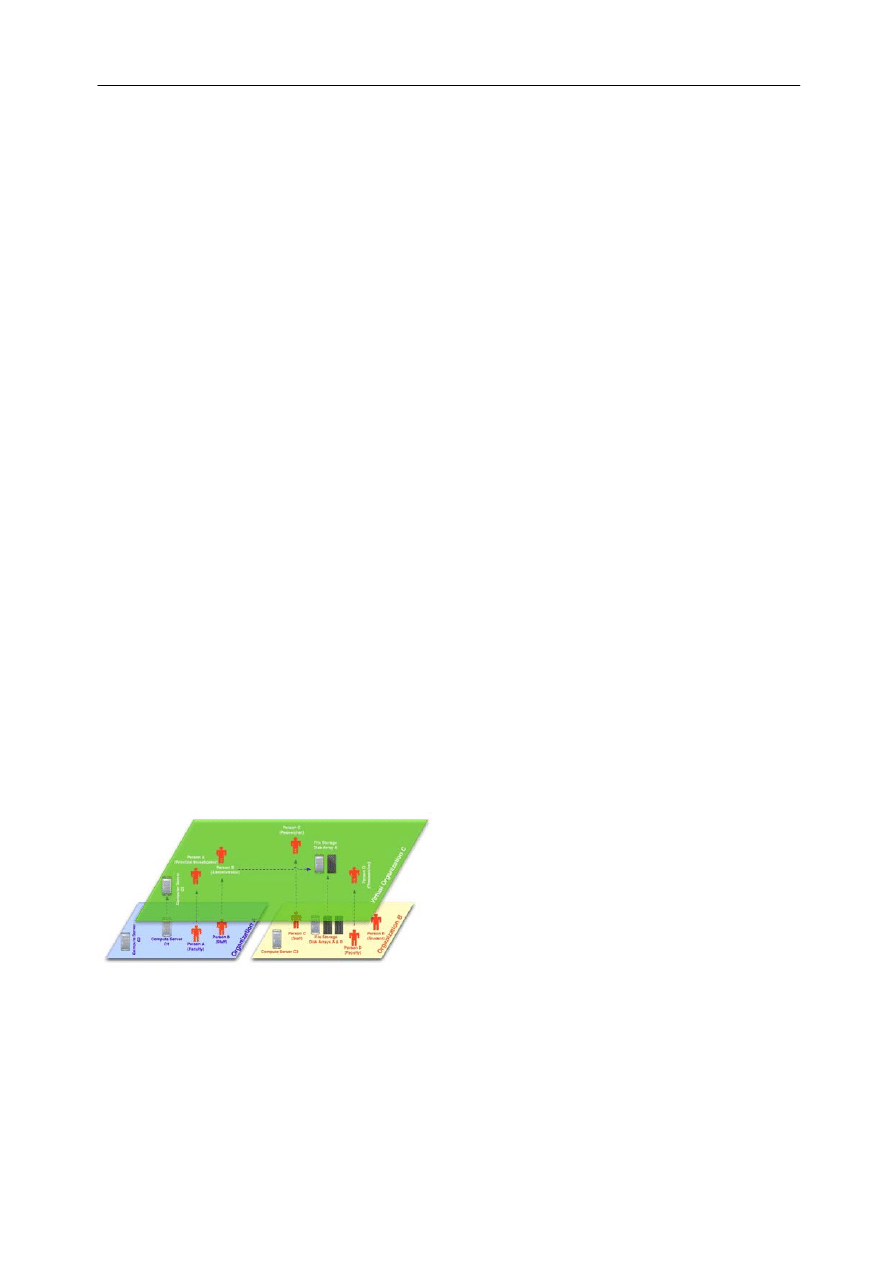
Figure 1 describes the relation between a VO and some
real organizations [4]. Some resources (including personnel)
in the real organizations are contributed to a big virtual world
which collects the contributions from all real organizations to
form a big pool so that all resources in the pool can be shared
by the members in this VO under some agreed rules and strict
security measures.
Fig. 1. An illustration of the VO with respect to real organizations
2.2. LCG, EGEE projects and the grid
application in high-energy physics
Currently being built and soon-to-be one of the largest
scientific instrument in the world, the Large Hadron Collider
(LHC) will hopefully be completed and be operational at the
beginning of 2008; it will produce roughly 12-14 Petabytes
(1Petabytes = 1 million Gigabytes, if being stored in normal
CDs, the accumulation of CDs for 1 PB of data will be piled up
to several kilometers tall) of data annually, which will be
distributed around the globe and analyzed by thousands of
scientists in some 500 research institutes and universities
worldwide that are participating in the LHC experiments.
About 100 000 CPUs at 2004 measures of processing power
are required to simulate and analyze these data. No any
single computer or supercomputer center in the world can
satisfy the requirement to analyses and store the data.
LCG (LHC Computing Grid) project emerged in 2002, as
Prof. Les Robertson (CERN's LCG project manager) said
"The LCG will provide a vital test-bed for the new Grid
computing technologies that are set to revolutionize the way
scientists use the world's computing resources in areas
ranging from fundamental research to medical diagnosis" [5].
The data from the LHC experiments will be distributed around
the globe according to a four-tiered model. The Tier-0 centre
of LCG is located at CERN; those data which arrive at Tier-0
will be quickly distributed to a series of Tier-1 centers after
initial processing, then continuously to the Tier-2s and Tier-3s.
BEIJING-PKU site [6] will act as a part of Tier-3s, which can
consist of local clusters in a Department of University or even
of individual PCs, and which may be contributed to LCG on a
regular basis [7]
The core task of implementing LCG project is the deve-
lopment of grid middleware. Nowadays, the heterogeneous IT
systems are not compatible with the model of computing grid;
therefore we need an extensible system, called as grid
middleware, to enable the interaction of grid and existing
network. The “grid middleware” refers to the security, resource
management, data access, instrumentation, policy, accoun-
ting, and other services provided for applications, users, and
resource providers to operate effectively in a Grid environ-
ment. Middleware acts as a sort of 'glue' which binds these
services together [8]. LCG project had studied and deployed
the grid middleware packages which come from some com-
ponents developed by other projects and organizations, such
as EDG (European DataGrid), Globus, Condor, PPDG,
GriPhyN and others. The middleware widely distributed at
CERN and the LHC community latter gradually has been
replaced by the “gLite” middleware that is maintained and
developed by EGEE (Enabling Grids for E-Science in Europe)
project.
EGEE is another important European project which was
started in April 2004 and aims to establish a Grid infrastruc-
ture for e-science (in European first, then later beyond
Europe), and its goal is to provide researchers with access to
a geographically distributed computing grid infrastructure,
available around clock. LCG contributed to the initial environ-
ment for EGEE: the gLite3 middleware of EGEE comes out as
the fruit of convergence of LCG 2.7.0 and gLite 1.5.0 in the
spring of 2006. One major difference between two middleware
is that LCG middleware focused on data handling but gLite3
does on data analysis.
The site of BEIJING-PKU has been upgraded to gLite3 by
following the general trends. So we will focus on gLite3
middleware because it includes the complete components
inherited from LCG-2.
S. Zhu and S. Qian, Grid Computing in Peking University
9
2.3. EUChinaGRID project and Peking
University
EUChinaGRID project focuses on extending the European
GRID infrastructure for e-Science to China and strengthening
the collaboration between China and Europe in computing grid
field [9]. Interoperability between two middleware, i.e. gLite3 of
EGEE and GOS (Grid Operation System) of CNGrid (China
National Grid) is one of the key goals of the project which will
be introduced in Chapter 5.
As introduced in Chapter 1, Peking University group has
been mainly engaged in 3 among 5 Working Packages (WPs)
of EUChinaGRID project. Within the scope of WP3 (pilot
infrastructure operational support), we have set up a fully
functional grid site BEIJING-PKU which is going to be
described in rather details in Chapter 4.
Two subgroups in PKU are participating in WP4 (grid
application) of EUChinaGRID pertaining to different disciplines
of sciences: Biology and Physics. The Beijing Nuclear
Magnetic Resonance Center (BNMRC) is a national center for
bio-molecular structural studies in China located at PKU; this
group will make use of new grid technology to enhance the
quality of Never-Born-Protein (NBP) applications. The PKU
high energy physics (HEP) group has participated in the CMS
experiment on LHC at CERN since 11 years ago; it will use
the computing grid on the huge amount of Monte-Carlo event
generation and data analysis. Some results obtained by HEP
group will be shown in Chapter 4.
In WP5 (dissemination) of EUChinaGRID, we have taken
part in organizing the training and other activities (e.g. to
briefing the journalists and medias for their participation in the
project conference, to making the presentations at various
international grid conferences, etc.). In November of 2006,
PKU has hosted a Grid tutorial taught by all Chinese tutors (in
its first time) and it got one of the highest feedback scores
evaluated by the trainees.
EUChinaGRID project is preparing to apply for the
extension under the 7th framework programme (FP7) of EC.
Hopefully, more partners would be able to join the second
term of project; also we would be able to continue our
activities and some new foreseen programs as outlined in
Chapter 5.
3. gLite Grid middleware
Some architectures of middleware were designed after
the proposition of computing grid concept, such as Five-Level
Sandglass Architecture designed by Ian Foster, OGSA (Open
Grid Services Architecture) and WSRF (Web Service
Resource Framework), etc. Of them, Five-Level Sandglass
Architecture is the most significant one, which leads to the
definition of grid protocol architecture. This model focus on the
protocol, but it also emphasizes the services, e.g. API
(Application Programming Interfaces) and SDK (Software
Development Kits) are two aspects considered much by this
model.
Just as its name implies, five components layers are
included in the Five-Level Sandglass Architecture [2]. Starting
from the bottom of the stack and moving upward, they are
fabric layer, connectivity layer, resource layer, collective layer
and application layer. The “fabric layer” defines the interface
to local shared resources; the “connectivity layer” defines the
basic communication and authentication protocols required for
grid-specific networking-service transactions; the “resource
layer” uses the communication and security protocols (defined
by the connectivity layer) to control secure negotiation, initia-
tion, monitoring, accounting, and payment for the sharing of
functions of individual resources; the “collective layer” is re-
sponsible for all global resource management and interaction
with collections of resources; and the “application layer” en-
ables the use of resources in a grid environment through
various collaboration and resource access protocols. Thus it
can be seen that there are some evident differences between
grid protocol and internet TCP/IP protocol (Fig. 2) [10]
Fig. 2. Differences between the grid protocol (left) and the internet
TCP/IP protocol (right)
Another important grid architecture “OGSA” is likely to be-
come the standard of grid protocol. OGSA is a kind of Service
Oriented Architecture (SOA), which concerns with the de-
scription of the services that have a network-addressable
interface and that communicate with protocols and data for-
mats. OGSA receives the strong help from the Globus project
which provides a collection of Grid services that follow OGSA
architectural principles and a development environment for
producing new Grid services that follow OGSA principles.
From Five-Level Sandglass Architecture to OGSA, the
essential change is from the models of function-based to of
service-oriented. The gLite middleware is developed with this
background and is the representative of second generation
grid middleware.
The gLite3 Middleware [11] developed by EGEE project
follows SOA architecture, which share many standards and
services with OGSA. Therefore, it is compatible with the
OGSA and this would be important if OGSA would become
the standard of grid protocol. The services work together in a
coherent way as an integrity component but they can also be
deployed independently, this allows their development in
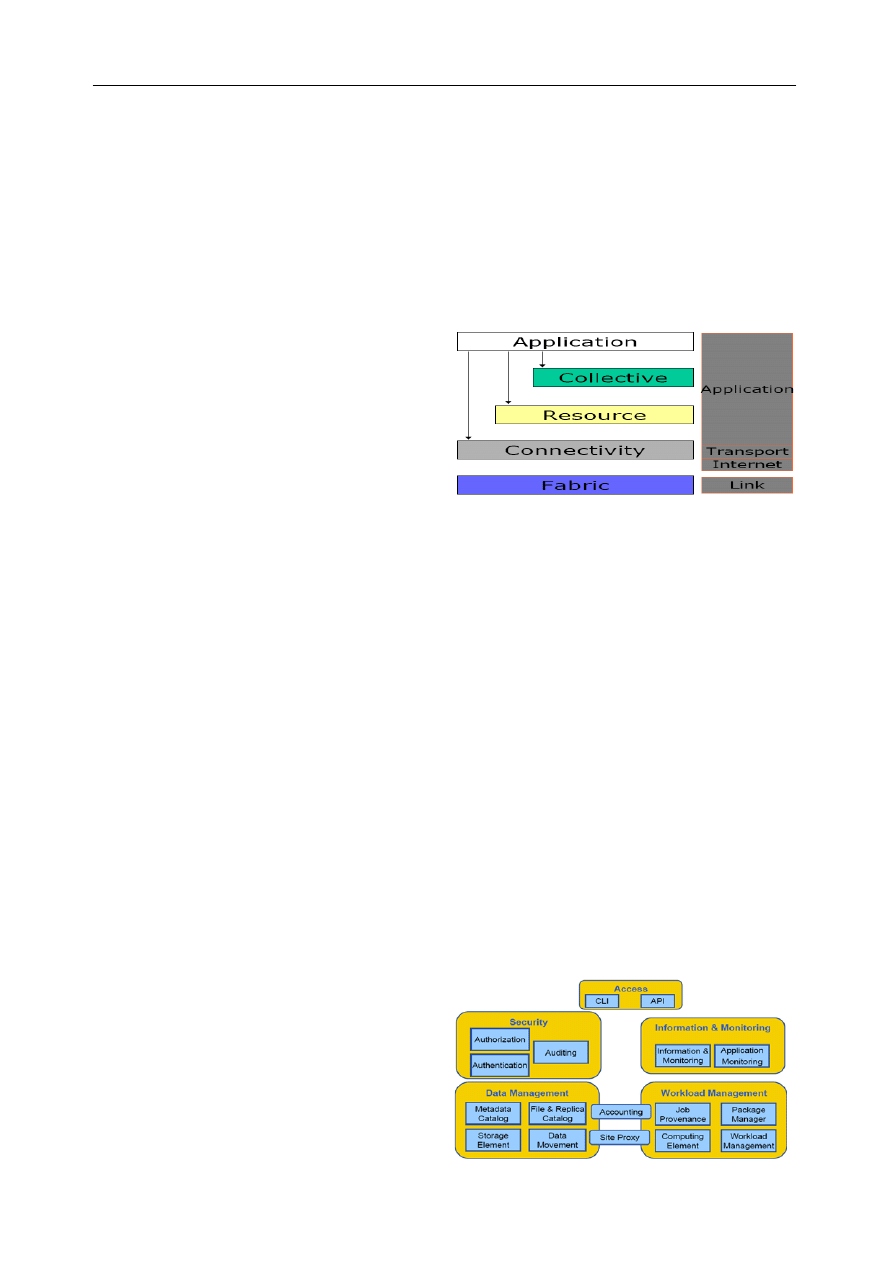
different contexts. The architecture [12] of gLite3 middleware
is shown in Fig.3 and is described in more details for each
system in next sub-sections.
Fig. 3. The gLite3 architecture

S. Zhu and S. Qian, Grid Computing in Peking University
10
3.1. Security Service
To ensure the security of grid system, there must be some
forceful security rules so that only users with privileges and
authorization are allowed to access it.
In gLite middleware, authentication is based on X.509 PKI
infrastructure which is issued by Certificate Authorities (CA).
The certificates will work like a passport to identify individuals.
A user or host holding the certificate has a private key
protected by password to prove the identity. Submitting jobs to
remote hosts with private key may not be very safe. In order to
reduce vulnerability, a proxy is used to connect to the remote
hosts on behalf of the user. Proxies and private keys are vital
to users or hosts because persons who steal them can
impersonate the owner.
As explained above, the user management in gLite
middleware is realized by VOs. A user must read and agree to
the usage rules and any further rules for the VO he (or she)
wishes to join and register some personal data with a
Registration Service in order to use resources of the VO.
VOMS (VO Management Service) is responsible to manage
information about the roles and privileges of users within a
VO.
Though certificate is not a short lived authentication, it has
the expiration date, after which the certificate is no longer valid
and users have to renew the certificate from CAs. However,
proxies usually have a lifetime of only a few hours. To manage
a large job, the user must extend the lifetime of proxy first.
3.2. CE (Computer Element) and Workload
Manage System (WMS)
The Computing Element (CE), including Grid Gate (GG),
BLASH, Local Resource Management System (LRMS), Work
Nodes (WNs) and other components, mount computing
resources, therefore represents the power, of a grid site. Here,
GG is the generic interface to the computer cluster and
BLASH is the interface passing the job to a layer that interacts
with the local resource manager; the executable jobs
submitted to CE will queue in LRMS to wait to be dealt with by
WNs. There should be some VO-specific application software
pre-installed at the grid sites in a dedicated area which WNs
can access.
Jobs assigned to CE are firstly selected by RB (Resource
Broker) that is the machine where WMS (Workload
Management System) services run. RB chooses CE
according to the information of Job Description Language
(JDL) file provided by the job submitter, and the Logging and
Bookkeeping service (LB) tracks history and status of jobs
managed by the WMS.
3.3. SE (Storage Element) and Data
Management Service (DMS)
SE (Storage Element) provides the interface to allow a
user or an application to store data. The Storage Resource
Manager (SRM) has been designed to be the single interface
(through the corresponding SRM protocol) for the manage-
ment of disk and tape storage resources which can be the
single disk server or disk array or MSS (Massive Storage
System). Any type of Storage Element offers an SRM
interface except for the Classic SE, which is becoming
obsolete by being phased out; now in gLite3 [11], SRM has
been migrated to v2.2 which can hide the storage system
implementation from users, and it can check the access rights
to the storage system and the files.
Table 1. Types of SE in gLite3
In gLite SE, GSIFTP (a GSI-secure FTP) is the protocol
for whole-file transfers, while RFIO (Remote File Input/Output)
or gsidcap is for local and remote file. In addition, normally a
monitoring service of “MON Box” is installed on the computer
where SE is installed to be responsible for the monitoring of
whole system.
3.4. Information System
(IS)
A Grid site publishes and monitors grid resources and
their status with Information System (IS). For users, IS help
them to find the best place to submit jobs; while for
administrators, more intuitionist information (e.g. to trace the
execution status of CE and to check the available storage
space in SE, etc.) can be found in IS.
IS publish much of the data conforming to the GLUE Grid
Laboratory for a Uniform Environment Schema which defines
a common conceptual data model to be used for Grid
resource monitoring and information finding. There are two
types of IS in gLite3: “Monitoring and Discovery Service
(MDS)” and “Relational Grid Monitoring Architecture (R-
GMA)”, more details can be found in [11].
4. BEIJING-PKU site and Grid applica-
tion on HEP in Peking University
Along with the development of grid computing technology,
the grid computing team of Peking University mainly considers
itself as a grid user. Our aim is to run a stable site, to exploit
more computing and data storage resources when needed, to
offer our spare resources (whenever available) to other users
and to make full use of the grid for the tasks in the high energy
physics and biology researches. This quite coincides to the
objectives of EUChinaGRID project.
4.1. BEIJING-PKU grid computing site
The construction of BEIJING-PKU site was started in the
middle of 2006, and become almost fully functional in the
Spring of 2007 after the bottleneck problem of international
network connection has been solved. It should be emphasized
that the construction of this site would not be successful if
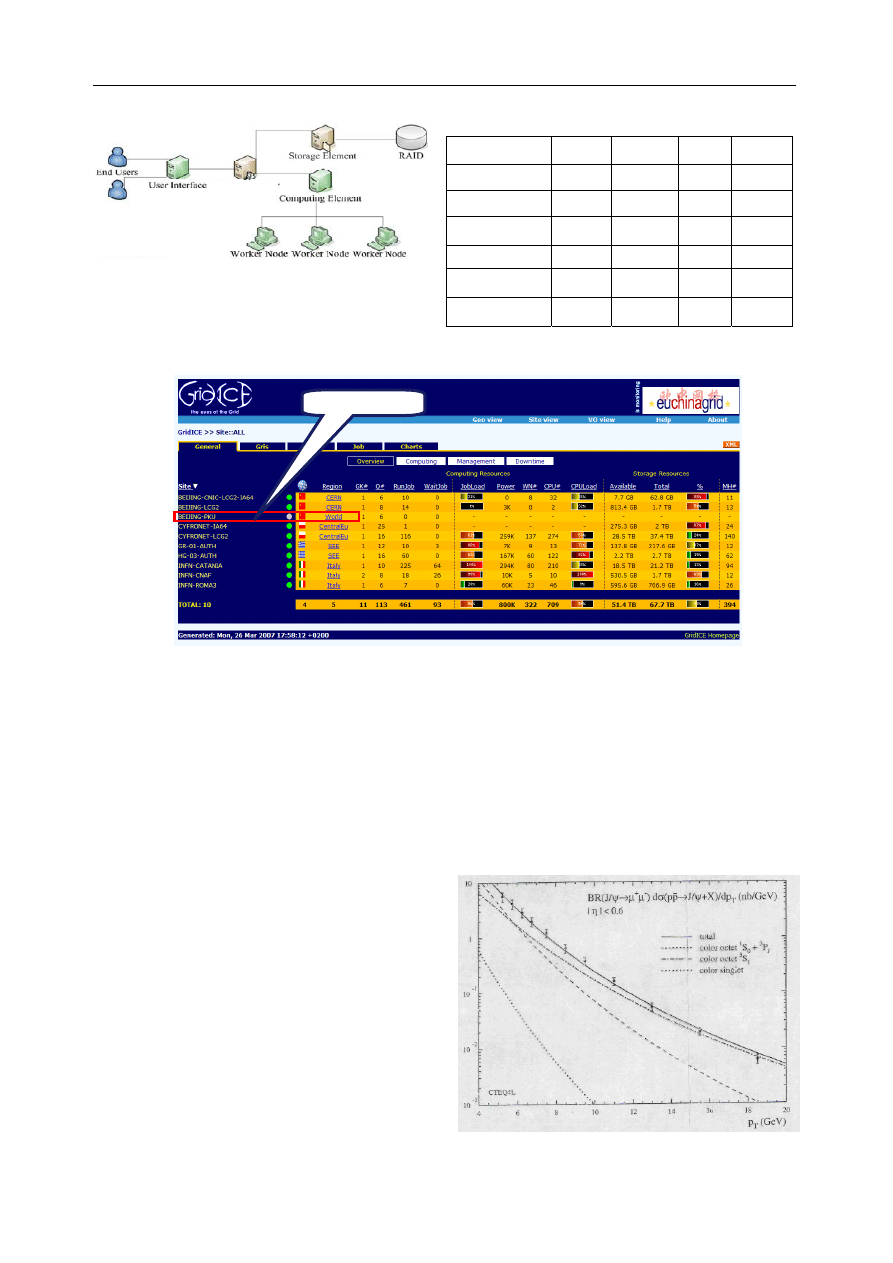
without the help from experts of EUChinaGRID project. Fig.4
shows the layout of the site. The assignment of computer
hosts is listed in Table 2. The site now can be constantly
detected by and shown at the GridICE monitoring system
(Fig.5)
S. Zhu and S. Qian, Grid Computing in Peking University
11
Information
System &
Workload
Management
System
Fig. 4. Topological layout of BEIJING-PKU site
Fig. 4. Topological layout of BEIJING-PKU site
Table 2. The assignment of hosts in BEIJING-PKU site
Table 2. The assignment of hosts in BEIJING-PKU site
Host
Host
Compo-
nents
Compo-
nents
Middleware
version
Middleware
version
system
system
Remark
Remark
grid.$MYDOAIN
UI
gLite3_0_0 SLC308
grid01.$MYDOMAIN
SE+MON gLite3_0_0 SLC308
grid03.$MYDOMAIN
WN1 gLite3_0_0
SLC308
no host
certificate
grid04.$MYDOMAIN
CE+SB gLite3_0_0 SLC308
grid06.$MYDOMAIN
WN gLite3_0_0
SLC308
no host
certificate
grid07.$MYDOMAIN
RB
gLite3_0_0 SLC308
Where $MYDOMAIN=phy.pku.edu.cn SLC=Scientific Linux CERN
BEIJING-PKU
Fig. 5. BEIJING-PKU site is detected by GridICE monitoring system
The site has been tested repeatedly. As a small-scale site,
at this stage we have not installed all components of gLite3
yet, but only some key components which will be helpful for
the robustness and stableness.
4.2. Grid application on HEP in Peking
University and our physics goal
Due to the huge amount of data going to be collected from
LHC which is scheduled to collide the proton beams with the
highest energy in the world in less than 6 months from now,
the PKU physics group must be ready for analysing these
data, not only the real data collected by CMS detector from
the middle of 2008, but also the Monte-Carlo (MC) data (with
the similar amount as the real experimental data) from now
on. The PKU physics group has worked on this application in
following aspects:
• established the BEIJING-PKU site for getting access to
the LCG system;
• used the above system to have analysed a large MC
dataset stored at CNAF in Italy, and have produced some
result;
• provided a configuration file for CMS collaboration in order
to generate at least 1 million prompt J/ψ events.
• has estimated the computer and storage resources
needed to handle these 1 million events.
The physics goal of PKU-CMS group is to use the heavy
Quarkonia (J/ψ or
ϒ) for verifying the Non-Relativistic
Quantum ChromoDynamics (NRQCD). In the past, normally
the p-p colliding beam experimental data can be explained
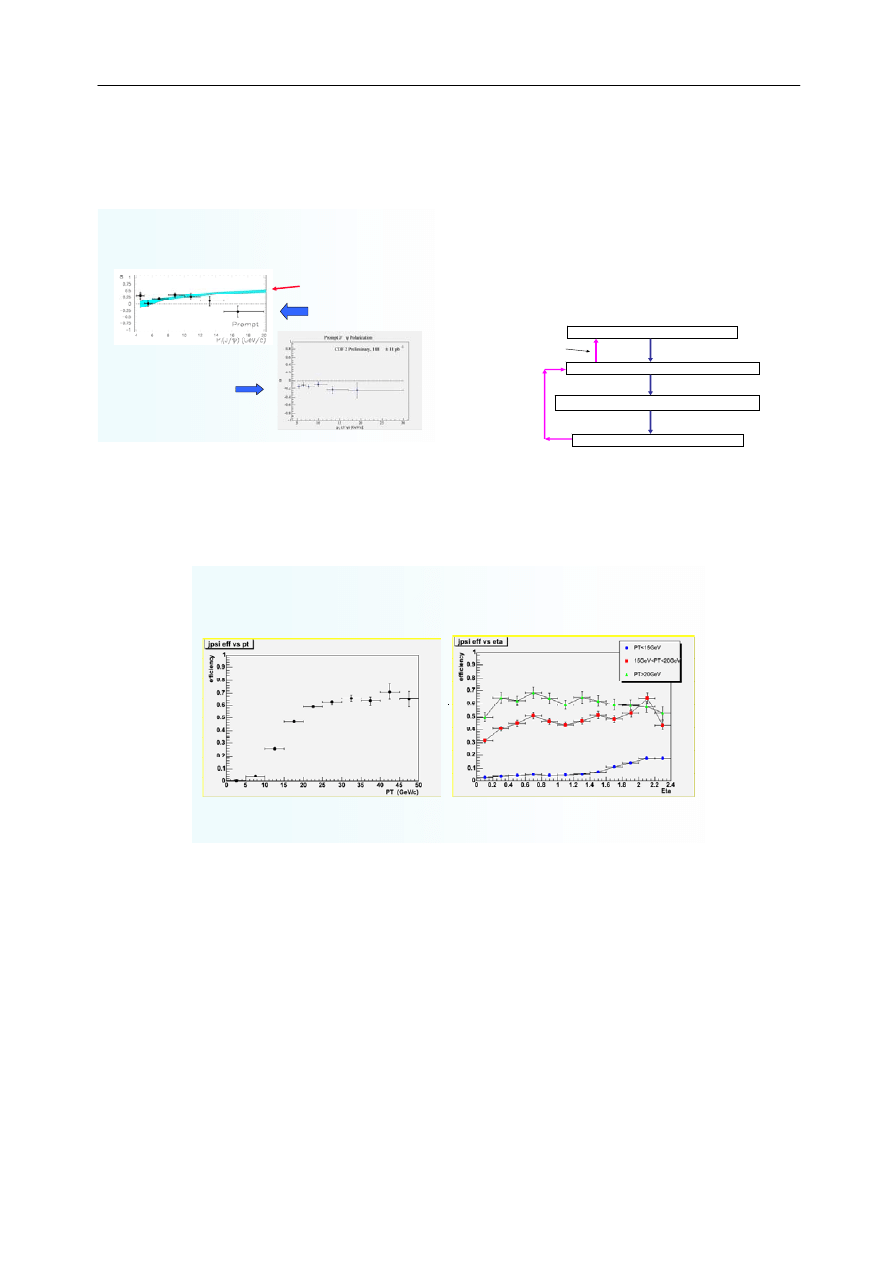
approximately by the Color Singlet Model (CSM) of NRQCD,
but CSM has large discrepancy (Fig. 6) on the high transverse
momenta J/ψ production rate from the CDF experimental data
on Tevatron (a proton-antiproton collider) at Fermilab.
Fig. 6. J/ψ Production rates & NRQCD
S. Zhu and S. Qian, Grid Computing in Peking University
12
In contrast, if a Color Octet Mechanism (COM) is
introduced, CSM + COM together can fit the experimental
data much better. However, when use the COM to predict the
J/polarization, the COM is still not coincide the data from CDF
experiment (Fig. 7)
2
J/
ψ Polarization
NRQCD Still can not fit the CDF data well yet.
CDF RUN 2 results
Phys. Rev. Lett. 85 (2000) 2886
CDF RUN 1 results
NRQCD prediction
Fig. 7. J/ψ Polarization
With LHC’s high luminosity (100 times higher than
Tevatron) and high energy (7 times higher than Tevatron), the
larger statistics of data are hopefully to help to solve the J/ψ
polarization puzzle.
4.3. Result of analysing the large Bs event data
set by using Grid tools
The huge amount (expected in the order of several
PetaBytes per year) of CMS data have been (and are going to
be) distributed at many places around world, We have used
the BEIJING-PKU grid site to submit the jobs for analysing a
large data set stored in Italy (as shown in Fig.4 below)
After analyzing nearly 20,000 events in a Bs Æ J/ψ + φ
event data set (stored in Italy), some results have been
obtained, an example is shown in Fig. 9 below.
PKU’s UI gets
the results from
submit the jobs
IHEP’s RB
run the jobs, send the jobs to CE
return the
results to
IHEP’s RB
give the jobs to WN
UI (User Interface)@PKU, China
RB (Resource Broker)@IHEP, China
CE (Computing Element)@CNAF, Italy
WN (Work Nodes)@CNAF, Italy
Fig. 8. The latest procedure via the IHEP LCG
J/
ψ offline reconstruction eff.
Efficiency vs. PT (both muons’ |eta|<=2.4) Efficiency vs. eta
Fig. 9. The sample result from the physics analysis with the grid tool.
There results have been summarized into a CMS Analysis
Notes [13] which has been approved by CMS at the end of
2006.
4.4. Ongoing work and an estimate of required
resourc
e
The next steps for us are to generate 1 million prompt J/
and 1 million prompt
ϒ events, then to put them through the
CMS full simulation and reconstruction software chain
(CMSSW). We have estimated that,
• for each million events, it needs about 24,000 hours
(or 1000 days) of CPU time (for one P4 Xeon 1.5GHz
computer), and about 1.1 TB of storage space;
• in result, we would need ~2800 days (i.e. ~ 9 years) of
CPU time and ~3.1 TB of storage space for such 2
million J/ψ and
ϒ events plus 40% of background
events
5. Future plan on grid computing in
Peking University
5.1. Application of grid computing on biology
research
The Peking University biology subgroup in EUChinaGRID
is located in the Beijing Nuclear Magnetic Resonance (NMR)
Center which is sponsored by Ministry of Science and
Technology and Ministry of Education of Chinese government,
also by Chinese Academy of Science and Chinese Academy
of Military Medical Sciences. Beijing NMR Center is managed
S. Zhu and S. Qian, Grid Computing in Peking University
13
by Peking University and is a national NMR facility established
on Nov. 4th, 2002. The center is for research and training in
bio-molecular NMR studies. We need to use computer for
processing and analyzing NMR data, for solution structure
calculation, and for molecular dynamic simulation.
The NMR Spectroscopy is a key method for obtaining high
resolution structure in addition to X-ray structure. It is operated
at the physiological temperature and condition which are
closer to native functional state. The structure calculation is
very time consuming for multiple structures and multiple
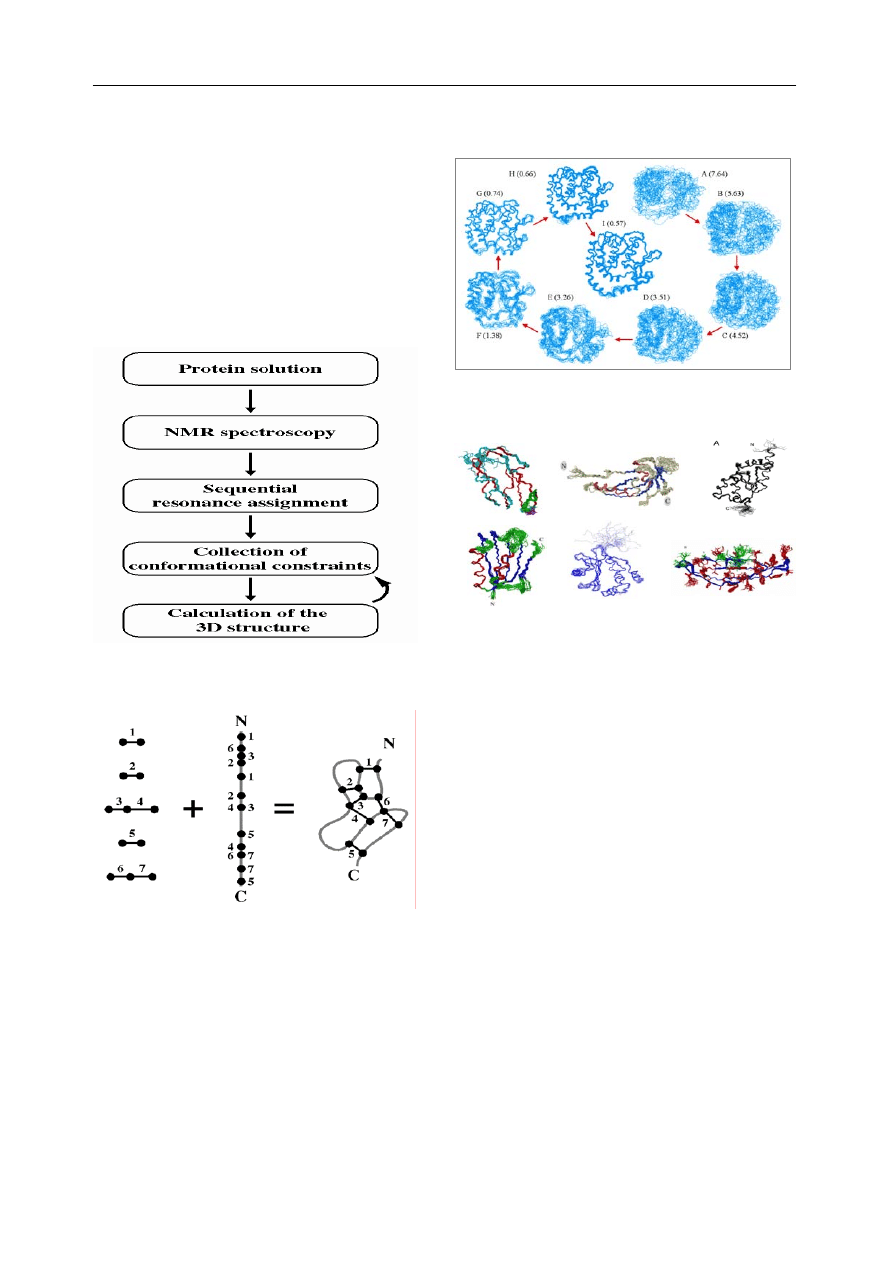
rounds. Fig. 10 is the procedures for calculation of 3D struc-
ture of protein molecules. Fig. 11 is a sketch to show how the
structures are formed from constrains.
Fig. 10. NMR structure determination
Fig. 11. Restrained molecular dynamics and simulated annealing
The structure calculation includes the energy minimiza-
tion. The empirical energy (which is from experimental data)
contains all information about the primary structure of the
protein and also data about topology and bonds in proteins in
general. Fig.12 is an example of structure calculation and
refinement, each round of calculation involves many struc-
tures, normally 200 structures per round, and each protein
may need 10-30 (or more) rounds of calculations. Some
structures calculated recently are shown in Fig.13.
The analysis software for protein structures is “Amber”
which is a commercial software and the licenses need to be
granted on all computers involved. .University Rome III has
procured the license and is testing it, hopefully it can be
available for us to use in near future
Fig. 12. Structure calculation and refinement
Fig. 13. Examples of recent structures being calculated
Similar as the PKU-Physics group, we also estimated the
computing resources needed by PKU-Biology group:
• By using the Intel 2.4 GHz Xeon CPU
• Each structure needs 4 hours, each round to compute 200
structures
• Each protein needs to be computed for 10 rounds
• Totally if 10 proteins to be analyzed
Æ
~ 80,000 hours (> 9 years) CPU time and > 1TB storage
space
5.2. Interoperability between middleware GOS
(of CNGrid) and gLite3 (of EGEE)
At present, the future possible standard of grid protocol
OGSA is just a big frame, without much concrete content yet;
users and designers also have many conflicts. Namely
nowadays there is no any mature grid standard yet. On other
hand, this would be an opportunity for the grid researcher to
make contribution on standardization of grid computing.
However, from a practical application point of view, currently
different grid systems can not easily share the resource yet
due to the different middleware, this is directly contrary to the
purpose of the grid computing, i.e. resource sharing.
CNGrid (China National Grid) has been supported by
Ministry of Science and Technology of Chinese government.
Its objective is to build a Chinese national grid system and to
promote the grid application. On another hand, the gLite
middleware of EGEE is becoming more and more popular is
physics, biology and other scientific applications, with the

S. Zhu and S. Qian, Grid Computing in Peking University
14
increasingly demand on the computing and storage resources,
while the CNGrid seems have some idling resources.
Therefore, the one goal of EUChinaGRID project is to study
the interoperability between two grid middleware (i.e. the GOS
of CNGrid and the gLite of EGEE), wishing that jobs can be
submitted each other between two Grid systems stably. Next
part will give an overview of GOS middleware, and compare it
with gLite.
The GOS middleware is divided into three levels: the
lower one is the Device level; the middle one is the Bus level
which can manage the resource information; the upper one is
the VOE (VEGA Operation Environment) level, which provides
the user support environment, including the basic API and the
management client for grid batch jobs [14].
Generally, there are following evident differences between
GOS and gLite systems.
A) Information system: GOS information services use resour-
ces relying on resource Routers and reveal resource
organizations, as well as information retrieval. But the in-
formation system of gLite is implemented through globus
MDS and RMMA packages, which conform to GLUE
Schema and publish information with LDAP according to
hierarchical structure
B) Security mechanism: gLite manages users with VOs and
ensures the security of grid through CA certificates,
proxies, SSL (Secure Shell). However, GOS grants users
privileges and roles to access grid system with community
rather than VOs.
C) Data management: GOS organizes data with grid catalog
system, while gLite manages data complexly and stably.
D) Workload management system: Interoperability will focus
on this part. gLite uses GRAM protocol to interact with
LCG-CE, and choose Condor-G as GRAM client to submit
batch job to LCG-CE. In contrast, GOS can simply imple-
ment jobs broker.
Interoperability is an important objective of EUChinaGrid
project, a team in Beijing University of Aeronautics and
Astronautics collaborating with a team in INFN/Catania has
got some progress [15]. A special gateway has been designed
with SEDA model and IoC model to change destination of job
submitting; in gLite middleware, for example, jobs will selected
to extend job management system rather than PBS queues.
There are also some breakthroughs in data transfer. The
simple transfer between two systems has been tested with the
sandbox model.
The core of all the designs is the gateway, with which
developers now can implement simple interoperability.
However, there are still many problems to be solved (e.g. the
large jobs still can not be submitted each other yet, the
management of different security systems are badly needed,
etc.) and more collaborators are welcome to take part in the
task.
5.3. Grid portal and promotion of grid
application
From gLite middleware installment and usage of UI we
can easily notice that users have to face complex commands
and the inconvenient operational interface, which the general
users should not waste time to learn. If users can work
conveniently with just buttons or intuitionist orders without
complex operations, the grid computing technology will be
earlier to be promoted. Therefore, the research on grid portal
is significant for grid computing from this sense.
One of goals of the EGEE project is to construct a good
development platform where users can design various appli-
cation programs through some interfaces. With these inter-
faces, we could provide web operations which the user are
familiar with, also through these interfaces we could imple-
ment authentication, submission of jobs and querying infor-
mation, etc. For the clients, it will be more convenient to visit
grid resources without considering the issues like differences
in the operating system, etc. For the administrators, to ma-
nage and to test the grid system may be visualized by using
these interfaces.
Grid portal generally consists of a three-tier structure that
supports (1) the SSL client browser, (2) the Web Application
Server (where the web application is running) and (3) the grid
service layer which includes some services such as file
transfer, job submitting and so on. With this network portal it is
expected to providing secure access, user management,
execution of operation, information publishing and monitoring,
etc.
The GENIUS (Grid Enabled web eNvironment for site
Independent User job Submission) developed by Italian INFN
(Istituto Nazionale di Fisica Nucleare) is a typical Grid portal
with rather rich functionalities. It is a web operational interface
developed based on the kernel components and services of
Globus’ base layer, and it is very suitable to be operated by
the non-professional grid users. The Supercomputing Center
of Chinese Academy of Science also has some successful
experience on the development of this kind of application
program. However, along with the new problems emerged in
the interoperability between different middleware, these
existing portals face some new problems on the aspects of
authorization and authentication, job submission and
information inquiring etc. We wish to develop a more suitable
grid portal with the solutions for the problems from the
interoperability.
6. Conclusion
We have briefly introduced the concepts and great
potentials of Grid computing, which will have attractive vast
prospectives on the applications in biological and medical
science, HEP, geo-science, astronomy and many other fields.
Some middleware of various grid computing projects have
entered the practical application stages, the gLite3
middleware explained in this paper is a typical one.
Peking University group has accumulated some
experience on the grid computing in last few years, But much
more work are needed to be done, for example,
• to start the biology application after the software license
issue is solved;
• to gear up the readiness of HEP application for the huge
amount of MC and real data to pour in when LHC to start
operation in less than a year;
• to participate in the interoperability study for different grid
middleware, etc.
We strongly believe that, with the collaborative effort from
all colleagues in the grid computing field, this promising new
technology will be more mature and will produce more great
application results which were unreachable in the past.

S. Zhu and S. Qian, Grid Computing in Peking University
15
4. https://documents.euchinagrid.org/getfile.py?docid=50&name=E
UChinaGrid-Del3.1v1.7&format=pdf&version=1
Acknowledgment
5. http://press.web.cern.ch/Press/PressReleases/Releases2003/PR
We are very grateful to EUChinaGRID project, the helps
and supports from all partners are essential for our
achievement in last two years. The construction of BEIJING-
PKU site has been a collective effort from all members of PKU
group; we particularly thank the contribution from Ms. K. Kang,
Mr. L. Zhao, D. Mu, Z. Yang, S. Guo and L. Liu. We are
indebted to Prof. B.Xia who provided all materials related to
the biological study. Finally, we appreciate the great help from
Polish colleagues in Jagiellonian University, Medical College –
Cracow on publishing this article.
gridice.cnaf.infn.it:50080/gridice/host/host_summary.php?siteNa
me=BEIJING-PKU
7. http://lcg.web.cern.ch/lcg/overview.html
8. http://www.ncess.ac.uk/learning/start/faq/
9. http://www.euchinagrid.org/
10. http://www.nesc.ac.uk/talks/talks/RobAlan+SteveBoothPresentati
11. https://edms.cern.ch/file/722398//gLite-3-UserGuide.html
12. http://osg-docdb.opensciencegrid.org/0004/000458/001/gLite-
References
13. Z. Yang, S. Qian, “/Psi Æ mu+ mu- reconstruction in CMS”,
CMS Analysis Notes 2006/094 (2006).
14. http://vega.ict.ac.cn/gos/gos11/vega_gos_manual.pdf
1. http://www-03.ibm.com/grid/about_grid/what_is.shtml
2. I. Foster, C. Kesselman (editors). The Grid: Blueprint for a New
Computing Infrastructure, 2nd edition. Morgan Kaufmann (2004)
3. IBM RedBooks: Introduction to grid computing with globus
http://www.redbooks.ibm.com/Redbooks
15.
Yongjian WANG, State-of-the-art of Interoperability Work in
EUChinaGrid Project, Beijing University of Aeronautics and
Astronautics
GRID SYSTEM
COMPUTER SCIENCE


BIO-ALGORITHMS AND MED-SYSTEMS
JOURNAL EDITED BY MEDICAL COLLEGE – JAGIELLONIAN UNIVERSITY
Vol. 3, No. 5, 2007, pp. 17-21
GRID: FROM HEP TO E-INFRASTRUCTURES
F
EDERICO
R
UGGIERI
–
INFN
Abstract: GRID technology has been applied to several scientific applications. High Energy Physics has been one of the
earliest adopters of the GRID approach due to problematic treatment of the huge quantity of data that the Large Hadron
Collider (LHC) at CERN will produce in the next years. GRID Infrastructures, initially set-up by those early users, are now
deployed in large number of countries and Europe is one of the big investors in the field. Several scientific applications are now
available on the GRID which is now recognised as one of the enabling e-Infrastructures technologies. Development of new e-
Infrastructures, especially in new emerging countries, could be relevant as an acceleration factor for the growth of scientific
communities in those countries.
Introduction
GRID is not an acronym and GRID technology is basically
an evolution of concepts like meta-computing and distributed
computing.
The GRID Bible is the famous book: “The GRID: Blueprint for
a new computing infrastructure” [1] edited by Ian Foster and
Carl Kesselman where the first (as far as I know) official
definition of GRID can be found: `A computational grid is a
hardware and software infrastructure that provides
dependable, consistent, pervasive, and inexpensive access to
high-end computational capabilities'.
They also started the first GRID project, Globus [2], which
developed the first "Middleware": the Globus Tool Kit.
Then the GRID was intended as:
a dependable infrastructure that can facilitate the usage of
distributed resources by many groups of distributed persons
or Virtual Organizations;
an extension of the WEB concept, which was originally limited
to distributed access to distributed information and
documents.
The classical example is the Power GRID where you plug in
and receive power; you don’t know (and you don’t care) where
it comes from.
Ian Foster in 2002 suggested [3] that GRID is a system that:
• “coordinates resources that are not subject to centralized
control … (A Grid integrates and coordinates resources
and users that live within different control domains–for
example, the user’s desktop vs. central computing;
different administrative units of the same company; or
different companies; and addresses the issues of security,
policy, payment, membership, and so forth that arise in
these settings. Otherwise, we are dealing with a local
management system.)”
• “… using standard, open, general-purpose protocols and
interfaces… A Grid is built from multi-purpose protocols
and interfaces that address such fundamental issues as
authentication, authorization, resource discovery, and
resource access … omissis… it is important that these
protocols and interfaces be standard and open, otherwise,
we are dealing with an application specific system.”
• “… to deliver nontrivial qualities of service. A Grid allows
its constituent resources to be used in a coordinated
fashion to deliver various qualities of service, relating for
example to response time, throughput, availability, and
security, and/or co-allocation of multiple resource types to
meet complex user demands, so that the utility of the
combined system is significantly greater than that of the
sum of its parts.”
This new and more extensive definition clarifies the main
differences between a GRID and a cluster or a farm of
computers.
My short history in Grids
In the 80' and early 90' the accent was on client-server and
meta-computing; many computing centres were trying to
overcome the limitations (and costs) of single mainframes
using clusters of servers and workstations.
In 1998 I. Foster and C. Kesselman edited their famous book
[1] and I knew about GRID by the first GRID presentation at
CHEP'98 (Computing in High Energy Physics) conference in
Chicago (USA).
My interest was also renovated by my colleague Giovanni
Aloisio who came to Bologna to present in a seminar the
possible use of the Globus Toolkit. It was 1999 and we started
the INFN-GRID Project based on Globus, and in November of
that year in the HEP-CCC Meeting at CERN there was a
discussion with F. Gagliardi (CERN), Georges Metakides and
Thierry Van der Pyl (senior officers from the EC IT
programme), on our major computing challenges related to
the data analysis of the experiments at the Large Hadron
Collider (LHC) [4] and possible new initiatives. My suggestion
to present a proposal to the European Commission (EC)
based on GRID technology was favourably accepted by the
European HEP Community and CERN agreed to lead it.
F. Ruggieri, GRID: from HEP to e-Infrastructures
18
HEP computing is, on the other hand, a typical High
Throughput Computing that allows a very simple or “natural”
parallelization based on the replica of the application program
and the Event based data structure (Figure 2).
In 2000 the UK Particle Physics Grid (GridPP) [5] was
started, and at the CHEP2000 conference in Padova (Italy)
the ideas were already defined. The proposal was accepted
by EC and in the same year started as the first European
GRID Project: DataGRID [4].
At the same time our HEP colleagues in US proposed two
GRID projects PPDG [6] and GriPhyN [7].
Event #1
Event #2
Event #3
Event #4
Event #5
Event #6
CPU 1
CPU 2
CPU 3
CPU 4
Dispatcher
Event #1
Event #2
Event #3
Event #4
Event #5
Event #6
Event #1
Event #2
Event #3
Event #4
Event #5
Event #6
CPU 1
CPU 2
CPU 3
CPU 4
CPU 1
CPU 1
CPU 2
CPU 2
CPU 3
CPU 3
CPU 4
CPU 4
Dispatcher
Dispatcher
DataGRID lasted until 2003 and then a new Grid Infrastructure
activity was approved by the EC: EGEE Project [8], while in
US OSG (Open Science GRID) [9] was started.
Nowadays many other projects in many countries (Japan,
China, etc.) have been started and GRID is now considered
an enabling technology for the emerging e-Infrastructures.
GRID for LHC and HEP
Fig. 2. Event based HEP High Throughtput Computing
We, as HEP community, got involved in Grids in the late
nineties to solve the huge LHC computational problem which
was starting to be investigated (after an initial under-
evaluation).
The basic approach proposed was to distribute the load of
LHC computing in the various laboratories with CERN being
the Data Source and the main repository of such data. The
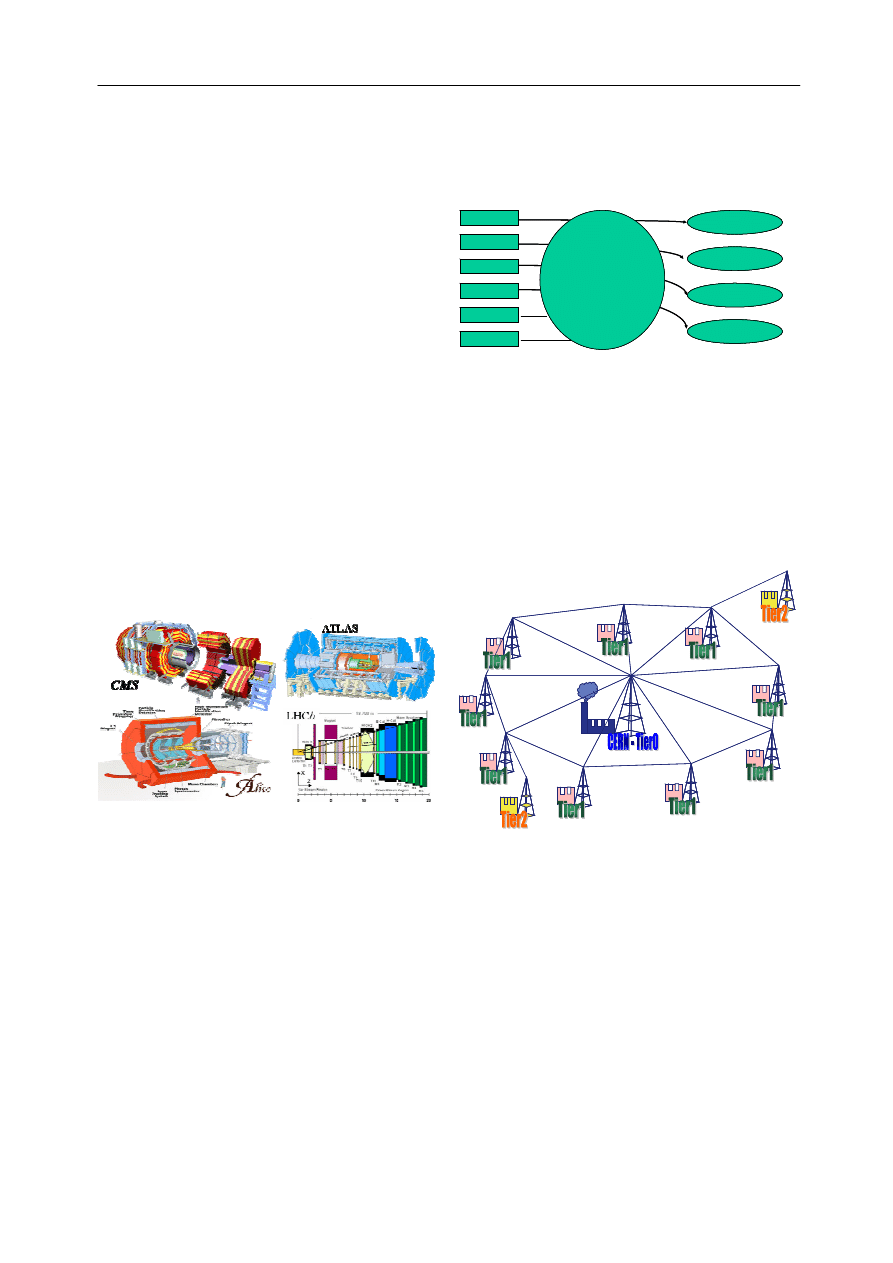
model, proposed by the MONARC Project [12], defined a few
levels or “tiers”, with CERN as a Tier0 and the other Regional
Centres as Tier1 with Tier2 underneath (Figure 3). The GRID
appeared as a natural answer to those requirements.
At that time, client-server and meta-computing were the
frontier and first implementations of Computer Farms were
appearing (Beowulf [10]). The largest problem anyway was
the huge amount of data expected to be produced and
analyzed (tens of PetaBytes).
Fig. 1. The four Experiments of LHC
Fig. 3. Tier Structure of LHC Grid
The “social” challenge was to allow thousands of
physicists to access those data easily from tens of countries in
different continents. It was also clear that even taking into
account the Moore's Law for the Computing power evolution,
the CERN budget traditionally dedicated to Computing
resources was largely insufficient. There was no obvious
solution on the market and such a worldwide enterprise
requested new approaches.
GRID Architecture
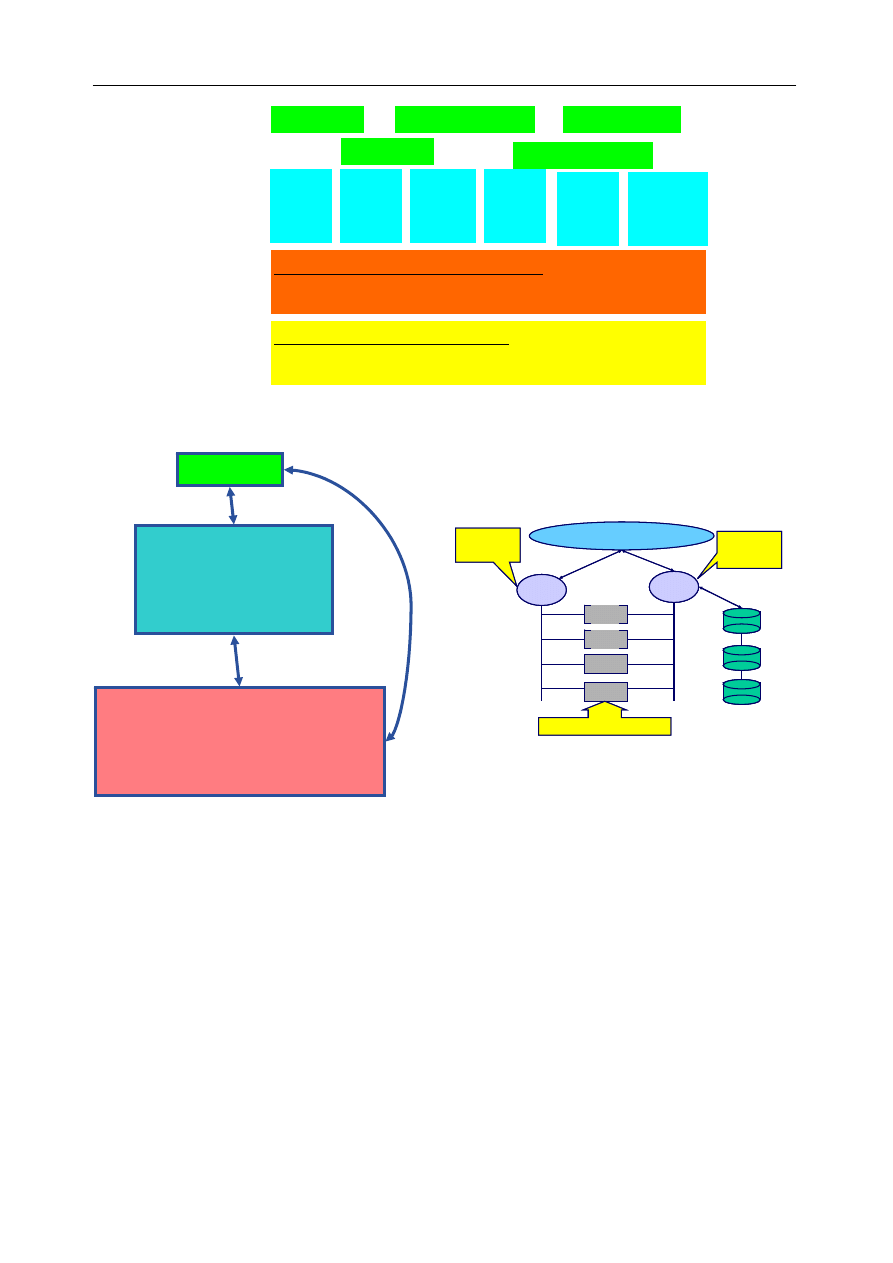
DataGRID suggested a layered Architecture for the GRID
and the four foreseen layers were half application related and
half Grid Hardware and Software related.
The basic GRID services implemented in software are
normally referred as middleware. The hardware and software
configuration is still very similar to that first architectural view
(Figure 4).
Several “new” technologies were proposed like Object
Oriented (OO) Programming and OO DataBases, and several
Research and Development projects proposed to solve it.
F. Ruggieri, GRID: from HEP to e-Infrastructures
19
Resource-specific implementations of basic services
E.g., Transport protocols, name servers, differentiated services, CPU schedulers, public key
infrastructure, site accounting, directory service, OS bypass
Resource-independent and application-independent services
authentication, authorization, resource location, resource allocation, events, accounting,
remote data access, information, policy, fault detection
Distributed
Computing
Toolkit
Grid Fabric
(Resources)
Grid Services
(Middleware)
Application
Toolkits
Data-
Intensive
Applications
Toolkit
Collaborative
Applications
Toolkit
Remote
Visualization
Applications
Toolkit
Problem
Solving
Applications
Toolkit
Remote
Instrumentation
Applications
Toolkit
Applications
Chemistry
Biology
Cosmology
High Energy Physics
Environment
Resource-specific implementations of basic services
E.g., Transport protocols, name servers, differentiated services, CPU schedulers, public key
infrastructure, site accounting, directory service, OS bypass
Resource-independent and application-independent services
authentication, authorization, resource location, resource allocation, events, accounting,
remote data access, information, policy, fault detection
Distributed
Computing
Toolkit
Grid Fabric
(Resources)
Grid Services
(Middleware)
Application
Toolkits
Data-
Intensive
Applications
Toolkit
Collaborative
Applications
Toolkit
Remote
Visualization
Applications
Toolkit
Problem
Solving
Applications
Toolkit
Remote
Instrumentation
Applications
Toolkit
Applications
Chemistry
Biology
Cosmology
High Energy Physics
Environment
Fig. 4. EU-DataGRID Architecture (2001)
Fig. 5. EGEE Middleware Layered structure
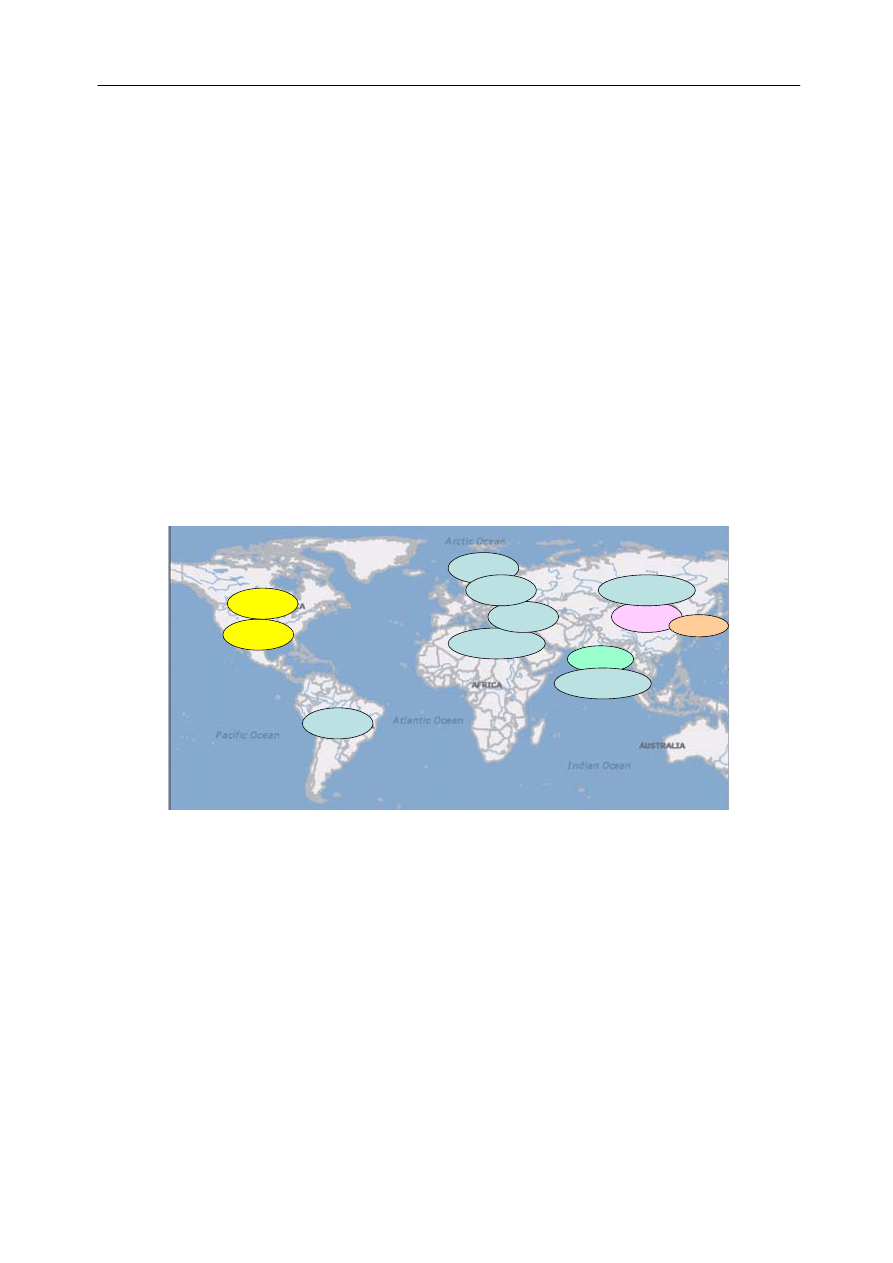
Computing GRID basic components
A very simple description of the Computing GRID
hardware building blocks can be schematically presented as
follows:
• computing resource or Computing Element (CE);
• storage resource or Storage Element (SE).
Those components shown in Figure 5 will be described in
the following paragraphs.
Computing Element
The Computing Element (CE) is the basic component of
the Computing Resources, it essentially corresponds to a
Batch Queue that processes the jobs submitted by the users.
Behind a CE there can be tens or hundreds or even
thousands of real computing machines or CPU (Central
Processing Unit). Those servers are organized in a cluster or
a farm of computers and the batch scheduler assigns to them
the jobs to be executed, just like in a farm cows in a row
produce milk or chickens make eggs.
WN
WN
WN
WN
CE
SE
Wide Area Network
Computing
Element
Storage
Element
Worker Nodes
WN
WN
WN
WN
WN
WN
WN
WN
WN
WN
WN
WN
CE
CE
SE
SE
Wide Area Network
Computing
Element
Storage
Element
Worker Nodes
Fig. 6. A CE and a SE made by a Computer Farm and a set of
Disks
Storage Element
The Storage Element (SE) is a system that allows the
storage of data and programs in the Grid. The hardware
architecture of such a storage is not relevant, provided that
the service is accessible via Grid tools, like GridFTP [13], for
data transfer, which allow storage and retrieval of data in the
Grid.
Grid Services
The list of Grid services developed on top of the basic
components is quite long. The main services currently used
are the following:
• Workload Management System (Resource Broker)
[14] chooses the best resources matching the user
requirements.
• Virtual Organization Management System (VOMS)
[15] allows to map User Certificates with Virtual
Organizations (VO) [16] describing rights and roles of
the users.
Foundation Grid Middleware
Security model and infrastructure
Computing (CE) and Storage Elements (SE)
Accounting
Information and Monitoring
Higher-Level Grid Services
Workload Management
Replica Management
Visualization
...
Applications
F. Ruggieri, GRID: from HEP to e-Infrastructures
20
• Data Oriented Services: Data & Meta-data Catalogs,
Data Mover, Replica Manager, etc.
• Information & Monitoring Services which allow to know
which resources and services are available and
where: GridICE [17].
• Accounting services to extract resource usage level
related to users or group of users and VOs.
Social impact of Grid Infrastructures
The Grids are considered as part of a more general specie
called e-Infrastructures which include also communication
networks. They support wide geographically distributed
communities and then enhance international collaboration of
scientists. The deployment and usage of such resources is
also promoting collaboration in other fields where we speak of
e-Business, e-Government and industrial take up.
One of the ways the Research and Education Grids and
networks make an impact on the society is that they allow the
access of many researchers to scientific resources,
laboratories and data, distributed around the world.
Researchers from developing countries will have less need to
travel and leave their home countries to participate into big
science and frontier scientific activities and then the so called
brain drain can be reduced.
Another important aspect is that the e-Infrastructures
promote the usage of network connectivity, computing
resources and open source software stimulating not only the
scientific activity, but also the technical development of
communities in the countries contributing to fight the digital
divide.
Grid Infrastructures around the world
A large number of projects around the world are currently
deploying Grid infrastructures or have already reached
production quality level. Large Grid Infrastructures are already
used in China (CNGrid [18] , ChinaGrid [19]), Europe (EGEE
[9]), Japan (NAREGI ) and United States (OSG, Teragrid) and
many National Grid Initiatives (NGI) were created to support
Grid Infrastructures at national level.
The European Commission has largely invested in Grids
trough the projects funded in the past Framework Programs
(FP5 and FP6) and is currently planning to invest even more
in FP7 (2007-2013).
CNGrid
NAREGI
GARUDA
EUChinaGRID
EELA
OSG
TeraGrid
EUMEDGRID
SEE-GRID
BalticGrid
EGEE
EU-IndiaGrid
CNGrid
NAREGI
GARUDA
EUChinaGRID
EELA
OSG
TeraGrid
EUMEDGRID
SEE-GRID
BalticGrid
EGEE
EU-IndiaGrid
Fig. 7. Grid infrastructures around the world
Conclusions
As it was discussed in the previous paragraphs, Grids are
part of the concept of e-Infrastructures, together with
communication networks they provide the necessary layers of
communication and collaboration tools needed by modern
scientists.
Grids can not only optimize the usage of resources, but
increase their usability and accessibility being a valid
instrument for cooperation in Science and Education fostering
the creation of a Human Network among scientists and
researchers.
e-Infrastructures are fundamental for long term development
and can play a role to mitigate phenomena like: the Digital
Divide and the Brain Drain.
References
1. “The GRID: Blueprint for a new computing infrastructure” edited
by Ian Foster and Carl Kesselman, Morgan Kaufman 1998.
2. Globus Project: http://www.globus.org/
3. What is the Grid? A Three Point Checklist. I. Foster,
GRIDToday, July 20, 2002.
4. Large Hadron Collider: http://lhc.web.cern.ch/lhc/
5. EU DataGRID Project: http://eu-datagrid.web.cern.ch/eu-
datagrid/
6. GridPP project: http://www.gridpp.ac.uk/
7. Particle Physics Data Grid: http://www.ppdg.net/
8. GRIPHYN: http://www.griphyn.org/
9. Enabling Grids for E-sciencE: http://www.eu-egee.org/
10. Open Science Grid: http://www.opensciencegrid.org/
11. Beowulf Project: http://www.beowulf.org/overview/index.html
12. MONARC Project: http://monarc.web.cern.ch/MONARC/
13. GridFtp: http://www.globus.org/grid_software/data/gridftp.php

F. Ruggieri, GRID: from HEP to e-Infrastructures
21
14. WMS: http://egee-jra1-wm.mi.infn.it/egee-jra1-wm/wms.shtml
15. VOMS: http://infnforge.cnaf.infn.it/voms/
16. Virtual Organization:
http://en.wikipedia.org/wiki/Virtual_organization
17. GridIce: http://gridice.forge.cnaf.infn.it/
18. CNGrid: http://www.cngrid.org/en_introduce.htm
19. ChinaGrid: www.chinagrid.edu.cn/
20. NAREGI: http://www.naregi.org/index_e.html
21. OSG: http://www.opensciencegrid.org/
22. Teragrid: http://www.teragrid.org/
23. FP7 – Cordis Web site:
http://cordis.europa.eu/fp7/home_en.html
GRID SYSTEM
COMPUTER SCIENCE


BIO-ALGORITHMS AND MED-SYSTEMS
JOURNAL EDITED BY MEDICAL COLLEGE – JAGIELLONIAN UNIVERSITY
Vol. 3, No. 5, 2007, pp. 23-25
GRID INFRASTRUCTURES AS CATALYSTS FOR DEVELOPMENT ON
ESCIENCE: EXPERIENCES IN THE MEDITERRANEAN
G
IUSEPPE
A
NDRONICO
*
,
R
OBERTO
B
ARBERA
**
,
K
OSTAS
K
OUMANTAROS
***
,
F
EDERICO
R
UGGIERI
****
,
F
EDERICA
T
ANLONGO
*****
,
K
EVIN
V
ELLA
******
*
INFN Sezione di Catania, Via S. Sofia, Catania, I-95123, Italy; giuseppe.andronico@ct.infn.it
**
University of Catania and INFN Sezione di Catania, Via S. Sofia, Catania, I-95123, Italy;
***
GRNET, Mesogion Avenue 56, Athens, 11527, Greece; kkoum@grnet.gr
****
INFN Sezione di Roma Tre, Via della Vasca Navale 84, Roma, I-00146, Italy;
federico.ruggieri@roma3.infn.it
*****
GARR, Via dei Tizii 6, Roma, I-00185, Italy; federica.tanlongo@garr.it
******
University of Malta, Msida Campus, Msida, MSD06, Malta; kevin.vella@um.edu.mt
Abstract: The digital gap prevents today in many parts of the world the diffusion of e-Science which is considered as one of
the key enablers of progress and development in the 21st Century. On the other hand, investing in e-Infrastructures is the key
for a long-term growth and changes in the Society in developing Countries. The paper discusses this topic and provides some
details about the EUMEDGRID Project experience in the Mediterranean area.
Keywords: Digital Divide, e-Infrastructure, e-Science, Grids, Information Technology, Mediterranean
In the last few years, the scenario of international
collaboration in Research and beyond has swiftly evolved with
the gradual but impressive deployment of large bandwidth
networks. A number of advanced services and applications
have been using these networks, enabling new ways of
remote collaboration. The environment resulting from the
integration of networking and other resources, such as
computing, storage, instruments and related systems is also
known as e-Infrastructure. In the most advanced economies,
knowledge is nowadays one of the major elements of
progress and economic welfare and e-Infrastructures are, in
turn, one of the major enablers of development in a
knowledge economy.
On the other hand, this menaces to widen the digital gap
between developing economies and the most advanced ones,
where knowledge is a commodity and an important share of
the budget of companies and governments is allocated on
R&D and on Education: the latter gets, as a return of their
conspicuous investments, more and more advanced
infrastructures and techniques that enable in turn new
developments, while the former, taken off late and with less
resources and urged by more fundamental needs, seem
incapable to reduce the gap.
At a first glance, to invest the limited budget of a
developing country in building e-Infrastructures could seem
unnatural, foolish as they have much more basic and
compelling needs. Nevertheless, it is important to understand
the role of e-Infrastructures in breaking this loop. In a saying:
“if you give a fish to a hungry man you feed him for a while,
but if teach him how to fish, you feed him for a life.”
Although needs such as food, water, medical services are
fundamental in the short term, a long-term solution cannot
build just upon them: other activities are necessary to create
favourable conditions for a sustainable growth. Agriculture and
industry developments are needed to produce food and
employment depending on the specific local situation, start
social innovation and improve the quality of life, and science is
at the basis of long-term innovation in both of them. Digital
infrastructures are necessary to allow researches to
participate to frontier scientific activities, to share
competences and experiences with their counterparts all
around the world, thus being up with the most recent tools and
methods.
This kind of investment should be therefore understood
and evaluated on several (tens of) years and should have a
“figure of merit” with respect to the obtained results and the
sustainability of future activities.
One of the most significant news in the outline of global e-
Infrastructures is the so-called “grid paradigm”, a revolutionary
distributed environment for sharing computing and storage
resources, allowing new methods of global collaborative
research - often referred to as e-Science. This new paradigm,
although still under development, is foreseen to have a large

G. Andronico et al., GRID infrastructures as catalzsts for development on escience:experiences...
24
impact well beyond the field of mere research: the national
and international initiatives developed to date are making the
"World Wide Grid" and its applications one of the major global
R&D topics of the century.
Grids are a set of services over the Internet, allowing
geographycally dispersed users to share computer power,
data storage capacity and remote instrumentation. The basic
concept of this new technology as well as its revolutionary
potential are in the very world “grid”, usually meaning the
electric distribution system in English: electric power is indeed
distributed to final users who are not aware how and where it
was produced, nor they need to use it: with grid computing, it
is just the same for remote resources.
Grid computing is in fact a particular example of distri-
buted computing based on the idea to share resources on a
global scale. Several elements are needed for a grid infra-
structure to work:
• An Authentication and Authorization system, providing
secure access to resources, to guarantee data privacy
and integrity (a critical factor in several application
fields such as biomedicine);
• A mechanism (the so-called middleware) able to
manage and allocate resources in an optimal way to all
users and applications who need them, just like the
Operative System does with programs running on your
PC;
• A reliable, high-performance network connection
amongst resources, ensuring that the time taken for
data transfer is negligible in comparison with the bene-
fit of quicker processing obtained thanks to distributed
computing.
First Grids were developed in the framework of the so-
called e-Science, an innovative approach to research, thanks
to the use of advanced technologies of communication and
regardless to geographical location of instruments, resources
and last but not least, brains.
The expectation that Grids will become very soon a com-
modity service, thus producing deep changes not only in
Science, but industry and the Society at large, is a common
belief amongst ICT experts. Accordingly, the European Com-
mission, several national programmes and large private com-
panies are investing in R&D projects since 2001, thus funding
the creation of pilot Grid implementations and collaborative
models for the usage of computing and data resources across
technological, administrative and national domains.
Although experts believe that, within the next two
decades, Grids will have an impact comparable to that of the
WWW, at the present time (further analogy with the WWW)
the development of Grids is, for the most part, in the hands of
the worldwide scientific community. Scientists are exploiting
the new technology to solve ever-more-difficult computational
and data management problems across a wide range of
domains.
OECD (Organisation for Economic Co-operation and
Development) recognized the importance of Grids since 2004,
when the GSF approved a proposal to convene a workshop
on Grids and Basic Research Programmes. This workshop,
held in Sidney on 25-27 September 2005, highlighted the
potential benefits for developing countries:
“Grids can provide access to vast scientific and computing
resources with only a modest investment in a local
infrastructure (a minimal useful installation would consist
of an Internet-linked high-performance workstation). The
potential benefits to developing countries are
considerable, since scientists would be able to join
international collaborations based on their potential
intellectual contributions alone. Thus, for example, it is
already foreseen that elementary particle physicists in
developing countries will be able to fully participate in the
operation and exploitation of the Large Hadron Collider
experiments at CERN (which is scheduled to begin
operations in 2007). After it is completed in 2007, the
LHC will generate 15 petabytes of data per annum 8,
servicing 5000 research scientists in 500 research
organisations or universities around the world. Such
global-scale collaboration among researchers will be
enabled by the Grid. Similar collaboration opportunities
are emerging in other data-intensive domains such as
astronomy, bioinformatics, the earth sciences and the
social sciences.”
One of the recommendations from the workshop focused
on facilitating the access to this technology to scientists from
emerging countries:
“Consideration should be given to the creation of new
mechanisms (or the strengthening of existing ones) to
facilitate access to Grids for researchers and research
organisations in developing countries, plus other
appropriate measures to broaden international
participation in Grid projects. Telecommunications
policies and regulations could be reviewed and, if
appropriate, modified to facilitate access to high-speed
computer networks in developing countries.”
In line with this vision, in the context of the last EU
Framework Programme for Research and Technological de-
velopment (FP6), several projects aiming to extend the Euro-
pean flagship Grid infrastructure EGEE [1], outside the
boundaries of EU were funded and launched, such as
SEEGRID (addressing South-East Europe) [2], EELA (Latin
America) [3], BALTIC-GRID (Baltic Region) [4] and
EUMEDGRID (Mediterranean countries) [5], while others
focused on interoperating such infrastructures with the ones
existing in other regions of the world, such as EUChinaGRID
(addressing the interoperability of Grids between Europe and
China) and EU-IndiaGrid (addressing the same issue between
Europe and India).
These experiences have proved to be very useful in order
to speed-up the process of adoption of this new technology
within the scientific communities of the beneficiary Regions.
But from experiences such as the SEE-GRID and
EUMEDGRID ones, we are learning that there is something
more, and perhaps more important, than the mere adoption of
a new technology developed by someone else. Indeed, it
appears that the grid paradigm is especially useful for those
countries that have scarce, often scattered in a wide territory,
IT resources at their disposal. The implementation and

G. Andronico et al., GRID infrastructures as catalzsts for development on escience:experiences...
25
coordination of a grid infrastructure at a national (or larger)
level can be regarded, especially in developing countries, as
an opportunity to optimize the usage of existing, limited
storage and computing resources and to enhance their
accessibility for all research groups.
Many research fields have indeed very demanding needs
in term of computing power and storage capacity, which nor-
mally are provided by large computing systems or supercom-
puting centres. Furthermore, sophisticated instruments may
be needed to perform specific studies. Such resources pose
different problems to developing economies: they are expen-
sive, they need to be geographically situated in a specific
place and – this is the case especially for those countries
where the larger part of researcher is forced to emigrate in
richer countries to continue their work in research – they could
not reach a critical mass of users, because, for example, they
are very specific and interest only a small community of re-
searchers, or small communities scattered across the country.
Thanks to the creation of a virtual distributed environment, all
these drawbacks can be overcome. Through an appropriate
access policy, different user groups can use resources wher-
ever disperse according to their availability. Furthermore,
geographically dispersed communities working at the same
problem can collaborate in real time on the same study or
experiment, thus optimizing not only hardwar
e and software
resources, but also human effort and “brains”.
Countries to adopt the Grid paradigm for the benefits of their
References
GRID SYSTEM
E-SCIENCE
This paper aims to present the experience of the
EUMEDGRID project and the achievements reached during
the first year of activity towards bringing the Mediterranean
http://www.see-grid.or
2.
3.
4.
htp://www.eu-eela.org
5. http://www.eumedgrid.eu


BIO-ALGORITHMS AND MED-SYSTEMS
JOURNAL EDITED BY MEDICAL COLLEGE – JAGIELLONIAN UNIVERSITY
Vol. 3, No. 5, 2007, pp. 27-31
RANDOMBLAST A TOOL TO GENERATE RANDOM “NEVER BORN
PROTEIN” SEQUENCES
G
IUSEPPE
E
VANGELISTA
,
G
IOVANNI
M
INERVINI
,
P
IER
L
UIGI
L
UISI
,
F
ABIO
P
OLTICELLI
*
Department of Biology, University Roma Tre, 00146 Rome, Italy;
*
Running title:
RANDOM NBP SEQUENCES GENERATION
Abstract: In an accompanying paper by Minervini et al., we deal with the scientific problem of studying the sequence to
structure relationships in “never born proteins” (NBPs), i.e. protein sequences which have never been observed in nature.
The study of the structural and functional properties of "never born proteins" requires the generation of a large library of
protein sequences characterized by the absence of any significant similarity with all the known protein sequences. In this
paper we describe the implementation of a simple command-line software utility used to generate random amino acid
sequences and to filter them against the NCBI non redundant protein database, using as a threshold the value of the Evalue
parameter returned by the well known sequence comparison software Blast. This utility, named RandomBlast, has been
written using C programming language for Windows operating systems. The structural implications of NBPs random amino
acid composition are discussed as compared to natural proteins of comparable length.
Introduction
The number of proteins that can be obtained combining
the 20 natural amino acids is astronomically large (100
20
for
proteins just 100 residues long) and thus natural proteins
represent only an infinitesimal fraction of the protein
sequences space. From this simple consideration arises the
concept of “never born proteins” (NBPs), i.e. protein
sequences which have never been exploited by nature [1]. In
the accompanying paper by Minervini et al., we describe a
computational approach undertaken for the study of the
sequence/structure relationships in NBPs using a grid imple-
mentation of the well known Rosetta protein structure predi-
ction software [2]. The final aim of this study is that of
answering the question if natural protein sequences were
selected during molecular evolution because they have unique
physico-chemical properties or else they just represent a
contingent subset of all the possible proteins with a stable and
well defined fold [1]. If the latter hypothesis was true, this
would mean that the protein realm could be exploited to
search for novel folds and functions of potential
biotechnological and/or biomedical interest. To be able to
approach this problem and to obtain statistically significant
results it is essential to analyse a large library of protein
sequences (at least 10
5
to 10
7
) which do not display any
significant homology with natural proteins. In other words, it is
necessary to sample the protein sequences space in different
points far away enough from the ensemble of natural proteins.
In this context, a reasonable approach is that of generating
random amino acid sequences and to compare them to the
known natural proteins in order to eliminate from the sample
under study those protein sequences which display statisti-
cally significant similarity with natural proteins. A collection of
all the known natural protein sequences is represented by the
National Center for Biotechnological Information non redun-
dant protein sequence database [3], hereafter named NR
database. Among the available tools to determine if a given
query amino acid sequence displays significant similarity with
any known natural protein, the Blast software [4], which
stands for Basic Local Alignment Search Tool, is one of the
most used in the computational biology community. Blast finds
regions of local similarity between sequences and can be
used to compare nucleotide or protein sequences to sequence
databases, calculating the statistical significance of matches
[5]. A parameter used by Blast to evaluate the statistical
significance of a match is the Expect value (or Evalue). This is
a parameter that describes the number of hits one can
"expect" to find by chance for a database of a given size. The
Evalue is related to the score S that is assigned to a match
between two sequences, to the lengths m and n of the
sequences and to the parameters K and λ (natural scales for
the search space size and the scoring system respectively [5])
by the equation:
Evalue = Kmn e
-λS
The Evalue parameter can be used as a threshold to
distinguish significant from non-significant matches. If the
statistical significance of a match is greater than the Evalue
threshold, the match is not considered significant, or the query
sequence is not considered to display significant similarity to
any protein present in the database.
In this paper we describe the implementation of a software
utility used to generate NBP sequences, or in other words,
random amino acid sequences with no significant similarity
with known natural proteins present in the NR database, as
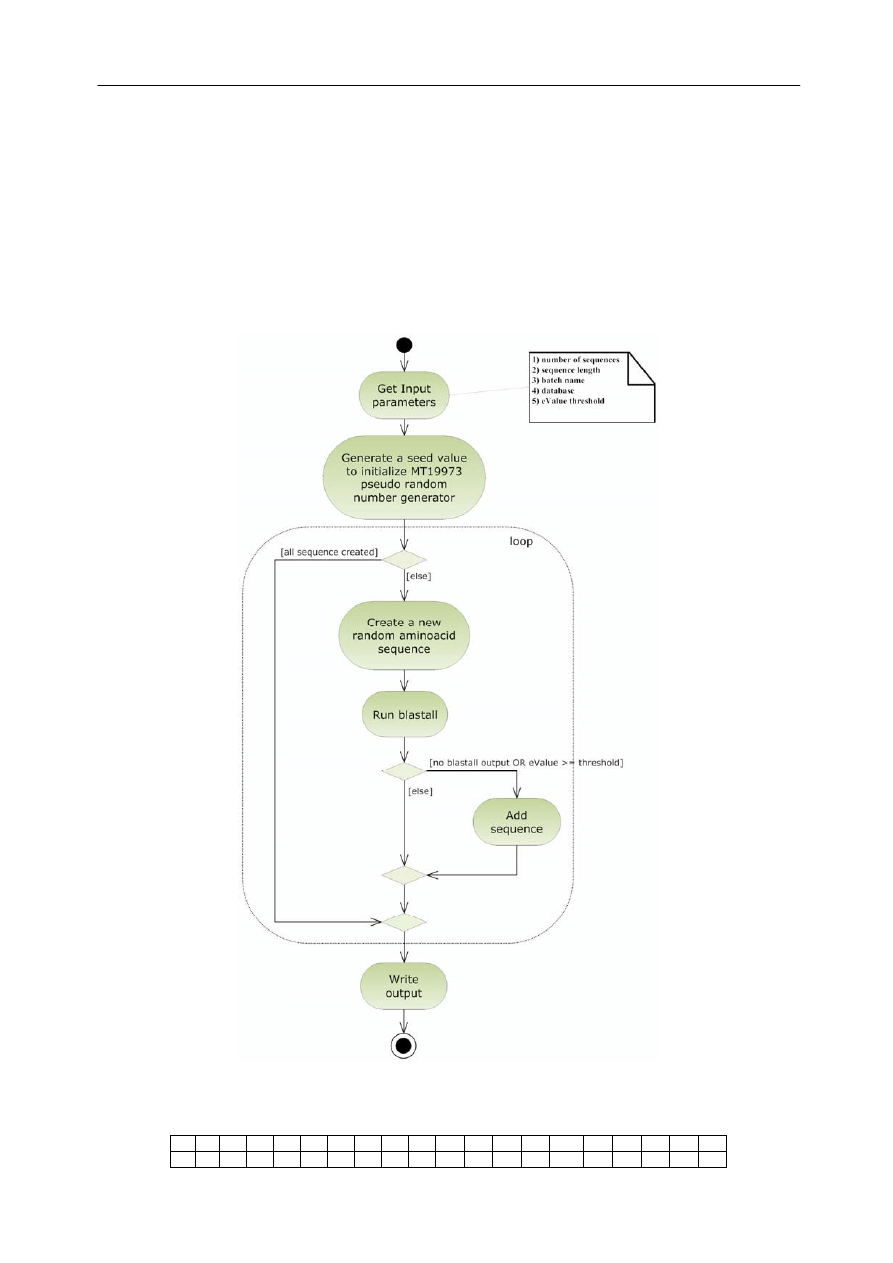
G. Evangelista et al., RandomBlast a tool to generate random “never born protein: seguences
28
evaluated by the Evalue parameter returned by Blast. Average
amino acid composition of a restricted NBP database (2×10
4
sequences) is analysed in comparison to that of natural
proteins and discussed in terms of its possible influence on
the structural properties of NBPs.
Results
Software description
RandomBlast consists of two main modules: a pseudo
random sequence generation module and a Blast software
interface module. A high level description of RandomBlast
workflow is shown in figure 1 using an activity diagram. The
first module uses the Mersenne Twister 1973 pseudo-random
number generation algorithm [6] to generate pseudo-random
numbers between 0 and 19. A free implementation of this
algorithm, available in C programming language from
Matsumoto and Nishimura [7], was used in RandomBlast.
Random numbers are then translated in single character
amino acid code using the conversion table shown in Table 1.
Single amino acids are then concatenated to reach the
sequence length specified by the user in the input parameters.
Fig. 1. Activity diagram showing the RandomBlast workflow. The inset details the RandomBlast input parameters.
Table 1. RandomBlast random number to amino acid type conversion table
0 1 2 3 4 5 6 7 8 9 10 11 12 13 14 15 16 17 18 19
G A V L I C M F W P S T Y N Q D E K R H
G. Evangelista et al., RandomBlast a tool to generate random “never born protein: seguences
29
Each generated sequence is then given in input to the
second RandomBlast module, an interface to the Blast blastall
program which invokes the following command:
blastall -m 8 -p blastp -d database -b 1;
where database in our case stands for the NR database, and
the parameters –m 8 and –b 1 indicate the alignment format
(tabular form) and the number of sequences to be returned
(just the first hit), respectively. Blastall output is then retrieved
by RandomBlast and the Evalue extracted from it. If the
Evalue is greater than or equals the threshold chosen by the
user, the sequence is valid and is added to the output log file.
Note that in our case we regard as valid only the sequences
that do not display significant similarity to any protein
sequence present in the database, so that, contrary to the
normal Blast usage, valid sequences are those displaying an
Evalue higher than the threshold. When the number of valid
sequences is equal to the number of sequences to be
generated, specified by the user, the program execution is
terminated and a log file, containing all the information about
input parameters and some information concerning the
sequences, is created. An example of this output log file is
shown in figure 2.
Fig. 2. RandomBlast sample output log file
The program is invoked using the following command:
randomBlast <numberOfSequences> <sequenceSize>
<batchName> <dbName> <threshold>;
so that the user can decide the total number of sequences
that will form a single batch, the size of each sequence (in our
case 70 amino acids), the name of the batch (that will
unequivocally identify the sequences), the name of the
database against which to execute the Blast search (in our
case the NR database) and the Evalue threshold (as already
mentioned, 1 in our case).
The RandomBlast utility has been written in C
programming language and it’s available, upon request to the
authors, for Windows operating systems.
Analysis of a restricted NBP database
generated using RandomBlast
Comparison between the average amino acid composition
of natural proteins (NPs) and that of a restricted database of
NBPs generated using RandomBlast (2×10
4
amino acid
sequences) reveals several interesting differences (Figure 3).
In fact, as expected for random sequences, in NBPs all the
twenty amino acids are almost equally represented. On the
contrary, in NPs some amino acids classes are largely
overepresented (Table 2). In NPs aliphatic amino acids
account for almost 42% of the total (as compared to 30% in
NBPs), while aromatic amino acids make up just 8% of the
total (as compared to 15% in NBPs). This can have important
implications for the ability of NBPs to fold in a stable and well
defined three-dimensional structure. For instance, the nearly
10% relative abundance of Leu in NPs as opposed to the 1%
abundance of Trp (Figure 3) can be connected to the ability of
branched aliphatic sidechains to easily “adapt” within a protein
hydrophobic core as compared to the bulky and rigid Trp
aromatic sidechain. Along the same line of considerations, the
1.5% abundance of Cys residues in NPs is likely connected to
the high reactivity of this amino acid which can result in
structure stabilization by disulphides formation but also in
uncorrect Cys pairing and misfolding.
Table 2. Percentage amino acid composition of NPs and NBPs by
amino acid classes*
NPs NBPs
Hydrophobic 49.99
44.93
Aliphatic 41.90 29.94
Aromatic 8.09 14.99
Polar 24.24
29.96
Basic 13.64
15.01
Acid 12.01
9.99
* Cys and Met have been included in the amino acids class “polar”
for simplicity
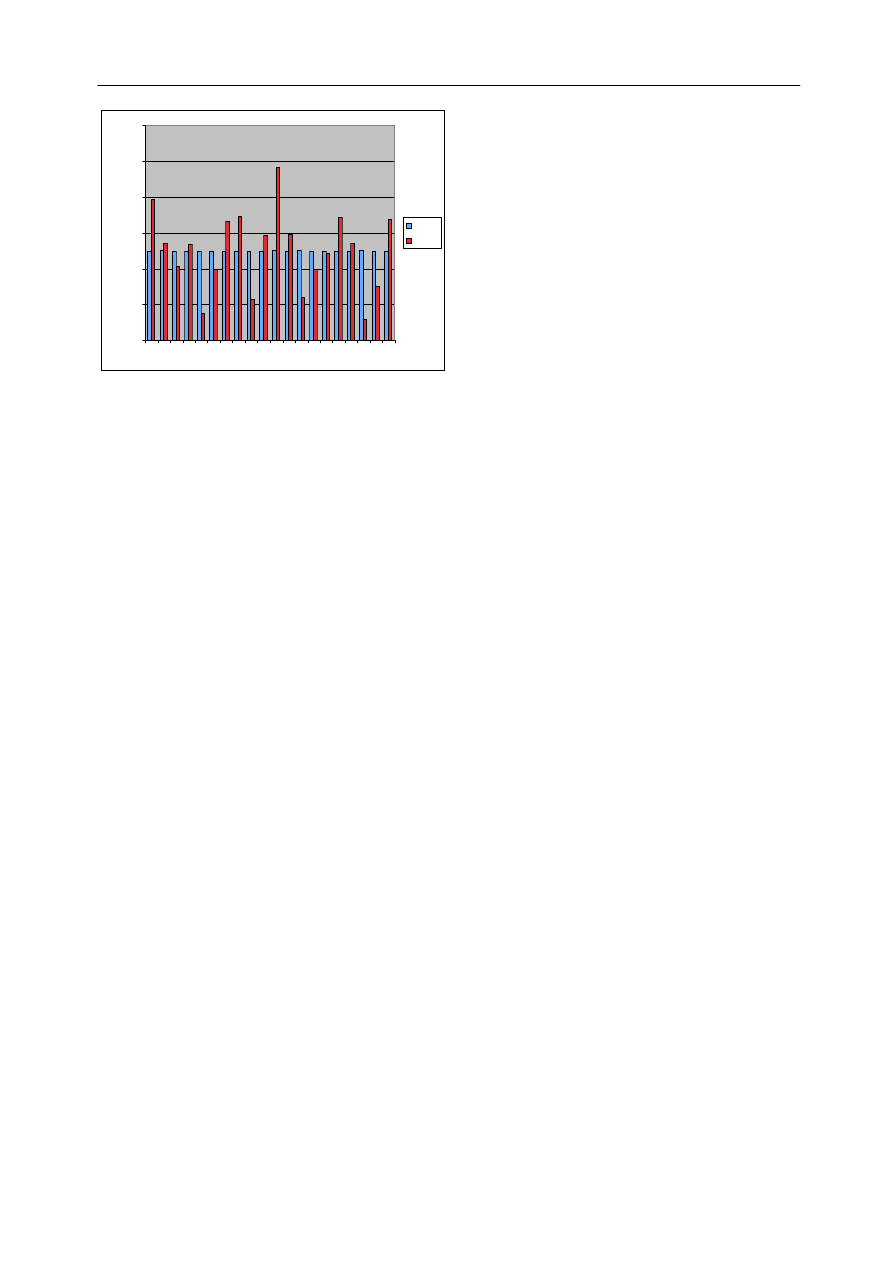
G. Evangelista et al., RandomBlast a tool to generate random “never born protein: seguences
30
0
2
4
6
8
10
12
A R N D C Q E G H I L K M F P S T W Y V
R
e
la
ti
v
e
a
bunda
nc
e
(
%
)
NBPs
NPs
Fig. 3. Average amino acid composition of NPs (SwissProt) database
[8] and of a restricted NBPs database. Amino acid composition has
been calculated using the perl script freqaa.pl [9], available at the
URL: http://www-alt.pasteur.fr/~tekaia/HYG/scripts.html
.
On the other hand, the amino acid composition of an
individual protein can be quite different from the average
amino acid composition of an entire database, also taking into
account the relatively short length of NBPs (70 amino acids).
To dissect this aspect we also compared the amino acid
composition of four randomly chosen NBPs with that of four
natural proteins of the same length (Table 3). For each of the
four NPs analysed, the same considerations made for the
complete database remain valid. In fact, for three of them the
relative abundance of Trp is 0%, while for one is under 1,5%,
the total aromatic amino acids relative abundance being under
10% in all four cases. Also the Leu, and more generally the
aliphatic amino acids relative abundance is in line with that
observed for the complete database (Table 3), reinforcing the
idea that a high proportion of aliphatic residues may be an
intrinsic property of proteins which display a stable fold.
Regarding the four NBPs analysed the observed amino acid
composition does not dramatically deviate from the average
database composition. In particular the aliphatic/aromatic
amino acids ratio is significantly higher than that observed for
NPs (Table 3). It is suggestive to speculate that this could be
one of the physico-chemical factors that guided molecular
evolution and shaped the ensemble of NPs. However, the
statistical significance and thus the relevance of these
considerations for protein structure studies will be assessed
only once the structural characteristics will be analysed for a
large library of NBPs, which will be the object of our future
studies.
Table 3. Percentage amino acid composition of selected NPs and NBPs*
NPs
NBPs
Taut
Trasp
L35
Peps
1
3000
6000
9000
A
8.57 7.14 7.14 7.14 5.71 4.28 5.71 1.42
C
1.42 2.85 0.00 1.42 4.28 1.42 5.71 1.42
D
1.42 2.85 1.42 7.14 4.28 2.85 10.00 7.14
E
12.8 4.28 1.42 5.71 5.71 7.14 4.28 1.42
F
1.42 1.42 4.28 2.85 1.42 5.71 12.8 4.28
G
8.57 10.00 7.14 7.14 8.57 10.00 7.14 4.28
H
4.28 4.28 7.14 2.85 8.57 5.71 1.42 2.85
I
2.85 4.28 2.85 7.14 8.57 1.42 1.42 4.28
K
1.42 2.85 10.00 7.14 5.71 7.14 1.42 8.57
L
11.40 7.14 8.57 7.14 2.85 7.14 8.57 11.4
M
4.28 2.85 5.71 8.57 1.42 2.85 7.14 2.85
N
0.00 1.42 0.00 4.28 2.85 2.85 2.85 5.71
P
2.85 7.14 2.85 4.28 7.14 2.85 2.85 2.85
Q
2.85 0.00 2.85 4.28 7.14 4.28 2.85 4.28
R
12.80 25.70 21.4 2.85 2.85 5.71 2.85 8.57
S
4.28 7.14 5.71 1.42 2.85 5.71 8.57 5.71
T
7.14 1.42 5.71 2.85 5.71 5.71 1.42 0.00
V
8.57 4.28 4.28 10.00 2.85 7.14 2.85 8.57
W
1.42 0.00 0.00 0.00 5.71 7.14 5.71 2.85
Y
1.42 2.85 1.42 5.71 5.71 2.85 4.28 11.4
*The Abbreviations and NCBI gi codes for the NPs are the following: Taut, 4-oxalocrotonate tautomerase, gi:148568806; Trasp, Trasposase,
gi:148521558; L35, ribosomal protein L35, gi:148567297; Peps, pyrrolidone-carboxylate peptidase, gi:147930188.

G. Evangelista et al., RandomBlast a tool to generate random “never born protein: seguences
31
Acknowledgements
This work has been supported by a European Com-
mission grant to the project “EUChinaGrid: Interconnection
and Interoperability of grids between Europe and China”
(contract number: 026634).
References
1. Chiarabelli C., Vrijbloed J.W., De Lucrezia D., Thomas R.M.,
Stano P., Polticelli F., Ottone T., Papa E., Luisi P.L.: Investiga-
tion of de novo totally random biosequences, Part II: On the
folding frequency in a totally random library of de novo proteins
obtained by phage display, Chem. Biodivers., 3, 840-859, 2006
2. Rohl C.A., Strauss C.E., Misura K.M., Baker D.: Protein structure
prediction using Rosetta, Methods Enzymol., 383, 66-93, 2004
3. Wheeler D.L., Barrett T., Benson D.A., Bryant, S.H., Canese K.,
Church D.M., et al., Database resources of the National Center
for Biotechnology Information, Nucleic Acids Res., 33, D39-D45,
2005
4. Altschul S.F., Gish W., Miller W., Myers E.W., Lipman D.J., Basic
local alignment search tool, J. Mol. Biol., 215, 403-410, 1990
5. Karlin S., Altschul S.F., Methods for assessing the statistical
significance of molecular sequence features by using general
scoring schemes, Proc. Natl. Acad. Sci. USA 87, 2264-2268,
1990
6. Matsumoto M., Nishimura T., Mersenne Twister: A 623-
dimensionally equidistributed uniform pseudo-random number
generator, ACM Transactions on Modeling and Computer
Simulation, 8, 3-30, 1998
7. Source code for MT19937 available at the URL:
http://www.math.sci.hiroshima-u.ac.jp/~m-mat/MT/emt.html
8. Bairoch A., Boeckmann B., Ferro S., Gasteiger E.: Swiss-Prot:
Juggling between evolution and stability, Brief. Bioinform. 5, 39-
55, 2004
9. Tekaia F., Yeramian E., Dujon B., Amino acid composition of
genomes, lifestyles of organisms, and evolutionary trends:
a global picture with correspondence analysis, Gene, 297, 51-60,
2002
GRID SYSTEM
PHARMACOLOGY


BIO-ALGORITHMS AND MED-SYSTEMS
JOURNAL EDITED BY MEDICAL COLLEGE – JAGIELLONIAN UNIVERSITY
Vol. 3, No. 5, 2007, pp. 33-37
A SOLUTION FOR DATA TRANSFER AND PROCESSING USING A
GRID APPROACH
A.
B
UDANO
*
,
P.
C
ELIO
**
,
S.
C
ELLINI
*
,
R.
G
ARGANA
*
,
F.
G
ALEAZZI
*
,
C.
S
TANESCU
*
,
F.
R
UGGIERI
*
,
Y.Q.
G
UO
***
,
L.
W
ANG
***
,
X.M.
Z
HANG
***
*
INFN Roma Tre, Roma, Italy.
**
Dipartimento di Fisica, Università Roma Tre and INFN Roma Tre, Roma, Italy.
***
IHEP, Beijing, China.
Abstract: An important aspect in a lot of physics and biology experiments is the access and the processing of the data from a
different places and in the shortest possible time. We implemented a data files moving system, based on GRID tools and
services, to automatically transfer the files from a site that generated the data to some other site in the same collaboration
group for processing and analysis. We also describe the GRID approach to a unified job submission and processing system
and the mirroring of data files using the catalogues. This approach allows GRID communities to cooperate more efficiently in
data analysis, to share the available resources and to backup the data at the same time.
Introduction
As part of our activity in the EUChinaGRID 1 project we
focused on the problem of data and resource sharing within
collaborations distributed in two different continents. Within
the activities supported in the project we chose to study the
problem of a physics experiment led by a Chinese-Italian
collaboration. The experimental site is located in Tibet region
in China and the data need to be transported and processed
at the two main computing centres of the Collaboration,
located at IHEP-Beijing in China and CNAF-Bologna in Italy.
In the following we will refer to the specific problem, although
the solution we propose could be applied equally well to other
cases.
Data taking is organized in RUNs, a period of data taking
during which conditions are kept reasonably constant. Each
RUN is made of several files (about 1 Gbyte each, in our
specific case). The experiment aims at a very high duty cycle,
and the expected amount of data collected in one day is of the
order of 300 GB. The computing resources available at the
experimental site allow only for some limited data processing
and data storage, whereas it is estimated that the computing
activities related to data processing, simulation and analysis
require of the order of 500 kSPECint2000 2.
This amount of resources is not available at a single
computing centre so we developed a GRID approach. This
environment provides us with the needed CPU power and
storage space, and furthermore provides more features like
redundancy of the services, security access and enforces the
definition of a common environment accessible from any site.
Data Moving
We started to develop the so called “Data Mover”
application to transfer data from the experimental site to the
collaboration computing centres using gLite 3 Grid services.
The “Data Mover” application is based on four Grid services:
the Storage Element (SE) 4, the File Transfer Service (FTS) 5,
the Logical File Catalog (LFC) and the User Interface (UI) 7.
The FTS is the component that permits to move in a controlled
way the data from a SE to another, provided that they both
support the Storage Resource Manager (SRM) 8 interface.
The FTS service works with “channels” that connect the SEs.
A channel is a named uni-directional logical connection from
one SE to another and it is configurable in terms of bandwidth,
number of streams, access policies, etc. Transfer of one file or
of a group of files is called a “job”. FTS jobs are processed
asynchronously: upon submission a job identifier is returned,
which can be used at any time to query the status of the
transfer.
The LFC permits to the GRID users to assign a logical
name to a physical file present on a SE. The association is
one-to-many, a logical name can point to several physical
copies of the same file (“replicas”).
The UI is the gateway to the Grid, where users are
authenticated and authorized to use the gLite Grid services.
The graphical sketch of our system follows: the arrows
indicate the FTS channels and the arrow type (continuous or
dashed) distinguishes channels owned by different FTS
servers.
The system was built with a certain degree of redundancy,
using more FTS servers and defining many channels for the
same destination. To keep the system as simple as possible,
no FTS server needs to be installed at the experiment site.
At the experiment site, data from the data acquisition (DAQ)
system are sent to the local storage system and routinely
migrated to the SE by a program running in crontab 9. Since,
in our case, the SE and the DAQ machines share the same
disk the migration involves no data copying, rather only the
metadata information stored in the SE database is updated.
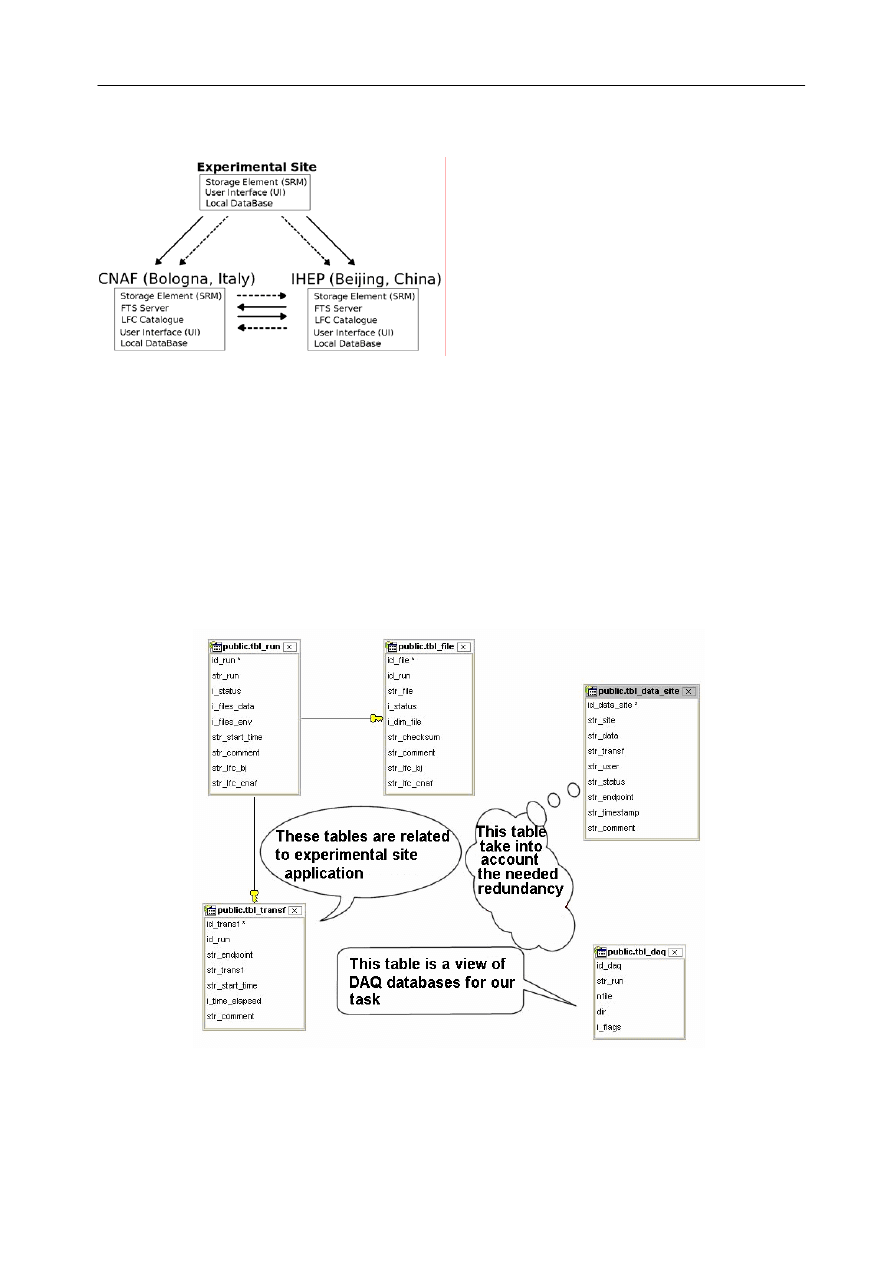
A. Budano et al., A solution for data transfer and processing using a GRID approach
34
As soon as a run has been successfully migrated, a flag is set
in the local DAQ database.
Fig. 2. Schematic view of “Data Mover” Application.
The Data Mover application is written in Perl 10
that is one
the most powerful languages for scripting: moreover, APIs
written in Perl are available for the FTS. The monitoring
application is written in Java language 11.
The application consists of three modules.
The first module takes care of initiating the transfer of runs
from the experiment site to one of the computing centers. The
status of the transfer is mapped to the Data Mover database.
For each run, the start time of the transfer is recorded into the
database. The starttime field is used to identify new runs
which still need to be transfered and it is also used to decide
to retry the transfer after a timeout in case of some
malfunctioning of the system. When a new run is scheduled
for transfer we register the identifier (ID) of this job into the
database, for later checking of the status of the transfer.
The second module has an instance running at each
computing center (China and Italy) and takes care of
synchronizing the two LFC catalogues. This job compares
entries in the two catalogues: if a file that is registered in the
remote catalog is not present in the local catalog, a transfer is
started from the remote to the local site. Upon successful
completion of the transfer the local file is registered in the local
catalogue and the remote copy is registered as a replica. This
module also takes care of updating the Data Mover database.
The third module is the garbage collector, which is
responsible for cleaning up the buffer disk at the experiment
site. All files that have been correctly transferred and which
have two distinct replicas in the remote LFC catalogues are
removed from the buffer disk. If there is still need for disk
space, the garbage collector starts to copy the files to tape.
Upon successful copy to tape, the files are deleted. The tapes
will then be sent to one of the main computing centres, and
there files will be stored in the SE and registered in the LFC
catalogue.
To perform a monitoring and check on the data transfer
we have also implemented a very simple DB in which we store
useful information and that is described in the following Fig. 7.
Fig. 3. DB structure
All these applications are supported by a textual
monitoring that writes on a logfile (with the possibility to
enable different levels of detail) and performs also status
checks of the main services to produce warnings and alarms.
To complete the work we also developed a Java Graphical
User Interface (GUI) application that enables a very useful
and easy check on all the working modules.

A. Budano et al., A solution for data transfer and processing using a GRID approach
35
Fig. 4. Graphical User Interface
Porting of data processing activities to
GRID
Why to use GRID
The GRID technology gives us the possibility to use more
distributed computing resources to take advantage of High
Throughput Computing and thus reduce the total wall-clock
processing time. This approach is particularly suited for
MonteCarlo simulations, which typically consist of CPU-bound
jobs for which the amount of needed input data is generally
limited and the executable can possibly have very little
dependencies on external software. However, the GRID
approach should also be considered for massive data
processing applications, especially if the CPU time needed to
process a block of input data is much larger than the time
needed to make those data available to the remote worker
node via the network. In our specific case, the time needed to
reconstruct 1 GB of raw data is of the order of several hours,
to be compared to the few minutes needed to transfer 1 GB
over WAN.
Definition of a common environment
A working environment, for a geographically spread
community, is based on the concept of Virtual Organization
(VO). The experiment's VO was created, as first step, and
roles were defined: then, all collaborating sites were asked to
support such VO. The mutual acceptance of the Digital
Certificates issued by the Chinese and Italian Certification
Authorities was also established.
An important benefit which stems naturally from the
adoption of GRID technologies is the enforcement of the
definition of a common environment, meaning anything from
the definition of common policies, such those on how to
organize files or to label software versions, to the definition of
procedures for data reconstruction and the use of the same
calibrations.
A script managing software installation at remote sites
was prepared. Each software package is distributed as a tar
archive and has an associated tag which will be published by
the CE upon successful installation. The tag name has a
simple structure consisting of a set of strings with obvious
meaning, separated by the '-' (dash) character for easy
parsing, like:
VO-<experiment>-<test|prod>-<program_name>-
<program_version>-<architecture>
The installation script is executed as a GRID job by the
software manager: it accepts switches to perform such
operations as software installation, validation and removal.
After each step a temporary tag composed by the
concatenation of the software tag and the status is published
by the CE: this temporary tag is used by the installation script
to make sure that the operations are performed in the right
order.
The experiment's software, as well as other software
needed to satisfy dependencies, was installed both at sites
which are collaborating with the experiment and at sites which
support the Argo VO even though the collaboration is not
present. All software was installed under the path pointed to
by the environment variable VO_<experiment>_SW_DIR, as
is usual for EGEE-like 12 sites.
As far as the file organization is concerned, a common
logical naming convention was defined for all kinds of files, for
raw data as well as files produced by data reconstruction or
Monte Carlo simulation. The format of the logical names
resembles that of a physical filename, and consists in a set of
strings separated by the '/' character. The tree-like structure
was chosen because:
• it can be easily mapped to a physical file-system as
well as to the logical file-system provided by tape
systems;
• it allows for easy navigability;
• it can be defined in such a way as to limit the maximum
number of entries at each level and at the same time
be “descriptive”, making some characteristics of the
data files apparent at a glance, like the time the file
was taken, or the release used for reconstruction.
The logical name uniquely identifies a file at any site and
in any environment, be it a disk or a tape file-system, or the
LFC catalogue, for example: the logical to “physical” mapping
is accomplished by pre-pending the logical name with a site-
specific prefix (meaning there will be one prefix for mapping to
disk at each site, another one for mapping to tape, yet another
one for mapping to LFC catalogue and so on).
Application porting
After the experiment's official software had been installed
at a bunch of sites, we started porting the experiment's
applications to GRID: we focused on the data reconstruction
application and the Monte Carlo simulation.
Both applications require submitting a large number of
jobs which are very similar to one another, differing only in a
small number of parameters (run number, input and output
filenames, energy range, calibration file,...), most of which can
be computed dynamically (for example, directly by querying a
database, or indirectly by combining other parameters
together). The main differences between submitting one such
job to the GRID or to a local farm are that in the former case:
• one needs also an accompanying Job Description
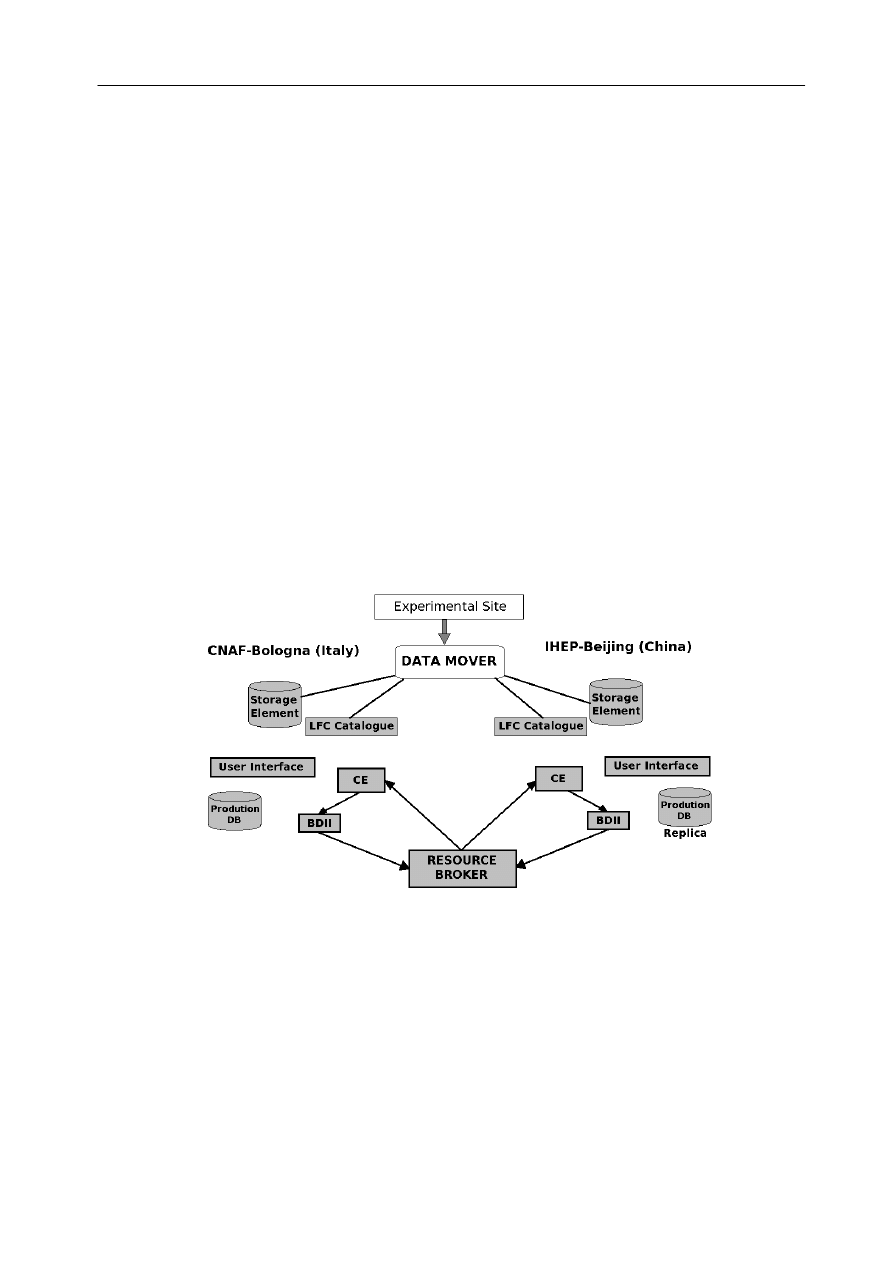
A. Budano et al., A solution for data transfer and processing using a GRID approach
36
• the scripts should be a little more general, e.g.: the
scripts should not rely on a specific absolute path for
the application executable, but rather make use of the
appropriate environment variable;
• keeping track of the jobs can be more difficult, since
the Resource Broker (RB) or the Workload
Management System (WLMS) 14 dynamically and
independently schedule jobs to potentially any
available CE which matches with the Job requirements.
For these reasons, the GRID case can be regarded as a
generalization of the submission to a local farm, so we
developed general procedures which could work in both
environments.
Such procedures rely on a few Perl scripts, some
configuration files and a number of template files.
Configuration files contain lines with the format:
VARIABLE := value
where “value” can be an arbitrary string: a small Perl library
contains all routines needed to use variables in the definition
of other variables, or within the scripts, or for making
substitutions in the template files.
Such a scheme is extremely powerful, as many important
changes can be performed without the need for editing the
Perl code, but just simply editing the template files. The
porting of the applications to GRID required us to extend the
procedures to handle the generation of the JDL file, and to
modify the template files.
To allow for simple tracking of the jobs, the experiment's
production database was extended in such a way as to store
the jobID returned at submission time: the jobID is stored as a
string, whose value clearly distinguishes between local and
GRID jobs. For the initial simplified version, we decided to
have just one master production database, which is mirrored
by remote sites. The production database can be accessed
from remote nodes so that each one can update the status
flag relevant to its own running job. Should the worker node
be unable to contact the database for any reason, a recovery
procedure was prepared: this procedure runs on any User
Interface and periodically checks and updates the status flag
for all jobs running since too long time.
Sites structure
In this specific case, the experiment's two main computing
centres are peers, so we defined a symmetrical architecture
with two GRID production sites for raw data reconstruction,
both storing a copy of the raw and reconstructed data,
continuously aligned.
The GRID architecture we are going to use is shown in
Figure 4. Each production site will keep a copy of the raw data
and of the reconstructed data, a LFC catalogue, a BDII
information systems and the UIs.
Fig. 5. Grid architecture
As already mentioned, there will be only one active
production database that will be inquired to discover the raw
data files to be processed: the request for computing
resources will be forwarded to a Resource Broker (RB). The
jobs will be submitted according to the availability of
computing resources and automatically the data files will be
read in input and written in output on the local SE. The
computing center at CNAF is using a SE of the type
SRM/CASTOR 15, while at IHEP the SE is of the type
SRM/dCACHE 16.
Once the job is finished the database will be updated and
the reconstructed events files will be copied to the other
computing centre’s SE through the same procedure for LFC
catalogues alignment described earlier for the Data Mover.
For safety reasons the production database will be mirrored,
thus also allowing users at different sites to enquire and select
data for physics analysis independently of the status of the
network links.
Current status
The procedures for Data Mover have been tested on a
test-bed including the sites of INFN Roma Tre, CNAF and
IHEP. Some minor configuration problems for FTS servers
were detected and solved. Some performance problems still

A. Budano et al., A solution for data transfer and processing using a GRID approach
37
persist during the file transfers and should be solved by the
network managers through better routing procedure.
The job submission was tested using different user interfaces
and computing resources both in Italy and in China.
Conclusions
A general Grid approach to the data transfer and
processing has been presented, which can be applied to
many cases of scientific and non-scientific data which need to
be analysed in a geographically distributed environment.
The automatic procedure to transfer the experimental data
using the GRID middleware tools allows both a good control
and monitoring of the operations and the fast availability of the
data to the processing system, through the use of LFC
catalogues.
Acknowledgements
The authors are grateful to the ARGO-YBJ experiment for
the supportive collaboration in the work.
The presented activity has been performed in the framework
of EUChinaGRID, an European co-funded Project.
References and Glossary
1. EUChinaGRID Project: http://www.euchinagrid.eu
2. SpecINT2000: http://www.spec.org
3. gLite: http://glite.web.cern.ch/glite/
4. Storage Element (SE):
https://twiki.cern.ch/twiki/bin/view/LCG/DpmGeneralDescription
5. File Transfer Service (FTS):
http://www.gridpp.ac.uk/wiki/GLite_File_Transfer_Service,
http://egee-jra1-dm.web.cern.ch/egee-jra1-dm/FTS/
6. LCG File Catalogne (LFC):
http://www.gridpp.ac.uk/wiki/LCG_File_Catalog,
https://twiki.cern.ch/twiki/bin/view/LCG/LfcGeneralDescription
7. User Interface (UI):
http://glite.web.cern.ch/glite/documentation/R3.0/default.asp,
http://www.gridpp.ac.uk/deployment/users/ui.html
8. Storage Resource Management RM: http://sdm.lbl.gov/srm-wg/
9. crontab:
http://www.opengroup.org/onlinepubs/009695399/utilities/crontab
.html
10. Perl: http://www.perl.com/
11. Java Language: http://java.sun.com/
12. EGEE: http://public.eu-egee.org/
13. Job Description Language (JDL): http://server11.infn.it/workload-
grid/docs/DataGrid-01-TEN-0102-02-Document.pdf,
http://server11.infn.it/workload-grid/docs/DataGrid-01-TEN-0142-
0 2.pdf
14. Resource Broker & WLMS:
https://edms.cern.ch/document/572489/,
https://edms.cern.ch/document/674643/
15. The CASTOR Project: http://castor.web.cern.ch/castor/
16. dCache: http://www.dcache.org/
Glossaries of Grid terms:
http://www.gridpp.ac.uk/gas/
http://egee-jra2.web.cern.ch/EGEE-JRA2/Glossary/Glossary.html
http://grid-it.cnaf.infn.it/fileadmin/users/dictionary/dictionary.html
GRID SYSTEM
COMPUTER SCIENCE


BIO-ALGORITHMS AND MED-SYSTEMS
JOURNAL EDITED BY MEDICAL COLLEGE – JAGIELLONIAN UNIVERSITY
Vol. 3, No. 5, 2007, pp. 39-43
HIGH THROUGHPUT PROTEIN STRUCTURE PREDICTION IN A GRID
ENVIRONMENT
G
IOVANNI
M
INERVINI
*
,
G
IUSEPPE
L
A
R
OCCA
**,
P
IER
L
UIGI
L
UISI
*
,
F
ABIO
P
OLTICELLI
*x
*
Department of Biology, University Roma Tre, 00146 Rome, Italy;
x
**I
NFN Sezione di Catania, 95123 Catania, Italy
Running title
: PROTEIN STRUCTURE PREDICTION IN GRID
Abstract : The number of known natural protein sequences, though quite large, is infinitely small as compared to the number
of proteins theoretically possible with the twenty natural amino acids. Thus, there exists a huge number of protein sequences
which have never been observed in nature, the so called “never born proteins”. The study of the structural and functional
properties of "never born proteins" represents a way to improve our knowledge on the fundamental properties that make
existing protein sequences so unique. Furthermore it is of great interest to understand if the extant proteins are only the result
of contingency or else the result of a selection process based on the peculiar physico-chemical properties of their protein
sequence. Protein structure prediction tools combined with the use of large computing resources allow to tackle this problem.
In fact, the study of never born proteins requires the generation of a large library of protein sequences not present in nature
and the prediction of their three-dimensional structure. This is not trivial when facing 10
5
-10
7
protein sequences. Indeed, on a
single CPU it would require years to predict the structure of such a large library of protein sequences. On the other hand, this
is an embarassingly parallel problem in which the same computation (i.e. the prediction of the three-dimensional structure of a
protein sequence) must be repeated several times (i.e. on a large number of protein sequences). The use of grid
infrastructures makes feasible to approach this problem in an acceptable time frame. In this paper we describe the set up of a
simulation environment within the EUChinaGRID infrastructure that allows user friendly exploitation of grid resources for large-
scale protein structure prediction.
Introduction
Simple calculations show that the number of known
natural proteins is just a tiny fraction of all the theoretically
possible sequences. As an example, the latest release of
UniProtKB/Swiss-Prot (release 52.5, 15 May 2007) contains
267354 sequence entries [1], many of which are evolutionary
related. On the other hand, considering random polypeptides
of just 100 amino acids in length (the average length of natural
proteins being 367 amino acids [1]), with the 20 natural amino
acids co-monomers it is possible to obtain 100
20
chemically
different proteins. This is an astronomically large number
which leads to the consideration that there is a huge number
of protein sequences which have never been exploited by
nature. In other words a huge number of “never born proteins”
(NBP) [2]. This arises the fundamental question if the set of
known natural proteins have particular features which make
them eligible for selection, in terms, for example, of particular
thermodynamic, kinetic or functional properties. One of the
key features of natural protein sequences is their ability to fold
and form a stable and well defined three-dimensional structure
which in turn dictates their specific biological function [3].
From this viewpoint, the study of the structural features of
NBP can help to answer the question if the natural protein se-
quences were selected during molecular evolution because
they have unique properties and which are such properties
(for instance a peculiar amino acid composition, hydropho-
bic/hydrophilic amino acids ratio, etc.). Such a problem cannot
be easily tackled with an experimental approach which would
require the production and structural characterization of a
large number of random polypeptides. Attempts have been
made in this direction [2], however we chose to tackle the
problem using a computational approach to generate a large
number of random proteins sequences with no significant
homology with natural proteins (see accompanying paper by
Evangelista et al.,) and to study their structural properties by
means of the well known ab initio protein structure prediction
software Rosetta abinitio [4]. However, to obtain statistically
significant results the size of the sequence data base to be
analysed must be sufficiently large (at least 10
5
to 10
7
se-
quences). This is a highly demanding problem from a compu-
tational viewpoint. In fact on a single CPU it would require
years of computing time to predict the structure of such a
large number of protein sequences. On the other hand, from a
computational viewpoint this is an embarassingly parallel
problem in that the same computation (i.e. the prediction of
the three-dimensional structure of a protein sequence) must
be repeated several times (i.e. on a large number of protein
sequences). Grid infrastructures are highly suitable tools to
approach this kind of problems in that a large number of grid
computing elements can be used to execute relatively simple
calculations. In this paper we describe the deployment of the

G. Minervini et al., High throughput protein structure prediction in a grid environment
40
Rosetta abinitio software on the GILDA testbed (see below),
as a first step towards porting of the software in the EUChi-
naGRID grid infrastructure. The development of a user friendly
working environment within the GENIUS portal is also de-
scribed, which allows the submission of a large number of
protein structure prediction simulations with the final aim of
structurally characterizing a large database of NBP se-
quences.
Methodological issues
The Rosetta software
Rosetta abinitio is an ab initio protein structure prediction
software which is based on the assumption that in a polypep-
tide chain local interactions bias the conformation of sequence
fragments, while global interactions determine the three-
dimensional structure with minimal energy which is also com-
patible with the local biases [4]. To derive the local sequence-
structure relationships for a given amino acid sequence (the
query sequence) Rosetta abinitio uses the Protein Data Bank
[5] to extract the distribution of conformations adopted by
short segments in known structures. The latter is taken as an
approximation of the distribution adopted by the query se-
quence segments during the folding process [4].
In detail, Rosetta workflow can be divided into two
modules:
Module I - Input generation - The query sequence is
divided in fragments of 3 and 9 amino acids. The software
extracts from the data base of protein structures the distribu-
tion of three-dimensional structures adopted by these frag-
ments based on their specific sequence. For each query
sequence a fragments data base is derived which contains all
the possible local structures adopted by each fragment of the
entire sequence. The procedure for input generation is rather
complex due to the many dependencies of module I. In fact, to
be executed the first Rosetta abinitio module needs the output
generated by the programs Blast [6] and PSIPRED [7] in
addition to the non redundant NCBI protein sequence data-
base [8]. On the other hand this procedure is computationally
inexpensive (10 min of CPU time on a Pentium IV 3,2 GHz).
Thus it has been chosen to generate the fragments database
locally with a perl script that automatizes the procedure for a
large dataset of query sequences. The script retrieves query
sequences from a random sequence database in FASTA
format (see accompanying paper by Evangelista et al.) and
executes Rosetta abinitio module I creating an input folder
with all the files needed for the execution of Rosetta abinitio
module II. Approximately 500 input datasets are currently
being generated weekly with this procedure.
Module II - Ab initio protein structure prediction – Using
the derived fragments database and the PSIPRED secondary
structure prediction generated by module I for each query
sequence, the sets of fragments are assembled in a high
number of different combinations by a Monte Carlo procedure
by Rosetta abinitio module II. The resulting structures are then
subjected to an energy minimization procedure using a semi-
empirical force field [4]. The principal non-local interactions
considered by the software are hydrophobic interactions,
electrostatic interactions, main chain hydrogen bonds and
excluded volume. The structures compatible with both local
biases and non-local interactions are ranked according to their
total energy resulting from the minimization procedure. A
single run with just the lowest energy structure as output takes
approx. 10-40 min of CPU time, for a 70 amino acids long
NBP and depending on the degree of refinement of the struc-
ture. Rosetta abinitio Module II has thus been deployed on the
GILDA testbed through the use of the GENIUS interface (see
below) with the option of parametric jobs submission to run a
large number of jobs, as required for the study of the large
library of NBP generated.
The GILDA testbed
GILDA (which stands for Grid Infn Laboratory for Dissemi-
nation Activities) is a virtual laboratory of the Italian National
Institute of Nuclear Physics (INFN) to demonstrate and dis-
seminate the capabilities of grid computing [9]. Within the
GILDA virtual laboratory, the GILDA testbed is a series of
sites and services (Resource Broker, Information Index, Data
Managers, Monitoring tool, Computing Elements, and Storage
Elements) on which the latest version of the INFN Grid mid-
dle-ware, compatible with gLite, is installed.
Results
Integration of Rosetta Module II on the GILDA
grid infrastructure
Single job execution on GILDA - A single run of Rosetta
abinitio Module II consists of two different phases. In the first
phase an initial model of the protein structure is generated
using the fragment libraries and the PSIPRED secondary
structure prediction. The initial model is then used as input for
the second phase in which it will be idealised. A shell script
has been prepared which registers the program executable
(pFold.lnx) and the required input files (fragment libraries and
secondary structure prediction file) on the LFC catalog, calls
the Rosetta abinitio Module II executable and proceeds with
workflow execution. A JDL file was created to run the applica-
tion on the GILDA working nodes which use the gLite middle-
ware [10].
Integration on the GENIUS web portal - A key issue to
attract the biology community towards the exploiting of the
Grid paradigm is to overcome the difficulties connected with
the use of the grid middleware by users without a strong
background in informatics. This is the main goal that has to be
achieved in order to disseminate the use of grid services by
biology applications. To achieve this goal and allow a wide
biologists community to run the software using a user friendly
interface, Rosetta abinitio application has been integrated on
the GENIUS (Grid Enabled web eNvironment for site Inde-
pendent User job Submission) Grid Portal [11], a portal deve-
loped by a collaboration between the italian INFN Grid Project
[12] and the italian web technology company Nice [13].
Thanks to this Grid portal, non-expert users can access a grid
infrastructure, execute and monitor Rosetta abinitio applica-
tion only using a conventional web browser. All the complexity
of the underlying grid infrastructure is in fact completely hid-
den by GENIUS to the end user. In our context, given the
huge number of NBP sequences to be simulated, an auto-
matic procedure for the generation of parametric JDL files has
been set up on the GENIUS Grid Portal. With this procedure,
exploiting the features introduced by the last release of the
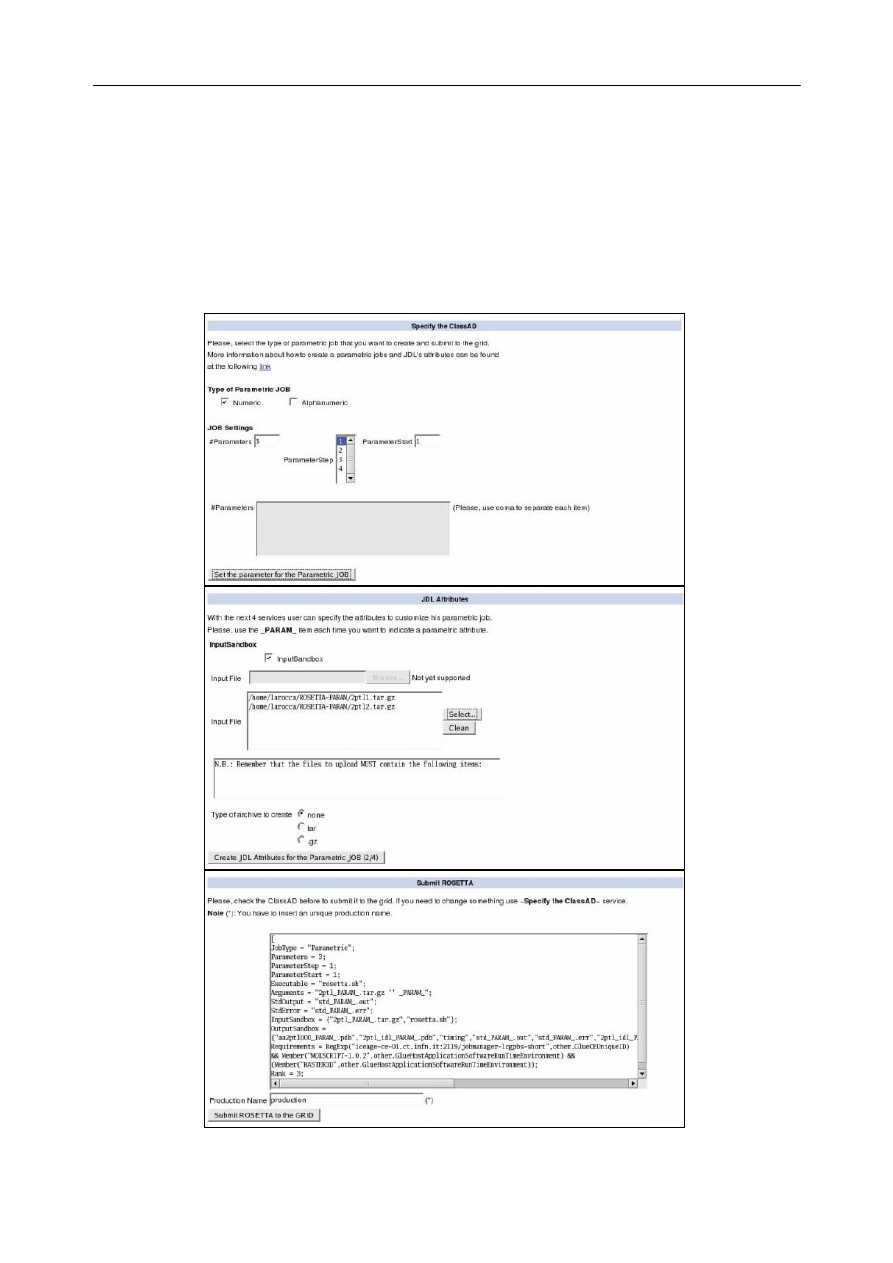
G. Minervini et al., High throughput protein structure prediction in a grid environment
41
gLite middleware, users can create and submit parametric
jobs to the grid. Each submitted job independently performs a
prediction of the protein structure.
Hereafter is described in detail the workflow adopted to
run Rosetta abinitio application on GENIUS. After the user has
correctly initialized his personal credentials on a MyProxy
Server, he can connect to the GENIUS portal and start to set
up the attributes of the parametric JDL that will be created “on
the fly” and then submitted to the grid. First the user specifies
the number of runs, equivalent to the number of amino acid
sequences to be simulated (Figure 1). Then, the user speci-
fies the working directory, the name of the shell script (Rosetta
abinitio executable), to be executed on a grid resource, loads
a .tar.gz input file for each query sequence (containing the
fragment libraries and the PSIPRED output file) and specifies
the output files (initial and refined model coordinates) in para-
metric form (Figure 1). The parametric JDL file is then auto-
matically generated and visualised in order to be inspected by
the user and submitted (Figure 1). The status of the parame-
tric job as well as the status of individual runs of the same job
can be also checked from within the GENIUS portal.
Fig. 1. Screenshots of the GENIUS grid portal showing services for the specification of the number of structure predictions to run (top panel), of
the input and output files (middle panel) and for the inspection of the parametric JDL file (bottom panel).
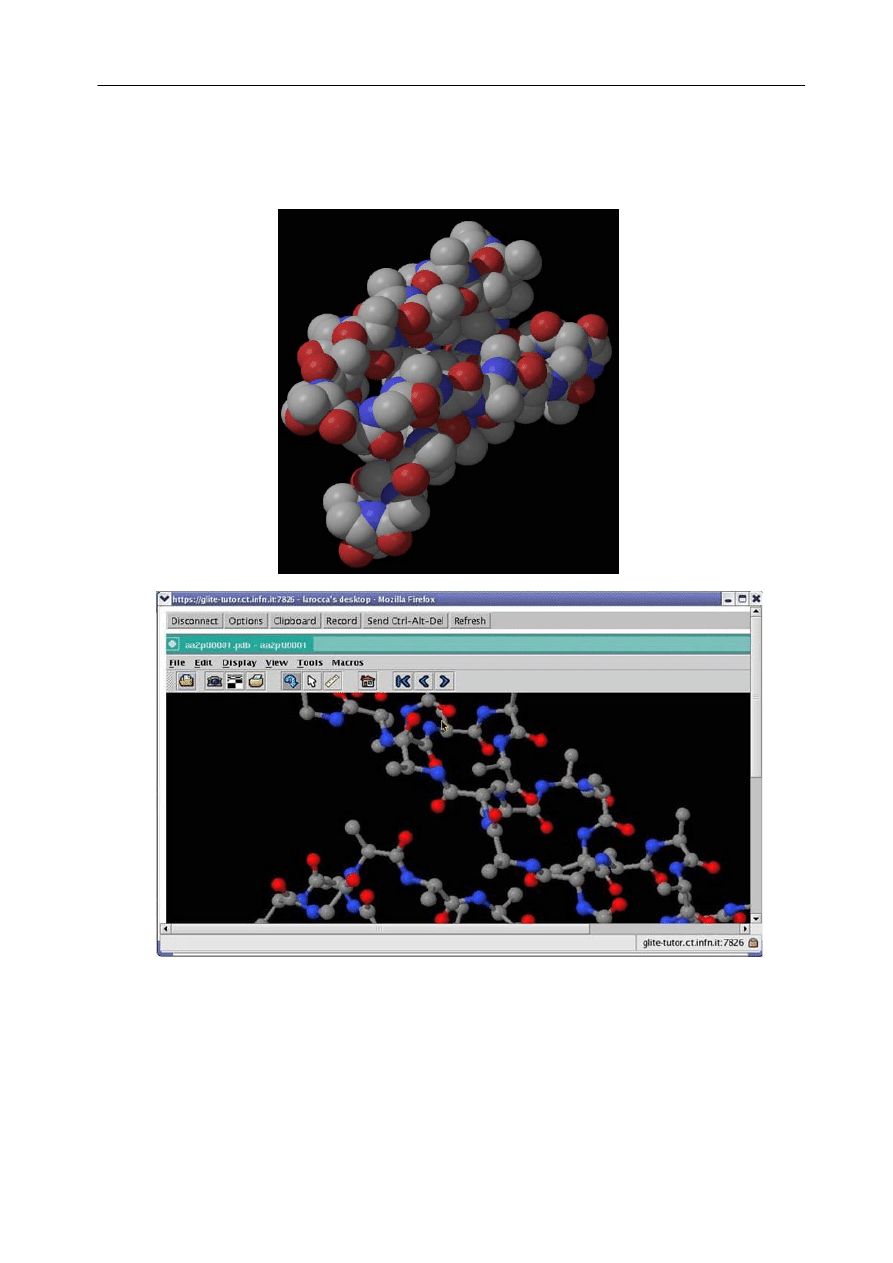
G. Minervini et al., High throughput protein structure prediction in a grid environment
42
When the prediction is done it is also possible, using the
portal, to inspect the output produced in graphics form. Figure
2 shows the graphical output of the predicted structure in
“spacefill” representation generated by Raster3D [14] in .png
format. In addition, in order to allow the user to analyse the
predicted NBP structural model, the JMOL Java applet [15]
has been embedded into the GENIUS portal. A JMOL
representation of a predicted NBP structure is also shown in
Figure 2.
Fig. 2. Graphical output of a protein structure prediction generated from within the GENIUS grid portal using Raster3D (left)
and JMOL (right).
Conclusions
Grid technologies are attracting increasing interest in the
biology community due to the possibility to approach
computational biology problems highly demanding in terms of
both computing and data storage resources. Protein structure
prediction is one of the major challenges in computational
biology in that a huge amount of data are available for protein
sequences while this is not the case for the corresponding
three-dimensional structures. On the other hand, knowledge
of the three-dimensional structure of a protein opens up the
way for the comprehension of its function and molecular
mechanism, a critical step in key areas of biomedical
research. From this viewpoint, the importance of the
deployment of Rosetta software in grid goes beyond the study
of NBPs. In fact, the same tool can be used to tackle equally

G. Minervini et al., High throughput protein structure prediction in a grid environment
43
complex and demanding biological problems, such as for
instance the prediction of the structure and function of the
entire set of proteins of a bacterial pathogen or a viruses,
allowing the selection and study of suitable targets for drug
design.
Acknowledgements
This work has been supported by a European Commis-
sion grant to the project “EUChinaGRID: Interconnection and
Interoperability of grids between Europe and China” (contract
number: 026634).
References
1. Bairoch A., Boeckmann B., Ferro S., Gasteiger E.: Swiss-Prot:
Juggling between evolution and stability, Brief. Bioinform. 5, 39-
55, 2004
2. Chiarabelli C., Vrijbloed J.W., De Lucrezia D., Thomas R.M.,
Stano P., Polticelli F., Ottone T., Papa E., Luisi P.L.:
Investigation of de novo totally random biosequences, Part II: On
the folding frequency in a totally random library of de novo
proteins obtained by phage display, Chem. Biodivers., 3, 840-
859, 2006
3. Branden C., Tooze J.: Introduction to protein structure, Garland
Publishing, New York, 1999
4. Rohl C.A., Strauss C.E., Misura K.M., Baker D.: Protein structure
prediction using Rosetta, Methods Enzymol., 383, 66-93, 2004
5. Berman H.M., Westbrook J., Feng Z., Gilliland G., Bhat T.N.,
Weissig H., Shindyalov I.N., Bourne P.E., The Protein Data
Bank, Nucleic Acids Res., 28, 235-242, 2000
6. Altschul S.F., Gish W., Miller W., Myers E.W., Lipman D.J., Basic
local alignment search tool, J. Mol. Biol., 215, 403-410, 1990
7. McGuffin L.J., Bryson K., Jones D.T., The PSIPRED protein
structure prediction server, Bioinformatics, 16, 404-405, 2000
8. Wheeler D.L., Barrett T., Benson D.A., Bryant, S.H., Canese K.,
Church D.M., et al., Database resources of the National Center
for Biotechnology Information, Nucleic Acids Res., 33, D39-D45,
2005
9. GILDA – https://gilda.ct.infn.it/
10. gLite middleware - http://glite.web.cern.ch/glite/
11. GENIUS Portal – https://genius.ct.infn.it/
12. INFN Grid Project – http://www.infn.it/
13. Nice – http://www.nice-italy.com/
14. Merritt E.A., Bacon D.J., Raster3D Photorealistic Molecular
Graphics, Methods in Enzymol., 277, 505-524, 1997
15. Jmol: An open-source Java viewer for three-dimensional
molecular structures. http://www.jmol.org/
EnginFrame Framework – http://www.enginframe.com/
RASTER-3D - http://skuld.bmsc.washington.edu/raster3d/
GRID SYSTEM
PHARMACOLOGY


BIO-ALGORITHMS AND MED-SYSTEMS
JOURNAL EDITED BY MEDICAL COLLEGE – JAGIELLONIAN UNIVERSITY
Vol. 3, No. 5, 2007, pp. 45-49
AN APPROACH TO PROTEIN FOLDING ON THE GRID –
EUCHINAGRID EXPERIENCE
M.
M
ALAWSKI
*
,
T.
S
ZEPIENIEC
**
,
M.
K
OCHANCZYK
***
,
M.
P
IWOWAR
***
,
I.
R
OTERMAN
***
.
*
Institute of Computer Science, AGH, Al. Mickiewicza 30, 30-059 Krakow, Poland
**
Academic Computer Center CYFRONET, ul. Nawojki 11, 30-950 Krakow, Poland
***
Department of Bioinformatics and Telemedicine, Jagiellonian University, Collegium Medicum,
ul. Sw. Anny 12, 31-008 Krakow, Poland
Abstract: Contemporary pharmacology in its quest for more relevant and effective drugs needs to examine large range of
biological structures to identify biological active compounds. We consider large grid environment the only platform to face such
a computational challenge.
In our project, the search is focused on peptide-like molecules containing about 70 amino acids in a single polypeptide chain.
The limited number of proteins existing in the nature will be extended to those, which have not been recognized in any
organisms (“never born proteins”). The assumption is that those which do not exist in the nature may also render biological
activity, which directed on pharmacological use may correct some pathological phenomena.
As the function results from the structure, two approaches are applied to predict cartesian coordinates of proteins’ atoms:
sophisticated Monte Carlo structure creation, elimination and refinement using the Rosetta program and our own program for
simulation of the protein folding process.
As a computing platform we use the EuChinaGRID project resources, which are currently a part of EGEE infrastructure and
are expanding to include Chinese resources as well. We describe the approach for porting the application to the grid and the
prototype portal developed for simulation management and results analysis.
Key words: protein folding simulation, grid system, pharmacology, drug design
Introduction
Fundamental research for individualized therapy
Contemporary pharmacology, which is expected to be
ready to design the therapy in the individual manner for each
patient, is facing a large challenge. The fast pace of drug
design, which is assumed to satisfy all specific expectations
related to particular disease and to particular patient, is the
critical issue. The know-how in chemical disciplines seems to
be developed on the satisfactory level. Computer equipment
and software are also ready to be applied. The only missing
link in simulation of biological processes is theoretical and
then numerical ability to predict three-dimensional structure of
protein. These are the molecules responsible for most of the
processes in each living organism. It was evidenced that the
function of protein molecule is determined entirely by its
structure. This is why the search for reliable numerical models
allowing correct structure prediction on the basis of known
amino acids sequence is necessary to make the progress in
fast new drug design aimed to correct disfunctional proteins.
All steps of so called “central dogma of molecular biology”:
from nucleic acids to biological function, seem to be
recognized to the extent of understanding the mechanism of
disfunction called disease. Instead of “drug design”
understood as correction of proteins’ activity, the “therapy
design” extends all over the steps of biological dogma and is
placed in the focus of modern pharmacology. The processes
of larger and larger systems need to be simulated in silico.
The experiments (forbidden in vivo) are possible in silico and
seem to be unlimited. The solution of this problem in its
complete form seems to attainable in the relatively close
future.
Simulation of the protein folding process
The only important step: accurate automated prediction of
the three-dimensional structure is still unavailable in the in
silico form. This is why many efforts are undertaken to solve
this problem. This is also why the very large computer
resources of grid-like size are exploited for protein structure
prediction programs. Despite of 30-years long history, the
correct model able to recreate the path according to which the
unique spatial structure of polypeptide chain is formed, is still
missing. The problem seems to be a hot one for life sciences
nowadays. There are some tools like Rosetta which applied to
particular amino acid sequence are able to suggest (only
suggest) the native conformation of protein. The outcome of
this method (treated so far as the best one) is the structure of
limited confidence. The question: How do the proteins fold ?
remains still unanswered. The probability based models are
not able to give the reliable answer to this question. As long
as the mechanism of folding is unrecognized, the models for
its modification are also unavailable.
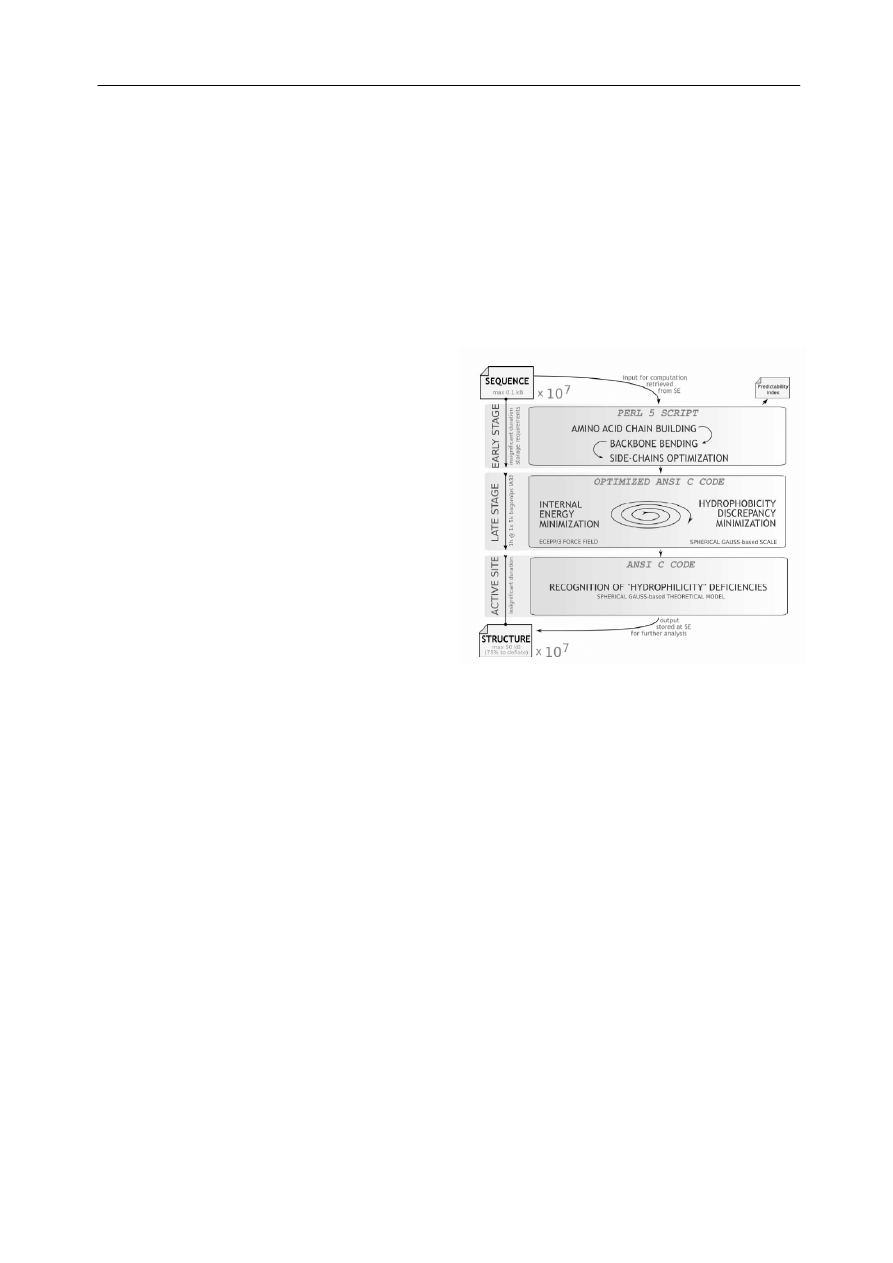
M. Malawski et al., An approach to protein folding on the grid – euchinagrid experience
46
The “never born proteins” project
The task of massive protein structure prediction for 70
amino acids long polypeptides (10
7
of them) has been
undertaken by the international team within IST EUChinaGrid
Project [1]. The team joins experts from two disciplines:
biochemistry specialists in protein structure prediction and
computer science specialist in grid system. O predict the
structure, the Rosetta method is applied and also a technique
elaborated recently in JUCM [2], which is an attempt to
simulate the protein folding process rather than protein
structure prediction, is harnessed. Within the project the
application was prepared to run on European and Chinese
grid-resources.
In this paper we describe the protein folding application,
focusing on the step which we needed for porting it to the grid.
We also give the overview of the additional tools based on a
portal, which were developed to simplify the process of
management of running such a large-scale application on the
grid and to aid biochemists interested in result analysis.
Related work
Distributed processing infrastructures such as grids or
peer-to-peer systems has been used for protein folding since
a relatively long time. The examples include early experiments
using CHARMM software and the grid infrastructure [3]. There
are also widely recognized projects that exploit the power of
thousands of PC machines voluntarily offered by the
participants via the BOINC platform clients [4]: pioneering
Predict@home [5], Folding@home [6], that performs
distributed molecular dynamics simulations, and
Rosetta@home, which is powered by Rosetta software [7].
Predictor@home was recently taken offline, Folding@home
concentrates on simulations of the folding pathways of single
proteins etiologically related to specific diseases, and
Rosetta@home is devoted to bringing to perform their jigsaw-
puzzle-game-alike method. The initiative of Human Proteome
Folding Project [8], running on the infrastructure of Grid.org
and World Community Grid and also using Rosetta software,
produced a database of predicted structures of all human
protein domains that were not yet resolved experimentally.
Running the application on the grid
The initial application comprised software developed by
the JUCM team were prepared to run on a single machine or
local cluster. When porting it to the grid such as EGEE, where
the basic processing unit is a batch job, it is necessary to
analyze application workflow in order to identify basic tasks
and their data dependencies. The task should be possibly
coarse-grained, since the overhead of job submission and
batch system execution is considerable.
Stages of simulation
The JUMC protein folding application consists of three
main stages shown in Fig.1.: early and late stage folding
followed by the active site recognition. Given a sequence,
creation of the early stage is entirely polypeptide backbone
dependent [9] and requires a large contingency table with
precomputed locations of tetrapeptides i a limited
conformational subspace [10]. Additionally at the step,
eventual steric clashes between distant amino acids are
detected and resolved. The late stage works with such an
intermediate structure by the introduction of side chain
interactions that are extended by an external force field
expressing hydrophobic character of some amino acids [11].
Its impact on the structure is evaluated as the discrepancy
between actual and expected hydrophobicity, dependent on
the distance from the centroid according to the gaussian
distribution and assigned due to the own normalized scale
distribution (“fuzzy-oil-drop”). Alternating with internal energy
minimizations in the ECEPP/3 force field prevents atoms from
overlapping. Distance relations between rigid elements of
such small peptides hinder the molecule to cover itself
thoroughly with hydrophylic residues providing hint for the
location of the active site [12].
Fig.1. Stages of the protein folding process simulation
Steps for porting to the grid
After identification of logical stages of the application, it is
necessary to consider also the technical side of the software,
such as executables, library dependencies, and input/output
files. The following steps were needed to grid-enable the
folding application.
1. For all programs used in workflow all the required pa-
ckages, which were not available on the grid worker
nodes, were collected. For example, the library of se-
quences required for early-stage and code dependencies
for late-stage were included.
2. The main script was created for running the application. It
is responsible for proceeding with workflow execution
checking if results of each stage are available. The
parameters of this script are a sequence string and an
identifier of the sequence.
3. It was decided to register results of computation for single
sequence in a separate file on the grid storage, namely in
LFC catalogue. The file name includes the sequence
identifier and the resulting protein is stored in PDB format.
4. A self-containing bundle of programs and libraries needed
for executing the application was created. This bundle was
also registered in LFC catalogue.
5. A script was created to prepare installation of application
on site each time when job is started and to spawn the
main scripts with appropriate parameters.
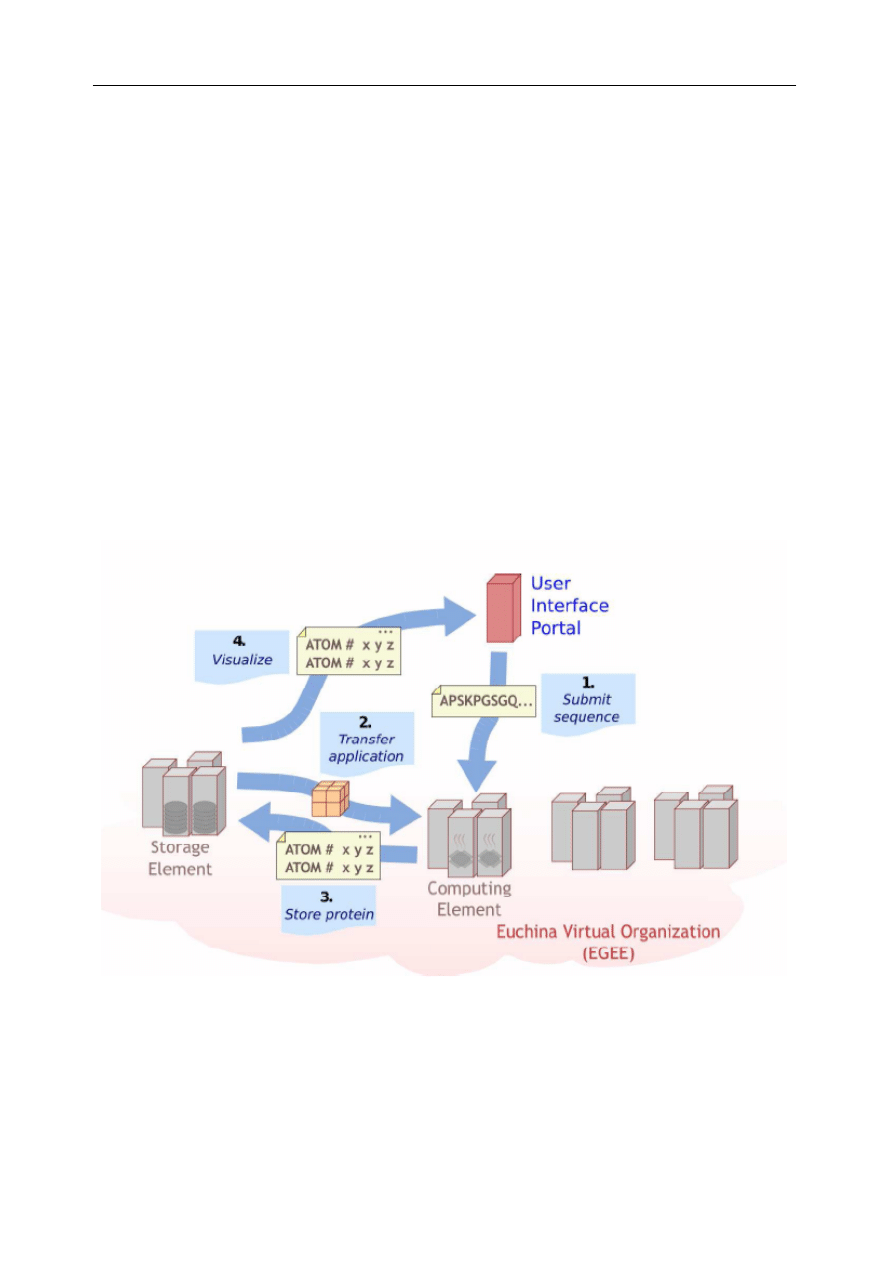
M. Malawski et al., An approach to protein folding on the grid – euchinagrid experience
47
6. Finally, the JDL (Job Description Language) file for gLite
middleware was created. Performing these steps resulted
in a self-contained application, which can be executed on
the grid infrastructure without any pre-installation required.
This is especially convenient for running it on many virtual
organizations within EGEE (euch as Euchina and VOCE
VOs) and also on Chinese grid infrastructure.
UI/Portal
As the number of simulation tasks and produced
structures is huge and the way they are processed and finally
interpreted is homogenous, we have developed a portal for
job submission and monitoring and for data analysis, that
appreciably simplifies the interaction of the average user with
the complex infrastructure of the grid. Portal was developed in
GridSphere Portal [13] using GridwiseTech LCG-API package
[14] to cooperate with grid infrastructure.
Job submission and monitoring
In Fig. 2 the most important features of the portal and
data-flow in the application were presented. Using the
application portal job submission is performed (step 1).
Typically this is done by uploading a file, in which up to
several thousand sequences are listed with their’s identifiers.
The portal creates a separate grid job for each sequence and
it adds them to the submission queue. Jobs from the queue
are submitted to grid using LCG-API Job Monitor. This is done
according to specified policies that could prevent from flooding
VOs with to many grid jobs. A single job running on grid
computing element download an application package to the
working node (step 2), compute the results and save them to
the grid storage system (step 3). Results of the jobs are
validated by the portal with a post-processing analysis
routines. In case of positive validation the results are
registered in the results database, otherwise decision what to
do next are left for the portal operator. Portal services analyze
also the results of jobs failures and decide whether to
resubmit a job or rather to ask the operator what to do next.
At runtime the operator can monitor computations using
the application portal. Monitoring in the portal was designed to
face the large amount of jobs running at the same time. The
portal implements features like grouping, browsing by various
criteria, viewing statistic and listing of current problems-to-
solve.
Finally, basing on database, the results of computations
can be browsed and accessed (step 4) for analysis by a set of
tools described in next paragraphs.
Fig. 2. User Interface portal in the context of the grid infrastructure
Result analysis
In the part of the portal devoted to the result analysis we
provide conventional tools that are familiar to biochemists and
biophysicists dealing with proteins. After choosing the id of a
resulted structure, remote secondary structure assignment is
performed remotely in DSSP [15] and presented graphically.
Using JUMC Structural Bioinfo Toolkit, that operates on
the server-side and generates images to the virtual
framebuffer using Java2D, the Á/A map with preferred areas
and contact map with different distance cut-offs are displayed.
We also reingeineered the MBT Protein Workshop [16] in
order to enable immediate visualization in the classic cartoon-
like representation. On the basis of our Toolkit we developed
a specialized molecular viewer that is able to point the location
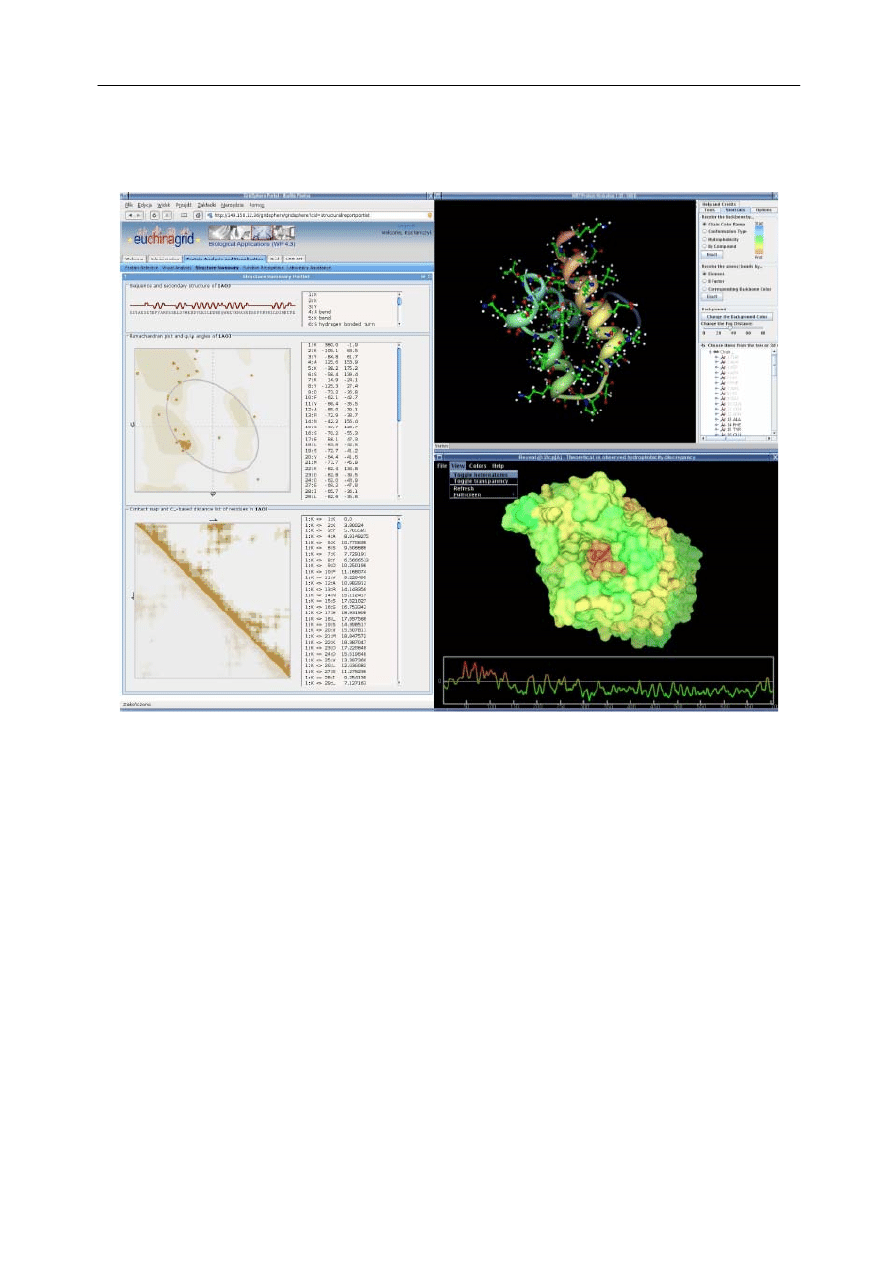
M. Malawski et al., An approach to protein folding on the grid – euchinagrid experience
48
of the probable active site using a color scale. Molecular
surface is computed remotely in MSMS [17] and retrieved via
Java RMI. If a protein was synthetized in a wet biology
laboratory and has undergone a 2D electrophoresis, within the
portal it is also possible to get an estimate location of the
molecule in the gel (portlet with a Curl wrapper to the
ExPASy.org service).
Fig. 3. Part of the portal for result analysis. Molecular viewers can be launched via JavaWebStart.
Summary and future work
The possibility to fold the proteins on such a scale
applying two different methods is the great opportunity to test
both of them. The mutual comparison of obtained results
(according to Rosetta in cooperation with University Roma Tre
[18] and basing on our mechanistic approach) is assumed to
help to understand the nature of proteins in respect to their
behavior in natural environment.
Moreover, the possible synthesis of the protein of
assumed as pharmacologically active allows (recognized on
the basis of predicted structure) immediate verification of
obtained computational results (experimental partners in the
Beijing University) and laboratory tests of harnessing them as
potential new drugs.
The approach to running the application on the grid was
tested on a sample batch comprising 10000 sequences and
the prototype portal was used for demonstration purposes.
Current work focuses on the development of a database for
management of simulations and improving the usability of
portal. Performing more tests will allow to verify both the
simulation model and our portal toolkit.
Acknowledgements
This work was partly funded by the European Commis-
sion, Project EUChinaGRID and by the related Polish SPUB-
M Grant. Maciej Malawski kindly acknowledges the support
from the Foundation for Polish Science.
References
1. IST EUChinaGRID Project. Project website:
http://www.euchinagrid.org.
2. Brylinski M., Konieczny L., Czerwonko P., Jurkowski W.,
Roterman I.: Earlystage folding in proteins (in silico) – sequence
to structure relation, J Biomed Biotechnol, 2 (2005) 65-79.
3. Natrajan A., Crowley M., Wilkins-Diehr N., Humphrey M., Fox A.,
Grimshaw A., and Brooks III C.: Studying Protein Folding on the
Grid: Experiences using CHARMM on NPACI Resources under
Legion. Proceedings of the HPDC Conference (2001), San
Francisco, USA.
4. Berkeley Open Infrastructure for Network Computing. Project
website: http://boinc.berkeley.edu.
5. Taufer M., An C., and Kerstens A., Brooks III Ch. L.:
Predictor@Home: A ’Protein Structure Prediction
Supercomputer’ Based on Global Computing, IEEE Transactions
on Parallel and Distributed Systems, 17, 8 (2006) 786-796.
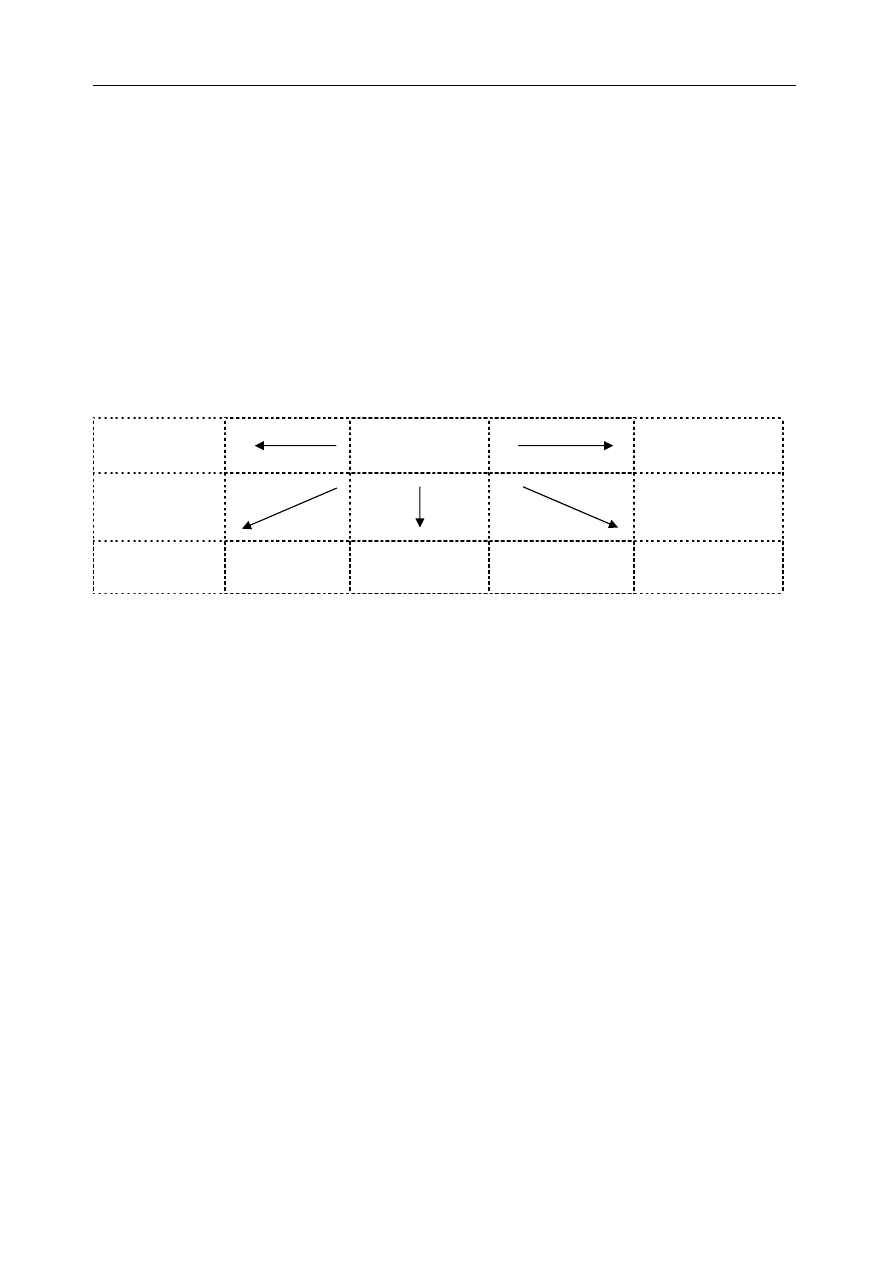
M. Malawski et al., An approach to protein folding on the grid – euchinagrid experience
49
6. Shirts M.R., Pande V.S.: Screen Savers of theWorld, Unite!
Science, 290 (2000) 1903-1904.
7. Rohl C.A., Strauss C.E., Misura K.M., Baker D.: Protein structure
prediction using Rosetta, Methods Enzymol, 383 (2004) 66-93.
8. Human Proteome Folding Project. Project website:
http://www.grid.org/projects/hpf.
9. Jurkowski W., Brylinski M., Wisniowski Z., Roterman I.: The
conformational subspace in simulation of early-stage protein
folding, Proteins, 55 (2004) 115-127.
10. Brylinski M., Jurkowski W., Konieczny L., Roterman I.: Limited
conformational space for early-stage protein folding simulation,
Bioinformatics, 20 (2004) 199-205.
11. Brylinski M., Konieczny L., Roterman I.: Fuzzy oil-drop
hydrophobic force field – a model to represent late stage folding
(in silico) of lysozyme, J Biomol Struct Dyn, 23 (2006) 519-528.
12. Brylinski M., Kochanczyk M., Konieczny L., Roterman I.:
Sequence-structure-function relation characterized in silico, In
Silico Biol, 6 (2006) 0052.
13. GridSphere Portal. Product website: http://www.gridsphere.org.
14. GridwiseTech LCG/EGEE API – GridSphere Integration Kit.
Product website:
http://www.gridwisetech.com/content/view/91/96/lang,en/.
15. Kabsch W., Sander Ch.: Dictionary of protein secondary
structure: pattern recognition of hydrogen-bonded and
geometrical features, Biopolymers, 22, 12 (1983) 2577-2637.
16. Moreland J.L., Gramada A., Buzko O.V., Zhang Q., Bourne P.E.:
The Molecular Biology Toolkit (MBT): A Modular Platform for
Developing Molecular Visualization Applications, BMC
Bioinformatics, 6 (2005) 21.
17. Sanner M.F., Olson A.J., Spehner J.-C.: Reduced Surface: An
Efficient Way to Compute Molecular Surfaces. Biopolymers, 38
(1996) 305-320.
18. Chiarabelli C., Vrijbloed J.W., De Lucrezia D., Thomas R.M.,
Stano P., Polticelli F., Ottone T., Papa E., Luisi P.L.:
Investigation of de novo Totally Random Biosequences, Part II,
Chemistry and Biodiversity, 3, 8 (2006) 840-859.
PHARMACY
GRID SYSTEM
PHARMACOLOGY
BIOCHEMISTRY
PROTEIN SCIENCE
MEDICINE


BIO-ALGORITHMS AND MED-SYSTEMS
JOURNAL EDITED BY MEDICAL COLLEGE – JAGIELLONIAN UNIVERSITY
Vol. 3, No. 5, 2007, pp. 51-52
MASSIVE IDENTIFICATION OF SIMILARITIES IN DNA MATERIALS
ORGANIZED IN GRID ENVIRONMENT
M
ONIKA
P
IWOWAR
*
,
T
OMASZ
S
ZEPIENIEC
*,**
,
I
RENA
R
OTERMAN
*
*
Department of Bioinformatics & Telemedicine Collegium Medicum UJ, Kraków, Poland
**
ACK CYFRONET AGH, Kraków, Poland
Introduction
The EUChinaGrid project is focused on the structure pre-
diction of proteins of potential pharmacological application.
Sequences of 70 amino acids long polipeptides (10
7
of them
that are classified as 'never born protein') are used to gene-
rate their three dimensional structures [9, 10].
The aim of genomic part of the project is to search all ac-
cessible genetic information (listed Materials and Methods)
completely sequenced as well as in progress to identify
stretches of genomic sequence about biological function
potential that were not identified to be exist in nature (proteins
“never born” in evolution). Innovation of genomic part of the
project rely on finding information about proteins in genomic
regions where it theoretically should not be (in case of hu-
mane genome it is big amount genetic materials (about 97%)
that does not encode any known proteins). Our attention is
focused especially on regions including protein-coding gene
fragments but also regions including other functional elements
such as part of RNA genes and regulatory regions. The main
task is defining the localization of similar nucleotide se-
quences (genome, chromosome, locus, structure of genetic
sequence e.g. part of gene or known repetitive sequences)
and statistical characterizing by cluster analysis and compari-
son of amino acids combination (kind of amino acid, type of
physical and chemical properties).
Materials and methods
The complete DNA sequence is analyzed in respect to the
presence of similar sequences to selected ones (“never born
proteins”) in noncoding region. The sequences of “never born
proteins” for 10
7
polypeptides are generated randomly. The
sequences of high significant sequence similarity to real pro-
teins are excluded.
Entire genetic information is taken from National Center of
Biotechnology Information (ftp.ncbi.nih.gov) to find similarities
of sequences. It was searched not only humane genome but
also other Eukaryotes genomes e.g. genomes of animals,
plants, fungi and Protists genomes and organelles (listed in
Table 1).
Table 1
.
Mammals
- Homo sapiens (human)
- Mus musculus (mouse)
- Rattus norvegicus (rat)
- Bos taurus (cow)
- Canis familiaris (dog)
- Sus scrofa (pig)
Other Vertebrates
- Danio rerio (zebrafish)
Invertebrates
- Anopheles gambiae (mosquito)
- Caenorhabditis elegans (nematode)
- Drosophila melanogaster (fruit fly)
Invertebrates
- Arabidopsis thaliana (thale cress)
- Avena sativa (oat)
- Glycine max (soybean)
- Hordeum vulgare (barley)
- Lycopersicon esculentum (tomato)
- Oryza sativa (rice)
- Triticum aestivum (wheat)
- Zea mays (corn)
Fungi
- Saccharomyces cerevisiae (baker's yeast)
- Schizosaccharomyces pombe (fission yeast)
- Magnaporthe grisea (rice blast fungus)
- Neurospora crassa (orange bread mold)
Protozoa
- Plasmodium falciparum (malaria)
Organelle genomes
- Mmitochondrial genomes (757 in Metazoa)
- Plasid genomes (57 in Eukaryota)
Genome sequences are translated to amino acids
sequences in three reading frames. Because of diversity in
type of translating genetic material among genomes the dif-
ferent genetic codes to proper genomes are applied
Taxonomy/Utils/wprintgc.cgi?mode=c)
Database storing contigs that have information about non-
bored protein is created to assist in fast finding information
e.g. genomes of different organisms, size of contigs, acces-
sion number and create sub-bases that can be useful in fur-
ther analysis. It is important also to perform statistical analysis
describing genetic materials which is analyzed e.g. type of
genomes, genetic codes, numbers and kind of repetitive ele-
ments, number of different gene structure, composition of
sequences.
The sequences of not existing proteins that are found in
genetic material are separated for further description and
characterization. One of the aim of analysis under considera-

M. Piwowar et al., Massive identification of similarities in DNA materials organized in ...
52
tion is to describe region in genomes with align sequences
and type of structure that create. Important was description
whether that sequences are part functional elements e.g.
genes or pseudo genes, promoters, start codons, splite sites,
introns, eksons, stop codons, polyadenylation sites that indi-
cate the presence of a gene nearby. It is done by using in
slico technique like evidence-base approach [8]. To obtain
assumed results is used selected gene finding softwares
(http://www.nslij-genetics. org/gene/programs.html/)
Another aim is description whether sequences are part of
repetitive elements (mikrosatelites, minisatelites) and to which
population of repetitive elements belong to [1,2,3]. Repetitive
sequences are taken from Giri Institute server
(http://www.girinst.org/repbase/update/index.html).
Cluster analysis methods for grouping homologous into
sequences families are planned. When all searching results
will be collected similar sequences will be used to construct
hierarchical tree [7, 6, 5]. It is expected revealing groups of
sequences which are related and give information about
amount sequences in particular cluster, in the same way like
in analysis that were done during genome-wide expression
patterns analysis [4].
Scripts for translating nucleotide sequences to amino
acids sequences are created in C programming language.
Program for searching protein database is BLAST
(http://www.ncbi.nlm.nih.gov/BLAST/).
Organizing Computations in Grid Infra-
structure
All the DNA materials prepared for described above ex-
periments are 15GB is size. All those data should be analyzed
against large amount of sequences. Processing all the com-
putation on average single-CPU machine would require about
200 days. Therefore, we organized computations in parallel
mode on resources provided by EUChina Virtual Organization
(VO). Resources in size of about 300 CPU enabled us to
complete all computations in two days. Additionally, the re-
sults of our work was a framework, that would be used easily
for any further computations in which BLAST package and
selection of gather DNA material are used. Below we de-
scribed the steps which enabled these computations on gLite-
based grid.
1. We use LFC catalog available for VO, that we were
using, to store all the materials that was prepared for
the experiment. This enabled access to them from all
machines taking part in computations.
2. Sequences that were subject of our experiment, were
group in batches of about 100000 and stored on LFC
catalog.
3. For the results of computations, a special space on
storage was created.
4. The main script that automatize all necessary work
(getting application copy, data transformation to
common format, running blast, copying the output files
to destination space etc.) was prepared. The script
was parameterized by location of DNA materials,
location of sequences batch. The names of output files
stored in repository were created as combination of
parameters.
5. A template grid job was constructed to process one
batch and one material file
6. In grid portal, based on GridSphere framework
(www.gridsphere.org) and LCGAPI services, we
developed user friendly application submission. In the
process of submission, the user is asked to specify the
selection of application-related files, next, portal
prepares and submit jobs accordingly.
7. User can observe the process of computations as well
as analyze results of computation both in the portal
and on the local machine after downloading them
previously from grid storage.
Having the framework prepared, we were able to carry out
the whole experiment in 38 hours. Average usage of re-
sources was 126 CPUs.
Summary
In this paper we presented, how computations related to
Genomics, could be organize on gLite-grid. The grid environ-
ment gives opportunity to radically speed-up computational
part in research on this field. The authors believe that similar
methodology would be adapted to other applications as well.
References:
1. Jurka J., Kapitonov V.V., Smit A.F.A.: Repetitive elements:
detection. Nature Encyclopedia of the Human Genome (Cooper,
N.D., ed.), vol. 5, 9-14, Nature Publishing Group, London, New
York and Tokyo 2003.
2. Jurka J.: Repetitive DNA: detection, annotation, and analysis. In
Introduction to Bioinformatics: A Theoretical and Practical
Approach. (Krawetz, S.A. and Womble D.D., eds), chapter 8,
151-167, Humana Press, Totowa NJ 2003.
3. Jurka J.: Repbase Update: a database and an electronic journal
of repetitive elements. Trends Genet. 9:418-420, 2000.
4. Eisen M.B., Spellman P.T., Brown P.O., Botstein D.: Cluster
analysis and display of genome-wide expression patterns, Proc
Natl Acad Sci U S A. 8;95(25):14863-14868, 1998.
5. Heyer L.J., Kruglyak S., Yooseph S.: Exploring Expression Data:
Identification and Analysis of Coexpressed Genes, Genome
Research 9:1106-1115, 1999.
6. Huang Z.: Extensions to the K-means Algorithm for Clustering
Large Datasets with Categorical Values. Data Mining and
Knowledge Discovery, 2, 283-304, 1998.
7. Jardine N., Sibson, R.: The construction of hierarchic and non-
hierarchic classifications. The Computer Journal 11:177, 1968.
8. Saeys Y., Rouzé P., Van de Peer Y.: In search of the small ones:
improved prediction of short exons in vertebrates, plants, fungi
and protists. Bioinformatics 23 (4):414-420.
DOI:10.1093/bioinformatics/btl639, 2007.
9. Brylinski M., Jurkowski W., Konieczny L., Roterman I.: Limited
conformational space for early-stage protein folding simulation.
Bioinformatics 20, 199-205, 2004.
10. Brylinski M., Konieczny L., Roterman I.: Fuzzy-oil-drop
hydrophobic force field - a model to represent late-stage folding
(in silico) of lysozyme. J Biomol Struct Dyn. 23, 519-528, 2006.
GRID SYSTEM
BIOINFORMATICS

BIO-ALGORITHMS AND MED-SYSTEMS
JOURNAL EDITED BY MEDICAL COLLEGE – JAGIELLONIAN UNIVERSITY
Vol. 3, No. 5, 2007, pp. 53-56
COMPUTERS IN MEDICINE
J.
K.
L
OSTER
,
A.
G
ARLICKI
,
M.
B
OCIĄGA
,
P.
S
KWARA
,
A.
K
ALINOWSKA
-N
OWAK
Chair of Gastroenterology, Hepatology and Infectious Diseases – Collegium Medicum – Jagiellonian
University – Cracow , Poland
Introduction
The computers have appeared in medicine since the 80th.
The early models were difficult to be used. Nowadays, the
tools produced by specialists in computer science are user
friendly making the doctor work easier and much faster.
The opinion concerning computers given by medical
doctor does not happen frequently. I would like to share my
opinion – the opinion of the user active in practical medicine.
Computers – so far – are mostly used as typing machine.
Unfortunately, this exploitation is far from the ideal one
omitting the powerful tools which are already available. In this
paper I would like to present the areas in which – according to
my opinion – the computers may be very helpful. The
traditional hand-written documentation has been collected.
This way not eliminates loosing of some documents, multiple
rewriting of some information etc. The critical for electronic
documentation is the education. The appropriate tools are
ready and wait for adaptation. The education seems to be
necessary in form of permanent education. The organization
of education is difficult due to large dispersion of staff
members and high differentiation of their duties. It seems that
the education shall be taken into consideration during the
preparation of work sheets. It makes possible the education
for the complete staff of the hospital. The collaboration
between many specializations is possible to be shown in such
case.
Specificity of the work in hospital
The work in hospital is recognized as quite strange and
complicated. This opinion is based on the computer programs,
which appear as completely not applicable to the doctors
expectations. The proposal is to invite the computer scientists
to hospital to accompany the doctors and to recognize his
work from his point of view. The aim of this technique is to
recognize the specificity of the doctors’ work.
The elimination of time consuming hand writing seems to
be difficult because of the first step syndrome. The start to be
fluent in any new discipline seems to the always the high
barrier, the passing trough is the challenge for beginners. The
training makes the master is the appropriate way to adopt the
computers in medical practice.
Medical documentation
Computers are quite closely related to medical
documentation. The extent to which his relation shall be
depends on the hospital administration which is responsible
for the work organization in hospital. The electronic medical
documentation requires even country wide law regulation to
ensure the validation of electronic documents by insurance
companies, health ministry and rental system. The wide
collaboration of high terdyinscyplinary character is expected.
Ambulatory
The place of first contact with new patent is the
ambulatory. The revision and analysis of documentation
making possible the first aid decision and additional diagnostic
procedures is of high importance. This place requires special
computer tools.
Registration
The registration procedure is highly time consuming for
patent. The visit in the physician’s office is unpredictable in
respect of waiting time. The 30-40 minutes lasting visit
requires few hours (or even the whole day) of waiting in the
queue before doctors interview. This disorder is usually
caused by the emergency patients, who are not able to wait.
The easy way to patients registration is in private cabinets,
where no emergency patients are accepted.
The time consuming operation is the documentation of
personal data, which can be introduced in computer system
before the visit starts. The commonly available computer
system eliminates also the multiple introducing of common
data (personal data) in different places in health care system.
The access to the National Health System resources makes
the administrative work much easier. Introduction of internet-
mediated registration system could also help to solve the
critical problem in medical care system organization.
The nation wide health care system enables also patients
registration in the hospital localized in a certain distance
versus the first aid doctor place. The free access too the
doctor makes possible search for the less occupied medical
care centers lowering the waiting time which is the wasting
time.

J.K. Loster et al., Computers in medicine
54
National system of med care
The nation wide electronic system is working in
scandinavian countries. Unfortunately the system in Poland is
based on paper documentation. The only electronic related
are sometimes the scanned documents (PDF format), which
being uneditable are close for any text changes. The forms of
multiple choice in electronic version could be of high
acceptance and expectation by medical doctors.
Additional examination
The medical examination ordered by particular specialist
must be very often extender also by the additional
examination of highly specific character. For example the
radiological examination is very often necessary to make the
proper decision in many disciplines. It is very convenient to
registry particular examination visible (available) for the other
department, which is ready to reserve the time and place for
the examination of patient, who did not appeared yet in the
radiology department.
E-prescription
The prescription documentation is quite stressful for
doctor, who are obliged to fulfill once again the next form
writing the name address and other identification data of
patent currently examined by the doctor. Electronic
prescription could print all known data concerning the patients
making the doctor work easier. The library of dosing system
related to particular drug (as well as information about drugs
interaction) available during the prescription preparation could
make the doctor work easier and faster. The significant
advantage is the serial prescription tool, which is able to print
the prescription without the additional visit to the doctor.
Analysis of the patients record during the therapy makes
possible the correction introduced selectively by the doctor
according to specially defined attributes for each user of the
system.
Hospital
Appearance of patent in hospital is accompanied by the
creation of patients’ record. It should cover all possible
diagnostic and therapeutic procedures. It ensures the
availability of any procedure during the hospital therapy. The
easy system of registration of procedures is the main
advantage for medical doctor. The system activates also the
administration record, the cost record. The patient appears
immediately on the hospital drug store record, where all
consumed drugs and injections are registered. The system
summarizes the disappearance of all drugs per day
eliminating possible lack of particular drug.
The controlled accessibility of “players” (doctors of
different specializations, nurses, pharmacists and many
others) must be controlled by system eliminating the
intervention of non-profesionalists into the system.
Patients registration in hospital
The contact with the external world (anything else than
hospital) making possible the cost calculation and staff
engagement. The additional equipment (for handicapted
patients requiring the every day help) may be traced by the
insurance companies and particularly the National health
System. The contact with the institution responsible for
pension founds makes the information transmission of
permanent form.
Medical interview
Medical interview is the step which also can be performer
in electronic system particularly in the initial step of interview,
when standard questions are asked. The availability of the
complete record of the patient making available information
describing the medical events, which happened years ago is
the time saving procedure. The ideal solution in this case
could be the movable computer, which can work
independently on the local conditions.
Manual examinations
The physical examination produces the result expressing
the presence of pathological symptoms. From the medical
point of view important is the registration of pathology as well
as their absence. The automatism of this procedure is
expected to make simple the acceptance of non existing
pathological events.
Reports
The therapeutic procedure starts when particular physical
or pharmacological treatment is ordered for patent. The
therapeutical treatment represents the dynamic event
accepting corrections and modification depending on patients’
reaction to the treatment. the procedures are usually
conducted by other specialists including nurses. The
electronic registration of procedural steps seems to be very
convenient. On the other hand the new problem appears
which is the responsibility. The electronic signature is
expected to the integral part of the electronic procedure. The
introduction of electronic signature is bottle neck of electronic
system of registration. Some medical systems expect the
doubled documentation: paper based and electronic.
The electronic registration of drug distribution equipped
additionally by the analytical tool oriented on drug interaction
seems to be of very helpful nowadays, when many newly
introduced drugs can cause some troubles in this field.
The programs automatically printing the labels which
pasted to the probes allow avoid the mismatch in clinical
materials.
The substitution of temperature monitoring table
(traditionally fixed on the patients bed) seems to be very
useful especially when the possibility to save also other
physiological parameters is available.
Additional duty of hospital doctor is the registration of
hospital infections detected in particular hospital. The
electronic transmission of information about such event seems
to be also a useful solution.
Clinical analysis
Patients record of information
The tool of particular importance is the electronic record of
information describing the patients history in hospital. The
installation of electronic system for patients registration made
the very time consuming procedure significantly shorter. The
possible errors in data transmission are eliminated what
allows avoiding of many misunderstandings in doctor work.

J.K. Loster et al., Computers in medicine
55
Time is important for therapeutic procedures
The traditional system of information distribution and
contacts between particular departments is time consuming.
The electronic communication between different departments
becomes significantly faster. Some clinical analyses need
traditional documentation what can be done independently
according to traditional system. The accessibility to the
information in electronic way is able to speed up the
therapeutic procedures significantly.
Instant Access to the patients record
The common organization of patients record seems to be
important. The accessibility to the data from different
localizations in hospital (emergency room, diagnostic
department, therapeutic department etc) is very useful for the
doctor, whose work requires high mobility. The accessibility to
the tools like Blackbery, Palm or PDA working in the system
push-email seems to be the good solution. Such equipment is
expensive however few computers of this kind per clinic could
solve the problem.
Medical data analysis
The computers are very useful for medical data collection.
The medical record of the patent with complicated disease
after few weeks of hospitalization (diagnostic and therapeutic
procedures) can be quite large. The storage of these data is of
significant importance. The fast analysis of these data seems
to be even more important. The tool allowing different
analyses (not particularly including the statistical methods, just
reports of different form) is very helpful and makes the work
much easier. The tables giving the summary of symptoms with
selected information important for particular patient shall be
compatible with administrative documentation to avoid the
redundancy in documentation.
Artificial intelligence
This discipline seems to be the most interesting one for
computer programmers. The expert systems may be very
useful for non professionalists. According to medical doctors
opinion, it is not the most important part of programs
applicable in medicine. The expert systems work well on the
self-diagnosis field for example in alergology. The
identification of some allergens may be achieved without the
immediate contact with the doctors, although at the end of
such procedure the advice to see the doctor shall be present.
Problems
Medical specializations and their influence on the
programs
The project of computer applications in hospital shown
above is not complete. The specializations of particular
hospitals require also the special solutions for computer
systems working in hospital. The misunderstanding between
the author of the program and expectations of medical doctor
makes the collaboration with computer program more difficult
and even impossible. The both collaborators (medical doctor
and computer science specialists) must exchange their
opinions to make the programs tolls compatible to the
specificity of medical discipline. The difficulties in mutual
comprehension shall be patiently solved on the basis of
discussion and fast as possible removing of not appropriate
program procedures.
Education
The introduction of new system is possible only on the
condition of permanent education of hospital staff. The form of
workshops seems to be the best educational form. The
education shall be organized on the basis of already available
data bases to demonstrate the program in its working form. It
seems that the long educational system (few months) with the
exam at the end of the course is the best form to ensure the
proper program applicability. The e-learning technique seems
to be the best form of permanent education of the members of
hospital staff.
Advantages of electronic systems in practical medicine
The computer systems make the work of medical doctors
optimal. The optimization of practical treatment seems to be in
close relation to optimal costs ensuring good organization.
The elimination of redundancy of some administrative
documentation makes possible focusing on the medical
problems. The issue of highest difficulty is the complexity of
the system. It seems that the all-or-none procedure (the
complete system instead of step-wise introduction of some
parts of system) is the correct solution. It is of particular
importance for hospital infections, which may be present in
different hospitals and transported by particular patients. The
worst solution is to implement the program without the
consultation with medical doctors. Such solution may cause
more disadvantages than advantages.
New discoveries available through the Internet
The access to the internet resources speeds up the
application of new diagnostic and therapeutic procedures
independently on the localization even in the globe scale. The
availability of medical scientific libraries makes the innovative
procedures popular. The possibility to share the experiences
and opinion is of high importance in practical medicine. The
study of professional publications becomes the standard in
every day life of hospitals.
Permanent monitoring of epidemiological data
The large scale medical data collection in unified system
applied for many countries seems to be critical for instant
recognition of the events of epidemiological character. The
data bases of appropriate size may help to give prognoses
and allow the tools for preventive medicine. This kind of
system covering all states in United States of America has
been working since few years with the excellent feedback on
the field of prevention.
Summary
The presence of computers with the specific medical tools
implemented is increasing permanently. The specificity of
medical doctors work shall be taken into account by
specialists in programming thus the close collaboration is
necessary to make the programs compatible to doctors
expectations. The most complicated is the lack of systems
communication. The network system satisfying doctors

J.K. Loster et al., Computers in medicine
56
expectations seems to make the collaboration with
programmers much easier particularly in the issue of
confidence. The discussion and mutual exchange of opinions
seems to be critical for interdisciplinary collaboration in this
field.
Large scale computing is of special interest for infectious
diseases. The access to the net system and to data bases in
the scale of the whole globe is of particular importance for
AIDS outbreak. The variability of this virus traced in the planet
scale may make possible the prediction of the prospective
mutants enabling preparation of therapeutic (pharmacological)
treatments in advance. This is why the access to the large
scale net system based on grid system seems to be promising
in the strategy of the AIDS therapeutic system.
GRID SYSTEM
MEDICINE

BIO-ALGORITHMS AND MED-SYSTEMS
JOURNAL EDITED BY MEDICAL COLLEGE – JAGIELLONIAN UNIVERSITY
SHORT COMMUNICATIONS
Vol. 3, No. 5, 2007, pp. 57
GRIDS AND THEIR ROLE IN SUPPORTING WORLDWIDE
DEVELOPMENT
F
EDERICA
T
ANLONGO
GARR, Roma, Italy
Grids are a set of services over the Internet, allowing
geographically dispersed users to share computer power, data
storage capacity and remote instrumentation. Although Grids
are still in a prototype phase, experts believe that they will
have a dramatic impact, comparable to WWW, in the next few
years; but while nowadays everybody knows the www and
every day millions of people use it to share information all over
the Internet, only a few of them are aware of the potential of
Grid technology.
The basic concept is in the very word “grid”, usually
meaning the electric distribution system in English-language
countries: electric power is indeed distributed to final users
who are not aware how and where it was produced, nor they
need to use it. With grid computing, it is just the same for
remote resources.
In the next future, the global network of computers will
become a whole, wide, computational resource that anyone
may access on demand: users will exploit the same
computing power of an enormous supercomputer just
connecting from their PC.
Grid computing is in fact a particular example of distribute
computing based on the idea to share resources on a global
scale. Of course, in order to work properly, Grids need :
− An Authentication and Authorization system, providing
secure access to resources, to guarantee data privacy
and integrity (a critical factor in several application
fields such as biomedicine);
− A mechanism (the so-called middleware) able to
manage and allocate resources in an optimal way to
all users and applications who need them, just like the
Operative System does with programs running on your
PC;
− A reliable, high-performance network connection
amongst resources, ensuring that the time taken for
data transfer is negligible in comparison with the
benefit of quicker processing obtained thanks to
distributed computing.
First Grids were developed in the framework of the so-
called eScience, an innovative approach to research, thanks
to the use of advanced technologies of communication and
regardless to geographical location of instruments, resources
and last but not least, brains.
A number of scientific applications characterized by very
demanding requirements in terms of data processing, can
benefit from this technology, which enables different
computing centres, wherever located, to collaborate at the
same computation with ideally (almost) the same
effectiveness that they would reach if all their CPUs were in
the same room.
Currently, Grid paradigm is being adopted in several
application fields, such as astrophysics, theoretical chemistry,
biomedicine, high-energy-physics, Climate, Earth Science,
Archaeology, natural disaster prevention and so forth.
As you may imagine, the potential of such technology is
enormous and affect not only a few scientist, but, in principle,
each person or organization using or not computing and
storage devices. Indeed, in the last few years, not only
research institutions, but several private companies and major
software houses as well as governments are approaching
grids and investing on them.
Granting access to large resources with comparatively
small investments in infrastructure, Grids may effectively
contribute to bridge digital divide and fight the drain brain in
developing countries, allowing researchers to participate in
large collaborations by providing their intellectual contribution
only.
OECD recognised the Grid approach’s potential OECD in
2005, recommending “The creation of new mechanisms (or
the strenghtening of existing ones) to facilitate access to Grids
for researchers and research organizations in developing
countries, plus other appropriate measures to broaden
international participation in grid projects” [from 2005 OECD
Global Science Forum].
The EC Research Infrastructures Programme supports
this recommendation in the framework of the FP6 for
Research and Scientific Development, trough funding a
number of Grid infrastructure and applications projects aiming
at promoting cooperation between EC and worldwide
emerging countries.
Such projects set out to integrate the European Grid
Infrastructure with other regions’, in order to create one wide
resource for scientists working on existing or future
collaboration and involve scientific partners from all around
the world.
EUChinaGRID (www.euchinagrid.eu), EU-IndiaGrid
(www.euindiagrid.eu), EUMEDGRID (www.eumedgrid.eu) and
EELA (www.eu-eela.eu) target respectively the collaboration
with China, India, the Southern Mediterranean and Latin
America.
In line with the support of the international extension of the
so-called European Research Area (ERA), such projects aim
at integrating the European Grid infrastructure with the ones
available in other world regions, often using different
middleware, in order to converge towards a whole and
providing wide resources for the benefits of researchers
working in international collaborations.

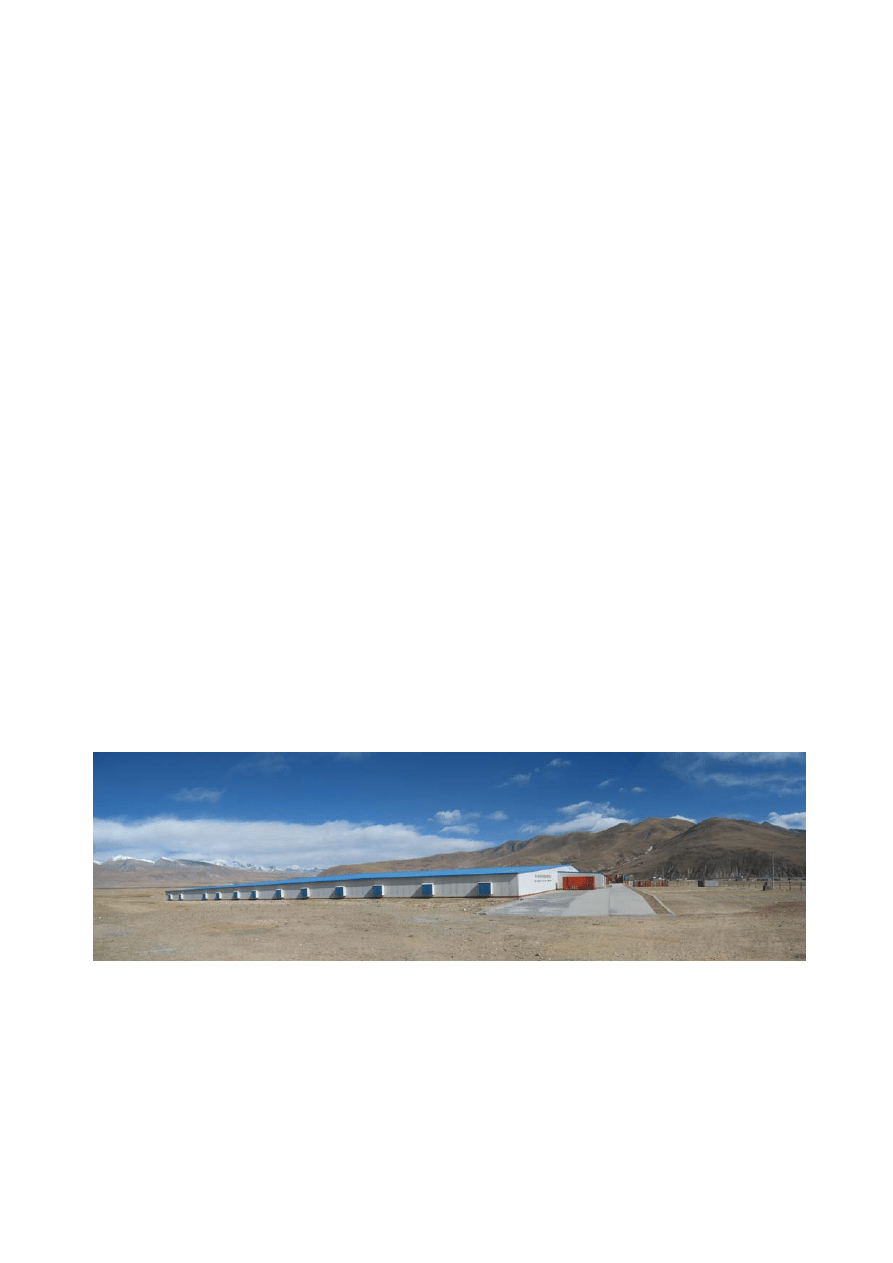
BIO-ALGORITHMS AND MED-SYSTEMS
JOURNAL EDITED BY MEDICAL COLLEGE – JAGIELLONIAN UNIVERSITY
Vol. 3, No. 5, 2007, pp. 59
GRIDS AT 4300 METERS OVER THE SEA LEVEL: ARGO ON
EUCHINAGRID
C.
S
TANESCU
*
,
F.
R
UGGIERI
*
,
Y.Q.
G
UO
**
,
L.
W
ANG
**
,
X.M.
Z
HANG
**
*
INFN Roma Tre, Roma, Italy.
**
IHEP, Beijing, China.
ARGO-YBJ is a Cosmic Ray Experiment in Yangbajing –
Tibet (P.R. China), which has reached the full configuration by
the end of year 2006 and is taking remarkable amounts of
data. The YangBaJing Laboratory is pretty unique due to the
altitude position of around 4300 m over the sea level which
makes it the ideal laboratory for the study of Extensive Air
Showers (EAS) in the region from 500 MeV (millions of
electron Volts, measuring the energy) to few TeV (millions of
MeV). On the other hand the position at such a highness
makes difficult to maintain a stable crew of researchers to
monitor and control the experiment. The usage of remote
controls via network and remote access to processes and
data is then mandatory to achieve an acceptable duty cycle in
the long term. The foreseen data that will be accumulated by
the end of 2007 is of the order of 100 TBytes (1012 Bytes)
and larger amounts of data are expected every forthcoming
year.
The needs of data exchange with the laboratory in Tibet
and of strong collaboration with Chinese institutes for the
analysis of these data is well in line with the typical
applications of a world-wide GRID. Today several hundreds of
Gigabytes of data are exchanged via Network while the usage
of the magnetic tape cartridges is being limited to the final
archive. Thanks a combination of Grid technology and high-
bandwidth network connectivity, EUChinaGRID greatly
improved the efficiency of the data transfer and dramatically
helps the coordinated analysis of those large quantities of
data between Europe and China.
Data and analysis results of the ARGO-YBJ experiment
are of widen importance for a large worldwide community
related to the investigation of the Gamma Ray Bursts (GRB).
Gamma-ray bursts are short-lived bursts of gamma-ray
photons, the most energetic form of light. At least some of
them are associated with a special type of supernovae, the
explosions marking the deaths of especially massive stars.
The Yang-Ba-Jing laboratory in Tibet is a part of the ARGO experiment

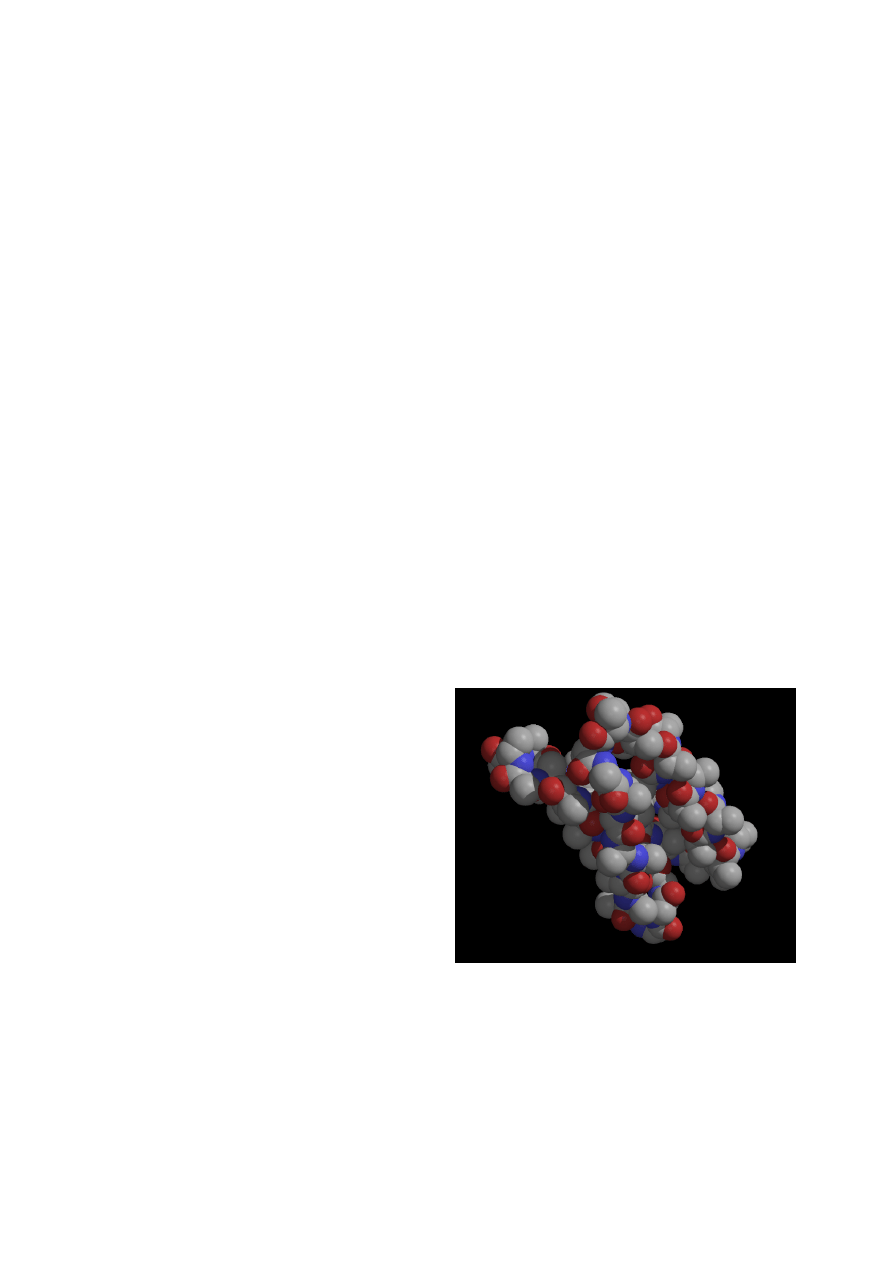
BIO-ALGORITHMS AND MED-SYSTEMS
JOURNAL EDITED BY MEDICAL COLLEGE – JAGIELLONIAN UNIVERSITY
Vol. 3, No. 5, 2007, pp. 61
EUCHINAGRID: A HIGH-TECH BRIDGE ACROSS EUROPE AND CHINA
F
EDERICA
T
ANLONGO
GARR, Roma, Italy
Co-Funded by the European Commission in the frame-
work of FP6, EUChinaGRID (www.euchinagrid.eu) aims at
integrating major Grid infrastructures in Europe (EGEE) and
China (CNGrid) for the benefits of eScience applications, thus
facilitating existing and future collaboration between Europe
and China. EUChinaGRID is also promoting the exchange of
expertise with Chinese counterparts towards the deployment
of new advanced services and applications in Grids, in line
with the support of the intercontinental extension of the Euro-
pean Research Area (ERA).
With a total budget of 1.636.000,00 €, the project is coor-
dinated by the Italian INFN (National Institute of Nuclear
Physics) and involves several high-profile partners in Europe
(CERN, Department of Biology, University of Roma Tre,
GARR, GRNET, Jagiellonian University medical College) and
China (Beihang University, CNIC - Chinese Academy of
Sciences, IHEP, Peking University).
The project is supporting the implementation of an inter-
continental pilot infrastructure, using in a first place EGEE-
supported applications in order to validate the infrastructure,
then facilitating the migration of new ones on the European
and Chinese infrastructures. EUChinaGRID’s first results were
therefore to facilitate scientific data transfer and processing:
pilot Physics (LHC), Astrophysics (ARGO), and Biology
(Early/Late Stage, Rosetta), applications are already ex-
ploiting the new infrastructure, while helping in validating it.
EUChinaGRID Project officially started on 1st January
2006 and, during the first year of works already achieved
several goals.
Started well ahead the foreseen plans, a first pilot infra-
structure is up and running with 9 sites, 3 of which in China.
All relevant Grid services were started and are maintained to
facilitate the access of users and Virtual Organizations (VO)
through the web portal.
A major challenge for the project is interoperability be-
tween European and Chinese middleware: reaching it,
EUChinaGRID will provide the International scientific commu-
nity a transparent access to a set of resources much greater
than separately available in each environment. After a year of
activity, a first version of the gateway between EGEE and
CNGrid is already available.
A pioneering work has being carried out as well in order to
achieve “vertical” interoperability, i.e. between Grid middle-
ware and the different versions of the IP protocol, thus ena-
bling the deployment of grid nodes in an IPv6 environment.
First results of IPv6-Grid Middleware compliance test were
published and widely disseminated to middleware developers;
this activity brought to the deployment of a version of GOS,
the middleware used by CNGrid, which is fully compliant with
IPv6.
During the last quarter of 2006 EUChinaGRID project also
supported with significant computing resources the WISDOM
Data Challenge. This virtual screening challenge of the inter-
national WISDOM (World-wide In Silico Docking On Malaria)
initiative started on 1st October and targeted compounds of
interest for drug discovery against neglected diseases.
EUChinaGRID had an intense dissemination activity with
about 500 students, users, developers and system
administrators in Europe and China were involved in interna-
tional conference, workshops and targeted training events.
Graphical output of a protein structure predicted with
ROSETTA


BIO-ALGORITHMS AND MED-SYSTEMS
JOURNAL EDITED BY MEDICAL COLLEGE – JAGIELLONIAN UNIVERSITY
Vol. 3, No. 5, 2007, pp. 63
RADIOLOGY ON GRID
A
NDRZEJ
U
RBANIK
Chair of Radiology – Collegium Medicum – Jagiellonian University – Cracow , Poland
Chair of Radiology – University Hospital , Krakow, Kopernika 21, Poland
The radiology is the discipline of medicine which deals with large databases of medical information. These are mostly of
graphic form. The computer resources to conduct the standard medical analyses like RTG, USG, mammography, CT and MRI
are appropriate to these analysis of this type of data.
There is only one medical diagnostic measurement which requires large scale computer resources. This measurement, very
important for neurological diagnostics, is the visualization of brain functionality. This technique is based on the magnetic
resonance phenomena (fMRI). The analysis of the source data (which is of large size) requires the massive calculation to be
performed in a relatively short time scale to make possible the diagnosis complete.
According to our experiences, such measurements are performed rather unfrequently, what makes the availability of large
scale computational resources and access to grid net of important meaning for practical medicine particularly in the radiology
specialization.


BIO-ALGORITHMS AND MED-SYSTEMS
JOURNAL EDITED BY MEDICAL COLLEGE – JAGIELLONIAN UNIVERSITY
Vol. 3, No. 5, 2007, pp. 65
GRID MONITORING IN EUCHINAGRID INFRASTRUCTURE
L
ANXIN
M
A
European Organization for Nuclear Research, Geneva - Switzerland
Institute of high energy physics, Beijing-China
EUChinaGrid is a Project which is founded by EU in 6th framework. Until now, EUChina grid infrastructure contains 10
sites which cover 4 counties in China and in Europe. There ara more than 1000 CPUs, 10 SEs, 10 CEs etc. in
EUChinaGrid infrastructure to support EUChina issues. The project has many applications, such as high energy
physics application, CMS , ATLAS, astroparticle physics applications (ARGO-YBJ / GRB) , biology application etc. So,
it is important to provide reliable grid services, improve the reliability of the grid infrastructure and provide stakeholders
with views of the infrastructure allowing to understand the current and historical status of the service. For this purpose,
gridIce and SAM are used to monitoring EUChina grid infrastructure. In this paper, we present tools which are able to
to check if a given grid service works as expected for a given user or set of users on the different resources available
on a grid.


Selvita is a product and solution provider for the Life Sciences Industry. We employ a world-class team of
dedicated medicine, chemistry, pharma, molecular biology, biotechnology and information technology
professionals and enjoy a very good cooperation with leading Polish, European and U.S. universities and
research institutes. We deliver comprehensive solutions to the customers from Life Sciences industry
targeted at lowering the cost of introducing innovative therapeutical compounds to the market. We
support our customers in the following ways:
9
Implementation of innovative and cost effective information technology platforms accelerating
research process and decreasing the risk of its failure
9
Enabling access to databases with ready, preprocessed knowledge for research organizations which
allows them to concentrate on their own creative process, rather than on mechanical knowledge
acquisition
9
Outsourcing of qualified R&D staff, specialized in subsequent phases of introduction of innovative
pharmaceuticals to the market
We also develop our own innovative biologically active structures, which are the effect of research at the
Polish universities, as candidates for further commercialization by our customers. The core strengths of
the company are:
9
molecule discovery & development
9
bioinformatics
9
contract research
Selvita implements advanced data processing solutions for the customers from biotechnology and
pharmaceutical industry, including bioinformatics applications (proprietary products, products from our
partners and customized solutions) in the area of genomics, proteomics, pharmacogenomics, PK/PD
modeling and cheminformatics.
The functionality of our solutions comprises all activities of data processing: molecular modeling, storage,
retrieval, data warehousing, data mining, integration and cleaning as well as applications for simulation,
sequence analysis, clusterization, phylogenetic prediction, parallel processing, agent technologies, grid
processing and data visualization.
Thanks to our solutions it is possible to design new compounds in silico based on quantitative structure-
activity relations, computer analysis of receptor interactions, conformation analysis, calculation of
physicochemical parameters of organic compounds. We also support construction of pharmacodynamics
and pharmacokinetics models of biologically active compounds.
We also provide outsourced drug design and screening services based on customers’ specifications with
the utilization of our own IT infrastructure and software as well as high quality laboratory infrastructure.
We also offer integration and access services to biological and other data over the Internet in compliance
with international standards and compatible with publicly available databases.
Selvita also offers integration services in the area of IT infrastructure cooperating with commercial
research equipment and bioreactor facilities. We also conduct our own research projects for the
pharmaceutical customers in collaboration with leading universities and institutes. We are also interested
in research cooperation on commercial and publicly funded (e.g. European Union) projects.
Please visit our website at www.selvita.com
Wyszukiwarka
Podobne podstrony:
4 Fuel and Lubrication System
JOINT CAPABILITIES INTEGRATION AND DEVELOPMENT SYSTEM
M37a2 Heating and Ventilation System 18 32
67 Audio and Visual System
Navigation and Audio System
Audel Hvac Fundamentals, Air Conditioning, Heat Pumps And Distribution Systems (Malestrom)
Lynge Odeon A Design Tool For Auditorium Acoustics, Noise Control And Loudspeaker Systems
Introduction to Mechatronics and Measurement Systems
M37a1 Heating and Ventilation System 1 17
Brain Facts A Primer on the Brain and Nervous System The Society for Neuroscience
C102990 0 SERVICE SYSTEM STARTING NO REMOTE
Altimeter and Barometer System Nieznany (2)
28 Wheel and Tire System Inspection
JOCCC Vol 9 No 1 2005
Eli, PAWLLO ZALICZENIE, ALGORYTM ZAMIENIAJACY LICZBĘ Z SYSTEMU SZESNASTKOWEGO NA DZIESIETNY
B8 Algorytmy optymalizacji w dyskretnych systemach produkcyjnych
4 Fuel and Lubrication System
JOINT CAPABILITIES INTEGRATION AND DEVELOPMENT SYSTEM
Alchemy Journal Vol 6 No 1
więcej podobnych podstron