
© P o l s k i e T o w a r z y s t w o G i n e k o l o g i c z n e
451
Ginekol Pol. 2011, 82, 451-454
P R A C E P O G L Ñ D O W E
ginekologia
Epidemiological models for breast cancer
risk estimation
Epidemiologiczne modele szacujàce ryzyko zachorowania na raka sutka
Rogulski Lech
1
, Oszukowski Przemysław
2
1
NZOZ „Medyk-Centrum”, Częstochowa, Polska
2
Instytut Centrum Zdrowia Matki Polki, Łódź, Polska
Abstract
Breast cancer is the most common malignancy affecting women worldwide. Effective prevention and screening are
only possible if there is precise risk prediction for cancer in an individual patient.
Mathematical models for estimation of breast cancer risk were developed on the basis of epidemiological studies.
It is possible to identify women at high risk for this disease using patient history data and the analysis of various
demographic and hereditary factors. The Gail risk model, originally developed in the United States to selectively
identify patients for breast cancer chemoprevention studies, remains to be the most widely used and properly
validated. The Cuzick-Tyrer model is more advanced and was developed for the International Breast Intervention
Study (IBIS-1). It incorporates the assessment of additional hereditary factors, body mass index, menopausal status
and hormone replacement therapy use. Genetic models aiming at calculating individual risk for BRCA1 and BRCA2
mutation carrier-state have also been designed.
In this review we discuss the usefulness of various risk estimation models and their possible application for breast
cancer prophylaxis.
Key words:
breast cancer
/
risk assessment
/
statistical models
/
chemoprevention
/
Streszczenie
Rak piersi jest najczęstszym nowotworem złośliwym występującym u kobiet w Polsce i na świecie. Warunkiem
odpowiedniego postępowania profilaktycznego i skriningowego jest możliwie precyzyjne określenie ryzyka
wystąpienia nowotworu u danej pacjentki.
Na podstawie badań epidemiologicznych zostały opracowane matematyczne modele służące do szacowania
ryzyka raka. Przy ich zastosowaniu na podstawie relatywnie prostych danych wynikających z wywiadu lekarskiego
oraz analizy czynników demograficznych i rodzinnych można wyselekcjonować pacjentki, u których ryzyko rozwoju
choroby nowotworowej jest podwyższone. Jednym z takich modeli, najpopularniejszym i najdokładniej przebadanym
na świecie jest model Gail’a opracowany w Stanach Zjednoczonych jako narzędzie identyfikujące pacjentki do
chemoprofilaktyki antyestrogenowej.
Otrzymano:
15.01.2011
Zaakceptowano do druku:
20.05.2011
Corresponding author:
Lech Rogulski
NZOZ „Medyk-Centrum”
Polska, 42-200 Częstochowa, al. Wolności 34
tel.: 660 691 606
e-mail: lech.rogulski@gmail.com
Nr
6/2011
452
P R A C E P O G L Ñ D O W E
ginekologia
Ginekol Pol. 2011, 82, 451-454
Rogulski L, et al.
Introduction
Breast cancer is the most common malignancy affecting
women. According to reports from the Maria Skłodowska-
Curie Institute of Oncology, Warsaw, in 2007 breast cancer was
diagnosed in more than 14 thousand women in Poland. It was
followed by colon, lung and endometrial cancer. In the same
year, more than 5 thousand patients died from breast cancer.
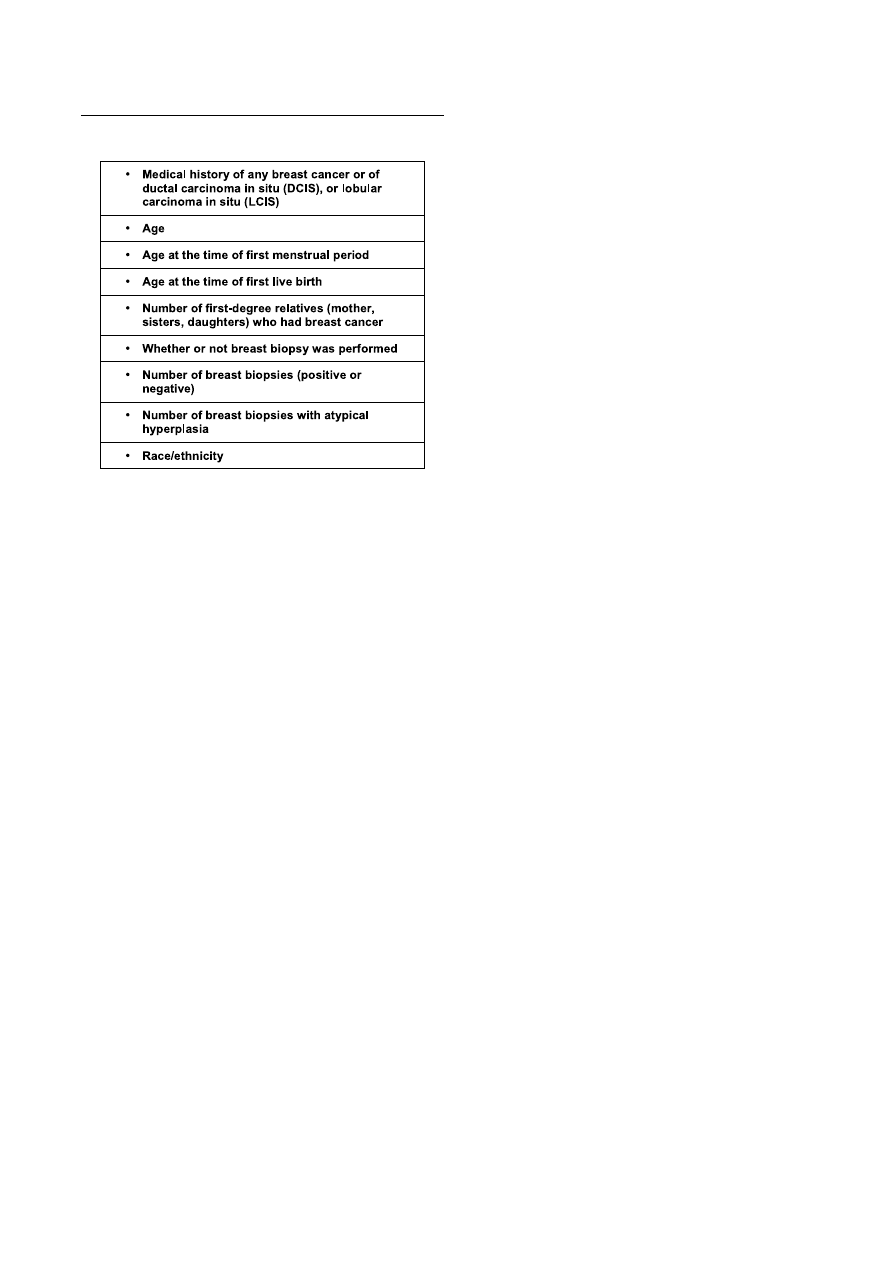
The standardized breast cancer incidence and mortality rates for
2007 were 47,7 and 14,5 per 100000 women, respectively.
In
highly developed Western countries breast cancer incidence is
significantly higher [1-3]. (Table I).
In the past decades, breast cancer incidence rate in Poland
has been on steady increase, which is most likely related to the
increasing prevalence of oncologically unfavorable demographic
and reproductive profiles of the society. The mortality rate
remains fairly stable which reflects improvements in diagnosis
and treatment. Unfortunately, more advanced-stage cancers are
diagnosed in Poland and 5-year survival rate is lower than in the
United States and Western Europe. In comparison, Sweden has
about twice the Polish incidence rate but identical mortality rate.
(Table I).
Currently, Poland has a well-designed mammography
screening program starting at 50 years of age. However,
prophylactic examinations and preventive care for younger
women are not readily available in spite of recommendations of
both national and international medical societies
[4, 5].
Due to limited resources in the health care system, it is
important for physicians to be able to identify women at risk
for developing breast cancer who may benefit from early and
intensive prophylaxis. A number of mathematical risk models
based on epidemiological studies have been designed to meet
such demand.
Gail Risk Model
Although it is possible to assess the risk factors for breast
cancer individually when counseling a patient, this method cannot
be standardized properly and thus translated into clinical decision-
making. When the option for breast cancer chemoprevention with
tamoxifen was introduced in the mid-80s, a new model for the
risk prediction was needed
[6]. Optimally, an absolute risk model
can be constructed from a sufficiently large database of patients
divided into subgroups with every possible combination of risk
factors. Each subgroup should be large enough for absolute risk for
developing cancer to be computed from a simple life expectancy
table. Understandably, such a method would be impractical due
to a sheer sample size required to obtain accurate results. Indirect
methods that rely on estimates for relative risk associated with
each factor are necessary.
In 1989 Mitchell Gail, a biostatistician working for the
National Cancer Institute, MD, USA designed a mathematical
model for breast cancer risk estimation
[7]. The basis for this
model were results from a large screening study known as the
Breast Cancer Detection Demonstration Project which included
284780 women who had been undergoing annual mammographic
examinations
[8]. Dr Gail and his associates identified several
key risk factors and estimated their relative risk values; which for
individual factors were multiplied by each other, projected on the
basic risk and converted into percentage values.
Exact mathematics aside, the Gail model provides an
estimated risk for developing breast cancer in a particular patient
for any subsequent time period. In most concomitant studies
utilizing the Gail model, risk assessment was limited to 5 years
and lifetime (up to 90 years of age). Since its publication, the
original Gail model underwent some modifications limiting its
application to invasive cancer risk only, incorporating atypical
hyperplasia in breast biopsy as a new risk factor and adding
effects of race or ethnicity
[9].
Table II summarizes data necessary for breast cancer risk
assessment with the modified Gail model. The National Cancer
Institute has published an online calculator based on this model
as a counseling tool for both patients and medical professionals
(available at http://www.cancer.gov/bcrisktool/).
The Gail model was thoroughly validated in various settings
and its strengths and limitations were recognized. It was primarily
designed for the general population where epigenetic risk factors
predominate over positive familial history. The history of cancer
in the first degree relative is both the single most important risk
factor and the only hereditary risk factor taken into account. Male
breast cancers and ovarian cancers occurring in patient family, as
well as age at diagnosis were also disregarded.
Innym, bardziej zaawansowanym modelem jest model Cuzick-Tyrer opracowany na potrzeby badania International
Breast Intervention Study (IBIS-1). Uwzględnia on dokładniejszą ocenę czynników dziedzicznych, a także wskaźnik
masy ciała, stan menopauzalny oraz przyjmowanie hormonalnej terapii zastępczej. Opracowane zostały również
modele czysto genetyczne służące do obliczania ryzyka nosicielstwa mutacji genów BRCA1 oraz BRCA2.
W niniejszej pracy rozważona jest użyteczność różnych modeli szacowania ryzyka oraz możliwości ich zastosowania
w profilaktyce raka sutka.
Słowa kluczowe:
rak sutka
/
ocena ryzyka
/
modele statystyczne
/
chemioprofilaktyka
/
Table I. Standardized breast cancer incidence and mortality rates (per 100000
women) in selected countries in 2007 [1-3].
© P o l s k i e T o w a r z y s t w o G i n e k o l o g i c z n e
453
P R A C E P O G L Ñ D O W E
ginekologia
Ginekol Pol. 2011, 82, 451-454
Epidemiological models for breast cancer risk estimation.
Since the vast majority of breast cancers occurs sporadically,
the Gail model was highly successful in predicting the number
of cancer cases in the general population. Rockhill et al. reported
the expected to observed (E/O) cases ratio to be 1.03 (95%
confidence interval (CI) – 0.88-1.21) in women screened regularly
with mammography
[10]. An Italian study by Decarli et al. gave
comparable results – E/O of 0.93 (95% CI 0.81-1.08)
[11].
Two major weaknesses of the Gail model were depreciation
of the risk in patients with strong positive family history and
relatively low predictive value for the development of cancer
in an individual patient. Therefore, genetic specialists at the
outpatient departments dealing with familial breast cancer ought
to be careful when using the Gail model and should emphasize its
limitations in their counseling. Patients should be reassured that
high estimated risk does not imply the certainty of developing
cancer in the future and, on the other hand, low estimated risk
does not warrant less stringent adherence to screening programs.
Additional issue with the Gail model is its reliance on regular
mammographic examinations for accurate estimation. In younger
women who are mostly unscreened, the Gail model may slightly
overestimate the risk.
The first clinical application for the Gail model was to
qualify patients for the Breast Cancer Prevention Trial (BCPT).
This first randomized placebo-controlled trial for breast cancer
chemoprevention with tamoxifen included women with 5-year
risk for developing cancer of at least 1.66% (1 or more cases in 60
women) [12]. The study has successfully shown a 49% decrease
in the incidence of invasive cancers in the tamoxifen pretreated
group. However, the beneficial effects were limited to estrogen-
positive cases. Further studies and meta-analyses confirmed the
observed results
[13].
According to recommendations by the U.S. Preventive
Services Task Force currently in effect, preventive use of
tamoxifen and raloxifen should be based on the elevated Gail risk
score with the same cut-off value as in the BCPT trial. Although
cancer chemoprevention falls outside of the scope of this review,
it is should be emphasized that the BCPT selection criteria for
the Gail score only lowered the number needed to treat, reducing
exposure to potentially dangerous drug, and made sample sizes
feasible to accrue. The results with regards to cancer prevention
are likely to be similar in general population but the side effects
of tamoxifen would prevail over its benefits.
Genetic Models
Genetic risk models neglect demographic and reproductive
risk factors and focus only on the family history for breast cancer.
The most popular is the Claus model
[14]. Based on a large
case-control study of 9418 women, it used sophisticated genetic
analyses to identify a hypothetical autosomal allele responsible
for increased breast cancer risk. The allele effect is age-dependent
and unveils more often in younger women. In general population,
one in 300 women is a carrier. Frequency increases with positive
family history and respective odds may be calculated from the
number of affected relatives. The elevated probability for the
allele carrier increases the overall cancer risk above that observed
in general population (10% in the United States at the time of the
original study by Claus et al.). Unfortunately, lack of epigenetic
risk factors confers to even lower predictive values than the Gail
model. Amir et al. have shown that predictive accuracy expressed
by the area under receiver-operator characteristic (ROC) curve
was 0.735 for the Gail model and 0.716 for the Claus model
[15].
Concordance of the Gail and Claus models in individual cases
has been shown to be low [16].
Other genetic risk models (BRCAPRO and BOADICEA)
took the risk assessment from a different perspective [17, 18].
With the analysis of lineage, they estimated the risk of the given
individual for BRCA1 and BRCA2 mutations. If the risk exceeds
20% (10% in the United States), then genetic testing may be
warranted
[19]. The primary application for these models is cost-
effective qualification for genetic profiling but they could be
used for risk assessment. The overall breast cancer risk can be
calculated as a product of carrier-state probability and the risk for
developing cancer with BRCA1 and BRCA2 mutations.
Genetic models should best be used in specialist breast
cancer prevention clinics where the positive family history is the
main reason for referral.
Cuzick-Tyrer Risk Model
The only model incorporating multiple epigenetic risk factors
and extensive family history is the Cuzick-Tyrer risk model
[20]. It was developed as an alternative to the Gail model for
qualification of patients for the International Breast Intervention
Study (IBIS-1)
[21]. The study was primarily based in the United
Kingdom, Australia and New Zealand. Although positive family
history and hyperplasia or lobular carcinoma in situ in previous
breast biopsies were the primary inclusion criteria, patients with
an estimated 10-year risk for developing breast cancer of 5% or
more were also considered for inclusion.
The model used in the IBIS trial was subsequently published
and is now available for downloading at http://www.ems-trials.
org/riskevaluator/. It provides an in-depth pedigree analysis of
the first and second degree relatives, including both breast and
ovarian cancer cases, age at diagnosis and occurrence of bilateral
disease. Possible results of genetic testing, menopausal status,
use of hormone replacement therapy and body mass index are
Table II. Data required to calculate breast cancer risk from the modified Gail model.

Nr
6/2011
454
P R A C E P O G L Ñ D O W E
ginekologia
Ginekol Pol. 2011, 82, 451-454
Rogulski L, et al.
taken into consideration as well. The model calculates predicted
absolute lifetime and 10-year risk for developing breast cancer as
well as risk for being BRCA1 or BRCA2 carrier from the family
tree analysis.
Amir et al. who compared different risk assessment models in
women with positive family history found that the Cuzick-Tyrer
model was the most accurate for the E/O ratio of 0.81 (95% CI
0.62-1.08) and the area under ROC curve of 0.762. Expectedly,
the Gail model seriously underestimated the risk in the study
population [15].
Discussion
Adjusting therapeutic and preventive interventions to the
individual risk for developing various diseases has become a
widespread approach, particularly in cardiovascular medicine.
Breast cancer risk estimation models brought this concept into
gynecologic oncology. Ideally, a woman presenting to a primary
care physician or gynecologist with breast cancer prophylaxis
should undergo triage with the most comprehensive risk model
that would determine time for initiation, method and frequency
of screening. Chemoprevention for high risk women should be
considered.
A common clinical problem is whether or not to obtain a
wide range screening mammograms in women in their forties.
While it is commonly accepted and reflected in various national
programs that screening should commence at 50 years of age,
certainly there are also younger women who would benefit from
such examinations. If we assume that a 50-year old woman with
no risk factors should be screened, then any younger women
whose estimated risk equals or exceeds that for the former should
be screened, too
[22]. Appropriate calculations could be easily
made with the Gail or Cuzick-Tyrer risk models.
McPherson et al. found that by using the presented rationale
about 75% of unscreened patients who were diagnosed with
breast cancer in their forties should have been recommended for
earlier mammography
[23]. The study did not consider, however,
the increased breast density in younger women and difficulties
in obtaining diagnostic images in that age group. Increased
radiological breast density by itself is one of the strongest risk
factors for breast cancer. Boyd et al. have demonstrated a 5-fold
increase of breast cancer incidence (95% CI 3.6–7.1) in women
who had more than 75% of glandular tissue on their screening
mammograms
[24]. Regrettably, this factor was not implemented
in any of the risk models.
Breast cancer risk models have the potential to become
useful tools in the Polish population. Adjustments should be
made to reduce cancer incidence and overall lifetime risk. Further
studies are needed as this subject coverage in the Polish literature
is scarce.
The authors declare no conflict of interests.
References
1. Data from Krajowa Baza Danych Nowotworowych: www.onkologia.org.pl/pl/p/7
2. Data from SEER (Surveillance Epidemiology and End Results): www.seer.cancer.gov
3. Data from NORDCAN: www-dep.iarc.fr/nordcan.htm
4. Rekomendacje Zarządu Głównego PTG w sprawie profilaktyki i wczesnej diagnostyki zmian w
gruczole sutkowym. Gin Prakt. 2005, 84, 14-15.
5. Bińkowska M, Dębski R. Screening mammography in Polish female population aged 45 to 54.
Ginekol Pol. 2005, 76, 871-878.
6. Cuzick J, Baum M. Tamoxifen and contralateral breast cancer. Lancet. 1985, 2, 282.
7. Gail M, Brinton L, Byar D, [et al.]. Projecting individualized probabilities of developing breast
cancer for white females who are being examined annually. J Natl Cancer Inst. 1989, 81, 1879-
1886.
8. Baker L. Breast cancer detection demonstration project: Five-year summary report. CA Cancer
J Clin. 1982, 32, 194-225.
9. Costantino J, Gail M, Pee D, [et al.]. Validation studies for models projecting the risk of invasive
and total breast cancer incidence. J Natl Cancer Inst. 1999, 91, 1541-1548.
10. Rockhill B, Spiegelman D, Byrne C, [et al.]. Validation of the Gail et al. model of breast cancer
risk prediction and implications for chemoprevention. J Natl Cancer Inst. 2001, 93, 358-366.
11. Decarli A, Calza S, Masala G, [et al.]. Gail model for prediction of absolute risk of invasive breast
cancer: independent evaluation in the Florence-European Prospective Investigation Into Cancer
and Nutrition cohort. J Natl Cancer Inst. 2006, 98, 1686-1693.
12. Fisher B, Costantino J, Wickerham D, [et al.]. Tamoxifen for prevention of breast cancer: report
of the National Surgical Adjuvant Breast and Bowel Project P-1 Study. J Natl Cancer Inst. 1998,
90, 1371-1388.
13. Cuzick J, Powles T, Veronesi U, [et al.]. Overview of the main outcomes in breast cancer
prevention trials. Lancet. 2003, 361, 296-300.
14. Claus E, Risch N, Thompson W. Genetic analysis of breast cancer in the cancer and steroid
hormone study. Am J Hum Genet. 1991, 48, 232-242.
15. Amir E, Evans D, Shenton A, [et al.]. Evaluation of breast cancer risk assessment packages in
the family history evaluation and screening programme. J Med Genet. 2003, 40, 807-814.
16. McTiernan A, Kuniyuki A, Yasui Y, [et al.]. Comparisons of two breast cancer risk estimates in
women with a family history of breast cancer. Cancer Epidemiol Biomarkers Prev. 2001, 10,
333-338.
17. Parmigiani G, Berry D, Aquilar O. Determining carrier probabilities for breast cancer susceptibility
genes BRCA1 and BRCA2. Am J Hum Genet. 1998, 62, 145-148.
18. Antoniou A, Pharoah P, Smith P, [et al.]. The BOADICEA model of genetic susceptibility to breast
and ovarian cancer. Br J Cancer. 2004, 91, 1580-1590.
19. McIntosh A, Shaw C, Evans G, [et al.]. Clinical Guidelines and Evidence Review for The
Classification and Care of Women at Risk of Familial Breast Cancer. London: National
Collaborating Centre for Primary Care/University of Sheffield, 2004.
20. Tyrer J, Duffy S, Cuzick J. A breast cancer prediction model incorporating familial and personal
risk factors. Stat Med. 2004, 23, 1111–1130.
21. Cuzick J, Forbes J, Sestak I, [et al.]. Long-term results of tamoxifen prophylaxis for breast
cancer- 96-month follow-up of the randomized IBIS-I trial. J Natl Cancer Inst. 2007, 99, 272-
282.
22. Gail M, Rimer B. Risk-based recommendations for mammographic screening for women in their
forties. J Clin Oncol. 1998, 16, 3105–3114.
23. McPherson C, Nissen M. Evaluating a risk-based model for mammographic screening of
women in their forties. Cancer. 2002, 94, 2830-2835.
24. Boyd N, Lockwood G, Byng J, [et al.]. Mammographic densities and breast cancer risk. Cancer
Epidemiol Biomarkers Prev. 1998, 7, 1133–1144.
Document Outline
Wyszukiwarka
Podobne podstrony:
Epidemiologiczne modele szacujace ryzyko zachorowania na raka sutka
Prof Majewska Szczepienia na grypę mogą zwiększać ryzyko zachorowania na covid 19
Epidemiologia i zachorowania na cukrzycę w Polsce i na świecie
Janusz Gajos Człowiek, którzy rządzi Polską, postanowił zmusić ludzi, żeby wzięli na siebie ryzyko z
D19240304 Rozporządzenie Ministra Spraw Wewnętrznych z dnia 24 marca 1924 r w przedmiocie obowiązko
D19230096 Rozporządzenie Ministra Zdrowia Publicznego z dnia 7 lutego 1923 r w przedmiocie obowiązk
D19250133 Rozporządzenie Ministra Spraw Wewnętrznych z dnia 11 lutego 1925 r w sprawie obowiązkoweg
Leczenie chorych na raka piersi w ciąży VI LEK
Kurkuma dlatego Hindusi nie chorują na raka
Lekarstwo na raka
Witamina B17 - lekarstwo na raka, @P PROD. KTÓRE CHRONIĄ PRZED RAKIEM @, Rak i terapia
PESTKI MORELI GORZKIEJ LEKIEM NA RAKA
Amigdalina ukrywanym lekiem na raka
Lek na raka
więcej podobnych podstron