Zbigniew TURLEJ
Electrotechnical Institute
Efficiency and colors in LEDs light sources
Abstract. The light gains from LEDs continue to grow, doubling a about every two years. It gives real hope for the LEDs solving problem of
efficiency in the lighting. This paper presents review some problems connected with efficiency and colors inorganic LEDs technologies, also gives
some new perspectives for development based on organic LED and plasmonics.
Streszczenie. Światło emitowane przez źródła LED podwaja swą skuteczność świetlną co dwa lata. To stwarza poważną nadzieje na rozwiązanie
problemu efektywności energetycznej w oświetleniu. W referacie zarysowano historię i perspektywy rozwoju efektywności i barwy w technologii LED
ze szczególnym uwzględnieniem materiałów nieorganicznych, organicznych i efektów plazmoniki. (Barwy i efektywność źródeł światła LED).
Keywords: energy efficiency, LED colors and technology, light and health, illuminating technology.
Słowa kluczowe: efektywność energetyczna, barwa i technologie LED, światło i zdrowie, technika świetlna.
Lighting and energy efficiency
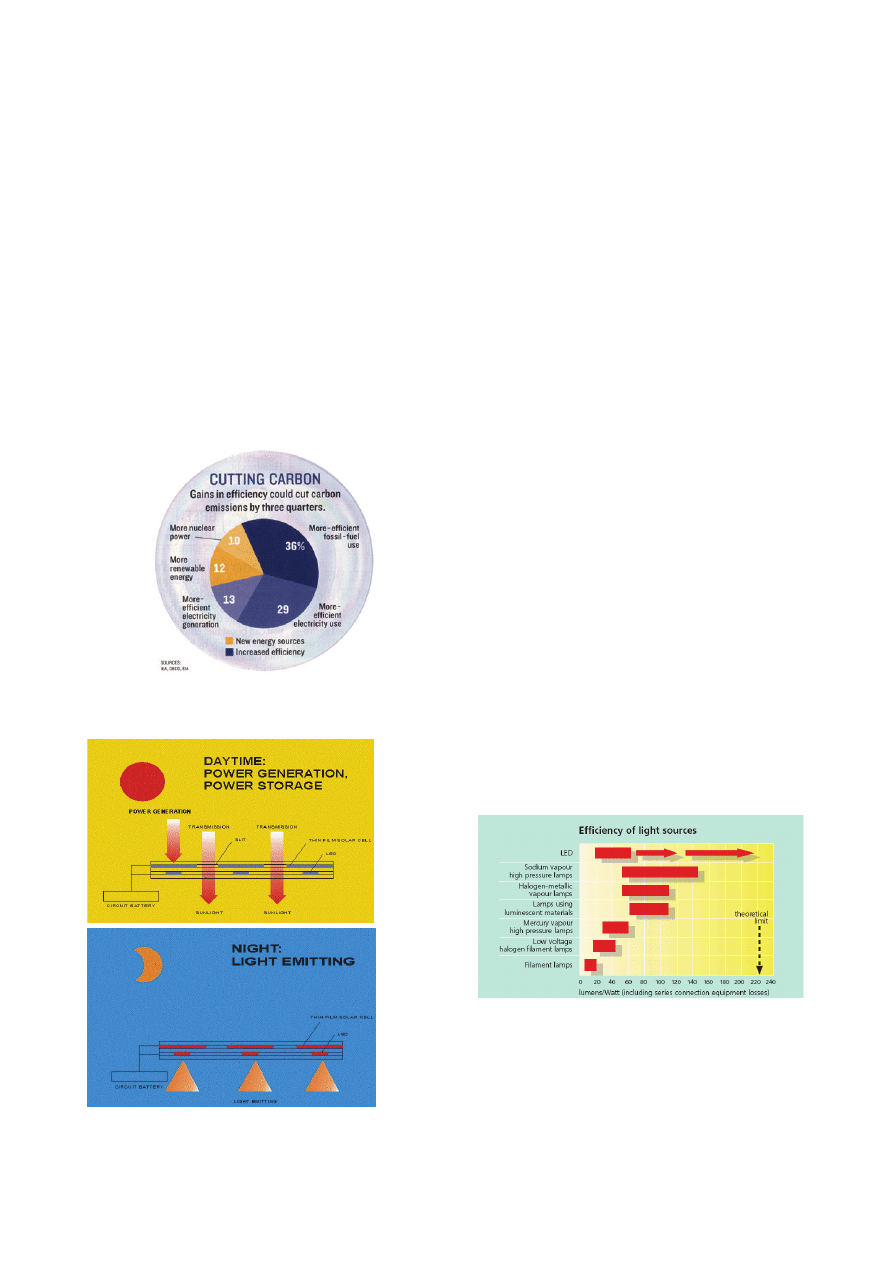
Population and economic growth threaten to keep
energy demand and carbon emissions growing, too. But the
new long-range forecasts (fig.1) produced by energy
experts show that in many key areas, increased efficiency
offers real hope for solving the problem.
Fig.1. The increasing efficiency offers the cutting carbon emissions
[1]
Fig.2. The integration of LEDs with photovoltaic (PV) and
architectural transparent materials
Lighting gobbles up 20% of the world’s electricity, or the
equivalent of roughly 600.000 tons of coal a day. Forty
percent of that powers old-fashioned incandescent light
bulbs – a 19
th
-century technology that wastes most of the
power it consumes on unwanted heat. Light emitting diode
(LED) lamps, not only use less electricity then incandescent
bulbs to generate the same amount of light, but they also
last 50 times longer. In December 2006, Dutch electronic
firm Philips became the first major bulb manufactures to
announce a gradual phase out of the production of
incandescent bulbs. Now exist an opportunity to have
lighting systems that modulate their intensity to supplement
natural light. These systems will require the integration of
LEDs with photovoltaic (PV) and architectural transparent
materials (fig.2).
The unique properties
Light sources should be as small as possible, produce
light efficiently and have a long life. Until now, however, no
filament or discharge lamp has combined all three
properties. Only light emitting diodes (LEDs) achieves this.
No other lamp possesses comparably small dimensions.
The miniature form requires small optical systems and
creates new demands for light guidance. The light optical
systems are mode from synthetic materials with light
refractive indices and replace the classic metal reflector.
The light gains from light diodes continue to grow, doubling
about every two years. It is not unrealistic to assume that in
ten to fifteen years LEDs will become the most efficient light
sources (fig. 3).
Fig.3. The light yield from LEDs is reaching ever higher vales [2]
With 50.000 operational hours light diodes have a very
long life. This results in a new conceptual approach to the
design and development of lighting. There is no longer a
need for equipment for changing the light source. LEDs and
luminaire grow old jointly and both are changed together
when the lamp has reached the end of its lifespan.
PRZEGLĄD ELEKTROTECHNICZNY - KONFERENCJE, ISSN 1731-6106, R. 5 NR 1/2007
55

The light production
In conventional lamps visible light arises as a by-product
of the warming of metal helix, or by a gas discharge or by
the conversion of a proportion of the ultraviolet radiation
produced in such a discharge. In light diodes the production
of light takes place in a semiconductor crystal which is
electrically excited to elektroluminescence (fig. 4, table 1).
Fig.4. LED functional principles. The light comes from
semiconductor crystal (LED chip). It is electrically excited to
produce light: two areas exist within the crystal, a n- conducting
area with a surplus of electrons and a p- conducting area with a
deficit of electrons. In the transitional area, called pn- transition or
depletion layer, light is produced in a recombination process of the
electron with the atom with the deficit of an electron when current is
applied to the crystal [2].
Table 1. History of light production by LED
1907
Henry Joseph Round (1881- 1966) discovers the
physical effect of elektroluminescence.
1962
The first red luminescent diode of type GaAsP
comes onto the market. The industrially produced
LED is barn.
1971
From the beginning of the seventies LEDs are
available in further colours: green, orange, yellow.
Performance and effectiveness is continually being
improved in all LEDs.
1980s to early 1990s High performance LEDs (LED
modules) in red, later red/orange, yellow and
green become available.
1995 The first LED producing white light by
luminescence conversion is introduced.
1997
White LEDs come onto the market.
As protection against environmental influences the
semiconductor crystal is set into a housing. This is
constructed so that the light radiates in a semicircle of
almost 180 degrees. Guidance of the light is thus easier
then in filament or discharge lamps, which generally radiate
light in all directions.
The monochromatic and the white colores
According to the type and composition of the
semiconductor crystal the light diode has different
monochromatic colors. Today there are blue, green, yellow,
orange, red and amber, together with nuances of these
colors. The white light can be generated by three general
approaches, illustrated in figure 5. The first is the
wavelength-conversion approach; the second is
the color
mixing approach; and the third is a hybrid between
the two.
Fig.5. The three possible approaches to white-light production [3]
Wavelength Conversion Approach
The first approach for transforming narrowband
emission into broadband white light involves using UV LEDs
to excite phosphors that emit light at down-converted
wavelengths. In general, this approach is likely to be the
lowest cost, because of its low system complexity (only a
single LED chip, and since the colors are created already
blended, lamp-level optical and color engineering is
minimized). It is also likely to be the least efficient, because
of the power-conversion loss associated with the
wavelength down-conversion; and the least flexible, since
the colors are “preset” at the factory.
Hence, a general challenge will be the development of UV
(340-380 nm) LEDs with high (>70%) external power-
conversion efficiency and input power density, and
multicolor phosphor blends with high (>85%) quantum
efficiency.
Color Mixing Approach
The second approach for transforming narrowband
emission into broadband white light is to combine light from
multiple LEDs of different colors. In general, this approach
is likely to be the most efficient, as there are no power-
conversion losses associated with wavelength down-
conversion. It is also likely to be the most flexible, since the
hue of the
light can be controlled by varying the mix of
primary colors, either in the lamp, or in the luminaire.
However, it is also likely to be the most expensive, because
of its high system complexity (multiple LED chips, mixing of
light from separate sources, and drive electronics that must
accommodate differences in voltage, luminous output,
element life and thermal characteristics among the
individual LEDs). Hence, a general challenge will be the
development of red, green and blue LEDs with high (>50%)
external power-conversion efficiencies and input power
density, and low-cost optics and control strategies for
spatially uniform, programmable color-mixing either in the
lamp or in the luminaire.
Hybrid Approach
The third approach for transforming narrowband
emission into broadband white light is a hybrid approach.
The present generation of white LEDs, with luminous
efficacies of 25
lm/W, is based on this approach. Primary
light from a blue (460 nm) InGaN-based LED is mixed with
blue-LED-excited secondary light from a pale-yellow
YAG:Ce
3+
-based inorganic phosphor. The secondary light is
centred at about 580 nm with a full-width-at-half-maximum
PRZEGLĄD ELEKTROTECHNICZNY - KONFERENCJE, ISSN 1731-6106, R. 5 NR 1/2007
56
line width of 160 nm. The combination of partially
transmitted blue and reemitted yellow light gives the
appearance of white light at a color temperature of 8000 K
and a luminous efficacy of about 25 lm/W. This combination
of colors is similar to that used in black-and-white television
screens – for which a low-quality white intended for “direct”
rather than “indirect” viewing – is acceptable. Other
variations of this approach are possible. The simplest
extension would be to mix blue LED light with light from a
blue-LED excited green and red duo-color phosphor
blend25 – this variation is likely to be give the best balance
between efficiency, color quality, cost and system
complexity. A more complex but perhaps more efficient
extension of this approach would be to mix blue and red
LED light with light from a blue-LED excited green
phosphor. In general, this approach is intermediate
amongst the three approaches in efficiency, complexity and
cost. It is likely to be intermediate in efficiency, as power-
conversion losses from wavelength down-conversion are
less from the blue than from the UV, but still greater than no
power-conversion losses. It is likely to be intermediate in
cost and system complexity, as only one (or at most two)
LEDs is used, but light from the LED must still be color-
mixed with light from the phosphor. Hence, a general
challenge will be the development of blue LEDs with high
(>60%) external power-conversion efficiencies and input
power density, blue-excitable duocolor phosphor blends
with high (>80%) quantum efficiency, and low-cost optics for
spatially uniform color-mixing in the lamp.
a)
b)
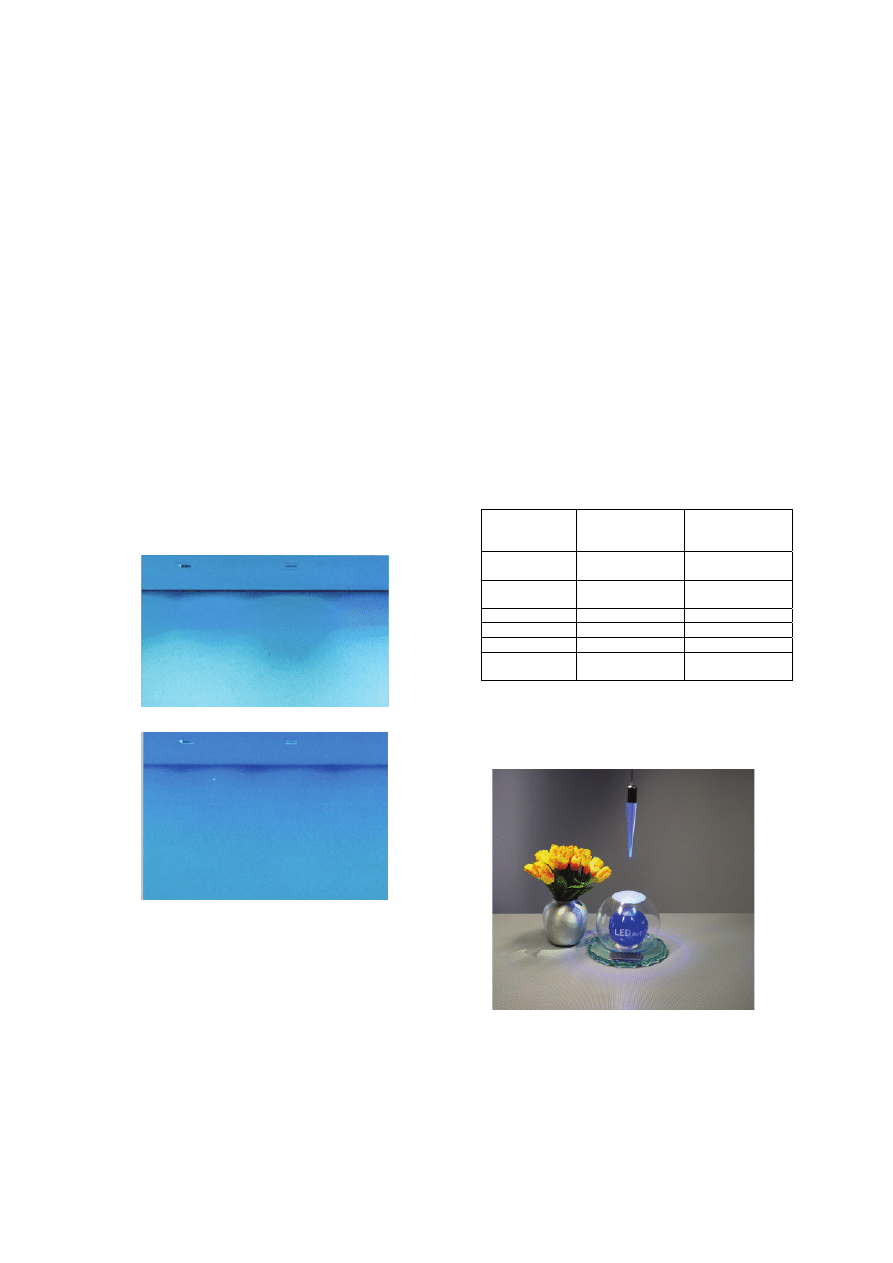
Fig. 6. The human eye registers even the slightest deviation in hue
(a) such as coloured wall washing (b) [2]
Problems with colors
One of the key characteristics of LEDs is their light color
saturation. Because of the manufacturing process we con
have deviations in the light colors of two of same LED
modules. The human eye registers even the slightest
deviation in hue (fig.6). Semiconductor producers classify
each LED into different categories, known as “binnings”
using the values actually measured. But even with the most
stringent selection, deviations still have to be accepted. To
ensure consistent colour Erco has introduced a
colour
compensation system. Every colour compensated LED
modules is individually measured and adjusted in the
factory. The compensation factors are permanently stored
in the control gear.
Blue LED and health
Circadian phototransduction is a term used to describe
how the retina converts light into neural signals that
regulate rhythms such as sleep, body temperature and
hormone production, and has been a topic of interest in
many laboratories around the world. We now know that the
circadian system is maximally sensitive to short-wavelength
light and that a combination of classical photoreceptors and
newly-discovered retinal neurons, which respond directly to
light exposure (called intrinsically-photosensitive retinal
ganglion cells or ipRGCs), participate in circadian
phototransduction. Much of what we do in lighting rests
upon a quantitative foundation for the specification of light
sources and light levels for vision. The model of circadian
phototransduction is the first attempt to establish a parallel
foundation for the circadian system. Much like we want to
know many lumens per watt a light source produces for the
visual system, it is now possible to calculate circadian
stimulus per watt. Table 2 shows values of circadian
stimulus per watt for several commercially available light
sources.
Table 2. Photopic lumens per watt and circadian stimulus per watt
for various light sources [3]
As we can see in Table 2 the blue LED light source (470
nm) is the most effective in suppressing melatonin than
others. Figure 7 shows the fixture for a melatonin regulation
in workplace.
Fig.7. The blue LED (470 nm) fixture for a effect melatonin
regulation in workplace designed by Electrotechnical Institute [4]
Looking a long way into the future, it is easy to imagine
that new standards will be adopted, new light sources
circadian systems, we may all end up in a healthier built
environment.
Light source
Photopic
lumens/watt
Circadian
stimulus/watt
Fluorescent
3000K
100 lm/W
74 CS/W
Fluorescent
7500K
100 lm/W
157 CS/W
Incandescent
12 lm/W
12 CS/W
D65
70 lm/W
133 CS/W
Clear Mercury
45 lm/W
18 CS/W
Blue LED
(470nm)
8 lm/W
15 lm/W
223 CS/W
418 CS/W
PRZEGLĄD ELEKTROTECHNICZNY - KONFERENCJE, ISSN 1731-6106, R. 5 NR 1/2007
57
LEDs - the new horizons
Korean company has released a single-die white
inorganic LED that can emit up to 240 lm at its maximum
drive current of 1A. The new P4 emitter is also claimed to
offer the word’s highest luminous efficacy, coming at 100
lm/W at 350 mA drive current that is required for general
illumination applications. Company says that the high
luminosity was reached through its proprietary phosphor
and packaging techniques, and further improvements are in
the pipeline. A 135 lm/W source is due to emerge this year,
and more incremental improvements are expected to lead
to 145 lm/W performance early in 2008.
Another
revolutionary means of lighting for the future is organic
LEDs (OLEDs).Today they illuminate displays, but they will
soon open up other types of lighting. Research on materials
has discovered a series of systems in which light can be
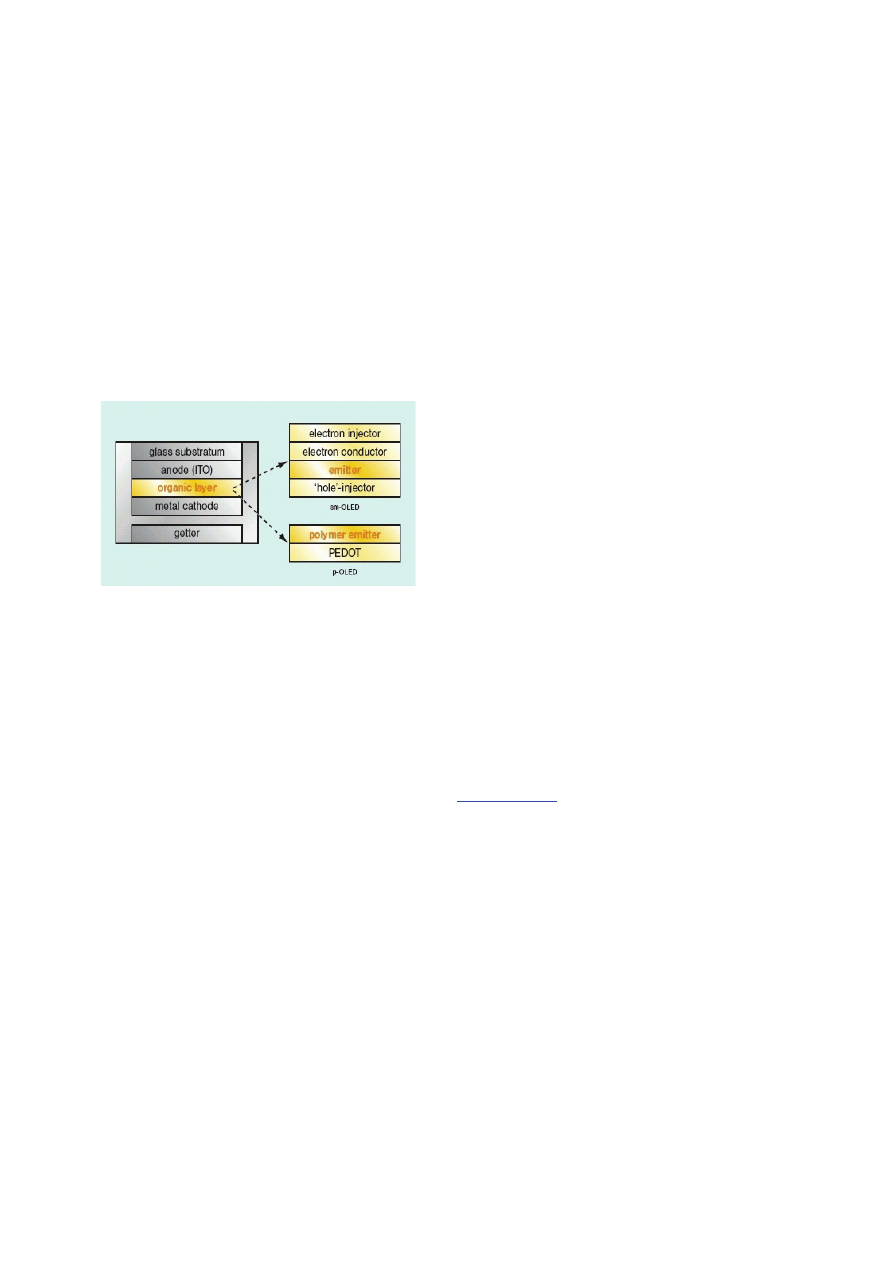
produced. The results reveal two groups: sm-OLEDs with
small molecules and p-OLEDs with polymers. They are
mainly differentiated by the number of materials necessary
to construct the light producing layers (fig 8).
Fig.8. Schematic representation of the functional principles of
OLEDs – the organic layer of sm-OLEDs consists of four coatings.
The same functionality can be achieved in p-OLEDs with two
coatings [5].
Using a method of light mixture in this organic layers,
white and colored OLEDs which are completely transparent
when switched off, can be manufactured. The production of
these is simple but their light can, however, only be dimmed
and not changed in color. The mixture for white light makes
it possible to adjust color temperature because distinct
organic layers are used to produce the three basic colors.
Such solutions hence offer possibilities for the design of
color sequences. Alternatively white light can be produced
with the aid of conversion principle, exactly as with
inorganic LEDs. If white OLEDs, which are constructed in
this way, then the light source is not transparent when
switched off. OLEDs, which are constructed from single,
individually controllable points, offer maximum flexibility in
the production of color and in dimming, however at very
high cost. In future solutions to this problem information
could, for example, be presented on illuminating surfaces.
Recently, however, scientist have been working on a new
technique for transmitting light through nanoscale interface
structures made of a metal and a dielectric. Under the right
circumstances, we have a resonant interaction between the
waves and the mobile electrons at the surface of the metal.
The result is the generation of surface plasmons – density
waves of electrons that propagate along the interface like
the ripples that spread across the surface of a pond after
you throw a stone into the water. Plasmonic materials may
revolutionize the lighting industry by making LEDs brighter.
It has become evident that this type of field enhancement
can also dramatically raise the emissions rates of dots and
quantum wells – tiny semiconductors structures that absorb
and emit light – thus increasing the efficiency and
brightness of solid-state LEDs. In 2004 at Japan’s Nichia
Corporation was demonstration that coating the surface of a
gallium nitride LED with dense arrays of plasmonic
nanoparticles (made of silver, gold or aluminum) could
increase intensity of the emitted light 14-fold.
REFERENCES
[ 1 ] G l a i n S . , K a s h i w a g i A . , K r o v a t i n Q ., Seeing the
scenarios, Davos Special Report, Newsweek, (2007), n.4, 44-
45,
[2] LED – Light from the Light Emitting Diode, Fördergemeinschaft
Gute Licht, (2006)
[3] Light Emitting Diodes (LEDs) for General Illumination, OIDA,
(2002)
[ 4 ] T u r l e j Z., Czynnik hormonalny w oświetleniu wnętrza, Prace
Instytutu Elektrotechniki, (2006), n.228, 297-306
[5] Briefings, Lighting, (2007), n.2, 8-14
[ 6 ] A t w a t e r H., The Promise of Plasmonics, Scientific American,
(2007), n.4, 38-45,
[7] F i g u e r o M., Research matters, LD+A, (2006), n.5, 24-26,
[8] S c h i e l k e T., Color compensation: ERCO technology for trude-
color varychrome LED luminaires, ERCO Leuchten GmbH, (2006),
25
_____________________
Author: dr inż. Turlej Zbigniew, Electrotechnical Institute,
Pożaryskiego 28, 04-703 Warsaw, Poland, e-mail:
PRZEGLĄD ELEKTROTECHNICZNY - KONFERENCJE, ISSN 1731-6106, R. 5 NR 1/2007
58
Wyszukiwarka
Podobne podstrony:
Emissions and Economic Analysis of Ground Source Heat Pumps in Wisconsin
Masonry and its Symbols in the Light of Thinking and Destiny by Harold Waldwin Percival
How effective are energy efficiency and renewable energy in curbing CO2 emissions in the long run A
Kołodziejczyk, Ewa Literature as a Source of Knowledge Polish Colonization of the United Kingdom in
Degradable Polymers and Plastics in Landfill Sites
Estimation of Dietary Pb and Cd Intake from Pb and Cd in blood and urine
Aftershock Protect Yourself and Profit in the Next Global Financial Meltdown
General Government Expenditure and Revenue in 2005 tcm90 41888
A Guide to the Law and Courts in the Empire
D Stuart Ritual and History in the Stucco Inscription from Temple XIX at Palenque
Exile and Pain In Three Elegiac Poems
A picnic table is a project you?n buy all the material for and build in a?y
Economic and Political?velopment in Zimbabwe
Power Structure and Propoganda in Communist China
A Surgical Safety Checklist to Reduce Morbidity and Mortality in a Global Population
VENTILATION AND COOLING IN UNDERGROUND MINES (2)
VENTILATION AND COOLING IN UNDERGROUND MINES
więcej podobnych podstron