Supers Rules Beta
These rules are in beta-format (we have not completed them). As such, there may be numerous
problems, misspellings, contradictions, etc. Please consider these rules both incomplete and
unplaytested.
That said, we believe what we have included will allow you to play JAGS Supers to a sufficient
degree: we think these rules have the basis to be great. Please join us in the creation of this
system.
-Marco 5/5/2001
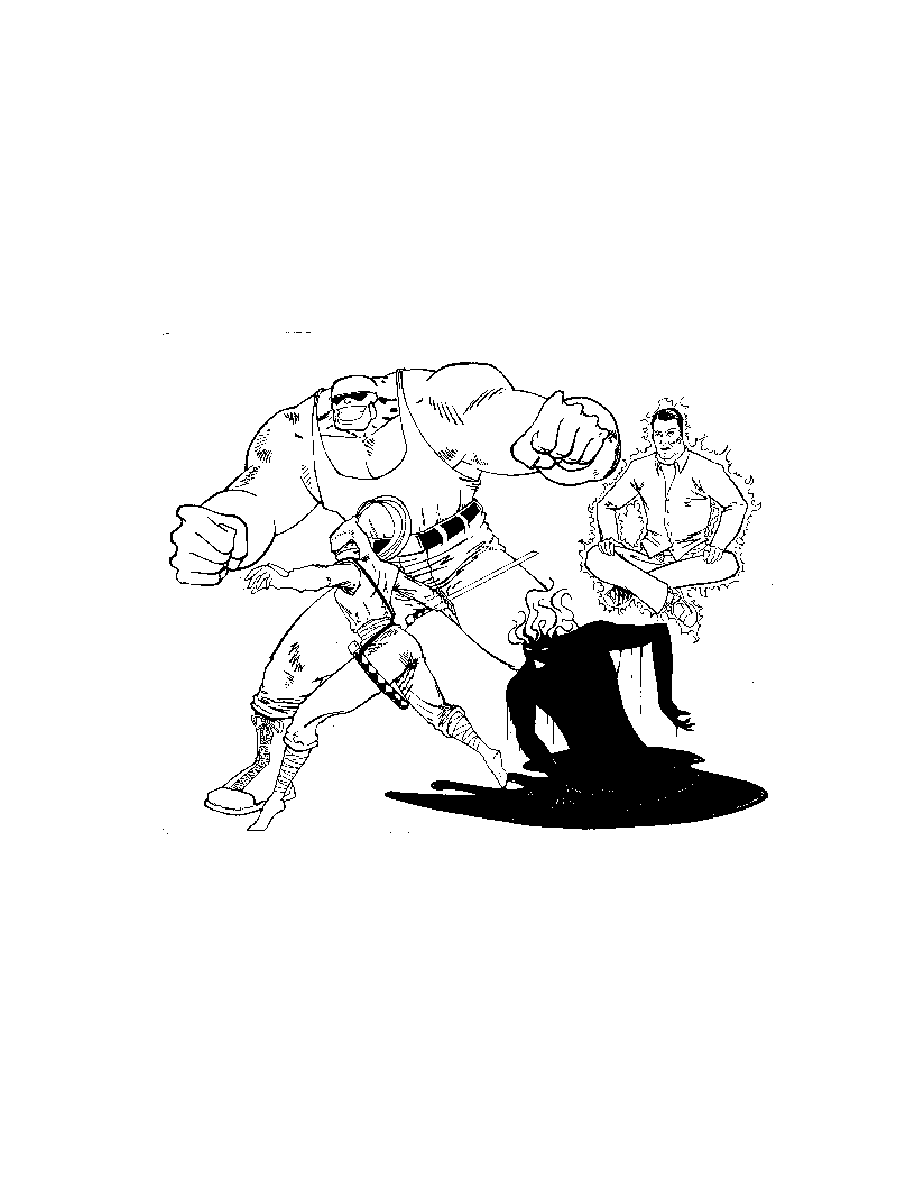
Storm Giant, Selina Bishop, Oil Slick, and “The Gipper”
-- one of the first JAGS Super’s Playtests
Super Heroes
JAGS Supers characters may be able to bench-press an SUV, throw lightning from their hands,
or bounce bullets off their chests. JAGS Supers are more than human. They are designed to
simulate comic book characters and, as there are a multitude of different genres of comic books,
there are a vast variety of JAGS Supers Characters.

The Abilities List
The JAGS Supers book consists of a short explanation (this document) and an Abilities Section.
These Abilities are super-human powers like Flight, Power Blast, and Force Field. When building
a super character, the player may simply choose powers off this list as a shopping list. As with
building a “normal” character or other Archetype, there is a “point” system but the Supers Rules
add a new concept: Letters. Instead of having a Power Blast that cost you 30 Character Points
you might have a Class B Power Blast. How does this work? Read on below.
Costumed Adventurers, Super Heroes, and Omega Ratings.
JAGS Supers defines two types of “Super Heroes” the Costumed Adventurer who exhibits a
lower-level of super powers than the full fledged “Super Hero.” A Super Hero may have a
secondary “Omega” Rating. This rating is a measure of raw power: basic Super Heroes are
Omega 1 (a strong Omega 1 character can lift a car). A more powerful character (one who could
lift a bus) might be Omega 5 or Omega 10. Characters who could battle the entire Army would be
Omega 100. The meanings of these notations are described in their section.
The Letter System
Super Abilities are bought with letters rather than character points. The reasons for this have to
do with game balance and changing values of powers as they get more or less powerful relative
to the norm. A detailed explanation of why we chose this bizarre method will be placed
elsewhere, but here is how it works:
Starting Letters
Characters are given a set of “Starting Letters.” These are the “points” with which you will
buy abilities. The standard starting point is 4D’s and 4E’s for a normal “Super Hero.” A
less powerful character (a Costumed Adventurer) would get 4B’s and 4C’s. The Rank or
Class of a Letter goes from weak (A) to powerful (Z). Should a character have a “letter”
which is ‘higher than Z or lower than A,’ there are rules for that too.
Class and Rank
Currently these words are used interchangeably: they tell what Letter ability is (so a
Force Field might be called Class C or Rank C).
Rank Value
Each Letter has a Rank Value showing how “powerful” it is. For example: E is 10, D is 9,
C is 8, etc. As “A” is Rank Value 6, A5 has a Rank Value of 5, A1 has a Rank value of 1.
For values “above” Z, the Rank Value is Z27 (Rank Value of 27), Z28 (Rank Value of 28).
POWER Factor
Most abilities have a POWER Factor. For example, Power Blast has POWER Factor of 4.
This means that a Class E Power Blast does (10 x 4 = 40pts of Damage). If this seems
confusing note that a Class D Power Blast does (9 x 4 = 36 damage), a Class C Power
Blast would do (8 x 4 = 32pts of damage).
Major, Minor Ranks
In the rules we sometimes refer to an Ability’s cost as Major (or Primary) or, say 2
Secondary. For a standard 4E, 4D Super Character, Primary (or Major) letters are E’s
and Secondary or Minor letters are D’s. These terms are, at this time, used
interchangeably.
The reason for this is so that certain abilities (like Immunity) can be charged as a
percentage of a character’s total letters. For this reason, it is unwise to give characters
something like 6E’s and 6D’s (there are other ways to make more powerful characters).
Letter Values and ‘Letter Arithmetic’
Here are the Rank Values for the letters.
Letter
Rank Value
A1
1
A2
2
A3
3
A4
4
A5
5
A
6
B
7
C
8
D
9
E
10
F
11
G
12
H
13
I 14
J 15
K
16
L 17
M
18
N
19
More Examples:
Bio-Armor has a POWER Factor of 3 so Class G Bio-Armor
would have a value of 36pts of Damage Resistance (and
72 points of Penetration Resistance).
Super Strength has a POWER Factor of 3.25 added to
STR and a POWER factor of 3 added to DP. A character
with A Super Strength would get +19.5 added to STR
(round normally to +20) and +18pts added to Damage
Points.
Plasma Blast has a POWER Factor of 3.75. A C Rank
Plasma Blast would do 33.75 (rounding up to 34) points of
damage.
Force Field has a POWER Factor of 4. An H Rank Force
Field would have a defense of (13 x 4 = 52).
Letter Arithmetic
This section tells how to get letters other than D’s and E’s. What happens when you
combine two E’s? How do you break up a D into lesser ranks? This section isn’t
extremely complex but it is a different form of math. Please read it carefully.
Addition
Two letters of the same rank combine to make a letter 2 Ranks higher. Two D’s make an
F. Two E’s make a G. Two G’s make an I, and so on.
Reduction
A letter can be reduced to either two letters of two Ranks less (i.e. an E can be split into 2
C’s) or one letter of 1 Rank less and one letter three Ranks less. So an E can be split into
a D and a B.
Some ‘Mathematical’ Notes: From these very simple beginnings, here are some truths.
• 3 B’s make an E (3 Letters of 3 Ranks Less make a single letter of 3 Ranks
more). So 3 C’s make an F.
• A D + an E make an F and a B (the E reduces to a D and a B, the two D’s
combine to make an F).
• If you add up 4D’s and 4E’s you get a J.
Why the Heck Did We Do This?
What were we thinking? Well, it’s too complicated to go into entirely (here) but you
deserve an explanation.
1. We originally charged points (so 1 point of Bio-Armor was 3pts) … so a character
might be built on 500pts and spend 100 of them on Armor for 33 points.
2. But, we realized that some powers (like attacks) were virtually worthless at the lower
levels (no normal character was at all scared of a 10pt of damage Power Blast but
everyone thought a 40pt Power Blast was good). So we asked ourselves: how does
the cost of Power Blast change with level and the answer was: each point of damage
that is likely to penetrate defenses is worth more than the last.

3. Okay, but why this strangeness? Well, this system prevents “Point Dumping” (a
character who spent all his points on Power Blast with the old system does
something like 250pts of damage! With this system, the guy who spent all his letters
gets a J for 60pts of damage. Impressive but not all that special.
4. Another bonus (along the same lines): a character with several different attacks went
broke under the old system since he had to buy all the attacks up to “useful” level.
Now, for the cost of one “Average” attack (an E) you can have two C Level attacks
which, while weaker, aren’t so weak as to be ludicrous.
Is the System Mathematically Stable?
Yes. We think so. It’s a tough mathematical proof (for us) but we’ve done a lot of work
with it and no matter how you divide up your letters, the amounts are all equivalent. We
believe that the values are right and the operations make sense.
Stacking (when two abilities give the same thing)
Sometimes two abilities effect the same thing. For example, characters with Super
Strength and Super Toughness both get extra Damage Points. In these cases, the rule is
that the abilities do not add. You take the highest value (so if your Super Strength gives
+30 Damage Points and your Super Toughness gives +35, your character has +35. This
applies to damage, defenses, etc.
Exceptions to the Stacking Rule
There are a couple of exceptions to the stacking rule. The first is so-called Natural
Damage or Damage Points. Anything bought with normal character points adds. If you
have +30 STR from your Super Strength and a 12 STR (for your normal character) your
STR is 42 (for 32 points of STR damage). If you have Level 3 Karate on top of that (+3
damage Karate bonus) you get to add that on too.
A second exception (along the lines of the first) is that some abilities have two modes:
Super Strength Mode and Normal STR mode (most of these are some kind of HTH
weapon). The rule works like this:
If an ability says it ‘stacks’ it does so, however it doesn’t stack with Super Strength.
Usually these abilities are meant for stronger-than-normal but not tremendously super
strong characters.
Character Types
JAGS Supers defines two basic types of supers characters (with Omega Characters as a third
option). These are the Standard Super Hero and the Costumed Adventurer.
• Standard Super Hero: Base Character points of 50 or 75 (more or less are possible too).
Letters of 4E and 4D. The characters are meant to be larger-than life super heroes.
• Costumed Adventurer: 150pts (or more) and 4B and 4C. The character can have no
attack greater than a C (even with ability defects) and pays the Rank Cost increase for
any attack that deals with his martial arts (such a character can have Level 4 Karate but
must limit himself to an A attack). Costumed Adventures do not pay a tax on high level
combat skills or rolls.
Both these character archetypes can be in the same campaign. What the Costumed Adventurers
lack in raw firepower they should make up for in skills and agility. If the GM is giving the Standard
characters more normal character points, then he should augment the Costumed Adventurers
accordingly.
Omega Levels
Okay, with the “Standard” system an
“average attack” will be a D, E, F, or
maybe a G (we think). That means that for
a Power Blast (biggest bang for the buck)
it’ll do about 36, 40, 44, or 48pts of
damage. That’s enough to plow a normal
man but it won’t one-shot a tank (2000pts
of damage). How do you make “earth
shattering” characters?
Well, we defined a second series of
“letters” based on the Greek Alphabet.
This was kind of slick but it was too
complex and no one normal could recite
the Greek Alphabet (okay, so we were
weird). But the Omega notation stuck.
Here’s the deal:
Omega 1 Characters: As above
(the normal Rank Values are
Omega 1). These characters are
super-human but still will have trouble dealing with a well trained SWAT team or army
platoon (with 70pt Sniper Rifles or M60 Machine guns).
Omega 5 Characters: Multiply all the Rank Values by 5 (so E is a value of 50 instead of
10 and an E-Rank Power Blast does 200pts of damage). Also multiply all Damage Points
by this number (so a “normal Super” with no additional DP would start with 50). Damage
for STR above 10 and Martial Arts Bonuses get the same multiplier. Omega 5 characters
can deal effortlessly with a big-city police force. They can take almost any man-portable
weapon hit.
Omega 10 Characters: As above but multiply the values by 10. A “normal super” with an
11 STR and 10 DP does 10pts of damage with a punch and has 100 DP. These
characters can be stopped by heavy-duty battlefield weapons (a tank shell does about
1500 PEN damage so that’ll penetrate their 300 or so points of armor).
Omega 100 Characters: Multiply as above (but by 100). A Super’s Class E Power Bolt
does 4000 points of damage (against E Bio-Armor of 3000pts). These characters can
only be stopped by each other. They can bench-press tanks easily. They are all but
immune to the weapons of mankind.
Abilities without Numerical POWER Ratings
For abilities that don’t have a strict numerical POWER rating (like, say Night Vision) usually their
cost is one-less Rank for each Omega Level (so if Night Vision costs an A at Omega 1, at Omega
5 it costs an A5, at Omega 10, an A4, and an A3 at Omega 100. The exception to this is abilities
which costs a Primary or Secondary: their costs do not change.
Movement rates can be multiplied by the Omega Level as well (so Teleporters can go further and
flying characters can fly faster). The GM should work with players to get this right: having
everyone fly around at 3x the speed of sound during combat can lead to game-system
malfunctions.

Ability Modification
Abilities may be modified in cost by either enhancing them or giving them defects. At this time,
this is not an exact science—we have included some common modifications here.
Rank Increase/Decrease
If an ability modification has a cost of +/-1 or more Ranks, that means that the Rank of
the ability goes up or down. If a C Rank Power Blast has a +2 Rank Enhancement, it
costs an E.
Class Cost
If an enhancement (never a defect) has a cost of +Class (or + Class-2) then you must
pay an additional letter. So if Rank C Power Blast has an enhancement for Class –2 then
the character pays an additional A power to add it on.
Some Standard Modifications
Here are some generic Ability Modifications (mostly to attacks). This section will be expanded
later but for now it’s some good hints as to how to define these types of scenarios.
Charge Up Time
Charge Up Time is bought for an attack ability that takes some time to ready. Charging
the ability must be declared, is visible (the character’s eyes crackle with power) and, if
“aborted” starts over. If an attack reaches full charge and isn’t used, that counts as
aborting it as well.
Charge Time
Cost Modifier
2 Turns (every other turn)
Rank –2
3 Turns
Rank –3
5 Turns
Rank –4
Device Modifier
Often an ability is a device. Devices come in many categories (from the magical device
which is easy to operate and doesn’t break) to the real-world guns that jam when
dropped in the mud, need expensive maintenance, etc. Here is how to create a Device
Wielding character. Note: Some abilities (Power Armor) are already devices. These can’t
be modified.
• Character has a single device that is NOT most of his power (i.e. a super strong
character has a back-up hand gun). No Modifier. Buy the ability normally. Yes, it can
be taken away, but Ion-Dude’s natural Force Field can be shorted out too if a twisted
genius tries hard enough (and since the ability is a device, you can do things like
hand it to someone else).
• All of a character’s abilities come from devices (or the vast majority). This is a
Tragedy (see the next section). The abilities don’t cost differently but the character
gets a bonus).
• A minor ability is a device that is defined as hard to use. This means that: attacks
must be drawn, the character must make a skill roll to use something that normally
doesn’t require one, the device is big and heavy (like a military radio), the device is
fragile or prone to malfunction. This gets a Rank –1 or Rank –2 reduction. This can
only be done once per character. The character may have other devices but they
don’t get the bonus (the exception is that if someone comes up with device rules that
are really impairing the GM may assign a negative)
• A major ability (the character’s primary defense), which is defined as a device, may
get a Rank –1 or Rank –2 defect but only if the GM rules that the character might go
into battle without it (if the character has native Bio Armor but has a Force Field ring,
for example). If the GM determines that the character, except in dire emergency won’t
abandon the device then it’s a Tragedy.
Rules and Regulations
What are the other rules regarding JAGS Supers characters? Well, we realized early on that
players who put all their points in combat skills were unfairly better than those who didn’t. Here
are some rules we applied for ‘skill taxes.’ The character will pay both a Skill roll tax and a skill
level tax (if applicable). This is only done once for the character’s highest cost attack unless the
character has attacks which implicitly stack (then do for all the attacks which stack).
High Combat Skills
Any Combat Skill above a 14- has a tax associated with it. This is because attacks are
much better when combined with high to-hit rolls. If a character gets Xp and wants to
raise his combat skill, he must first pay the tax.
Combat Skill
Class Tax
15-
Highest Attack Class –2
16-
Highest Attack Class –1
17-
Highest Attack Class –0
18-
Highest Attack Class +1
Combat Skill Level (ranged attacks)
Class Tax
Level 2 Combat Skill
Class +0
Level 3 Combat Skill
Class –2
Level 4 Combat Skill
Class –1
Martial Arts Mixed With HTH Combat
When you’re Super Strong, Karate can do more than just add a point or two of damage. If
you don’t plan on punching in a fight, having a good Tai Chi block can be super effective.
If your punch doesn’t do much damage but you have a toxic touch, something like Kung
Fu (hard to block) is an obvious choice.
We think mixing Super Abilities and Martial Arts is cool—and realistic. But it isn’t in the
flavor of the comics that everyone with a super power fights like Bruce Lee. So this is
what happens: you must pay a tax based on your highest level Offensive ability that
makes use of your marital art.
Martial Art
Art Class Tax Rank Tax
Art Tax: This is paid for the Block and other
special effects of the martial art. The cost is a
letter based on the character’s highest
primary Offense (any HTH attack) or Defense
(Armor, Force Field, etc.)
Rank Tax: Because martial art damage adds
to your HTH damage, you pay for the power
as though it were a little higher.
Karate/TKD L2
N/A
+1 Rank
Karate/TKD L3
N/A
+2 Rank
Karate/TKD L4
N/A
+4 Rank
Tai Chi L2
Defense –3
N/A
Tai Chi L3
Defense –2
N/A
Tai Chi L4
Defense –1
N/A
Kung Fu L2
Offense –2
N/A
Kung Fu L3
Offense –1
N/A
Kung Fu L4
Offense –0
N/A
Street Fighting L3
Offense –1
+1 Rank
Street Fighting L4
Offense –2
+2 Rank
Boxing L2
Defense –4
+1 Rank
Boxing L3
Defense –3
+2 Rank
Boxing L4
Defense –2
+4 Rank
Wrestling/Jujitsu L2
Defense –3
+1 Rank
Wrestling/Jujitsu L3
Defense –2
+2 Rank
Wrestling/Jujitsu L4
Defense –1
+3 Rank
Example1: Thunderbolt has Super Strength Class E and Level 2 Street Fighting at a 14-. He pays
no additional tax for this (it is considered within the normal range). Suppose he wants to go to
Level 3 Street Fighting on 15-?
This computes to:
• A skill roll Class tax of Rank-2. Now, a class tax means you buy a separate letter. So this
would cost an additional C (for the 15- roll).
• Street Fighting is not a Ranged Attack so he ignores that table and moves to the marital
art’s table.
• Street Fighting L3 has Class tax of Offense –1 (the Offense level of the Super Strength is
E so he pays a D) –and—
• There’s a Rank Tax of +1 for Street Fighting L3 which means his Rank E Super Strength
winds up costing an F (but counts as an E for damage done).
Super Strength: Class E (Cost is 1E)
•
Street Fighting 15- (C Class Tax)
•
Street Fighting L3 (+1 Rank for an F)
Total Cost for Ability: 1F, 1C
Super Strength has a STR POWER Factor of 3.25 and Rank E has a Rank value of 10 so he
winds up with 10 x 3.25 = 32.5 (rounds normally to 33) extra STR. Now, remember that in
addtion to Thunderbolt’s normal STR (say, 12) Level 3 Street Fighting does +2 damage so his
Base HTH damage winds up being 32 +2 +2 = 36pts.
Example 2: Dead-Eye has Level 4 Bullet Ability of D on an 18-. He pays a Class Tax of Rank +1
for his skill roll (that’s a E) and a Level Tax of Rank +2 so the cost is:
• Skill roll tax of E.
• Skill level tax of Class –1 (Class C)
Bullet: Class D [Ranged attack]
•
Fire Arms 18- (Class E)
•
Fire Arms L4 (Class D)
Total Cost for Ability: 2D, 1E
Bullet has a damage POWER Factor of 3 and Class D has a Rank Value of 9 so the damage is
3 x 9 = 27 (Penetrating).
Example 3: Rage has Power Fist of C and Level 4 Karate 15-. He is a Costumed Adventure
which means he’s limited by the rules to a maximum attack of C. He also has the Ability Strong at
an A.
• Power Fist stacks with HTH damage (the karate) and the ‘Strong’ version of Super
Strength stacks as well so this is all done together.
• Power Fist: Karate gets no Art tax, but has a Rank Tax of +4. This means that his C goes
to a G (which isn’t legal for Costumed adventures: they can have a max of C).
So: he drops his Power Fist to an A5. This means that he re-computes:
• Power Fist A gets a Rank Increase of +4 (Level 4 Karate) so it goes to a C, still legal.
• Strong of A gets a Rank Increase of +4 (Level 4 Karate again) so it goes to a C as well.
• Both A’s pay a Class -2 Skill Roll Tax (15-). Rank A minus two ranks is A3 so he pays
two A3 Ranks as well. He can split an additional A5 to get two A3’s.
Power Fist [Rank A5] and Strong [Rank A5].
•
Power Fist and Karate 15- Level 4: C, A4
•
Strength and Karate 15-, Level 4: C, A5
Total Cost for Ability: 2C, 2A4
Assuming his natural STR and BLD are 13, he winds up with: Power Fist [POWER Factor of
3.75 = A5(5) x 3.75 + 18.75, Strong [POWER Factor of 1] = A5(5) x 1 = 5, +5 for Karate, +3 for
STR, +1 For BLD. He strikes for 19 + 5 + 5 + 3 + 1 = 33pts of damage.

Stacking
Sometimes two abilities effect the same thing. For example, characters with Super
Strength and Super Toughness both get extra Damage Points. In these cases, the rule is
that the abilities do not add. You take the highest value (so if your Super Strength gives
+30 Damage Points and your Super Toughness gives +35, your character has +35. This
applies to damage, defenses, etc.
Exceptions to the Stacking Rule
There are a couple of exceptions to the stacking rule. The first is so-called Natural
Damage or Damage Points. Anything bought with normal character points adds. If you
have +30 STR from your Super Strength and a 12 STR (for your normal character) your
STR is 42 (for 32 points of STR damage). If you have Level 3 Karate on top of that (+3
damage Karate bonus) you get to add that on too.
A second exception (along the lines of the first) is that some abilities have two modes:
Super Strength Mode and Normal STR mode (most of these are some kind of HTH
weapon). The rule works like this:
• If ability says it ‘stacks’ it does so, however it doesn’t stack with Super Strength.
Usually these abilities are meant for stronger-than-normal but not tremendously
super strong characters.
• One version of Super Strength does stack with other abilities. This is the
comparatively weak version ‘Strong’ which is meant as a way to make some
characters a good deal stronger than normal but not ‘paranormally’ strong.
Tragedies
Tragedies are “Super Hero Defects.” Of course the normal characters can get their 10 points of
Defects and many of them may be related to the nature of the game. Tragedies are more defined
as things that are wrong with you BECAUSE of your Super Powers. Or things that are wrong with
your powers.
Tragedies are either Major or Minor. A group of minor tragedies can be major. The GM may
declare a class of Critical Tragedy which applies to characters so inconvenienced by their abilities
that they are probably not viable PC’s (inability to move from a room, for example).
• Minor Tragedy: Character gets Minor –3 extra letters.
• Major Tragedy: Character gets Minor –2 extra letters.
Device Based Powers
The character’s abilities come from a device. If the device is a magic ring (or filling—a
player did this!) you get no points. Sure, the ring can be taken but unless that’s
happening all the time (then it counts and the GM can determine what it counts as) it’s
not a tragedy.
A character with a suit of Power Armor does count, though. If he’s at a fancy ball and a
fight breaks out, he doesn’t have his powers. If trouble does come, he might have to run
and change (but remember, most super heroes would want a chance to change into their
costumes). This is a minor tragedy.

Bizarre Appearance
This is easily either major or minor. If the character looks strange but not … well, not
monstrous enough to scare a jaded urbanite (i.e. the character is weird looking but so are
guys in spandex anyway) this is minor (assuming it’s strange enough to scare anyone). If
the character tries to avoid the streets of a major city due to screaming, fainting, etc. it’s
major.
Awful Side Effect
If the character is, say, on fire all the time or has some really noxious effect they can’t
shut off this is probably major. If the bad effects are held under control but cause the
character angst (and have a real potential of breaking loose) then it’s minor.
Shape Changer
If a character’s primary attack doesn’t work in his “human” (or whatever) form, this is a
minor tragedy. If the character pretty much has most of his powers, this isn’t worth
anything.
Document Outline
Wyszukiwarka
Podobne podstrony:
BESM d20 Optional Rules
zostan supersprzedawca(1)
2010 Ne Waza Judo BJJ Rules
JAGS Movement
dydaktyka notatki, Supersiatkareczka, Nauka, Filologia polska
Eurocode 5 EN 1995 1 1 Design Of Timber Structures Part 1 1 General Rules
Pirates Optional Rules
Java Coding rules
Draft Import implementing rules 22072008
Zostan SuperSprzedawca
Be a Network Marketing Superstar
Differential Signals, Rules to Live By
JAGS Defenses
Breaking the rules
Ferengi Rules Of?quisition
ICAO ANNEX 2 RULES OF THE AIR
42 Rules of Marketing A Funny Practical Guide (2)
Mutant Chronicles Rules 2nd Edition FAQ
więcej podobnych podstron