5-Step Investing Formula
Online Course Manual
Introduction to Investing
www.investools.com
© 2005 INVESTools Inc. All rights reserved.
2
Section 2 of 11

THE 5-STEP INVESTING FORMULA
Introduction to Investing
page 2 of 13
© 2005 INVESTools Inc. All rights reserved.
SECTION 2 Introduction to Investing
Tolerance for Risk .................................................................................. 4
Setting Goals ........................................................................................ 6
Asset Allocation .................................................................................... 6
Tax Exposure ........................................................................................ 7
Brokerage Firms .................................................................................... 8
Introduction to the 5-Step Investing Formula ........................................ 9
Section Contents

THE 5-STEP INVESTING FORMULA
Introduction to Investing
page 3 of 13
© 2005 INVESTools Inc. All rights reserved.
INTRODUCTION
SECTION 1 Getting Started
Logging into the INVESTools Investor Toolbox
Support Links
Workshop Review
Account Information
Subscription Renewal
Technical Support
Contact an Instructor
SECTION 2 Introduction to Investing
Tolerance for Risk
Setting Goals
Asset Allocation
Tax Exposure
Brokerage Firms
Introduction to the 5-Step Investing Formula
THE 5-STEP INVESTING FORMULA
SECTION 3 Step 1: Searching for Stocks
Using a Prebuilt Search
Navigating the List of Stocks
SECTION 4 Step 2: Industry Group Analysis
Top-Down Analysis
Big Chart
AutoAnalyzing All Stocks in a Group
Best & Worst Industries List
SECTION 5 Step 3: Fundamental Analysis
Phase 1
Phase 2
Price Pattern
Volatility
Zacks Report
Market Guide
News
AutoAnalyzer™
SECTION 6 Step 4: Technical Analysis
Technical Indicators
Moving Averages
MACD
Stochastics
Volume
Support & Resistance
Buy Signals
Money Management
Sell Stop Orders
How Many Shares to Buy
Sell Signals
Insider Trading
SECTION 7 Step 5: Portfolio Management
Creating a Portfolio
Managing Your Portfolio
Paper Trading Account
BONUS SECTION
SECTION 8 Bonus Topics
TurboSearch
Index Tracking Stocks / Exchange-Traded Funds
Dow Jones Industrial Average—
The Diamonds (DIA)
S&P 500—The Spider (SPY)
NASDAQ—The Qs (QQQQ)
SECTION 9 Introduction to Options
Advantages/Risks of Options
Leverage
Call Options
Put Options
Covered Calls
SECTION 10 Appendix
Phase 2 Stock Scoring Form
Phase 2 Quick List for Zacks Report and
Market Guide
Investment Tracking Record
SECTION 11 Glossary
Course Overview

THE 5-STEP INVESTING FORMULA
Introduction to Investing
page 4 of 13
© 2005 INVESTools Inc. All rights reserved.
Introduction to Investing
Tolerance for Risk
Investing in the stock market involves both risk and reward. The rewards are
easy to deal with; in fact, you want rewards... the more rewards the better. But
it’s different with risk—where it’s possible to lose money in an investment.
There are different levels of risks associated with investing and you need to
find the level of risk you can manage and that you’re comfortable with.
One of the biggest mistakes new investors make is that they invest money
they can’t afford to lose. They invest their grocery money or rent money in the
stock market and hope that money will double or triple overnight... instantly
solving all their financial problems. But that’s not investing; that’s gambling.
If you’re not willing to take the risks of gambling in Las Vegas or other places,
why do it in the stock market?
The stock market has proven to be a wonderful place to invest money and
to make money over the long term. However, investing in hopes of quickly
doubling or tripling your money involves risks and should never be done
except with “risk capital”—money you can afford to lose without dramatically
changing your financial circumstances if it is lost.
When dealing with your money, focus on things you understand. Most
novice investors make the same mistakes again and again because they don’t
understand what they’re doing wrong or they don’t have the discipline to stop.
The best investors tend to be automatic, meaning they have a plan and they
stick to it. This course will give you that step-by-step plan. Throughout this
program, we will teach some strategies to help you become more disciplined
and automatic in your investing approach.
The biggest enemy of an investor is emotion. When stocks are dropping and
your investments are losing value, you may get that pit-in-the-bottom-of-
your-stomach feeling. When you get this feeling, it’s difficult to make a good
decision (this is when you find it hard to sleep). Instead of making a good,
appropriate decision, you tend to become paralyzed and do nothing... the worst
possible thing to do. We’ll teach you how to manage that risk going into a
trade, which helps take the emotion out of investing.
Keep in mind that investing in the stock market is not a get-rich-quick scheme.
If you’re trying to solve a huge financial burden by investing in the stock
market, you may be setting yourself up for disappointment.
It’s important to understand that getting into a good stock doesn’t happen
by accident. It’s something you have to research and patiently wait for. Just
because you take a course or invest in the stock market doesn’t assure you
instant success... nor does it assure you of any success, for that matter.
But if you follow the simple, time-proven approaches we teach, you’ll have
a greater opportunity to make money over time as you invest in the stock
market.

THE 5-STEP INVESTING FORMULA
Introduction to Investing
page 5 of 13
© 2005 INVESTools Inc. All rights reserved.
The Psychology of Trading
Most of what we do in the stock market is affected by emotions. It’s amazing
the impact what we think can have on the bottom line.
To find out what you think, there is a question you should ask yourself: Who
am I? This helps you determine your strengths and weaknesses. The market
has a way of pointing out your weaknesses if you don’t find them first. Not
only that, but it tends to cost you a lot of money. So shore up your weaknesses
before the market does it for you.
For example, ask yourself...
• Am I quick to make decisions or am I analytical?
• Am I a visual person? Do I like to look at charts?
• Can I respond to news and then make a buy or sell decision?
• Can I handle risk?
• How much am I willing to lose on any one trade without losing sleep
over it?
• What are my performance goals in the market over the next year... five
years... and ten years?
• Am I more comfortable with holding stocks for long periods of time or
shorter periods of time?
If you aren’t matching strategies in accordance with your personality and
trading style, you’ll ultimately undermine your own success. One of the
biggest mistakes people make is that they do not adopt strategies that fit their
personality.
If you find that trading doesn’t come naturally, you’re most likely pursuing
strategies that aren’t conducive to your comfort level. Pursue strategies that
mesh with you, your lifestyle, your family, and your tolerance for risk. If you
don’t, you’ll do poorly in the market.
Know Your Tolerance for Risk
Because there are so many risks and different levels of risks involved with
different investing strategies, realize your tolerance for risk. Everyone is a little
different, so you’ll need to start monitoring your levels as you start investing or
getting more involved in investing—whatever the case may be.
Sit down and take an inventory; figure out what your strengths and weaknesses
are. Doing this will also help you find your identity as an investor. Once you
identify your strengths and weaknesses, you’ll develop a trading style.

THE 5-STEP INVESTING FORMULA
Introduction to Investing
page 6 of 13
© 2005 INVESTools Inc. All rights reserved.
Setting Goals
You need to create your own mission statement for investing. This mission
statement represents your investment goals. Whether you’re investing for the
long term or short term, having goals gives you focus.
Anyone who invests needs to have goals and objectives. A goal defines what
percentage return you want to earn on a particular investment (which varies
from stock to stock depending on the duration of the investment).
For example, a common approach to investing is referred to as “buy and hold.”
With this strategy, investors take a longer term view of the market. They are
comfortable with the 10-12% annual returns the market has averaged over
the past 50-70 years. They simply want their money to grow in a market that
is compounding at a nice, consistent rate. Their goal is for a long-term gain
averaging 10-12% a year.
Be sure you set realistic goals (e.g., to do better than the market and to
improve on your return every year) and don’t get discouraged with mistakes.
Unfortunately, you’ll likely have some losing trades—even the experts do.
Keep the losing plays small, as outlined later in the course.
Most of all, believe you can do it. Thousands of people with no experience in
the market have gone through this course and found consistent, market-beating
returns. There is no reason why you can’t do the same.
Wealth is rarely an accident and it certainly won’t happen by next week.
However, it can happen if you set goals and put in the time and effort to make
it all work. The tools and knowledge you gain from this course are the vehicles
to get you where you’ve dreamed of going.
The goal of most investors is to buy low and sell high. By consistently
applying the 5-Step Investing Formula, you can better attain this goal, which
helps you work toward reaching your overall goal of financial success in the
stock market.
Asset Allocation
Diversify your portfolio with different types of stocks from different industry
groups and sectors—this is called asset allocation. Asset allocation determines
how you would answer the questions below:
• How do I allocate money to the different types of investments in the
market?
• How much should I have “in cash”?
• How much do I put in interest-bearing investments, like a money
market fund or bonds?
• How much should I put into stocks?

THE 5-STEP INVESTING FORMULA
Introduction to Investing
page 7 of 13
© 2005 INVESTools Inc. All rights reserved.
• How much should I put into small stocks? ...Into mid-cap stocks?
...Into large stocks?
• How much should I invest in options?
• How much should I put into real estate?
Knowing what your goals and objectives are can help you determine where to
put the emphasis in your portfolio.
Small companies often can be riskier. However, oftentimes these companies
are the growth opportunities, as small companies tend to be the undiscovered
ones. If you do your homework with fundamental analysis (to be discussed),
you’ll find that a small company growing by 60-70% in earnings and revenues
could be a good company to buy at an early stage. It could be the next Cisco or
IBM... the next “big thing.”
Everyone seems to be interested in options these days. There are conservative
ways to use options to insure your portfolio against loss and to also create
income and cash flow. In addition, there are more aggressive (and thus more
risky) ways to use options as leverage to accelerate returns.
To manage the risk of these more aggressive options strategies, you should
initially devote no more than 5-10% of your total account to such strategies.
For example, if you have a $100,000 account, put no more than $5,000 to
$10,000 into aggressive option plays. As you continue with your education,
your knowledge will grow and accordingly you’ll learn of better ways to
accelerate your returns—while keeping your risk manageable.
Don’t judge the success of your investing by what you’ve accomplished with
your portfolio in a week or two. It generally takes a while to build a solid
portfolio. Continually work, progress, improve, and grow your account so
that when you finally reach retirement, you’ll have a big enough portfolio to
generate the kind of cash flow and income you need to sustain the lifestyle you
want.
Tax Exposure
There are tax advantages for investors... legal loopholes in the tax code
that can be taken advantage of if you know what they are and how to use
them. To discover the possible tax savings you can realize, meet with your
accountant. Depending on your trades and how often you trade, you could save
significantly.
Portfolio income is the type of income most investors have. It includes interest
earned, dividends, capital gains on the sale of investment assets, and mortgage
interest received. This income is taxed at ordinary rates and is not subject to
self-employment taxes. However, if done wisely, the income can be deducted
as an investment expense. Visit with a qualified accountant to find out what can
be done to save money in taxes on your investments.

THE 5-STEP INVESTING FORMULA
Introduction to Investing
page 8 of 13
© 2005 INVESTools Inc. All rights reserved.
Brokerage Firms
After you’ve researched a stock and decided it’s an investment you want to
make—a process we’ll discuss—it’s time to place the trade. You need to send
the order to an exchange where stocks, mutual funds, and options are bought
and sold. To do this, you need a broker.
Most orders are placed with a broker. A broker is the person you deal with
when it comes to trading stocks—however frequently you make decisions and
change your investment portfolio. The term “broker” refers to either a live
person who places the trade for you or the online broker, which is accessed
with a computer. Using a computer, you don’t actually deal with a person,
although you still deal with an online brokerage company.
When you buy a stock in the market, you pay a commission to do so. There
is no charge to hold the stock—you can hold it as long as you want. But as
soon as you sell it, you pay another commission for the sell. There are almost
always two commissions involved in each transaction: one to get into a stock
play and one to get out.
Internet technology has improved the entire communication process between
investor and broker. Using the Internet, you can view your investing account
online to see exactly how much money you have and to get up-to-the-minute
statistics on your account as it quickly updates after a change or trade is made.
If you withdraw money or buy stock, it is reflected online and available for
viewing so that you can constantly know your account status.
There are three different levels of brokerage firms (most are Web accessible):
1. Full-service brokers
2. Discount brokers
3. Online brokers
You pay more money in commissions for full-service brokers, but the return
for doing so is that they offer more services, information, and resources.
Discount brokers offer minimal services in return for lower commissions. They
are very popular with people who are looking to save money on commission
fees but who still want some of the services normally associated with a full-
service broker.
The last level of brokers is the online broker. These brokers have gained
recognition since about 1994 by developing tools and resources on the Internet
that allow investors to trade and transact business in the stock market much
quicker, easier, and cheaper than ever before. In return for a minimal level
of service, customers save money in commissions, reducing trading costs
dramatically.
Most INVESTools Investor Education graduates use the Investor Toolbox
for all of their research. They focus on the efficient execution and low
commissions when looking for a broker.
THE 5-STEP INVESTING FORMULA
Introduction to Investing
page 9 of 13
© 2005 INVESTools Inc. All rights reserved.
Opening an Account
To invest in the stock market, you need to open a brokerage account with the
firm that best meets your needs.
To open a brokerage account, you need to fill out an account agreement. This
agreement spells out the risks and safeguards of trading with the specific
broker. It also goes over the nature of your relationship with your broker
and clearly defines the nature of the services to be provided. Once you’ve
completed the account agreement, you’ll need to make a monetary deposit (the
minimum amount of the deposit varies from broker to broker) to open your
account and begin investing. You are then charged a commission per trade,
which varies from firm to firm.
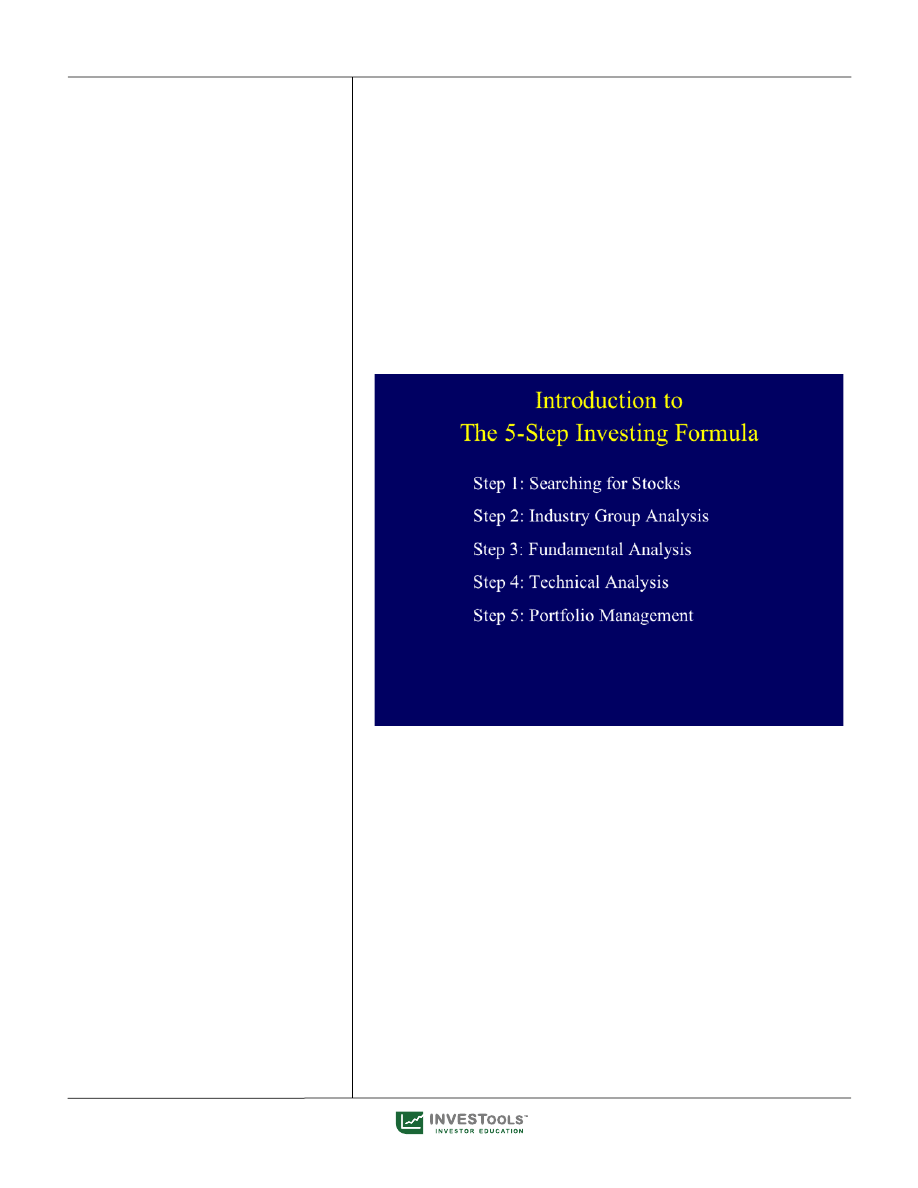
Introduction to the 5-Step Investing Formula
The five steps of the 5-Step Online Investing Formula are as follows:
1. Searching for Stocks
2. Industry Group Analysis
3. Fundamental Analysis
4. Technical Analysis
5. Portfolio Management
THE 5-STEP INVESTING FORMULA
Introduction to Investing
page 10 of 13
© 2005 INVESTools Inc. All rights reserved.
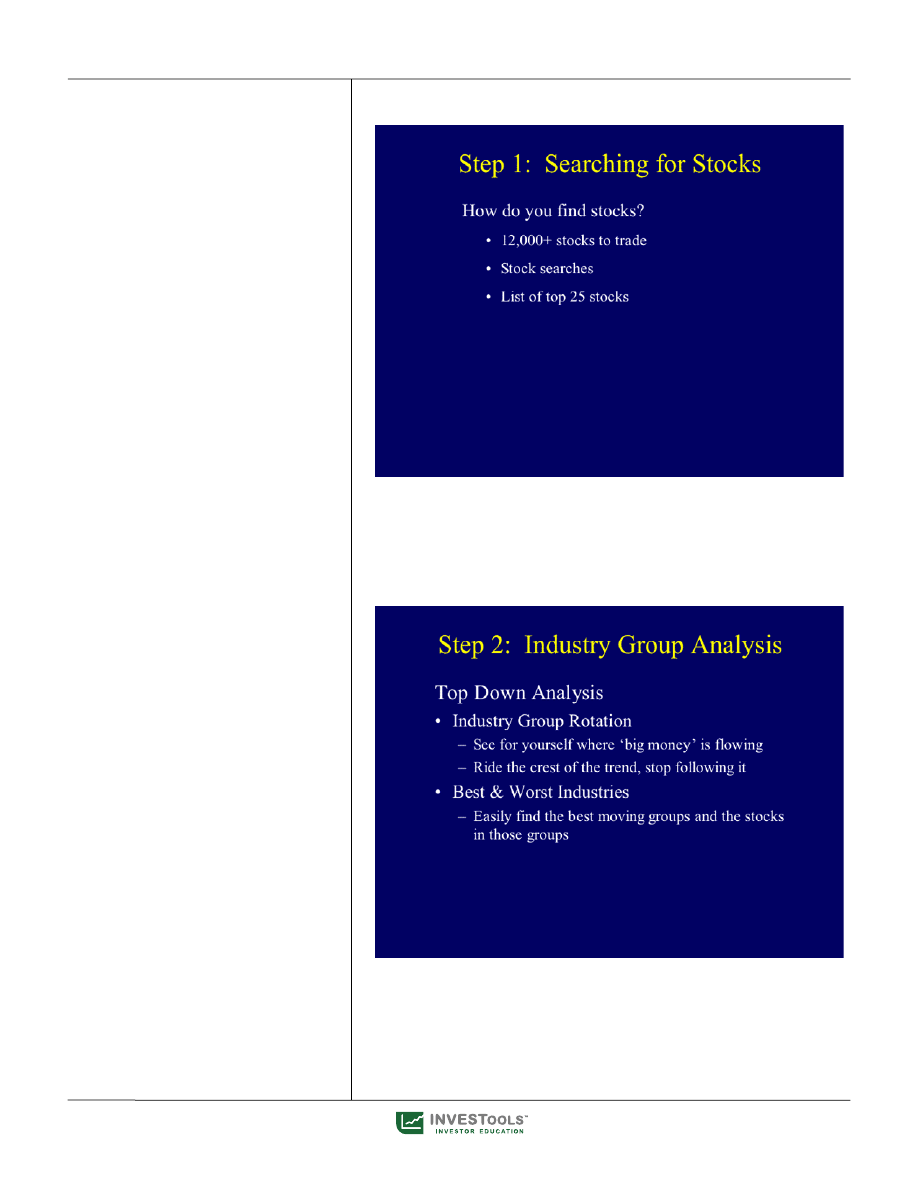
Step 1 of the formula is to search for an investment. This step helps you find
stocks in a repeatable process. It allows you to search the entire database of
over 12,000 stocks using a set of easy-to-use, prebuilt search criteria. When
you run a search in its most basic form, it returns 25 stocks for evaluation.
More advanced searches will be outlined near the end of the course.
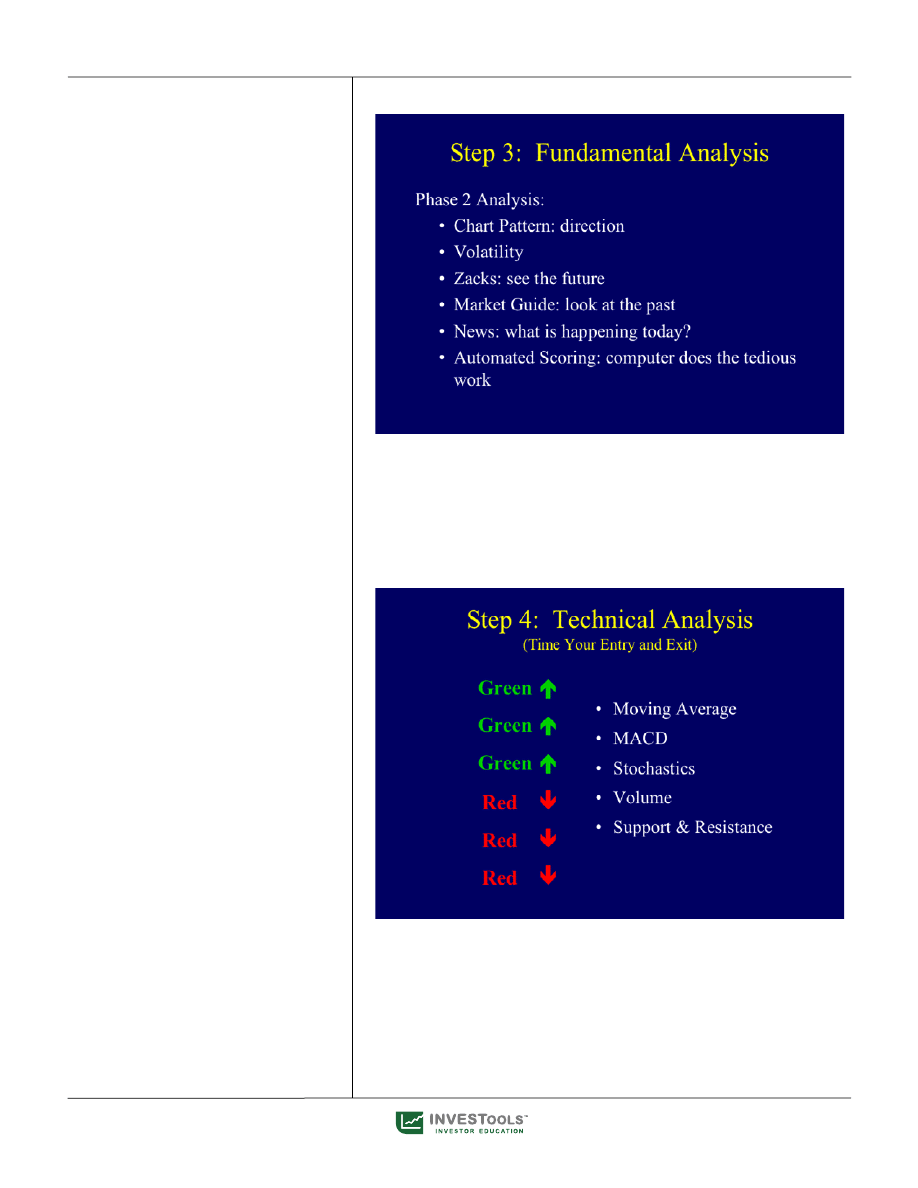
Step 2 covers industry group analysis, where you perform top-down analysis to
find stocks. You will learn how to focus on the strongest industry groups in the
market and how to find the best stocks in those strong groups. You will also
learn how to see where the institutional money is flowing in the market week
by week using our proprietary industry group tools.
THE 5-STEP INVESTING FORMULA
Introduction to Investing
page 11 of 13
© 2005 INVESTools Inc. All rights reserved.
Step 3 narrows the list of 25 stocks using a process called fundamental analysis
or Phase 2. With this step, you decide whether or not a stock belongs in your
portfolio. It involves a specific set of repeatable steps that takes the emotion out
of choosing stocks and helps you approach the market like a professional.
This step has largely been automated by the Investor Toolbox. What would literally
take you hours of research using other financial Web sites takes a matter of seconds
with the Investor Toolbox. It does the tedious, time-consuming work for you.
Step 4 is technical analysis, which explains the buy and sell signals that appear
on a stock chart. This step includes the green and red signals on the following
indicators: moving average, MACD, and stochastics. It also looks at support and
resistance, as well as volume. Technical analysis helps you know when to buy and
sell a stock.
THE 5-STEP INVESTING FORMULA
Introduction to Investing
page 12 of 13
© 2005 INVESTools Inc. All rights reserved.
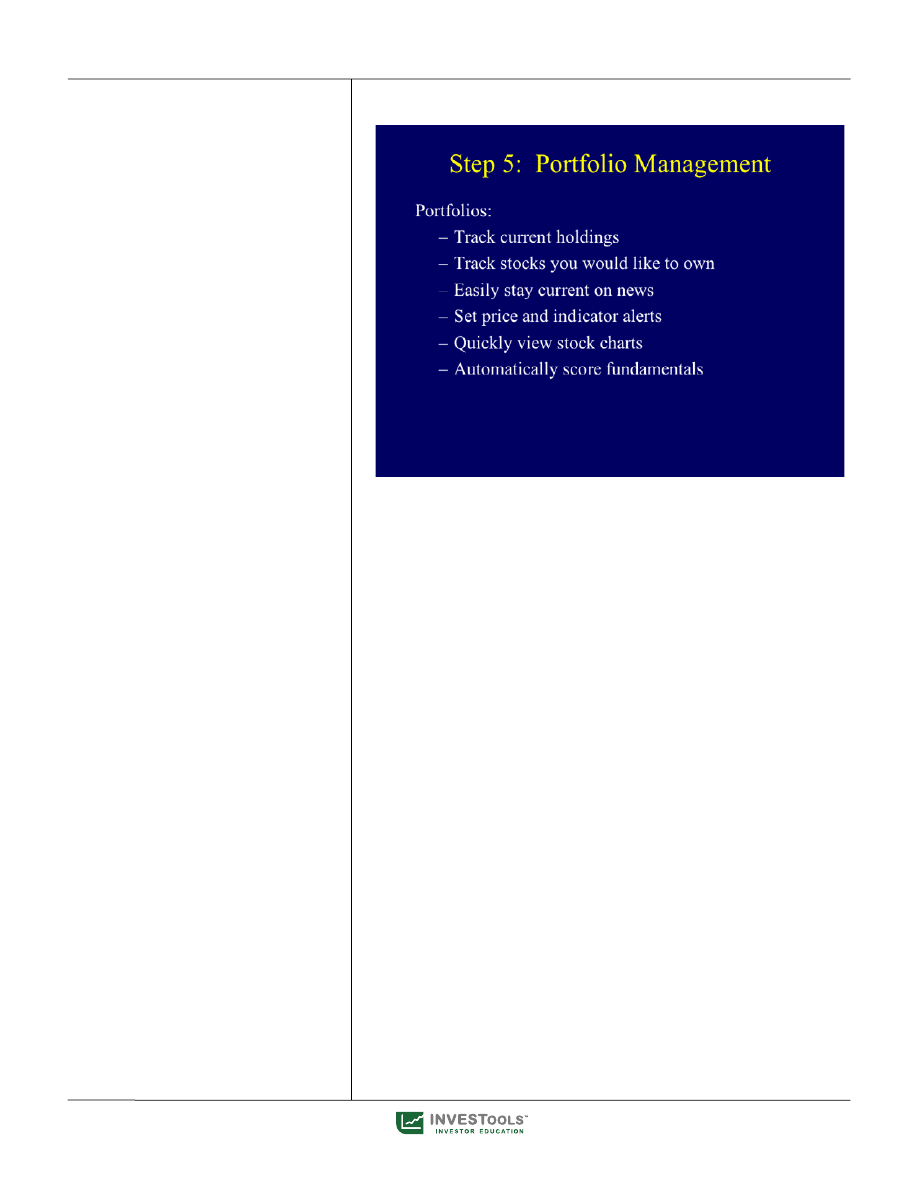
Step 5 consists of monitoring and managing stocks you own or stocks you
would like to own. Here you’ll look for sell signals on the stocks you own and
look for buy signals on the stocks you want to own. You can also check the
news on all the stocks you’re working with (which can influence signals) and
automatically score stocks through the Step 2 fundamental tests. The Investor
Toolbox Portfolio Management is also an easy way to set price alerts and buy
and sell signal alerts, and to look at various reports on stocks.
Now, let’s get started. Open up section 3, which explains step 1 of the 5-Step
Investing Formula: Searching for Stocks.

THE 5-STEP INVESTING FORMULA
Introduction to Investing
page 13 of 13
© 2005 INVESTools Inc. All rights reserved.
© 2005 INVESTools Inc. All rights reserved. Neither INVESTools or its subsidiaries nor any of their respective officers, employees, representatives, agents or independent
contractors are, in such capacities, licensed financial advisers, registered investment advisers or registered broker-dealers. Neither do they provide investment or financial
advice or make investment recommendations, nor are they in the business of transacting trades. Nothing contained in this manual constitutes a solicitation, recommendation,
promotion, endorsement or offer (buy or sell) by INVESTools, or others described above, of any particular security, transaction or investment.
Warranty disclaimer: The content included in this manual and the Investor Toolbox Web site is provided as is, without any warranties. Neither INVESTools
no any of its subsidiaries or affiliates make any guarantees or warranties as to the accuracy or completeness of, or results to be obtained from using, any of its
products or services (including any content therein). INVESTools and its subsidiaries and affiliates hereby disclaim any and all warranties, express or implied,
including warranties of merchantability or fitness for a particular purpose or use. Neither INVESTools nor any of its subsidiaries or affiliates shall be liable to you
or anyone else for any inaccuracy, delay, interruption in service, error or omission, regardless of cause, or for any damages resulting therefrom. In no event will
INVESTools nor any of its subsidiaries or affiliates be liable for any indirect, special or consequential damages, including but not limited to lost time, lost money,
lost profits or lost good will, whether in contract, tort, strict liability or otherwise, and whether or not such damages are foreseen or unforeseen with respect to any
use of our products or services. In the event that liability is nevertheless imposed on INVESTools or any of its subsidiaries or affiliates, such parties’ cumulative
liability for damages under any legal theory shall not exceed the amount of fees you paid for the particular product or service. This warranty addresses specific
legal rights; you may also have other rights, which vary from state to state. Some states do not allow the exclusion or limitation of incidental or consequential
damages, so the above limitation or exclusion may not apply to you.
The principals and employees of, as well as those who provide contracted services for, INVESTools have not promised, represented or warranted that you will earn a profit
when or if you purchase securities. It is recommended that anyone trading securities should do so with caution and consult with a broker before doing so. Past performances
of any principals and employees of, as well as those who provide contracted services for, INVESTools or any of its subsidiaries or affiliates may not be indicative of
futur performance. Securities used as examples presented in this manual or the Investor Toolbox Web site are used for illustrative purposes only and do not constitute a
recommendation to buy or sell individual securities. They should be considered speculative with a high degree of volatility and risk.
Trading securities can involve high risks and the loss of any funds invested; trading options can result in the loss of more than the original amount invested.
No part of this manual may be reproduced in any form, by any means, photocopying, electronic or otherwise, without written permission from the publisher.
Wyszukiwarka
Podobne podstrony:
Introduction to VHDL
268257 Introduction to Computer Systems Worksheet 1 Answer sheet Unit 2
Introduction To Scholastic Ontology
Evans L C Introduction To Stochastic Differential Equations
Zizek, Slavoj Looking Awry An Introduction to Jacques Lacan through Popular Culture
Introduction to Lagrangian and Hamiltonian Mechanics BRIZARD, A J
Introduction to Lean for Poland
An Introduction to the Kabalah
Introduction to Apoptosis
Syzmanek, Introduction to Morphological Analysis
Brief Introduction to Hatha Yoga
0 Introduction to?onomy
Introduction to politics szklarski pytania
INTRODUCTION TO VERBS
An Introduction to USA 6 ?ucation
introdution to capabilities classes 5WEH7OVOF6IJEZ7SO6GMF63NSJPWSXDLGIJQTMA
An Introduction to Database Systems, 8th Edition, C J Date
Introduction to the MOSFET and MOSFET Inverter(1)
więcej podobnych podstron