
National Geographic Video Library
presents
Dangerous Dining
Poziom B1(Intermediate)
Beata Tomaszewska
2
© Copyright Nowa Era 2011, Materiały do powielania
Dangerous Dining
Vocabulary
1
Match each dish (1–12) with the country (A–L) which is famous
for it.
Dish
Country
1
moussaka
A
Japan
2
paella
B
Mexico
3
black pudding
C
Greece
4
sweet and sour pork
D
India
5
escargot
E
Spain
6
sushi
F
the UK
7
tortilla
G
China
8
curry
H
the USA
9
tortellini
I
Israel
10 muffi n
J
France
11 falafel
K
Turkey
12 shish kebab
L
Italy
2
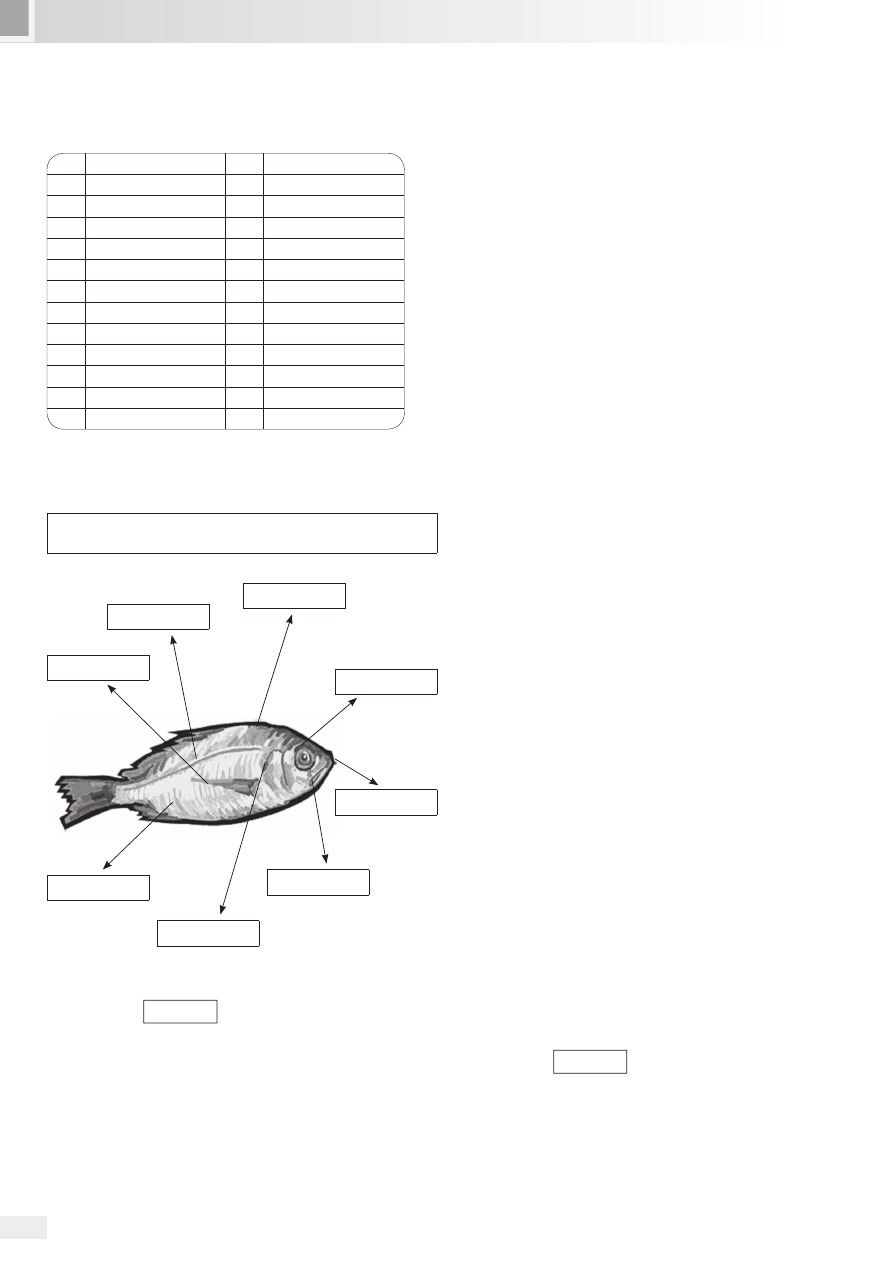
Label boxes A–H with the words from the box.
Listening
3
Watch the fi lm and choose the correct answer (a, b, c)
1 The puff er fi sh...
A
is the most expensive fi sh at the seafood market.
B
is one of the most dangerous/poisonous types of fi sh in
Japan.
C
is served in a few restaurants in Tokyo.
2 Tom has decided to eat at the Matsumoto restaurant
because...
A
he has heard stories about this restaurant.
B
he wants to take risks.
C
it is a restaurant with long traditions.
3 In order to serve fugu, cooks must...
A
take special classes.
B
show a special document to customers.
C
pass an exam.
4 Many people died from puff er fi sh poisoning after the
World War II because...
A
they didn’t know how to cook it properly.
B
they ate puff er fi sh found in garbage.
C
restaurants served fugu which wasn’t fresh.
5 Every year in Japan,
A
2,500 people die from puff er fi sh poisoning.
B
70 % of those who try fugu get sick.
C
there are 3 fatal cases of puff er fi sh poisoning.
6 The toxin...
A
is found in most parts of puff er fi sh.
B
in some kind of fugu can kill more than 20 people.
C
is as strong as cyanide.
7 Fugu fl esh is arranged on a plate in the form of
a chrysanthemum because...
A
it is a common fl ower in Japanese culture.
B
it makes the dish look beautiful.
C
it is a popular funeral fl ower.
8 The fugu meal...
A
consists of many dishes.
B
is always dangerous.
C
is served with tea.
9 The fi lm story...
A
warns people against eating puff er fi sh.
B
describes the tradition of eating fugu.
C
explains how to eat fugu safely (when the fugu meal is safe).
Speaking
4
Work in pairs. When choosing a place to eat what
do you pay attanetion to? Choose four aspects to
discuss: location, size, decor, menu, service, customers,
atmosphere, price?
A
B
C
E
F
G
H
D
gills fi n mouth nostrils eyes scales spine fi shbones
EXAM
EXAM
3
© Copyright Nowa Era 2011, Materiały do powielania
Dangerous Dining
Grammar: Present Perfect vs Simple Past
5
Put the verb into present perfect, present perfect
continuous or simple past tense. Watch the video to check
the answers.
Tom Caradona is in Japan. He___________________
1
(come) to Tokyo for the fugu experience and he
___________________ (bring) his friend, Aki.
„I___________________
2
(hear) stories about people dying
from trying fugu”, says Tom
Over the years, hundreds of people___________________
3
(die) from eating it.
„I___________________
4
(do) it for 53 years”, says the chef.
„I ___________________
5
(take) the exam in 1949”
Fugu___________________
6
(kill) 2,500 Japanese people
between 1945 and 1975.
Regulations and education___________________
7
(cut)
the number of deaths to only three annually.
Grammar: so that
7
Match the fi rst and the third column to make logical
sentences with so that.
1 Chef Hayashi is the
one who must
prepare the fi sh safely
so
that
A
they can’t breathe.
2 The toxin kills by
paralysing people’s
nerves
B
Tom and Aki don’t
get sick.
3 It paralyses the lungs
C
the poisoned person
can’t move.
8
What tenses are used in parts 1–3 of the sentences?
What tenses are used in parts A–C?
What tense is used in this sentence? Tom spoke English slowly
so that the Japanese chef was able to understand him.
9
Finish the sentences with your own ideas:
The infl uences of other
culinary traditions
on Polish cuisine.
The diet of the average
Pole: healthy or not?
A healthy menu.
Your favourite place
to eat.
What do Poles eat
for breakfast/
lunch(dinner)/ supper?
Poisonous food.
Food of the future.
Restaurants of the future.
Fast food vs slow food.
What makes a perfect
cook?
TV cooking shows.
Teenagers’ favourite
dishes.
out for with on off from
Each year some people die__________poisoning after
1
eating death cap mushrooms
I’d like to move to Tokyo ,so I’ve started looking __________
2
a nice place to rent .
Don’t throw__________litter while driving.
3
You should order ice cream topped__________raspberry
4
syrup. It’s delicious!
Italy is well know__________its varieties of pasta.
5
It’s diffi cult to stop children__________eating sweets.
6
The painkiller I took 5 hours ago has just worn__________,
7
and I can feel my tootache again.
Mum, don’t help me__________this cake. I’d like to make it
8
__________my own.
You should wait until your tea cools down a little so that
1
........................................................................................................................................................................................................
Always wash your hands before eating so that
2
................................................
........................................................................................................................................................................................................
We booked a table in the restaurant in advance so that
3
........................................................................................................................................................................................................
Vocabulary
10
Put the missing prepositions into each gap. Some
prepositions are used more than once.
6
Work in pairs. Talk about your experience connected
with food. Discuss one of the following aspects: cooking,
dining, serving , ordering.
Speaking
11
Topics for discussion.
EXAM

4
© Copyright Nowa Era 2011, Materiały do powielania
Dangerous Dining
OBJECTIVES: by the end of the lesson students will be able to:
Give examples of dishes typical in a given country;
•
Talk about dishes;
•
Describe their favourite place to eat in;
•
Select details while listening/watching a short fi lm;
•
Defi ne the general message of the fi lm;
•
Use the structure conjunction
•
so that;
Deifne the diff erence between the present perfect and past simple
•
tense;
Talk about their food experience using the present perfect and past
•
simple tense;
Select a proper preposition for a given verb;
•
Name the main parts of fi sh.
•
PROCEDURE
*Note: You may choose steps 4–10 to concentrate on listening
comprehension/video watching activities only, when you discuss
the topic of food or restaurants.
Lead in (7 min)
Write on the board: BIGOS, PIEROGI. Make students guess what the class
1
will be about. (Food, Traditional dishes)
Brainstorming: Ask students to give you the names of other popular dishes
2
in Poland, and which of them are typically Polish, and which of them come
from other countries (eg. pizza).
Students do Task 1.
3
*Before watching (4 min)
Ask students what they know about Japanese food (sushi, sake).
4
Introduce the word: puff er fi sh/fugu.
Students do Task 2.
5
If necessary, pre-teach the words: poison, diner, cyanide, annually,
6
to wear off , fl esh.
*While watching (12 min)
Ask students to read Task 3.
7
Play the video(4.35min) twice (subtitles off ). Students do Task 3.
8
Write the answers on the board and discuss them.
After watching (6 min)
Working in pairs, students do Task 4. Set time limit: 3 minutes. Both
9
students must be involved in the discussion, giving and justyfi ng their
opinions. At the end, they must agree on the top two aspects. Write on
the board the aspects from Task 4, ask each pair to call their choices, put
a tick next to each aspect chosen. You will get the result of your class
opinions.
Working on language (10 minutes)
Choose one of the activities:
Students, working in pairs, do Task 5: revision of the present perfect and
10a
past simple tense.
Ask students to put the correct form of a verb. Check the answers.
If time allows, you may play the sentences again (with subtitles on).
(Time: 1 – 0.56 min, 2 – 1.18 min, 3 – 1.29 min, 4 – 1.41min, 5 – 1.46 min,
6 – 2.24 min, 7 – 2.30 min)
DANGEROUS DINING - TEACHER’S NOTES
Level: B1
Time: 45 minutes (* 16 minutes)
Podstawa programowa: Theme 6:
Food
Grammar: Present Perfect vs Simple
Past; so that
Vocab: parts of fi sh; national dishes;
verbs with prepositions;
Exam Preparation :
Listening: Multiple Choice;
Structures: Gap fi lling; verb forms
Speaking: Talking about restaurants,
food experience, dishes.
Key
Task 1
1C 2E 3F 4G 5J 6A 7B 8D 9L 10H 11I 12K
Task 2
A fi ns B spine C scales D eyes E nostrils F mouth G gills H fi shbones
Task 3
1A 2C 3C 4B 5C 6B 7A 8A 9C
Task 5
has come, has brought
1
have heard
2
have died
3
have been doing
4
took
5
killed
6
have cut
7
Task 7
1B 2C 3A
Task 9
You should wait until your tea cools down a little so that you don’t get
1
burnt.
Always wash your hands before eating so that you don’t catch any bacteria.
2
We booked a table in the restaurant in advance so that we didn’t have to
3
wait in a queue.
Task 10
1 from 2 for 3 out 4 with 5 for 6 from 7 off 8 with, on
Analyse with students the diff erence between the tenses in these sentences.
Task 6: Set time limit: 2 minutes. Each student must say 5 sentences. If they
lack ideas, ask them to think about a restaurant they’ve been to or a dish
they’ve tried to prepare etc.
Students do Task 7. Analyse the tenses in the sentence structure with
10b
„so that”. Ask students to fi nish sentences in Task 9.
Students work in a group of 3 on Task 10. Prepare cards with
10c
prepositions: OUT, FOR, WITH, ON, OFF, FROM, each preposition on
a separate card. Give each set to a group of 3. While checking the
answers, ask each group to raise the card with the preposition they
have chosen.
Bank of topics to discuss (6 min)
Cut out the cards with the topics. Ask each pair of students to draw
11
one. Give them 2 minutes to prepare a list of 3-5 arguments/aspects
to mention while discussing the topic. Ask them to write them on the
other side of the card. Put them into the Bank of topics.
Note: Collect the cards with topics and arguments in a box. Start classes
by asking a couple of students to draw a card and discuss the topic for 1-2
minutes, preferably, without looking at the arguments listed; however,
if students lack ideas, they should use the notes on the other side of the card.
Projects
Ask your students to prepare a project (individual, pair or group) on one of the
following topics:
A map of places to eat in your town.
1.
A map of regional dishes in Poland.
2.
The perfect restaurants / cafe.
3.
National cuisines: a country of your choice
4.
Unusual restaurants / bars.
5.
The concept of slow food in Poland
6.
Wyszukiwarka
Podobne podstrony:
boze narodzenie na swiecie[ karty pracy
karty pracy liscie cz b
Bajka o jesiennym szalu, Karty pracy, wiersze
cyfry 2, cyferki, karty pracy - cyferki
Karta pracy nr9, karty pracy, karty pracy
karta pracy samodzielnej kl 3-MATEMATYKA dod odejm w zakr 100, karty pracy kl 3
TEST WIEDZY O MUZYCE(1), KARTY PRACY
cz4Tydzie2, Szkoła, Rozkład, scenariusze, karty pracy, Kolorowa klasa, Operon KL 1
cz4Tydzie1, Szkoła, Rozkład, scenariusze, karty pracy, Kolorowa klasa, Operon KL 1
Gwiazdka, karty pracy kl. I-III
karty pracy nr 12 luty
karty pracy 3, 4 i5 str 6
karty pracy emocje
karty pracy Poznaj Szczecin id Nieznany
karty pracy 6 latka od punktu do punktu(1)
Karty pracy
więcej podobnych podstron