1
Wykład 14
Wykład 14
Unia Gospodarcza i Walutowa
Unia Gospodarcza i Walutowa
Korzyści
Korzyści
ze wzrostu handlu
ze wzrostu handlu
i wyeliminowania
i wyeliminowania
ryzyka na rynku
ryzyka na rynku
walutowym
walutowym. .
Koszty rezygnacji
Koszty rezygnacji
z autonomicznej
z autonomicznej
polityki pieniężnej
polityki pieniężnej
Mundel 1961
Mundel 1961
EMU
EMU
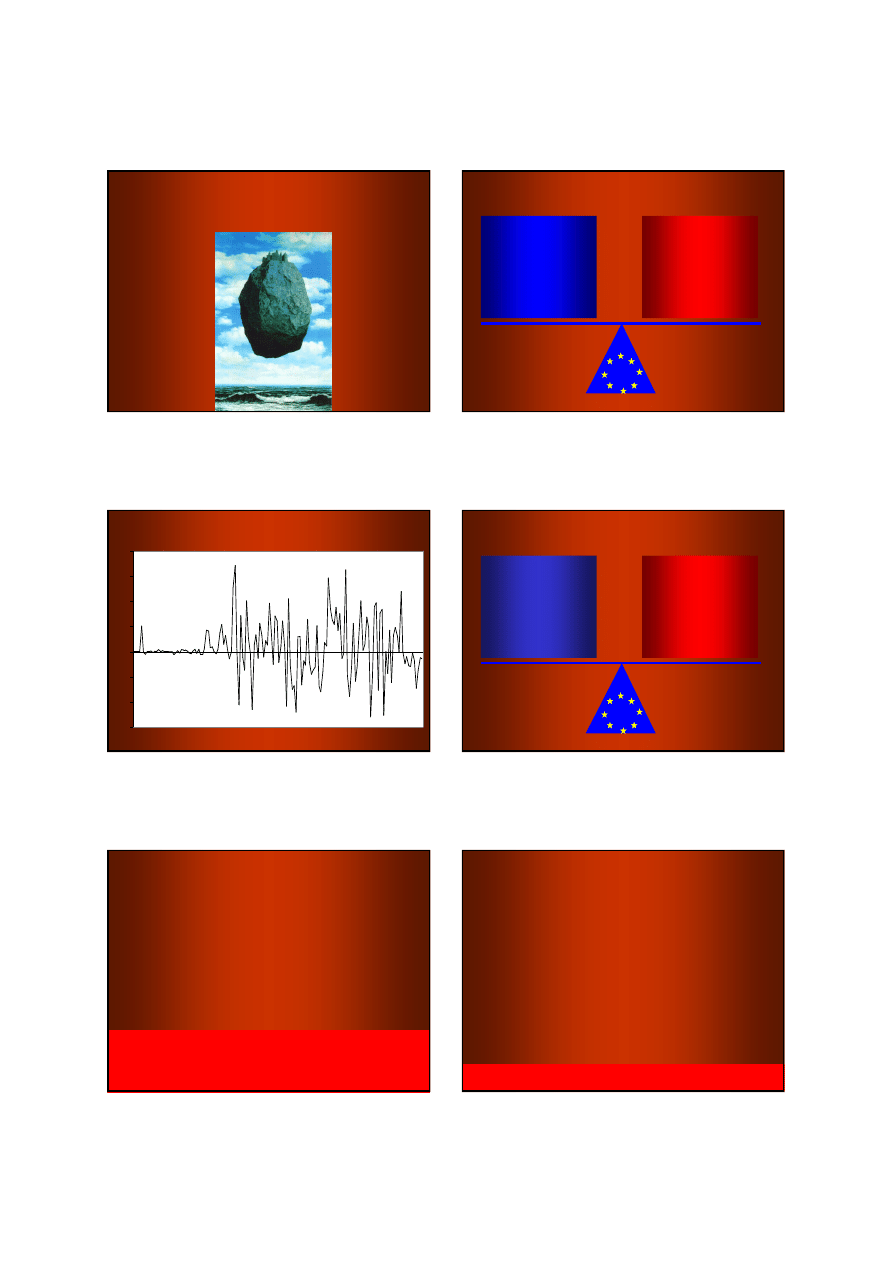
Po rozpadzie systemu w Bretton Woods wahania kursów
okazały się znacznie większe niż wcześniej przypuszczano
-15%
-10%
-5%
0%
5%
10%
15%
20%
1961Q1 1965Q1 1969Q1 1973Q1 1977Q1 1981Q1 1985Q1 1989Q1 1993Q1 1997Q1
DEM/USD
Korzyści z pozbycie
Korzyści z pozbycie
się ryzyka
się ryzyka
negatywnych szoków
negatywnych szoków
wywoływanych
wywoływanych
przez wahania kursu
przez wahania kursu
walutowego
walutowego
Koszty rezygnacji
Koszty rezygnacji
z autonomicznej
z autonomicznej
polityki pieniężnej
polityki pieniężnej
Mundel 1973
Mundel 1973
EMU
EMU
Exchange Rate Volatility and World Trade: A Study by the Research Department
Exchange Rate Volatility and World Trade: A Study by the Research Department
of the IMF”,
of the IMF”, IMF Occasional Paper
IMF Occasional Paper, No. 28, IMF Washington, July 1984
, No. 28, IMF Washington, July 1984
Wei Shang
Wei Shang--jin, „Currency Hedging and Goods Trade”,
jin, „Currency Hedging and Goods Trade”, European Economic
European Economic
Review
Review, vol. 43, 1999, pp. 1371
, vol. 43, 1999, pp. 1371--1394.
1394.
••
A puzzle in empirical international finance is
A puzzle in empirical international finance is
the difficulty in identifying a large and
the difficulty in identifying a large and
negative effect of exchange rate volatility on
negative effect of exchange rate volatility on
trade.
trade.
••
The pro
The pro--trade effect of the euro (i.e. Rose
trade effect of the euro (i.e. Rose
effect) is modest
effect) is modest –
– somewhere between 5%
somewhere between 5%
and 15%.
and 15%.
••
The pro
The pro--trade effect varies a great deal
trade effect varies a great deal
across nations. Spain seems to have been
across nations. Spain seems to have been
the biggest gainer while Greece’s gain is
the biggest gainer while Greece’s gain is
estimated to be nil or even negative.
estimated to be nil or even negative.
Richard E. Baldwin, “In or out: does it make a difference?”
Richard E. Baldwin, “In or out: does it make a difference?”, , 9 May 2006
9 May 2006
2
Doświadczenia strefy euro
Doświadczenia strefy euro
Paul De Grauwe
Paul De Grauwe, , On Monetary and Political Union
On Monetary and Political Union
Paper prepared for the CESifo Workshop on “Enlarging the Euro Area”, 24
Paper prepared for the CESifo Workshop on “Enlarging the Euro Area”, 24
November 2006
November 2006
••
One of the surprises of the functioning of
One of the surprises of the functioning of
the Eurozone has been the extent to which
the Eurozone has been the extent to which
the competitive positions of the Eurozone
the competitive positions of the Eurozone
countries have diverged.
countries have diverged.
••
Germany which by applying tough wage
Germany which by applying tough wage
moderation since 1999, dramatically
moderation since 1999, dramatically
improved its competitive position within
improved its competitive position within
the Eurozone at the expense of other
the Eurozone at the expense of other
countries.
countries.
Olivier Blanchard,
Olivier Blanchard, A Macroeconomic survey of Europe
A Macroeconomic survey of Europe, May 2008
, May 2008, ,
http://econ
http://econ--www.mit.edu/faculty/blanchar/papers
www.mit.edu/faculty/blanchar/papers
••
Portugal: The story behind the scenes:
Portugal: The story behind the scenes:
••
1995
1995--2001. Boom
2001. Boom from anticipations
from anticipations of
of
entry into the Euro, a bright future, and
entry into the Euro, a bright future, and
lower interest rates.
lower interest rates.
••
Steady decrease in employment. Steady
Steady decrease in employment. Steady
increase in wages, decrease in
increase in wages, decrease in
competitiveness
competitiveness, and l
, and large account
arge account
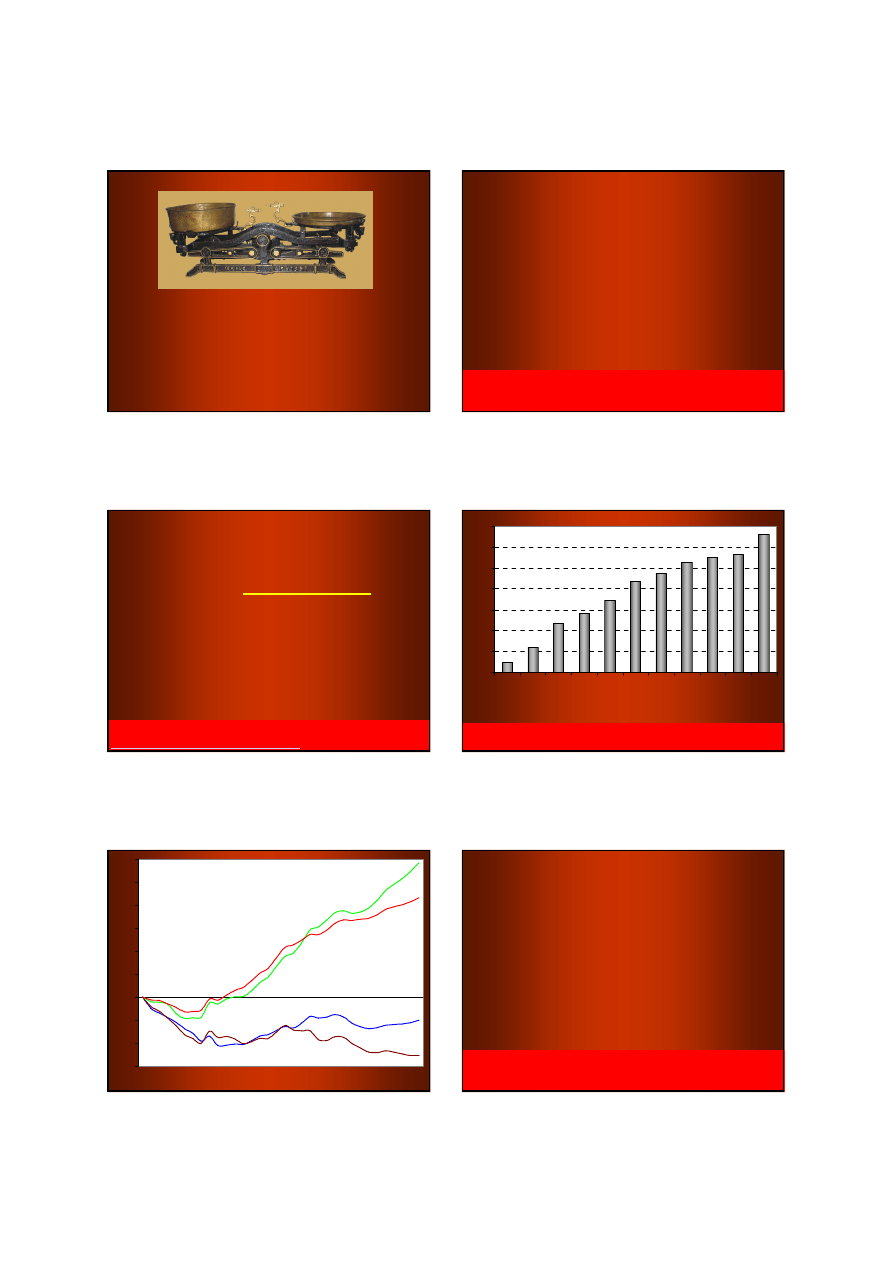
Skumulowany wzrost ULC: 1999-2007
0%
5%
10%
15%
20%
25%
30%
35%
Ni
em
cy
Au
st
ria
Fi
nl
an
di
a
Be
lg
ia
Fr
an
cj
a
Ho
lan
di
a
W
ło
ch
y
Hi
sz
pa
ni
a
Po
rtu
ga
lia
Gr
ec
ja
Irl
an
di
a
““Monitoring Labo
Monitoring Labouur Cost Developments Across Euro Area Countries, ECB,
r Cost Developments Across Euro Area Countries, ECB,
Monthly Bulletin, November 2008, s. 70
Monthly Bulletin, November 2008, s. 70
REER
-15%
-10%
-5%
0%
5%
10%
15%
20%
25%
30%
1999Q1 2000Q1 2001Q1 2002Q1 2003Q1 2004Q1 2005Q1 2006Q1 2007Q1
FRANCJA
NIEMCY
HISZPANIA
WŁOCHY
Ansgar Belke, Daniel Gros, “Instability of the Eurozone? On Monetary Policy,
Ansgar Belke, Daniel Gros, “Instability of the Eurozone? On Monetary Policy,
House Prices and Structural Reforms”,
House Prices and Structural Reforms”, Hohenheimer Diskussionsbeitrage
Hohenheimer Diskussionsbeitrage Nr.
Nr.
271/2006,
271/2006, Universität Hohenheim, Stuttgart
Universität Hohenheim, Stuttgart, 2006
, 2006, p. 29
, p. 29
••
These large competitive positions did not
These large competitive positions did not
translate earlier into different growth rates
translate earlier into different growth rates
because of offsetting tendencies in the
because of offsetting tendencies in the
housing markets.
housing markets.
••
The low interest rate environment fostered
The low interest rate environment fostered
by the ECB’s policy and the global
by the ECB’s policy and the global
developments led to a housing boom in a
developments led to a housing boom in a
number of countries, including Italy.
number of countries, including Italy.
3
••
Fundamental problems restraining
Fundamental problems restraining
Portugal’s economy are home
Portugal’s economy are home--grown:
grown:
••
wide current account
wide current account
••
fiscal deficits
fiscal deficits
••
household, corporate and government debt
household, corporate and government debt
••
substantial competitiveness gap
substantial competitiveness gap
••
Portugal have been living beyond its means
Portugal have been living beyond its means
for many years, borrowing via banking
for many years, borrowing via banking
system from the rest of the world, raising
system from the rest of the world, raising
external indebtedness
external indebtedness
Portugal: IMF, 2008 Article IV Consultation
Portugal: IMF, 2008 Article IV Consultation
Ansgar Belke, Daniel Gros, “Instability of the Eurozone? On Monetary Policy,
Ansgar Belke, Daniel Gros, “Instability of the Eurozone? On Monetary Policy,
House Prices and Structural Reforms”,
House Prices and Structural Reforms”, Hohenheimer Diskussionsbeitrage
Hohenheimer Diskussionsbeitrage Nr.
Nr.
271/2006,
271/2006, Universität Hohenheim, Stuttgart
Universität Hohenheim, Stuttgart, 2006
, 2006, p. 29
, p. 29
••
When Italy fell into recession in 1993, the
When Italy fell into recession in 1993, the
lira depreciated substantially. Producer
lira depreciated substantially. Producer
price inflation accelerated, but the total
price inflation accelerated, but the total
increase in prices was much less than the
increase in prices was much less than the
depreciation of the exchange rate. As a
depreciation of the exchange rate. As a
result, It
result, Ita
aly regained competitiveness.
ly regained competitiveness.
••
This time, Italy cannot regain
This time, Italy cannot regain
competitiveness through nominal
competitiveness through nominal
exchange rate depreciation.
exchange rate depreciation.
Paul De Grauwe
Paul De Grauwe, , On Monetary and Political Union
On Monetary and Political Union Paper prepared for the
Paper prepared for the
CESifo Workshop on “Enlarging the Euro Area”, 24 November 2006
CESifo Workshop on “Enlarging the Euro Area”, 24 November 2006
••
Thus the latter have worked as “beggar
Thus the latter have worked as “beggar--
thy
thy--neighbor” (wage) policies forcing other
neighbor” (wage) policies forcing other
countries in turn to also institute drastic
countries in turn to also institute drastic
policies of wage moderation.
policies of wage moderation.
••
The correction mechanism is likely to be
The correction mechanism is likely to be
painful. Other countries will be forced to
painful. Other countries will be forced to
intensify their policies of wage moderation,
intensify their policies of wage moderation,
inducing the former again to restrict wage
inducing the former again to restrict wage
increases. All this is adding to deflationary
increases. All this is adding to deflationary
tendencies characterized by low growth in
tendencies characterized by low growth in
consumption and investment and by
consumption and investment and by
increasing unemployment
increasing unemployment
••
Unless productivity is raised, the burden of
Unless productivity is raised, the burden of
adjustment will fall on consumption and
adjustment will fall on consumption and
investment.
investment.
••
A combination of market rigidities and weak
A combination of market rigidities and weak
competitiveness may lead to a prolonged
competitiveness may lead to a prolonged
period of difficulty slow
period of difficulty slow--growth adjustment.
growth adjustment.
••
Averting this scenario, and regaining
Averting this scenario, and regaining
competitiveness within EMU, will require
competitiveness within EMU, will require
implementation of a bold supply
implementation of a bold supply--oriented
oriented
reform agenda, with emphasis on
reform agenda, with emphasis on
••
enhancing product market competition and
enhancing product market competition and
labor market flexibility.
labor market flexibility.
Portugal: IMF, 2008 Article IV Consultation
Portugal: IMF, 2008 Article IV Consultation
Polska w strefie euro
Polska w strefie euro::
Ryzyka związane z wejściem do unii walutowej
Ryzyka związane z wejściem do unii walutowej
kraju doganiającego ekonomicznie kraje zamożne
kraju doganiającego ekonomicznie kraje zamożne
Co chroni Polskę przed
Co chroni Polskę przed
ryzykiem utraty
ryzykiem utraty
konkurencyjności?
konkurencyjności?
4
Źródło
Źródło: : Hans
Hans--Werner Sinn, The Pathological Export Boom and the Bazaar
Werner Sinn, The Pathological Export Boom and the Bazaar
Effect. How to Solve the German Puzzle?, CESifo Working PaperNo. 1708, s. 5
Effect. How to Solve the German Puzzle?, CESifo Working PaperNo. 1708, s. 5
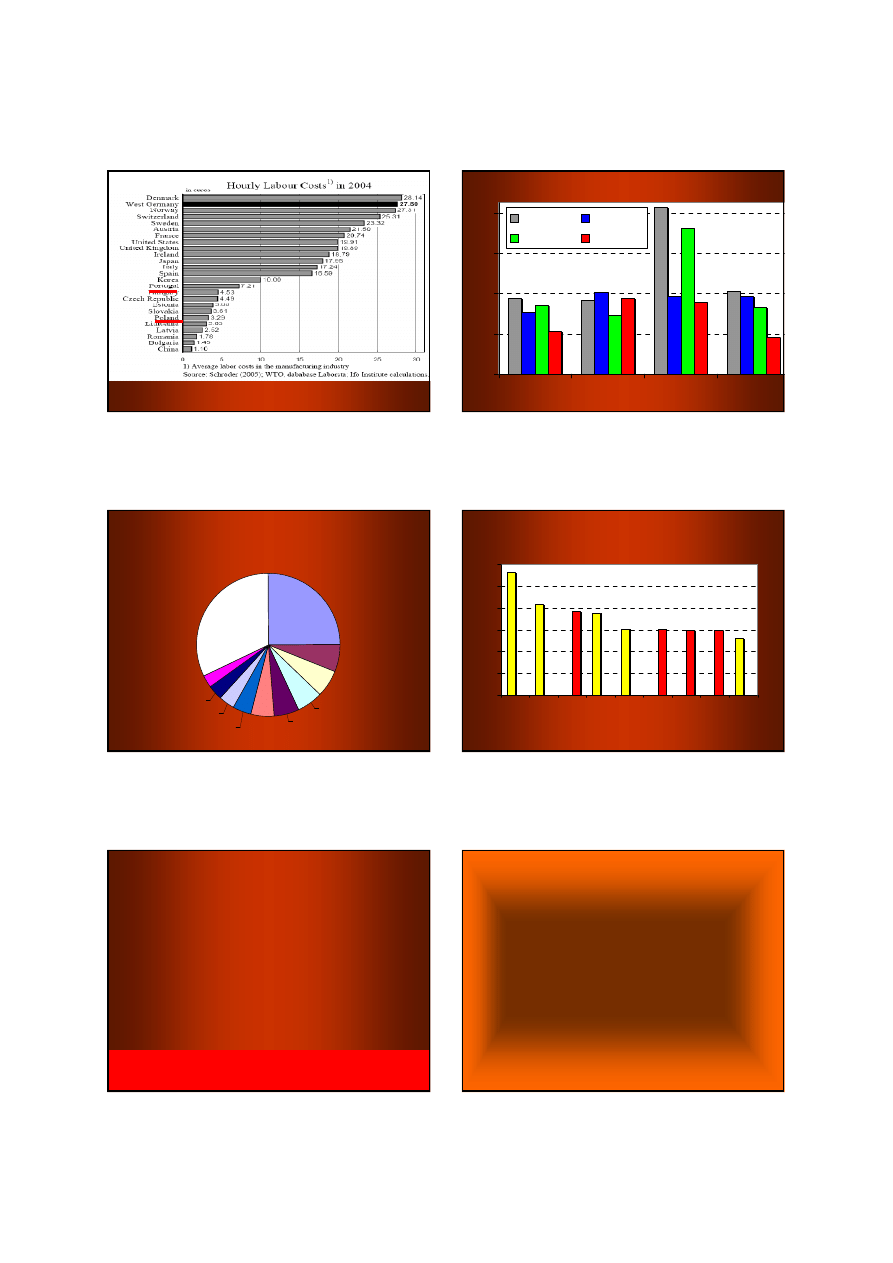
Eksport krajów euro poza strefę euro
0%
4%
8%
12%
16%
US
UK
EEC
Azja
Niemcy
Francja
Włochy
Hiszpania
Polska: eksport
Niemcy; 25,0%
Francja; 6,2%
Włochy; 6,1%
Anglia; 5,7%
Czechy; 5,6%
Rosja; 5,4%
Ukraina; 4,0%
Holandia; 3,8%
Szwecja; 3,2%
Węgry; 2,8%
Pozostałe; 32,2%
Wydajność w krajach Europy Środkowej w relacji
do średniej w EU15 po uwzględnieniu niższych
kosztów pracy (bez ich uwzględnienia: 25%)
0%
50%
100%
150%
200%
250%
300%
B
uł
ga
ria
R
um
un
ia
S
ło
w
ac
ja
Ło
tw
a
Li
tw
a
W
ęg
ry
C
ze
ch
y
P
ol
sk
a
E
st
on
ia
Źródło:Michael Marrese, The convergence of CEEMEA countries amid global recession, October 2008
J. David Lopez Hans
J. David Lopez Hans--Werner Sinn,
Werner Sinn,--Salido, Fernando Restoy
Salido, Fernando Restoy, , Inflation
Inflation
Differentials in EMU: The Spanish Case
Differentials in EMU: The Spanish Case, , Banco De Espana, Documents de
Banco De Espana, Documents de
Trabajo, No. 0514, 2005
Trabajo, No. 0514, 2005
••
Persistent inflation differentials of the
Persistent inflation differentials of the
Spanish economy are not linked to a
Spanish economy are not linked to a
structural catching
structural catching--up process, thus the
up process, thus the
self correction mechanisms are relatively
self correction mechanisms are relatively
weak, and may generate long
weak, and may generate long--lasting losses
lasting losses
in competitiveness.
in competitiveness.
Co
Co –
– oprócz efektu BSE
oprócz efektu BSE
–
– może prowadzić do
może prowadzić do
wzrostu inflacji?
wzrostu inflacji?
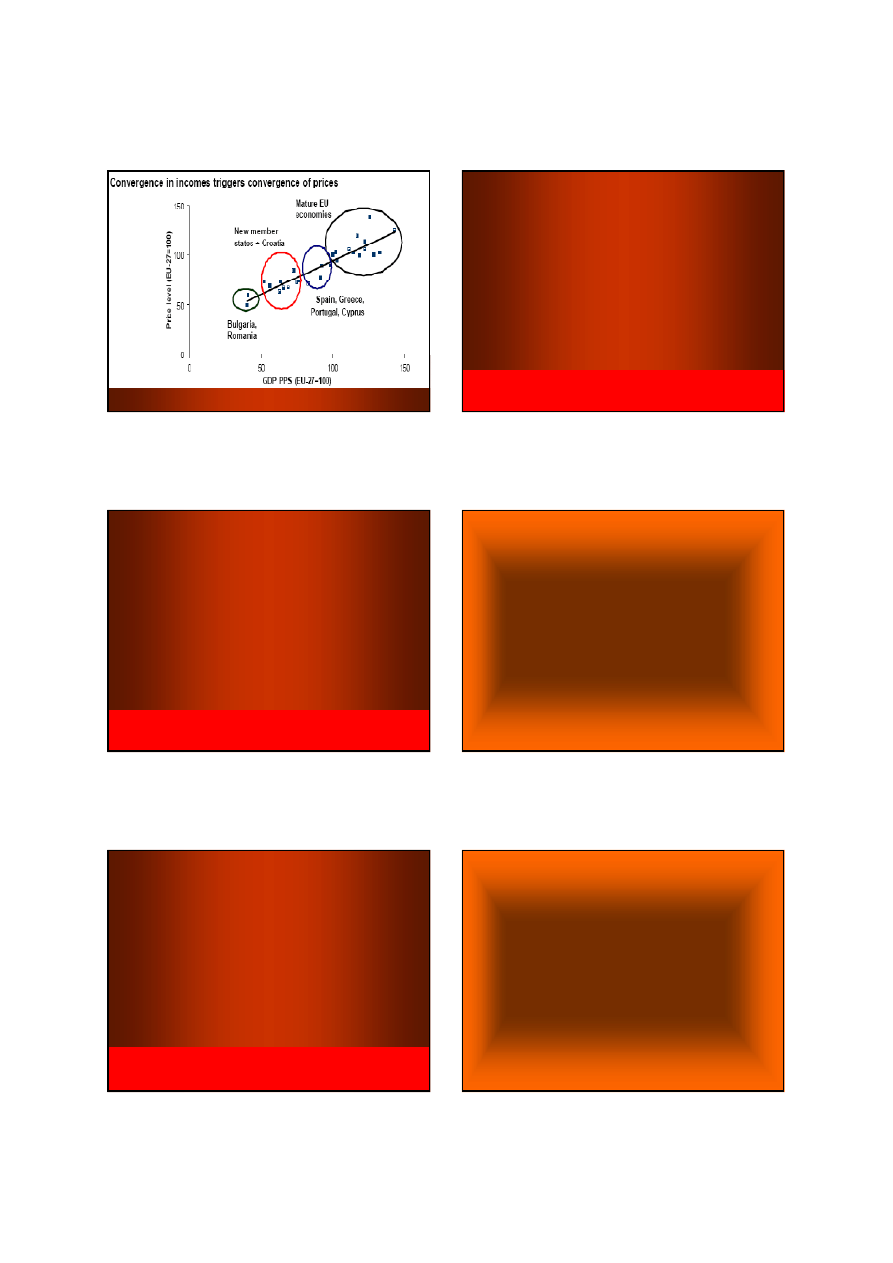
5
Euro adoption in CEE
Euro adoption in CEE. Special report, Erste bank, May 8, 2008
. Special report, Erste bank, May 8, 2008, s. 4
, s. 4
Peter Hoeller, David Rae
Peter Hoeller, David Rae, , Housing Markets and Adjustment in Monetary Union
Housing Markets and Adjustment in Monetary Union, ,
OECD, Economics
OECD, Economics Department Working Paper No. 550, April 17
Department Working Paper No. 550, April 17
••
The housing market often plays a central
The housing market often plays a central
role in magnifying cycles.
role in magnifying cycles.
••
Backward
Backward--looking or extrapolative
looking or extrapolative
expectations in the housing markets in the
expectations in the housing markets in the
hosing market can be highly destabilizing
hosing market can be highly destabilizing
as temporary shocks are magnified and
as temporary shocks are magnified and
create large and long
create large and long--lasting market
lasting market
bubbles.
bubbles.
Sebastian Royo
Sebastian Royo, , The Euro and Economic reforms: The Case of Spain?
The Euro and Economic reforms: The Case of Spain?
Paper presented at the Conference “The Euro and the Dollar” University of
Paper presented at the Conference “The Euro and the Dollar” University of
Miami, April 25, 2006
Miami, April 25, 2006
••
The real estate bubble has overshadowed the
The real estate bubble has overshadowed the
lack of competitiveness of the Spanish
lack of competitiveness of the Spanish
economy.
economy.
••
While the construction sector is booming
While the construction sector is booming
(over 700,000 houses were built in Spain in
(over 700,000 houses were built in Spain in
2004, more than the total in France, Germany,
2004, more than the total in France, Germany,
Belgium, Holland and Luxembourg combined)
Belgium, Holland and Luxembourg combined),,
••
manufacturing production regressed 0,4
manufacturing production regressed 0,4
percent in
percent in 2005
2005
(the automotive sector
(the automotive sector
declined almost 9 percent in
declined almost 9 percent in 2005
2005
) and
) and
••
exports
exports was
was not experiencing almost any
not experiencing almost any
growth.
growth.
Jaki powstrzymać boom
Jaki powstrzymać boom
na rynku hipotecznym?
na rynku hipotecznym?
••
A rational property tax is essential for
A rational property tax is essential for
improving economic stability and resource
improving economic stability and resource
allocation.
allocation.
••
To maximize the effectiveness of the
To maximize the effectiveness of the
property tax as a national economic
property tax as a national economic
stabilizer, and to take it out of the political
stabilizer, and to take it out of the political
arena where politicians may be tempted to
arena where politicians may be tempted to
manipulate rates for short
manipulate rates for short--term electoral
term electoral
advantage, the rate setting power should be
advantage, the rate setting power should be
handed to the Bank of England
handed to the Bank of England.
.
John Muellbauer
John Muellbauer, , The U.K. and the Euro
The U.K. and the Euro –– The Role of Asymmetries
The Role of Asymmetries
in Housing and Credit Market
in Housing and Credit Market. . W:
W: Submissions on EMU from leading
Submissions on EMU from leading . .
academics
academics, HM Treasury 2003
, HM Treasury 2003, s. 193
, s. 193--194
194
Jak zabezpieczyć się
Jak zabezpieczyć się
przed utratą
przed utratą
konkurencyjności w
konkurencyjności w
strefie euro?
strefie euro?
6
A. Macoun, B. Kramarz, E. Nowersztern, J. Kofod, M. Lundgren
A. Macoun, B. Kramarz, E. Nowersztern, J. Kofod, M. Lundgren, , The Danish
The Danish
Design Cluste
Design Cluster,
r, May 4, 2007
May 4, 2007
••
30% of the Danish workforce changes jobs
30% of the Danish workforce changes jobs
every year, while an average Dane only
every year, while an average Dane only
remains with the same company for 8 years
remains with the same company for 8 years
••
High level of education spending (at 8% of
High level of education spending (at 8% of
GDP, the highest in the world, with
GDP, the highest in the world, with
additional training through the FlexSecurity
additional training through the FlexSecurity
system)
system)
••
In 2001 the government formed the
In 2001 the government formed the
Globalization Council, chaired by the Prime
Globalization Council, chaired by the Prime
Minister, consisting of business leaders,
Minister, consisting of business leaders,
academic representatives, global experts,
academic representatives, global experts,
and labor union spokespersons. In 2006,
and labor union spokespersons. In 2006,
the government presented its globalisation
the government presented its globalisation
strategy.
strategy.
••
I have been struck at how, in many cases,
I have been struck at how, in many cases,
differences in productivity can be traced to
differences in productivity can be traced to
differences in the competitive environment
differences in the competitive environment
rather than from access to technology, or
rather than from access to technology, or
capital, or skilled labor.
capital, or skilled labor.
••
More intense competition truly forces firms
More intense competition truly forces firms
to use the existing technology more
to use the existing technology more
effectively, and forces inefficient firms out.
effectively, and forces inefficient firms out.
Olivier Blanchard
Olivier Blanchard, , “Is there a viable European social and economic model?”,
“Is there a viable European social and economic model?”,
Van Lanschot lecture, Tilburg University, july 2006
Van Lanschot lecture, Tilburg University, july 2006
••
Against the background of still highly sheltered
Against the background of still highly sheltered
domestic markets, the efficacy of competition
domestic markets, the efficacy of competition
enforcement is key.
enforcement is key.
••
Increased independence accorded to the future
Increased independence accorded to the future
Comision Nacional de Competencia
Comision Nacional de Competencia..
••
To promote such independence, Parliament will
To promote such independence, Parliament will
need to exercise its new consultative role in the
need to exercise its new consultative role in the
appointment of the Commission’s members.
appointment of the Commission’s members.
••
The independence of sectoral regulators should
The independence of sectoral regulators should
also be enhanced, with an extension of
also be enhanced, with an extension of
Parliamentary oversight to the nomination of all
Parliamentary oversight to the nomination of all
their members,
their members,
••
And the establishment of an arm’s length
And the establishment of an arm’s length
relationship with the relevant sectoral ministers.
relationship with the relevant sectoral ministers.
Spain: IMF, 2008 Article IV Consultation
Spain: IMF, 2008 Article IV Consultation
Jakie czynniki zmniejszałyby
Jakie czynniki zmniejszałyby
zmniejszać możliwą
zmniejszać możliwą
procykliczność wpływu
procykliczność wpływu
polityki pieniężnej EBC na
polityki pieniężnej EBC na
polską gospodarkę?
polską gospodarkę?
••
Reformy strukturalne
Reformy strukturalne
••
deregulacja rynków,
deregulacja rynków,
••
silne preferencje dla wydatków na naukę i
silne preferencje dla wydatków na naukę i
oświatę (Szwecja, Finlandia),
oświatę (Szwecja, Finlandia),
••
zwiększenie elastyczności rynków pracy
zwiększenie elastyczności rynków pracy
(Dania, Holandia)
(Dania, Holandia)
••
Regulacje zmniejszające ryzyko pojawienia
Regulacje zmniejszające ryzyko pojawienia
się niestabilnych boomów kredytowych
się niestabilnych boomów kredytowych
••
Rada Polityki Fiskalnej: wydłużenie
Rada Polityki Fiskalnej: wydłużenie
horyzontu decyzyjnego; uwolnienie polityki
horyzontu decyzyjnego; uwolnienie polityki
fiskalnej od wpływu cyklu wyborczego
fiskalnej od wpływu cyklu wyborczego
Ansgar Belke, Daniel Gros, “Instability of the Eurozone? On Monetary Policy,
Ansgar Belke, Daniel Gros, “Instability of the Eurozone? On Monetary Policy,
House Prices and Structural Reforms”,
House Prices and Structural Reforms”, Hohenheimer Diskussionsbeitrage
Hohenheimer Diskussionsbeitrage Nr.
Nr.
271/2006,
271/2006, Universität Hohenheim, Stuttgart
Universität Hohenheim, Stuttgart, 2006
, 2006, p. 29
, p. 29
••
Without political union, the
Without political union, the
ECB lacks a
ECB lacks a
public constituency supporting its
public constituency supporting its
monetary stance
monetary stance
in the face of political
in the face of political
pressure. Public support was a cornerstone
pressure. Public support was a cornerstone
for the German
for the German
Bundesbank’s ability
Bundesbank’s ability
to
to
pursue low
pursue low--inflation hard
inflation hard--currency policy.
currency policy.
••
Monetary union is thus likely to undergo a
Monetary union is thus likely to undergo a
major stress
major stress
.
.
Wyszukiwarka
Podobne podstrony:
pp miedzynarodowe 14 sty
PP 2008 13
PP 2008 04
Ekspert nr 2008 14 (2)
PP 2008 09
PP 2008 08
PP 2008 03
PP 2008 01
PP 2008 07
PP 2008 15
PP 2008 12
PP 2008 10
2008 14 92 Niepełnosprawni
PP 2008 17
PP 2008 13
więcej podobnych podstron